

Note: This article contains affiliate links. If you click on these links and make a purchase, I may earn a small commission at no extra cost to you. This helps support my research and content. Read my full affiliate disclosure here.
Camellias are prized for glossy leaves and long-lasting blooms, but fungal diseases can quickly spoil both foliage and flowers. Choosing the right fungicide for camellias matters because timing, active ingredients, and application method determine whether you prevent disease or merely slow symptoms. This guide covers seven vetted fungicide options suited for camellia care, shortlisted for disease coverage, application practicality, and garden safety. We evaluate how each product handles common issues like leaf spot and petal blight, plus ease of use and timing so you can pick a treatment that fits your planting situation and maintenance routine.
Top Picks at a Glance
| Best Overall The best all-around choice for most situations | Bonide Captain Jack's NeemMax Concentrated Cold Pressed Neem Oil, 16 oz |  |
| Best Quality Built to a higher standard if you want something more solid | Gardentech Daconil Fungicide Concentrate, 16 fl oz |  |
| Best Value The sweet spot between price and what you get | BioAdvanced Disease Control for Roses, Flowers & Shrubs Concentrate, 32 oz |  |
| Best Budget The cheapest option that still gets the job done reliably | Garden Safe Fungicide3 with Neem Oil, Ready‑to‑Use Spray (32 oz) |  |
| Highest Rated A top-rated pick with lots of positive feedback | Monterey Fungi-Max Systemic Fungicide, 16 oz (with Measuring Spoon) |  |
| Most Popular A crowd favorite that many people choose with confidence | Bonide Captain Jack's Liquid Copper Fungicide Ready-to-Use, 32 oz |  |
| Best Seller A high-volume bestseller chosen again and again | Bonide Captain Jack Copper Fungicide 16 oz Concentrate |  |
Bonide Captain Jack's NeemMax Concentrated Cold Pressed Neem Oil, 16 oz

| Item Form | Concentrate |
|---|---|
| Target Species | Multi-Purpose |
| Liquid Volume | 16 fluid ounces |
| Active Ingredients | Cold Pressed Neem |
Bonide Captain Jack's NeemMax is a concentrated neem oil designed for gardeners who want a single, plant-based product to tackle insects, fungal diseases, mites, and nematodes. Supplied as a concentrate, it is mixed into water and applied as a foliar spray for pests and diseases or as a soil drench to reduce nematode pressure. The formula includes a built-in surfactant so it disperses evenly and does not require adding dish soap. In practice NeemMax treats eggs through adults, helps prevent powdery mildew and botrytis, and can be used across ornamentals, vegetables, herbs and houseplants. Practical benefits include organic-compatible active ingredient, multi-target control, and flexibility of spray or drench applications. Limitations are that it must be mixed correctly and applied according to label directions, repeat treatments are typically needed for heavy infestations, and it is less selective than some insecticidal soaps so care around beneficial insects is advisable.
Best for: Gardeners who prioritize a practical, all-purpose organic treatment and want one concentrated product to manage multiple pest and disease problems across ornamentals and edibles.
Less Ideal for: Those seeking a single-application, fast-acting synthetic pesticide or growers who need products that spare beneficial insects in integrated pest management programs.
- Concentrated cold-pressed neem provides broad-spectrum botanical control of insects, fungi, mites, and nematodes.
- Built-in surfactant improves dispersal so it mixes and sprays evenly without adding soap.
- Can be applied as spray or soil drench for above- and below-ground pest control.
- Suitable for use on a wide range of plants including vegetables, ornamentals, and houseplants.
- Requires correct mixing and regular reapplication for effective control in heavy infestations.
- Non-selective action can impact beneficial insects if applied indiscriminately.
Verdict: Buy this if you want a single concentrated, cold-pressed neem product that handles insects, fungi, mites, and nematodes for organic gardening.
Gardentech Daconil Fungicide Concentrate, 16 fl oz

| Unit Count | 16 Fluid Ounces |
|---|---|
| Item Form | Liquid |
| Target Species | Insects |
| Active Ingredients | Chlorothalonil |
Daconil Fungicide Concentrate is a garden-focused broad-spectrum fungicide that treats and prevents many common foliar diseases including leaf spots, rusts, blights and powdery mildew when used as directed. You mix measured amounts into a hand-held, hose-end or tank sprayer and apply as a fine spray to thoroughly wet upper and lower leaf surfaces. The product’s active ingredient chlorothalonil offers rain-resistant protection and is labeled for use on vegetables, flowers, shrubs, fruit and shade trees, making it useful for both preventive programs and first-sign treatments. The built-in measuring cap simplifies dilution and the concentrate format lets you treat multiple plants or larger beds without frequent repurchasing. Important limitations are strict safety and site restrictions, the need for protective clothing during mixing and application, and specific pre-harvest intervals for edible plants, so follow the label carefully. Also avoid use on lawns and on plants under heat or water stress to prevent injury.
Best for: Gardeners focused on reliable, performance-oriented disease control who plan to run a preventive or curative spray program across vegetables, ornamentals and fruit trees and who are willing to follow label safety and timing requirements.
Less Ideal for: Casual gardeners who prefer pesticide-free or organic options, or those unwilling to use protective gear and follow pre-harvest intervals for edible crops.
- Broad-spectrum control covering more than 65 diseases including common powdery mildew and blights
- Concentrate format treats multiple plants and stretches a single purchase
- Rain-proof protection after application for dependable results in light weather
- Easy-to-use measuring cap and compatible with common sprayers
- Requires careful personal protective equipment and handling due to eye, skin and inhalation hazards
- Not labeled for use on lawns and has restrictions around certain public or high-traffic sites
Verdict: Choose this concentrate when you want a proven, rain-resistant broad-spectrum fungicide for preventive and corrective treatment of powdery mildew and other foliar diseases.
BioAdvanced Disease Control for Roses, Flowers & Shrubs Concentrate, 32 oz

| Unit Count | 32 Fluid Ounces |
|---|---|
| Item Type Name | Fungicide |
| Item Form | Spray |
| Target Species | Fungus |
| Active Ingredients | Tebuconazole |
This concentrate uses the systemic active ingredient tebuconazole to treat and prevent common fungal diseases such as black spot, powdery mildew, rust and boxwood blight on ornamental plants. You mix the concentrate with water and apply with a pump-style sprayer as a coarse spray; one 32-ounce bottle makes up to 42 gallons of spray, so a little goes a long way for repeat treatments. The formula offers up to two weeks of rainproof protection after drying and works from the inside out, which helps protect new growth between applications. It is intended for outdoor use on roses, flowers, shrubs, trees, vines and treated houseplants and is labeled for listed diseases rather than every possible pathogen. Be mindful of label directions, safety guidance and local restrictions where sale may be limited, and note that it is a chemical fungicide rather than a purely homeopathic option. For routine disease control on established ornamentals this concentrate is a practical, economical choice when used as part of a regular care plan.
Best for: Gardeners who prioritize efficient, repeatable disease control for ornamental shrubs and camellias and want a concentrate that treats from within and stretches over multiple applications.
Less Ideal for: People seeking only organic or non-synthetic treatments or those who prefer single-use ready-to-spray products for very small plantings.
- Systemic action treats and prevents listed fungal diseases from the inside out.
- Concentrate mixes with water to make up to 42 gallons of spray, extending value for larger plantings.
- Rainproof protection that lasts up to two weeks after the spray dries.
- Pump-style tank compatible and applied as a coarse spray for straightforward backyard use.
- Contains tebuconazole, a synthetic active ingredient, so users must follow safety and application instructions carefully.
Verdict: A concentrated systemic fungicide that delivers economical, two-week rainproof protection for camellias and other ornamentals, making it a practical choice for gardeners focused on reliable disease control.
Garden Safe Fungicide3 with Neem Oil, Ready‑to‑Use Spray (32 oz)

| Item Form | Spray |
|---|---|
| Target Species | Fungus |
| Liquid Volume | 32 fluid ounces |
| Active Ingredients | Neem Oil Extract |
Garden Safe Fungicide3 with Neem Oil is a ready-to-use spray that combines fungicidal, insecticidal and miticidal action for use on houseplants, ornamentals and edible garden plants. You spray for full coverage of leaves and stems, preferably in the early morning or late evening to reduce the chance of leaf burn from the oil base. The active clarified neem oil extract helps control common fungal problems such as black spot, rust and powdery mildew while also targeting soft-bodied pests like aphids, whiteflies and spider mites at egg, larval and adult stages. For houseplant use it is convenient because it needs no mixing and can be applied as a preventative or at first signs of disease or infestation. Limitations to keep in mind are that oil-based sprays can cause phytotoxicity on sensitive foliage if applied in hot sun or too frequently, and this product is a broad botanical rather than a fast-acting synthetic, so pests may take longer to clear. Follow label directions carefully for dilution and reapplication intervals when treating indoor plants.
Best for: For plant owners who prioritize a dependable, low-prep treatment that controls both fungal diseases and common soft-bodied pests on houseplants and nearby ornamentals.
Less Ideal for: Not the best choice for growers wanting an immediate knockdown chemical for severe infestations or for those who prefer non-oil contact products for very sensitive foliage.
- Three-in-one action: fungicide, insecticide and miticide in one ready-to-use spray.
- Contains clarified neem oil extract, a botanical active ingredient suitable for organic gardening.
- Ready-to-use spray form requires no mixing and is easy to apply to houseplants and containerized ornamentals.
- Targets multiple life stages of pests including eggs and larvae, improving control over repeat infestations.
- Oil-based formula can cause leaf burn if applied in direct sun or at the wrong time of day.
- Not a fast-acting contact poison for all pests so multiple applications may be required for heavy infestations.
Verdict: Choose this ready-to-use neem oil spray when you want a reliable, multi-purpose botanical solution to prevent and manage common fungal diseases and soft-bodied pests on houseplants.
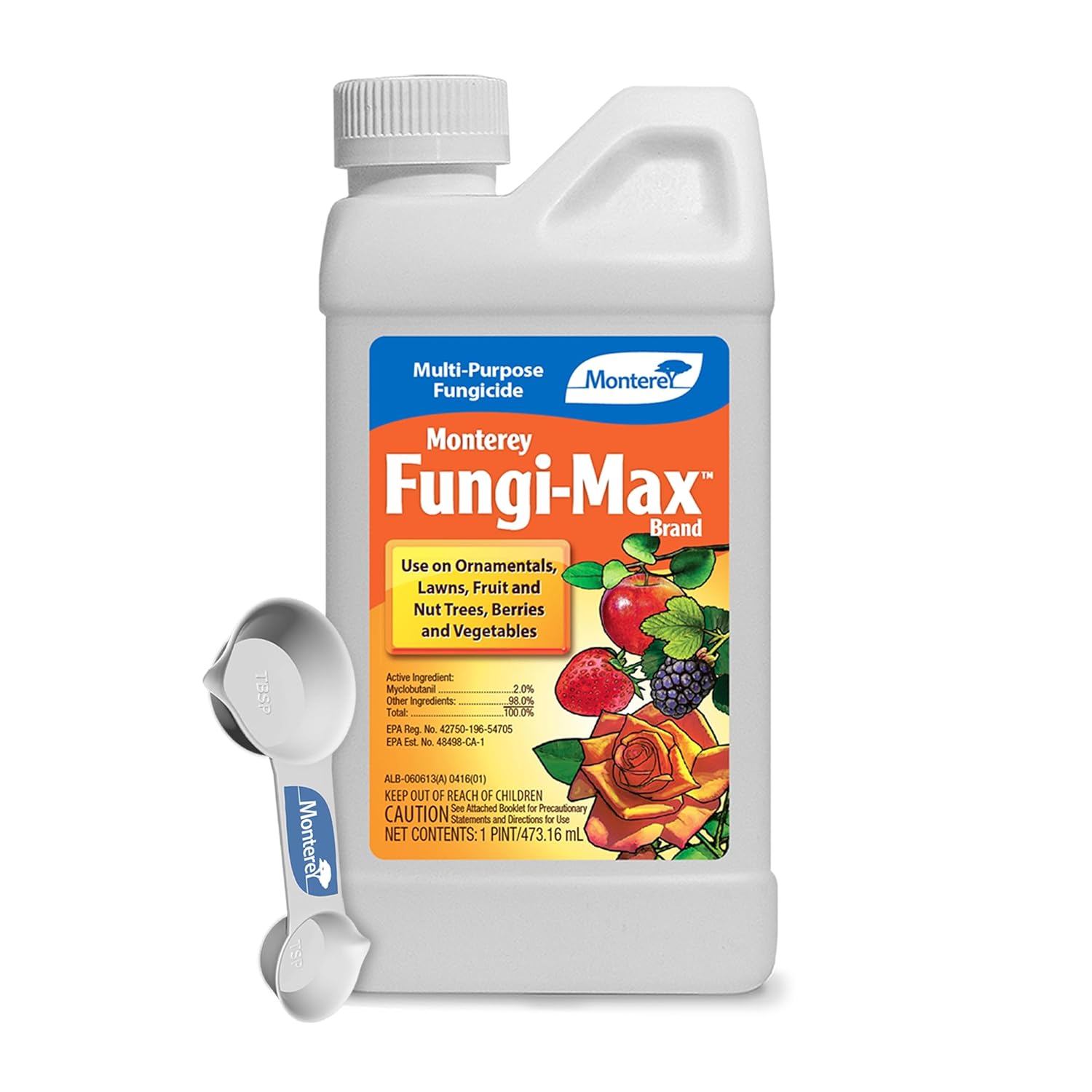
Monterey Fungi-Max Systemic Fungicide, 16 oz (with Measuring Spoon)
| Item Form | Liquid |
|---|---|
| Application Method | Spray |
| Coverage | Wide range of plants and plant types |
| Target Species | Flowers, Vegetables, Trees, Lawn Grass |
| Liquid Volume | 16 fluid ounces |
Monterey Fungi-Max is a concentrated liquid fungicide that you dilute and apply with a sprayer to prevent and control many common plant diseases. It is used outdoors on flowers, shrubs, trees, lawns and edible plants including vegetables and fruiting trees; for tomato growers it is intended to control leaf spots, blights and powdery mildew when applied at the first sign of disease. The product’s systemic action means it is absorbed and provides residual protection for up to two weeks, which reduces how often you need to spray during an outbreak. A measuring spoon is included to help with mixing and the spray application method works with standard pump or backpack sprayers. Important limitations are that it must be mixed and applied correctly according to the label and it is not listed as organic, so it may not suit organic-certified operations; also coverage on large plantings requires multiple bottles. For gardeners who want a reliable, easy-to-use fungicide to protect tomatoes and other outdoor plants, Fungi-Max delivers predictable, short-term disease control when applied promptly.
Best for: Gardeners who prioritize reliable, fast-acting disease control for outdoor tomato beds and mixed orchards and who want a product that gives measurable residual protection between applications.
Less Ideal for: Growers who require organic-certified products or those managing very large commercial tomato plantings where bulk coverage and cost per acre are primary concerns.
- Systemic action provides plant uptake and up to two weeks of protection per application.
- Broad labeled coverage for many plant types including vegetables and fruit trees.
- Liquid concentrate mixes for use with standard spray equipment for even coverage.
- Includes a measuring spoon to simplify accurate dilution amounts.
- Not listed as organic so unsuitable for certified organic production.
- One bottle may not cover large tomato plantings without repeated purchases.
Verdict: For home tomato growers seeking dependable, systemic disease control that reduces spray frequency, Monterey Fungi-Max is a practical, easy-to-use choice.
Bonide Captain Jack's Liquid Copper Fungicide Ready-to-Use, 32 oz

| Item Form | Spray |
|---|---|
| Unit Count | 32 Ounce |
| Active Ingredients | copper |
Bonide Captain Jack’s Liquid Copper Fungicide is a trigger-spray, ready-to-use copper treatment designed to control common fungal diseases such as black spot, powdery mildew, blight and peach leaf curl. It is applied by shaking and thoroughly spraying tops and undersides of leaves every 7 to 10 days or as needed, and the label allows application up to the day of harvest on listed edible plants. The product’s copper active ingredient makes it broadly effective against many foliar diseases and the convenient spray bottle removes the need to mix concentrates. Practical benefits include organic approval for many uses and clear directions for repeat treatments, which helps with consistent disease management. Important limitations are that it is a contact-style copper spray rather than a systemic cure, so thorough coverage and repeated applications are required for control, and care must be taken to follow label directions to avoid phytotoxicity on sensitive varieties.
Best for: Gardeners who prioritize established, proven solutions and want an organic-approved spray that controls common foliar diseases on roses and other plants with minimal setup.
Less Ideal for: Growers looking for a systemic fungicide or a single-application cure for long-term prevention should consider alternatives with systemic activity.
- Ready-to-use trigger spray for easy application without measuring or mixing
- Approved for organic gardening and label allows use up to day of harvest on listed edibles
- Effective copper active ingredient against a wide range of foliar fungal diseases including black spot
- Clear instructions for treatment interval make follow-up applications straightforward
- Contact-action copper requires thorough coverage and repeat sprays rather than a one-time systemic fix
- Potential for phytotoxicity on some sensitive plants if label directions are not followed
Verdict: A ready-to-use, organic-approved copper spray that provides reliable contact control of black spot and other foliar diseases when applied thoroughly and on schedule.
Bonide Captain Jack Copper Fungicide 16 oz Concentrate

| Unit Count | 16 Ounce |
|---|---|
| Item Form | Liquid |
| Target Species | Fungus |
| Active Ingredients | Copper Octanoate (Copper Soap) |
Bonide Captain Jack Copper Fungicide is a liquid concentrate designed to prevent and treat a broad range of fungal diseases on vegetables, fruits, ornamentals, and turf. Mixed with water per label directions, it is sprayed onto plant surfaces, including tops and undersides of leaves, and can be applied up to the day of harvest, which makes it practical for food crops like tomatoes. The active ingredient copper octanoate provides contact protection against powdery mildew, blight, black spot, rust, peach leaf curl and similar diseases. Application is straightforward and repeatable every 7 to 10 days as needed, and the product is cleared for use in organic gardening. Limitations to consider are that copper is a contact fungicide so it does not systemically move through the plant and works best as a preventative or early-treatment tool rather than curing severe systemic infections. Users should follow safety directions and avoid overuse to reduce copper buildup in soil.
Best for: Gardeners looking for a performance-focused, organic-approved fungicide to include in a preventative disease program for tomatoes and other edibles.
Less Ideal for: Growers seeking a systemic treatment for already advanced internal infections or those who prefer non-copper chemistries to avoid soil accumulation.
- Approved for organic gardening and can be used up to the day of harvest
- Controls a wide range of common diseases affecting tomatoes such as blight and powdery mildew
- Concentrated liquid formula mixes with water for spray application
- Repeatable 7–10 day application schedule makes preventative programs easy to maintain
- Acts as a contact fungicide and does not move systemically within the plant
- Repeated use can contribute to copper accumulation in soil if not managed
Verdict: Use this organic-approved copper concentrate when you want an effective, easy-to-apply preventative spray to protect tomatoes from common fungal diseases.
Choosing the Right Fungicide for Camellias: Key Factors to Consider
Disease Spectrum and Label Claims
Camellias are vulnerable to several distinct fungal problems, including leaf spot, petal blight, root-related rots, and occasional powdery mildew. A fungicide that lists the specific pathogens or the named diseases relevant to camellias gives you confidence it will work for your problem. Labels that explicitly include azalea and camellia diseases or list the common causal genera make it easier to match product to symptom.
Avoid treating by guesswork. If the label only references turf or agricultural crops, it may not be suitable for ornamental shrubs-labels determine legal and safe use. Also consider whether a product is preventive, curative, or both, since that affects timing and the number of applications needed.
Mode of Action and Resistance Management
Fungicides work through different biochemical modes of action. Rotating or combining products with distinct modes reduces the chance that fungal populations develop resistance. For recurring camellia issues, selecting a product with a different mode of action than what you recently used is a practical resistance-management step.
Look for products that provide guidance on rotation intervals and avoid repeated use of single-site actives when disease pressure is high. Broad-spectrum multi-site contact fungicides can be useful for rotation and for short-term resistance risk mitigation, while systemic actives offer longer protection but require careful rotation planning.
Application Method and Practicality
How a fungicide is formulated matters in real garden work. Ready-to-use sprays, hose-end applicators, hose concentrates, and concentrates that require measuring each have different convenience and waste profiles. For large established camellias, a concentrated product mixed into a backpack or pump sprayer can be efficient. For small specimen plants on a patio, a ready-to-use bottle or a small trigger-spray is often more practical.
Also consider spray droplet size recommendations and whether the product requires covering or rinsing of nearby ornamentals, edible plants, or containers. Ease of mixing, nozzle compatibility, and whether you must wear specialized PPE affect how likely you are to apply treatments correctly and on schedule.
Timing, Frequency, and Residual Protection
Fungal diseases often respond best to preventative treatments applied before conditions favor disease. Understanding labeled intervals for repeat applications and environmental persistence helps you plan a season-long program. Some products require applications every 7 to 14 days under high disease pressure, while others offer longer residual control.
Factor in local climate and camellia bloom timing. In wet springs or in shady, poorly ventilated sites, shorter intervals or a preventative program is often necessary. Be mindful of pre-bloom and bloom restrictions on some actives if you want to protect flowers.
Plant Safety and Environmental Considerations
Camellia cultivars vary in sensitivity. Some fungicides can cause leaf scorch or petal injury if applied in hot, sunny conditions or at incorrect concentrations. Always check the label for ornamental and camellia-specific phytotoxicity warnings and recommended spray conditions.
Consider non-target impacts as well. Oil-based mixes or certain systemic products may affect beneficial insects or nearby understory plants. Choose products and application timings that minimize harm to pollinators and follow buffer and runoff guidance to protect nearby water features.
Ease of Identification and Symptom Matching
Correctly identifying the fungal issue will influence product choice and timing. Leaf spots, blights, and mildew present differently and respond differently to control measures. A fungicide that is labeled broadly for leaf spots and blights covers common camellia problems, but if you see petal blight or root symptoms you may need a product or cultural approach more targeted to those problems.
Pair label reading with simple inspection: note lesion shape, location, and whether flowers or roots are affected. That informs whether you need a contact spray that treats new infections on foliage or a systemic option that moves within the plant to protect new growth.
Identifying Common Camellia Fungal Problems
Camellia leaf spot typically shows as circular brown or tan lesions with darker borders on older leaves. Petal blight causes brown, water-soaked spots on flowers that can rapidly spread through a bloom flush. Powdery mildew appears as a white dusty coating on upper leaf surfaces, while stem or root rots are usually evident as dieback, wilting, or poor vigor.
Accurate symptom ID helps you decide whether a preventative program or an immediate curative treatment is appropriate. Take note of whether symptoms appear after extended wet weather, as many fungal outbreaks follow periods of prolonged leaf wetness.
- Leaf spot: circular lesions on older foliage, often during wet seasons
- Petal blight: rapid browning of blooms, often in humid, cool weather
- Powdery mildew: white powdery film, favors dry leaves with high humidity
- Root or crown rot: decline, dieback, and sometimes soft wood near the base
Cultural Controls That Reduce Fungicide Need
Good cultural practices lower disease pressure and make fungicide programs more effective. Improve air circulation by pruning crowded branches, avoid overhead watering, and remove and dispose of infected leaves and spent blooms rather than composting them. Plant camellias in well-draining sites and avoid heavy mulch piled against stems.
- Prune to open canopy and improve airflow
- Water at the soil level to limit leaf wetness
- Clean up fallen leaves and infected petals promptly
- Ensure soil drains well and avoid waterlogged roots
Timing Treatments Around Bloom and Weather
For many camellia fungal issues, preventative sprays applied before extended wet periods are more effective than treating after large outbreaks develop. Monitor weather forecasts during bloom and the months when your camellias typically develop spots.
If disease appears, start treatment quickly and follow label intervals. Avoid spraying during the heat of the day and do not apply when rain is expected unless the label specifies rainfast timing.
- Apply preventative sprays before prolonged wet weather in spring
- Avoid spraying under hot, sunny conditions to prevent leaf scorch
- Follow label reapplication intervals when disease pressure is high
Mixing and Applying Safely in Home Gardens
Read and follow label mixing rates exactly. Overconcentrating can harm foliage or flowers, while under-dosing can be ineffective and promote resistance. Use appropriate personal protective equipment recommended on the label and choose application equipment that produces uniform coverage of leaf surfaces and flower buds.
When tank mixing, check label compatibility and perform a small patch test on an inconspicuous branch if you are uncertain about phytotoxicity on a cultivar you value.
- Measure and mix according to label directions
- Wear recommended PPE and avoid drift onto non-target plants
- Test tank mixes on a small area before full-plant application
When to Call for Diagnostic Help
If symptoms are severe, recur despite proper fungicide use, or if you suspect root disease, seek a formal diagnosis from a local extension service or plant clinic. Root and crown problems often require cultural correction or different treatment approaches than foliar diseases.
A lab diagnosis can identify the causal pathogen and support targeted management, especially for high-value or rare camellia cultivars where you want to avoid unnecessary sprays.
- Consider diagnosis for persistent or worsening decline
- Bring samples that include affected leaves, stems, and a description of recent care
- Use diagnostic results to refine timing and product class choices
How We Chose the Best Fungicide for Camellias
We focused on fungicides whose modes of action and labeled uses match the fungal issues that commonly affect camellias, such as azalea/camellia leaf spot, petal blight, and powdery mildew. Editorial filters prioritized products that offer clear labeled directions for woody ornamentals, measurable disease control in typical home-garden conditions, and multiple application formats to suit different gardener preferences. Key evaluation criteria included disease spectrum and labeled use, mode of action to reduce resistance risk, application method and ease, foliage and bloom safety, and persistence or reapplication interval. We checked label clarity, recommended timing for preventative versus curative use, and compatibility with standard spray equipment. Products lacking clear instructions for camellias, without appropriate ornamental labels, or with known bloom phytotoxicity under normal use were excluded. The resulting selections balance disease control, gardener usability, and safety for ornamental plantings.
FAQ
How often should I spray camellias during a wet spring?
It depends on the product label and disease pressure. Many fungicides call for applications every 7 to 14 days under high pressure. Preventative timing before extended wet spells is usually more effective than waiting for heavy symptoms.
Can I use the same fungicide on camellias every season?
Repeated use of the same active ingredient can increase resistance risk. Rotate products with different modes of action and follow label guidance on rotation to maintain long-term effectiveness.
Will fungicide harm camellia blooms or foliage?
Some products can cause scorch or petal damage if applied in hot sun or at too-strong a concentration. Always follow temperature and concentration guidance on the label and avoid spraying during peak heat.
Should I remove infected leaves or just spray?
Removing and destroying infected leaves and spent blooms reduces the fungal spore load and improves spray effectiveness. Composting infected material is not recommended in many cases because spores can survive and re-infect plants.
Are systemic fungicides better than contact sprays for camellias?
Systemic fungicides can protect new growth by moving within the plant, while contact fungicides provide coverage where applied and can help with immediate control. The choice depends on disease type, timing, and resistance-management strategy.
Can I spray fungicide while my camellias are in full bloom?
Some products restrict use during bloom due to potential flower injury or pollinator risk. Check the label for bloom-stage restrictions and, if allowed, avoid spraying during peak pollinator activity.
Final Verdict
Choose a fungicide for camellias by matching the product's labeled disease spectrum and mode of action to the symptoms you see, and plan applications around bloom timing and local weather. Prioritize products with clear label instructions for ornamentals, rotate active ingredients to manage resistance, and use cultural practices to reduce overall disease pressure. Balancing disease coverage, application practicality, and plant safety will help you protect blooms and foliage with the fewest interventions. With a sensible spray schedule and good garden hygiene, you can keep camellias healthy while minimizing unnecessary treatments.
