

Note: This article contains affiliate links. If you click on these links and make a purchase, I may earn a small commission at no extra cost to you. This helps support my research and content. Read my full affiliate disclosure here.
Growing pumpkins invites fungal threats from powdery mildew, downy mildew, and other leaf spots that can quickly reduce yield and fruit quality. Choosing the right fungicide for pumpkins matters because application timing, spectrum of control, and residue interval shape whether your vines stay vigorous through fruit set and maturation. This guide shortlists seven top-rated fungicides for pumpkins and explains the practical factors gardeners should weigh, including how often to spray, what diseases are covered, and compatibility with organic or conventional programs. Read on for clear criteria and garden-tested application tips to help you select the best product for your patch.
Top Picks at a Glance
| Best Overall The best all-around choice for most situations | Southern Ag Liquid Copper Fungicide, 32 oz |  |
| Best Quality Built to a higher standard if you want something more solid | Bonide Revitalize Biofungicide Concentrate, 16 oz |  |
| Best Value The sweet spot between price and what you get | Garden Safe Fungicide3 Ready-to-Use Trigger Spray (32 fl oz) |  |
| Best Budget The cheapest option that still gets the job done reliably | Bonide Fung-onil Multi-Purpose Fungicide, 32 oz Ready-to-Use Spray |  |
| Highest Rated A top-rated pick with lots of positive feedback | Monterey Fungi-Max Systemic Fungicide, 16 oz (with Measuring Spoon) |  |
| Most Popular A crowd favorite that many people choose with confidence | Bonide Captain Jack's Liquid Copper Fungicide Ready-to-Use, 32 oz |  |
| Best Seller A high-volume bestseller chosen again and again | BioAdvanced 3-in-1 Insect, Disease & Mite Control Spray, 24 fl oz |  |
Southern Ag Liquid Copper Fungicide, 32 oz

| Item Form | Liquid |
|---|---|
| Target Species | Fungus |
| Special Features | organic |
| Liquid Volume | 32 fluid ounces |
Southern Ag Liquid Copper Fungicide is a ready-to-mix copper fungicide sold in a 32 ounce bottle for treating fungal and some bacterial diseases on ornamentals and fruit trees. It is applied as a foliar spray, typically diluted according to label directions and used with a pump or hose-end sprayer to cover trunks and foliage for preventative and curative treatments. The formulation is labeled organic and noted to control common problems like leaf spots, blights and moss or algae on surfaces. Practical benefits include broad-spectrum disease control and a liquid form that meters easily into sprayers for larger trees. Limitations are that copper products can build up in soil with frequent use and must be applied carefully to avoid phytotoxicity on sensitive varieties; always follow timing and dilution instructions. The bottle size suits homeowners and small orchards who need multiple applications without frequent reordering.
Best for: Home orchardists and gardeners looking for a straightforward, organic-acceptable fungicide to protect fruit trees with scheduled foliar sprays who prioritize reliable disease control and ease of application.
Less Ideal for: Growers who need a systemic product for internal disease control or those managing very large commercial orchards that require bulk industrial formulations and tailored application programs.
- Broad-spectrum activity against fungal and some bacterial diseases common on fruit trees
- Liquid concentrate mixes for use with pump or hose-end sprayers for easier coverage
- Labeled as organic, which fits organic or low-chemical treatment plans
- 32 ounce bottle provides multiple applications for backyard orchards
- Repeated applications can lead to copper accumulation in soil if not managed
- Risk of leaf burn on sensitive plants if applied at improper dilution or in hot conditions
Verdict: A practical, organic-acceptable copper concentrate that makes preventive and curative foliar treatments for backyard fruit trees simple and effective.
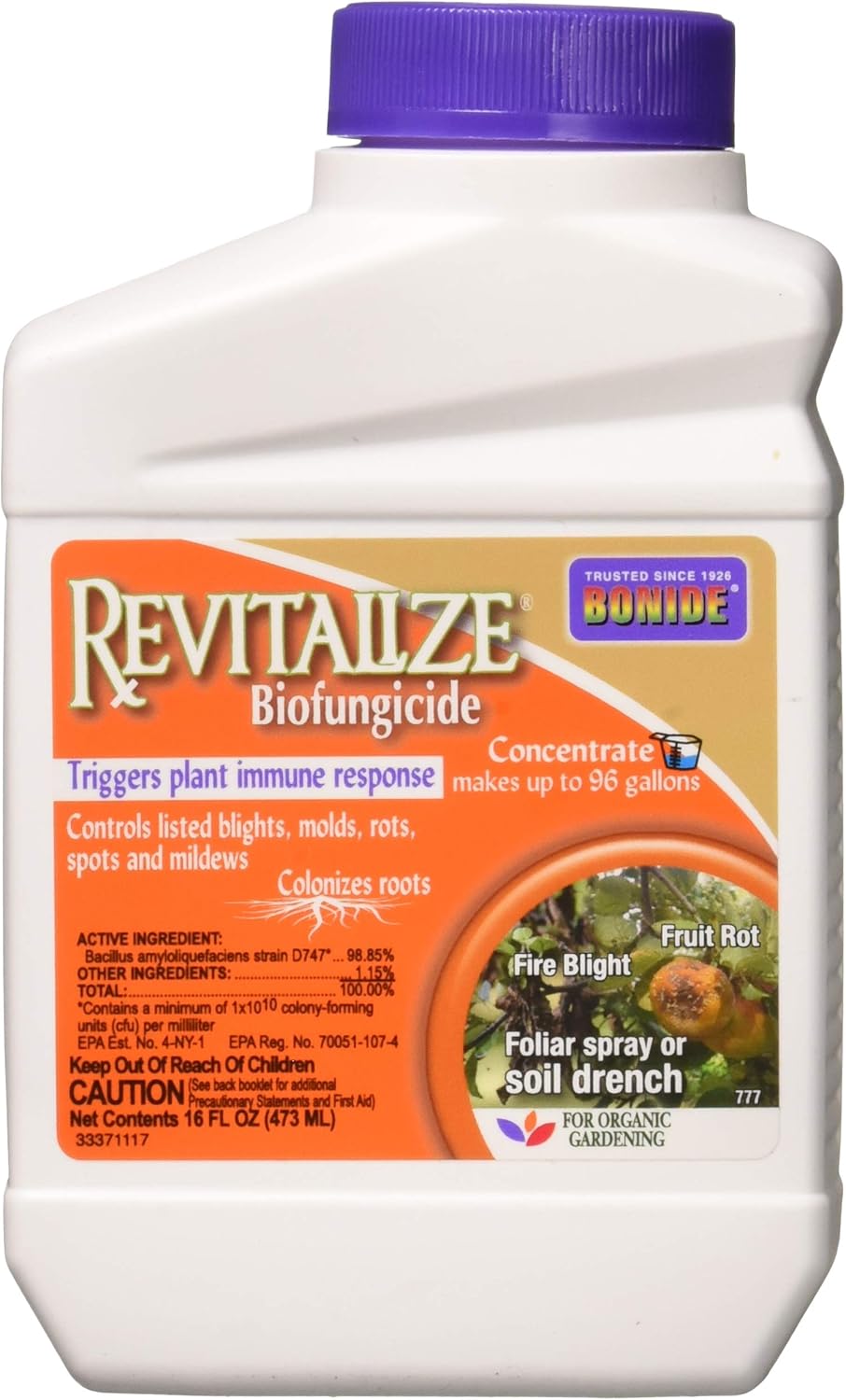
Bonide Revitalize Biofungicide Concentrate, 16 oz
| Unit Count | 16 Ounce |
|---|---|
| Item Form | Spray |
| Target Species | Disease |
| Liquid Volume | 16 fluid ounces |
Bonide Revitalize is a ready-to-mix 16 oz concentrate that triggers a plant immune response using a strain of Bacillus amyloliquefaciens to control blights, molds, rots, spots and mildews. It is typically mixed with water and applied as a foliar spray or soil drench with a hand pump sprayer or similar equipment; one bottle makes about 24 gallons when mixed as directed. For pumpkin growers this means you can treat foliage and the root zone to reduce powdery mildew, blight, and other fungal threats without synthetic fungicides, and it is approved for organic production and use up to harvest. Practical benefits include broad application options, suitability for vegetables and ornamentals, and an active biological mode of action that reduces chemical residues. Limitations are that results depend on timely and repeated applications and good coverage, it is not an instant curative for severe infections, and performance can vary with environmental conditions and application technique.
Best for: Gardeners growing pumpkins who prioritize effective, organic-compatible disease control and are willing to follow a spray schedule for prevention and maintenance.
Less Ideal for: Growers seeking a fast-acting chemical curative for severe, established fungal outbreaks or those who prefer single-application, systemic chemical solutions.
- Biological active ingredient approved for organic gardening
- Can be used as foliar spray or soil drench for top-to-bottom protection
- Concentrated formula stretches to roughly 24 gallons when mixed as directed
- Labeled for use on vegetables including pumpkins and safe up to day of harvest
- Requires frequent, thorough coverage and correct timing to be effective
- Not an immediate cure for advanced infections; best for prevention and early control
Verdict: A practical organic-compatible concentrate for pumpkin growers who want preventative and maintenance disease control across foliage and root zones.
Garden Safe Fungicide3 Ready-to-Use Trigger Spray (32 fl oz)

| Unit Count | 32 Fluid Ounces |
|---|---|
| Item Form | Spray |
| Target Species | Fungus |
| Active Ingredients | Clarified Hydrophobic Extract Of Neem Oil 0.9% |
Garden Safe Fungicide3 is a ready-to-use trigger spray formulated with clarified hydrophobic extract of neem oil to control common fungal diseases and some insect and mite pests. You spray it for full coverage of plant tissue on roses, ornamentals, houseplants and edible crops; label guidance advises treating at first sign of disease or as a preventative and timing applications for early morning or late evening to reduce leaf burn risk. Its three-in-one action means you can address powdery mildew, black spot and rust while also reducing aphids, whiteflies and spider mites without mixing concentrates. Practical users will appreciate the convenience of a pre-mixed bottle and the organic-friendly neem active ingredient. Important limitations are the need to avoid application to wilted or stressed plants and to test tender varieties first for sensitivity, plus standard precautions for inhalation and skin contact. For pumpkins this product is best used preventatively or at early disease stages and as part of an integrated program that includes sanitation and resistant varieties.
Best for: Gardeners who prioritize practical, low-fuss protection for home vegetable beds and ornamentals and want a single spray that handles both fungal and common insect problems.
Less Ideal for: Large-scale growers who need concentrated formulations for widespread spraying or users seeking a product targeted only to severe, established fungal outbreaks.
- Ready-to-use trigger spray requires no mixing and is convenient for spot and plant-by-plant treatment
- Neem oil active ingredient gives broad activity against fungi, insects, and mites
- Label allows use on edible plants so it can be applied in vegetable gardens including pumpkins
- Instructions emphasize timing to reduce leaf burn, helping safer applications on warm days
- Contains oil-based active ingredient that can cause leaf burn on stressed or tender plants if applied in full sun
- Product label warns of inhalation and skin irritation risk so protective measures are needed
Verdict: A convenient ready-to-use neem spray that gives preventive and early-stage control of fungal diseases plus added insect and mite suppression for home pumpkin plots.
Bonide Fung-onil Multi-Purpose Fungicide, 32 oz Ready-to-Use Spray

| Unit Count | 32 Ounce |
|---|---|
| Item Form | Spray |
| Target Species | Fungicide |
| Active Ingredients | Chlorothalonil |
Bonide Fung-onil is a 32-ounce ready-to-use spray that uses chlorothalonil to control and prevent common fungal problems such as leaf spot, blight, rust, and mildew. It comes in a trigger-sprayer bottle so you can shake and apply directly to affected lawns and plants without mixing concentrates. Typical use is to spray both tops and bottoms of leaves or turf blades until wet and repeat every 7 to 14 days when disease pressure appears. The practical benefits are broad-spectrum activity across vegetables, ornamentals, shrubs, trees, and grass, convenient spray delivery for small areas and quick application, and a trusted active ingredient for preventative protection. Important limitations are that it is a chemical fungicide so users must follow label safety directions and reapply on a schedule rather than rely on a single treatment, and it is not an organic option. For someone managing recurring fungal issues on turf like St. Augustine grass, this product provides an easy, affordable way to reduce disease spread when used as part of routine care and proper cultural practices.
Best for: Gardeners on a tight budget who need a straightforward, ready-to-use fungicide to manage recurring fungal problems on lawns and landscape plants and who prioritize convenience and proven chemistry over organic options.
Less Ideal for: Homeowners seeking certified organic treatments, those who prefer systemic or single-application alternatives, or users who do not want to follow safety precautions for chemical fungicides.
- Ready-to-use trigger bottle requires no mixing for quick spot treatments
- Chlorothalonil offers broad-spectrum control of leaf spot, blight, rust, mildew and other common fungal diseases
- Suitable for use on a wide range of plants including turf, ornamentals, vegetables and fruit
- Convenient 32 oz size covers multiple small-to-medium applications
- Chemical active ingredient limits use for organic or low-chemical gardening approaches
- Requires repeated applications on a 7 to 14 day schedule while disease pressure persists
Verdict: A low-cost, ready-to-use broad-spectrum fungicide that makes routine disease control on St. Augustine grass and other garden plants quick and simple.
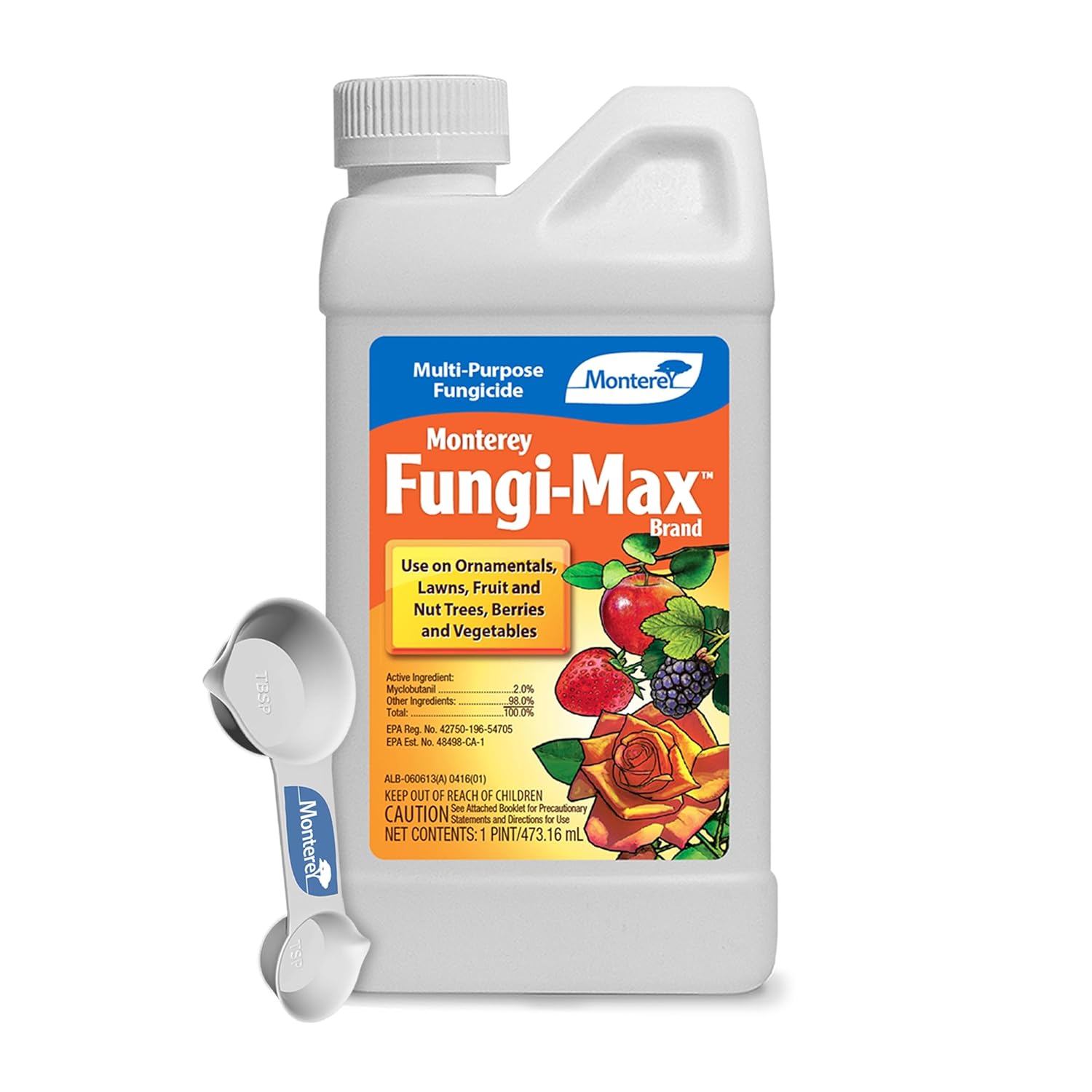
Monterey Fungi-Max Systemic Fungicide, 16 oz (with Measuring Spoon)
| Item Form | Liquid |
|---|---|
| Application Method | Spray |
| Coverage | Wide range of plants and plant types |
| Target Species | Flowers, Vegetables, Trees, Lawn Grass |
| Liquid Volume | 16 fluid ounces |
Monterey Fungi-Max is a concentrated liquid fungicide that you dilute and apply with a sprayer to prevent and control many common plant diseases. It is used outdoors on flowers, shrubs, trees, lawns and edible plants including vegetables and fruiting trees; for tomato growers it is intended to control leaf spots, blights and powdery mildew when applied at the first sign of disease. The product’s systemic action means it is absorbed and provides residual protection for up to two weeks, which reduces how often you need to spray during an outbreak. A measuring spoon is included to help with mixing and the spray application method works with standard pump or backpack sprayers. Important limitations are that it must be mixed and applied correctly according to the label and it is not listed as organic, so it may not suit organic-certified operations; also coverage on large plantings requires multiple bottles. For gardeners who want a reliable, easy-to-use fungicide to protect tomatoes and other outdoor plants, Fungi-Max delivers predictable, short-term disease control when applied promptly.
Best for: Gardeners who prioritize reliable, fast-acting disease control for outdoor tomato beds and mixed orchards and who want a product that gives measurable residual protection between applications.
Less Ideal for: Growers who require organic-certified products or those managing very large commercial tomato plantings where bulk coverage and cost per acre are primary concerns.
- Systemic action provides plant uptake and up to two weeks of protection per application.
- Broad labeled coverage for many plant types including vegetables and fruit trees.
- Liquid concentrate mixes for use with standard spray equipment for even coverage.
- Includes a measuring spoon to simplify accurate dilution amounts.
- Not listed as organic so unsuitable for certified organic production.
- One bottle may not cover large tomato plantings without repeated purchases.
Verdict: For home tomato growers seeking dependable, systemic disease control that reduces spray frequency, Monterey Fungi-Max is a practical, easy-to-use choice.
Bonide Captain Jack's Liquid Copper Fungicide Ready-to-Use, 32 oz

| Item Form | Spray |
|---|---|
| Unit Count | 32 Ounce |
| Active Ingredients | copper |
Bonide Captain Jack’s Liquid Copper Fungicide is a trigger-spray, ready-to-use copper treatment designed to control common fungal diseases such as black spot, powdery mildew, blight and peach leaf curl. It is applied by shaking and thoroughly spraying tops and undersides of leaves every 7 to 10 days or as needed, and the label allows application up to the day of harvest on listed edible plants. The product’s copper active ingredient makes it broadly effective against many foliar diseases and the convenient spray bottle removes the need to mix concentrates. Practical benefits include organic approval for many uses and clear directions for repeat treatments, which helps with consistent disease management. Important limitations are that it is a contact-style copper spray rather than a systemic cure, so thorough coverage and repeated applications are required for control, and care must be taken to follow label directions to avoid phytotoxicity on sensitive varieties.
Best for: Gardeners who prioritize established, proven solutions and want an organic-approved spray that controls common foliar diseases on roses and other plants with minimal setup.
Less Ideal for: Growers looking for a systemic fungicide or a single-application cure for long-term prevention should consider alternatives with systemic activity.
- Ready-to-use trigger spray for easy application without measuring or mixing
- Approved for organic gardening and label allows use up to day of harvest on listed edibles
- Effective copper active ingredient against a wide range of foliar fungal diseases including black spot
- Clear instructions for treatment interval make follow-up applications straightforward
- Contact-action copper requires thorough coverage and repeat sprays rather than a one-time systemic fix
- Potential for phytotoxicity on some sensitive plants if label directions are not followed
Verdict: A ready-to-use, organic-approved copper spray that provides reliable contact control of black spot and other foliar diseases when applied thoroughly and on schedule.
BioAdvanced 3-in-1 Insect, Disease & Mite Control Spray, 24 fl oz

| Unit Count | 24 Fluid Ounces |
|---|---|
| Item Form | Spray |
| Liquid Volume | 24 fluid ounces |
| Active Ingredients | 0.012% Imidacloprid, 0.014% Tau-fluvalinate, 0.015% Tebuconazole |
| Specification Met | EPA |
This ready-to-use BioAdvanced 3-in-1 spray combines an insecticide, miticide, and fungicide for broad protection on ornamental plants, including orchids listed among similar use sites. It is applied with a trigger sprayer to foliage and blooms, killing aphids, caterpillars, Japanese beetles and controlling spider mites on contact while the systemic components provide rainproof protection for up to 30 days. The inclusion of a fungicide helps manage common diseases such as powdery mildew and black spot, which can benefit orchids prone to fungal problems in humid conditions. Practical benefits are ease of use, multi-target control in one bottle, and coverage for dozens of plants per container. Important limitations are that the formula contains systemic insecticides so it must be used according to label directions and is not allowed for sale in several states, and specific orchid suitability is not detailed on the label so spot-testing on a few plants is prudent before wide application. Expect good short-term control but follow safety and timing guidance for flowering plants.
Best for: Home gardeners who want a single, easy-to-use product to manage common insect pests, mites, and fungal issues on ornamental plants and potted specimens while minimizing application time.
Less Ideal for: Specialist growers who require orchid-specific products or organic/chemical-free controls should consider targeted or softer alternatives tailored to sensitive species.
- Combines insect, mite, and fungal control in one ready-to-use spray for simplified treatment.
- Trigger-spray applicator makes spot and foliar application easy for container and potted plants.
- Systemic, rainproof protection that can last up to 30 days reduces reapplication frequency.
- Covers many common pests on ornamentals including aphids, caterpillars, Japanese beetles, and spider mites.
- Label does not list detailed directions specific to orchids so compatibility with sensitive species is not guaranteed.
- Not available for sale in several states which limits access depending on location.
- Contains multiple active ingredients so users must follow safety precautions and withholding periods for bloom treatments.
Verdict: A convenient all-in-one ready-to-use spray for casual orchid and ornamental growers who want combined insect, mite, and disease control with minimal fuss.
Choosing the Right Fungicide for Pumpkins: Key Factors to Consider
Disease Spectrum
Different fungicides control different groups of pathogens. For pumpkins you need products that target powdery mildew, downy mildew, and common foliar spot pathogens. A broader spectrum reduces the need for multiple products but may increase resistance pressure if overused.
Knowing which diseases are most prevalent in your area and season helps you choose a fungicide whose active ingredient lists those pathogens. Consider rotating modes of action across applications to slow resistance when treating recurring diseases in the same patch.
Residual Protection and Reapplication Interval
Residual protection defines how long a single application suppresses disease before another spray is required. Shorter residuals mean more frequent applications during high-pressure periods, while longer residuals reduce labor and spray costs.
Also factor in rainfastness and how soon after rain you must reapply. In climates with heavy dew or frequent showers, choose products with proven persistence or plan for tighter spray schedules to maintain continuous protection.
Application Method and Ease
Formulation type drives how easy a fungicide is to measure, mix, and spray. Concentrates that dilute cleanly and suspend well in water make accurate application simpler, while wettable powders or flowables may need more agitation.
Consider sprayer size and nozzle choice for even coverage on sprawling vines. Ease of application also includes clarity of label directions for timing, rate, and personal protective equipment so you can apply safely and effectively.
Compatibility With Integrated Pest Management
A fungicide should fit into a broader IPM plan that includes resistant varieties, crop sanitation, and canopy management. Choose products that can be rotated by mode of action and that do not overly disrupt beneficial fungi or other cultural controls.
Some fungicides pair well with biologicals or lower-toxicity materials. Evaluate label restrictions for tank mixing and any known antagonisms so you can sequence treatments without negating other controls.
Residue, Pre-Harvest Interval, and Safety
Check label guidance on pre-harvest intervals and re-entry times to match your harvesting schedule and family safety. Shorter PHIs let you treat later in the season if disease pressure spikes close to harvest, but stricter PHIs may be required for certain active ingredients.
Also review PPE and environmental precautions, especially near pollinators and water. For home gardeners, products with lower toxicity and simple safety instructions are often more practical.
Resistance Management
Pathogen populations can develop resistance to single-site fungicides when a single mode of action is used repeatedly. To protect future efficacy, use fungicides with different modes of action in rotation and follow label limits on the number of sequential applications.
Monitoring field response and switching chemistry families when performance drops helps maintain control. Resistance management also influences whether you select broad-spectrum multi-site materials or targeted single-site products.
Timing Treatments Around Pumpkin Growth Stages
Timing fungicide applications to plant growth and local disease onset is critical. Begin protective sprays when vines first fully expand or at the earliest sign of disease in nearby cucurbits, because many fungal pathogens spread rapidly once established.
During rapid vine growth and fruit set, keep a closer spray interval to protect foliage that supports fruit development. Reduce frequency later in the season only if disease pressure is low and weather becomes drier.
- Start at vine emergence or when conditions favor disease
- Tighten intervals during humid, warm periods
- Follow label pre-harvest intervals before harvesting pumpkins
Sprayer Setup and Coverage Tips
Even coverage of leaves, stems, and the undersides of leaves is essential for effective control. Use a spray nozzle that delivers a medium to coarse droplet pattern to reduce drift and improve deposition on large, waxy pumpkin leaves.
Calibrate your sprayer so you apply the labeled rate per acre or per 100 gallons, depending on instructions. Poor calibration can underdose and promote resistance or overdose and cause phytotoxicity.
- Select nozzles for canopy penetration
- Check pump pressure and agitation regularly
- Avoid spraying in hot midday sun to reduce leaf burn risk
Organic and Lower-Impact Options
Organic-acceptable fungicides and biocontrols often have shorter residuals and may require more frequent applications, but they fit well where chemical residues or environmental impact are primary concerns. These materials can be very effective when used preventatively and combined with good airflow and sanitation.
For gardeners committed to organic approaches, focus on timing, thorough coverage, and integrating cultural controls like pruning and crop rotation to reduce inoculum. Consider alternating organic materials with other low-risk products within label allowances to broaden control.
- Use organics preventatively for best results
- Combine with cultural practices to lower disease pressure
- Expect more frequent applications under heavy disease pressure
Mixing and Tank Safety
Always read and follow label mixing instructions. Start by filling the tank with the recommended amount of water, add any adjuvants if allowed, then add the fungicide while maintaining agitation to ensure even suspension.
Be aware of compatibility charts on labels. When tank mixing is allowed, add products in the recommended order and test a small jar mix first to check for precipitation or separation. Wear appropriate PPE and dispose of leftover spray mix according to local guidance.
- Follow label order for mixing
- Conduct small jar compatibility tests
- Wear PPE and clean equipment thoroughly after use
Dealing With Severe Outbreaks
When powdery or downy mildew becomes widespread, prioritize protectant-active products and rotate modes of action to regain control. In severe cases, increase spray frequency to the shortest labeled interval until disease pressure subsides.
Sanitation is important after control is achieved. Remove heavily infected debris and avoid planting successive cucurbit crops in the same spot without a break to reduce carryover inoculum.
- Switch chemistry families if performance declines
- Increase application frequency within label limits
- Remove and discard severely infected plant material
How We Chose the Best Fungicide for Pumpkins
We shortlisted products that provide reliable, repeatable disease control on cucurbits and that fit common pumpkin growing situations from small patches to larger market gardens. Evaluation prioritized fungicide spectrum against powdery and downy mildew plus common leaf spots, proven residual protection window, and labeled application frequency to match realistic spray schedules. We also considered product compatibility with tank mixes and integrated pest management, clarity of label instructions including pre-harvest intervals, and formulation type for ease of measuring and mixing. Safety and re-entry intervals were reviewed to ensure recommendations fit home garden practices, and options with organic-acceptable active ingredients were included for growers seeking lower-impact choices. Exclusions: products lacking clear pumpkin labeling, experimental formulations without established use history, and any material with inadequate label guidance for timing and rates were not considered.
FAQ
When should I start spraying fungicide on pumpkins?
Start preventative sprays when vines are establishing and conditions favor disease, such as warm, humid weather or when nearby cucurbits show symptoms. Early, timely applications are usually more effective than waiting for visible outbreaks.
Can I apply fungicide after pumpkins start forming fruit?
Yes, many labeled fungicides can be applied during fruit set, but you must follow pre-harvest intervals and label instructions. Choose products with appropriate PHIs for the time between application and harvest.
How do I avoid fungicide resistance in pumpkin pathogens?
Rotate products with different modes of action and avoid repeated sequential applications of the same chemistry. Use integrated cultural controls and only spray at labeled rates and intervals to reduce selection pressure.
Are organic fungicides effective on pumpkins?
Organic materials can be effective, especially as preventive treatments combined with good cultural practices. They often have shorter residual activity, so you may need more frequent applications under high disease pressure.
What spray equipment works best for pumpkins?
A backpack or wheeled sprayer with medium-coarse nozzles that provide good canopy penetration usually works well. Calibrate your sprayer to apply the correct labeled rate and ensure even coverage on leaf undersides and inner canopy.
Can I tank mix fungicides with fertilizers or insecticides?
Tank mixing is sometimes allowed but depends on label compatibility. Always check the product label, perform a small jar test for mixing compatibility, and follow recommended orders of addition to avoid reactions.
Final Verdict
When selecting a fungicide for pumpkins, prioritize the diseases you expect to encounter, the product's residual protection, and label instructions for timing and safety. Balance ease of application and tank mix flexibility with resistance management concerns to keep control effective season after season. By matching your spray schedule to vine growth and local weather, and by rotating modes of action, you can protect foliage and fruit without compromising future options.
