

Note: This article contains affiliate links. If you click on these links and make a purchase, I may earn a small commission at no extra cost to you. This helps support my research and content. Read my full affiliate disclosure here.
Tomato leaf spot diseases can quickly weaken plants, reduce yields, and make harvesting a week-to-week scramble. Choosing an effective fungicide matters because timing, mode of action, and safety around edible crops determine whether a spray stops disease or simply delays it. This guide highlights seven shortlisted fungicides selected for use against tomato leaf spot in home and small-scale vegetable gardens. We focus on how each option behaves in the garden, with attention to application method, residual protection, and safety around fruiting plants. Read on to understand the practical tradeoffs and which product traits matter most for tomatoes.
Top Picks at a Glance
| Best Overall The best all-around choice for most situations | Bonide Fung-onil Multi-Purpose Fungicide Ready-to-Use Spray, 32 oz |  |
| Best Quality Built to a higher standard if you want something more solid | Bonide Captain Jack's Tomato & Vegetable 3-in-1 Ready-to-Use Spray, 32 oz |  |
| Best Value The sweet spot between price and what you get | Gardentech Daconil Fungicide Concentrate, 16 fl oz |  |
| Best Budget The cheapest option that still gets the job done reliably | Gardentech Daconil Ready-to-Use Fungicide, 32 oz |  |
| Highest Rated A top-rated pick with lots of positive feedback | Monterey Fungi-Max Systemic Fungicide, 16 fl oz |  |
| Most Popular A crowd favorite that many people choose with confidence | Bonide Captain Jack's Liquid Copper Fungicide Ready-to-Use, 32 oz |  |
| Best Seller A high-volume bestseller chosen again and again | Bonide Captain Jack Copper Fungicide 16 oz Concentrate |  |
Bonide Fung-onil Multi-Purpose Fungicide Ready-to-Use Spray, 32 oz

| Unit Count | 32 Ounce |
|---|---|
| Item Form | Spray |
| Target Species | Fungicide |
| Active Ingredients | Chlorothalonil |
Bonide Fung-onil Ready-to-Use is a broad-spectrum garden fungicide packaged in a 32 ounce trigger-spray bottle for easy, direct application. It uses chlorothalonil to manage leaf spot, rust, blight, mildew, scab and other listed fungal problems and can be applied to vegetables, fruits, flowers, shrubs and trees. Typical use is shaking the bottle, then thoroughly spraying both tops and undersides of leaves at the first sign of disease and repeating every 7 to 14 days as directed. The ready-to-use format eliminates measuring and mixing, which saves time for casual gardeners and those treating small beds or container groups. Because it is a conventional chemical fungicide it gives reliable, preventive disease control when used as directed, but users must follow safety guidance on the label and avoid application to plants or areas not listed. The product is straightforward to use and convenient for routine garden maintenance, though gardeners seeking organic or completely nonchemical options should consider alternatives.
Best for: Gardeners who want an affordable, no-fuss fungicide for routine prevention and control of common fungal diseases across a variety of plants and prefer a product that is ready to spray.
Less Ideal for: People committed to organic gardening or those who avoid synthetic pesticides should choose an organic-certified or cultural control method instead.
- Ready-to-use trigger bottle requires no mixing or measuring
- Broad-spectrum active ingredient (chlorothalonil) controls many common fungal diseases
- Suitable for a wide range of plants including vegetables, fruits, ornamentals, shrubs and trees
- Clear repeat-application guidance (every 7 to 14 days) for preventive treatment
- Contains a conventional chemical active ingredient that is not organic
- Requires careful adherence to label safety directions and application limits
Verdict: A convenient, budget-friendly ready-to-use fungicide that delivers broad-spectrum control for common garden fungal diseases.
Bonide Captain Jack's Tomato & Vegetable 3-in-1 Ready-to-Use Spray, 32 oz
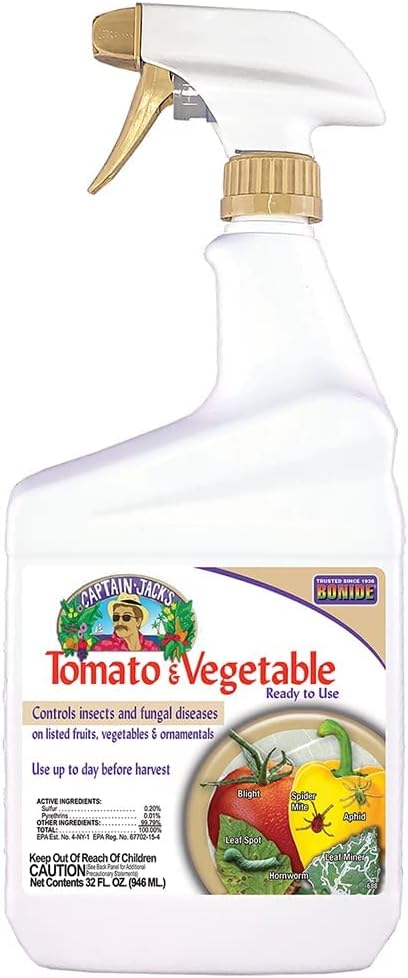
| Unit Count | 32 Ounce |
|---|---|
| Active Ingredients | sulfur |
| Item Type Name | Tomato & Vegetable 3-in-1 Ready-To-Use |
| Special Features | organic |
Bonide Captain Jack's Tomato & Vegetable Ready-to-Use is a 32 oz spray formulated to control common insect pests and a range of fungal diseases on tomatoes and other garden plants. It is used as a contact spray applied to foliage and new growth with a trigger nozzle that makes spot or whole-plant coverage straightforward. The product lists sulfur as an active ingredient and claims control of aphids, spider mites, caterpillars and more while also suppressing problems like powdery mildew, leaf spot and blight when applied preventively. Practical benefits include the convenience of a pre-mixed bottle, suitability for many listed vegetables and ornamentals, and a broad target list that lets one treat mixed beds without swapping products. Limitations are that it works by contact so thorough coverage is required and it is intended for preventive or early-season use rather than curing severe established infections. Users who need systemic control or highly targeted biological products may prefer an alternative formula.
Best for: Gardeners who want a simple, all-in-one spray to prevent and manage common insect pests and early fungal problems on tomatoes and mixed vegetable beds.
Less Ideal for: Growers seeking systemic fungicides, targeted biological controls, or solutions for severe, established diseases should consider other products.
- Ready-to-use bottle with trigger nozzle for quick application
- Controls a broad range of common garden insects and several fungal diseases
- Suitable for use on tomatoes, many vegetables and ornamentals
- Contains sulfur, a long-established option for organic-compatible fungal control
- Contact-only action requires thorough coverage and repeat applications for good control
- Not formulated for systemic action so it will not cure deep or established infections
Verdict: Pick this ready-to-use spray if you want a convenient, broad-spectrum preventive product to manage common tomato pests and early fungal issues.
Gardentech Daconil Fungicide Concentrate, 16 fl oz

| Unit Count | 16 Fluid Ounces |
|---|---|
| Item Form | Liquid |
| Target Species | Insects |
| Active Ingredients | Chlorothalonil |
Daconil Fungicide Concentrate is a chlorothalonil-based liquid concentrate formulated to prevent and control more than 65 fungal diseases such as leaf spots, rusts, blights, fruit rot and mildew on flowers, vegetables, shrubs and shade trees. You mix the measured amount in a hand-held, hose-end or tank sprayer and apply a fine spray to thoroughly wet upper and lower leaf surfaces; the product is rain-proof once dry and can be used as both a curative at first sign of disease and a preventative treatment. Notable features include an easy measuring cap, broad-spectrum disease coverage, and label directions for use on a variety of plant types. Important limitations are that it is for outdoor residential use only, is not labeled for home lawns or many public turf sites, and requires careful protective gear and handling because it can irritate eyes and skin and is harmful if inhaled or swallowed. Follow label dilution rates and pre-harvest intervals for edible crops, avoid application in heat or stress conditions, and keep people and pets off treated areas until dry.
Best for: Gardeners who prioritize reliable, preventative disease control for outdoor ornamentals and edible plants and who follow label safety instructions and protective practices.
Less Ideal for: People who need a fungicide for home lawns, high-contact public turf, or who cannot use products that require respirators and protective clothing.
- Broad-spectrum control of over 65 common foliar diseases including blights, rusts and mildew
- Concentrated formula works with hand-held, hose-end or tank sprayers for flexible application
- Measuring cap and clear label directions simplify mixing and dosing
- Rain-proof protection once spray has dried for reliable residual control
- Contains chlorothalonil which requires protective equipment and careful handling due to irritation and toxicity risks
- Not labeled for lawns or many public turf and high-contact sites
Verdict: Choose this concentrate when you want a proven, broad-spectrum fungicide for dependable outdoor disease prevention and control.
Gardentech Daconil Ready-to-Use Fungicide, 32 oz

| Brand | Gardentech |
|---|---|
| Item Type Name | Daconil Fungicide Ready To Use, 32Oz |
| Target Species | Fungus |
| Liquid Volume | 32 fluid ounces |
Daconil Ready-to-Use is a grab-and-go fungicide formulated to kill, stop, and help prevent a wide range of foliar plant diseases. In practice you spray it on affected foliage to control leaf spots, rust, blights, fruit rot, and mildew on tomatoes and other garden plants. Its main benefits are ease of use and broad-spectrum activity so you do not need to mix concentrate or calibrate dosages, which makes it convenient for quick spot treatments and routine preventative sprays. The ready-to-use formulation is also handheld and portable for small to medium beds and home vegetable gardens. Important limitations are typical for non-selective fungicides: it is a pesticide that should be kept away from children, pets, and aquatic areas, and repeated use may require attention to label directions and spray intervals to avoid phytotoxicity or resistance issues. For budget-minded gardeners dealing with active tomato leaf spot, this product provides a practical, no-fuss option to get disease under control quickly.
Best for: Home gardeners who want a simple, no-mess way to treat and prevent tomato leaf spot without mixing concentrates and who prefer a convenient ready-to-use product.
Less Ideal for: Large-acreage growers or gardeners who need a cost-per-gallon solution or who prefer to avoid chemical fungicides in favor of organic or cultural-only controls.
- Ready-to-use formula requires no mixing or measuring
- Broad-spectrum activity against leaf spots, blights, rust, and mildew
- Easy handheld application suitable for small vegetable gardens
- Contains active pesticide ingredients that require careful handling around children, pets, and water
- Less economical for large gardens compared with concentrated formulations
Verdict: If you need a quick, no-mix solution to control tomato leaf spot in a home garden, this ready-to-use fungicide lets you spray and move on.
Monterey Fungi-Max Systemic Fungicide, 16 fl oz

| Item Form | Liquid |
|---|---|
| Application Method | Spray |
| Coverage | Wide range of plants and plant types |
| Target Species | Flowers, Vegetables, Trees, Lawn Grass |
| Liquid Volume | 16 fluid ounces |
Monterey Fungi-Max is a concentrated liquid fungicide formulated for home garden and landscape use to prevent and control common fungal diseases. You mix the product with water and apply it with a spray tank or pump sprayer; it works systemically so the active ingredient moves into plant tissue to protect leaves, stems, and roots. The label cites control for problems like powdery mildew, rust, leaf spots, crown rot, and several turf diseases, and the manufacturer says one application can protect plants for up to two weeks. Because it covers flowers, shrubs, fruit and nut trees, vegetables, and lawns, it is useful for mixed gardens where multiple plant types need disease management. Practical benefits include broad-spectrum disease coverage, systemic action that reaches new growth, and straightforward dilution and spray application. Important limitations are the need to follow label directions carefully for timing and mixing, potential incompatibility with certain sprayers or tank mixes, and the fact that repeat applications may be required for ongoing pressure or severe outbreaks.
Best for: Home gardeners and property owners who prioritize dependable, proactive disease control across mixed plantings and want a product that reaches plant tissue rather than only contact protection.
Less Ideal for: Organic gardeners or those seeking a contact-only, ready-to-use spray should consider alternatives designed for certified organic use or simpler ready-mix formulations.
- Systemic action that protects new growth after application
- Broad listed coverage for ornamentals, vegetables, fruit trees and turf
- Suitable for spray-tank or pump-sprayer application for yard-scale use
- One application offers up to two weeks of protection under normal conditions
- Not an organic or OMRI-listed product, so not suited for certified organic production
- Requires careful dilution and label reading to avoid misuse
Verdict: Choose Monterey Fungi-Max when you need a reliable, systemic fungicide that provides broad disease protection across a diverse home garden.
Bonide Captain Jack's Liquid Copper Fungicide Ready-to-Use, 32 oz

| Unit Count | 32 Ounce |
|---|---|
| Item Form | Spray |
| Active Ingredients | copper |
Bonide Captain Jack’s Liquid Copper Fungicide is a trigger-spray, ready-to-use copper solution designed to prevent and treat common fungal diseases on fruits, vegetables, nuts, herbs and ornamentals. It is applied by shaking the bottle and thoroughly spraying tops and undersides of leaves, with repeat applications every 7 to 10 days or as needed. The product is labeled for organic gardening and can be used up to the day of harvest, making it practical for vegetable beds and fruit trees where residue concerns matter. Notable features include its broad-spectrum activity against powdery mildew, leaf spot, blight and peach leaf curl, and the convenience of a pre-mixed spray bottle that removes measuring or mixing. Limitations are inherent to copper products: it treats fungal problems but does not replace cultural controls like good airflow and sanitation, and overuse of copper can accumulate in soil so following label directions is important. As a ready-to-use option, it is best for gardeners who want a simple, approved solution for recurring fungal issues without handling concentrates.
Best for: Gardeners who prioritize proven, labeled products and want an easy-to-use organic-approved fungicide for edible beds and ornamentals based on real-world effectiveness and peer recommendations.
Less Ideal for: Gardeners seeking an all-in-one pest control product or those who prefer to avoid any copper-based treatments should look at non-copper alternatives or integrated disease-management approaches.
- Ready-to-use trigger spray requires no mixing or measuring
- Approved for organic gardening and can be applied up to day of harvest
- Effective against a broad range of common fungal diseases
- Convenient repeat-application interval (7–10 days) for ongoing control
- Contains copper which can build up in soil with excessive use
- Does not address non-fungal problems like insects or bacterial diseases
Verdict: A convenient, ready-to-use copper fungicide for gardeners who want an effective organic-approved spray to manage common fungal diseases.
Bonide Captain Jack Copper Fungicide 16 oz Concentrate

| Unit Count | 16 Ounce |
|---|---|
| Item Form | Liquid |
| Target Species | Fungus |
| Active Ingredients | Copper Octanoate (Copper Soap) |
Bonide Captain Jack Copper Fungicide is a liquid concentrate designed to prevent and treat a broad range of fungal diseases on vegetables, fruits, ornamentals, and turf. Mixed with water per label directions, it is sprayed onto plant surfaces, including tops and undersides of leaves, and can be applied up to the day of harvest, which makes it practical for food crops like tomatoes. The active ingredient copper octanoate provides contact protection against powdery mildew, blight, black spot, rust, peach leaf curl and similar diseases. Application is straightforward and repeatable every 7 to 10 days as needed, and the product is cleared for use in organic gardening. Limitations to consider are that copper is a contact fungicide so it does not systemically move through the plant and works best as a preventative or early-treatment tool rather than curing severe systemic infections. Users should follow safety directions and avoid overuse to reduce copper buildup in soil.
Best for: Gardeners looking for a performance-focused, organic-approved fungicide to include in a preventative disease program for tomatoes and other edibles.
Less Ideal for: Growers seeking a systemic treatment for already advanced internal infections or those who prefer non-copper chemistries to avoid soil accumulation.
- Approved for organic gardening and can be used up to the day of harvest
- Controls a wide range of common diseases affecting tomatoes such as blight and powdery mildew
- Concentrated liquid formula mixes with water for spray application
- Repeatable 7–10 day application schedule makes preventative programs easy to maintain
- Acts as a contact fungicide and does not move systemically within the plant
- Repeated use can contribute to copper accumulation in soil if not managed
Verdict: Use this organic-approved copper concentrate when you want an effective, easy-to-apply preventative spray to protect tomatoes from common fungal diseases.
Choosing the Right Fungicide for Tomato Leaf Spot: Key Factors to Consider
Active Ingredient and Mode of Action
Different fungicides use distinct active ingredients that target fungal cells in varying ways. Choosing a product with a different mode of action from what you used last season helps slow resistance development in pathogen populations. For tomato leaf spot specifically, broad-spectrum actives can suppress multiple common pathogens, while narrow-spectrum options may work well for a confirmed diagnosis but carry greater resistance risk.
Check label wording about resistance management, such as rotation groups or limits on the number of applications per season. That guidance affects long-term control in your garden and helps preserve the product's usefulness.
Formulation and Application Method
Formulations include ready-to-use sprays, concentrates that require dilution, wettable powders, and dusts. Concentrates allow precise dosing for larger beds but require measuring and mixing. Ready-to-use bottles are simpler for a few plants but may cost more per application. Wettable powders and soluble granules can provide economical, concentrated options, but they may need more careful mixing to avoid nozzle and filter clogging.
Application method affects coverage. Foliar sprays that produce fine, uniform droplets give better coverage on undersides of leaves where spots form. Consider nozzle type, spray pressure, and whether you need a handheld pump sprayer or a trigger bottle for spot treatment.
Residual Protection and Rainfastness
Residual protection describes how long foliage stays protected after application. Longer residuals reduce spraying frequency but may be affected by rain and sunlight. Rainfast products bind to the leaf surface or penetrate tissue, while others wash off easily and require reapplication after rain.
When heavy rains are common, choose a product with good rainfastness or plan repeat applications after wet weather. Balance longer residuals with resistance management, since more persistent actives can exert selection pressure on fungi.
Crop Safety and Pre-harvest Interval
Tomatoes are an edible crop, so label directions about pre-harvest interval (PHI), re-entry intervals, and maximum seasonal applications are critical. Some fungicides require waiting days or weeks before harvest; others allow shorter intervals. Follow PHI to avoid unwanted residues on fruit and to protect family health.
Also consider phytotoxicity risk. Certain products can cause leaf burn or flower drop under high temperatures or if applied at too-high rates. Look for label warnings about application timing and temperature limits.
Ease of Use and Safety Handling
Ease of measuring, mixing, and applying affects how consistently you treat disease. Clear label instructions, simple mixing ratios, and minimal required personal protective equipment make it more likely you'll apply correctly and on schedule. Conversely, complex tank mixes or products that need specialized equipment increase the chance of user error.
Safety handling includes required gloves, respirators, or protective clothing. For small gardens, lower-toxicity formulations with straightforward safety measures are often preferable, especially where children or pets are present.
When to Start Treatments
Begin applications at the first sign of leaf spot or when weather conditions favor disease development, such as frequent morning dew, high humidity, or prolonged leaf wetness. Preventive sprays are effective when applied before widespread lesions appear, but curative options can still limit spread if used promptly.
Establish a schedule based on the product label and local disease pressure. In warm, humid stretches check plants more often and shorten spray intervals accordingly. Remove and destroy severely infected leaves to reduce inoculum between applications.
- Treat at early symptoms to limit spread
- Increase frequency during humid, rainy periods
- Combine sprays with sanitation: remove infected foliage
Integrating Fungicides Into Cultural Controls
Fungicides are most effective when combined with cultural practices that reduce disease pressure. Space plants for good air flow, prune low branches that contact soil, and water at the base to minimize wet foliage. Mulch paths to prevent soil splash that spreads spores.
Rotate varieties when possible and select disease-tolerant cultivars to reduce reliance on chemical control. Keep stakes and cages clean between seasons to avoid moving spores from one year to the next.
- Water in the morning to allow foliage to dry
- Avoid overhead irrigation when leaf spot is active
- Sanitation reduces the number of spores available to re-infect plants
Spot Treatment Vs. Whole-Plant Spray
Decide whether to treat only affected leaves or spray the entire plant. Spot treatment reduces chemical use and may be adequate for isolated lesions on a few plants. Whole-plant sprays provide uniform coverage and are preferable when infection is widespread or when protecting developing fruit.
When treating whole plants, ensure thorough coverage including leaf undersides and the interior canopy. In small beds, careful whole-plant spraying can prevent lesions from spreading to neighboring plants.
- Spot treat early, whole-plant spray for broader outbreaks
- Ensure good coverage when doing whole-plant applications
- Follow label directions on maximum number of applications
Minimizing Resistance Risks
Fungal pathogens can develop resistance when the same mode of action is used repeatedly. Alternate products with different modes of action according to label recommendations. Use the lowest effective application frequency and integrate nonchemical measures to lower selection pressure.
Consult resistance-group guidance on product labels and avoid consecutive applications of the same chemistry. If a product shows reduced control in your garden, rotate to a different mode of action and revisit cultural controls.
- Rotate modes of action across the season
- Limit repeated applications of the same active ingredient
- Combine chemical control with sanitation and resistant varieties
Application Tips for Backyard Gardeners
Use a sprayer that gives a fine, even mist for good leaf coverage. Clean equipment after each use to avoid cross-contamination or nozzle clogging. Measure carefully and follow label mixing instructions to avoid phytotoxicity or poor control.
Apply in the early morning or late evening when temperatures are cooler and wind is low to reduce drift and improve deposition. Wear the protective equipment specified on the label, and keep people and pets out of the treated area until the re-entry interval has passed.
- Calibrate sprayer to deliver recommended volume per area
- Clean sprayer parts to prevent buildup and blockages
- Apply when wind is minimal and temperatures are moderate
How We Chose the Best Fungicide for Tomato Leaf Spot
We evaluated products by how well they fit realistic tomato garden use and by measurable product attributes that affect disease control and gardener workflow. Key evaluation criteria included active ingredient spectrum and resistance-management potential, because effective leaf spot control depends on modes of action that still work against local pathogen populations. We assessed formulation type and application flexibility, since sprays, dusts, and ready-to-use concentrates affect coverage and drift in small beds. Residual protection and rainfastness were considered to understand how long a single application protects foliage in variable weather. We also examined crop safety and pre-harvest intervals to ensure options are appropriate for fruiting tomatoes. Ease of mixing, label clarity, and required protective equipment were reviewed to reflect real-world handling and safety. Products were excluded if labels did not list tomatoes as a labeled crop, if required application methods were impractical for backyard gardeners, or if resistance-management guidance was absent. The resulting shortlist favors solutions that balance reliable leaf spot suppression with practical, safe use in edible gardens.
FAQ
How often should I apply fungicide for tomato leaf spot?
Frequency depends on the product label and weather. Many labels call for applications every 7 to 14 days under regular conditions, shortened during wet, humid periods. Always follow the specific interval on the label and adjust for local disease pressure.
Can I harvest tomatoes soon after spraying?
That depends on the product's pre-harvest interval. Some fungicides require several days before harvest, while others allow shorter intervals. Always check and follow the PHI on the label to avoid residues on fruit.
Is it better to spray preventively or only after seeing symptoms?
Preventive applications during conditions favorable for disease can stop leaf spot before it spreads, but targeted curative sprays can limit outbreaks if applied promptly. Preventive programs are most useful when leaf wetness and humidity are persistent.
Will one product control all types of leaf spot on tomatoes?
No single fungicide controls every tomato leaf spot pathogen equally. Some actives have broader spectra, while others are specific. Confirming the pathogen helps, but integrating cultural controls and rotating actives improves overall management.
Can I tank-mix fungicides with fertilizers or insecticides?
Tank-mixing depends on label directions and product compatibility. Some mixes can increase efficacy or reduce trips through the garden, but others can cause phytotoxicity or reduce fungicide performance. Always read both labels and, when in doubt, perform a small compatibility test.
Are organic fungicides effective for tomato leaf spot?
Organic options can provide suppression, especially when used preventively or in low-disease situations. They may require more frequent applications and work best when combined with good cultural practices. Effectiveness varies by active ingredient and disease pressure.
Final Verdict
Selecting the right fungicide for tomato leaf spot comes down to matching active ingredient and application type to your garden conditions. Prioritize products labeled for tomatoes with appropriate pre-harvest intervals, choose formulations you can apply thoroughly, and rotate modes of action. Combine chemical treatments with cultural controls and sanitation to reduce disease pressure and protect product efficacy. With the right balance of safety, coverage, and resistance management you can keep leaf spot in check and protect yields.
