

Note: This article contains affiliate links. If you click on these links and make a purchase, I may earn a small commission at no extra cost to you. This helps support my research and content. Read my full affiliate disclosure here.
Garden diseases can wipe out weeks of work in a few rainy days, so picking the right fungicide matters for preserving blooms, fruit, and foliage. Whether you grow vegetables, ornamentals, or container plants, the right product reduces disease spread, protects new growth, and fits your watering and harvesting schedule. This guide shortlists seven strong options suited to home gardening situations and explains the practical strengths and tradeoffs of each choice. We evaluated products for disease control, application flexibility, and user safety to help you choose with confidence. Read on for what we looked at and how each option performs in real garden use.
Top Picks at a Glance
| Best Overall The best all-around choice for most situations | Bonide Captain Jack's Liquid Copper Fungicide Ready-to-Use, 32 oz |  |
| Best Quality Built to a higher standard if you want something more solid | Gardentech Daconil Fungicide Concentrate, 16 fl oz |  |
| Best Value The sweet spot between price and what you get | Garden Safe Fungicide3 with Neem Oil, Ready-to-Use, 1 Gal |  |
| Best Budget The cheapest option that still gets the job done reliably | Bonide Fung-onil Multi-Purpose Fungicide Ready-to-Use Spray, 32 oz |  |
| Highest Rated A top-rated pick with lots of positive feedback | Monterey Fungi-Max Systemic Fungicide, 16 fl oz |  |
| Most Popular A crowd favorite that many people choose with confidence | Bonide Captain Jack's Ready-to-Use Neem Oil Spray, 32 oz |  |
| Best Seller A high-volume bestseller chosen again and again | Scotts DiseaseEx Lawn Fungicide, 10 lb |  |
Bonide Captain Jack's Liquid Copper Fungicide Ready-to-Use, 32 oz

| Unit Count | 32 Ounce |
|---|---|
| Item Form | Spray |
| Active Ingredients | copper |
Bonide Captain Jack's Liquid Copper Fungicide comes in a 32-ounce trigger-spray bottle and is formulated for ready-to-use disease control in organic gardens. It is applied by shaking and thoroughly spraying tops and undersides of leaves, with repeat treatments every 7 to 10 days or as directed. The active ingredient copper targets fungal and bacterial problems such as powdery mildew, blight, leaf spot, black rot and peach leaf curl, and the label states it can be used up to the day of harvest on listed edible crops. The convenience of a trigger bottle saves time compared with mixing concentrates, and the product’s organic approval makes it suitable for gardeners aiming to meet organic production standards. Important practical limits are that copper treatments require consistent reapplication for management rather than one-time cure, and users must follow safety guidance and label directions to avoid overuse on sensitive plants or soil accumulation over long term use.
Best for: Gardeners who want a straightforward, organic-compatible spray to manage common fungal and bacterial diseases across edibles and ornamentals and prefer convenience over mixing concentrates.
Less Ideal for: Growers managing sensitive soil with strict low-copper limits or those seeking a single-application systemic cure should consider alternative disease-management approaches.
- Ready-to-use trigger spray for quick application without mixing
- Approved for organic gardening and safe to use up to day of harvest on listed crops
- Effective against a broad set of common fungal and bacterial plant diseases
- Covers both foliage surfaces when applied as directed for comprehensive protection
- Requires repeat applications every 7–10 days for continued control
- Contains copper which can accumulate in soil with frequent long-term use
Verdict: A convenient ready-to-use copper spray for gardeners who want an organic-approved, broad-spectrum foliar treatment to manage common plant diseases.
Gardentech Daconil Fungicide Concentrate, 16 fl oz

| Unit Count | 16 Fluid Ounces |
|---|---|
| Item Form | Liquid |
| Target Species | Insects |
| Active Ingredients | Chlorothalonil |
Daconil Fungicide Concentrate is a garden-grade chlorothalonil concentrate made for routine disease control on ornamentals, vegetables, fruit and shade trees. You measure the concentrate with the built-in cap, dilute it in a handheld, hose-end or tank sprayer, and apply until leaf surfaces are thoroughly wet; the label lists dozens of diseases it controls, including blights, leaf spots, rusts and mildews. Its rain-proof protection and preventive action make it useful for scheduled applications when conditions favor disease. Practical benefits include a broad disease spectrum, a small concentrated bottle that treats multiple applications, and clear label directions for mixing and timing. Important limitations are safety restrictions and handling precautions: it can irritate skin and eyes, is harmful if inhaled or swallowed, and should not be used on lawns or sites where people and pets gather; users must wear protective gear and keep treated areas clear until dry. Also follow edible pre-harvest intervals when treating food crops.
Best for: Gardeners who prioritize reliable, preventative fungal protection and are comfortable following label safety procedures for concentrated chemical treatments.
Less Ideal for: Casual users who prefer low-toxicity, organic controls or need a product safe for use in high-traffic lawns, playgrounds or pet areas.
- Broad spectrum control effective against many common fungal diseases listed on the label
- Concentrated 16 fl oz makes multiple treated gallons when mixed, reducing packaging and trips to buy more
- Works with common sprayers (hand-held, hose-end, tank) and includes a measuring cap for easier mixing
- Rain-proof protection once applied, so it holds up to light rainfall after drying
- Contains chlorothalonil and requires strict personal protective equipment and handling precautions
- Not labeled for use on lawns and is restricted around public or high-traffic sites
Verdict: Buy this if you need a proven, concentrated fungicide that provides broad preventative and curative control for common garden diseases when used with proper safety precautions.
Garden Safe Fungicide3 with Neem Oil, Ready-to-Use, 1 Gal

| Item Form | Spray |
|---|---|
| Target Species | Fungus |
| Liquid Volume | 128 fluid ounces |
| Active Ingredients | Neem Oil Extract |
Garden Safe Fungicide3 with Neem Oil is a one-gallon, ready-to-use spray formulated to manage common fungal diseases, insect pests, and mites in home gardens. You use it by spraying complete coverage on affected foliage in the early morning or late evening to reduce the risk of leaf burn; it is recommended for roses, flowers, houseplants, ornamental trees and shrubs, and edible fruit and vegetable plants. The active clarified hydrophobic neem oil extract works as a fungicide against black spot, rust, and powdery mildew while also targeting aphids, whiteflies, spider mites and other listed pests across eggs, larvae and adults. Practical benefits include broad-spectrum control without mixing concentrated chemicals and the convenience of a large ready-to-use container for multiple treatments. Important limitations are that timing matters to avoid phytotoxicity on sensitive plants and that label directions must be followed for safe use on edibles; also oil-based sprays may require thorough coverage and occasional reapplication for effective control. For gardeners who want an all-in-one organic-friendly spray, this product simplifies routine pest and disease management.
Best for: Gardeners who want a single, convenient product to manage common fungal and insect problems around the home and prefer organic-friendly solutions that reduce the need to buy separate treatments.
Less Ideal for: People managing very large or commercial plantings who need concentrated products for tank mixing or professional-strength controls should look elsewhere.
- Combines fungicide, insecticide, and miticide actions in one ready-to-use formula
- Contains neem oil extract, a commonly accepted ingredient for organic gardening
- Large 1 gallon volume supports multiple applications across a home garden
- Effective against both fungal diseases like powdery mildew and pests such as aphids and spider mites
- Oil-based spray can cause leaf burn if applied in direct sun or at the wrong time
- Requires complete coverage and possible repeat applications for persistent problems
Verdict: A practical, ready-to-use neem oil formula that combines fungal and pest control for home gardeners who want one product to handle common garden problems.
Bonide Fung-onil Multi-Purpose Fungicide Ready-to-Use Spray, 32 oz

| Unit Count | 32 Ounce |
|---|---|
| Item Form | Spray |
| Target Species | Fungicide |
| Active Ingredients | Chlorothalonil |
Bonide Fung-onil Ready-to-Use is a trigger-spray fungicide intended for routine prevention and spot treatment of fungal problems in home gardens. The bottle arrives ready to spray so you can shake and apply directly to leaves, covering tops and undersides until wet, then repeat every 7 to 14 days while disease pressure persists. Its active ingredient, chlorothalonil, is a broad-spectrum option that controls leaf spot, rust, blight, mildew, scab and similar fungal issues on vegetables, fruits, ornamentals, shrubs and trees. The convenience of a 32-ounce ready-to-use bottle makes it easy for weekend gardeners to treat affected plants without mixing concentrates. Important practical limitations are standard safety precautions and label directions you must follow because chlorothalonil is a conventional chemical fungicide and not suitable for organic-certified applications. For gardeners prioritizing straightforward, dependable control of common fungal diseases, this product simplifies application and provides wide plant coverage, but it requires careful handling and adherence to reapplication intervals.
Best for: Home gardeners who want an easy, ready-to-use solution to prevent and treat common fungal diseases across vegetables, fruits and ornamentals while keeping upfront cost and fuss low.
Less Ideal for: Gardeners seeking organic or natural disease control methods or those unwilling to follow chemical-safety precautions should consider alternative products.
- Ready-to-use trigger sprayer for easy, no-mix application
- Broad-spectrum active ingredient (chlorothalonil) effective against many common fungal diseases
- Suitable for use on a wide range of plants including vegetables, fruits, ornamentals, shrubs and trees
- 32-ounce size provides enough product for multiple treatments in a typical home garden
- Contains a conventional synthetic fungicide that is not approved for organic-certified gardens
- Requires careful adherence to safety instructions and reapplication intervals
Verdict: A convenient, ready-to-use broad-spectrum fungicide that makes treating common garden fungal diseases quick and straightforward.
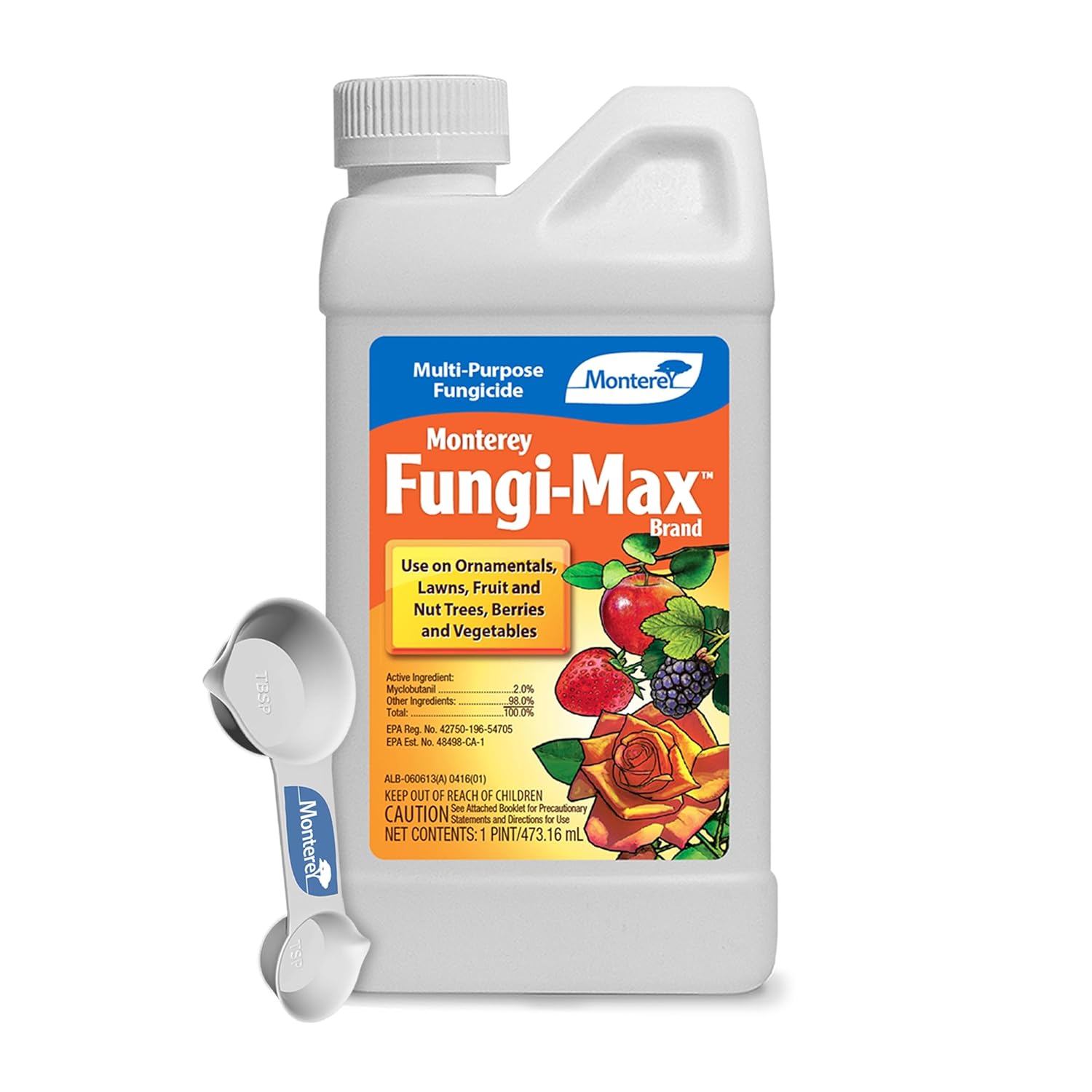
Monterey Fungi-Max Systemic Fungicide, 16 fl oz
| Item Form | Liquid |
|---|---|
| Application Method | Spray |
| Coverage | Wide range of plants and plant types |
| Target Species | Flowers, Vegetables, Trees, Lawn Grass |
| Liquid Volume | 16 fluid ounces |
Monterey Fungi-Max is a concentrated liquid fungicide formulated for home garden and landscape use to prevent and control common fungal diseases. You mix the product with water and apply it with a spray tank or pump sprayer; it works systemically so the active ingredient moves into plant tissue to protect leaves, stems, and roots. The label cites control for problems like powdery mildew, rust, leaf spots, crown rot, and several turf diseases, and the manufacturer says one application can protect plants for up to two weeks. Because it covers flowers, shrubs, fruit and nut trees, vegetables, and lawns, it is useful for mixed gardens where multiple plant types need disease management. Practical benefits include broad-spectrum disease coverage, systemic action that reaches new growth, and straightforward dilution and spray application. Important limitations are the need to follow label directions carefully for timing and mixing, potential incompatibility with certain sprayers or tank mixes, and the fact that repeat applications may be required for ongoing pressure or severe outbreaks.
Best for: Home gardeners and property owners who prioritize dependable, proactive disease control across mixed plantings and want a product that reaches plant tissue rather than only contact protection.
Less Ideal for: Organic gardeners or those seeking a contact-only, ready-to-use spray should consider alternatives designed for certified organic use or simpler ready-mix formulations.
- Systemic action that protects new growth after application
- Broad listed coverage for ornamentals, vegetables, fruit trees and turf
- Suitable for spray-tank or pump-sprayer application for yard-scale use
- One application offers up to two weeks of protection under normal conditions
- Not an organic or OMRI-listed product, so not suited for certified organic production
- Requires careful dilution and label reading to avoid misuse
Verdict: Choose Monterey Fungi-Max when you need a reliable, systemic fungicide that provides broad disease protection across a diverse home garden.
Bonide Captain Jack's Ready-to-Use Neem Oil Spray, 32 oz

| Item Form | Liquid |
|---|---|
| Target Species | Insects |
| Liquid Volume | 32 fluid ounces |
| Active Ingredients | Clarified Hydrophobic Extract of Neem Oil |
Bonide Captain Jack's Ready-to-Use Neem Oil Spray is a multi-purpose garden treatment in a 32 oz trigger bottle that targets insects, mites, and common fungal diseases. It is typically used by shaking and spraying all plant surfaces, including undersides of leaves, at the first sign of pests or powdery mildew and reapplying every 7 to 14 days as needed. The product contains a clarified hydrophobic extract of neem oil and is marketed for use on vegetables, fruits, roses, shrubs, trees, houseplants, and turf, and is labeled for organic gardening use up to harvest. Practical benefits include broad-spectrum control of eggs, larvae, and adults, some fungicidal activity against rust and blight, and a convenient ready-to-spray bottle that simplifies spot treatments. Limitations are that it is a contact product so thorough coverage is required for effectiveness, it may need frequent reapplication during heavy infestations, and applications should avoid peak sun to reduce plant stress. Users should follow safety directions to keep the spray away from children and pets.
Best for: Buyers who prefer a single, organic-approved spray to manage common pests and fungal issues across ornamentals and edible plants and who prioritize products with wide user adoption and clear instructions.
Less Ideal for: Gardeners seeking a systemic or long‑lasting residual treatment for large infestations or for those who want a one-time application solution across large landscapes.
- Multi-action: labeled as insecticide, miticide, and fungicide for broad garden protection
- Ready-to-use trigger bottle for easy spot or whole-plant applications without mixing
- Approved for organic gardening and safe to use up to the day of harvest
- Active neem extract targets eggs, larvae, and adults for fuller pest control
- Effectiveness depends on thorough coverage because it works on contact rather than systemically
- May require frequent reapplication during heavy pest pressure
Verdict: A convenient, organic-approved neem spray that gives broad, contact-based control of insects, mites, and common fungal diseases for home gardens.
Scotts DiseaseEx Lawn Fungicide, 10 lb

| Unit Count | 160 Ounce |
|---|---|
| Item Type Name | Scotts DiseaseEx For All Grass Types 10lb |
| Active Ingredients | Azoxystrobin |
| Coverage | Up to 5,000 sq. ft. per 10 lb bag |
Scotts DiseaseEx is a granular fungicide designed for homeowners to prevent common turf diseases and to treat early outbreaks. It controls 26 named lawn diseases such as brown patch, powdery mildew, necrotic ring spot, and red thread, and the manufacturer says it begins working within 24 hours and protects for up to four weeks. You apply it with a broadcast or drop spreader following the labeled spreader settings; one 10 lb bag treats up to 5,000 square feet and can be reapplied every 14 to 28 days as needed. The active ingredient is azoxystrobin, a systemic fungicide that helps stop disease progression rather than just masking symptoms. Important practical points: follow label safety directions to keep people, pets, and water bodies away from treated areas, and do not exceed the yearly application limits. It is best used as a preventive step in routine lawn care or as a targeted curative application when disease conditions appear. Proper spreader calibration and adherence to safety guidance are necessary to get even coverage and avoid off-target problems.
Best for: Homeowners who prioritize preventing lawn disease and prefer a proven, easy-to-apply granular product as part of routine lawn maintenance.
Less Ideal for: Those who want organic or non-chemical disease control methods or who manage very small patch repairs only; also not suited for users unwilling to follow labeled safety or spreader instructions.
- Controls a broad list of turf diseases (26 listed) for versatile protection.
- Begins working within 24 hours and provides up to four weeks of control per application.
- Treats up to 5,000 sq ft per 10 lb bag, suitable for typical residential lawns.
- Systemic active ingredient (azoxystrobin) helps stop disease development rather than just masking symptoms.
- Contains a pesticide that requires precautions around people, pets, and aquatic life and must not be overapplied.
- Requires a spreader and correct settings for uniform coverage, which adds a setup step for some users.
Verdict: A reliable, homeowner-friendly granular fungicide for preventing and treating a wide range of common lawn diseases on residential lawns.
Choosing the Right Fungicide: Key Factors to Consider
Disease Spectrum
Different fungicides control different groups of pathogens such as powdery mildew, downy mildew, rusts, blights, and leaf spots. Knowing which diseases are most likely in your garden helps narrow choices. If you routinely see several fungal problems, a broad-spectrum product or a rotation plan with complementary modes of action will reduce crop loss.
A targeted product can be more effective for a single recurring issue, while a broad-spectrum option gives flexibility for mixed plantings. Check label listings for the specific pathogens and crops to confirm suitability before applying.
Active Ingredient and Resistance Management
Fungicides work by specific biochemical modes of action, and repeated use of a single mode of action can select for resistant fungal strains. Rotate products with differing modes of action, or choose multi-site contact fungicides when resistance is a concern. Understanding the active ingredient helps you plan a season-long strategy rather than relying on one product.
For long-term control in a vegetable or fruit patch, alternate systemic actives with contact protectants and follow label guidance on maximum applications per season. This approach preserves effectiveness and reduces the chance of treatment failure.
Application Method and Garden Setup
Home gardeners apply fungicides by hand-sprayer, hose-end applicator, backpack sprayer, or root drench in containers. Some formulations are ready-to-use sprays, others are concentrates that require careful dilution. The method you prefer affects how much product you use, how evenly it covers foliage, and how fast you can treat larger beds.
Consider plant spacing and canopy density: dense canopies need better spray coverage to reach undersides of leaves. Container growers often need drench options for root diseases, while ornamental beds benefit from foliar sprays that protect foliage directly.
Safety and Crop Use Restrictions
Labels include critical safety information such as required protective gear, reentry intervals, and preharvest intervals for edible crops. For small-scale or family gardens, choose products with clear, short reentry instructions and appropriate harvest waiting periods. Also check pollinator safety notes and avoid spraying flowering plants during active pollination periods when possible.
If you have pets, children, or frequently used outdoor spaces, give extra weight to products with lower toxicity and straightforward cleanup instructions. Always follow label directions to minimize unintended exposure.
Weather Performance and Residual Protection
Rainfastness determines whether rain will wash a spray off leaves and how soon you must reapply. Some fungicides bind to leaf surfaces and remain effective through light rain, while others require reapplication after moisture events. Residual protection also varies by active ingredient and formulation.
For climates with frequent showers, choose options rated as rainfast or plan shorter spray intervals. In dry regions, longer residual activity reduces the number of applications needed over a season.
Ease of Use and Label Clarity
Clear mixing instructions, simple concentration markings, and straightforward timing make treatments less error-prone. Gardeners often mix small batches, so formulations that measure easily reduce waste and the risk of overdosing. Labels that specify coverage area per volume help plan how much product to buy.
Also look for concise pest and crop lists and simple application intervals. When labels are confusing or vague about home garden use, mistakes become more likely, so clarity is a practical selection factor.
When to Treat Versus When to Wait
Not every spotting or yellowing leaf needs a fungicide. Start with cultural fixes like removing infected foliage, improving air circulation, and avoiding overhead watering. Treat when you see active spreading lesions, recurrent infections, or conditions favorable to disease such as prolonged leaf wetness.
Early intervention with a targeted application can prevent an outbreak from becoming severe, but unnecessary spraying increases work and can stress plants. Time applications to disease onset and the label's recommended intervals rather than on a fixed calendar alone.
- Inspect under leaves and in dense canopies for early signs of disease.
- Increase spacing or prune to improve airflow before spraying.
- Apply protectant fungicides preventatively during high-risk weather.
Spray Techniques for Better Coverage
Good coverage is essential for foliar diseases. Use a sprayer that delivers a fine, even mist and adjust nozzle pattern to wet both upper and lower leaf surfaces without runoff. Move slowly and spray from multiple angles for dense shrubs and tall plants.
Apply during cooler parts of the day to reduce evaporation and avoid leaf burn on sensitive species. Rinse sprayers thoroughly after use and follow label advice on tank-mixing to avoid chemical interactions.
- Test spray on a single plant if unsure about leaf sensitivity.
- Maintain consistent pressure for even application.
- Label tank-mix warnings prevent reduced effectiveness or plant injury.
Using Fungicides in Edible Gardens
In vegetable and fruit plantings, follow preharvest intervals closely to ensure food safety. Choose products labeled for the specific crop and adhere to maximum seasonal application limits. For container-grown edibles, pay attention to soil-applied options that list root disease control.
When possible, use contact, low-residue products close to harvest and systemic options earlier in the season according to label timing. Wash harvested produce thoroughly even when using approved products.
- Keep a treatment log for application dates and intervals.
- Avoid spraying pollinator-attractive flowers during bloom.
- Comply with harvest wait times printed on the label.
Organic and Low-Toxicity Options
Organic-approved fungicides and low-toxicity contact sprays are attractive for home gardeners who prioritize minimal chemical exposure. These products often work best as preventatives and need more frequent applications than some synthetic systemic controls.
They can be integrated into an overall disease management plan that emphasizes cultural controls and resistant varieties. Read labels to confirm which options are allowed in certified organic production if you garden under those standards.
- Organic options can be less persistent and require scheduled sprays.
- Combine with sanitation and crop rotation for best results.
- Label lists will indicate organic certification or allowed status.
Storage, Disposal, and Responsible Use
Store fungicides in their original containers with labels intact, in a locked, dry area away from food and out of reach of children and pets. Keep products in temperature ranges recommended on the label and avoid freezing unless the product states it is stable.
Dispose of rinsate and empty containers according to local regulations and label instructions. Never pour leftover concentrates onto the soil or into drains. Responsible use reduces environmental impact and keeps your garden and neighborhood safe.
- Triple-rinse containers when required and follow local disposal rules.
- Record lot numbers and purchase dates for inventory control.
- Keep application records for the season to track effectiveness.
How We Chose the Best Fungicide
We focused on formulations and attributes that matter to everyday gardeners dealing with common fungal problems. Evaluation criteria included disease spectrum to assess which pathogens the product controls, active ingredient mode of action to reduce resistance risk, application flexibility covering spray, drench, and foliar use, and safety profile for people, pollinators, and edible crops. We also considered rainfastness and residual protection because weather determines how often you must reapply. Finally, ease of mixing and clarity of label instructions mattered for safe, accurate use in small garden plots. Products were excluded if labels did not permit use on common home garden crops or if directions were unclear about application timing and preharvest intervals. We did not include products intended only for commercial or industrial turf without home garden labeling. The resulting shortlist balances broad disease control, practical application, and safety guidance gardeners can follow in backyard and container growing situations.
FAQ
How often should I apply a fungicide during a disease outbreak?
Application frequency depends on the product and the label. Many protectant sprays require reapplication every 7 to 14 days, while some systemic products offer longer intervals. Reapply after heavy rain if the label indicates loss of coverage.
Can I use the same fungicide on vegetables and ornamentals?
Often you can, but only if the label lists both crop types. Labels specify allowed crops and preharvest intervals for edibles. Always read the label to ensure the product is registered for each plant you intend to treat.
Are organic fungicides as effective as synthetic ones?
Organic fungicides can be effective, especially as preventatives, but they sometimes require more frequent applications and may provide shorter residual control. Their performance also depends on correct timing and thorough coverage.
Will fungicide use harm pollinators and beneficial insects?
Some fungicides have low toxicity to pollinators, while others can be harmful if applied to blooming plants. Avoid spraying during bloom and follow label guidance on pollinator protection to reduce risk to beneficial insects.
What should I do if a fungicide seems ineffective?
First confirm correct diagnosis, coverage, and timing. If those are correct, consider rotating to a product with a different mode of action and review application rates and intervals. Persistent failure may indicate resistant strains or misidentified issues.
Can I tank-mix fungicides with fertilizers or insecticides?
Tank-mixing is sometimes allowed but not always safe. Check labels for compatibility and perform a small jar test when in doubt. Incompatible mixes can reduce effectiveness or injure plants.
Final Verdict
Choose a fungicide based on the specific diseases you face, the crops you grow, and how you apply treatments in your garden. Prioritize a product whose active ingredient and application method match your timing, resistance-management plan, and safety needs. For many home gardeners, balancing disease coverage with clear label instructions and pollinator safety yields the most reliable season-long results. Use cultural controls first, then add targeted fungicide applications and rotations to preserve long-term effectiveness.
