

Note: This article contains affiliate links. If you click on these links and make a purchase, I may earn a small commission at no extra cost to you. This helps support my research and content. Read my full affiliate disclosure here.
If you keep mulch beds tidy and healthy, the right garden rake makes daily maintenance faster and gentler on plants. A rake built for mulch beds helps you spread material evenly, shape borders, and remove debris without tearing roots or compacting soil. This guide covers five top shortlisted rakes chosen for how they behave in real gardens, patios, and planting strips. We explain the practical tradeoffs from tine spacing and edge profile to handle length and durability so you can pick the style that fits your bed size and maintenance routine. Read on for the key features we evaluated and why they matter in a mulched planting area.
Top Picks at a Glance
| Best Overall The best all-around choice for most situations | TABOR TOOLS J16A Telescopic Adjustable Metal Leaf Rake (8–23" Head) |  |
| Best Value The sweet spot between price and what you get | WORKPRO 16" Hand Rake with Soft Grip |  |
| Best Budget The cheapest option that still gets the job done reliably | Finder 15.6-inch Hand Rake with Ergonomic PVC Grip |  |
| Highest Rated A top-rated pick with lots of positive feedback | Haliaeetus 14.6'' Stainless Steel Garden Hand Rake with Ergonomic Wood Handle |  |
| Most Popular A crowd favorite that many people choose with confidence | Oliynedy Adjustable Metal Leaf Rake with Expandable Head |  |
TABOR TOOLS J16A Telescopic Adjustable Metal Leaf Rake (8–23" Head)

| Head Size | 8–23 inches |
|---|---|
| Handle Material | Alloy Steel |
| Head Material | Metal |
| Grip Material | Rubber |
The TABOR TOOLS J16A is a versatile leaf rake that adjusts both in handle length and head width to handle large sweeps and detail work with one tool. The telescopic alloy steel handle locks anywhere between the collapsed and full length, letting users set a comfortable reach for standing or tight spots. The fan head expands from about 8 to 23 inches and clicks into position so you can use a wide span for quick clearing of leaves or a narrow span for raking between perennials and under shrubs. Galvanized metal tines resist rust for low maintenance and the rubberized grip improves control during longer sessions. The folding head and collapsible handle make storage simple in a shed or garage. This is not a heavy-duty landscape rake and is not intended for breaking up compacted soil or moving large woody debris, so expect best results on leaves, grass clippings, pine straw, and light yard litter.
Best for: A homeowner or gardener who wants one flexible rake that handles both quick lawn sweeps and careful work around flower beds without needing multiple tools.
Less Ideal for: Landscapers or users who need a heavy-duty tool for moving large branches, gravel, or breaking up compacted soil should choose a sturdier, purpose-built rake.
- Adjustable fan head spans 8 to 23 inches for wide or precise raking
- Telescoping alloy steel handle locks at any length for comfortable reach
- Galvanized steel tines resist rust for low maintenance
- Folds compactly for easy storage and transport
- Rubberized grip improves comfort and control
- Not designed for heavy-duty tasks like cement or large woody debris removal
- Metal tines may bend if used on very hard surfaces or for prying
Verdict: A practical, easy-to-store adjustable rake that covers both wide leaf cleanup and delicate garden tasks with one tool.
WORKPRO 16" Hand Rake with Soft Grip

| Handle Material | PP+TRP |
|---|---|
| Head Material | Stainless Steel |
| Length | 16" |
| Item Weight | 8 ounces |
This small WORKPRO hand rake is a practical tool for gathering grass clippings, debris, and loosening soil in tight spots where a full-size rake is awkward. Its polished stainless-steel head and flexible tines resist rust and provide enough spring to collect clippings without digging up delicate roots. The PP+TPR soft-grip handle improves comfort and control during repetitive raking, and the hole in the handle makes it easy to hang for storage. Because it is only 16 inches long and lightweight, it is easy to maneuver around flower beds, planters, and lawn edges, but it is not intended to replace a full-size rake for large lawns. For routine clipping cleanup on small to medium patches of grass, edging, or quick spot work near garden beds, this rake offers precise results and durable construction at a modest scale.
Best for: Buyers who want an affordable, durable hand rake for spot-cleaning grass clippings, edging, and precision work around beds and containers.
Less Ideal for: Users who need to clear large areas of turf or collect heavy, wet clippings should choose a full-size rake or a leaf blower instead.
- Stainless steel tines resist rust and maintain shape for long-term use
- Soft PP+TPR handle offers a secure, comfortable grip that reduces wrist strain
- Compact 16-inch length reaches tight spots and works well around beds and edges
- Lightweight design is easy to maneuver for quick grass clipping cleanup
- Short length makes it inefficient for cleaning large lawns or long sessions
Verdict: A compact, budget-friendly stainless-steel hand rake that excels at precise grass clipping cleanup and edging in small garden areas.
Finder 15.6-inch Hand Rake with Ergonomic PVC Grip

| Head Material | Alloy Steel |
|---|---|
| Handle Material | Plastic |
| Grip Material | Polyvinyl Chloride (PVC) |
| Head Size | 15.6 inches |
This Finder hand rake is a small, budget-friendly tool for mulched beds, raised planters, and narrow planting areas where a full-size rake is awkward. The fan-shaped head has flexible, heat-treated A3 alloy steel tines with an anti-rust coating, so it gathers leaves, pine needles, petals and loose mulch without gouging soil or damaging plant roots. The contoured PVC grip and bright orange plastic handle make one-handed work comfortable and the hanging hole keeps storage simple. At about 15.6 inches long the rake gives good control in tight spots and around individual plants, and the flat tines make light grooming and surface leveling quick. It is not intended for heavy-duty tasks like moving dense, wet mulch or raking large areas, and the compact handle means more bending for extended use. For everyday tidy-up of mulch beds and edging, though, it delivers solid performance at a low cost.
Best for: Gardeners who want an inexpensive, no-frills hand tool for routine cleanup and light grooming of mulch beds, raised beds, and container plantings in tight spaces.
Less Ideal for: People who need a tool for large-area raking or heavy-duty moving of wet or compacted mulch should choose a full-size or more robust rake instead.
- Compact size reaches tight spots and raised beds easily
- Heat-treated A3 alloy steel tines with anti-rust coating for durability
- Fan-shaped flat tines gather debris gently without disturbing plants
- Contoured PVC grip provides comfortable one-handed use
- Hanging hole for convenient storage
- Short handle requires bending for larger jobs or prolonged use
Verdict: A cheap, durable hand rake that excels at quick, gentle cleanup and grooming of mulch beds and tight planting areas.
Haliaeetus 14.6'' Stainless Steel Garden Hand Rake with Ergonomic Wood Handle
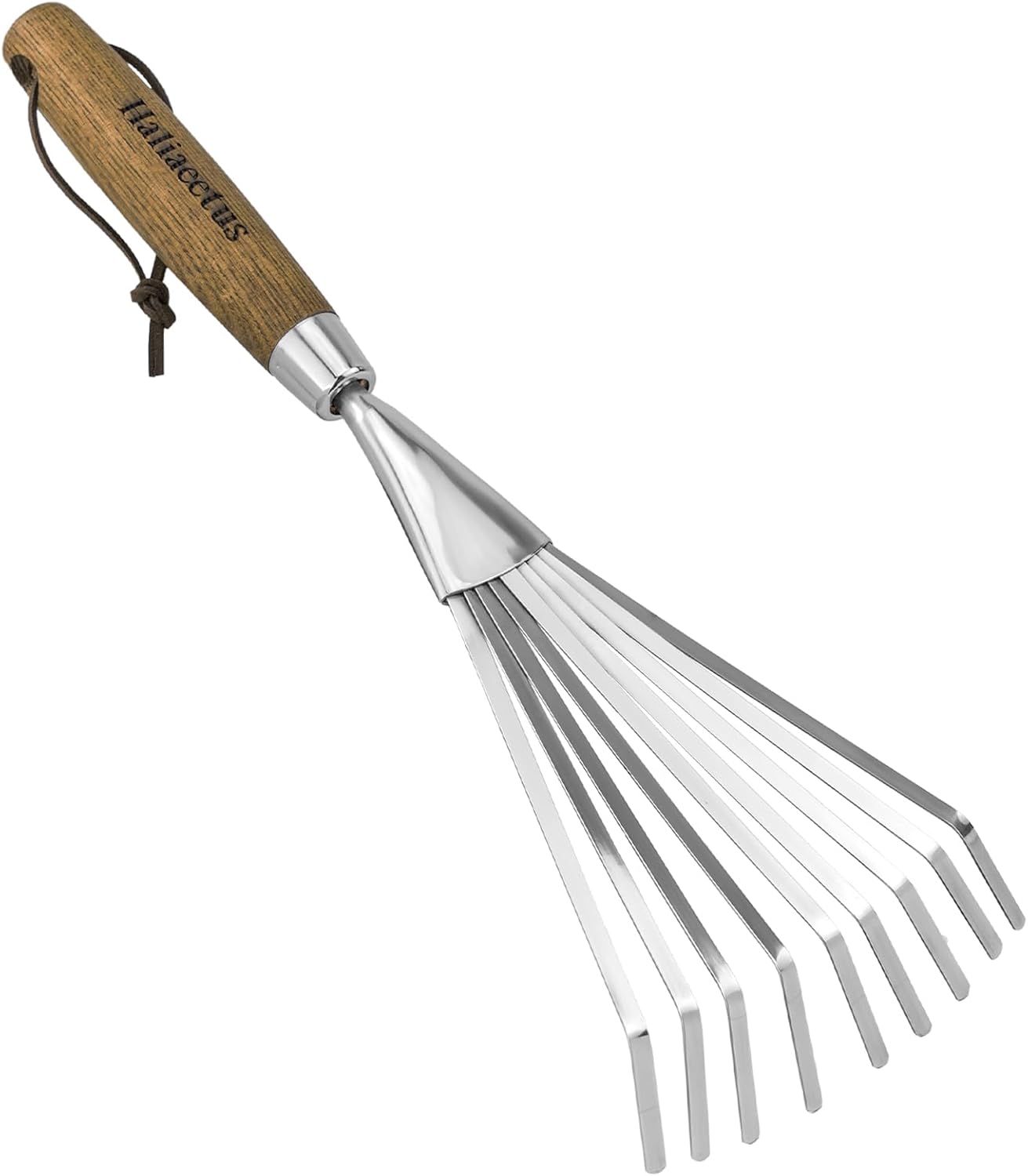
| Item Highlight | 9 Tine Stainless Steel Small Rake with Ergonomic Wood Handle |
|---|---|
| Handle Material | Wood |
| Head Material | Stainless Steel |
| Item Weight | 0.27 kg |
| Handle Type | Ergonomical |
This small hand shrub rake is built for precise work in mulch beds and tight planting areas where a full-size rake cannot reach. Its nine stainless steel tines are close together and flexible enough to gather leaves, loose debris, and light mulch without digging up roots, while the compact head lets you work around stems and low shrubs. The polished metal head and seamless welding to the wooden handle aim to improve durability and resist bending during regular yard tasks. The ergonomically shaped solid wood grip is smooth and comfortable for repeated use and helps reduce wrist strain during longer tidy-up sessions. Because it is a hand tool, it moves less material per pass than a full-size rake, so expect slower progress on larger areas, and it is not intended for heavy-duty digging or prying. For gardeners who prioritize a dependable, long-lasting tool to maintain mulch beds and clean around plants, this rake covers the most common small-area chores very well.
Best for: Gardeners who need a reliable hand tool for precise cleanup and maintenance of mulch beds and small planting areas and who prioritize durability and ease of use over speed.
Less Ideal for: People who regularly clear large lawns or need a tool for heavy digging, soil breaking, or moving large volumes of material should choose a full-size or heavy-duty rake instead.
- Stainless steel head resistant to bending and corrosion for repeated use
- Nine closely spaced tines that grab leaves and light debris in tight spots
- Ergonomic solid wood handle shaped to reduce wrist strain
- Seamless welding between head and handle for improved durability
- Small head size makes it inefficient for clearing large areas quickly
- Not suitable for heavy-duty tasks like breaking compacted soil or moving large amounts of mulch
Verdict: A sturdy, well-made hand rake that reliably cleans mulch beds and tight planting areas without stressing your wrists.
Oliynedy Adjustable Metal Leaf Rake with Expandable Head

| Rake Type | Garden Rake |
|---|---|
| Manufacturer Warranty Description | 1 Year Warranty |
| Head Material | Metal |
| Handle Material | Plastic |
| Head Size | 17 inches |
This adjustable metal leaf rake lets you change the head width from about 9 to 17 inches and breaks down into multiple handle pieces for easier storage and transport. The metal head and 1-inch diameter poles give it enough stiffness for clearing leaves and light debris across lawns and around shrubs, while the narrower setting is useful for tight spots like flower beds or pine straw. The plastic-sleeved handle and grip make it comfortable to hold, and assembly is simple: screw the poles together with no tools. Because the head is painted to resist rust and the pole joints collapse, the rake works well both at home and carried in an RV or trunk. Expect reasonable durability for routine leaf cleanup but not industrial abuse; the plastic handle sections and locking mechanism can wear faster than all-metal models if subjected to heavy leverage or prying. This is a practical, portable option for homeowners who need a versatile rake without specialized features.
Best for: A buyer who values social proof and wants a dependable, versatile rake for routine yard care and occasional travel; good for homeowners who prefer a portable, easy-to-assemble tool.
Less Ideal for: Landscape professionals or gardeners who need a heavy-duty, single-piece all-metal rake for daily commercial use.
- Adjustable head width (9–17 inches) for tight spots and open areas
- Collapsible multi-piece handle for compact storage and transport
- Metal head and 1" diameter poles provide firm raking performance
- Painted finish on head helps resist rust during outdoor use
- Handle sections and plastic top may be less durable than a single-piece wooden or all-metal handle
- Not intended for heavy-duty prying or moving large, wet debris
Verdict: A practical, portable adjustable-head metal rake that balances everyday yard performance with easy storage and transport.
Choosing the Right Garden Rake for Mulch Beds: Key Factors to Consider
Tine Shape and Spacing
Tine geometry determines how mulch moves and how aggressively the tool digs. Narrow, closely spaced tines pick up fine debris but can drag or bunch light mulch, while wider spacing lets loose material pass through for a fluffing effect. Curved or angled tines tend to pull and gather without gouging, which is useful when you want to smooth a bed without uprooting small plants.
Consider how dense your mulch is and whether you need to move large clumps. For fresh or chunky mulch you may prefer sturdier, wider-set tines that can reset material. For thin layers and delicate borders, choose a gentler profile that spreads mulch rather than lifts it.
Handle Length and Ergonomics
Handle length affects posture and control. Longer handles let you stand upright for broad beds and reduce back strain, but they can be harder to control around tight plantings. Shorter handles offer precise maneuvering but require more bending. Grip shape and material matter for repeated use; a comfortable, slip-resistant grip reduces hand fatigue and improves accuracy when shaping edges.
Also think about overall balance. A well-balanced rake transfers less stress to the wrist and shoulder, especially when you are shifting heavy piles of mulch. If you frequently work in both beds and containers, a medium-length handle often provides the best compromise.
Head Width and Maneuverability
Head width determines how much material you move in a single pass and how easily the tool fits between plants. Wide heads speed up open-area cleanup but are awkward near shrubs, tight borders, or irregular garden beds. Narrower heads let you work close to stems and edges, making them a better choice for flower beds and formal landscapes.
Think about the shape of your beds. Long straight runs benefit from a broader head, while curved beds and beds with many plantings benefit from a slim, nimble head profile.
Material and Corrosion Resistance
Rakes used in mulched beds are exposed to moisture, acidic decomposition byproducts, and soil salts. Steel tines and heads should have a durable finish or be stainless to avoid rust that weakens tines and causes staining in beds. Wooden or composite handles should be sealed or reinforced at the head joint to prevent splitting where the most stress occurs.
A rust-resistant finish extends tool life and keeps tines moving freely. Consider replaceable heads or tines as an option if you want to extend service life without replacing the entire tool.
Weight and Long-Term Fatigue
Weight influences how long you can work comfortably. A heavier, more robust rake can move bulky mulch with fewer passes but will tire you more quickly when used for extended periods. Lightweight aluminum or composite options reduce fatigue but sometimes lack the rigidity needed for dense or wet mulch.
Balance the need to move material efficiently with how long you plan to rake at one time. If you maintain large beds, a slightly heavier head with an ergonomic handle can be worth the extra effort; for quick touch-ups, a light, nimble rake is preferable.
Raking Technique for Mulch Beds
Good technique extends the life of both your mulch and plants. Start by removing large debris and weeds by hand, then use the rake with gentle, short strokes to redistribute material. Work from the outer edges toward the center when building a uniform layer to avoid piling mulch against stems.
Keep the tines shallow to prevent pulling up soil or damaging roots. For thin mulch layers use a light touch and let the rake's shape do the work; for thicker layers, lift and shift small amounts rather than trying to drag large clumps in a single pass.
- Use short, controlled strokes near plant bases
- Hold the handle lower for precision, higher for larger passes
- Avoid pushing mulch against trunks or stems
Maintaining Your Rake
Clean your rake after use by knocking off caked mulch and rinsing if necessary. Dry thoroughly and store in a covered, ventilated area to slow rust and wood decay. Periodically inspect the head-to-handle joint and tighten or reinforce as needed.
- Remove stuck debris before storage
- Lightly oil metal parts to prevent rust
- Sand and reseal wooden handles annually if stored outdoors
Choosing Between Flexible and Rigid Heads
Flexible heads are forgiving around plants and spread fine mulch without pulling. They are ideal for leaves and light wood chips. Rigid heads provide more control when moving dense or wet mulch and are better for reshaping beds and removing coarse debris.
Match the head stiffness to your typical mulch type and the season. Wet spring mulch often performs better with a firmer head, while dry, fine materials are easier to work with using a flexible profile.
- Flexible head: gentle spreading, suited to light mulch
- Rigid head: better for heavy, compacted material
- Consider a mid-stiffness compromise for mixed tasks
Storage and Seasonal Care for Longer Life
Store rakes hanging off the ground to keep tines aligned and protect handles from moisture. In winter or wet seasons, move tools to a dry shed or garage to reduce freeze-thaw damage to wooden parts and minimize corrosion on metal heads.
If you keep multiple tools, label or group rakes by task so you always grab the right head for mulch work rather than a general-purpose leaf rake.
- Hang tools to protect tines and heads
- Keep them dry and off bare soil
- Group by task for quicker access
Adapting Rakes for Different Mulch Types
Not all mulch behaves the same. Shredded bark, coarse wood chips, pine needles, and compost all require different handling. Adjust your approach by changing stroke length, angle of attack, and depth of tines to suit the material.
For example, pine needles often slip through wide tines and need repeated light passes, while coarse chips can be redistributed faster with firmer, wider-spaced tines. Be prepared to modify technique depending on moisture content and particle size.
- Shredded bark: medium spacing, gentle strokes
- Coarse chips: wider spacing, firmer head
- Pine needles: narrow spacing and repeated passes
How We Chose the Best Garden Rake for Mulch Beds
We selected rakes that perform well specifically in mulched planting areas by applying hands-on garden criteria focused on durability, turf and plant safety, and material handling. Our editorial filters prioritized the following evaluation dimensions: tine shape and spacing, which affects how mulch moves and how often you disturb underlying soil; handle strength and ergonomics, which influences fatigue during frequent garden work; head width and maneuverability, important for navigating tight beds and around plants; and corrosion resistance, because mulch and watering accelerate metal wear. We excluded general-purpose leaf rakes with overly flexible heads or very wide profiles that tend to scatter mulch and damage delicate stems. Tools aimed only at heavy-duty earthmoving or grading were also set aside since they are overbuilt for everyday mulching tasks. Final selections were those that balanced safe mulch distribution, comfortable long-term use, and long-lasting finishes suited to outdoor storage and wet conditions.
FAQ
What tine spacing is best for spreading mulch without removing it?
Moderate tine spacing with slightly curved tines is usually best. It lets smaller particles pass while allowing you to fluff and redistribute the top layer without digging into the soil or lifting root systems.
Should I use a metal or plastic head in mulch beds?
Metal heads are more durable for moving coarse or wet mulch but must have good corrosion protection. Plastic heads are lighter and gentler on plants but can flex or wear faster. Choice depends on the type of mulch and how frequently you use the tool.
How often should I rake my mulch beds?
Often depends on local conditions and the amount of debris, but many gardeners perform light raking every few weeks to redistribute material and check for weeds. Heavier reshaping is usually done seasonally when adding or renewing mulch.
Can I replace the handle if it breaks?
Often yes. Many rakes have replaceable handles or head fittings. Check the joint design and look for threaded or bolted connections that allow handle replacement rather than discarding the entire tool.
Is there a recommended handle length for smaller beds or containers?
For smaller beds and containers a medium-to-short handle offers better control and reduces the risk of knocking plants. Shorter handles let you get closer when edging and working around pots.
Final Verdict
When choosing a garden rake for mulch beds, focus on how the tine design, head width, and handle ergonomics match your bed layout and mulch type. Expect tradeoffs between speed and precision: wider, stiffer heads move more material quickly but are harder to use around plants; narrow, flexible heads are gentler but require more passes. Prioritize a rust-resistant head and a comfortable handle that fits your working posture. With those fundamentals in mind, select the rake that balances control with the endurance to handle the size of your beds so you can maintain tidy, healthy mulch layers efficiently.
