

Note: This article contains affiliate links. If you click on these links and make a purchase, I may earn a small commission at no extra cost to you. This helps support my research and content. Read my full affiliate disclosure here.
Moving and spreading mulch is one of those chores that becomes noticeably easier with the right shovel. A shovel built for scooping mulch changes how much you can load, how often you bend, and how neatly you deposit material around beds and trees. This guide focuses specifically on shovels designed for scooping mulch, so you can find tools suited to heavy loads, longer reaches, and repeat use. We shortlisted five top options and evaluated them across capacity, ergonomics, and durability to help you pick a tool that fits your garden size and physical needs. Below are the factors we examined and the garden-ready advice that will help you match a shovel to your workflow.
Top Picks at a Glance
| Best Quality Built to a higher standard if you want something more solid | Plexon 27" Short-Handle Square Point Shovel with Hardened Manganese Steel Blade and Fiberglass Shaft |  |
| Best Value The sweet spot between price and what you get | Ashman 41" Heavy-Duty Square Transfer Shovel with D-Grip |  |
| Best Budget The cheapest option that still gets the job done reliably | Fiskars FiberComp Soil Scoop (hand shovel) |  |
| Highest Rated A top-rated pick with lots of positive feedback | Bully Tools Heavy Duty Poly Scoop with Extra-Long Fiberglass Handle |  |
| Most Popular A crowd favorite that many people choose with confidence | GARDEN WEASEL Oversized Potting Scoop |  |
Plexon 27" Short-Handle Square Point Shovel with Hardened Manganese Steel Blade and Fiberglass Shaft

| Blade Material | Manganese Steel |
|---|---|
| Handle Material | Fiberglass |
| Grip Type | Ergonomic D-grip |
| Style Name | Square |
This 27-inch Plexon square-point shovel is built for moving and transferring loose materials like mulch, gravel, and topsoil in confined garden spaces. The heat-treated 50Mn manganese steel blade resists bending and chipping, so repeated scooping of damp mulch and gravel holds up without deforming. The square blade makes lifting, leveling, and spreading material easier than a round-point digging shovel, and the powder-coated finish helps resist rust when stored outdoors seasonally. The shorter handle increases control and leverage in raised beds, tight beds, and around plantings where a full-length shovel is cumbersome. A fiberglass shaft keeps the tool lighter than steel, resists moisture, and dampens vibration while the contoured polypropylene D-grip improves leverage and comfort during extended scooping tasks. Expect excellent material transfer performance, but the short handle reduces reach for deep trenches or heavy digging and is not meant as a primary tool for breaking hard ground.
Best for: Gardeners who prioritize efficient material transfer and control in raised beds, narrow beds, or small yards and want a durable, low-maintenance tool for spreading mulch and gravel.
Less Ideal for: Those needing a general-purpose digging shovel for deep trenches or breaking hard, compacted ground should choose a longer-handled digging shovel instead.
- Hardened 50Mn manganese steel blade resists bending and chipping for heavy scooping tasks
- Square point profile efficiently lifts, levels, and spreads mulch and loose materials
- Fiberglass handle is lightweight, moisture-resistant, and reduces vibration
- Ergonomic D-grip improves leverage and comfort during repeated scooping motions
- Short 27-inch handle limits reach for deep digging or tasks that need standing leverage
- Not designed for breaking very compacted or rocky soil where a full-length digging shovel is preferable
Verdict: A durable, compact square-point shovel built to move and spread mulch and loose materials with superior control in tight garden spaces.
Ashman 41" Heavy-Duty Square Transfer Shovel with D-Grip

| Blade Material | Metal |
|---|---|
| Handle Material | Plastic |
| Material Type | Metal, Plastic |
| Grip Type | Ergonomic |
The Ashman 41-inch square transfer shovel is built for moving material and tackling compacted ground around the yard. Its straight-edge metal blade is sharpened for slicing into soil and cutting small roots, and the wide square blade makes it easy to scoop and transfer loose materials like mulch, soil, or gravel. The long shaft and D-grip let you use two-handed leverage for heavier lifts, which reduces strain when filling wheelbarrows or spreading mulch beds. The plastic handle keeps weight down and resists the maintenance issues of wood, while the hardened steel blade increases durability when digging in firm or dry soils. Expect solid everyday performance for tasks such as edging, trenching, and moving mulch, though the rigid metal blade and straight square profile are less efficient for deep digging in very dense clay or for precision planting. Overall this is a practical, durable scoop shovel for routine garden hauling and bed preparation.
Best for: Buyers who prioritize an efficient, low-maintenance tool for scooping and moving mulch, soil, and other loose materials around beds and walkways.
Less Ideal for: If you need a tool primarily for deep narrow digging, frequent heavy-duty construction excavation, or long-term high-leverage use, a full-steel or long-handle digging spade would be a better choice.
- Wide square metal blade suited for scooping and transferring mulch and loose materials
- Sharpened, hardened blade that cuts through compacted soil and small roots
- Long 41-inch shaft with D-grip for two-handed leverage and reduced fatigue
- Plastic handle lowers overall weight and resists rot or regular maintenance
- Plastic handle is durable but may flex under extreme heavy leverage compared with steel or hardwood handles
- Square blade shape is not ideal for very deep narrow digging or precise planting
Verdict: A durable, low-maintenance square transfer shovel that makes scooping and moving mulch quick and efficient for routine garden work.
Fiskars FiberComp Soil Scoop (hand shovel)

| Material Type | Alloy Steel |
|---|---|
| Blade Material | Fiberglass/Nylon Composite |
| Grip Type | Ergonomic |
| Item Type Name | FiberComp Soil Scoop |
| Manufacturer Warranty Description | Lifetime |
The Fiskars FiberComp Soil Scoop is a compact hand shovel built for moving soil, mulch, or potting mix quickly thanks to its oversized scoop and ergonomic grip. Its one-piece Nyglass (fiberglass/nylon) composite construction keeps the tool light for extended use while resisting rust and bending that can affect metal scoops. Typical uses include filling pots, scooping mulch into planting beds, transplanting small plants, and loading birdseed or compost. The generous scoop volume reduces trips back to a wheelbarrow and the hang hole makes storage simple. Because the handle and blade are molded as a single piece, you do not need to worry about a loose ferrule or handle separation during routine digging. The main limitations are that it is a hand tool intended for small to medium tasks rather than heavy digging in compacted soil or roots, and the composite blade is not sharpened for cutting through dense sod. For gardeners who value a lightweight, rustproof scoop for routine mulching and potting work, this is a practical, low-maintenance choice backed by a long-standing brand.
Best for: Gardeners who want a lightweight, low-maintenance hand tool for scooping mulch, potting mix, and soil during planting and routine bed work, and who prioritize ease of use and durability over heavy-duty digging power.
Less Ideal for: People who need a tool for breaking hardpan, cutting roots, or large-scale trenching should choose a full-size spade or digging fork instead.
- Oversized scoop displaces more soil or mulch per pass to speed common tasks
- One-piece fiberglass/nylon composite construction is lightweight and resists rust and bending
- Ergonomic grip improves comfort during repeated scooping
- Hang hole for convenient storage
- Backed by a lifetime warranty from the manufacturer
- Not intended for heavy-duty digging in compacted or rocky ground
- Blade is not sharpened for cutting roots or sod
Verdict: If you want a lightweight, rustproof scoop that moves mulch and potting mix quickly with minimal effort, this Fiskars FiberComp Soil Scoop is an easy practical pick.
Bully Tools Heavy Duty Poly Scoop with Extra-Long Fiberglass Handle

| Material Type | Polypropylene |
|---|---|
| Handle Material | Fiberglass |
| Blade Material | Polypropylene |
| Grip Type | D-Grip |
This Bully Tools poly scoop is built as a workhorse for moving loose material like mulch, soil, stone, and snow. The deep polypropylene blade resists wear and will not scratch composite, wood, concrete, or pavers, so you can drag and dump piles without worrying about surface damage. The extra-long fiberglass handle reduces bending and back strain when scooping full loads and the oversized D-grip gives secure control even with gloves on. Assembly is quick and simple. For garden mulch tasks the wide mouth and sturdy blade make loading wheelbarrows or beds fast, and the surface-safe design lets you work near decks and paths without scuffing. The scoop is not metal, so it will flex under extreme leverage and is less suited for prying compacted material or digging into frozen ground. Expect excellent durability for routine material handling but avoid heavy levering tasks that require a steel shovel.
Best for: Buyers who prioritize a reliable, surface-safe tool for frequent material-moving jobs and want reduced back strain during repetitive scooping of mulch and soil.
Less Ideal for: Those who need a tool for digging, prying, or breaking frozen ground should choose a metal digging shovel or a dedicated pry tool instead.
- Durable polypropylene blade that is surface-safe on decks, pavers, and concrete
- Extra-long fiberglass handle reduces bending and back strain during repetitive scooping
- Oversized D-grip provides comfortable control with work gloves
- Wide mouth and deep scoop speed up loading and transferring mulch or soil
- Made in USA construction and commercial-grade design
- Polypropylene blade can flex and is not suitable for prying compacted or frozen material
- Not intended for heavy-duty digging where a steel shovel is required
Verdict: Choose this scoop if you want a reliable, surface-safe, and ergonomic tool that makes repetitive mulch and soil moving faster and easier.
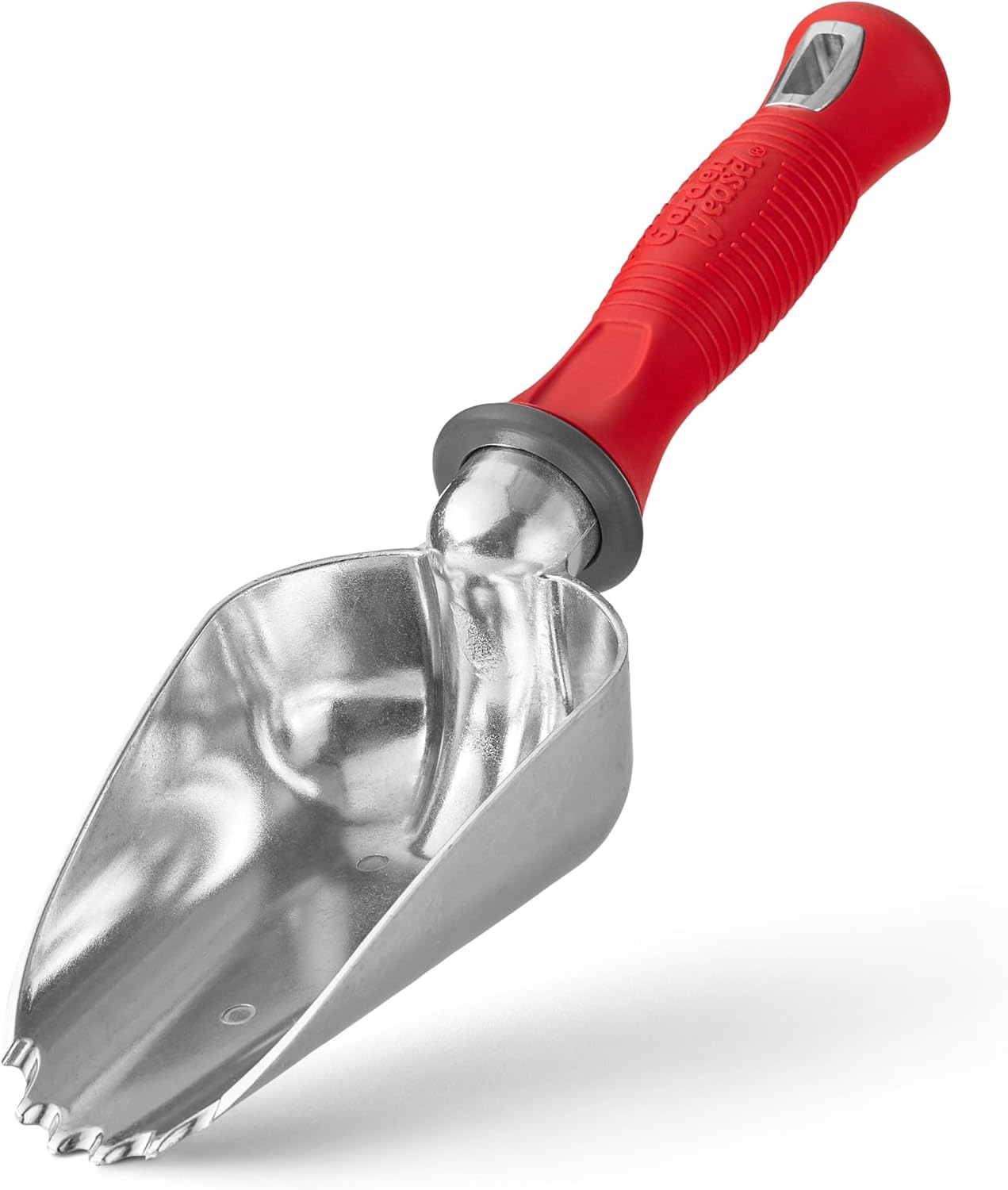
GARDEN WEASEL Oversized Potting Scoop
| Material Type | Aluminum |
|---|---|
| Blade Material | AluminIron |
| Handle Material | Thermoplastic Rubber (TPR) |
| Grip Type | Textured |
The Garden Weasel oversized potting scoop is a one-piece hand tool designed to dig, cut and scoop soil, compost, and fertilizer with minimal spillage. Its deep, 1.25-inch scoop and tall sides let you transfer loose material from bags or containers directly into pots and planting holes, while the serrated tip breaks up clumps and slices through small roots so you do not need a separate knife. Construction uses a proprietary Aluminiron alloy for a lightweight yet rust-resistant blade and a full-length tang for strength, and the 6-inch textured non-slip rubberized grip reduces hand fatigue during repetitive tasks. The tool hangs easily when not in use and rinses clean after a day in the garden. It is not intended for prying large rocks or heavy-duty digging in compacted clay where a full-size spade would be better, and very large roots will blunt the serration over time, so occasional sharpening or replacement may be needed for intensive root cutting.
Best for: Buyers who want a single, durable hand tool that speeds routine potting, planting, and bag-to-bed transfers while minimizing mess and wrist strain.
Less Ideal for: Gardeners who need a heavy digging tool for rocky or compacted soils or who frequently tackle large roots should choose a full-size spade or root saw instead.
- Deep scoop with tall sides reduces spillage when transferring soil and amendments
- Serrated tip cuts roots and breaks up clumps so you can use one tool for multiple tasks
- One-piece Aluminiron construction offers lightweight strength and corrosion resistance
- Ergonomic textured TPR grip reduces hand fatigue during extended use
- Built-in eyelet for hanging makes storage simple
- Not suitable for heavy prying or breaking up very compacted ground
- Serration can dull if used persistently on large roots
Verdict: If you want a durable, multiuse hand scoop that reduces spillage and replaces several small tools during potting and planting, this is a top practical choice.
Choosing the Right Garden Shovel for Scooping Mulch: Key Factors to Consider
Scoop Capacity and Shape
Scoop capacity directly controls how much mulch you move per trip. A wider, deeper bowl picks up more volume but can become heavy quickly once filled. Shape matters too: a slightly curved or cupped scoop contains loose material better, while a flatter, broader face makes shallow scraping and spreading easier.
Consider the average weight of your mulch and how far you carry loads. If you routinely move material long distances or work solo, choose a moderate capacity to avoid overloading. For short transfers or mechanized spreading, a larger capacity speeds the job but increases strain.
Handle Length and Reach
Handle length affects posture and leverage. A longer handle lets you stand more upright and reduces repetitive bending, which is important when moving many loads. Too long a handle, however, can be awkward in tight beds or when maneuvering around plants.
Think about how you work in your garden. If you have to reach into wheelbarrows, beds, or over low barriers, an extra few inches of shaft can save your lower back. If you do a lot of close-in work under shrubs or in raised beds, a shorter handle offers better control.
Grip Design and Comfort
Grip style and material change how the tool feels after an hour of use. Soft or shaped grips can reduce hand fatigue and prevent slipping when your hands are wet or dirty. A T- or D-handle gives more purchase for heavy loads and controlled dumping, while a plain straight shaft with a cushioned sleeve may be lighter and less obstructive.
Also consider hand spacing. If you like to choke up on the shaft for finer control, choose a handle profile that remains comfortable at multiple grip points.
Materials and Long-Term Durability
Shovels see abrasion from sandy mulch, impacts on edges, and repeated flexing. Blade materials that resist corrosion and edge wear extend functional life. Reinforced connections where blade meets shaft prevent wobble and early failure. Wooden shafts offer vibration damping but can rot or splinter if not maintained; metal or composite shafts resist moisture but can transmit more shock to the hands.
Select materials that match your maintenance willingness and climate. For wet regions, rust-resistant blades and sealed shafts reduce upkeep. For heavy-duty seasonal use, look for thicker gauge metal and well-fastened joints.
Weight, Balance, and Fatigue
Weight determines how heavy a full load feels and how quickly fatigue sets in. Balance between the blade and handle changes control when lifting and dumping. A heavier blade may be durable but makes repeated lifts more strenuous; a lightweight assembly eases repetition but can flex or feel unstable when loaded.
If you perform long sessions moving mulch, prioritize a tool with a comfortable unloaded weight and a balance point that keeps the load manageable through the lift and deposit phases.
Edge Geometry and Dump Control
Edge shape influences how cleanly mulch releases and how well you can slice into piles for precise scoops. A slightly rolled or beveled edge helps prevent material from sticking and allows controlled pouring. A sharp squared edge can shear compacted piles but may catch on roots or stones.
Think about whether you need precise placement around plants or fast bulk transfers. Different edge geometries suit different tasks, so choose one that matches how you spread mulch.
Choosing Between Long and Short Handles
Long-handled shovels reduce bending and are better for filling wheelbarrows or reaching into tight piles without stooping. They are ideal for larger landscapes where trips are longer and back strain matters. Short-handled options shine in raised beds, containers, and tight planting beds where maneuverability and precise placement matter more than reach.
Try to match handle length to your typical working posture and the common transfer distance. If possible, test handling on a similar task or visualize a full-lift motion to ensure the length supports an ergonomic lift.
- Long handle: less bending, better reach, slightly heavier to manage.
- Short handle: improved control in tight spaces, easier to maneuver around plants.
- Mid-length compromise for mixed-use gardens with both beds and larger open areas.
When to Prioritize Capacity Over Precision
If you are moving mulch from one large pile to many beds and you value speed, pick a shovel with a bigger, deeper scoop. Larger scoops reduce trips but increase load weight, so that choice pairs best with good handle ergonomics and a balance that keeps lifting manageable.
For spot mulching near delicate plants or finishing beds with thin, even layers, choose a narrower or shallower scoop that gives you more precise control when placing material.
- High capacity for bulk transfers and long wheelbarrow runs.
- Lower capacity for careful placement around plants and root zones.
Working with Different Mulch Types
Coarser, chunkier bark or large wood chips behave differently than fine shredded mulch. Chunky material tends to bridge and can leave voids in a scoop, so a wider, deeper bowl helps capture more volume. Fine mulch compacts and can be heavier by volume, increasing strain and favoring a smaller scoop.
Wet mulch adds weight, so always consider the moisture content you typically handle and favor a design that keeps loads reasonable when material is damp.
- Chunky bark: wider, deeper scoops to capture irregular pieces.
- Fine or damp mulch: smaller scoops to limit weight per trip.
- Mixes: choose a balanced scoop that handles both without frequent overflow.
Maintaining a Mulch Shovel for Long Life
Regular cleaning after use prevents material buildup that promotes corrosion or wood rot. Wipe off damp mulch, remove clinging bits from the scoop, and store the shovel off the ground or hanging to keep the shaft dry. Periodic light sanding and oiling of wooden handles prolongs life and reduces splintering.
Check fasteners and the blade-to-shaft joint for loosening. Tighten or replace worn hardware before it creates wobble. For metal blades, touch up scratches and apply a light protective coating if your climate is wet.
- Clean and dry after use to prevent rot and rust.
- Inspect and tighten joints seasonally.
- Oil wooden handles and touch up metal finishes as needed.
Using a Shovel to Load Versus Spread
Some shovels are optimized for loading into wheelbarrows with deep bowls and strong edges, while others are shaped to spread and smooth mulch with a flatter face. If you do both tasks regularly, prioritize a more versatile mid-shape that scoops reasonably well and allows controlled spreading.
When spreading, practice short, controlled dumps rather than dramatic heaves. This reduces scattering and helps you lay an even layer without damaging plants or disturbing soil.
- Loading: deep, cup-like scoops and sturdy edges.
- Spreading: flatter faces for smoothing and even placement.
- Versatile mid-shapes work well for gardeners who perform both tasks.
How We Chose the Best Garden Shovel for Scooping Mulch
To assemble this list we looked for shovels purpose-built or well-suited to lifting and moving loose organic material like bark, compost, and wood chips. Key dimensions and design choices were central to inclusion: scoop volume and shape for efficient loads, handle length and grip geometry that reduce back strain, construction materials that resist abrasion and rot, and edge design for clean scoops and controlled dumping. We also considered balance and overall weight because a poorly balanced shovel multiplies fatigue during repeated trips. Excluded from consideration were narrow digging spades, lightweight decorative trowels, and multi-tool gadgets that compromise scooping capacity. We emphasized real-garden durability and ergonomics over novelty features. Editorial filters prioritized tools that make frequent mulch handling faster and less tiring across a range of garden sizes and physical abilities.
FAQ
What shovel blade shape works best for scooping mulch?
A rounded or cupped blade generally holds loose mulch better and reduces spillage when carrying. Flatter blades work better for spreading and scraping shallow layers. Choose the blade shape that matches whether you prioritize carrying volume or precision placement.
Is a wooden shaft better than a metal or composite shaft for repeated mulch work?
Wooden shafts absorb shock and feel comfortable, but they require more maintenance and can rot if stored wet. Metal and composite shafts resist moisture and can be lighter, though they may transmit more vibration. The best choice depends on your climate and willingness to maintain the tool.
How big should the scoop be if I move mulch long distances by hand?
For long-distance transfers, a moderate scoop that limits full-load weight is smarter than the largest possible bowl. Smaller loads reduce back strain over many trips. Pair the scoop with a longer handle to minimize bending and improve ergonomics.
Can I use a digging spade to move mulch effectively?
Digging spades can work in a pinch but are usually narrower and less efficient at carrying loose material. They are better for cutting into soil or transplanting. A dedicated scooping shovel is shaped to hold and release mulch more cleanly.
How should I store a mulch shovel to prolong its life?
Store the shovel clean and dry, preferably hanging or off the ground to keep the shaft from sitting in moisture. Oil wooden handles occasionally and touch up metal finishes to prevent rust. Regular inspection of joints helps catch issues early.
Final Verdict
Pick a shovel that matches how you work rather than the biggest-looking scoop. For large bulk transfers, prioritize capacity, a strong edge, and handle ergonomics to reduce trips and protect your back. For precision work near plants or in tight beds, choose a more manageable scoop and a handle length that offers control. Weigh tradeoffs between capacity, weight, and durability based on how often and how far you move mulch. With the right balance of scoop shape, handle design, and materials, you can make mulch handling faster, less tiring, and more consistent across your garden.
