

Note: This article contains affiliate links. If you click on these links and make a purchase, I may earn a small commission at no extra cost to you. This helps support my research and content. Read my full affiliate disclosure here.
If you are treating broad lawns, fields, or long fence lines you need a solution that covers lots of ground without constant reapplications. Choosing the right grass killer matters because application method, coverage rate, and residual activity determine how quickly you clear unwanted turf and how long treated areas stay bare. This guide gathers six top picks selected for scale-oriented performance and practical handling in large outdoor spaces. We shortlisted options that balance sprayability, treated acreage per container, and persistence so you can decide which approach fits your property and maintenance rhythm. Read on for the testing criteria and what to expect from these large-area products.
Top Picks at a Glance
| Best Overall The best all-around choice for most situations | Roundup Weed & Grass Killer Concentrate, 1 gal. |  |
| Best Quality Built to a higher standard if you want something more solid | RM43 Total Vegetation Control 43% Glyphosate Plus Weed Preventer, 2.5-Gallon |  |
| Best Value The sweet spot between price and what you get | Hi-Yield Super Concentrate Killzall Weed & Grass Killer, 1 gal |  |
| Best Budget The cheapest option that still gets the job done reliably | Ortho GroundClear Weed & Grass Killer with Comfort Wand, 1 gal. |  |
| Highest Rated A top-rated pick with lots of positive feedback | Roundup QuickPro Herbicide Powder (108.8 oz) |  |
| Best Seller A high-volume bestseller chosen again and again | Compare-N-Save 75324 Herbicide, 1-gallon (glyphosate concentrate) |  |
Roundup Weed & Grass Killer Concentrate, 1 gal.

| Unit Count | 128 Fluid Ounces |
|---|---|
| Coverage | 300 Square_Feet per gallon of spray solution |
| Item Form | Liquid |
| Active Ingredients | Triclopyr; Diquat Dibromide; Puazifop-P-Butyl; Triethylamine Salt |
This 1 gallon Roundup concentrate is designed for homeowners who need a fast, reliable solution to persistent weeds and crabgrass. You mix the concentrate per label and apply with a tank or hose-end sprayer; one gallon of concentrate makes 21 to 42 gallons of spray and each gallon of spray covers about 300 sq. ft., so a single bottle treats large areas or many spot treatments. The formula lists active ingredients including triclopyr and diquat and promises visible results in hours and rainproof performance in about 30 minutes, which reduces the chance of wasted applications. It is suitable for use around driveways, walkways, flower beds, and fence lines and allows replanting after the interval specified on the label. Important practical limitations are the safety precautions and application limits on the label: avoid drift to desirable plants, keep people and pets away until spray dries, and do not exceed the maximum single or yearly application rate. For buyers who prefer clear instructions and predictable performance, this concentrate is straightforward to use but requires careful, label‑compliant handling.
Best for: Homeowners who want a dependable, proven herbicide to eliminate stubborn crabgrass and other broadleaf weeds and who follow label directions and safety precautions.
Less Ideal for: People seeking an organic or nonchemical option or those who need a product safe for immediate access by children or pets without waiting for treated areas to dry.
- Concentrated formula stretches to 21–42 gallons of spray, enabling coverage of large areas
- Fast visible results in hours and rainproof in as fast as 30 minutes
- Effective on a wide range of weeds and grasses, including crabgrass and dandelion
- Can be used around beds, walkways, driveways and for lawn replacement when applied correctly
- Requires careful mixing and strict adherence to label rates and replanting intervals
- Potential for drift can damage desirable plants if applied in windy conditions
Verdict: A concentrated, fast-acting herbicide that reliably knocks out crabgrass and other tough weeds when mixed and applied according to the label.
RM43 Total Vegetation Control 43% Glyphosate Plus Weed Preventer, 2.5-Gallon
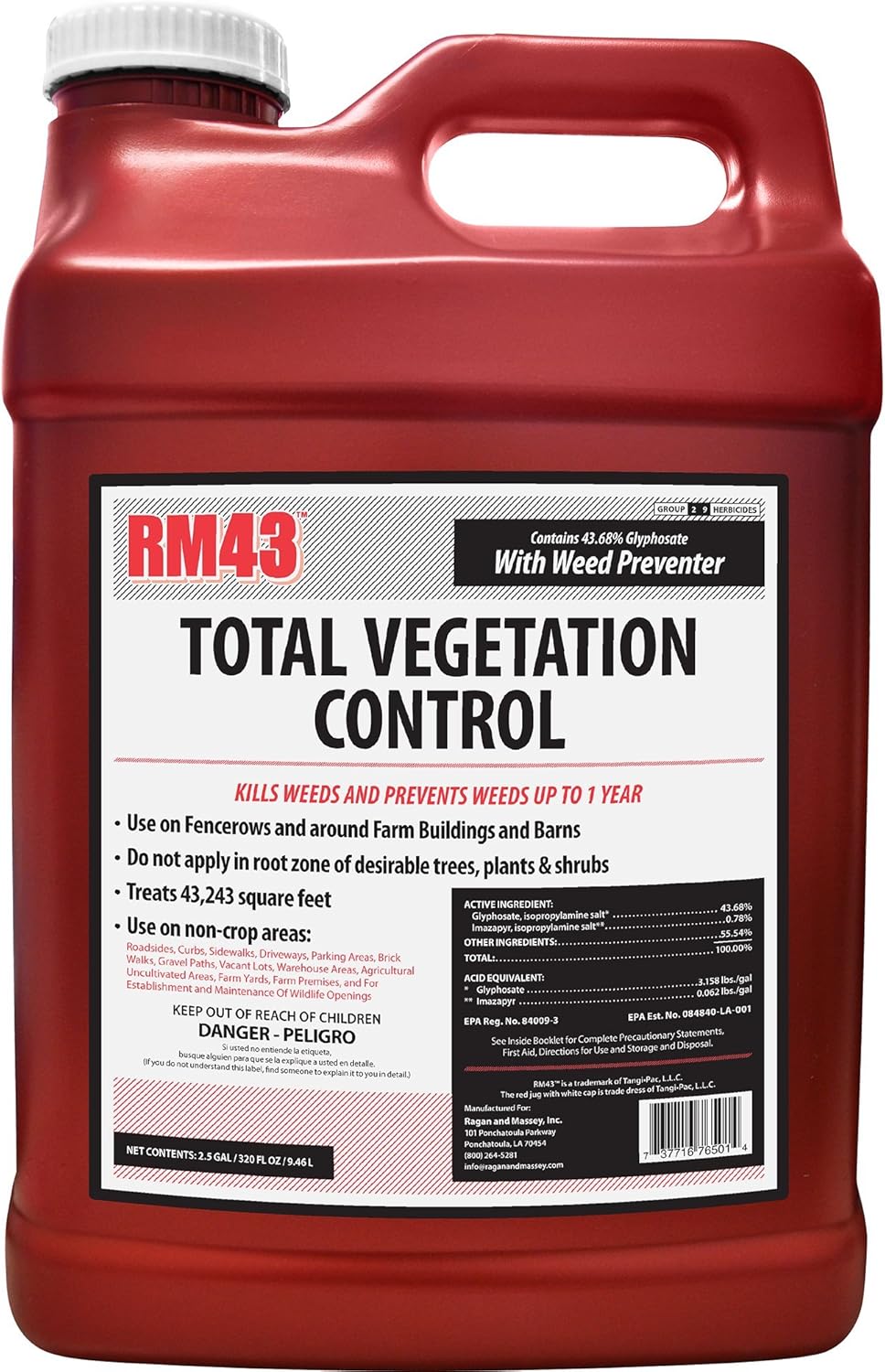
| Unit Count | 320 Fluid Ounces |
|---|---|
| Liquid Volume | 320 fluid ounces |
| Coverage | 243 243 square feet |
| Active Ingredients | Glyphosate isopropylamine salt, Imazapyr isopropylamine salt |
RM43 Total Vegetation Control is a concentrated 2.5‑gallon herbicide intended for killing existing growth and preventing regrowth for up to a year on areas where no vegetation is desired. You mix it into spray solution and apply to hardscape edges, gravel driveways, fence rows, and around buildings as either spot treatments or blanket applications on bare ground. The formula pairs glyphosate and imazapyr with a surfactant so it kills grasses, broadleaf weeds, vines, brush and some woody growth and becomes rainfast in about two hours. Practical benefits for driveway use include long residual control that reduces repeat spraying and a large coverage rate that treats many square feet from one container. Important limitations are that it is for non‑crop areas only and will damage desirable plants if sprayed over roots or drift occurs, and the active ingredient blend makes it persistent so care is required where you may later want vegetation to return. Follow label directions for mixing, application timing and safety precautions when using near soil that will be planted later.
Best for: Gardeners, property owners, and maintenance crews who prioritize strong, long‑lasting weed eradication on gravel driveways and other non‑crop hardscape areas and want to minimize repeat applications.
Less Ideal for: Homeowners planning to replant treated areas soon or those needing selective weed control near desirable plants should choose a less persistent or more targeted product.
- Combination of glyphosate and imazapyr for both knockdown and long residual control
- Concentrated 2.5‑gallon container covers large areas without frequent refills
- Rainfast in about two hours so light rain soon after application is less likely to reduce effectiveness
- Suitable for total vegetation control on gravel driveways, fence rows and other non‑crop areas
- Persistent active ingredients that can prevent desirable vegetation from reestablishing for an extended period
- Not safe for use where desirable plant roots may be exposed or where drift could contact nearby plants
Verdict: Choose RM43 when you need a single, heavy‑duty application that delivers broad spectrum kill and up to a year of weed prevention on gravel driveways and other non‑crop surfaces.
Hi-Yield Super Concentrate Killzall Weed & Grass Killer, 1 gal

| Active Ingredients | Glyphosate |
|---|---|
| Liquid Volume | 128 fluid ounces |
| Coverage | 25600 square feet |
| Item Form | Liquid |
This Hi-Yield super concentrate is a glyphosate-based liquid concentrate designed to kill grasses, broadleaf weeds, and woody brush down to the root. It mixes with water and is applied with a sprayer, and the double-surfactant formula helps the solution stick and dry on foliage for faster uptake. The 1 gallon concentrate covers up to 25,600 square feet, making it a practical choice for treating large lawns, fence lines, driveways, or commercial sites when you need broad control rather than spot treatments. Notable features are the high glyphosate concentration and the surfactant system that improve performance on tougher weeds. Important limitations are that it is not for use on lawns and requires a separate spraying accessory and careful handling because it is a nonselective herbicide. For users focused on reliably clearing large areas of unwanted vegetation, this bottle gives concentrated, professional-strength coverage but demands careful mixing, application timing, and protective equipment.
Best for: Buyers who need a powerful, professional-strength herbicide to clear large areas of weeds and brush and who prioritize reliable, fast-acting performance over selective application.
Less Ideal for: Home gardeners seeking a lawn-safe or selective spot treatment or users uncomfortable handling concentrated chemical herbicides should consider gentler or targeted alternatives.
- High-concentration glyphosate formula for strong, systemic weed control
- Double-surfactant mix improves coverage and uptake on foliage
- Large coverage per bottle (up to 25,600 sq ft) suitable for big areas
- Liquid concentrate mixes to desired volume so you carry less product
- Nonselective herbicide so it will damage desirable plants if contacted
- Requires separate sprayer and careful mixing and protective gear
- Not labeled for use on lawns, limiting some residential uses
Verdict: Choose this concentrated glyphosate formula when you need powerful, large-area weed and grass control delivered in a single 1-gallon bottle.
Ortho GroundClear Weed & Grass Killer with Comfort Wand, 1 gal.

| Item Form | Spray |
|---|---|
| Coverage | 5120 square feet |
| Unit Count | 128 Fluid Ounces |
| Active Ingredients | Ammonium Nonanoate |
Ortho GroundClear is a one-gallon ready-to-use weed and grass spray designed for spot and surface treatment on driveways, walkways, patios, and landscape beds. The formula absorbs on contact and shows visible browning in about 15 minutes, becoming rainproof roughly two hours after drying, which helps when weather is unpredictable. The included Comfort Wand makes it easy to aim at weeds growing between gravel and pavers without soaking surrounding surfaces. It is OMRI Listed, so it can fit into some organic-minded maintenance routines. Coverage is large for a single container, and the product lists ammonium nonanoate as the active ingredient, which works by contact so small or actively growing weeds are best treated. Because it is a contact herbicide, perennial or well-established weeds may need repeat applications or mechanical removal for full control, and care is required to avoid spray drift onto desirable plants. Follow safety directions and keep pets and children away until treated areas are dry.
Best for: Homeowners who want a practical, hands-on solution to remove weeds from gravel driveways and hardscapes and who prioritize quick, targeted results with minimal setup.
Less Ideal for: People seeking a long-term systemic control for deep-rooted perennial weeds or a total lawn herbicide should consider systemic products or integrated mechanical removal instead.
- Fast visible results on contact, often browning in about 15 minutes.
- Comfort Wand enables precise targeting in gravel joints and along edges.
- Becomes rainproof in approximately 2 hours, reducing loss from unexpected rain.
- OMRI Listed, compatible with some organic production standards.
- Contact-only action means deeper or perennial roots may require multiple applications.
- Spray can damage nearby desired plants if not applied carefully.
Verdict: A fast, ready-to-use contact spray with a comfort wand that makes quick, precise weed control on gravel driveways simple and practical.
Roundup QuickPro Herbicide Powder (108.8 oz)

| Item Form | Powder |
|---|---|
| Coverage | Non-selective broad spectrum coverage |
| Active Ingredients | Glyphosate; Diquat |
| Unit Count | 108.8 Ounce |
| Liquid Volume | 1 gallons |
Roundup QuickPro is a concentrated powder herbicide designed to be mixed with water and applied through standard sprayers for rapid control of unwanted vegetation. It combines glyphosate for systemic, lasting control with diquat for quicker leaf uptake, so you can see visible browning in as little as 24 hours and the spray becomes rainfast in about an hour. Typical use is mixing 1.5 ounces per gallon of water, treating driveways, fence lines, and other areas where nonselective weed kill is acceptable while protecting desirable plants from drift. The powder format yields a lot of product in one unit and is convenient for users who prefer to mix exact doses when treating larger areas. Important limitations include the nonselective nature of the formula, which means careful application and shielding of desirable plants are required, and the product contains glyphosate, which some buyers may want to avoid. Follow label safety directions to protect people, pets, and non‑target plants.
Best for: Buyers who prioritize a reliable, fast‑acting solution for removing unwanted grass and weeds from nonplanting areas and who value predictable, professional‑style results.
Less Ideal for: Gardeners wanting selective lawn treatments, organic-only approaches, or those who need to treat areas near sensitive plants or pollinator habitat should consider alternatives.
- Fast visible control due to combined glyphosate and diquat action
- Concentrated powder mixes to treat large areas with controlled dosing
- Rainfast in about one hour so treatments hold up through brief showers
- Works systemically for control of many annual and perennial weeds
- Nonselective formula can damage desirable plants if not carefully applied
- Contains glyphosate which some gardeners may prefer to avoid
Verdict: Choose Roundup QuickPro when you need a dependable, fast‑acting nonselective herbicide that delivers visible control quickly and holds up through light rain.
Compare-N-Save 75324 Herbicide, 1-gallon (glyphosate concentrate)

| Active Ingredients | glyphosate |
|---|---|
| Liquid Volume | 1 gallons |
| Item Form | Spray |
| Coverage | 25000 square_feet |
This one-gallon Compare-N-Save concentrate uses glyphosate to kill a wide range of annual and perennial weeds and grasses by foliar uptake down to the roots. It is mixed with water to create ready-to-use spray: the label recommends about 1.5 ounces per gallon for general use and up to 2.5 ounces per gallon for tougher perennials, with the full gallon making multiple gallons of spray for larger areas. Typical uses include clearing driveways, walkways, fence lines, garden preparation, lawn renovation, and stump or brush treatment. Notable features are fast visible results in 2 to 4 days, rainproofing within about two hours, and broad area coverage when diluted (manufacturer states it can cover thousands of square feet at recommended rates). Important limitations are that glyphosate will kill any green plant it contacts so careful targeting and protective gear are required, it has no residual pre-emergent activity, and label directions must be followed for safe use around edible gardens. For commercial lawn work, its concentration and economy make it effective but it demands disciplined application to avoid off-target damage.
Best for: Commercial landscapers or property managers who need an economical, fast-acting nonselective herbicide for clearing large areas and preparing sites for renovation while following safety protocols.
Less Ideal for: Home gardeners seeking a selective lawn-safe product or people who need a long-lasting pre-emergent should consider alternatives.
- Concentrated formula stretches to many gallons of ready-to-use spray for large-area work.
- Fast visible control with results often in 2 to 4 days and rainproofing in about two hours.
- Broad-spectrum activity against annual and perennial weeds and grasses, including root kill.
- Simple dilution instructions let crews mix strength for general or tougher targets.
- Nonselective glyphosate will damage or kill desirable plants if drift occurs.
- No residual activity so repeat treatments or follow-up prevention are required for long-term control.
Verdict: A cost-effective, concentrated glyphosate concentrate that delivers fast, large-area weed and grass control when used with proper precautions.
Choosing the Right Grass Killer for Large Area: Key Factors to Consider
Coverage Per Unit
How much area a single container will treat matters most for large properties. Products list recommended dilution rates and treated acreage per bottle or jug; those numbers directly affect how often you must stop to refill, how many containers to buy, and overall labor time.
Beyond label math, realistic coverage also depends on application equipment and technique. High-concentration concentrates can cover a lot of ground but require accurate measuring and consistent spray output. Pre-mixed or hose-end formulations reduce mixing errors but may raise cost per treated acre. Consider both the label acreage and the practical output from the sprayer you plan to use.
Residual Control Duration
Residual activity determines how long treated areas remain free of regrowth. For large areas, longer persistence reduces repeat applications and follow-up work, which is often more valuable than a lower upfront cost.
Residual varies by active ingredient, soil interactions, rainfall after application, and the type of vegetation present. If you need a long-term bare patch for landscaping or construction, choose products known for extended soil activity. If you want quick knockdown without long-term soil effects, look for contact actives with short persistence.
Application Ease
Ease of application covers how simple it is to mix, spray, and manage treated acreage safely. Large-area users should favor formulations that mix cleanly, reduce clogging, and allow steady calibration so spray patterns remain consistent across long runs.
Look for clear label instructions for broadcast rates, tank-mix compatibility, and recommended nozzle types. Products that foam or settle quickly increase the time spent agitating and refilling. Also consider packaging that facilitates pouring and measuring, and whether the formulation is forgiving if you need to cover slopes or uneven terrain.
Sprayer Compatibility
Not all grass killers behave the same in different sprayers. Backpack sprayers, wheeled tow-behind sprayers, and ATV booms each produce different flow rates and droplet sizes, which affect coverage and drift risk.
Ensure the product label lists compatible equipment and recommended nozzle types for broadcast applications. Products that require fine droplets for leaf uptake may increase drift on windy days, while those tolerant of coarse droplets work better for direct soil treatment. Consider the sprayer capacity relative to the product's dilution rate to avoid excessive refilling.
Selectivity and Vegetation Spectrum
Decide whether you need total vegetation control or selective grass removal. Some formulations target grasses broadly and will damage desirable turf or nearby ornamental plants, while others are nonselective and useful for clearing an area prior to renovation or planting.
Understanding the vegetation spectrum helps prevent accidental damage to desirable plants. If you need to clear strips but preserve adjacent beds, look for products and application methods that allow precise targeting. Always plan buffer zones and read label instructions about proximity to desirable plants.
Planning a Large-Area Treatment
Begin by mapping the target area and noting nearby desirable vegetation, water sources, and access points for equipment. A clear plan reduces the chance of overspray or retreating sections you missed.
Estimate total acreage and convert that to the number of containers needed using the product's recommended broadcast rate. Factor in a margin for overlap and potential reapplication if weather interferes with effectiveness.
Schedule applications for calm, dry days and avoid treatment before heavy rain. Weather affects uptake and runoff risk, so checking forecasts for 24 to 48 hours after application improves outcomes.
- Measure and mark boundaries with flags or rope
- Plan for equipment refill locations and safe disposal of rinse water
- Note shaded areas that may dry slower and need different timing
Choosing the Right Application Equipment
Equipment choice influences speed and consistency. For many large properties, wheeled boom sprayers or ATV-mounted booms cover ground faster and maintain a uniform application rate compared with handheld units.
Backpack sprayers are more maneuverable in uneven terrain or around obstacles but require more frequent refilling. Match tank capacity and nozzle selection to the recommended rate to avoid under- or over-application.
- Use boom sprayers for open, level areas
- Choose adjustable nozzles to control droplet size and flow
- Calibrate sprayers before treating to confirm output
Minimizing Environmental Impact
Protect non-target plants and waterways by maintaining buffer strips and avoiding applications on windy days. Read label restrictions on proximity to wells, streams, and sensitive habitats and follow them closely.
Use spot treatments near ornamentals or employ physical barriers to prevent spray drift. Consider mechanical removal or targeted sequencing where environmental risks are high.
- Establish a no-spray buffer around water features
- Avoid treating before heavy rain to reduce runoff
- Store and dispose of rinse water and leftover mixes according to local guidelines
Timing and Follow-Up
Apply when target grasses are actively growing for better uptake. Dormant or drought-stressed turf absorbs herbicide less effectively, reducing control.
Plan for follow-up checks at intervals recommended on the label. Large areas may require spot treatments for regrowth or missed patches. Mark treated zones so you can monitor results and avoid unnecessary retreatment.
- Treat during active growth phases for most grasses
- Re-evaluate treated sections after a few weeks
- Keep records of application rates, dates, and weather conditions
Safety and Personal Protection
Wearing appropriate personal protective equipment is essential when mixing and applying herbicides. For large-area work this often means splash-resistant outerwear, gloves, eye protection, and respiratory protection if specified on the label.
Take extra care when transporting, loading, and rinsing large containers to avoid spills. Use spill kits or absorbent materials and clean equipment thoroughly after each use to prevent accidental exposure to non-target sites.
- Follow label PPE instructions exactly
- Keep bystanders and pets away from treated areas until safe reentry times have passed
- Rinse and triple-rinse containers when required and store them securely
How We Chose the Best Grass Killer for Large Area
We prioritized attributes that matter when treating large swaths of unwanted grass and turf. Coverage efficiency was a top filter: we favored formulations and application systems that treat the most square footage per container when used at recommended rates. Residual control was assessed to reflect how long treated areas remain free of grass regrowth, especially important on large sites where repeat applications are costly in time and labor. Application practicality was another key criterion, including compatibility with common sprayers, tank-mix flexibility, and clear labeling for broadcast use. Environmental and safety considerations guided exclusions: products with unusually complex buffer restrictions or that required special licensing for common homeowner scenarios were not included. We also looked at selectivity and control spectrum to ensure options fit different goals, from total vegetation control to targeted turf removal. Finally, we excluded experimental formulations lacking established use data or those primarily designed for small-plot spot treatments. The resulting list reflects products that balance treated area per unit, persistence, ease of application, and predictable results in large outdoor spaces.
FAQ
How much area will a single container typically treat?
Coverage per container varies widely depending on concentration and recommended dilution rate. Check the label's treated-acreage chart and adjust for sprayer output. For large properties, calculate total volume needed and include a margin for overlap.
Can I use a backyard sprayer to treat several acres?
Backpack sprayers can treat large areas but require frequent refilling and are slower. For multiple acres, wheeled booms or ATV-mounted sprayers increase efficiency and maintain consistent application rates.
How long after application can I reseed or plant?
Waiting time depends on the active ingredient and residual soil activity. Some products allow reseeding within weeks, while others require months. Always follow label instructions for replanting intervals to avoid poor germination.
Will treatments wash into nearby streams after rainfall?
Herbicide movement depends on formulation, soil type, and rainfall timing. Avoid heavy rain within 24 to 48 hours after application and maintain buffer zones to reduce the risk of runoff to waterways.
Can I mix different products to increase effectiveness?
Tank-mixing changes efficacy and drift risk and is only safe if the label permits it. Check compatibility recommendations and test a small mix before broadcasting. When in doubt, separate applications reduce the chances of adverse reactions.
What should I do with leftover mixed spray?
Use mixed spray as directed or dispose of it according to label instructions and local regulations. Never pour rinse water into storm drains or natural waterways; collect and handle rinse water per local hazardous waste guidance.
Final Verdict
For large-area grass control prioritize products that maximize treated acreage per unit and offer residual control consistent with your project timeline. Match the formulation to your equipment so you can apply evenly and safely across broad runs. Balance persistence against the need for future planting or surface work and plan for environmental protections like buffers and careful timing. With the right focus on coverage, application ease, and sprayer compatibility you can clear large areas efficiently while minimizing repeat work and unintended impacts.
