

Note: This article contains affiliate links. If you click on these links and make a purchase, I may earn a small commission at no extra cost to you. This helps support my research and content. Read my full affiliate disclosure here.
If you grow in a compact 2×2 tent you need a light that gives even coverage, sensible heat output, and the right spectrum for the plant stage. A poorly matched fixture creates hot spots, wasted electricity, or leggy growth when plants stretch toward uneven light. This guide shortlists the top options suited specifically for a 2×2 tent and explains the practical tradeoffs gardeners face when sizing, positioning, and running small tent lights. We evaluate each pick for usable light output, heat management, spectrum flexibility, canopy coverage, and energy efficiency. Read on to see the top choices and the criteria that matter for small-space indoor growing.
Top Picks at a Glance
| Best Overall The best all-around choice for most situations | Spider Farmer SF1000D 100W Dimmable Full-Spectrum LED Grow Light |  |
| Best Quality Built to a higher standard if you want something more solid | VIVOSUN LumaLight 100W LED Full Spectrum Grow Light |  |
| Best Value The sweet spot between price and what you get | MARS HYDRO FC-E1500 150W LED Full Spectrum Grow Light |  |
| Best Budget The cheapest option that still gets the job done reliably | KOSCHEAL KT600 65W Full-Spectrum LED Grow Light |  |
| Highest Rated A top-rated pick with lots of positive feedback | FARMLITE KS-3-120W 120W Full-Spectrum LED Grow Light for 2×2 Tent |  |
| Most Popular A crowd favorite that many people choose with confidence | Spider Farmer SF1000 100W Full Spectrum LED Grow Light |  |
| Best Seller A high-volume bestseller chosen again and again | VIPARSPECTRA P1000 100W LED Grow Light |  |
Spider Farmer SF1000D 100W Dimmable Full-Spectrum LED Grow Light

| Light Source Wattage | 100 watts |
|---|---|
| Light Source Type | Light Emitting Diode |
| Light Source Special Features | Samsung LM301B diodes, full spectrum, no-fan design |
| Number of Light Sources | 600 |
| Input Voltage | AC110-130V |
The Spider Farmer SF1000D is a compact, 100W full-spectrum LED built for small grow spaces such as 2×2 tents. It uses high-density Samsung/Bridgelux-type diodes arranged across a waterproof board and an aluminum heat sink to deliver even canopy coverage with low noise because it has a no-fan design. Typical use is ceiling- or hook-mounted over a 2×2 to 3×3 area for seed starting, vegetative growth, and flowering; the manufacturer lists a veg footprint around 3×3 and a flowering footprint of 2×2. The dimmable driver makes it easy to dial light intensity for different growth stages, and the low 100W draw offers better energy efficiency than comparable HID fixtures, with less heat to manage. Practical benefits include quiet operation, solid build materials, and protective cable covers for safer tent installations. Limitations are the modest output for larger or commercial setups and the fixed coverage pattern that may require raising or adding fixtures for denser canopies.
Best for: Growers who want a quiet, energy-efficient light for a single 2×2 tent and who value straightforward, adjustable performance across all plant stages.
Less Ideal for: Commercial growers or hobbyists running multiple tents or large canopies who need higher total output or advanced control features.
- Full spectrum with blue, 3000K, 5000K, deep red (660-665nm) and IR suitable for all growth stages
- Dimmable 100W driver for adjustable intensity across veg and flower phases
- No-fan design with large aluminum heat sink provides quiet operation and passive cooling
- Waterproof LED board and protective cable covers improve safety inside tents
- 100W total output is ideal for 2×2 tents but may be insufficient for larger or heavily canopied grows
- No integrated controller or app features for scheduling or advanced automation
Verdict: A quiet, energy-efficient 100W full-spectrum LED that gives balanced, adjustable light for a single 2×2 tent setup.
VIVOSUN LumaLight 100W LED Full Spectrum Grow Light

| Wattage | 100 watts |
|---|---|
| Light Source Type | LED |
| Number of Light Sources | 336 |
| Is Waterproof | True |
| Control Method | Remote |
The VIVOSUN LumaLight 100W is a compact full-spectrum LED grow light intended for indoor gardens and patios. It uses a mix of white, blue, red and far-red diodes to support all growth stages from seedlings through flowering, and the array is arranged to deliver uniform intensity across the canopy. Typical use is hanging above a small grow area with the included rope hangers and adjusting intensity via the four-level dimming knob or remote/mobile control when paired with VIVOSUN accessories. Notable features include IP65 water and dust resistance for high-humidity setups, a low-heat design for closer placement to plants, and Bluetooth/remote control compatibility for easier scheduling. Practical benefits are even coverage for several small plants, lower heat stress, and long expected LED life. Limitations are its 100W power level, which is best for small tents or a few plants rather than larger grow rooms, and some advanced scheduling requires the separate GrowHub controller for full smart automation.
Best for: A practical home grower who wants a reliable, compact full-spectrum light for seedlings through flowering and values even coverage and low heat in a small tent or patio setup.
Less Ideal for: Large-scale growers or those outfitting multi-shelf systems who need higher wattage fixtures or broader coverage should consider more powerful models.
- Full-spectrum diode mix (white, blue, red, far-red) suitable for all growth stages
- Dimmable four-level control plus Bluetooth/remote connectivity for convenient intensity adjustments
- IP65 waterproof and dustproof rating allows use in humid or misted environments
- Low-heat design with aluminum body for efficient thermal management and longer LED life
- At 100 watts it is intended for small tents or modest plant counts and not optimized for larger grows
- Advanced smart scheduling requires purchasing the GrowHub controller separately
Verdict: A dependable, compact full-spectrum LED grow light that delivers even coverage and low heat for small indoor grows.
MARS HYDRO FC-E1500 150W LED Full Spectrum Grow Light

| Light Source Type | LED |
|---|---|
| Wattage | 150 watts |
| Power Source | Corded Electric |
| Light Source Special Features | Dimmable, Remote Control Compatibility |
| Specification Met | DLC, ETL |
The MARS HYDRO FC-E1500 is a plug-and-play 150W LED grow light aimed at growers using small tents or tight indoor spaces. It uses high-efficiency Bridgelux diodes to deliver a full spectrum intended for both veg and bloom stages and is sized for core coverage of a 2×2 ft area with usable coverage up to 3×3 ft. The fixture is aluminum-bodied for passive heat dissipation and supports dimming plus remote or app control when paired with Mars Hydro controllers. Practical benefits include a compact footprint that fits cramped tents, low energy draw for its output, and a straightforward setup that gets plants under light quickly. It also daisy-chains with other units for simple expansion. Important limitations are that output and efficiency are aimed at small grows rather than large canopy production, and advanced growers will need separate controllers or the brand ecosystem to access smart scheduling and full remote features. Expect solid performance for single-plant or small multi-plant 2×2 tent setups where space and energy efficiency matter.
Best for: Growers who want a no-fuss, energy-conscious light for a 2×2 tent or similarly small indoor grow space and value straightforward setup and predictable results.
Less Ideal for: Large-scale or commercial growers who need higher total output or full-featured integrated controllers built into the fixture.
- Compact 150W unit optimized for 2×2 ft core coverage and up to 3×3 ft usable area
- High-efficiency Bridgelux LEDs for good light output per watt
- Dimmable with remote/app control compatibility for simple light scheduling
- Aluminum housing provides passive heat dissipation for stable operation
- Smart features require separate Mars Hydro controllers or hub to unlock full app control
- Designed for small tents so not ideal as a sole light for larger canopies
Verdict: A compact, energy-efficient 150W LED that delivers practical, reliable coverage for a 2×2 tent and makes setup and expansion easy.
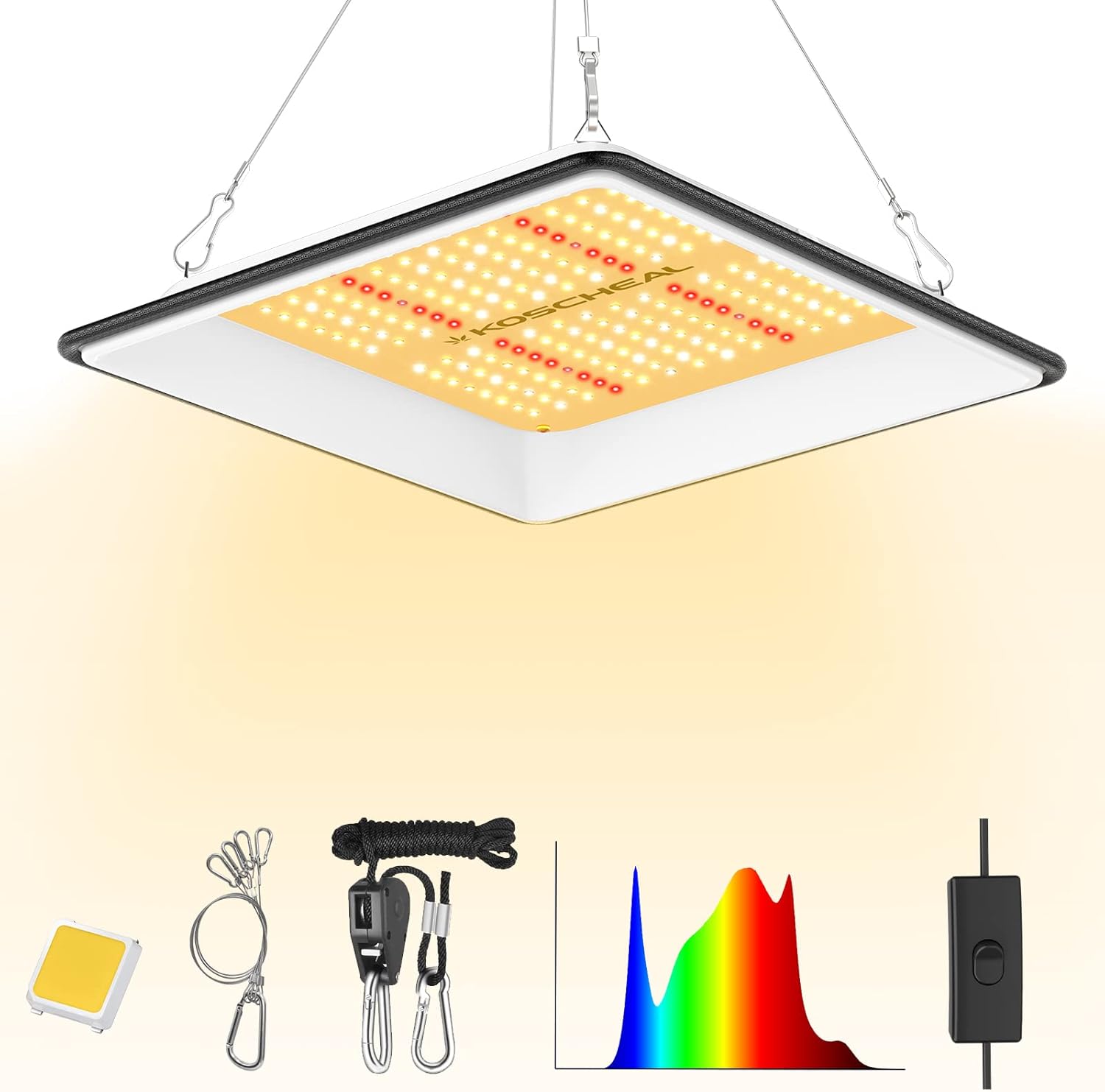
KOSCHEAL KT600 65W Full-Spectrum LED Grow Light
| Wattage | 65 watts |
|---|---|
| Efficacy | 2.9 µmol/J |
| Light Source | LED |
| Number of Light Sources | 208 |
| Water Resistance Level | Water Resistant |
The KOSCHEAL KT600 is a compact, fanless LED fixture built for small tents and indoor racks. It delivers a listed 2.9 µmol/J efficacy while drawing about 65 watts, and its spectrum mixes 3000K and 5000K white diodes with 660nm red and 730nm IR for seedling through bloom stages. The integrated reflector is intended to concentrate light toward the canopy and reduce edge dropoff, which helps achieve even coverage across a small 2×2 ft space. Because it is fanless and waterproof-coated, the KT600 runs silently and can be used in living spaces or humid setups without added noise. Controls are basic with an on/off switch and remote control option for simple daily use. Limitations to note are the fixed non-dimmable output on this model and the small footprint, which means rapid growers or larger canopy needs will require multiple units or a higher-output fixture for optimal yields. The build is practical for home growers seeking a low-noise, energy-efficient lamp for a single 2×2 tent.
Best for: Home growers setting up a single 2×2 tent who prioritize low noise, energy efficiency, and a full spectrum for seed-to-harvest growth.
Less Ideal for: Commercial growers or anyone needing wide-area coverage or variable dimming control should choose a higher-output or dimmable fixture instead.
- High reported efficacy (2.9 µmol/J) for good light-per-watt performance
- Full-spectrum blend including deep red and IR to support all growth stages
- Fanless design provides silent operation suitable for bedrooms or small grow rooms
- Reflector design improves center intensity and reduces edge light loss
- Waterproof-coated LED board and rubber border increase safety and durability
- No built-in dimming on this KT600 model so output adjustments require multiple units or a controller on other models
- Single fixture covers a small footprint so larger tents need additional lights
Verdict: A quiet, energy-efficient 65W full-spectrum LED built to deliver effective coverage for a single 2×2 tent.
FARMLITE KS-3-120W 120W Full-Spectrum LED Grow Light for 2×2 Tent

| Light Source Type | LED |
|---|---|
| Light Source Wattage | 120 watts |
| Light Output Maximum | 264 lumens |
| Power Source | Corded Electric |
| Light Source Special Features | Dimmable, Daisy-Chain, 0-10V Control, Master/Slave Modes |
The FARMLITE KS-3-120W is a compact, rectangular LED grow light built for a single 2×2 grow tent or as a modular element in a larger setup. It delivers a full spectrum that includes red and blue wavelengths for veg-to-flower cycles and offers a built-in dimmer plus 0-10V external control so you can tune intensity from seedling through bloom. Practical extras include daisy-chain capability and master/slave modes to control multiple fixtures from one unit, and the aluminum housing provides passive heat dissipation so the fixture runs quietly without a fan. The light is lightweight and comes with hanging kits and a long power/RJ11 cable, which simplifies installation in a small tent. Important limitations are that its stated coverage overlaps with 3×3/4×4 claims in the marketing copy, so expect ideal, high-yield results in a true 2×2 footprint; also lumen figures listed are low relative to wattage, so rely on spectrum and PPFD charts where available rather than lumens alone. For growers who prioritize dependable, no-fuss operation in a 2×2 space this unit is a solid option.
Best for: Growers who want a reliable, low-maintenance LED for a single 2×2 tent or a small array controlled from one point and who prioritize quiet operation and simple setup.
Less Ideal for: Large-scale growers or those needing very high PPFD across larger tents should choose higher-output fixtures or multiple units rather than relying on this single lamp.
- Full spectrum (including 660nm and 450nm) suitable for vegetative and flowering stages
- Built-in dimmer plus 0-10V and master/slave control for flexible intensity management
- Daisy-chain support and included RJ11 cable and hanging kits make multi-fixture setups straightforward
- Aluminum housing with passive cooling provides quiet, maintenance-free operation
- Lightweight, compact form factor sized for 2×2 tents
- Published lumen number is low relative to wattage which may mislead light intensity expectations
- Coverage claims in extended text are broad; optimal high-yield performance is limited to a 2×2 footprint
Verdict: A compact, quiet full-spectrum LED built for dependable, adjustable performance in a 2×2 grow tent.
Spider Farmer SF1000 100W Full Spectrum LED Grow Light

| Light Source Type | LED |
|---|---|
| Light Output Maximum | 10000 lumens |
| Light Source Wattage | 100 watts |
| Light Source Special Features | Dimmable |
| Specification Met | IP67 |
The Spider Farmer SF1000 is a compact 100W full spectrum LED grow light intended for 2×2 to 3×3 grow spaces and small tents. It uses a high diode count and upgraded LED chips to deliver broad-spectrum output that supports seedlings through flowering, with a dimmer knob to reduce intensity for early stages and ramp up for bloom. The fanless design and thick aluminum heatsink keep operation quiet while providing passive cooling, and the fixture meets IP67 for durable performance. Typical use is ceiling or tent mounting above individual plants or a small canopy where uniform coverage and deeper canopy penetration matter. Notable features include daisy-chain compatibility for linking multiple units under unified dimming, a 0–100% dimmable control, and a driver claimed to offer efficient power delivery. Practical benefits are even light distribution in a small footprint, predictable veg-to-flower capability, and near-silent operation. Limitations are inherent to its class: it is sized for small areas so you will need multiple units for larger tents, and the product description emphasizes specs from manufacturer tests rather than independent third-party PPFD maps.
Best for: Growers who want a quiet, compact full spectrum light for a small tent or single-plant setup and value adjustable intensity for each growth stage.
Less Ideal for: People running larger multi-plant rooms or commercial operations who need higher total output and broader single-fixture coverage.
- Full spectrum output suitable for all growth stages with added red and IR for flowering
- Dimmable 0–100% control lets you tailor light intensity to seedlings, veg, and bloom
- Fanless design with sturdy aluminum heatsink for quiet, low-maintenance operation
- Compact footprint ideal for 2×2 to 3×3 tents and small indoor setups
- Daisy-chain capable so multiple fixtures can be linked and dimmed together
- Coverage and power are intended for small grows so larger areas require multiple units
- Manufacturer gives efficiency and coverage figures without independent third-party PPFD charts
Verdict: A quiet, dimmable 100W full spectrum fixture that is a practical, balanced choice for hobbyists running 2×2 to 3×3 tents.
VIPARSPECTRA P1000 100W LED Grow Light

| Light Source Type | LED |
|---|---|
| Wattage | 100 watts |
| Color Temperature | 4000 Kelvin |
| Light Source Special Features | Daisy Chain, Dimmable |
| Number of Light Sources | 216 |
The VIPARSPECTRA P1000 is a compact 100W LED grow light engineered for small tents and seed starting. It delivers a full spectrum that blends reds, whites, and far‑red to support veg and bloom phases while running quietly without a fan thanks to large aluminum heat sinks. The unit includes a six‑level dimmer knob for dialing intensity and a daisy‑chain feature so multiple units can be linked for larger setups. Typical use is hanging the light above a 2×2 tent where it provides dense PAR and even coverage at recommended heights; the package ships with rope hangers, hooks, a dimming cable, and a power cord for quick setup. Practical benefits are its low energy draw relative to traditional HID fixtures, uniform light distribution for small footprints, and simple plug‑and‑play operation. Limitations to note are its single integrated form factor which means coverage beyond a 2×2 area will require additional units and the fixed color temperature profile that cannot be adjusted beyond the dimmer levels. For a cautious buyer seeking a reliable, low‑heat light for a 2×2 tent, the P1000 is straightforward and conservative in performance.
Best for: Buyers who want a dependable, low‑risk grow light for a single 2×2 tent or seed starting area and prefer simple setup and conservative energy use.
Less Ideal for: Growers who need wide single‑fixture coverage for larger tents or who require tunable spectrum control for advanced light recipes.
- Full spectrum tuned for veg and flowering stages including far‑red for fuller bloom development
- Low power draw (100W) that approximates higher‑wattage HID output, reducing operating cost
- Built‑in dimmer for simple intensity control across growth stages
- Fanless design with large aluminum heat sinks for quiet, low‑heat operation
- Daisy‑chainable so multiple units can be linked for expanding a small setup
- Designed for small footprints so you will need additional units for larger tents or multiple canopy layers
- Spectrum is fixed to the manufacturer mix and cannot be changed beyond brightness adjustments
Verdict: A compact, energy‑efficient 100W full‑spectrum light that reliably covers a 2×2 tent with easy dimming and expandability for cautious growers.
Choosing the Right Grow Light for 2X2 Tent: Key Factors to Consider
Canopy Footprint and Hanging Height
Canopy footprint is critical in a 2×2 tent because light that falls outside the usable zone is wasted energy. Measure the effective illuminated area at realistic hanging heights you will use. A fixture with a tight, intense beam may be fine when placed higher, but in a small tent you often hang lights closer to plants to avoid shadows and make the most of limited vertical space.
Consider how light intensity falls off toward the edges. Fixtures that maintain even output across a roughly 2×2 area reduce hot spots and edge stretch. Also factor in any vertical growth during flowering so the footprint at final canopy height still covers the plants without burning them.
PPF, PPFD and Practical Light Output
Total photon flux (PPF) and photon flux density (PPFD) are how plants experience light. For a 2×2 tent you want a fixture that produces adequate PPFD across the canopy without requiring excessive adjustments to height. Look for measured or manufacturer-provided PPFD maps for a small footprint; these maps show usable intensity rather than an abstract wattage number.
Higher PPF does not always translate to better results if the fixture does not distribute light evenly. Aim for a balance where average PPFD across the canopy meets your crop stage needs-lower for seedlings and higher for flowering-while peak-to-average variance remains low.
Heat Output and Thermal Design
Heat is especially important in compact tents because air exchange is limited and temperatures can rise quickly. Fixtures with poor thermal design create microclimates under the lamp that stress plants and complicate tent ventilation. Evaluate how the fixture dissipates heat: passive aluminum heatsinks, active fans, or a combination influence where heat is released and how it affects canopy temperature.
A lamp that runs cool allows you to hang it closer for better light use and reduces the burden on exhaust fans. Conversely, a high-heat fixture may force higher hang distances or stronger ventilation, which affects odor control, humidity, and energy use.
Spectrum and Stage Flexibility
Different growth stages benefit from different spectral balances. Seedlings and clones often respond well to a slightly cooler, blue-rich spectrum to keep internodes short, while flowering typically benefits from fuller-spectrum or red-enhanced output. Fixtures that offer switchable spectrums or have a balanced full-spectrum output give you control across stages without changing lamps.
Consider whether spectrum control is simple to use and repeatable across cycles. Some fixtures provide separate channels for veg and bloom, while others rely on a single fixed spectrum that is engineered to work for all stages. The choice depends on how much fine-tuning you plan to do and how many growth stages you will run in a confined space.
Energy Draw and Operating Costs
Electricity use is a practical ongoing cost that becomes more visible when running lights for many hours each day. Compare system wattage to delivered PPF to judge efficiency. A more efficient fixture typically requires less ventilation and runs cooler for the same usable light level, which also reduces the load on fans and other equipment.
Factor in typical daily run hours for the stages you plan to grow. Small differences in efficiency compound over months. Also confirm that your tent's electrical circuit can handle the chosen light plus any fans or accessories without tripping breakers or requiring rewiring.
Fixture Size, Mounting, and Build Quality
Physical size and mounting options matter inside a 2×2 tent where every inch of vertical and horizontal space is valuable. A fixture that is too wide can block access or overhang into reflective walls and produce uneven light. Consider hang points, included cables or ratchets, and how easy it is to service the fixture in place.
Durability influences long-term value. Look for solid thermal materials, sealed electronics against humidity, and user-serviceable parts if you plan to run lights continuously. A reliable fixture reduces downtime and keeps light cycles consistent for predictable plant growth.
Sizing a Light for Plants and Stages
Match the light to the crop and growth stage you plan to run. Seedlings and clones need much less intensity than compact flowering plants, so a fixture that can dim or has multiple channels lets you reuse the same lamp across stages without changing the hang height dramatically.
When planning final flower intensity decide whether you will raise the fixture or increase PPFD. In a 2×2 tent raising the light may run into canopy height limits, so choosing a fixture that can deliver adequate intensity from a modest height is often the better option.
- Use a PPFD map to check intensity at your intended hanging height
- Prefer dimming or dual-channel control for multi-stage use
- Account for vertical space used by trellis or training systems
Ventilation and Temperature Management
Even a relatively cool LED can raise canopy temperature in a tiny tent if ventilation is undersized. Coordinate light choice with your exhaust and circulation fans so the system removes heat without creating strong drafts that stress plants.
Place temperature sensors at canopy level and monitor how different light settings affect tent temperature. If a fixture forces the exhaust to run constantly at high speed, you will see higher operational noise and possibly reduced longevity for fans.
- Measure canopy temperature rather than ambient tent air
- Use inline exhaust and small oscillating fans to equalize heat
- Consider light placement to avoid pooling heat in corners
Dimming, Scheduling, and Electrical Considerations
Dimmable fixtures or separate veg/bloom channels make it easier to tune intensity for each stage and reduce electrical draw during lower-demand periods. Confirm that the dimming control is intuitive and that the fixture responds smoothly across its range.
Check the fixture's power draw against your available circuit capacity and include other tent equipment in the calculation. Small tents are often used in living spaces with limited circuits, so safe electrical planning is important.
- Plan for maximum simultaneous load including fans and controllers
- Prefer soft-start or smooth dimming to reduce electrical stress
- Use timers or controllers that support your preferred light schedules
Practical Setup Tips for a 2X2 Footprint
Position the fixture to center the most intense part of the beam over the main canopy. In a 2×2 tent slight adjustments can noticeably improve uniformity. If your fixture has an asymmetrical spread, rotate or offset it so plants get balanced light.
Use reflective tent walls to your advantage but avoid placing lights flush against fabric or reflective panels where heat can build. Small adjustments to hang height and plant placement often outperform cranking wattage higher.
- Start with the manufacturer recommended hang height and adjust in small increments
- Use a handheld PAR meter or smartphone app readings to compare spots across the canopy
- Train plants to fill the 2×2 area rather than clustering under the brightest point
Maintenance and Longevity in Humid Environments
Humidity in a tent can accelerate corrosion and reduce fan life. Choose fixtures with sealed drivers and corrosion-resistant housings when you expect high humidity during flowering.
Inspect fans, lens covers, and heatsinks periodically for dust and residue buildup. A quick clean can restore cooling performance and prevent thermal throttling that reduces light output.
- Avoid fixtures with exposed electronics in high-humidity setups
- Schedule cleaning during light-off periods to prevent stress to plants
- Keep spare hanging hardware and spare fuses or connectors on hand
How We Chose the Best Grow Light for 2X2 Tent
We focused on the real needs of growers using a 2×2 tent and applied concrete, repeatable filters to assemble this list. We prioritized fixtures that offer usable canopy footprint at typical hanging heights for a 2×2 footprint and that deliver light where plants actually grow rather than spec-sheet peak numbers. Reliable heat control and thermal design were essential filters because small tents trap heat quickly. Spectrum versatility was required so fixtures could support seedling, vegetative, and flower stages without forcing supplemental bulbs. Energy efficiency and measured PPF or PPFD performance per watt were included so running costs and electrical load remain practical for hobby growers. Durability and build quality were considered to minimize early failures under continuous cycles. We excluded lights intended only for propagation trays or full-room commercial rigs that do not scale down to a 2×2 footprint. The final selections balance canopy coverage, thermal behavior, spectrum control, and operational efficiency-the same dimensions used to assign scorecard labels for each product.
FAQ
How high should I hang a grow light in a 2×2 tent?
Hang height depends on the fixture and plant stage. Generally start at the manufacturer recommended height and move the light closer or farther while watching plant response. Seedlings typically sit closer to reduce stretching, while flowering stages may need more distance to avoid heat stress.
Can one fixture handle both veg and bloom in a 2×2 tent?
Often yes. Many compact fixtures provide dimming or separate channels for veg and bloom, allowing one unit to cover multiple stages. Spectrum flexibility and adequate PPF at your chosen hang height are the main requirements.
Will a higher wattage always give better results in a small tent?
Not necessarily. Higher wattage can increase heat and require stronger ventilation without improving uniformity. A properly matched fixture that distributes light evenly and runs cool often produces better results than an oversized lamp that creates hot spots.
Do I need a PAR meter for a 2×2 tent setup?
A PAR meter is helpful but not strictly required. It provides objective PPFD readings so you can fine-tune hang height and placement. If you do not have one, use plant response, measured temperatures, and relative readings across the canopy to guide adjustments.
How important is spectrum versus total light output?
Both matter. Spectrum influences morphology and flowering, while total photon flux determines growth energy. For small tents, a balanced full spectrum with the option to emphasize blue or red for specific stages gives the most practical flexibility.
How often should I clean and inspect my tent fixtures?
Inspect fixtures every few weeks during active cycles and clean fans and heatsinks as needed. Frequency increases with humidity and dust levels. Regular checks help maintain cooling performance and consistent light output.
Final Verdict
For a 2×2 tent prioritize a fixture that delivers even canopy coverage at realistic hanging heights while managing heat effectively. Aim for a balance of usable PPFD, spectrum flexibility for different stages, and energy efficiency so your ventilation and electrical setup remain practical. Consider mounting options and durability to simplify year-round use. With those tradeoffs in mind you can select a compact light that supports healthy growth across propagation, vegetative, and flower cycles.
