

Note: This article contains affiliate links. If you click on these links and make a purchase, I may earn a small commission at no extra cost to you. This helps support my research and content. Read my full affiliate disclosure here.
If you keep succulents indoors, the right grow light makes the difference between stretched, weak plants and compact, colorful rosettes. Succulents need bright, steady light with a spectrum that supports leaf color and flowering without overheating a small windowsill or shelf. This guide shortlists the top options for indoor succulents and explains why each type suits specific setups from single pots to multi-tier propagation rigs. We evaluated the picks for spectrum fidelity, heat management, usable coverage, and ease of use so you can match a light to your space and plant habits. Read on for concise buying guidance and practical setup tips before the product list.
Top Picks at a Glance
| Best Overall The best all-around choice for most situations | LEOTER 4-Head LED Grow Light with Full Spectrum, Timer and 10-Level Dimming |  |
| Best Quality Built to a higher standard if you want something more solid | Barrina T5 1ft LED Grow Lights, 5000K Full Spectrum — 4-Pack |  |
| Best Value The sweet spot between price and what you get | RWNTAO Dual-Head Clip Grow Lights, Full-Spectrum LED 2-Pack |  |
| Best Budget The cheapest option that still gets the job done reliably | ELFTIA EL-01 USB Full Spectrum LED Grow Light Strip |  |
| Highest Rated A top-rated pick with lots of positive feedback | Sonamindary GL04 10W Full-Spectrum LED Grow Light (Single Head) |  |
| Most Popular A crowd favorite that many people choose with confidence | GooingTop HY-021 6000K Full-Spectrum Clip Grow Light |  |
| Best Seller A high-volume bestseller chosen again and again | Briignite A19 Full Spectrum LED Grow Light Bulb (2-Pack) |  |
LEOTER 4-Head LED Grow Light with Full Spectrum, Timer and 10-Level Dimming

| Light Source Type | LED |
|---|---|
| Number of Light Sources | 80 |
| Wattage | 80 watts |
| Control Method | Remote |
| Mounting Type | Clip On |
The LEOTER 4-head grow light is a USB-powered, clip-on lamp built for indoor plant care that combines full-spectrum and targeted red/blue diodes to support seedlings, vegetative growth and flowering. It uses 80 LEDs arranged across four adjustable heads on flexible goosenecks so you can position light over individual large plants or groupings. Notable features are three spectral modes (red+blue, warm/full spectrum, and combined), a circular memory timer with 3/9/12-hour presets, and ten brightness levels for fine control over intensity. The strong metal clip and flexible necks make it simple to aim light at tall foliage without permanent installation. Practical benefits include reduced need for supplemental natural light, convenient daily scheduling for busy users, and a compact footprint that suits shelves or plant stands. Important limitations are that the unit is described as a clip/desk lamp rather than a wide-panel fixture, so coverage for very large single specimens may require placing heads close to foliage or using multiple units, and the timer resets if unplugged so it needs occasional reprogramming after power loss.
Best for: Buyers who want a controllable, space-efficient grow light to supplement indoor sun for larger houseplants and prefer a proven, feature-rich unit with preset timers and adjustable heads.
Less Ideal for: Growers who need single-fixture coverage for floor-to-ceiling specimens or large multi-plant setups should consider full-size panel fixtures or multiple units instead.
- Full spectrum plus red and blue LEDs (80 total) to support all growth stages
- Ten dimming levels for precise intensity control
- Three timer presets with memory function for hands-off daily scheduling
- Adjustable 4-head design and flexible goosenecks for targeted placement
- Strong metal clip allows mounting on shelves, desks, or plant stands
- Designed as a clip-on lamp so single-unit coverage is limited for very large plants
- Timer settings must be reset after the light is unplugged
Verdict: A versatile, adjustable clip-on grow light that gives busy indoor gardeners precise control over spectrum, intensity and scheduling to boost large plant growth in compact spaces.
Barrina T5 1ft LED Grow Lights, 5000K Full Spectrum — 4-Pack

| Wattage | 5W |
|---|---|
| Color temperature | 5000K |
| Linkable | Link up to 16 lights |
| Control | Separate on/off switches |
The Barrina T5 1ft grow light 4-pack provides straightforward, energy-efficient supplemental lighting for seedlings, vegetative plants, and flowering houseplants. Each slim fixture produces a 5000K full spectrum output at 5W and includes an on/off switch so you can control lights individually or run them together. The lights are plug-and-play and come with power cords, connector cables, clips, double-sided tape, and cable ties for quick installation on shelves, racks, or small indoor shelving units. Because fixtures link up to 16 units, you can scale a multi-shelf setup without extra wiring. Practical benefits include low power draw, compact footprint that fits tight spaces, and a high PPFD-focused output that supports photosynthesis. Limitations are that these are short 1-foot fixtures intended for close-proximity use rather than lighting large rooms, the mounting relies on adhesive and clips rather than a heavy-duty mounting system, and they are not magnetic, which reduces some placement options. For growers who want an easy, modular lighting solution for small indoor setups, these deliver reliable light for everyday use.
Best for: Buyers who want a compact, energy-efficient grow-light system to brighten shelves or small indoor racks and who value easy installation and scalable setups.
Less Ideal for: Growers who need to light large rooms, tall plants, or wide benches should choose longer or higher-output fixtures instead.
- Full-spectrum 5000K output suitable for seedlings through flowering
- Individual on/off switches for each fixture allow flexible light scheduling
- Linkable design supports up to 16 lights for easy expansion
- Low power consumption (5W per 1ft fixture) reduces energy use
- Includes basic installation kit (power cords, connectors, clips, tape, cable ties)
- Short 1ft length limits coverage area per fixture
- Mounting depends on adhesive and clips rather than more secure hardware
- Not magnetic, reducing placement options on metal surfaces
Verdict: A compact, low-energy, and linkable 1ft grow light kit ideal for efficiently lighting shelves and small indoor plant setups.
RWNTAO Dual-Head Clip Grow Lights, Full-Spectrum LED 2-Pack

| Power Source | Corded Electric (USB, 5V) |
|---|---|
| Wattage | 8 watts |
| Control Method | App |
| Additional Features | Dimmable, Full Spectrum |
| Installation Type | Clip-on |
The RWNTAO dual-head clip grow lights are a compact, practical solution for indoor plants that need supplemental light. Each pack includes two two-headed lamps with a mix of white and red LEDs to provide a full spectrum aimed at both vegetative growth and flowering. The flexible 360 degree goosenecks and strong clips make it easy to position the beams over pots, shelves, or a small grow rack, while the 10 dim levels and three light modes let you tune intensity for seedlings through mature plants. The built-in timer with cycle memory (3/9/12 hours) removes the need to turn the lights on and off daily. These lights run from USB/5V power and claim high PPFD and flicker-free output, so they are energy efficient and gentle on plants. Limitations to note are the relatively low total wattage compared with larger fixtures and the tabletop/clip mounting only, which means they are best for a few plants or close-proximity setups rather than full shelves or larger grow tents.
Best for: A practical choice for hobbyist indoor gardeners who want an easy, adjustable clip-on light to supplement a few houseplants or a small seedling station without complex setup.
Less Ideal for: Not well suited to growers who need high-output fixtures for full shelving, large grow tents, or commercial-scale propagation.
- Full-spectrum mix of white and red LEDs tailored for vegetative growth and flowering
- 360 degree flexible gooseneck and sturdy clips allow precise positioning over pots and shelves
- Ten dim levels and three light modes provide adaptable intensity for different growth stages
- Timer with cycle memory (3/9/12 hours) automates daily on/off schedules
- USB/5V power makes them energy efficient and easy to power from adapters or power banks
- Low total wattage compared with larger grow fixtures limits coverage and depth for bigger setups
- Clip-on mounting restricts use to surfaces that can accept the clamp and may not suit all layouts
Verdict: A versatile, user-friendly clip-on grow light pack that delivers adjustable full-spectrum lighting and automated timers for small indoor gardens.
ELFTIA EL-01 USB Full Spectrum LED Grow Light Strip

| Wattage | 6 watts |
|---|---|
| Input Voltage | USB 5V |
| Beam Angle | 120 degrees |
| Number of Light Sources | 84 |
| Recommended Uses For Product | Plant Growth |
This slim ELFTIA LED grow light strip is a simple, low-power option for supplementing light to succulents, seedlings, and small potted plants. It plugs into any 5V USB power source and delivers a 5500K white-red full spectrum intended to mimic midday sun while avoiding the purple look of many grow lights. With 84 LEDs at 6 watts and a 120 degree beam angle the strip covers a modest shelf or windowsill run and can be mounted with double-sided tape or twist ties for easy placement. The light is freestanding or stick-on, easy to use with a conventional timer outlet, and produces relatively comfortable color rendering for living spaces. Limitations are its low total output and single fixed intensity, so it is best for low-light plants like succulents and small seedlings rather than dense canopies or larger vegetable setups. Also note a USB adapter is not included, and the unit is not water resistant so it should stay dry in indoor displays.
Best for: Budget-minded indoor gardeners who want a no-frills, energy-efficient supplement for succulents or seedlings on shelves and windowsills.
Less Ideal for: Growers who need high-intensity lighting for multiple large plants, full grow cycles of vegetables, or outdoor/humid installations should choose a more powerful, weatherproof fixture.
- USB 5V power lets you run it from common phone chargers or USB hubs
- Full spectrum 5500K mix provides natural white light and good color rendering
- Very low wattage (6W) for energy-efficient continuous use
- Lightweight, slim strip with easy stick-on or tie mounting for shelves and plant stands
- Fixed output with no dimmer or spectrum controls
- Not water resistant so unsuitable for humid or wet installations
- Low overall light output limits use to small plants or short-distance placement
Verdict: A very affordable, low-power USB grow strip that delivers natural-looking full spectrum light ideal for succulents and small indoor plant displays.
Sonamindary GL04 10W Full-Spectrum LED Grow Light (Single Head)

| Wattage | 10 watts |
|---|---|
| Color Temperature | 5000 Kelvin |
| Light Source | LED |
| Power Source | Corded Electric |
| Bulb Base | E26 |
The Sonamindary GL04 is a small, single-head grow light intended for desktop or shelf use where plants need a reliable supplemental light source. It delivers a 5000K full-spectrum output and claims a PPFD of about 375 μmol/m²/s at 6 inches, which is useful for seedlings, herbs, succulents, and foliage plants. The lamp uses an E26 bulb base and is corded electric with a built-in timer option, and the silicone-sleeved flexible arm makes it easy to position the beam over individual pots or grouped plants. For succulents the concentrated light and adjustable head let you direct intensity where plants stretch or need stronger light without moving pots. The light is not water resistant and is made of plastic, so it is best kept in dry indoor spots. Because it is a single-head, coverage is limited for larger collections and may require multiple units for racks or wide shelves. The GL04 is straightforward to set up and aims to give steady supplemental illumination for small indoor succulent displays.
Best for: Buyers who want a compact, dependable supplemental light for a few indoor succulents or a small shelf and who prioritize consistent, easy-to-position illumination.
Less Ideal for: Not a good fit for collectors with large plant racks or those needing waterproof fixtures for humid terrariums or greenhouse use.
- Full-spectrum 5000K LED designed for plant growth
- Flexible silicone-sleeved arm for precise positioning
- Compact desktop/table installation fits small indoor setups
- Timer feature for consistent daily light cycles
- E26 base and replaceable bulb type allow simple maintenance
- Single head limits effective coverage for multiple or large succulents
- Not water resistant so must be kept away from humidity or wettings
Verdict: A compact, easy-to-position full-spectrum LED that reliably provides focused supplemental light for small succulent collections.
GooingTop HY-021 6000K Full-Spectrum Clip Grow Light
| Power Source | Corded Electric |
|---|---|
| Color Temperature | 6000 Kelvin |
| Light Output Maximum | 2500 lumens |
| Light Source Special Features | Dimmable |
| Number of Light Sources | 84 |
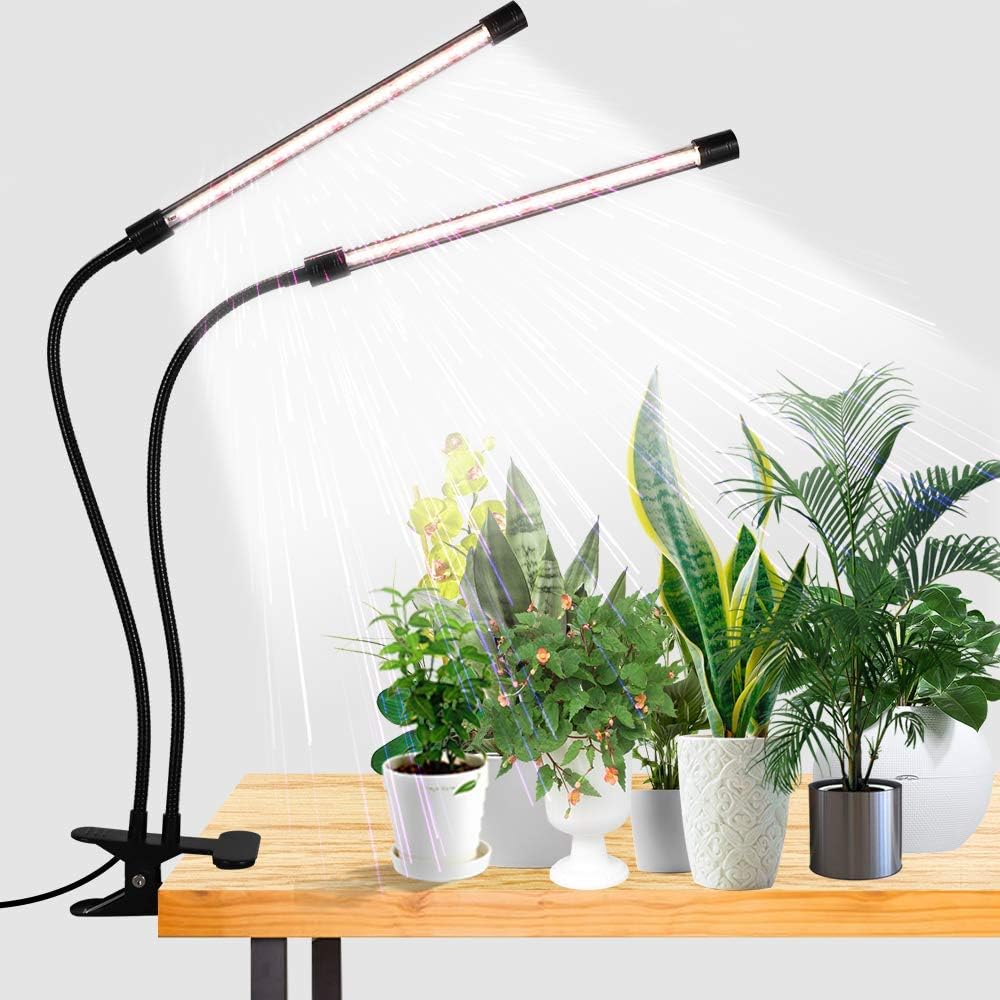
This GooingTop HY-021 is a compact clip-on grow light built for small houseplants, seedlings and shelf gardens. It uses 84 LEDs (white plus deep red) to deliver a 6000K full-spectrum output intended to mimic midday sun, with a high color-rendering output that also makes it pleasant as a reading lamp. Two flexible gooseneck heads and a strong clamp let you aim light precisely over pots and seed trays, while the attached remote provides 50%/100% dim levels and repeating timers at 4, 8 or 12 hours for hands-off scheduling. Practical benefits include low power draw (listed as roughly 10 W LED draw), a claimed 1 to 2 square meter coverage for seedlings, and an included timer that simplifies day/night cycles. Limitations are its design for small setups rather than large grow racks and the clip mounting limits placement compared with freestanding fixtures. The unit also relies on the corded remote instead of a smartphone app and the lifespan claim is typical of LEDs but not independently verifiable from the listing.
Best for: Buyers who want a simple, low-power, plug-and-play grow light to boost seedlings and a few houseplants on a desk or shelf and who value an easy-to-use timer and adjustable brightness.
Less Ideal for: Growers planning multi-shelf installations, larger vegetable grows, or who need networked or app-based control should consider larger bar lights or fixtures designed for commercial racks.
- Full-spectrum 6000K output with added 660 nm red LEDs to support vegetative growth and flowering
- Attached remote with dimming (50%/100%) and repeat timer settings (4/8/12 hours) for easy scheduling
- Flexible dual goosenecks and strong clamp enable precise positioning over small pots and seed trays
- High reported color rendering for comfortable viewing and accurate plant color assessment
- Low electrical draw around 10 W while covering small growing areas
- Clip-mount design and stated 1–2 m² coverage make it better suited to individual plants or small trays rather than large multi-shelf setups
- No smart app or wireless control option; remote is cord-attached which limits placement flexibility
Verdict: A compact, easy-to-use clip grow light that delivers full-spectrum light and convenient timer/dim controls for small indoor plant setups.
Briignite A19 Full Spectrum LED Grow Light Bulb (2-Pack)

| Light Type | LED |
|---|---|
| Additional Features | Full Spectrum |
| Bulb Base | E26 |
| Light Output Maximum | 1000 lumens |
| Light Source Operating Life | 30000 hours |
These Briignite A19 grow bulbs are full-spectrum LED replacements that screw into any standard E26 fixture to give indoor plants consistent, natural-looking light. Each bulb outputs about 1000 lumens at roughly 11 to 12 watts, so they act like a 60 to 100 watt incandescent while using far less energy, which is handy for running multiple bulbs on a budget. The 3500–4000K warm daylight color and high CRI make foliage colors appear normal rather than the purple hue of some grow lights, so they work well in living spaces and plant shelves. Built-in features include app control and push-button options and an advertised 25,000 to 30,000 hour operating life. Limitations to note are modest reported PPF compared with purpose-built high‑output grow fixtures and the 180 degree beam, which is better for general room lighting than targeted canopy penetration for dense or tall plants. For small collections, seed starting, or supplementing light in low-light rooms these bulbs are an economical, easy-to-install choice.
Best for: Houseplant owners who need an affordable, plug-and-play light to supplement natural light for a few pots, seedlings, or a small indoor garden while keeping energy costs low.
Less Ideal for: Growers aiming to flower large or dense canopy crops or outfitting multi-tiered grow racks will want higher‑PPF, purpose-built fixtures instead.
- Full spectrum output that looks like natural white light and preserves true foliage color
- Low power draw (around 11–12W) with 1000 lumens brightness for energy-efficient continuous use
- Standard E26 base fits common fixtures for tool-free installation
- High CRI of 90 helps accurate color rendering in living spaces
- Beam angle and lumen-focused design give less concentrated PAR/PPF than dedicated high‑output grow fixtures
- App and push-button controls are basic compared with advanced programmable controllers
Verdict: A low-cost, easy-to-install full-spectrum LED bulb that gives natural-looking light and energy savings for small indoor plant collections.
Choosing the Right Grow Light for Indoor Succulents: Key Factors to Consider
Spectrum and Light Quality
The light spectrum determines how succulents allocate energy. A fixture that delivers a balanced mix of blue and red wavelengths encourages compact, sturdy growth and supports flowering for species that bloom under high light. Blue light helps keep leaves short and dense, while red light supports flowering and overall biomass.
Full-spectrum or broad-spectrum LEDs that list peak wavelengths and provide PAR numbers are more useful than bulbs that only claim "bright white." For small indoor collections, you want a fixture whose spectrum approximates daylight in the bands succulents use, not just high lumens which emphasize human visual response rather than plant needs.
Intensity and PAR at Plant Height
Succulents require relatively high light compared with many houseplants, so the photosynthetic photon flux density at the height of the pot is critical. Check manufacturer PAR maps or stated PPFD values at realistic distances-many compact fixtures produce adequate PAR only within a few inches.
Consider the typical distance between your fixture and the rosette tops. If you plan to mount lights several feet above a shelf, you will need higher-output fixtures or multiple smaller lights positioned closer to plants. Overly low intensity leads to etiolation, while overly intense light at close range can damage leaves if heat control is poor.
Heat Output and Thermal Design
Succulents often tolerate warmth, but excessive localized heat from a fixture can burn tissue, dry out potting mix too fast, or cause leaves to drop. Good fixtures move heat away from the diodes with heat sinks or passive cooling, allowing you to place lights closer without harming plants.
Also consider how heat interacts with small enclosures like closed terrariums or propagation boxes. Fixtures with low surface temperature or integrated fans reduce the risk of hotspots that stress succulents and their roots.
Coverage Pattern and Adjustability
A light's beam angle and the number of diodes dictate how evenly it illuminates a group of pots. Narrow-focused lights are fine for a single specimen but create falloff across a tray. Wider-angle fixtures or multiple adjustable heads provide more uniform coverage over several plants.
Adjustability matters for changing plant sizes. Fixtures with height, tilt, or gooseneck options let you prevent lower leaves from getting shaded and allow you to raise lights as seedlings or pups grow taller.
Controls, Timers, and Dimming
Daily light period and intensity affect succulent behavior. Integrated timers and dimming let you replicate seasonal daylength changes and reduce stretch without manual intervention. Simple mechanical timers work, but built-in programmable timers or dimmable drivers provide finer control.
Being able to dial down intensity is also useful for acclimating plants to a stronger light or for propagation where lower PPFD encourages root development without scorching young tissue.
Form Factor and Mounting Options
Indoor succulent setups vary from single-pot stands to tiered shelving units. Choose a form factor that matches your space: clamp or gooseneck lights are flexible for small desks, bar-style fixtures suit shelves and trays, and panel lights work well for wider benches.
Mounting hardware and cord length determine how easily you can position the fixture. Also think about aesthetics and how visible the light will be in living spaces; slimmer profiles integrate better into tight indoor displays.
Matching a Light to Your Succulent Species and Goals
Different succulents have different light tolerances. Compact, high-light species like echeverias and haworthias show the most benefit from higher PAR and a bluer balance, while many desert cacti appreciate strong light with a warm component to encourage flowering. Consider whether you want to prioritize coloration, compact form, or bloom induction when choosing spectral emphasis.
For propagation or seed starting, pick a gentler setting or lower-output fixture to avoid drying out tender tissue. If your primary aim is to maintain potted specimens and keep them compact and colorful, aim for a setup that provides steady daily PAR rather than occasional intense bursts.
- Bright, compact rosettes need higher continuous PAR
- Propagation benefits from lower intensity and diffuse light
- Flowering often responds to increased red spectrum and longer daily light
Setting Up Lighting for Multi-Level Shelves
Multi-level shelving requires attention to evenness and light falloff. Place adjustable fixtures or multiple narrow-beam lights so each shelf receives its own source rather than relying on one high-mounted lamp.
Consider using reflectors or matte white shelf backs to improve evenness without raising intensity. Dimming and timers help you balance energy use across levels and prevent the top shelf from dominating the light budget.
- Use dedicated fixtures per shelf when possible
- Raise lights as plants grow to maintain uniform coverage
- Reflective surfaces can reduce shadowing between pots
Acclimating Indoor Succulents to Artificial Light
Move plants gradually from natural light to artificial light, starting with lower intensity or reduced daily hours and increasing over one to two weeks. Sudden exposure to higher PAR can result in bleaching or sunburn even indoors.
Watch leaf response closely: stretched internodes indicate insufficient light while white or brown spots suggest too much intensity or heat. Adjust height and duration rather than immediately switching fixtures.
- Increase daily hours before increasing intensity
- Monitor leaf color and compactness as acclimation indicators
- Use timers to enforce consistent daily cycles
Power and Energy Considerations for Continuous Use
LED grow lights are much more efficient than older technologies and are suitable for long daily runs needed by succulents. Still, check input wattage and efficacy ratings to estimate ongoing energy use for lamps that run eight to twelve hours a day.
If you have many plants, an efficient panel or multiple low-wattage fixtures can be more economical than one oversized lamp. Also factor in heat load in small indoor spaces, which can affect HVAC use over time.
- Compare wattage and lumen-to-watt efficiency for long-term running costs
- Use lower-wattage units with multiple fixtures for even coverage
- Account for heat contribution to room temperature
Placement Tips for Best Results
Place lights so the brightest area sits at the crowns of plants rather than at the pot rim. For rosette succulents, centering the beam lets all leaves receive even illumination and reduces stretching toward the light source.
Keep cords and mounting hardware secure, and avoid placing fixtures where watering splashes or humid conditions could reach electrical components. For show windowsill displays, choose slim fixtures that complement rather than dominate the aesthetic.
- Center beams on rosettes, not on pot edges
- Maintain safe distance from water and humidity
- Secure mounts to prevent accidental falls
How We Chose the Best Grow Light for Indoor Succulents
We focused on features that matter for growing succulents under artificial light. Primary evaluation criteria included spectral balance and intensity, because succulent morphology and flowering depend on the right red and blue proportions and sufficient PAR at pot level. Heat management was judged next; succulents tolerate warm conditions but can suffer soft tissue or leaf drop from hot fixtures placed close to small pots. Coverage and adjustability were assessed to make sure a single fixture can handle either one plant or a small cluster without uneven stretch. Build and mounting options were included to reflect common indoor setups such as clamp, gooseneck, or slim shelf-mounted fixtures. Usability factors covered timer and dimming features since daily light duration and intensity control simplify care across seasons. Finally durability and energy efficiency were considered because an LED that lasts and uses less power reduces maintenance and running cost over time. We excluded specialty horticultural fixtures intended for large greenhouse benches or for high-intensity crop production; this guide is limited to compact fixtures suitable for household succulent collections. Models were screened to include only units that met minimum spectrum and heat control expectations for succulent culture.
FAQ
How many hours of light do indoor succulents need each day?
Most indoor succulents do well with about eight to twelve hours of light daily. Seasonal adjustments are useful: shorter durations in winter mimic natural cycles while longer summer-like schedules can encourage flowering in some species.
Can I use a regular LED household bulb instead of a grow light?
Regular LEDs provide visible brightness but often lack the spectral balance and PAR output succulents need. They can work for low-light tolerant species but for reliable compact growth and color you want a fixture designed with appropriate plant wavelengths.
Will my succulents overheat under LED grow lights?
LEDs generally run cooler than older lamp types, but fixtures with poor thermal design can create localized heat. Keep lights at manufacturer-recommended distances, watch for leaf wilting or discoloration, and choose fixtures with heat sinks or passive cooling for closer placement.
Is a dimmer or timer necessary for succulent lighting?
Timers are very helpful to provide consistent daily cycles, which reduce stretch and stress. Dimmers are useful for gradually ramping intensity during acclimation or for multi-use fixtures that handle both propagation and mature plants.
How do I tell if my succulents are getting too little light?
Signs of insufficient light include elongated stems, widely spaced leaves, pale color, and leaning toward the nearest window. If you observe these, increase intensity or daily hours and monitor for recovery over several weeks.
Can a single fixture cover several small pots?
A single fixture can cover multiple small pots if it has a wide beam angle or you position it close enough to reduce falloff. For evenly spaced trays, multiple small fixtures or a wider panel usually deliver more uniform results than one narrow-beam lamp.
Final Verdict
Choose a grow light by matching spectrum and intensity to the succulents you keep and the space you have. Prioritize fixtures that provide adequate PAR at the distance you will mount them, with good heat management and simple controls for daily scheduling. Accept tradeoffs between single-specimen focused lights and wider-coverage panels. For most indoor succulent collections, a modestly powered, spectrally balanced LED with adjustable height and a timer will produce compact, colorful plants with minimal fuss.
