

Note: This article contains affiliate links. If you click on these links and make a purchase, I may earn a small commission at no extra cost to you. This helps support my research and content. Read my full affiliate disclosure here.
If you grow Monstera indoors you already know that light quality changes leaf shape, size, and overall vigor. A purpose-built grow light can provide the steady, consistent spectrum and intensity Monsteras need when natural light is limited or inconsistent. This guide covers seven shortlisted grow lights for Monstera, selected for their spectrum control, usable coverage, and heat performance. We evaluate options on the light spectrum they deliver, usable canopy coverage, heat and humidity behavior, and practical features like mounting and timers. Read on to find the configuration that fits your space and the growth goals for your plants.
Top Picks at a Glance
| Best Overall The best all-around choice for most situations | LBW Full-Spectrum Grow Light with Adjustable Stand and Timer |  |
| Best Quality Built to a higher standard if you want something more solid | FECiDA 2-Head Adjustable Floor Grow Light with Stable Base |  |
| Best Value The sweet spot between price and what you get | GLOWRIUM G2 Floor Grow Light with Adjustable Stand | 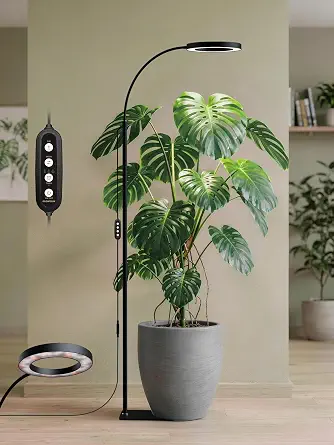 |
| Best Budget The cheapest option that still gets the job done reliably | wolezek 65" LED Grow Light with Adjustable Gooseneck and Remote |  |
| Highest Rated A top-rated pick with lots of positive feedback | LYCBY2 FC-08 Sunrise & Sunset Full-Spectrum Grow Light for Large Indoor Plants |  |
LBW Full-Spectrum Grow Light with Adjustable Stand and Timer

| Light Source Type | Light Emitting Diode |
|---|---|
| Light Output Maximum | 1080 lumens |
| Wattage | 10 watts |
| Number of Light Sources | 80 |
| Power Source | Corded Electric |
This LBW grow light is built for floor plants and tall specimens like Monstera, delivering broad, even illumination from 80 LEDs mounted on a flexible gooseneck. You set the telescoping pole between about 20 and 68 inches to position the halo head above large pots, then fine-tune intensity with five dimming levels and three color modes to match growth stage or ambient room light. The unit includes a practical auto timer with 6/8/12/16-hour options so plants receive consistent daily light without manual intervention. A heavy metal circular base with non-slip pads improves stability for big planters, and tool-free assembly gets it ready in minutes. Output is efficient at roughly 10 watts and the full spectrum supports foliage development and overall plant vigor. Limitations to note are the modest wattage for dense canopies at greater distances and the single light head may not fully cover multiple large plants side by side, so you may need a second lamp for wider setups.
Best for: Plant owners who want a single, easy-to-use lamp to boost foliage growth on a tall houseplant and prefer adjustable light intensity and an automatic timer for consistent care.
Less Ideal for: People needing high-output lighting for several large specimens spread across a wide area or growers who require intense wattage for flowering and fruiting stages.
- Adjustable height (telescoping pole) and 360-degree gooseneck for precise targeting of tall plants
- Full-spectrum LED array with multiple color modes and five dimming levels for different growth stages
- Built-in auto timer (6/8/12/16H) for steady daily light without manual scheduling
- Stable metal circular base with non-slip pads reduces risk of tipping around large pots
- 10W power may be underpowered for very large or dense canopies at maximum height
- Single head provides limited lateral coverage for multiple large plants
Verdict: A compact, user-friendly full-spectrum floor grow light that gives tall houseplants like Monstera targeted, timer-controlled illumination to improve foliage health.
FECiDA 2-Head Adjustable Floor Grow Light with Stable Base

| Light Source Type | LED |
|---|---|
| Number of Light Sources | 204 |
| Additional Features | 4,8,12,16,20 Hr Timer |
| Mounting Type | Free Standing On Floor |
| Power Source | Corded Electric |
This FECiDA floor grow light is built for tall houseplants like a Monstera, offering a two-head lamp on a stable round base with a height range that suits large foliage. It uses LED light sources and a full spectrum that includes warm 3000K, cool 5000K, and 660nm plus UV-IR elements to encourage vegetative growth and fuller leaves. The touch control and 5-mode timer (4/8/12/16/20 hours) make it easy to set daily on/off cycles so you can maintain consistent light without monitoring. The unit is corded and plugs into a standard outlet and supports daisy-chaining up to three units from one socket for larger setups. Practical benefits include an elegant living-room friendly design that doubles as décor, a sturdy base that resists tipping, and adjustable height for different plant sizes. Important limitations are the modest 25 watt rating listed in specs despite marketing claims of high lumen output and that the lamp is meant for indoor use only, so it is not suited to outdoor or weather-exposed placements.
Best for: Plant owners who prioritize consistent, high-quality light for large indoor specimens and want a floor lamp that fits a living-room aesthetic while delivering full-spectrum output and timer automation.
Less Ideal for: Growers needing high-intensity, commercial-grade output for dense canopy flowering or large multi-shelf grow tents should consider higher-wattage fixtures instead.
- Full-spectrum LED array including 3000K, 5000K and 660nm plus UV-IR for balanced plant growth
- Adjustable height that accommodates tall plants and multiple link rods for different sizes
- Built-in 5-mode timer with daily auto on/off for consistent light cycles
- Stable base and decorative design suitable for living-room placement
- Daisy-chainable power allowing up to three units from one outlet for expanded coverage
- Wattage listed at 25 watts may be lower than buyers expect given some brightness claims
- Intended for indoor use only and not weatherproof for outdoor placement
Verdict: A stylish, full-spectrum floor lamp that gives Monstera and other tall houseplants reliable, timed indoor sunlight in a living-room friendly form.
GLOWRIUM G2 Floor Grow Light with Adjustable Stand

| Light Source Type | LED |
|---|---|
| Additional Features | Adjustable Height, Dimmable, Flexible, Full Spectrum, Timer |
| Wattage | 20 watts |
| Number of Light Sources | 66 |
| Controller Type | Remote Control |
The GLOWRIUM G2 is a floor-style grow lamp designed to give large indoor plants reliable supplemental light without complicated installation. It uses 66 full-spectrum LEDs in a 20W fixture mounted on a three-section aluminum stand so you can raise the lamp to match a Monstera's canopy as it grows. Controls include stepless 10 to 100% dimming across six levels, a 3/9/12-hour auto timer, and a remote plus in-line push-button operation for quick adjustments. Practical features such as a wide base, anti-slip design, 13-foot power cord, and good heat dissipation make it easy to position near living-room plants and keep running safely for long periods. The lamp offers three light modes that combine warm, cool, and red spectrums to support rooting, vegetative growth, and flowering stages. Limitations are that it is meant for indoor use only and has a freestanding footprint, so it takes floor space and is less suitable for very small apartments or for growers who need wall- or ceiling-mounted fixtures.
Best for: Houseplant owners who want a straightforward, durable lamp to give a growing Monstera reliable, adjustable supplemental light without fussing with mounts or complex setups.
Less Ideal for: People with very limited floor space, those who need ceiling- or wall-mounted lighting, or growers who require IP-rated fixtures for humid rooms.
- Adjustable three-section stand lets you raise the light to match Monstera height and changing canopy needs
- Full-spectrum LED array with warm, cool, and red modes supports all growth stages
- Stepless 10–100% dimming and 3/9/12-hour timer add automation and precise intensity control
- Aluminum construction improves heat dissipation for longer runtime and durability
- Long 13-foot power cord and stable anti-slip base make placement flexible and secure
- Freestanding design requires floor space and may not fit very tight or high-shelf setups
- Specified as indoor use only so it is not suitable for humid outdoor or unprotected patio placements
Verdict: A practical, easy-to-use floor grow light that gives Monsteras adjustable full-spectrum illumination as they grow.
wolezek 65" LED Grow Light with Adjustable Gooseneck and Remote

| Number of Light Sources | 80 |
|---|---|
| Wattage | 20 |
| Control Method | Remote |
| Power Source | Corded Electric |
| Voltage | 120 volts |
This wolezek floor-style grow light is designed to give houseplants a flexible, budget-friendly light source. It plugs into a standard E26 socket and uses 80 LEDs at 20W to deliver full-spectrum light with three color temperatures and five brightness levels. The 360° gooseneck and 65-inch height make it easy to angle light over a Monstera’s canopy and raise or lower the beam as the plant grows. Built-in 6/12/16 hour timers and remote control simplify daily schedules so you can set consistent light cycles without moving the lamp. Aluminum construction feels stable for a low-cost fixture, and the pole-mount design is suited to potted plants rather than whole grow tents. Limitations include no waterproofing and no separate floor base included for freestanding use, and the product relies on a corded mains connection and E26 fitting for installation. For the price this light balances adjustability and usable spectrum for a Monstera in a window-poor spot, though larger multi-plant setups may need something with higher wattage or a different mounting style.
Best for: Ideal for plant owners who want an inexpensive, easy-to-use light to boost a single Monstera or a few potted houseplants in a low-light room and who value simple controls and adjustability.
Less Ideal for: Not a good fit for growers needing waterproof fixtures, high-output lights for multiple large specimens, or integrated floor stands for heavy or very tall plants.
- Adjustable 360° gooseneck and 65-inch height for targeted light over a Monstera canopy
- 80 LEDs with three color temperatures and five brightness levels for stage-specific lighting
- Remote control plus 6/12/16-hour timer for hands-off daily schedules
- Aluminum construction offers reasonable stability and durability for indoor use
- Not water resistant so unsuitable for humid or splash-prone locations
- No separate freestanding base included, designed to insert into pots or mount on poles
- 20W output may be insufficient for multiple large plants or dense shelving setups
Verdict: A budget-friendly, adjustable full-spectrum LED that gives a single Monstera flexible, timed light without complexity.
LYCBY2 FC-08 Sunrise & Sunset Full-Spectrum Grow Light for Large Indoor Plants

| Light Source Type | Light Emitting Diode |
|---|---|
| Wattage | 24 watts |
| Light Output Maximum | 2000 lumens |
| Color Rendering Index | 95 |
| Light Source Special Features | Adjustable Spectrum, Dimmable, Timer Function, UV And IR Light |
This LYCBY2 FC-08 grow light is built for steady, everyday supplemental lighting for larger houseplants such as monstera. It provides a 24W full-spectrum output from 124 LEDs and a 6.5-inch ring head that spreads light across broad leaves. The lamp offers a 12-hour sunrise-to-sunset cycle plus 4/8/16 hour timers and ten dimming levels so you can set consistent daily schedules and fine-tune intensity as a plant grows. A telescoping pole and 360° gooseneck let you position the ring over the canopy for even coverage while the included clamp stand and UL-certified adapter simplify setup and safety. Practical benefits include high CRI for natural color rendering and timer/auto-repeat for hands-off operation. Important limitations are that it is a single-lamp solution best for one plant or a small grouping beneath the ring head and the mounting style requires a stable clamp or surface for the telescoping pole.
Best for: Plant owners who prioritize dependable, repeatable supplemental light and want a low-maintenance solution to keep a monstera or other large indoor plant healthy without daily adjustment.
Less Ideal for: Growers who need to light multiple widely spaced plants or a whole shelving unit should consider larger panels or multiple fixtures instead.
- Sunrise and sunset 12-hour cycle with repeat timers for consistent daily light rhythms
- 24W full-spectrum output with 124 LEDs and high CRI for even, natural-looking illumination
- Telescoping pole plus 360° gooseneck for precise positioning over large canopies
- Ten dimming levels and 4/8/16 hour timer options for flexible intensity and scheduling
- UL-certified adapter and included clamp stand for safer, straightforward setup
- Single ring head provides best coverage for one large plant or a small cluster rather than multiple distant plants
- Hanging/clamp mounting requires a stable surface and may not suit every display location
Verdict: Choose this lamp if you want a reliable, schedule-driven full-spectrum light that makes keeping a large indoor plant like a monstera simple and low-maintenance.
Choosing the Right Grow Light for Monstera: Key Factors to Consider
Spectral Balance and Intensity
Monsteras need a spectrum that supports both vegetative leaf expansion and overall plant vigor. A balanced mix of blue light supports compact, strong stems and leaf development, while red wavelengths help with energy capture that supports larger leaf size. Intensity matters too; too-weak light leads to leggy growth and small leaves, while overly intense light can scorch lower leaves if placed too close.
When choosing a fixture, look for tunable spectrum or a broad full-spectrum output that approximates natural daylight. Adjustable output or dimming lets you fine-tune intensity as the plant grows or seasonal daylight changes.
Canopy Coverage and Beam Pattern
Even light distribution across the plant crown prevents uneven leaf size and growth habit. A fixture's beam angle and mounting height determine how much uniform canopy you get. Narrow beams might work for a single pot directly under the lamp but create hot spots and dark edges on larger plants. Wider beam patterns or panels provide more even coverage for sprawling leaves.
Consider the typical spread of your Monstera and position the light so that outer leaves receive similar intensity as the center. For multiple plants or a larger specimen, prioritize wider coverage or a modular layout of fixtures.
Heat Output and Humidity Interaction
Grow lights produce varying amounts of heat. Excessive heat near foliage can cause leaf edges to brown or increase water demand, while low heat fixtures keep humidity stable but may need to be placed closer to reach adequate intensity. High-heat fixtures can be fine if you have room above the plant and good airflow, but they require attention to avoid localized drying.
If you keep Monsteras in humid rooms, choose fixtures with sealed electronics or IP ratings to avoid moisture-related failures. Also plan for ventilation or a small fan to disperse heat from more powerful lights.
Mounting Flexibility and Height Adjustment
Monsteras change shape and height as they mature. A light that can be easily raised, lowered, or angled lets you maintain optimal distance from the canopy as the plant grows. Some fixtures include hanging hardware, adjustable cables, or extendable goosenecks for precise positioning.
Fixtures that are hard to adjust may force you into either too-close or too-far placements, both of which negatively affect leaf development. Also consider the ceiling height and whether the fixture works with existing supports or requires additional hardware.
Control Features and Timers
Daily light duration influences Monstera rhythm and flowering potential. Integrated timers, programmable schedules, or simple on-off timers help maintain consistent photoperiods without manual intervention. Dimming and spectrum presets provide additional control for seedlings versus mature foliage stages.
Features should be straightforward to use and reliable. Complex app-based controls are convenient but can add failure points. For many growers a simple timer and dimmer are the most practical controls.
Durability and Build Quality
Indoor plant fixtures face dust, occasional humidity, and frequent handling. A solidly built unit with a protective cover over LEDs and robust power connections will last longer. Metal housings and passive cooling fins are preferable to fragile plastics that may warp under heat.
Check for replaceable drivers or modular components for longevity. Good build quality reduces the chance of early electrical or mechanical failure and preserves consistent light output over time.
How Much Light Does a Monstera Need
Monsteras prefer bright, indirect light rather than direct intense beams. In practice that means providing enough photosynthetic photon flux density (PPFD) to keep leaves large without placing the light so close that it burns tissue. Aim for moderate PPFD for mature specimens and slightly higher for active growth phases.
Measure or estimate how much usable light reaches the canopy from your chosen fixture. If natural window light is already contributing, you can use a lower-output lamp or run the light for fewer hours per day.
- Mature indoor Monsteras typically do well with moderate-intensity light for 10 to 14 hours daily.
- Reduce intensity or duration when placing a lamp close to foliage to avoid heat stress.
Positioning and Rotating Your Plant
Placing the fixture centrally above the plant helps preserve symmetrical growth, but you should rotate the pot periodically to even out exposure. For vining plants that climb a support, angle and distance adjustments are particularly important as the canopy changes shape.
If you use multiple fixtures to cover a large specimen, stagger their heights to avoid overlapping hot spots and ensure a smooth gradient of light across the leaves.
- Raise lights as the plant grows to maintain recommended distance and avoid shading new leaves.
- Rotate plants weekly for balanced development when using a single directional fixture.
Integrating Grow Lights with Natural Light
Combine artificial and natural light rather than treating the grow light as a complete substitute when possible. Natural daylight delivers broad spectrum and dynamic intensity that complements fixed-spectrum fixtures. Use the grow light to supplement cloudy days or extend photoperiods in winter.
Be mindful of shifts in natural sunlight through the seasons. You may need to reduce artificial hours in summer and increase them in winter to maintain consistent daily light integral.
- Monitor plant response after changing the mix of natural and artificial light for a week or two.
- Adjust timer schedules seasonally rather than leaving the same setting year-round.
Safety and Placement Around Furniture
Ensure the fixture is securely mounted and that power cords are routed away from high-traffic areas. Bulky stands or hanging hardware should not risk tipping pots or rubbing leaves. Heat-producing fixtures should have clearance from curtains, shelves, and wall surfaces.
Consider splash and humidity risk if you water from above. Fixtures with exposed electronics should be located where mist or splashed water cannot reach them.
- Use drip trays and stable stands to prevent accidental water contact with electrical components.
- Keep fixtures at least a few inches from combustible or heat-sensitive materials.
Common Light-Related Problems and Fixes
Small or pale new leaves often indicate insufficient light. Increasing intensity gradually or moving the fixture closer can help, but allow the plant time to adjust to stronger light. Brown dry leaf edges often point to heat stress or too-low humidity near a hot fixture.
Uneven leaf size across the plant usually means uneven coverage. Either reposition the light, add a secondary fixture, or rotate the plant more frequently to correct uneven growth patterns.
- Address yellowing by checking both light level and watering habits; both factors interact.
- If leaves show bleaching or bronzing, back the light away and increase airflow to reduce heat buildup.
How We Chose the Best Grow Light for Monstera
We focused on attributes that matter to Monstera care and omitted lights that are poorly documented or clearly undersized for typical indoor plants. Primary evaluation criteria were spectral output and adjustability, because Monsteras respond to both blue and red wavelengths for balanced leaf growth and stem strength. Coverage and lumen distribution were assessed to ensure a single unit can uniformly light several leaves or a small cluster without hot spots. We also scored thermal performance and humidity tolerance since excessive heat or wet leaves beneath a hot fixture can stress tropical foliage. Practical usability was included: mounting options, integrated timers or dimming, and durability of power components influence how the light performs week after week. We excluded fixtures aimed only at seed-starting or microgreens when their spectrum and coverage were not suited to mature Monstera foliage. This process produced a shortlist of reliable, garden-ready fixtures gardeners can realistically use in living rooms, sunrooms, or grow tents.
FAQ
How close should a grow light be to a Monstera?
Distance depends on the fixture's intensity and beam angle. Start with a moderate distance recommended by the manufacturer and watch for leaf response. Move the light closer if growth is leggy, and back it off if lower leaves show heat stress or bleaching.
Can I use a regular LED lamp instead of a grow light?
Regular LEDs can help if they emit a broad spectrum and provide enough intensity, but many household bulbs lack sufficient red and blue output for optimal plant development. For consistent results, choose fixtures specified for plant growth or full-spectrum outputs.
How many hours of artificial light does a Monstera need each day?
Typically Monsteras do well with about 10 to 14 hours of combined natural and artificial light daily. Adjust duration based on seasonal daylight and the plant's visible response over several weeks.
Will grow lights encourage variegation to return?
Stable, adequate light supports variegated growth, but variegation is also genetic and influenced by overall plant health. Bright, indirect light helps maintain variegation without causing leaf burn.
Are high-heat lights bad for Monsteras?
High-heat fixtures can be used safely if there is enough distance and airflow. Problems arise when heat dries the foliage or raises transpiration beyond what you can water for. Choose lower-heat LEDs when possible or ensure adequate ventilation.
Final Verdict
Choosing the right grow light for Monsteras means balancing spectrum, usable coverage, and heat behavior against the space you have. Prioritize a fixture that offers a broad spectral output with adjustable intensity and stable mounting so you can scale lighting as the plant grows. Consider thermal performance and ease of positioning as tie-breakers when features appear similar. Focus on how the light integrates with your natural light, the plant's response over a few weeks, and whether the fixture supports simple controls and durable construction. Those priorities will help you select a practical, long-lasting solution that keeps Monstera leaves large and healthy.
