

Note: This article contains affiliate links. If you click on these links and make a purchase, I may earn a small commission at no extra cost to you. This helps support my research and content. Read my full affiliate disclosure here.
Picking the right grow light under $100 affects plant growth, electricity cost, and how much setup you need in a small indoor space. Whether you are starting seedlings on a windowsill, supplementing light for houseplants, or running a compact herb station, the wrong fixture can mean leggy seedlings, slow growth, or high energy bills. This guide shortlists the top budget grow lights and explains why each style made the cut. We evaluate spectral balance, power efficiency, build and mounting options, and practical durability so you can choose a fixture that matches your space and plant goals. Read on for the criteria we used and practical advice for installing these lights in a real home garden.
Top Picks at a Glance
| Best Overall The best all-around choice for most situations | MARS HYDRO TS600 100W Dimmable LED Grow Light |  |
| Best Value The sweet spot between price and what you get | VIPARSPECTRA P700 70W Dimmable Full Spectrum LED Grow Light |  |
| Best Budget The cheapest option that still gets the job done reliably | Briignite A19 Full Spectrum LED Grow Light Bulb (2-Pack) |  |
| Highest Rated A top-rated pick with lots of positive feedback | LYCBY2 FC-08 Sunrise & Sunset Full-Spectrum Grow Light for Large Indoor Plants |  |
| Most Popular A crowd favorite that many people choose with confidence | GooingTop HY-021 6000K Full-Spectrum Clip Grow Light |  |
| Best Seller A high-volume bestseller chosen again and again | Aokrean Halo Full-Spectrum LED Grow Light with Base (2-Pack) |  |
MARS HYDRO TS600 100W Dimmable LED Grow Light

| Wattage | 100 watts |
|---|---|
| Power Source | Corded Electric |
| Light Source Type | LED |
| Light Output Maximum | 10000 lumens |
| Material Type | Aluminum |
The MARS HYDRO TS600 is a 100W full‑spectrum LED grow light built for small grow spaces such as 2×2 tents, cabinets, and plant shelves. It delivers a sunlike spectrum with red, IR and broad white diodes and an optimized diode layout intended to give even PPFD across the footprint. The unit is dimmable from 0 to 100 percent, so you can reduce intensity and power draw for seedlings and increase it for flowering. Its aluminum construction and patented 120° reflector aim to concentrate light toward plants rather than wasting it, and the rated PPF and PPE make it more efficient than comparable traditional HID fixtures. Practical benefits include low noise, low operating cost at about 100W, and a small lightweight form factor that is easy to mount in compact spaces. Limitations are its modest overall output compared with larger panels, so it is best for one to two plants or single small tents rather than larger runs, and the light should not be touched while in operation due to high voltage warnings.
Best for: Buyers who want an affordable, efficient, easy‑to‑use LED for a small tent or single‑plant setup and value adjustable intensity across growth stages.
Less Ideal for: Growers planning larger multi‑plant canopies or full‑room installs should choose a higher‑output fixture or multiple units instead.
- Dimmable 0–100% control lets you tailor intensity for seedlings through flowering
- Full spectrum with red and IR diodes for all growth stages
- Low power draw (100W) with efficient photon output (listed PPE ~2.0 µmol/J)
- Compact, lightweight aluminum design suitable for small tents and shelves
- Designed for 1–2 plants or a 2×2 footprint so not suitable as a single solution for larger grow areas
- IR diodes are relatively dim and may require supplemental far‑red for specific flowering strategies
Verdict: A budget‑friendly, dimmable 100W full‑spectrum LED that reliably covers a 2×2 grow space and keeps operating costs low.
VIPARSPECTRA P700 70W Dimmable Full Spectrum LED Grow Light

| Light Output Maximum | 11000 lumens |
|---|---|
| Light Source Wattage | 70 watts |
| Mounting Type | Hanging Mount |
| Light Source Special Features | Dimmable |
| Number of Light Sources | 216 |
The VIPARSPECTRA P700 is a 70W full spectrum LED grow light built for seed starting and vegetative stages. It uses 216 diodes and a tuned mix of red and white LEDs to deliver high PAR output (advertised 11,000 lumens) across a small footprint roughly suited to a 2×2 ft veg area. The light is fanless and relies on large aluminum heat sinks to keep running temperatures low while the included 4-level dimmer lets you dial intensity for seedlings, clones, or mature veg. Setup is simple with hanging mount hardware included and the unit draws about 0.65 A at 120V so it runs far cooler and uses far less power than a comparable 150W HPS/MH system. For compact tents, shelves, or single-cabinet grows it offers a good balance of light output, spectrum, and efficiency. Limitations are its small coverage area and modest absolute wattage compared with larger fixtures, so gardeners with bigger canopies will want a higher-output model or multiple units.
Best for: Growers who want an efficient, low-heat fixture to run a single tent, shelf, or cabinet and who prioritize electricity savings and adjustable output for seedlings and veg.
Less Ideal for: Commercial growers or hobbyists running multi-plant canopies or larger tents who need wider coverage and higher total light output.
- Full spectrum diode layout optimized for seedlings and vegetative growth
- Low power draw (70W) with high reported lumen/PAR output for energy efficiency
- Fanless design with aluminum heat sinks for quiet, low-heat operation
- Integrated 4-level dimmer for easy intensity adjustment
- Coverage geared to a small 2×2 ft veg area so not ideal for larger grows
- Absolute wattage and diode count are modest compared with larger commercial fixtures
Verdict: A compact, energy-efficient full spectrum LED that delivers strong veg-stage light and adjustable intensity for small tents and cabinets.
Briignite A19 Full Spectrum LED Grow Light Bulb (2-Pack)

| Light Type | LED |
|---|---|
| Additional Features | Full Spectrum |
| Bulb Base | E26 |
| Light Output Maximum | 1000 lumens |
| Light Source Operating Life | 30000 hours |
These Briignite A19 grow bulbs are full-spectrum LED replacements that screw into any standard E26 fixture to give indoor plants consistent, natural-looking light. Each bulb outputs about 1000 lumens at roughly 11 to 12 watts, so they act like a 60 to 100 watt incandescent while using far less energy, which is handy for running multiple bulbs on a budget. The 3500–4000K warm daylight color and high CRI make foliage colors appear normal rather than the purple hue of some grow lights, so they work well in living spaces and plant shelves. Built-in features include app control and push-button options and an advertised 25,000 to 30,000 hour operating life. Limitations to note are modest reported PPF compared with purpose-built high‑output grow fixtures and the 180 degree beam, which is better for general room lighting than targeted canopy penetration for dense or tall plants. For small collections, seed starting, or supplementing light in low-light rooms these bulbs are an economical, easy-to-install choice.
Best for: Houseplant owners who need an affordable, plug-and-play light to supplement natural light for a few pots, seedlings, or a small indoor garden while keeping energy costs low.
Less Ideal for: Growers aiming to flower large or dense canopy crops or outfitting multi-tiered grow racks will want higher‑PPF, purpose-built fixtures instead.
- Full spectrum output that looks like natural white light and preserves true foliage color
- Low power draw (around 11–12W) with 1000 lumens brightness for energy-efficient continuous use
- Standard E26 base fits common fixtures for tool-free installation
- High CRI of 90 helps accurate color rendering in living spaces
- Beam angle and lumen-focused design give less concentrated PAR/PPF than dedicated high‑output grow fixtures
- App and push-button controls are basic compared with advanced programmable controllers
Verdict: A low-cost, easy-to-install full-spectrum LED bulb that gives natural-looking light and energy savings for small indoor plant collections.
LYCBY2 FC-08 Sunrise & Sunset Full-Spectrum Grow Light for Large Indoor Plants

| Light Output Maximum | 2000 lumens |
|---|---|
| Wattage | 24 watts |
| Light Source Special Features | Adjustable Spectrum, Dimmable, Energy Efficient, Full Spectrum, Timer Function, Uv And Ir Light |
| Color Rendering Index | 95 |
| Mounting Type | Hanging |
This LYCBY2 FC-08 grow light is built for steady, long-term indoor plant care rather than occasional spotlighting. It delivers 24 watts and about 2000 lumens from a dense LED array and includes a 12-hour sunrise-to-sunset cycle that gradually ramps brightness up and down to mimic natural daylight. Typical use is hanging or clamping the lamp over a larger specimen such as a monstera, fiddle leaf fig, palm or bird of paradise, then setting the 4/8/16 hour timer and one of ten dimming levels to match your plant needs. The telescoping pole and 360° gooseneck make positioning simple as the canopy grows, and the included UL-certified adapter and energy-efficient LED design support reliable daily operation. Practical benefits are broad, even coverage from the enlarged ring head and flexible scheduling so plants get consistent light without daily intervention. Limitations are that the lamp is single-unit output at 24W so very large multi-shelf setups may need multiple fixtures and the color temperature leans natural-white rather than customizable warm/cool presets.
Best for: Buyers who prioritize a dependable, set-and-forget lighting solution for single large houseplants and want predictable daily cycles without frequent adjustments.
Less Ideal for: People building large-scale grow racks, multi-shelf propagation setups, or those who need highly tunable color-spectrum control for specific growth stages.
- Sunrise/sunset 12-hour cycle and repeat timer for consistent, hands-off daily lighting
- 24W full-spectrum output with 124 LEDs for broad, even coverage over large canopies
- Telescoping pole plus 360° gooseneck for precise positioning as plants grow
- UL-certified power adapter and energy-efficient LEDs support dependable continuous use
- Single 24W unit may be insufficient as the sole light for very large or multi-tiered setups
- Color temperature is fixed near natural white rather than offering separate warm/cool spectrum presets
Verdict: Choose this lamp if you want a reliable, energy-efficient full-spectrum light with automatic sunrise/sunset cycling for hands-off care of single large indoor plants.
GooingTop HY-021 6000K Full-Spectrum Clip Grow Light
| Power Source | Corded Electric |
|---|---|
| Color Temperature | 6000 Kelvin |
| Light Output Maximum | 2500 lumens |
| Light Source Special Features | Dimmable |
| Number of Light Sources | 84 |
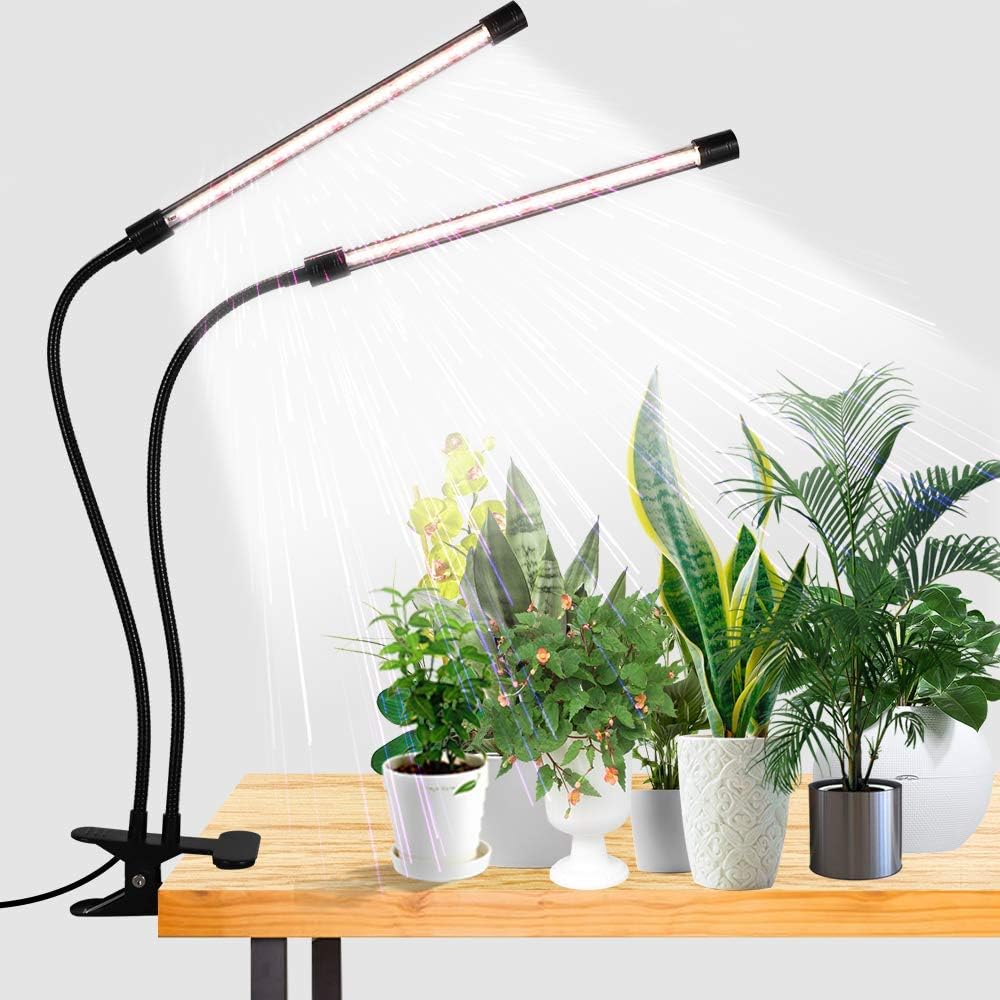
This GooingTop HY-021 is a compact clip-on grow light built for small houseplants, seedlings and shelf gardens. It uses 84 LEDs (white plus deep red) to deliver a 6000K full-spectrum output intended to mimic midday sun, with a high color-rendering output that also makes it pleasant as a reading lamp. Two flexible gooseneck heads and a strong clamp let you aim light precisely over pots and seed trays, while the attached remote provides 50%/100% dim levels and repeating timers at 4, 8 or 12 hours for hands-off scheduling. Practical benefits include low power draw (listed as roughly 10 W LED draw), a claimed 1 to 2 square meter coverage for seedlings, and an included timer that simplifies day/night cycles. Limitations are its design for small setups rather than large grow racks and the clip mounting limits placement compared with freestanding fixtures. The unit also relies on the corded remote instead of a smartphone app and the lifespan claim is typical of LEDs but not independently verifiable from the listing.
Best for: Buyers who want a simple, low-power, plug-and-play grow light to boost seedlings and a few houseplants on a desk or shelf and who value an easy-to-use timer and adjustable brightness.
Less Ideal for: Growers planning multi-shelf installations, larger vegetable grows, or who need networked or app-based control should consider larger bar lights or fixtures designed for commercial racks.
- Full-spectrum 6000K output with added 660 nm red LEDs to support vegetative growth and flowering
- Attached remote with dimming (50%/100%) and repeat timer settings (4/8/12 hours) for easy scheduling
- Flexible dual goosenecks and strong clamp enable precise positioning over small pots and seed trays
- High reported color rendering for comfortable viewing and accurate plant color assessment
- Low electrical draw around 10 W while covering small growing areas
- Clip-mount design and stated 1–2 m² coverage make it better suited to individual plants or small trays rather than large multi-shelf setups
- No smart app or wireless control option; remote is cord-attached which limits placement flexibility
Verdict: A compact, easy-to-use clip grow light that delivers full-spectrum light and convenient timer/dim controls for small indoor plant setups.
Aokrean Halo Full-Spectrum LED Grow Light with Base (2-Pack)

| Bulb Base | E26 |
|---|---|
| Number of Light Sources | 48 |
| Wattage | 10 watts |
| Power Source | Corded Electric |
| Timer | 3/9/12H |
The Aokrean Halo grow light is a compact LED lamp designed for indoor plant growth and decorative display. It ships as a two-pack and can be used either by inserting the stake into potting soil or by placing the pot on the supplied ABS base for a freestanding lamp. The unit uses 48 LEDs per light and offers three spectrum modes (white, warm white plus red, and mixed) plus ten brightness levels controlled by a touch/push button and a built-in timer with 3/9/12 hour cycling. The telescoping pole extends to cover taller small-to-medium pots and the 5V USB power and low 10W draw make it energy efficient and safe for continuous use. Practical benefits include flexible placement, multiple spectrum settings for seedlings through vegetative growth, and a small footprint that doubles as home decor. Limitations are its non-waterproof construction and modest light output suited to single pots or small clusters rather than a full grow shelf, and the base relies on pot weight for stability.
Best for: Buyers who want a simple, low-risk grow light for a few houseplants or seedlings and prefer plug-and-play controls, automatic timers, and a neat decorative look that fits on a windowsill or tabletop.
Less Ideal for: Gardeners who need high-intensity lighting for multiple larger plants, full shelves, or humid greenhouse conditions should choose a more powerful, waterproof fixture.
- Dual installation: stake into soil or place on included base for freestanding use
- Full-spectrum LEDs with three spectrum modes and 10 brightness levels for different growth stages
- Built-in timer with 3/9/12 hour cycles for automated daily light scheduling
- Low power draw (10 watts) and USB/5V power for efficient, low-heat operation
- Not water resistant so it must be kept away from wet environments
- Light output is modest and best for single small-to-medium pots rather than larger setups
Verdict: Aokrean Halo is a compact, easy-to-use full-spectrum grow light best suited to low-risk buyers who want a plug-and-play solution for a few indoor pots or seedlings.
Choosing the Right Grow Light: Key Factors to Consider
Spectral Quality
Light spectrum affects plant processes such as photosynthesis, morphology, and flowering. For seedlings and leafy greens, a spectrum richer in blue light helps produce compact, sturdy growth, while red wavelengths support stem elongation and flowering signals. A balanced full-spectrum fixture mimics natural daylight and reduces the need to change fixtures between stages.
When shopping on a budget, check the listed wavelengths and whether the manufacturer provides a spectral distribution chart. Even without a chart, fixtures that advertise full-spectrum or a combination of red and blue diodes usually perform better for a wider range of plants than single-color options.
Power Consumption and Heat
Energy draw determines operational cost and can influence how close you can safely place the light to plants. Lower-watt fixtures are cheaper to run but may require closer placement or longer daily run times to achieve the same light dose. High-efficiency diodes deliver more usable light per watt, which is important when you want to keep electricity use low under a $100 fixture.
Heat management is also critical for small indoor spaces. Fixtures with poor thermal design can create hotspots that stress plants or force you to hang lights higher, reducing usable intensity. Look for features such as aluminum housings or passive cooling fins that help dissipate heat.
Light Intensity and Coverage Footprint
A grow light must provide sufficient intensity across the area you intend to cover. Seedlings and young plants need less intense light than flowering crops, but even seedlings benefit from uniform coverage to avoid stretching. Check manufacturer claims for coverage area at specified hanging heights; realistic specs indicate where the fixture will work best.
On a budget, you may prefer a light that focuses intensity on a small footprint for shelf setups or a wider low-intensity spread for tabletop herbs. Match the fixture footprint to your planting layout to avoid buying a light that is too weak or that wastes output over unused space.
Mounting, Size, and Installation
How a fixture mounts affects flexibility and how it fits into your grow area. Smaller lights that include hangers, adjustable ropes, or suction mounts are easier to use on shelves, in tents, or over a countertop. Desk-style panels and clip-on fixtures can be handy for single pots but may not scale if you expand.
Consider the physical size and weight relative to available supports. A lightweight panel is easier to position at seedling height, while a larger unit may need stronger mounting points. Also check cord length and plug type for placement options in confined indoor spaces.
Durability and Warranty
Budget fixtures vary in component quality. Good build quality, firm connectors, and protected diodes increase the odds that a light will last through several growing cycles. A warranty or clear support policy adds protection if an electrical component fails.
Pay attention to signs of better construction such as metal housings, integrated heat sinks, and IP ratings if you expect humid conditions. While warranties do not guarantee performance, they indicate that manufacturers stand behind basic reliability.
Controls and Usability
User controls affect how easily you can adapt light schedules and intensity to plant stages. Integrated dimmers, separate veg/flower switches, or compatibility with timers simplify management. Without good controls, you may need additional accessories such as separate timers or dimmer plugs, which adds complexity.
Consider how likely you are to change settings frequently. If you want a set-and-forget solution, look for lights with simple on/off timers or consistent output. If you intend to experiment with light cycles, choose fixtures that offer straightforward dimming or stage switches.
Matching a Grow Light to Plant Stage
Seedlings, vegetative plants, and flowering crops have different light demands. Seedlings thrive under lower intensity with a higher proportion of blue light to prevent stretching. Vegetative growth benefits from steady, moderate intensity and a balanced spectrum, while flowering or fruiting stages often need increased red and far-red energy to trigger production.
For a budget fixture under $100, think about the stages you will most often grow. Many affordable lights aim for a compromise spectrum that is adequate across stages, but if you plan extended flowering or larger yields, be realistic about the limits of low-cost units.
- Start seedlings under cooler, blue-leaning light at close distances.
- Move plants slightly farther from lights as intensity and plant size increase.
- Use supplemental fixtures or longer photoperiods rather than relying on a single low-cost fixture for heavy flowering.
Mounting Strategies for Small Spaces
Effective mounting makes the difference between an effective setup and plants that sit in inconsistent light. Hanging kits with adjustable rope ratchets are inexpensive and let you raise or lower fixtures as seedlings grow. Clip-on lights work for single pots or window boxes, while panels require stable overhead support.
Account for cord routing and ventilation. Place fixtures where cords do not drape across wet surfaces, and avoid enclosing lights in airtight boxes without airflow, as heat can build up quickly even with efficient LEDs.
- Use adjustable hangers for vertical flexibility.
- Keep cords away from watering areas and provide simple airflow.
Controlling Run Times and Light Schedules
Most indoor growers use daily timing to mimic natural cycles. Leafy greens and herbs often do well with 12 to 16 hours of light, while seedlings sometimes require up to 18 hours for rapid growth. Flowering plants typically need a distinct reduction in light hours to initiate bloom in some species.
A basic mechanical or digital timer is an inexpensive way to maintain consistent schedules. If your chosen fixture has dimming or stage switches, use them to tune intensity across development stages without changing distance or schedule constantly.
- Set a consistent daily schedule with a timer.
- Adjust daily hours and intensity as plants transition stages.
Dealing with Heat and Ventilation
Even low-wattage grow lights produce some heat, which accumulates in small enclosures. Heat can dry media or raise canopy temperatures, causing stress. Good placement and passive ventilation usually suffice for single-shelf setups, but monitor temperature closely when lights run long hours.
If heat becomes an issue, increase vertical spacing, add a small fan for air mixing, or reduce daily run time. Proper thermal management extends component life and keeps plants within their ideal temperature range.
- Allow a small air gap above lights for passive cooling.
- Use gentle airflow to prevent hot spots and strengthen stems.
Scaling Up From a Single Fixture
Start with a single light that covers your initial footprint, but choose a style you can add to later. Panels and strip-style units stack or can be grouped to expand coverage more predictably than clip lights. When adding more lights, try to maintain consistent spectrum and height across fixtures to avoid uneven growth.
Plan wiring and mounting so you can safely add fixtures without overloading circuits or creating tangled cords. Modular expansion keeps costs manageable and lets you match lighting to growing area increments.
- Prefer fixtures that are easy to pair for consistent coverage.
- Plan electrical load and cord management for future expansion.
How We Chose the Best Grow Light
We focused on criteria that directly affect plant performance, running cost, and homeowner convenience for budget indoor lighting. Key evaluation points included spectral quality, where lights that offer a balanced or targeted spectrum for vegetative and flowering stages scored higher. Energy efficiency mattered because lower draw reduces long-term cost and heat stress in small setups. Light intensity and coverage were assessed to ensure fixtures can support seedlings or a small canopy at practical hanging distances. Build quality and mounting versatility determined how well a fixture integrates into racks, shelves, or apartment setups. Ease of use and control options, such as dimming or simple timers, were included because they affect daily management and stage-specific lighting changes. We excluded oversized commercial fixtures and any products clearly intended for large grow rooms to keep the guide focused on home and hobby scales under the price cap. Items were filtered for verified specifications rather than marketing claims, and we prioritized features that gardeners report as impactful in real indoor environments.
FAQ
How many hours should a grow light run each day for seedlings?
Seedlings usually do well with 14 to 18 hours of light daily, depending on species. Use the higher end for fast-growing vegetables and reduce hours if seedlings show signs of stress or overheating.
Can a grow light under $100 support flowering plants?
A budget grow light can support small flowering projects or short bloom cycles, but it may lack the intensity or spectral tuning for large or heavy-yield flower crops. Expect good results for herbs and small container blooms.
How close should I hang a LED grow light to plants?
Recommended distance varies with fixture intensity, but many budget LEDs work well 6 to 18 inches above seedlings and 12 to 24 inches for vegetative growth. Monitor plant response and adjust height if leaves show bleaching or stretching.
Do I need a timer with a grow light?
A timer simplifies consistent schedules and is recommended. Mechanical or digital timers are inexpensive and prevent human error, which can stress plants when light cycles fluctuate.
Will a grow light raise my indoor temperature significantly?
Low-wattage LED grow lights add some heat, especially in small enclosures, but they usually do not raise room temperature drastically. Ensure ventilation or a small fan if you run lights for long daily periods in tight spaces.
Final Verdict
When choosing a grow light under $100, prioritize spectral balance and energy efficiency because they have the biggest impact on plant health and operating cost. Match the fixture footprint and intensity to your planting area and the stages you grow most often, and factor in mounting and heat management for reliable daily use. Budget lights can deliver strong results for seedlings, herbs, and small houseplant projects if you accept limits around heavy flowering or large canopy coverage. Focus on the tradeoffs described here to pick a unit that fits your space and growing goals with confidence.
