

Note: This article contains affiliate links. If you click on these links and make a purchase, I may earn a small commission at no extra cost to you. This helps support my research and content. Read my full affiliate disclosure here.
A good hand garden spreader makes routine lawn and bed care faster and less wasteful, especially when you manage a small yard, balcony garden, or patch of ornamental beds. Choosing the right tool affects how evenly seed, fertilizer, or granular treatments are applied, and it changes how much cleanup and touch-up you must do afterward. This guide looks at seven shortlisted hand garden spreaders that suit common home-gardening tasks and tight spaces. We evaluated each option for how controllable the spread is, how durable the construction feels, and how easy each unit is to load, adjust, and clean. Read on to see practical notes on deployment, setup, and which features matter most for precise granular work.
Top Picks at a Glance
| Best Overall The best all-around choice for most situations | Scotts Whirl Hand-Powered Spreader |  |
| Best Quality Built to a higher standard if you want something more solid | CHAPIN TurfPro 25 lb Handheld Bag Spreader |  |
| Best Value The sweet spot between price and what you get | Yhtpouqe 80 oz Handheld Spreader for Seed, Fertilizer and Ice Melt |  |
| Best Budget The cheapest option that still gets the job done reliably | CHAPIN 8740A 64 oz Hand Shaker Spreader |  |
| Highest Rated A top-rated pick with lots of positive feedback | ZXJ Handheld Seed Shaker 90oz Multi-Purpose Hand Spreader |  |
| Most Popular A crowd favorite that many people choose with confidence | Scotts Whirl Hand-Powered Spreader |  |
| Best Seller A high-volume bestseller chosen again and again | Scotts Turf Builder EdgeGuard Mini Broadcast Spreader |  |
Scotts Whirl Hand-Powered Spreader

| Capacity coverage | Up to 1,500 sq. ft. |
|---|---|
| Material Type | Poly |
| Usage | Seed, fertilizer, salt, ice melt |
| Included Components | Scotts – 71060 |
The Scotts Whirl is a simple hand-powered spreader built for small yards and quick spot treatments. It mounts to your forearm and uses a rotating dispenser to broadcast seed, fertilizer, salt, or ice melt for year-round tasks like overseeding, feeding, and deicing. Its ergonomic arm support and lightweight poly construction make it comfortable to use for short jobs and reduce wrist fatigue compared with carrying multiple bags. The mechanism is engineered for reasonably even coverage across walkable paths and small patches, and the unit comes ready to use out of the box. Limitations include a modest capacity suited to lawns under 1,500 square feet and a basic plastic build that will not stand up to heavy commercial use. It also requires walking at a steady pace and some practice to get uniform spread rates, so larger yards will be less efficient than using a hopper or tow-behind spreader.
Best for: Buyers with small to medium residential lawns who value a lightweight, low-cost tool for occasional seeding, fertilizing, and deicing tasks and want an easy, no-fuss solution.
Less Ideal for: Homeowners with large properties, professional landscapers, or anyone who needs high-capacity, heavy-duty spreading for extensive lawns should consider larger hopper or tow-behind models.
- Ergonomic arm support reduces wrist strain during use
- Ready to use out of the box with simple hand-powered operation
- Designed for even coverage suitable for spot treatments and small lawns
- Lightweight poly construction makes it easy to carry and store
- Capacity limited to smaller yards so frequent refills are needed for larger areas
- Plastic construction is less durable than metal options for heavy or commercial use
Verdict: An inexpensive, easy-to-use handheld spreader that makes spot seeding and small-lawn feeding fast and comfortable.
CHAPIN TurfPro 25 lb Handheld Bag Spreader

| Item Type Name | Garden Spreader |
|---|---|
| Brand Name | CHAPIN |
| Number of Pieces | 1 |
| Indoor Outdoor Usage | Outdoor |
The CHAPIN TurfPro 25 lb handheld bag spreader is built for targeted, small-area work where a walk-behind spreader is overkill. You fill the zippered bag with seed, fertilizer, or granular pest control, sling the padded shoulder strap on, then use the adjustable gate and flow control to meter material while walking tight spaces, around plants, or on steep slopes. Enclosed gears and waterproof construction mean it stands up to damp conditions, and the rear baffle helps keep product off clothing for cleaner operation. The compact bag design and 25 lb capacity make it easy to carry and maneuver in beds, around trees, and on patios, though it requires more frequent refills than larger broadcast spreaders and relies on the operator for consistent walking speed. This is a practical tool for homeowners or pros who need precise coverage in confined areas and want durable, low-maintenance components rather than complex electronics or attachments.
Best for: Gardeners and lawn care pros who need precise, durable spreading in small areas, tight corners, beds, or steep terrain where a larger broadcast spreader cannot reach.
Less Ideal for: Homeowners with large, open lawns that require fast, uniform coverage should choose a larger broadcast or tow-behind spreader instead.
- Adjustable gate and flow control for precise application of seed and granular products
- Waterproof bag and enclosed gears increase durability in damp conditions
- Padded shoulder strap and compact design make it easy to carry and maneuver in tight spaces
- Rear baffle reduces mess by keeping product off clothing and legs
- 25 lb capacity requires frequent refilling for larger lawns
- Manual operation depends on consistent walking speed for uniform spread
Verdict: Choose this handheld bag spreader when you need precise, durable spreading for small or hard-to-reach lawn and garden areas.
Yhtpouqe 80 oz Handheld Spreader for Seed, Fertilizer and Ice Melt

| Capacity | 80 ounces (2.5L) |
|---|---|
| Adjustable openings | 3 settings (small, medium, large) |
| Includes | Scoop and one glove |
The Yhtpouqe handheld spreader is a simple, one‑hand tool for applying grass seed, fertilizer, and winter salt across small to medium yards and pathways. You fill the large 80‑ounce hopper with the included scoop, set one of three opening sizes by rotating the lid, and squeeze to dispense an even flow. The ergonomic handle and lightweight plastic construction make it easy to carry and use without straining your wrist, and the screw top helps keep materials dry between jobs. Practical extras include a protective glove and a scoop for quicker filling. Expect efficient coverage with fewer refills thanks to the 2.5L capacity, but very fine powders or unusually shaped granules may require trial to find the right opening. The unit is best for spot seeding, fertilizing small lawns, sidewalks, and driveways rather than treating large acreage where a broadcast or walk‑behind spreader would be faster.
Best for: Buyers who want a compact, no‑fuss tool to quickly seed, fertilize, or de‑ice small to medium areas and who prioritize ease of use and fewer refill interruptions.
Less Ideal for: Those maintaining large properties, professional landscapers, or anyone needing very precise broadcast patterns over wide areas should consider larger or powered spreaders.
- Generous 80‑ounce (2.5L) hopper reduces refills for small to medium jobs
- Three adjustable opening sizes for controlling spread rate and particle size
- Lightweight ergonomic handle eases one‑handed operation and reduces wrist strain
- Screw‑top lid and included glove/scoop simplify filling and storage
- Plastic construction may wear faster under heavy seasonal use compared with metal spreaders
- Not suited for large lawns or commercial use where higher capacity or motorized spreaders are needed
Verdict: A practical, easy‑to‑use handheld spreader that speeds small‑to‑medium yard seeding, fertilizing, and de‑icing with precise control and minimal refills.
CHAPIN 8740A 64 oz Hand Shaker Spreader

| Capacity | 1.8 kg |
|---|---|
| Bottle Type | Shaker Bottle |
| Reusability | Reusable |
| Material Type | Plastic |
The CHAPIN 8740A is a handheld shaker-style spreader built for small-area, spot work where a push or tow spreader is overkill. It holds up to 64 ounces in a wide-mouth poly bottle and uses a large handle and screw-top lid so it is easy to fill, carry and operate with one hand even while wearing gloves. The twist lid offers three aperture sizes so you can adjust flow for fine seed, pelletized fertilizer, sand or rock salt, and the upright design lets you store it with product inside. Practical benefits include portability for sidewalks, steps, garden patches and shaded turf and minimal moving parts that simplify cleaning and upkeep. Limitations are inherent to the format: it is meant for small zones and manual shaking can be tiring for larger lawns, and the plastic construction is less robust than metal options for heavy daily commercial use.
Best for: A homeowner or renter who needs an inexpensive, portable spot spreader for sidewalks, steps, small lawn patches and garden beds and values easy storage and simple operation.
Less Ideal for: Landscapers or anyone needing to cover large areas quickly should choose a push or tow spreader instead.
- Large 64-ounce capacity reduces refill trips for small jobs
- Three twist-open apertures let you control flow for seed, fertilizer or salt
- Wide screw-top and large handle make filling and one-handed use easy
- Lightweight reusable polyethylene bottle that stands upright for storage
- Manual shaking is inefficient for large lawns or prolonged spreading
- Plastic construction is less durable than metal for heavy commercial use
Verdict: A low-cost, no-frills handheld shaker that makes quick spot spreading of seed, fertilizer or salt simple and portable.
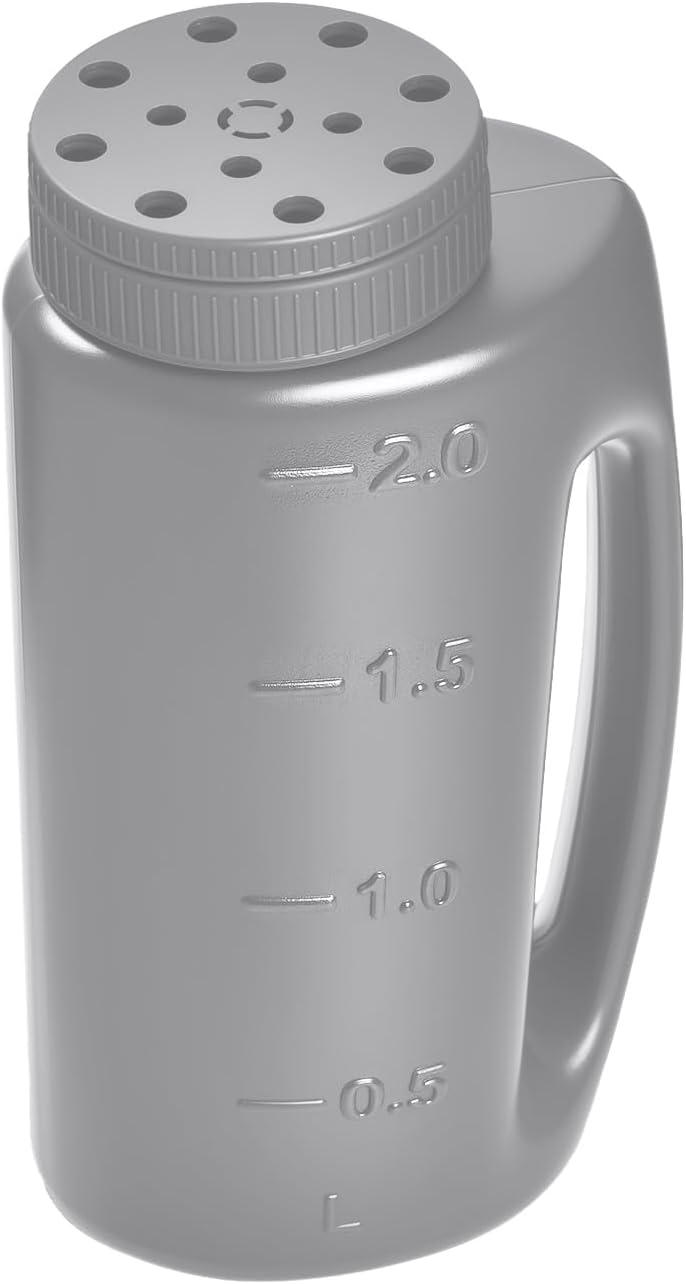
ZXJ Handheld Seed Shaker 90oz Multi-Purpose Hand Spreader
| Capacity | 90 oz |
|---|---|
| Material | Weather-resistant plastic |
| Adjustable openings | Three front openings |
| Intended use | Seed, fertilizer, ice melt & lawn care |
The ZXJ Handheld Seed Shaker is a simple, sturdy hand spreader that puts adjustable control and a large hopper into a lightweight package. It is typically used for overseeding small lawns, spot-applying fertilizer, or spreading ice melt on walkways; three front-adjustable openings let you dial flow from fine seeds to coarser materials. The 90 ounce capacity reduces refills when covering moderate areas, and the front-facing diffuser helps distribute material more evenly for fewer missed patches. Construction uses weather-resistant plastic and an ergonomic handle to limit fatigue during extended use, and the included gloves are a convenient touch. Important limitations are its handheld format and plastic build, which make it best for small-to-medium jobs rather than large lawns or heavy commercial use, and very fine calibration for tiny seed rates may require careful handling. For homeowners who value straightforward, reliable performance the unit delivers predictable results with minimal fuss.
Best for: Buyers who want a dependable, easy-to-use spreader for routine home lawn care and seasonal tasks, prioritizing consistent results and low fuss over heavy-duty capacity.
Less Ideal for: Professionals or homeowners with several acres to cover or those needing a heavy steel tow-behind spreader for commercial workloads.
- Three adjustable openings for controlled flow from fine seed to coarser materials
- Large 90 oz hopper reduces the need for frequent refills on moderate jobs
- Front-facing diffuser promotes more even distribution across passes
- Lightweight, ergonomic design reduces user fatigue during use
- Handheld plastic construction is not suited to very large lawns or heavy commercial use
- May require careful handling to achieve very fine seed rates
Verdict: A reliable, no-frills handheld spreader that gives homeowners precise, repeatable distribution for small-to-midsize lawn and seasonal tasks.
Scotts Whirl Hand-Powered Spreader

| Capacity | Up to 1,500 sq. ft. |
|---|---|
| Material Type | Metal, Plastic |
| Handle Material | Rubber |
| Additional Features | Adjustable Arm Support, Smooth Even Coverage |
The Scotts Whirl is a compact, hand-powered spreader built for small yards and spot applications. It holds enough product to cover about 1,500 square feet and arrives ready to use, so you can start seeding, fertilizing, or spreading ice melt without assembly. The adjustable arm support and rubber handle improve comfort during short jobs and the simple hopper and flow design deliver generally smooth, even coverage for granular products. Because it is hand-powered and lightweight, the Whirl is very maneuverable around flower beds, walkways, and tight spaces where a broadcast cart would be awkward. The main limitations are capacity and precision: it is intended for small areas, not full-size lawns, and it lacks fine calibration settings found on larger broadcast spreaders, so careful walking speed and overlap are needed to avoid streaks. For routine small-lawn tasks and seasonal spot treatments it is practical and easy to use, but expect to refill more often and pay attention when applying products that require strict rates.
Best for: Buyers who need a simple, no-fuss spreader for small lawns, patching, and seasonal spot treatments and who prefer a lightweight, easy-to-handle tool over larger walk-behind spreaders.
Less Ideal for: Homeowners with medium to large lawns who need wide coverage or precise granular rates should consider a larger, calibrated broadcast spreader instead.
- Compact and lightweight design makes it easy to maneuver in tight areas
- Adjustable arm support and rubber handle increase comfort during use
- Factory assembled and simple hopper delivers smooth, even coverage for granular products
- Multiuse: suitable for grass seed, lawn fertilizer, salt, and ice melt
- Small capacity limits use to yards roughly 1,500 sq ft or spot treatments
- Lacks precise calibration settings found on larger spreaders, requiring careful walking speed to control application rate
Verdict: A simple, comfortable handheld spreader that makes seeding, fertilizing, and spot ice-melt work quick and easy on small lawns.
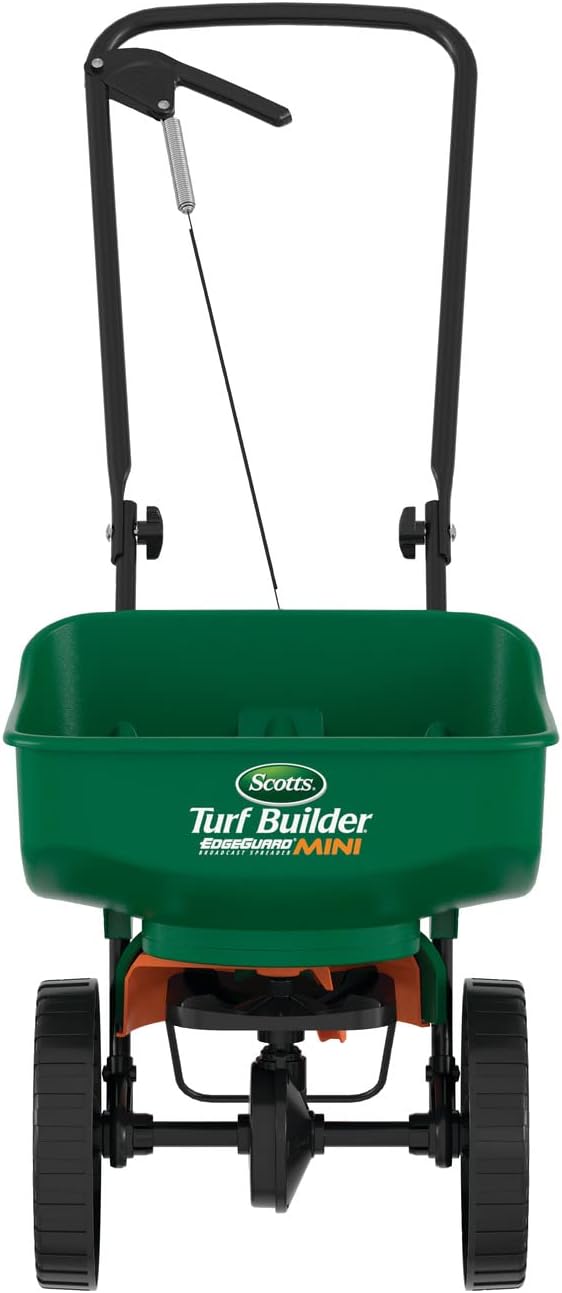
Scotts Turf Builder EdgeGuard Mini Broadcast Spreader
| Capacity | Up to 5,000 sq. ft. |
|---|---|
| Usage | Applies fertilizer, seed, granular weed control, salt, and ice melt |
| Features | EdgeGuard technology, curved hopper, dual-bladed agitator |
| Storage | Fold-down handle for compact storage |
The Scotts Turf Builder EdgeGuard Mini Broadcast Spreader is a small, ready-to-use lawn spreader made for treating lawns up to about 5,000 sq. ft. It comes pre-calibrated so you set the rate dial to the recommendation on your product label, pour granules into the hopper, and walk the lawn for even coverage. Notable features include a curved hopper and dual-bladed agitator that help keep seed and fertilizer flowing smoothly, open-spoke wheels that roll across typical yard terrain, and a fold-down handle for compact storage. The standout is Scotts EdgeGuard which blocks the right-side spray pattern so you can spread close to sidewalks, driveways, and planting beds with less cleanup. Because it is a mini model, capacity and range are aimed at smaller properties and frequent refills may be needed on larger yards. It handles a variety of granules and can also disperse ice melt or salt in winter, but it is not intended for heavy commercial use or very large lawns where a larger, higher-capacity spreader would be more efficient.
Best for: Homeowners with small to medium yards who prioritize tidy, predictable fertilizer and seed application and prefer a simple, low-fuss tool that minimizes accidental spreading onto hard surfaces.
Less Ideal for: Landscapers, contractors, or owners of large properties who need higher capacity and heavier-duty construction should choose a larger professional spreader.
- EdgeGuard technology reduces product on sidewalks and driveways for neater application
- Pre-calibrated and simple dial settings make it easy for first-time users to apply recommended rates
- Curved hopper and dual-bladed agitator promote consistent flow and even coverage
- Fold-down handle and compact size for easy storage in small sheds or garages
- Designed for small lawns so it requires frequent refills on larger properties
- Lightweight mini design is not suited for heavy commercial or contractor use
Verdict: A simple, compact spreader that gives reliable, tidy coverage for small lawns thanks to pre-calibration and EdgeGuard control.
Choosing the Right Hand Garden Spreader: Key Factors to Consider
Spread Pattern Control
How evenly a spreader lays down seed, fertilizer, or granular treatments directly affects germination, lawn color uniformity, and pest-control effectiveness. A spreader that throws unevenly forces you to overlap passes, which can lead to doubled application in bands and poor coverage elsewhere.
Assess spread width and whether the device offers a consistent fall pattern at different settings. For narrow beds and walkways, look for models that can narrow the pattern without sacrificing evenness. For small lawns, a moderate throw that reduces the number of passes is helpful but only if distribution remains uniform.
Adjustment Precision
The ability to set and repeat precise application rates matters when working with concentrated fertilizers, weed-and-feed formulations, or expensive seed. A coarse or fuzzy adjustment mechanism makes it hard to follow package application rates and increases the risk of over-application.
Check for clear, graduated settings and a control that resists accidental movement. Some units include simple metering dials or levers that lock in place. Consider how easy it will be to match the spreader setting to the product label and to reproduce that setting across sessions.
Build Durability
Hand spreaders are exposed to abrasive granules, moisture, and repeated handling. Durable materials and robust joints lengthen service life and reduce the chance of cracks, stripped fasteners, or warped hoppers. Metal parts exposed to moisture should use corrosion-resistant coatings or stainless alloys.
Inspect how the handle attaches to the hopper, how the metering linkage is protected, and whether the wheels or agitator parts are replaceable. A sturdier unit may cost more upfront but will save time and the hassle of mid-season failures.
Hopper Capacity & Refill
Capacity influences how often you need to stop and refill during a job. For small lawns and garden beds, a compact hopper can be lighter and easier to carry, but too small a capacity forces frequent trips back to the bag. Larger hoppers reduce refills but add bulk and weight.
Consider the typical amount you apply per session and whether the opening is wide enough to pour from common product bags. Removable hoppers or hinged lids that stay open during filling make refills quicker and cleaner.
Ease of Cleaning
Residues from fertilizer and seed can clog metering mechanisms and corrode unprotected metal. A spreader that is straightforward to disassemble and rinse will last longer and perform more predictably. Smooth hoppers, accessible agitators, and simple linkages reduce the time needed for maintenance.
Look for parts that are easy to reach without tools, drain holes that prevent trapped moisture, and materials that tolerate a gentle rinse. Avoid designs with many hidden cavities where wet granules can accumulate and harden.
When a Hand Spreader Is the Right Tool
Hand garden spreaders are ideal when you need control in small to medium areas or when working around flower beds, shrubs, and tight pathways. They give better precision than throwing by hand and are lighter and simpler than push or tow-behind units.
If you have scattered patches of seed to overseed a lawn, targeted fertilizer applications, or small-scale pest control granules, a hand spreader reduces mess and lowers the chance of accidental over-application near plant roots or hardscapes.
- Best for patios, small lawns, raised beds, and containers
- Useful for spot treating weeds or reseeding thin areas
- Easier storage and transport than larger spreaders
Application Tips for Even Coverage
Start by calibrating the spreader with the product you intend to use. Many packages give recommended settings and a sample test area. Use a small test run on cardboard to confirm how far and how densely granules are being thrown.
Walk at a steady pace and overlap passes by about 20 to 30 percent to avoid striping. For narrow strips, slow your pace and reduce the opening. After applying fertilizer, water according to product directions to move granules into the soil and limit surface runoff.
- Calibrate with the actual product before you treat the lawn
- Maintain a consistent walking speed and overlap passes slightly
- Adjust application near beds and hard surfaces to avoid drift
Maintenance and Winter Storage
Rinse the hopper and moveable parts after each use to remove abrasive residues. Let the spreader dry completely to avoid corrosion. If the unit has metal components, a light coat of appliance oil on exposed linkages before storage can prevent stiffness the following season.
Store the spreader off the ground in a dry place. Keep it away from direct sunlight to prevent plastic parts from becoming brittle. Inspect seals and fasteners each season and replace worn components before peak application times.
- Rinse and dry after use, then store indoors
- Lubricate moving parts lightly for winter storage
- Check settings and replace worn fasteners before spring
Safe Use Around Plants and Hardscapes
Avoid applying granular chemicals directly next to sensitive plants or non-target areas. Use a shield or hand-guard when treating near garden beds to prevent accidental drift. If product labels restrict application on slopes, follow those limits to reduce runoff risk.
Wearing gloves and eye protection during handling reduces contact with concentrated materials. Clean up any spills promptly and store leftover product in its original container away from children and pets.
- Use shields or temporary barriers when working next to delicate plantings
- Follow label limits for slopes and watering after application
- Wear gloves and clean spills immediately
Best Granules to Use with Hand Spreaders
Hand spreaders work well with seed mixes, granular fertilizers, ice melt, and certain pest-control granules. The particle size and shape affect flow through the metering gate, so choose products recommended for small broadcast equipment when possible.
Avoid very fine dusts that can clog the mechanism or lightweight granules that drift in the wind. If you must use a mix of particle sizes, test in a small area first to check for consistent distribution.
- Prefer uniform granular sizes for consistent flow
- Test mixes before applying to a large area
- Avoid dusty products that can cake in the hopper
How We Chose the Best Hand Garden Spreader
We focused on practical performance and durability for small-scale home use. Primary evaluation criteria included spread pattern control, meaning how consistently a unit distributes granules at different settings, and build durability, covering materials, joints, and resistance to abrasion from coarse products. We also considered hopper capacity and ergonomics to match common container sizes and gardener comfort during repeated short passes. Adjustment precision and calibration mattered because many hand spreaders are used for fertilizer and seed where over- or under-application changes results. Ease of cleaning and corrosion resistance were assessed since many granules leave residue that can clog mechanisms. We excluded large tow-behind or broadcast walk-behind machines and any tools intended only for professional bulk application. Final selections balanced accuracy, longevity, and usability for homeowners, balcony gardeners, and small-plot vegetable growers.
FAQ
How do I calibrate a hand garden spreader for fertilizer?
Calibration usually involves setting the metering opening recommended on the product label, filling the hopper, and walking a measured test distance while collecting or counting granules. Compare the delivered amount to the label rate and adjust the setting or walking speed until they match. Repeat with the actual product you will use.
Can I use a hand spreader for seed and fertilizer at the same time?
It depends on particle sizes and the label instructions for both materials. Combining seed and fertilizer can work if both flow similarly, but mixing very different particle sizes can cause uneven distribution. Testing on a small area first is advisable.
How often should I clean my spreader?
Rinse out the hopper and operate the control to flush the metering area after each use. A deeper inspection and light lubrication before long-term storage or at the start of the season helps maintain performance. More frequent cleaning is needed if you use corrosive or caking products.
Will a small hand spreader cover a typical suburban lawn?
A small hand spreader can cover a modest suburban lawn but will require more passes and refills than a larger push spreader. For very large lawns, a larger unit may be more efficient, but for small yards and spot treatments, a hand spreader offers better control.
How do I avoid applying too much near flower beds and walkways?
Reduce the metering opening and slow your walking pace near beds and hardscapes. Use a hand-held shield or temporary barrier to block drift and make a narrow pass parallel to the bed to control overspray.
Final Verdict
For small lawns, raised beds, and targeted garden work, a hand garden spreader is a practical compromise between precision and convenience. Prioritize models that offer precise spread pattern control and repeatable adjustment settings if you are working with concentrated fertilizers or expensive seed. Balance hopper size with how much you are willing to carry and choose a unit that is easy to clean and built to resist abrasion and moisture. Focus on the tradeoffs between capacity and maneuverability to match your typical jobs, and you will have a tool that makes granular applications quicker, cleaner, and more consistent.
