

Note: This article contains affiliate links. If you click on these links and make a purchase, I may earn a small commission at no extra cost to you. This helps support my research and content. Read my full affiliate disclosure here.
Choosing the right hand saw for cutting wood straight matters more than technique alone. A saw with the right blade geometry, tooth pattern, and stiffness keeps the kerf true so your layout lines stay accurate and joints fit cleanly. Whether you are trimming boards for furniture, squaring rough lumber, or making accurate crosscuts for trim, the saw itself influences how easy it is to follow a line. This guide covers six shortlisted hand saws that excel at cutting wood straight. We evaluated each option against practical workshop and jobsite criteria gardeners and woodworkers care about, including how the blade tracks, tooth layout for clean cutting, handle comfort for steady control, and resistance to wobble and binding. Read on to understand the features that make a saw cut straight and which characteristics to prioritize for your projects.
Top Picks at a Glance
| Best Overall The best all-around choice for most situations | Jorgensen 15-Inch Hand Saw with 8 TPI Black-Coated Blade |  |
| Best Quality Built to a higher standard if you want something more solid | IRWIN Marathon ProTouch 15-Inch Coarse-Cut Carpenter Saw |  |
| Best Budget The cheapest option that still gets the job done reliably | VPQZUPG Japanese Pull Saw 6" SK5 Double-Edge (14/17 TPI) |  |
| Highest Rated A top-rated pick with lots of positive feedback | Jorgensen 20-Inch Hand Saw with 11 TPI Black-Coated Blade and Ergonomic Non-Slip Handle |  |
| Most Popular A crowd favorite that many people choose with confidence | RUITOOL 6-inch Japanese Ryoba Pull Saw |  |
| Best Seller A high-volume bestseller chosen again and again | QYQRQF 14 in. Pro Hand Saw with Ergonomic Soft-Grip Handle |  |
Jorgensen 15-Inch Hand Saw with 8 TPI Black-Coated Blade

| Number of Teeth | 8 |
|---|---|
| Blade Material | Alloy Steel |
| Handle Material | Aluminum |
| Surface Recommendation | Plastic,Wood |
The Jorgensen 15-inch hand saw is a straightforward, heavy-cut handsaw aimed at general woodworking and outdoor trimming tasks. Its 8 TPI triple-ground teeth deliver aggressive, fast cuts through dimensional lumber and framing stock, while the SK5 high-carbon steel blade holds an edge and resists bending under regular use. The black Teflon-like coating reduces friction and helps keep sap and debris from building up on the blade. The reinforced aluminum frame and TPE/ABS ergonomic grip make it comfortable to hold for extended sessions and the handle includes 45° and 90° angle guides useful for marking cuts. Practical uses include rip and cross cuts on rough lumber, pruning thick branches, and cutting PVC or trim where speed matters more than ultra-fine finish. Limitations are inherent to the coarse 8 TPI: it is not intended for fine finish work or precise joinery and will leave a rougher cut on delicate stock. Also, being a fixed non-folding saw it requires safe storage with the included edge protector.
Best for: A buyer who wants a reliable, fast-cutting handsaw for general carpentry, framing, and heavier trimming tasks and values durability and comfort during frequent use.
Less Ideal for: Not the best choice for woodworkers focused on fine finish work, delicate trimming, or precision joinery who need higher-tooth-count saws.
- Aggressive 8 TPI triple-ground teeth for fast, efficient cutting of rough lumber
- SK5 high-carbon steel blade offers good edge retention and resists bending
- Black low-friction coating reduces material buildup and helps corrosion resistance
- Ergonomic aluminum-framed handle with TPE/ABS grip and built-in angle guides
- Coarse 8 TPI tooth pattern produces a rougher finish not suited to fine joinery
- Fixed blade requires careful storage and is less portable than folding saws
Verdict: Choose this saw if you want a durable, comfortable hand saw that makes fast, aggressive cuts for general carpentry and trimming.
IRWIN Marathon ProTouch 15-Inch Coarse-Cut Carpenter Saw

| Blade Material | Alloy Steel |
|---|---|
| Number of Teeth | 14 |
| Blade Shape | Rectangular |
| Power Source | Hand powered |
The IRWIN Marathon ProTouch 15-inch carpenter saw is built for heavy-duty, performance-focused wood cutting. Its M2 tooth geometry and Tri-Ground teeth deliver fast, efficient cutting across and with the grain, while deep gullets clear chips quickly to maintain cutting speed. The tapered-pitch nose improves clearance and control when starting cuts and working near corners, and the thick-body blade adds rigidity for straighter strokes when ripping or crosscutting. The wood ProTouch handle is shaped for comfort during extended use but remains robust for jobsite wear. This saw is best used for framing, rough carpentry, and general-purpose wood cutting where speed and aggressive material removal matter more than super-fine finish. Limitations include a coarse 9-point tooth pattern that leaves a rougher cut compared with fine-tooth saws and a wooden handle that some users may find less ergonomic than modern composite grips.
Best for: Buyers who prioritize fast, aggressive cutting for framing, rough carpentry, or frequent jobsite use and want a reliable, high-performance hand saw.
Less Ideal for: People who need very fine, smooth finish cuts for trim, cabinetry, or finish carpentry should choose a finer-toothed saw designed for precision.
- Aggressive M2 and Tri-Ground teeth for fast cutting and efficient chip removal
- Deep gullets reduce clogging and keep the cut moving quickly
- Thick-body blade improves rigidity for straighter, controlled strokes
- Tapered-pitch nose aids clearance and starting cuts in tight spots
- Coarse 9-point tooth pattern produces a rougher finish not ideal for fine joinery
- Wooden handle offers durability but less modern ergonomic padding
Verdict: Choose this saw when you need a durable, high-performance carpenter saw that cuts fast and clears chips efficiently for rough and framing work.
VPQZUPG Japanese Pull Saw 6" SK5 Double-Edge (14/17 TPI)

| Blade material | SK5 steel |
|---|---|
| Blade length | 6 inch |
| Tooth count | 14/17 TPI double edge |
This 6-inch Japanese pull saw is a budget-friendly hand tool aimed at small woodworking and trim tasks. Its SK5 steel blade has two edges with 14 and 17 teeth per inch so you can pick a coarser edge for faster material removal or the finer edge for cleaner, straighter cuts. The pull-cut design helps you guide the blade accurately along a line while using less force than a push saw, which is useful when working on joinery, dowels, or furniture trim. The compact wood handle and short blade make the saw easy to maneuver around tight workpieces and help reduce wobble on delicate cuts. Limitations include the short blade length, which is not suitable for ripping larger boards or long straight cuts, and the saw is a basic, no-frills tool with no replaceable blade system shown. For straightforward, small-scale jobs where control and cost matter, this saw delivers a practical, effective solution.
Best for: Buyers seeking an inexpensive, controllable saw for small woodworking, trimming, and joinery where accuracy matters more than long cutting length.
Less Ideal for: Woodworkers who need to make long rip cuts, work on large dimensional lumber, or who prefer modular saws with replaceable blades and premium handles.
- Double-edge 14/17 TPI blade offers choice between faster cuts and finer finish
- SK5 steel blade provides sharpness suited to detail woodworking
- Pull-cut design improves control and reduces pushing force for straighter cuts
- Compact 6-inch blade and wood handle make it easy to maneuver in tight spaces
- Short 6-inch blade is not suitable for long rip cuts or larger boards
- No indication of replaceable blade or advanced ergonomics
Verdict: A low-cost, compact pull saw that gives excellent control for short, straight cuts and fine woodworking tasks.
Jorgensen 20-Inch Hand Saw with 11 TPI Black-Coated Blade and Ergonomic Non-Slip Handle

| Power Source | hand_powered |
|---|---|
| Number of Teeth | 11 |
| Blade Material | High Speed Steel |
| Handle Material | ABS and TPE |
The Jorgensen 20-inch hand saw is a straightforward, reliability-minded tool for cutting wood, PVC and similar materials. Its 11 TPI triple-ground teeth and induction hardened high-speed steel blade are designed to hold an edge and cut quickly on both push and pull strokes, while the low-friction black coating helps reduce binding. The molded ABS and TPE handle is shaped for a firm, non-slip grip and includes 45 and 90 degree guide marks to help keep cuts square. Practical touches include a cardboard sleeve and plastic tooth protector for safe storage and transport. In use the saw excels at fast, coarse ripping and trimming tasks around the workshop or yard, and the robust blade construction makes it suitable for repeated use without frequent re-sharpening. It is not a fine-tooth finish saw, so expect rougher edges on delicate joinery and slower performance on very hard, dense timbers. For routine framing, pruning and general carpentry where dependable, aggressive cutting is the priority, this saw performs well.
Best for: Buyers who prioritize a durable, workhorse handsaw for everyday cutting tasks like framing, pruning and general carpentry and who want a tool that stays sharp through repeated use.
Less Ideal for: Woodworkers needing a fine-tooth saw for smooth finish cuts or hobbyists doing delicate joinery should choose a finer TPI saw instead.
- Triple-ground 11 TPI teeth and induction hardened high-speed steel blade for durable, fast cutting
- Low-friction black coating reduces binding for smoother strokes
- Ergonomic ABS+TPE non-slip handle with angle guides for comfortable, accurate cutting
- Includes blade protector and cardboard sleeve for safer storage
- Coarse 11 TPI tooth pattern produces rougher cuts not suited for fine finish work
Verdict: A tough, no-nonsense 20-inch handsaw built for fast, reliable cutting on everyday woodworking and yard tasks.
RUITOOL 6-inch Japanese Ryoba Pull Saw

| Blade Material | Sk5 Steel |
|---|---|
| Blade Length | 6 inches |
| TPI | 14 & 17 |
| Handle Material | Beechwood |
This RUITOOL 6-inch Ryoba pull saw is built for precise, straight cuts and flush trimming on both hardwood and softwood. The thin, flexible SK5 carbon-steel blade (0.67 mm) uses a pull stroke, which gives better control and a cleaner cut than many western push saws. One side has 17 TPI for finer crosscuts and hardwood, the other 14 TPI for faster rip-style cuts in softer stock. The hardened three-edge teeth improve sharpness and chip removal, so it cuts quickly for its size. The compact length and lightweight profile make it easy to guide for finish work, trim, dovetailing, and flush cutting near edges. The beechwood handle is simple and comfortable for short sessions, but users who do heavy repetitive cutting may prefer a larger ergonomic grip. Because the blade is very thin and short, it is not suited to long rip cuts or thick timbers where a longer blade and greater stroke are needed. For anyone prioritizing straight, controlled finish cuts and flush trimming in small to medium woodworking tasks, this saw performs well.
Best for: Buyers who want a controllable pull saw for accurate finish cuts, trim work, and flush cutting on small to medium woodworking projects and value proven user feedback.
Less Ideal for: Woodworkers who frequently cut large boards, long rip cuts, or do high-volume repetitive cutting should choose a longer or more industrial saw.
- Double-edge design (14 and 17 TPI) lets you choose between faster rip-style cuts and finer crosscuts
- SK5 high-carbon steel blade is thin and flexible for clean, precise flush and finish cuts
- Hardened three-edge teeth improve sharpness and chip clearance for quicker cutting
- Compact, lightweight form is easy to control for detail work and flush trimming
- Short 6-inch blade limits efficiency on long rip cuts and large stock
- Simple wooden handle may be less comfortable for extended heavy use
Verdict: A precise, controllable 6-inch Ryoba pull saw ideal for straight finish cuts and flush trimming on small to medium woodworking tasks.
QYQRQF 14 in. Pro Hand Saw with Ergonomic Soft-Grip Handle
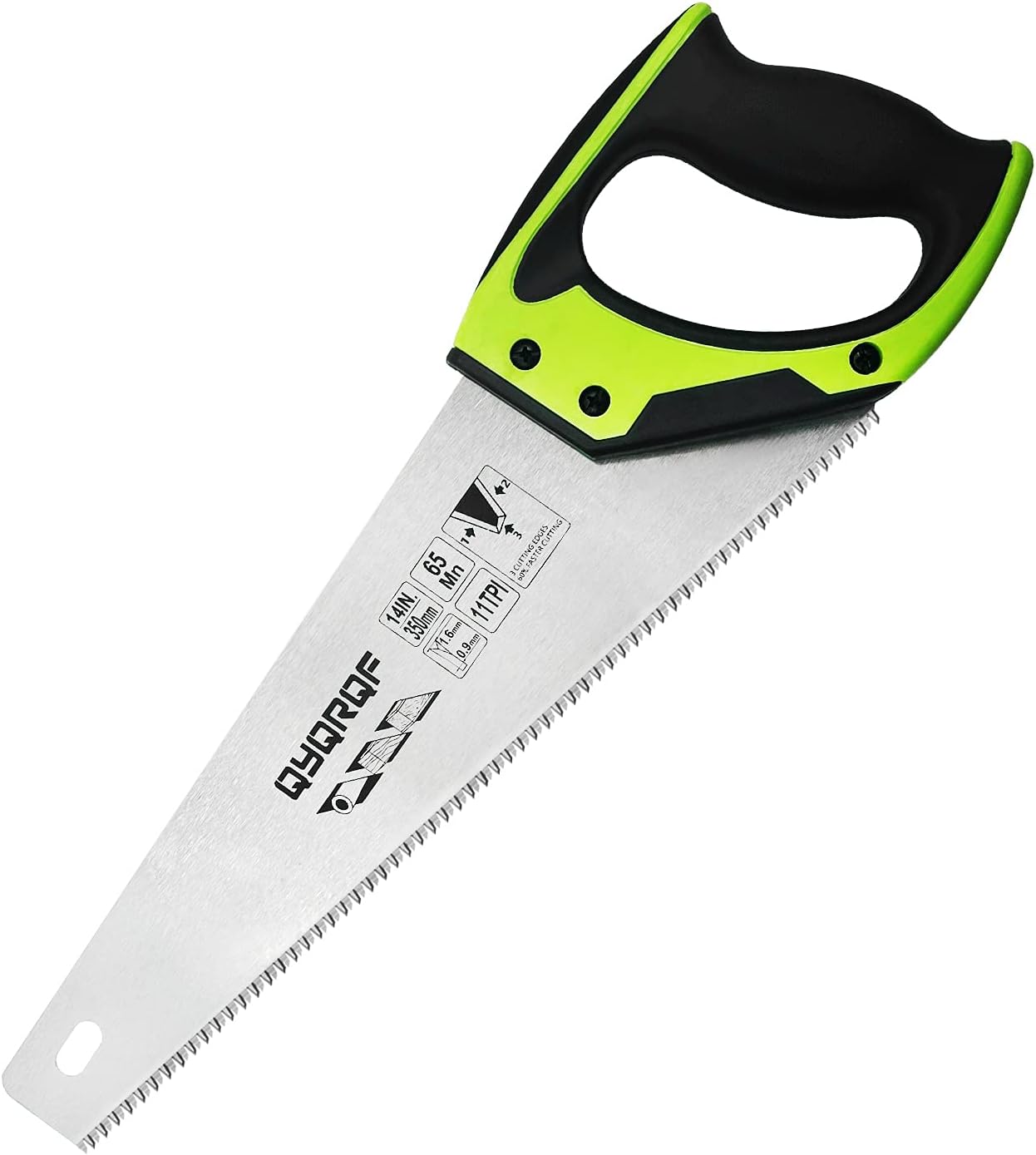
| Blade Material | Alloy Steel |
|---|---|
| Blade Length | 14 inches |
| Number of Teeth | 11 |
| Handle Material | Thermoplastic Elastomers |
This 14-inch pro hand saw is built for fast, accurate cuts in wood, plywood and PVC pipe. The 65Mn heat-treated alloy-steel blade with three-face grinding and deep gullets clears chips quickly, and the 11 TPI fine-cut tooth pattern makes controlled crosscuts and trim work straightforward. A low-friction coating helps the blade slide through material, while the thermoplastic elastomer soft-grip handle is shaped for comfort during repeated strokes and reduces hand fatigue. It ships with a protective sleeve and a hard case for safe storage. For someone focused on practical performance, the saw delivers durable sharpness and predictable cuts without power tools. Limitations are its manual speed compared with a power saw and that the 11 TPI is a compromise between fast ripping and very fine finishing, so you may need a different tooth count for very fine trim or rip work.
Best for: Buyers who prioritize efficient, reliable hand cutting for routine wood trimming and light carpentry and want a durable tool that reduces hand fatigue during regular use.
Less Ideal for: Users who need the fastest bulk ripping or ultra-fine finish cuts, or those who prefer powered saws for large projects.
- Heat-treated 65Mn alloy-steel blade for long-lasting edge retention
- Three-face grinding and deep gullets for faster chip removal and quicker cuts
- Low-friction coating reduces binding and improves stroke efficiency
- Ergonomic non-slip soft-grip handle reduces hand fatigue during extended use
- Manual saw cannot match the speed of powered cutting tools
- 11 TPI is a middle-ground tooth count and may not be ideal for very fine finish cuts or fast ripping
Verdict: A durable, comfortable 14-inch hand saw that speeds up manual cutting with a heat-treated blade and efficient tooth geometry, ideal for everyday wood and trim work.
Choosing the Right Hand Saw for Cutting Wood Straight: Key Factors to Consider
Blade Stiffness and Reinforcement
A stiff blade is essential for cutting a straight kerf. Thin, flexible blades tend to bow or flutter under pressure, which causes the cut to drift away from the marked line. Look for blades with reinforcement such as a thicker spine, laminated backing, or heat-treated steel that resists bending over the length of a cut.
Reinforcement matters more the longer the cut. For short trims stiffness is less critical, but for ripping full-length boards you want a blade that tracks without deflection. Stiffness also reduces user fatigue because you do not need to overcorrect or compensate during the stroke.
Tooth Geometry and Set
Tooth shape, pitch, and set directly influence how a saw cuts and how confidently it follows a line. Coarse, aggressive teeth remove material quickly but can be harder to steer precisely. Finer tooth patterns produce cleaner kerfs and are easier to guide for accurate crosscuts.
The set of the teeth determines kerf width and how freely the blade moves through wood. Minimal and consistent tooth set helps the saw slide without binding while still giving enough clearance. For straight cutting, prioritize a tooth pattern matched to the cut type you do most often and one with even, predictable set.
Handle Design and Stroke Control
A handle that fits your hand and aligns with the blade axis helps you maintain a straight stroke. Handles that force wrist angle or encourage uneven pressure will steer the blade off the line. Look for handles with a comfortable palm contact, finger placement that promotes a steady grip, and an orientation that keeps your forearm and shoulder aligned with the cut.
Material and texture matter too. A secure non-slip grip reduces accidental twisting, especially when working outdoors with sweaty or wet hands. Slightly longer handles can give better leverage for long rips, while compact handles often aid fine control on short crosscuts.
Cut Type: Rip Versus Crosscut
Cutting wood straight depends on choosing the right tooth pattern for the task. Rip teeth are shaped to sever wood fibers along the grain and track well for lengthwise ripping. Crosscut teeth are angled to sheathe and slice fibers across the grain for cleaner end cuts.
If you need one saw for both tasks, look for a moderate tooth count and a hybrid pattern that balances tracking with finish. For precision joinery, use a saw optimized for the cut type to minimize wandering and tearout.
Blade Length and Stroke Consistency
Blade length affects how many strokes are needed and how straight the line stays. Longer blades let you use longer, smoother strokes that reduce the tendency to veer. Short blades require more starts and stops, which can introduce error at the line. However, long blades need greater stiffness to stay true.
Consider the typical board sizes you work with. For full-length rips on standard boards choose a blade long enough for a single smooth stroke. For tight spaces or short trim work, a shorter blade that is well controlled can be preferable.
Maintenance and Sharpening
A sharp, well-set saw tracks better than one with worn or hooked teeth. Regular maintenance keeps tooth geometry consistent and the kerf predictable. Learn basic sharpening and setting techniques or choose blades that are straightforward to refile when needed.
Rust resistance and coating influence how often you must maintain a blade, particularly for outdoor or garden workshop use. Proper storage to avoid bending and keeping teeth free of pitch and sap will help preserve straight-cutting performance.
Common Causes of Wandering Cuts
Wandering cuts usually come from one of three sources: a flexible blade, inconsistent hand pressure, or incorrect tooth geometry for the task. Understanding which factor is responsible helps you correct the issue without switching tools unnecessarily.
Blade deflection is often subtle. If the blade bows on the return stroke or when cutting deeper into the board, you will see gradual drift. Uneven pressure or wrist twist typically shows up as an abrupt change in direction near the start or finish of a cut.
- Flexible blade: increases with length and thinness
- Poor grip or misaligned handle: causes wrist torque
- Wrong tooth pattern: rips vs crosscuts behave differently
- Binding from sawdust or pitch: stalls or kicks the blade
Techniques to Improve Straight Cutting
Controlled setup and body alignment make a big difference. Brace the work at chest height when possible, align your shoulder behind the blade, and use your non-dominant hand to steady the board. Start cuts with a light, accurate scoring stroke to establish the path, then increase pressure once the kerf is established.
Maintain consistent stroke length and pressure. Pause to clear sawdust in deep cuts and avoid forcing the blade. For long rips consider a temporary guide clamped to the board to keep the saw on track.
- Score the line first with a light forward stroke
- Use a clamp or straightedge guide for longer cuts
- Clear sawdust periodically to prevent binding
- Keep shoulders, elbow, and wrist aligned with the blade
When to Use a Saw Guide or Fence
A saw guide or fence is useful when absolute straightness is required or when repeating identical cuts. Guides reduce dependence on hand alignment and are especially helpful on long rips or when working with inexperienced cutters.
Use clamps to secure the guide and test on scrap before committing to the workpiece. Guides are not a substitute for a proper blade and handle combination but they multiply the accuracy of a well-made hand saw.
- Best for long rips and repeatable angled cuts
- Helps on slippery or warped boards that deflect the saw
- Combine with a stiff blade for optimal results
Materials and Finishes That Affect Cutting
Different woods and finishes change how a saw behaves. Resinous or wet woods can gum up teeth and increase binding. Hard, dense woods require consistent tooth geometry and a stout blade to keep the kerf straight. Softwoods are more forgiving but can still cause wandering if the blade flexes.
A corrosion-resistant finish protects the blade in outdoor or garden workshop conditions and makes cleaning pitch easier. Consider coatings and steel treatments as part of long-term performance, especially if you store tools in humid environments.
- Resinous woods need frequent cleaning to avoid gumming
- Hardwoods demand stiffer blades and suitable tooth pitch
- Protective finishes reduce maintenance in damp settings
Safe Handling and Ergonomics
Safety and comfort affect cut quality. A painful or awkward grip leads to compensating movements that throw off a straight line. Keep a relaxed but secure grip and maintain a stable stance during long cuts.
Wear eye protection and keep hands clear of the kerf. Secure workpieces with clamps or a vise to eliminate movement that can force the saw off its line.
- Use clamps or a vise to prevent board movement
- Keep a neutral wrist to avoid torque
- Replace handles or add grip tape if the saw slips
How We Chose the Best Hand Saw for Cutting Wood Straight
We selected hand saws that are built to produce straight, repeatable cuts in typical workshop and outdoor woodworking tasks. Our evaluation prioritized blade geometry that resists flex, consistent tooth raker and set patterns that slice cleanly without wandering, and spine or reinforcement features that preserve blade stiffness over longer cuts. We also considered handle ergonomics and grip placement because a comfortable, well-aligned handle reduces wrist twist and helps maintain a steady line. Additional criteria included tooth count and configuration suited to rip versus crosscutting, the ease of keeping a straight kerf under light pressure, and the saws' ability to avoid binding in damp or resinous woods. We excluded specialty or highly novel experimental blades that are not widely available to typical gardeners and woodworkers. Products that lacked clear specifications for tooth pattern or blade stiffness were also filtered out. The final picks are those that met our blade-tracking, tooth-performance, stiffness, and control benchmarks.
FAQ
What tooth count is best for cutting straight lines?
It depends on the cut. Lower tooth counts cut faster for rip work but may be harder to steer. Higher tooth counts slice cleaner for crosscuts and are easier to track precisely. Choose a tooth pitch suited to the grain direction you cut most often.
Can a flexible blade be made to cut straight with technique?
Technique helps, but a flexible blade will always be more prone to wandering. Proper stance and a light scoring stroke reduce drift, but for consistently straight long cuts a stiffer blade or a guide is a more reliable solution.
How often should I sharpen or set my hand saw to keep cuts straight?
Frequency depends on use and wood types. Hobby users may sharpen once per season, while heavy users of abrasive or resinous woods will need more frequent attention. Sharpen when teeth show dulling or when the saw begins to require more force or starts to wander.
Is a saw guide necessary for straight cuts on short boards?
Not usually. Short boards can be cut straight with a well-chosen saw and good technique. Guides become valuable for long rips, repeatable cuts, or when you need perfect accuracy across multiple workpieces.
How does handle fit affect straight cutting?
Handle fit is crucial. A handle that aligns your wrist and forearm with the blade axis reduces torque and makes it easier to maintain a straight stroke. If a handle causes awkward angles, you will compensate with wrist movement that steers the saw off line.
Final Verdict
Prioritize blade stiffness, appropriate tooth geometry, and a handle that aligns with your stroke when choosing a hand saw for cutting wood straight. Decide whether you need a long, stiff blade for full-length rips or a finer-toothed option for precise crosscuts, and factor in maintenance needs for sharpness and set. Balancing these tradeoffs will help you pick a saw that tracks true for the cuts you do most often. When in doubt, choose a saw with reinforcement and a comfortable handle, and consider using a guide for the most demanding straight-line work.
