

Note: This article contains affiliate links. If you click on these links and make a purchase, I may earn a small commission at no extra cost to you. This helps support my research and content. Read my full affiliate disclosure here.
Working with PVC pipe requires a saw that delivers straight, burr-free cuts without kicking or crushing the material. The right hand saw reduces finishing work, speeds installations, and keeps joints tight so solvent cement and fittings seat properly. This guide shortlists the top hand saws for PVC pipe and explains the tradeoffs you should consider for accuracy, control, and long-term use. We evaluated tools across blade geometry, handle ergonomics, and ease of producing square cuts so you can pick the saw that fits how you work. Read on for the criteria we used and practical notes to help you choose the best tool for your piping projects.
Top Picks at a Glance
| Best Overall The best all-around choice for most situations | HAUTMEC 11-Inch PVC Pipe Saw with Adjustable Angle Handle |  |
| Best Quality Built to a higher standard if you want something more solid | Starrett K148-12 PVC Saw, 12" Blade, Cast Aluminum Handle with Level |  |
| Best Value The sweet spot between price and what you get | Goldblatt Folding Drywall Saw, 5-Inch Jab Saw with Soft-Grip Handle |  |
| Best Budget The cheapest option that still gets the job done reliably | HAUTMEC 14-Inch Hand Saw with 11 TPI Fine Teeth |  |
| Highest Rated A top-rated pick with lots of positive feedback | ZETSAW Pipe Saw 240 with 5 Replacement Blades |  |
| Most Popular A crowd favorite that many people choose with confidence | QYQRQF 14 in. Pro Hand Saw with Ergonomic Soft-Grip Handle |  |
| Best Seller A high-volume bestseller chosen again and again | TOOLAN 8-in-1 Multi-Blade Hand Saw with Quick-Change Handle |  |
HAUTMEC 11-Inch PVC Pipe Saw with Adjustable Angle Handle

| Power Source | Manual |
|---|---|
| Number of Teeth | 10 |
| Cutting Angle | 70 degrees |
| Blade Material | 65Mn steel |
| Handle Material | Aluminum |
This HAUTMEC 11-inch saw is built for precise, portable cutting of PVC, ABS, acrylic and light woodworking tasks. Its 1mm heat-treated 65Mn steel blade and double-ground 10 TPI teeth deliver smooth, low-chipping cuts in plastic pipe and sheet materials, while the rigid blade reduces flex for straighter results. A tool-free, keyless blade-change system plus an 11-position quick-release adjustable handle (up to 70 degrees) make it easy to set comfortable cutting angles in tight under-sink or recessed spaces. The die-cast aluminum core handle with a non-slip TPR overmold gives secure grip and feels durable for repeated use. The saw is compact and light enough to carry in a standard tool bag, and the included plastic protection sleeve helps protect the teeth in storage. Limitations are its fine 10 TPI tooth pattern and 11-inch blade length, which are optimized for pipe and trim work but will be slower on large-diameter lumber or heavy pruning compared with coarse or longer saws.
Best for: Homeowners and DIYers who want a reliable, portable saw for plumbing repairs and trim work where clean cuts in PVC and other plastics matter and access is limited.
Less Ideal for: Landscape or heavy carpentry users who need long-reach or coarse-toothed saws for large dimensional lumber or pruning thicker branches.
- Rigid 1mm heat-treated 65Mn steel blade resists bending for straighter cuts
- 10 TPI double-ground teeth produce smooth, low-chipping cuts in PVC and sheet materials
- 11-position keyless adjustable handle allows comfortable angles in tight spaces
- Die-cast aluminum core with TPR overmold provides a secure, ergonomic grip
- Compact 11-inch form factor is easy to carry and stores safely with a protective sleeve
- Short 11-inch blade and fine tooth count make it slower on large lumber or thick branches
Verdict: Choose this saw if you need a compact, rigid blade and adjustable handle for clean, controlled PVC and pipe cuts in tight spaces.
Starrett K148-12 PVC Saw, 12" Blade, Cast Aluminum Handle with Level

| Blade Length | 12 inches |
|---|---|
| Blade Material | High Speed Steel |
| Handle Material | Aluminum |
| Cutting Angle | 90 degrees |
The Starrett K148-12 is a straightforward, professional hand saw built for accurate cuts in PVC and similar materials. It ships with a 12-inch high-speed steel blade and a cast aluminum handle that includes a built-in level vial and surface markings for 45 and 90 degree cuts. In typical use it is a one-handed tool for trimming PVC and ABS pipe, cutting plasterboard or plywood, and making general-purpose straight cuts on job sites. The aluminum handle feels sturdy and the level vial helps keep cuts square without needing a separate tool. The HSS blade provides durable cutting performance and is suitable for repeat use on plastic and softer building materials. Limitations are its fixed 12-inch blade length, which limits reach compared with larger saws, and there is no mention of replaceable blade fittings or specialized tooth geometry for very fine or metal cuts. For someone focused on reliable, accurate PVC pipe and jobsite cutting, this is a solid, no-frills choice.
Best for: Buyers who need a dependable, accuracy-focused hand saw for frequent PVC and general building-material cutting on job sites.
Less Ideal for: People who primarily cut large-diameter pipe or need long-reach or replaceable specialized blades should consider alternatives.
- Built-in level vial and 45/90 surface markings for more accurate cuts
- Durable cast aluminum handle that withstands jobsite use
- High speed steel 12" blade suitable for PVC, ABS, plasterboard and plywood
- Blade length is fixed at 12 inches which limits reach for large-diameter pipes or deeper cuts
- No explicit information about blade replaceability or specialized tooth count for ultra-fine cuts
Verdict: Choose this saw if you want a rugged, accuracy-focused 12" hand saw built for frequent PVC and general-purpose cuts.
Goldblatt Folding Drywall Saw, 5-Inch Jab Saw with Soft-Grip Handle

| Blade Material | High Speed Steel |
|---|---|
| Blade Length | 5 inches |
| Number of Teeth | 40 |
| Cutting Angle | 180 degrees |
| Handle Material | Plastic or Rubber |
The Goldblatt folding drywall saw is a pocketable jab saw built for quick, one-off cuts and access work. Its 5-inch bi-metal blade with 8 TPI triple-ground teeth cuts aggressively in both push and pull strokes, and the tapered pointed tip makes punching through wallboard straightforward. The blade locks open for safe use and folds into the handle for compact storage in a tool bag or pocket. The soft, ergonomic handle improves comfort during repetitive cuts and the deep gullets help keep debris out of the teeth for consistent cutting performance. It is most useful for cutting drywall, plywood, PVC panels and similar sheet materials where a short, maneuverable blade is preferred. Limitations include the short blade length, which reduces reach for cutting through larger-diameter PVC pipe or making long straight cuts, and the manual jab style requires careful control to avoid ragged edges on thin plastic. If you need a small, durable saw for quick access cuts and on-site trimming, this model is a practical, portable option; for long runs or many pipe cuts a larger dedicated PVC cutter or longer saw will be faster and produce cleaner results.
Best for: Buyers who value compact, durable hand tools for occasional on-site trimming and access cuts and who prioritize portability and quick setup over long cutting reach.
Less Ideal for: Workers who need to cut many lengths of PVC pipe, make long straight cuts, or require perfectly smooth edges should choose a longer saw or a purpose-built PVC cutter instead.
- Folding lockable design for safe storage and easy transport
- Bi-metal 8 TPI triple-ground blade that cuts in both directions for faster penetration
- Ergonomic soft-grip handle reduces hand fatigue during repeated cuts
- Deep gullets help clear debris and maintain cutting performance
- 5-inch blade limits reach and makes long or large-diameter pipe cuts awkward
- Jab-saw action can leave rough edges on thin plastics without careful technique
Verdict: A compact, lockable jab saw that delivers fast, portable cuts for drywall and small panel work when portability and quick access matter most.
HAUTMEC 14-Inch Hand Saw with 11 TPI Fine Teeth

| Blade Material | High Carbon Steel |
|---|---|
| Number of Teeth | 11 TPI |
| Blade Length | 14 inches |
| Power Source | Manual |
The HAUTMEC 14-inch hand saw is a simple, budget-friendly tool for cutting small lumber, PVC pipe, branches, and trim. Its 1.0 mm high-carbon steel blade resists bending for straighter cuts and the 11 TPI triple-ground teeth deliver relatively smooth, fine cuts with less tear-out than coarse saws. The ergonomic ABS handle with soft TPR rubber gives a secure, non-slip grip for one-handed work and reduces fatigue during longer sessions. A protective blade cover is included for safer storage. Because it is a traditional push-style saw with a rectangular blade and 90-degree cutting angle, it is best for measured, controlled cuts rather than fast stock removal. The blade is not replaceable on this model so heavy-duty daily workshop use will eventually blunt it; sharpening or replacement means buying a new saw. For homeowners and hobbyists who need an inexpensive, reliable hand saw for occasional PVC, wood, and garden trimming, this offers good value and predictable performance.
Best for: Buyers looking for an inexpensive, no-frills hand saw for occasional DIY, PVC pipe cuts, garden pruning, and light woodworking projects who prioritize value over replaceable blades.
Less Ideal for: Professional carpenters or users who need a saw for heavy daily use or fast, aggressive ripping cuts should consider a replaceable-blade saw or power tool instead.
- Thin 1.0 mm high-carbon steel blade resists bending for straighter cuts
- 11 TPI triple-ground teeth provide cleaner, fine cuts in wood and PVC
- Ergonomic ABS handle with soft TPR rubber offers a secure, comfortable grip
- Includes protective blade cover for safer storage and transport
- Blade is fixed to the handle so you cannot swap in a fresh blade when it dulls
Verdict: A straightforward, low-cost 14-inch hand saw that delivers cleaner cuts on PVC and light wood tasks for occasional DIY and yard work.
ZETSAW Pipe Saw 240 with 5 Replacement Blades

| Power Source | Manual |
|---|---|
| Blade Material | High Speed Steel |
| Other Special Features of the Product | Japanese Hand Saw, Plumber saw for PVC Pipe, Replaceable Blades |
| Surface Recommendation | Plastic, Wood |
The ZETSAW Pipe Saw 240 is a compact Japanese hand saw made specifically for cutting PVC and similar plastics, and it ships with five replacement blades. In use it functions like a plumber saw: the specially ground teeth and narrow kerf let you squarely cut pipe up to roughly 100mm diameter with minimal burrs, and the 225mm blade is also suitable for small plastic, wood, and light branch pruning tasks. The replaceable high speed steel blades keep the tool economical and simple to maintain. Its plastic handle and slim blade make the saw easy to control in tight spots commonly found when working on plumbing runs. The main limitations are that it is a manual tool so it requires effort for larger or thicker pipes and it is optimized for small-diameter pipe rather than heavy industrial cutting. If you need a durable, low-maintenance hand saw for routine PVC work and clean, accurate cuts, this model is a practical choice.
Best for: Buyers who want a reliable, low-maintenance hand saw for regular PVC plumbing work and accurate cuts without power tools.
Less Ideal for: Professionals routinely cutting large-diameter or heavy-duty materials who need a powered cutter or a larger industrial saw.
- Teeth ground for clean cuts in PVC/PE with reduced burrs
- Includes five replaceable high speed steel blades for continued use
- Narrow kerf and slim blade offer good control in tight plumbing spaces
- Versatile enough for small plastic, wood, and light branch pruning
- Manual operation can be slow and tiring on larger or thicker pipes
- Plastic handle may feel less durable under heavy, prolonged use
Verdict: A dependable, easy-to-maintain plumber saw that delivers clean PVC cuts and long-term value thanks to replaceable high-speed steel blades.
QYQRQF 14 in. Pro Hand Saw with Ergonomic Soft-Grip Handle
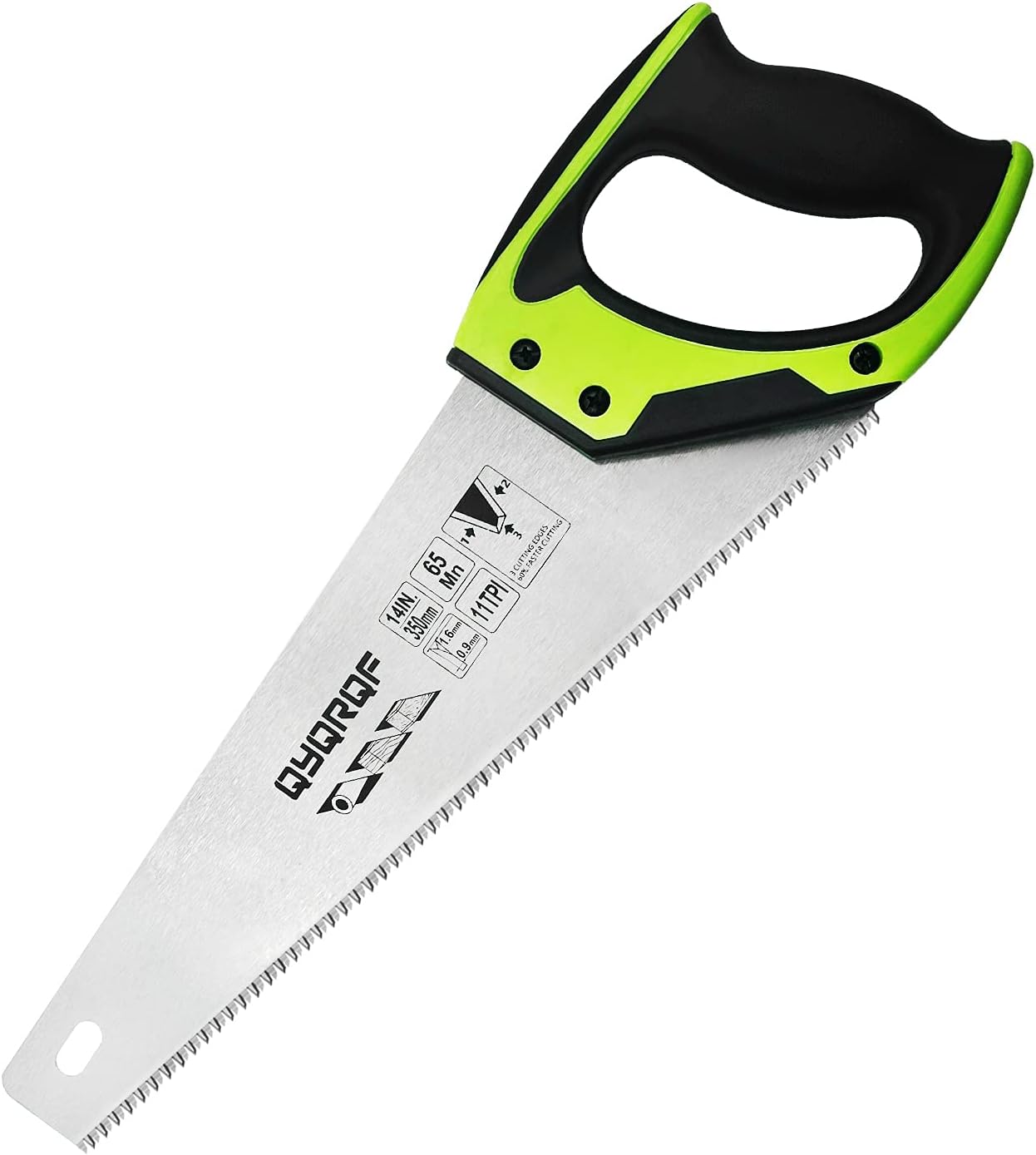
| Blade Material | Alloy Steel |
|---|---|
| Blade Length | 14 inches |
| Number of Teeth | 11 |
| Handle Material | Thermoplastic Elastomers |
This 14-inch pro hand saw is built for fast, accurate cuts in wood, plywood and PVC pipe. The 65Mn heat-treated alloy-steel blade with three-face grinding and deep gullets clears chips quickly, and the 11 TPI fine-cut tooth pattern makes controlled crosscuts and trim work straightforward. A low-friction coating helps the blade slide through material, while the thermoplastic elastomer soft-grip handle is shaped for comfort during repeated strokes and reduces hand fatigue. It ships with a protective sleeve and a hard case for safe storage. For someone focused on practical performance, the saw delivers durable sharpness and predictable cuts without power tools. Limitations are its manual speed compared with a power saw and that the 11 TPI is a compromise between fast ripping and very fine finishing, so you may need a different tooth count for very fine trim or rip work.
Best for: Buyers who prioritize efficient, reliable hand cutting for routine wood trimming and light carpentry and want a durable tool that reduces hand fatigue during regular use.
Less Ideal for: Users who need the fastest bulk ripping or ultra-fine finish cuts, or those who prefer powered saws for large projects.
- Heat-treated 65Mn alloy-steel blade for long-lasting edge retention
- Three-face grinding and deep gullets for faster chip removal and quicker cuts
- Low-friction coating reduces binding and improves stroke efficiency
- Ergonomic non-slip soft-grip handle reduces hand fatigue during extended use
- Manual saw cannot match the speed of powered cutting tools
- 11 TPI is a middle-ground tooth count and may not be ideal for very fine finish cuts or fast ripping
Verdict: A durable, comfortable 14-inch hand saw that speeds up manual cutting with a heat-treated blade and efficient tooth geometry, ideal for everyday wood and trim work.
TOOLAN 8-in-1 Multi-Blade Hand Saw with Quick-Change Handle

| Power Source | Manual |
|---|---|
| Blade Material | Alloy Steel |
| Included Components | 1 pcs handle, 8 pcs blade |
| Blade Length | 6 inches |
This TOOLAN 8-in-1 hand saw is a compact manual cutting kit that uses a quick-change, self-locking handle to accept a range of reciprocating-style blades for different materials. Typical use is straightforward: choose the blade that matches the material, insert it into the handle and lock it in place for plunge cuts, trimming or short rip cuts where a power saw is impractical. Notable features include an ergonomic TPR anti-slip grip, a blade-clamp that supports both side- and middle-hole blades, and a mix of blades for drywall, wood, metal and PVC. Practical benefits are portability, low setup time and the ability to do controlled cuts in tight spaces without noise or a power source. Important limitations are that it is a manual tool so cutting thick or large-diameter PVC will be slower than a powered saw, and the small handle and blade lengths limit long straight cuts. The included thin blades are intended for precision and light work rather than heavy demolition. For occasional PVC repairs, small-diameter pipe cutting and jobs where speed and power are not required, this tool is convenient and reliable.
Best for: Buyers who want a low-risk, compact hand tool for occasional PVC repairs, small pipe cuts and tight-space work where a quiet, portable manual saw is preferable to power tools.
Less Ideal for: Professionals or DIYers who routinely cut large-diameter PVC or need fast long cuts should choose a powered reciprocating saw or a larger handsaw instead.
- Quick-change, self-locking handle for fast blade swaps without tools
- Includes eight blades covering drywall, wood, metal and PVC cutting needs
- Ergonomic TPR non-slip grip reduces hand fatigue during repeated cuts
- Compatible with common reciprocating blades so replacements are easy to source
- Manual operation makes long or thick PVC cuts slower than power saws
- Short blade and handle size limit long straight cuts and larger projects
Verdict: A compact, low-risk manual saw kit that makes neat, controlled cuts in PVC and other materials when portability and precision matter more than cutting speed.
Choosing the Right Hand Saw for Pvc Pipe: Key Factors to Consider
Blade Tooth Geometry and Pitch
Tooth geometry affects how the blade removes plastic chips and whether it melts or shreds PVC. Finer teeth with a shallow rake tend to slice cleanly with less tearing, while aggressive, coarse teeth can gouge and create irregular edges.
Tooth pitch also changes the cutting feel: higher TPI (teeth per inch) will slow the cut but produce smoother edges, useful for small-diameter pipe and finish work. Lower TPI cuts faster but can leave more burrs that must be removed before joining. Consider the balance between cutting speed and edge quality for your projects.
Blade Stiffness and Length
A longer, stiffer blade helps make straight cuts on wider-diameter pipe, reducing the chance of bowing that leads to angled or uneven ends. Short blades are easier to control on tight spaces or short runs but may struggle to maintain a square cut on larger pipe.
Materials and blade thickness determine stiffness; thin blades flex under load and can wander. Look for blades designed to resist lateral flex and to stay aligned under normal hand pressure so your cuts remain square across the pipe circumference.
Handle Shape and Grip Comfort
A comfortable handle improves control and reduces fatigue during repetitive cuts. Handles that support a full palm grip and position the wrist naturally let you apply steady, even feed pressure, which is crucial for clean PVC cuts.
Non-slip surfaces and finger contours help when your hands are wet or when you need to steady a pipe with your other hand. Also consider whether the handle allows one-handed clamping against a bench or two-handed sawing for larger pipes.
Cut Smoothness and Burr Management
How much finishing work a cut requires affects project time and joint quality. Smooth cuts reduce the need for reaming or sanding before solvent welding or mechanical joining. Saw blades that leave minimal burrs simplify alignment and result in better seals.
Think about whether you are willing to do light deburring with a utility knife or file, or whether you prefer a blade that produces near-ready ends. For visible runs or tight-fitting assemblies, prioritize smooth-cut performance.
Control and Feed Consistency
Consistent feed rate and predictable tooth engagement make it easier to hit a square cut and avoid wandering. A saw that bites evenly along each stroke gives you repeatable results, which is important when cutting multiple pieces of the same length.
Control is influenced by blade geometry, handle balance, and weight. Lighter saws may be less fatiguing but can be harder to steady; heavier saws can damp vibration but increase effort. Decide which tradeoff fits your workflow.
Preparing PVC for Accurate Cuts
Support the pipe so it cannot roll or flex while you saw. Use a vise with soft jaws, pipe clamps, or a miter box to hold the workpiece steady and keep the cut square to the pipe axis. When clamping, avoid crushing the pipe by using jaw protectors or wrapping the pipe with a scrap cloth.
- Mark the cut line clearly around the circumference before sawing.
- If possible, score a shallow guide line with a utility knife to help the saw track.
- Rotate the pipe slowly while sawing to keep the blade engaged on the full diameter.
Techniques to Reduce Burrs and Melting
Use a steady, moderate stroke and avoid excessive pressure that can heat the blade and melt the PVC. Let the teeth do the work; pushing too hard often causes rough edges and a melted surface that needs scraping.
- Keep a short, controlled stroke on thin-wall pipe to limit flexing.
- Pause occasionally to clear plastic chips from the blade.
- Finish with a light file or deburring tool if any roughness remains.
When to Use a Miter Box or Guide
A miter box or simple guide is worth using when you need repeated square cuts or precise miters for visible joints. Guides keep the saw perpendicular and remove guesswork, especially for long runs of identical lengths.
- Pair guides with a rigid blade to get repeatable, true cuts.
- Consider a miter box that fits the pipe diameter or use a universal jig with adjustable supports.
Maintenance and Blade Care
Keep the blade clean of plastic buildup, which dulls teeth and increases friction. Wipe the blade after use and occasionally remove stubborn residue with a solvent safe for the blade's finish. Store saws where blades are protected from bending or corrosion.
- Replace the blade when teeth show wear or skipping occurs.
- Check handle fixation periodically to ensure the blade remains straight under load.
Best Practices for Different Pipe Sizes
For small-diameter pipe, a finer-tooth blade with a short length gives better control and smoother finishes. For larger-diameter pipe, choose a longer, stiffer blade that spans more of the circumference to maintain square cuts without binding. Adapt your support method to the pipe size: larger pipes need wider support points to prevent sagging while cutting, whereas small pipes can be held in a padded vise or a compact clamp.
- Use a backer board when cutting thin-wall pipe to reduce deformation.
- Rotate the pipe rather than angling the saw to keep cuts square.
How We Chose the Best Hand Saw for Pvc Pipe
We chose these hand saws by focusing on performance characteristics that matter when cutting nonmetallic pipe. Blade tooth geometry and rake angle determine how cleanly a saw severs PVC without chipping or melting the plastic. Adequate blade length and stiffness affect the ability to make straight cuts on the range of pipe diameters typical in plumbing and irrigation. Handle ergonomics and grip shape influence control and fatigue for repetitive cuts. We prioritized blades that resist bending or snagging mid-cut and handles that allow one-handed bracing when needed. Cutting speed and the amount of finishing work required were weighted as practical factors for installers and DIYers. We excluded multipurpose blades designed for metal or masonry because their tooth patterns and heat generation can damage or roughen PVC. Tools that required powered operation were also omitted; this roundup is strictly manual saws. The final list reflects a balance of clean cutting, control, durability, and ease of producing square, repeatable cuts on PVC pipe.
FAQ
What tooth count is best for cutting PVC pipe?
Higher tooth counts (finer teeth) generally give smoother edges on small-diameter or thin-wall PVC, while lower tooth counts cut faster on larger-diameter pipe. Choose a middle-ground tooth pitch if you need both speed and reasonable finish.
Can I use a regular wood saw on PVC pipe?
Often a wood saw will work, but its tooth geometry and rake may leave rougher edges or cause melting if the blade heats. Blades designed with plastic-friendly tooth patterns produce cleaner results.
How do I make perfectly square cuts on pipe?
Use a clamped guide or miter box, support the pipe to prevent movement, mark a full-layout line, and use a stiff blade with controlled strokes. Rotating the pipe while sawing helps keep the cut perpendicular to the axis.
Is deburring always necessary after sawing PVC?
Not always. Many fine-tooth blades produce cuts that need only light cleaning. For solvent-welded joints or snug fittings, a quick pass with a deburring tool or file ensures good contact and seal.
How do I prevent the blade from melting the PVC?
Avoid excessive pressure and high-speed sawing. Use steady, moderate strokes so teeth remove material rather than friction heating it. Clear plastic chips frequently and consider a blade with a tooth geometry that slices rather than tears.
How often should I replace the blade?
Replace the blade when you notice increased effort, skipping teeth, or visibly degraded tooth edges. Blade life depends on frequency of use and whether the saw contacts abrasive materials during cutting.
Final Verdict
Prioritize blade tooth geometry and stiffness when choosing a hand saw for PVC pipe, because these factors most affect cut smoothness and the need for finishing. Match blade length and handle ergonomics to the pipe sizes and the amount of repetitive cutting you expect to do. Accept tradeoffs between speed and finish: faster, coarse blades require more deburring but move work along faster, while finer blades produce near-ready ends. Use proper support, a guide, and steady technique to get square, repeatable cuts for reliable joints.
