

Note: This article contains affiliate links. If you click on these links and make a purchase, I may earn a small commission at no extra cost to you. This helps support my research and content. Read my full affiliate disclosure here.
If you manage a small lawn, several containers, or a few raised beds, a handheld garden spreader can save time and improve results compared with hand scattering. The right handheld model helps you apply seed, fertilizer, and soil amendments more evenly, reduces waste, and cuts down on cleanup time. This guide shortlists the top handheld garden spreaders for small-scale outdoor spaces and evaluates each one across real gardener concerns including spread uniformity, control, and durability. Read on to see which compact spreaders match your planting style and maintenance routine.
Top Picks at a Glance
| Best Overall The best all-around choice for most situations | WORX 20V Cordless Broadcast Spreader WG869 |  |
| Best Quality Built to a higher standard if you want something more solid | Brinly 5 lb. Handheld Broadcast Spreader |  |
| Best Value The sweet spot between price and what you get | PERSZEN Handheld Seed and Salt Spreader (up to 80 oz) |  |
| Best Budget The cheapest option that still gets the job done reliably | ZXJ Handheld Seed Shaker Hand Spreader — 90 oz Capacity |  |
| Highest Rated A top-rated pick with lots of positive feedback | Scotts Whirl Hand-Powered Handheld Spreader |  |
| Most Popular A crowd favorite that many people choose with confidence | CHAPIN 8740A 64 oz Hand Shaker Spreader |  |
WORX 20V Cordless Broadcast Spreader WG869

| Battery | 1 Lithium Ion battery required (included) |
|---|---|
| Max coverage per load | Up to 4600 sq. ft. per load |
| Max spread distance | Up to 5 ft. |
| Flow-rate settings | 8 settings |
| Speed control | 6 speeds |
The WORX 20V Cordless Broadcast Spreader is a battery-powered handheld spreader designed to replace slow manual models for small to mid-size yards. It is used by filling the tub with seed, fertilizer, ice-melt or feed, setting one of eight flow-rate positions and one of six speed settings, then walking the lawn while holding the trigger for one-handed operation. The motor throws material up to about 5 feet and the anti-clog agitator keeps granular materials moving for an even spread. Practical features include an edge-control deflector for cleaner borders, a lightweight body that makes it easy to carry, and compatibility with the WORX PowerShare 20V battery platform. The spreader excels at quick seeding, fertilizing, and winter de-icing on areas around 1/4 to 1/2 acre, but its tub capacity and broadcast pattern make it less efficient for larger properties or professional jobs where a tow-behind unit would be faster. Expect straightforward, low-effort use with occasional refills for bigger lawns.
Best for: Gardeners with small to medium lawns who want a fast, low-effort way to seed, fertilize, or apply ice-melt without a bulky machine and who prefer handheld, battery-powered tools.
Less Ideal for: Homeowners with large properties, commercial landscapers, or anyone who needs to cover many acres in a single pass should consider larger tow-behind or walk-behind spreaders instead.
- Cordless 20V motor offers hands-free broadcast up to about 5 ft for quicker coverage than manual hand spreaders
- Anti-clog agitator maintains steady flow and reduces downtime from jams
- Lightweight design enables comfortable one-handed use and easy maneuvering
- Adjustable 6-speed and 8 flow-rate settings let you tune distance and material flow for different granule sizes
- Edge-control deflector reduces overspread into driveways, beds, and patios
- Small tub capacity requires frequent refills on larger yards
- Not intended for professional or large-acreage applications where tow-behind spreaders are faster
Verdict: A lightweight, battery-powered handheld spreader that makes seeding, fertilizing, and de-icing fast and easy for small to mid-size yards.
Brinly 5 lb. Handheld Broadcast Spreader

| Capacity | 5 lb / 0.5 gal / 2 L |
|---|---|
| Use cases | Seed, fertilizer, ice melt, salt |
| Spread distance | Up to 5 ft (variable) |
| Construction | Poly hopper with enclosed gears and steel-plated hardware |
The Brinly 5 lb. handheld spreader is built for quick, accurate spot work around walkways, flower beds, and small lawns. You fill the funnel-shaped hopper by scooping, use the ergonomic trigger and extra-long crank to broadcast material, and adjust the flow gate knob to control spread rate and distance (manufacturer claims up to about 5 feet). The reinforced contoured lip makes loading easier than a flat-top shaker, and the rotary broadcast design gives a more even distribution than hand-scattering. Tough poly construction, enclosed gears, and steel-plated hardware make it feel durable for repeated seasonal use, and the 5 lb capacity keeps the tool light while covering small plots. It is not intended for large lawns where a wheeled spreader is faster, and very fine powders may need careful flow adjustment to avoid clumping. For targeted de-icing, spot-seeding, and small-scale fertilizing this spreader balances control and durability in a compact package.
Best for: Buyers who prioritize precise, reliable performance for spot-seeding, small-plot fertilizing, or targeted de-icing and who want a durable handheld tool rather than a larger wheeled spreader.
Less Ideal for: Not a good fit for users needing to cover large lawns quickly or landscapers who prefer high-capacity wheeled spreaders for commercial work.
- Compact 5 lb capacity is easy to carry and ideal for spot work
- Funnel-shaped hopper and contoured lip speed filling and reduce spills
- Adjustable flow gate and ergonomic trigger provide good control over spread rate
- Rotary broadcast design yields more even distribution than hand-shaking
- Durable poly hopper with enclosed gears and steel-plated hardware for season-to-season use
- Small capacity makes it inefficient for large lawns or full-property coverage
- May require careful adjustment for very fine or damp materials to prevent clogging
Verdict: If you need a compact, durable handheld spreader that delivers controlled, even broadcasts for spot-seeding and small-area fertilizing, this Brinly 5 lb model is a practical choice.
PERSZEN Handheld Seed and Salt Spreader (up to 80 oz)

| Capacity | Up to 80 oz |
|---|---|
| Adjustable openings | 3 sizes |
| Material | High quality plastic |
| Manufacturer | PERSZEN |
This handheld PERSZEN spreader is a simple, no-frills tool for broadcasting grass seed, fertilizer, ice melt, or salt across small areas. You fill the wide-mouth hopper, select one of three adjustable opening sizes on the lid, then walk and shake or gently tilt the unit to release granules evenly. Its 80 oz capacity reduces refills for typical yard patches and sidewalks, and the ergonomic handle makes extended use easier on the wrist. The plastic construction keeps the tool light and easy to clean, though it is not as rugged as metal alternatives and will wear faster under heavy, frequent use. The adjustable lid and controlled front opening help prevent over-application compared with scooping or hand throwing, so you can get a more uniform spread for overseeding or deicing. Because it is manual, it is best suited to small lawns, raised beds, pathways, and spot applications rather than large properties where a push spreader would be faster.
Best for: Buyers who want a compact, efficient tool to evenly apply seed, fertilizer, or ice melt on small to medium outdoor areas and value ease of use and minimal storage space.
Less Ideal for: Owners of large lawns or commercial maintenance operations that need faster coverage and greater durability should consider walk-behind or tow-behind spreaders.
- Adjustable three-size lid lets you control flow for fine seed or coarser materials
- Large 80 oz capacity reduces trips to refill during common yard tasks
- Ergonomic handle offers comfortable grip for extended use
- Lightweight plastic design is easy to carry and simple to clean
- Plastic construction is less durable than metal for heavy or commercial use
- Manual shaking limits coverage speed on large lawns
Verdict: A simple, lightweight handheld spreader that gives precise, controlled distribution for small yards and spot jobs.
ZXJ Handheld Seed Shaker Hand Spreader — 90 oz Capacity
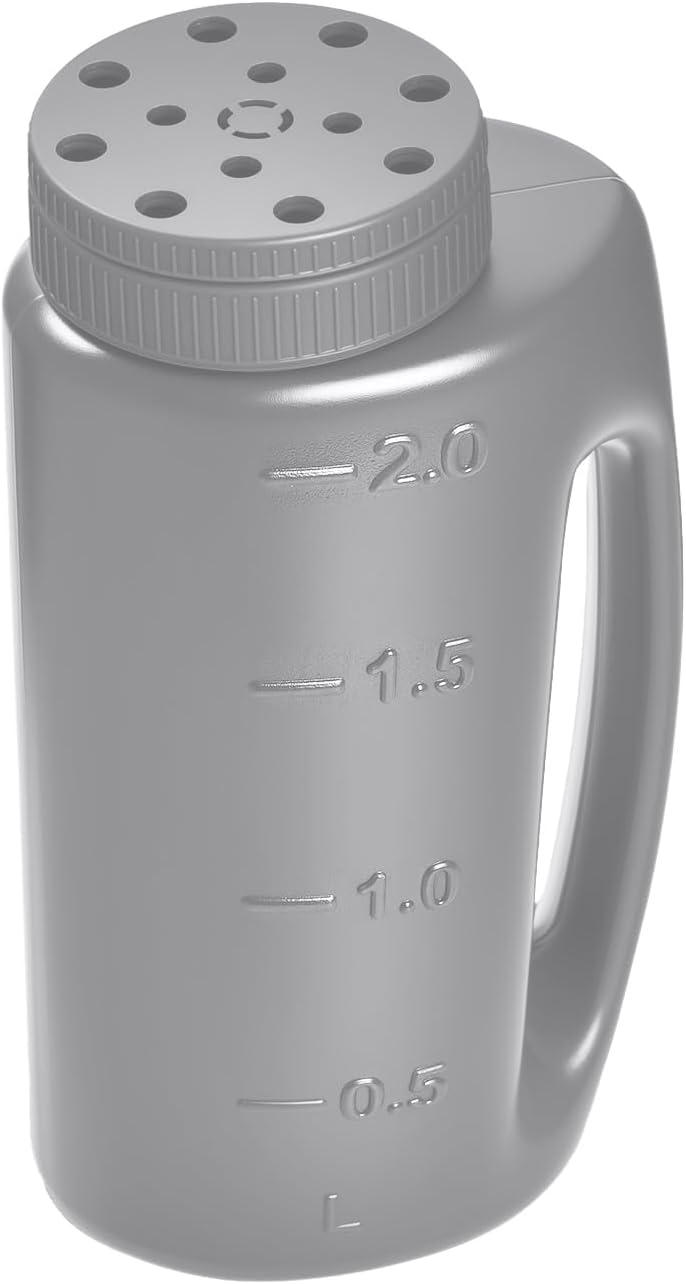
| Capacity | 90 oz |
|---|---|
| Included accessory | Garden gloves |
| Material | Weather-resistant plastic |
| Adjustable openings | Three settings |
The ZXJ Handheld Seed Shaker is a compact broadcast spreader aimed at small to medium yard tasks. It uses a front-facing diffuser and three adjustable openings to control flow so you can switch between fine grass seed and coarser materials like ice melt. The 90 oz capacity reduces refills compared with tiny hand spreaders, and the included garden gloves and ergonomic handle make longer passes more comfortable. Built from weather-resistant plastic, it is lightweight and easy to rinse after use. Expect good uniformity on lawns and walkways when cranked to the right setting, but it lacks a motorized or hopper-agitation system so very damp or clumpy products may need pre-breaking. The unit is straightforward to operate and store, making it a practical, no-frills choice for routine lawn seeding, fertilizing small plots, or spreading salt in winter.
Best for: Homeowners who want an affordable, easy-to-use spreader for routine lawn seeding, fertilizing, and occasional ice-melt tasks and who prioritize simplicity and low maintenance.
Less Ideal for: Commercial landscapers or users who need to treat very large areas quickly or handle consistently wet, clumpy materials should choose a heavier-duty or motorized spreader.
- Large 90 oz hopper reduces trips to refill during small to medium jobs
- Three adjustable openings provide flow control for seeds, fertilizer, or ice melt
- Ergonomic handle and included gloves improve comfort during extended use
- Weather-resistant plastic construction is easy to clean and store
- No mechanical agitation or motor makes it less effective with damp or clumpy materials
- Lightweight plastic may feel less durable under heavy professional use
Verdict: A budget-friendly, easy-to-use handheld spreader that delivers good control and reduced refills for small to medium seasonal lawn and ice-melt tasks.
Scotts Whirl Hand-Powered Handheld Spreader

| Material Type | Metal, Plastic |
|---|---|
| Handle Material | Rubber |
| Capacity Coverage | Up to 1,500 sq. ft. |
The Scotts Whirl is a lightweight handheld spreader designed for small lawns and year-round tasks like seeding, fertilizing, and spreading ice melt. It arrives fully assembled and uses a simple hand-powered mechanism that gives controlled, even distribution of granules over areas up to about 1,500 sq. ft. The adjustable arm support and rubber handle make it comfortable to hold during short jobs, and the metal and plastic construction keeps the unit sturdy while remaining easy to maneuver. Because it is compact and manual, it is quick to set up and very portable for spot treatments, walkways, and driveways in winter. The limitations are obvious: capacity and reach are modest compared with wheeled broadcast spreaders, so it is best for small yards or targeted applications rather than whole-acre feeding. Users should also expect to walk more and refill more often on larger properties. For someone who prioritizes a reliable, no-frills tool for routine small-area work, the Whirl performs predictably and durably.
Best for: Homeowners with small yards who want a dependable, low-maintenance spreader for seasonal seeding, fertilizer touch-ups, and targeted ice melt.
Less Ideal for: People with large lawns or those who need to cover wide areas quickly should choose a larger wheeled or broadcast spreader instead.
- Engineered for smooth, even product coverage to reduce clumping and misses
- Adjustable arm support and rubber handle for greater comfort during use
- Ready to use out of the box since it comes fully assembled
- Lightweight, portable design suitable for quick spot treatments and winter ice melt
- Small capacity limited to roughly 1,500 sq. ft. per fill, requiring frequent refills on larger lawns
- Hand-powered operation is slower and more physically involved than wheeled spreaders for big jobs
Verdict: A simple, reliable handheld spreader that delivers even coverage for small lawns and targeted tasks.
CHAPIN 8740A 64 oz Hand Shaker Spreader

| Capacity | 1.8 kg |
|---|---|
| Bottle Type | Shaker Bottle |
| Reusability | Reusable |
| Material Type | Plastic |
The CHAPIN 8740A is a simple, high-capacity hand shaker that lets you apply small, targeted amounts of seed, fertilizer, ice melt, or sand where a walk‑behind spreader can’t reach. It uses a wide screw-top for quick filling and a twist lid with three opening sizes so you can match the discharge to pellet or granular materials. The large handle is easy to hold with or without gloves and the plastic bottle stands upright for convenient storage even when loaded. Typical use is for sidewalks, steps, patches of lawn, planter beds, and other tight spots that need precise application rather than broad coverage. Because it is manual there are no complex parts to maintain and it is reusable and hand-washable. Limitations are inherent to the format: it is meant for spot jobs rather than treating large lawns, and control of spread rate depends on how fast you shake and the particle size of the material used.
Best for: Buyers who want a reliable, low‑maintenance tool for targeted spreading on sidewalks, steps, small patches of lawn, and garden beds and who prioritize ease of use and proven performance.
Less Ideal for: Homeowners needing to cover large lawns or long driveways should choose a broadcast or walk‑behind spreader instead.
- 64-ounce capacity reduces refills during small jobs
- Three twist-open lid sizes let you match flow to seed, fertilizer, salt, or sand
- Large, easy-grip handle works with or without gloves for winter use
- Simple, durable design with minimal maintenance and reusable bottle
- Not suitable for treating large lawns or wide areas due to manual spot-application design
Verdict: Choose the CHAPIN 8740A when you need a no‑fuss handheld shaker for precise, year‑round spot spreading of seed, fertilizer, or ice melt.
Choosing the Right Handheld Garden Spreader: Key Factors to Consider
Spread Uniformity
Even distribution determines whether seed and fertilizer germinate and feed plants consistently. Uneven spread creates patchy growth and forces repeat applications that waste material and time. For handheld spreaders, uniformity depends on the dispensing aperture design, the spread pattern at walking speed, and how the device prevents bridging inside the hopper.
When evaluating uniformity, consider whether the spreader can handle the particle sizes you plan to use. Some handheld units are tuned for fine grass seed while others work better with coarser pellets. Expect some tradeoffs: tighter patterns give precise delivery near beds and borders, while wider patterns cover turf faster but require steady walking speed.
Flow Control and Metering
Good flow control lets you set application rates to match bag instructions and the material's grain size. A predictable meter reduces the risk of overapplication that can burn turf or underapplication that leaves gaps. Look for adjustable gates or dials with clear detents or graduated markings.
Smooth, adjustable control is especially important if you switch between seed, fertilizer, and ice melt or soil amendments. Devices that lack fine adjustment force you to make multiple short passes or estimate by feel, which increases error. Also check that the control mechanism resists clogging from damp fertilizer and that it does not slip during use.
Hopper Capacity and Refill Convenience
Hopper size dictates how often you stop to refill and how balanced the spreader feels as you work. For small lawns and container zones, a compact hopper keeps the tool light while offering enough capacity to cover a typical bed or several pots. Oversized hoppers add weight and reduce control at the edges.
Consider how easy it is to open and refill the hopper, how securely it closes, and whether the shape funnels material cleanly to the exit. A wide mouth or removable funnel speeds refills. Also note whether the hopper design traps dust or allows moisture to accumulate, which can lead to caking.
Ergonomics and Handling
Handheld spreaders are used while walking beds, edging lawns, and working in tight spaces, so comfort and balance matter. Look for grip shapes and trigger placements that let you control flow without contorting your wrist. Lightweight bodies reduce fatigue during repeat applications.
Handle reach and rotation capability determine how easily you can aim the spread pattern into narrow beds or along sidewalks. Some designs include shoulder straps or hand loops to distribute load for longer jobs. Pay attention to the weight distribution as the hopper empties, since a top-heavy spreader can become awkward and harder to steer precisely.
Materials and Weather Resistance
Garden spreaders are stored outdoors or in unheated sheds, so materials that resist UV, rust, and brittle failure lengthen service life. Plastics should be thick enough to resist cracking from repeated drops and sunlight exposure. Metal components, shafts, and fasteners benefit from corrosion-resistant coatings or stainless construction.
Seals and bearings that tolerate gritty fertilizer help maintain smooth operation. Avoid units with exposed steel that will rust quickly in humid climates. Consider whether replacement parts are likely to be available or if the design is simple enough to maintain with common hardware.
Cleanup and Maintenance
Granular fertilizers and seed can leave residue that attracts moisture and encourages clogs or corrosion if not cleaned. A spreader that disassembles easily or that has smooth internal surfaces reduces the effort required after a job. Look for hoppers and metering parts that are reachable without tools.
Regular cleaning routine matters: rinsing and drying after use, checking the meter for grit, and lubricating moving parts will extend the tool's life. Also consider whether the design protects critical components from dust and grit while in use to lower maintenance frequency.
Best Uses for Handheld Spreaders
Handheld spreaders excel in small landscapes, container groups, and raised beds where a full-size broadcast spreader would be unwieldy. They are ideal for spot-seeding thin patches, topdressing small lawns, and applying controlled amounts of slow-release fertilizer around individual shrubs and perennials.
Because these tools keep application localized, they help you avoid over-treating flower beds and compact planting areas. They also simplify seasonal tasks like overseeding narrow strips and treating pathways without tracking granules from a large hopper.
- Spot-seeding small bare patches
- Feeding containers and hanging baskets
- Applying starter or slow-release fertilizer to beds
- Treating sidewalks and tight turf edges
How to Calibrate a Handheld Spreader
Calibration helps match the spreader setting to the material and desired application rate. Start by consulting the product directions for recommended settings if available, then test on a measured area. Use a flat, measured swath and walk at your normal speed to distribute material.
Collect and weigh or measure the material applied across the test swath, then adjust the gate or dial and repeat until the amount matches the bag's suggested per-square-foot rate. Keep a note of settings for the common products you use so you can repeat the process quickly in future seasons.
- Measure a test strip equal to a common walkway width
- Use consistent walking speed and gate setting during tests
- Record the matched setting for each product you use
Care and Storage Tips
After each use, empty the hopper and brush or rinse away residual granules. Dry the spreader thoroughly before storage to prevent corrosion and caking. If a unit disassembles, remove the meter assembly and clean internal parts to remove dust or sticky residues.
Store your handheld spreader in a dry, shaded place away from direct sunlight to protect plastic parts. Periodically inspect fasteners, seals, and any coated metal for wear and replace or lubricate parts as needed to avoid sticky gates or seized linkages.
- Empty and dry completely before storing
- Clean metering components to prevent buildup
- Store indoors or under cover to limit UV and moisture exposure
Materials and Particle Size Compatibility
Not all handheld spreaders handle every granular product equally. Fine seed, pelletized fertilizers, and larger composted granules flow differently and may require different gate settings or even different dispenser geometries. Check whether the spreader's aperture and agitator design are suited for the products you plan to apply.
If you switch materials frequently, prefer designs with adjustable gates and an agitator or simple internal fins that reduce bridging. For very fine or dusty materials, look for a model that limits fugitive dust and directs the pattern rather than letting material float and drift.
- Match spreader aperture to particle sizes you plan to use
- Adjust gate settings when switching materials
- Favor agitators or internal features that prevent bridging
Walking Technique and Pattern Control
Maintaining a steady walking speed and consistent overlap is essential for even coverage. Walk parallel lines at a comfortable pace and use visual guides like fence lines or path edges to keep your passes consistent. For narrow beds, overlap slightly to avoid thin strips near borders.
When treating small patches, make slow, controlled passes and adjust the gate to a lower flow. Practice on similar surfaces to learn how the unit behaves at your normal pace; this will improve accuracy during actual applications.
- Keep steady walking speed for even coverage
- Use visual guides to maintain straight passes
- Overlap slightly at edges to prevent missed strips
How We Chose the Best Handheld Garden Spreader
We focused on features that matter when spreading seed and granular amendments in small outdoor spaces. Key evaluation criteria were spread uniformity, which reflects how consistently granules are distributed across walkable areas and beds; flow control and dispenser accuracy, which affect how easy it is to meter application rates for different materials; hopper capacity and refill convenience, because small gardens need models sized for short jobs without frequent stops; ergonomics and handling, which influence user fatigue and precision when walking borders or working pots; materials and weather resistance, important for year-round outdoor storage; and cleanup and maintenance, since sticky or wet fertilizers can clog simple mechanisms. We excluded large tow-behind or walk-behind units that are inappropriate for confined yards, as well as devices designed only for liquid or granular-only specialty chemistries. Models with unclear control mechanisms, poor build details, or lack of basic sealing on moving parts were not considered. The final shortlist balances practical on-the-ground use with manageable hopper sizes and reliable metering suited to small lawns, containers, and raised beds.
FAQ
Can a handheld spreader handle both seed and fertilizer?
Often yes. Many handheld units are designed to handle a range of particle sizes, but you should check the manufacturer guidance and calibrate the flow for each product. Fine seed may need a smaller opening and slower walking speed to avoid clumping.
How do I avoid clogging when using damp fertilizer?
Choose a spreader with a simple, accessible metering assembly and consider using an agitator if the product tends to bridge. Clean the hopper after each use and avoid storing damp fertilizer in the tool. If clogs form, disassemble the meter and dry components thoroughly before reassembly.
What walking speed should I use with a handheld spreader?
Use a steady, comfortable pace you can repeat across the area. Calibration tests should be performed at your normal walking speed so the gate setting matches the application rate. Faster speeds widen spread patterns and increase material delivery per pass.
Is a larger hopper better for small gardens?
Not necessarily. Larger hoppers hold more material but increase weight and can reduce control, especially in narrow beds and containers. For small gardens, a compact hopper that balances capacity with maneuverability is usually preferable.
How often should I clean and maintain my spreader?
Clean the hopper and metering parts after every use to prevent buildup and moisture damage. Inspect seals and moving parts at the start and end of each season and lubricate any bearings or pivot points as needed. Regular maintenance prevents clogs and extends service life.
Final Verdict
For small lawns, containers, and narrow beds, prioritize a handheld spreader that delivers consistent spread patterns, fine flow control, and comfortable handling. Expect tradeoffs between hopper size and maneuverability: pick a model that matches the typical job size you tackle. Durable materials and easy access for cleaning will reduce long-term maintenance and keep the tool functioning reliably. Focus on calibration and walking technique as much as hardware. With the right settings and a design suited to the particle sizes you use, a handheld garden spreader will save time and produce more even, professional-looking results in small outdoor spaces.
