

Note: This article contains affiliate links. If you click on these links and make a purchase, I may earn a small commission at no extra cost to you. This helps support my research and content. Read my full affiliate disclosure here.
If you are fighting persistent dandelions in lawn or turf areas, choosing the right herbicide for dandelions makes a big difference in control and grass health. The wrong product or timing can stress desired grass, leave gaps for more weeds, or require repeat treatments. This guide focuses on top-performing herbicides selected specifically for dandelion control across common lawn types and site conditions. We shortlisted six options and evaluated them on practical gardener concerns like effectiveness on established plants, safety for turf, and ease of application. Read on to understand which attributes matter most and how those attributes affect results in a real yard.
Top Picks at a Glance
| Best Overall The best all-around choice for most situations | Roundup for Lawns Ready-to-Use with Extend Wand, 1.33 gal. |  |
| Best Quality Built to a higher standard if you want something more solid | Nufarm Change Up Premium Selective Herbicide, 32 oz |  |
| Best Value The sweet spot between price and what you get | Spectracide Large Plot Weed Stop for Lawns Concentrate, 1 gal |  |
| Best Budget The cheapest option that still gets the job done reliably | Spectracide Weed Stop for Lawns Concentrate, 32 oz Ready-to-Spray |  |
| Most Popular A crowd favorite that many people choose with confidence | Ortho WeedClear Lawn Weed Killer Ready-to-Spray, 32 fl. oz. |  |
| Best Seller A high-volume bestseller chosen again and again | Roundup Weed & Grass Killer4 with Pump 'N Go 2 Sprayer, 1.33 gal |  |
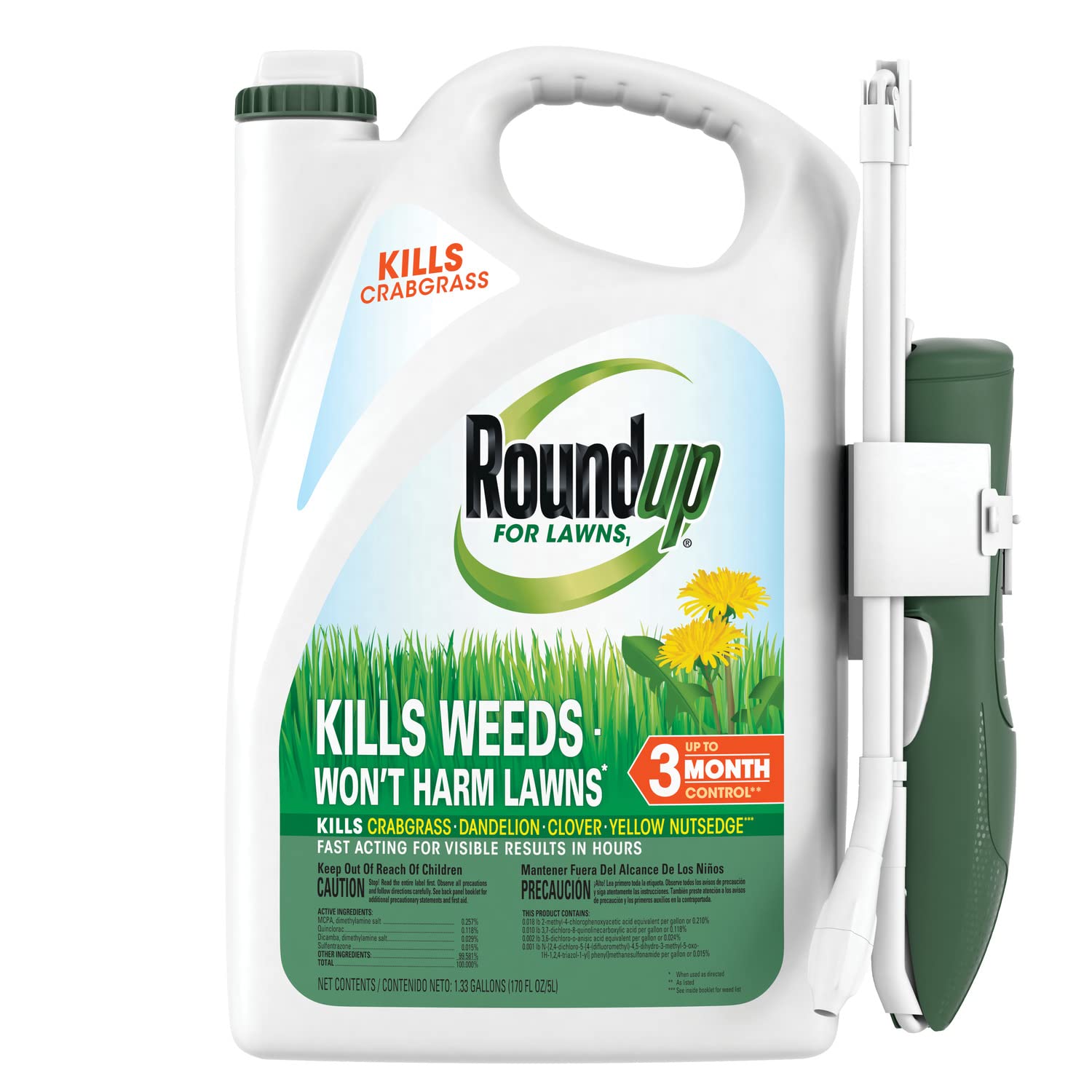
Roundup for Lawns Ready-to-Use with Extend Wand, 1.33 gal.
| Liquid Volume | 1.33 gallons |
|---|---|
| Coverage | 5,000 square feet |
| Item Form | Liquid |
| Active Ingredients | Mcpa, Dimethylamine Salt, Quinclorac, Dicamba, Satr?ntazone |
Roundup for Lawns is a ready-to-use liquid herbicide designed to kill a wide range of common lawn weeds, including dandelions, crabgrass, clover, and yellow nutsedge. It is used as a spot treatment on actively growing weeds in northern turf varieties like Kentucky bluegrass, perennial ryegrass, fescues, and zoysiagrass. The built-in extend wand and continuous spray make it straightforward to target individual plants without mixing or separate equipment. The formula starts working quickly with visible effects in hours and becomes rainproof in about three hours, which helps avoid reapplication after light rain. Coverage of up to 5,000 square feet means one jug treats a typical medium lawn, and the product advertises up to three months of control for listed weeds when used as directed. Important limitations are that it is intended for northern grasses only and should be applied when temperatures are between 45 and 90°F; repeated applications at 21 day intervals may be necessary for persistent grassy weeds. Treated areas should be kept clear of people and pets until sprays dry.
Best for: Homeowners with northern-type lawns who want an easy, ready-to-use product to target dandelions and other common broadleaf weeds without mixing concentrates. It suits users who prioritize convenience and spot treatment over broadcast programs.
Less Ideal for: Those with warm-season lawns or who need a nonchemical or granular broadcast solution should consider different products. Commercial applicators or users needing broad systemic weed control across mixed turf types may prefer a professional formulation.
- Ready-to-use formula requires no mixing or additional sprayer
- Extendable spray wand allows precise spot treatment and easier reach
- Fast-acting and rainproof in about three hours
- Covers up to 5,000 sq ft so a single jug treats a typical lawn
- Claims control of a wide list of common lawn weeds, including dandelions
- Labeled only for use on specified northern grass types so not suitable for all lawns
- May require multiple applications for some grassy weeds
- Contains multiple active herbicide ingredients which require following safety directions carefully
Verdict: An easy, ready-to-use spot-treatment herbicide that quickly targets dandelions and other common broadleaf weeds in northern lawns with minimal setup.
Nufarm Change Up Premium Selective Herbicide, 32 oz

| Item Form | Liquid |
|---|---|
| Coverage | 1000 square feet |
| Active Ingredients | MCPA, fluroxypyr, dicamba |
| Unit Count | 32 Ounce |
Nufarm Change Up is a concentrated liquid herbicide that combines MCPA, fluroxypyr, and dicamba to target more than 200 broadleaf weeds, with labeled use on a wide range of turfgrasses. It is mixed and applied to lawns at the recommended rate to spot-treat or cover up to 1,000 square feet per 32 ounce bottle. The formulation works relatively quickly against tough weeds such as dandelion, plantain, and chickweed and is labeled as an alternative where 2,4-D use is a concern. Practical benefits include broad turf tolerance for both cool- and warm-season grasses and clear use-rate guidance, which helps professional landscapers and serious homeowners get reliable control while minimizing turf damage. Limitations are that it is a chemical control only and requires careful mixing, correct application rates, and adherence to label precautions to avoid off-target injury, especially around desirable broadleaf plants and ornamentals.
Best for: Buyers who prioritize fast, reliable broadleaf weed control on lawns and need a product that works across multiple turf types, including pros and experienced homeowners comfortable with chemical herbicides.
Less Ideal for: Gardeners who prefer organic methods, want to protect nearby broadleaf ornamentals, or are inexperienced with mixing and applying concentrated herbicides.
- Controls more than 200 broadleaf weeds including dandelions
- Labeled for both cool- and warm-season turfgrasses, offering broad turf tolerance
- Concentrated 32 oz bottle covers up to 1,000 square feet for larger treatment areas
- Contains three active ingredients for faster and more robust weed knockdown
- Requires careful mixing and precise application to avoid off-target damage
- Chemical control only and not suitable for users seeking organic or non-chemical options
Verdict: Choose Change Up when you need a concentrated, fast-acting selective herbicide that reliably knocks down dandelions and other broadleaf weeds across most turfgrasses.
Spectracide Large Plot Weed Stop for Lawns Concentrate, 1 gal

| Item Form | Liquid |
|---|---|
| Coverage | 32000 square feet |
| Unit Count | 128 Fluid Ounces |
| Kills | 200+ listed weeds |
Spectracide Large Plot Weed Stop is a concentrated lawn herbicide designed to treat large areas of turf for broadleaf weeds such as dandelion, chickweed and clover. You mix the concentrate with water and apply it with a tank or hose-end sprayer; the formula claims visible results within hours and root-kill for persistent weeds. It is labeled for use on both northern and southern grass types and lists coverage rates that let one gallon treat many thousands of square feet, which makes it efficient for whole-yard applications. The product becomes rainproof within hours and the label gives clear temperature and timing guidance to avoid grass injury. Practical limitations include the need for careful measuring and proper sprayer equipment, plus observing temperature limits and post-application restrictions to protect turf and people. For stubborn weeds a repeat spot treatment may be required. Follow all safety directions and keep people and pets off treated areas until dry.
Best for: Buyers who want an efficient, whole-lawn solution to remove dandelions and other broadleaf weeds across large yards and who are comfortable mixing and applying a concentrate with a sprayer. Ideal for homeowners focused on maximizing coverage and reducing repeat applications across established turf.
Less Ideal for: Gardeners needing a ready-to-use spot treatment or those who prefer non-chemical weed control methods should consider alternatives. Do not choose this if you lack safe application equipment or cannot follow temperature and drying restrictions.
- Concentrated formula provides high coverage so one bottle treats large areas
- Kills a wide range of broadleaf weeds down to the root for longer control
- Works on common dandelions and other listed weeds with visible results in hours
- Rainproof within hours so light rain soon after application is less likely to wash it away
- Requires mixing and a compatible sprayer which adds setup time and potential for mixing errors
- Must not be applied above specified air temperatures to avoid turf damage
Verdict: A cost-effective concentrated herbicide that treats very large lawns and reliably kills dandelions and other broadleaf weeds when mixed and applied correctly.
Spectracide Weed Stop for Lawns Concentrate, 32 oz Ready-to-Spray

| Item Form | Liquid |
|---|---|
| Coverage | 8,000 square feet |
| Unit Count | 32 Ounce |
| Active Ingredients | 2,4-D, Mecoprop-P, Dicamba, Sulfentrazone |
Spectracide Weed Stop for Lawns Concentrate is a ready‑to‑spray herbicide formulated to kill broadleaf weeds, including dandelions, by contact down to the root. You attach the QuickFlip sprayer to a garden hose, set the dilution built into the bottle, and spray until weeds are wet; the label recommends application when daytime temperatures are between 45 and 90 degrees and mowing two to three days before treatment for best results. The formula lists common active ingredients used for long‑established weeds and promises visible wilting in as little as three hours and rainproofing after an hour. It covers a large area per bottle and is marketed for common turfgrasses such as bluegrass, fescue, Bermuda and perennial ryegrass, though it warns against treating zoysiagrass just coming out of dormancy. Practical limitations are that it is a contact systemic mix that requires thorough coverage to reach roots, timing and turf compatibility matter to avoid lawn injury, and safety precautions mean keeping people and pets off treated areas until dry and waiting several weeks before reseeding.
Best for: Homeowners who want an affordable, ready‑to‑use solution to quickly control visible dandelions and other broadleaf weeds across a typical lawn without buying separate sprayers.
Less Ideal for: People managing newly seeded lawns, delicate or uncommon turf varieties, or those seeking an organic or nonchemical dandelion control method should consider alternatives.
- QuickFlip hose‑attach sprayer for easy application without mixing separate equipment
- Visible results in as little as three hours for fast knockdown of dandelions and other broadleaf weeds
- Formulated for use on common turfgrasses and designed to spare lawn when used as directed
- Rainproof within one hour so light showers are less likely to wash treatment away
- Requires thorough spray coverage and correct timing to reach roots and avoid turf damage
- Not safe for all turf stages such as zoysiagrass coming out of dormancy and should not be used above 90°F
Verdict: A budget‑friendly, ready‑to‑spray concentrate that gives fast visible control of dandelions across a typical lawn.
Ortho WeedClear Lawn Weed Killer Ready-to-Spray, 32 fl. oz.

| Item Form | Spray |
|---|---|
| Coverage | 5000 square_feet |
| Liquid Volume | 32 fluid ounces |
| Active Ingredients | 2,4-D; Quinclorac; Dicamba (dimethylamine salts) |
Ortho WeedClear Ready-to-Spray is a hose-end herbicide designed for homeowners who want a fast, no-mixing option to remove broadleaf and grassy weeds including dandelions. You attach it to a garden hose, flip the on switch, and spray the lawn until wet; the formula claims visible results in hours and becomes rainproof within one hour, which simplifies timing around weather. It lists active ingredients commonly used in lawn weed control and covers up to 5,000 sq. ft. per 32 fl. oz. bottle, so one treatment can handle a typical yard. The product is labeled safe for many northern lawn grasses when applied according to directions and warns against use on sensitive grasses and ornamental plants. For risk-aware buyers, the clear directions, labeled grass compatibility, and fast weatherproofing reduce uncertainty about damage to turf and wasted applications. Limitations are that it is not suitable for all turf types, needs application when weeds are actively growing and temperatures are within the recommended range, and users must follow safety precautions to avoid exposure to skin and eyes.
Best for: Homeowners who want an easy, proven spot- and lawn-treatment for dandelions and other common weeds and who prioritize clear usage guidance and documented turf compatibility.
Less Ideal for: Landscapers or gardeners working with sensitive turf species or ornamental beds, and those who need a product labelled for year-long residual prevention rather than a fast knockdown solution.
- Ready-to-use hose-end sprayer requires no measuring or mixing
- Fast-acting formula with visible results in hours and rainproof in one hour
- Covers up to 5,000 sq. ft. from a single 32 fl. oz. bottle
- Labeled safe for many common northern turfgrasses when directions are followed
- Not labeled for use on several warm-season or sensitive grasses and ornamentals
- Requires application when weeds are actively growing and within a specified temperature range
Verdict: A fast, easy hose-end herbicide that reliably knocks down dandelions and other common lawn weeds while being safe for many turfgrasses when used as directed.
Roundup Weed & Grass Killer4 with Pump 'N Go 2 Sprayer, 1.33 gal

| Unit Count | 170 Fluid Ounces |
|---|---|
| Coverage | 300 Square_Feet |
| Item Form | Spray |
| Active Ingredients | Triclopyr; Fluazifop-P-Butyl; Diquat Dibromide |
This Roundup kit combines a 1.33 gallon container of Weed & Grass Killer4 with a Pump 'N Go 2 sprayer so you can treat patches of dandelions and other broadleaf weeds without mixing concentrates. The formula lists multiple active ingredients for control of tough weeds and grasses and the extendable wand improves reach and accuracy while you stay upright. It becomes rainproof quickly and the manufacturer says you can see visible results in hours and replant 1 to 30 days after application. The built-in sprayer gives up to 10 minutes of continuous spray, which is convenient for treating beds, driveways, cracks, and edging. Important practical limits are safety and use restrictions: the product is an herbicide that requires protective clothing, keeps people and pets away until spray dries, and should be applied only where you want vegetation killed. It is best for spot treatments and perimeter use rather than broadcast application across lawns where selective control is needed.
Best for: Buyers who want a straightforward, low-hassle solution for eliminating dandelions and other persistent weeds in beds, cracks, and edges without mixing concentrates and who prioritize predictable, fast results.
Less Ideal for: Homeowners seeking a lawn-safe selective herbicide for turf-wide weed control or those who prefer non-chemical weed management methods.
- Ready-to-use kit with an included Pump 'N Go sprayer—no mixing required
- Extendable wand and up to 10 minutes continuous spray for accurate spot treatment
- Formulation targets broadleaf weeds and grasses and reports visible results in hours
- Becomes rainproof quickly allowing treatment to remain effective after short delays
- Contains strong herbicide active ingredients that require protective clothing and caution around desirable plants
Verdict: An easy, effective spot-treatment system that delivers quick control of dandelions and other broadleaf weeds without mixing concentrated chemicals.
Choosing the Right Herbicide for Dandelions: Key Factors to Consider
Active Ingredient and Mode of Action
The active ingredient determines how the herbicide attacks dandelions and whether it targets root systems or only foliage. Some actives move systemically down into the taproot, improving control of mature plants, while contact actives only scorch leaves and often require repeated applications. Knowing the mode of action also helps avoid resistance issues if you need repeated treatments over multiple seasons.
When comparing products, check whether the label specifies systemic control of broadleaf weeds and lists dandelion explicitly. For repeated or widespread use, rotate chemistries or combine with cultural controls to reduce the chance of tolerant populations developing.
Turf Species Compatibility
Different herbicides are labeled for different grass types. A product safe on cool-season grasses such as fescue and ryegrass may damage warm-season grasses like Bermuda or Zoysia, and vice versa. Always match the herbicide labeling to the lawn species and the time of year when the grass is actively growing to reduce phytotoxicity risk.
If you maintain mixed lawns or plan to reseed or overseed after treatment, choose a product with clear instructions for timing relative to planting. Turf compatibility directly affects which products are practical for your yard and how soon you can repair any treated areas.
Timing and Growth Stage
Application timing affects uptake and ultimate control. Dandelions are most vulnerable when actively growing and before they set seed; root translocation is generally better in spring and fall when the plant is moving sugars to roots. Applying during dormancy or extreme heat can reduce effectiveness.
Consider the life stage of the weeds in your yard and plan applications when soil moisture and temperatures favor active growth. Some products have label guidance on best seasons or growth conditions that optimize control.
Formulation and Application Method
Herbicides come as ready-to-use sprays, concentrates for dilution, granules, or spot-treatment gels. Ready-to-use options simplify application for small patches, while concentrates are more cost-effective for larger areas but require accurate mixing. Granules offer ease for homeowners who prefer not to spray, but they may deliver slower uptake.
Think about your yard size, access to spray equipment, and how precise you need the application to be. Ease of measuring, required protective equipment, and the ability to target blooms or rosettes matter when planning a treatment strategy.
Re-entry Intervals and Safety
Label instructions include re-entry intervals, precautions for children and pets, and recommended personal protective equipment. These rules protect users and determine how quickly you can resume normal yard activities or allow pets on treated areas. They also influence timing relative to other lawn tasks like mowing or watering.
Pick products whose safety profile and required precautions match your household routines. If you have frequent lawn use by children or pets, consider products with shorter re-entry intervals and clear guidance on safe practices.
When Chemical Control Makes Sense
Using herbicide for dandelions is most appropriate when infestations are widespread, when hand removal is impractical, or when dandelions reappear quickly after digging. Chemical options can protect turf density by reducing repeated disturbance from mechanical removal.
Before treating, evaluate lawn health. Improving mowing height, fertility, and soil conditions reduces future dandelion pressure and often enhances herbicide performance by promoting vigorous turf that competes with new weed seedlings.
- Spot treat small patches to reduce chemical use
- Combine with cultural improvements for longer-term control
- Avoid spraying during drought stress or extreme heat
Seasonal Calendar for Best Results
Spring and fall applications typically give the best systemic uptake into dandelion taproots. In spring, treat when rosettes are actively growing and before heavy flowering. In fall, treatments benefit from the plant's downward movement of carbohydrates into roots, improving systemic herbicide translocation.
Summer treatments can work on young plants but are less reliable on mature, heat-stressed dandelions. Adjust timing around local weather and lawn growth patterns for optimal outcomes.
- Early spring: target newly emerged rosettes
- Late summer to fall: treat actively growing plants for root uptake
- Avoid applications during drought or when grass is dormant
Spot Treatment and Application Tips
For small infestations, spot treating individual plants reduces chemical exposure and cost. Use a nozzle or trigger sprayer that gives good coverage to the rosette without overspraying surrounding turf. For concentrates, mix only what you need and label leftover solution for disposal according to local guidelines.
Mow a few days before treatment if the dandelions are tall, but avoid mowing immediately after application. Watering schedules should follow label directions; many systemic products require a short dry period for foliage uptake followed by light watering to move residues into soil if specified.
- Apply on calm days to prevent drift
- Calibrate sprayer to deliver labeled rate
- Protect desirable ornamentals from drift and runoff
Integrating Herbicides with Cultural Practices
Chemical control is one tool in an integrated lawn management plan. Thicken turf through appropriate fertilization, overseeding, and correct mowing height to reduce bare patches where dandelions establish. Aeration and soil pH correction can remove the environmental advantages that let dandelions outcompete grass.
After herbicide treatment, monitor the area for new seedlings and spot treat as needed. Overseed treated patches once the herbicide's waiting period has passed to restore competitive turf cover and prevent new dandelion flushes.
- Address soil compaction and pH to discourage dandelion growth
- Plan overseeding based on product label timing
- Use targeted follow-up treatments rather than blanket applications
Environmental and Neighborhood Considerations
Consider runoff risk and nearby gardens or waterways before application. Avoid treating slopes or areas prone to heavy runoff without buffering measures. Use spot treatments or low-drift nozzles near ornamental beds to prevent non-target damage.
Talk to neighbors if you treat a shared lawn or common area, as timing and method choices can affect adjacent properties. Follow label instructions to minimize environmental exposure and respect local regulations governing herbicide use.
- Use buffer strips near water and gardens
- Prefer low-drift application methods in windy areas
- Check municipal rules on herbicide application and public spaces
How We Chose the Best Herbicide for Dandelions
We selected products based on criteria that reflect everyday results in home lawns and turf. Effectiveness on established dandelions was a primary filter, giving preference to treatments with documented activity against mature taproots and regrowth suppression. Turf safety and selectivity were essential, with attention to labeled grass species and damage risk to cool- and warm-season lawns. Application practicality was evaluated, including formulation type, required tank mixes, and realistic coverage for home gardeners. Residual activity and re-treatment intervals were considered to balance control with the need to reseed or overseed. We excluded items with insufficient label guidance for home lawn use or those requiring specialized commercial equipment. Products that rely solely on mechanical digging or non-chemical control were not included. The final list reflects options that meet the above filters while offering a range of application styles and control profiles. These evaluation criteria align directly with the scoring metrics used in our per-product scorecards.
FAQ
Can a single application eliminate mature dandelions?
A single well-timed systemic application often kills many mature plants, but deeply established taproots or heavy infestations may require follow-up treatments. Effectiveness depends on application timing, active ingredient, and plant condition.
Will herbicide treatment harm my lawn grass?
Some herbicides are selective and safe for many turf species when applied at the labeled rate and timing, while others can damage sensitive grasses. Match the product label to your turf species and avoid applying during stress periods to reduce damage risk.
How long after treatment can I mow or reseed?
Mowing and reseeding intervals vary by product. Many labels recommend waiting a few days before mowing and several weeks before seeding. Follow label instructions for post-application activities to ensure herbicide uptake and safe reseeding timing.
Are granular herbicides as effective as liquid sprays?
Granules can be effective for broad application and are easier to apply without sprayers, but they often act slower and may need rain or irrigation for activation. Liquid systemic sprays typically give faster contact and translocation into roots for established dandelions.
Can I treat dandelions near flower beds or vegetable gardens?
Treat carefully near desirable plants; drift or runoff can damage ornamentals and edibles. Use spot treatments, shielded applications, or apply on calm days and maintain buffer zones to protect non-target vegetation.
Final Verdict
Choosing the right herbicide for dandelions depends on balancing fast, systemic control with the safety of your turf and household routines. Focus on products with a mode of action suited to root uptake, confirm compatibility with your grass species, and time applications when plants are actively growing. Pair chemical treatment with cultural practices like overseeding, mowing at the correct height, and soil improvement to reduce future dandelion pressure. Prioritize safety instructions and follow label timing to get reliable control while protecting your lawn and landscape.
