

Note: This article contains affiliate links. If you click on these links and make a purchase, I may earn a small commission at no extra cost to you. This helps support my research and content. Read my full affiliate disclosure here.
If you are dealing with persistent poa annua in lawns, choosing the right herbicide matters for both control and the health of desirable turf. Poa annua behaves differently through the seasons and can reseed itself rapidly, so treatment must consider timing, contact versus systemic activity, and how the product affects surrounding grass species. This guide covers five top herbicide options suited for Poa Annua Grass situations. We shortlisted products that balance effectiveness on poa annua with reasonable turf safety and practical application windows. Below we explain the criteria used, the main factors to weigh when choosing a treatment, and answers to common questions gardeners face when targeting this weed in lawns.
Top Picks at a Glance
| Best Overall The best all-around choice for most situations | Pronamide 3.3 SC Herbicide, 1 Gallon |  |
| Best Quality Built to a higher standard if you want something more solid | Syngenta Tenacity Turf Herbicide, 8 oz |  |
| Best Value The sweet spot between price and what you get | Quali-Pro Prodiamine 65 WDG Pre-emergent Herbicide, 5 lb |  |
| Highest Rated A top-rated pick with lots of positive feedback | Quali-Pro Prodiamine Pre-Emergent Herbicide, 5 lb Granules |  |
| Most Popular A crowd favorite that many people choose with confidence | Scotts Halts Crabgrass & Grassy Weed Preventer, 10.06 lb. |  |
Pronamide 3.3 SC Herbicide, 1 Gallon

| Unit Count | 128 Fluid Ounces |
|---|---|
| Item Form | Liquid |
| Active Ingredients | Pronamide 35.6% |
Pronamide 3.3 SC is a suspension concentrate herbicide intended primarily as a pre-emergent treatment for warm-season turfgrass with some post-emergent activity. It is typically mixed in spray tanks and applied to turf where it creates a soil residual that suppresses germinating annual weeds, and it is noted specifically for controlling Poa annua. The formulation is low-odor and designed for tank-mix flexibility so you can combine it with compatible products to broaden control or address existing weeds. Because it uses a different chemistry than sulfonylurea herbicides, it is a useful rotational tool to manage resistant weed populations. Practical benefits include strong residual control and the ability to fit into an integrated program. Important limitations are that label directions must be followed for timing and rates to avoid turf injury and that it is not a standalone quick knockdown for large, established infestations; post-emergent results are limited compared with dedicated contact herbicides.
Best for: Turf managers and homeowners focused on performance who need a rotational pre-emergent to suppress Poa annua in warm-season lawns and who plan seasonal, programmatic weed control.
Less Ideal for: Casual users seeking an immediate knockdown solution for large, established weeds or those unwilling to follow specific label timing and application requirements.
- Effective pre-emergent residual control against Annual Bluegrass in warm-season turf
- Different active ingredient class useful for resistance management against sulfonylurea-resistant weeds
- Suspension concentrate formulation with low odor and tank-mix flexibility
- Available in a one-gallon jug suitable for treating multiple applications
- Not designed as a fast-acting contact solution for large established weed patches
- Requires careful adherence to label timing and rates to prevent turf damage
Verdict: Choose Pronamide 3.3 SC when you need proven residual pre-emergent control of Poa annua as part of a performance-oriented turf herbicide program.
Syngenta Tenacity Turf Herbicide, 8 oz

| Unit Count | 8 Fluid Ounces |
|---|---|
| Item Form | Liquid |
| Coverage | 2000 ft^2 per 1sp of product |
| Active Ingredients | Mesotrione |
Tenacity Turf Herbicide is a concentrated mesotrione-based liquid designed for both pre-emergent and post-emergent control of common lawn weeds including crabgrass, clover, chickweed and dandelions. You apply it diluted according to label rates with a handheld or hose-end sprayer to target problem areas or broadcast across the lawn; when used as a pre-emergent it is taken up as weeds emerge and when applied post-emergent it acts systemically for selective control. The product covers a large area per bottle and the active ingredient provides residual control so you can expect longer suppression than a contact-only herbicide. Important practical points are that it is turf-selective so follow the label for grass species and mixing instructions to avoid turf injury, and results can take several days to appear. Also this is a concentrated chemical intended for careful, measured application rather than spot-use by people who prefer non-chemical methods.
Best for: Gardeners focused on strong, reliable crabgrass and broadleaf weed control who are comfortable using concentrated herbicides and following label directions for turf safety.
Less Ideal for: People seeking organic, mechanical, or spot-only solutions or those unwilling to follow detailed mixing and application instructions should consider other options.
- Systemic mesotrione active ingredient controls both pre- and post-emergent weeds
- Selective to turf when used per label, allowing treatment without killing desirable grass species
- Concentrated 8 oz liquid provides wide coverage per bottle
- Provides residual suppression, reducing frequency of repeat applications
- Requires careful mixing and adherence to label for turf safety
- Not a non-chemical or organic option for weed control
Verdict: Choose Tenacity when you want a concentrated, turf-selective herbicide that delivers pre- and post-emergent control of crabgrass and other common lawn weeds.
Quali-Pro Prodiamine 65 WDG Pre-emergent Herbicide, 5 lb

| Item Form | Granule |
|---|---|
| Unit Count | 80 Ounce |
| Coverage | 0.5-2.30 lbs per acre or 0.185-0.55 oz per gallon, 1,000 sq.ft. |
| Active Ingredients | Prodiamine, Iron, Herbicide |
Quali-Pro Prodiamine 65 WDG is a pre-emergent herbicide sold as granules that prevent many common grassy and broadleaf weeds when incorporated into soil or applied as a spray solution. It is typically mixed at label rates and applied with a pump sprayer or battery hand can to flower beds and landscape areas in spring and fall for season-long control of weeds like crabgrass, chickweed, foxtail and spurge. The product’s broad-spectrum activity and flexible coverage rates make it cost effective for treating multiple beds or larger areas, and the dry formulation stores and measures easily. Important practical considerations include strict adherence to label directions for application rate and safety equipment and timing, and the fact that it is a preventive product so it will not control weeds that are already established. Also follow specific flower bed planting intervals, since pre-emergents can inhibit seed germination of desirable annuals and some perennials. When used correctly it is a reliable way to reduce weed pressure before seedlings emerge.
Best for: Gardeners who prioritize efficient, preventive weed control in established flower beds and want a cost-conscious, season-long solution to reduce weed emergence without frequent spot treatments.
Less Ideal for: People who need to remove existing mature weeds, or who plan to seed annual flowers immediately after treatment; those wanting an all-in-one post-emergent solution should look elsewhere.
- Broad-spectrum control of many grassy and broadleaf weeds
- Granule form that mixes for spray application and is simple to store and measure
- Effective for both spring and fall applications for season-long prevention
- Flexible coverage rates allow treating small beds to larger landscape areas
- Pre-emergent only and will not kill weeds already growing
- Can prevent germination of desirable seeds so timing relative to planting is critical
Verdict: Use this prodiamine granular pre-emergent when you want a practical, cost-effective way to prevent common weeds in established flower beds before they emerge.
Quali-Pro Prodiamine Pre-Emergent Herbicide, 5 lb Granules

| Item Form | Granule |
|---|---|
| Coverage | Pre-emergent grass and broadleaf weed control, season long crabgrass control |
| Active Ingredients | Prodiamine 65% |
Quali-Pro Prodiamine is a granular pre-emergent herbicide designed to prevent germination of common annual grassy and broadleaf weeds across lawns and landscape beds. You apply it before weed seeds germinate in spring or as a fall treatment to build residual control through the growing season. The product contains 65% prodiamine, which is widely used for reliable, long-lasting control of crabgrass, annual bluegrass and several broadleaf weeds, and it mixes readily when tank-mixed with fertilizers or iron. In real-world use it offers predictable, season-long suppression when applied at the labeled rate and incorporated by irrigation or rainfall. Important practical limits are that it is preventive only and will not kill established weeds, and proper timing and rate are essential to avoid reduced effectiveness. For larger areas the 5 lb package covers moderate lawn acreage but may require multiple bags for extensive turf.
Best for: Homeowners and lawn care professionals who prioritize a dependable, season-long preventive solution to keep crabgrass and annual weeds from establishing in turf.
Less Ideal for: Gardeners needing a post-emergent solution for existing weeds or those who prefer liquid ready-to-use products for spot treatments.
- High active ingredient concentration (Prodiamine 65%) for long residual control
- Granular form allows easy broadcast application and tank mixing with fertilizers
- Effective season-long crabgrass and annual weed suppression when applied correctly
- Suitable for spring or fall applications to build preventive control
- Pre-emergent only and will not control established weeds
- 5 lb bag may be insufficient for large lawns without purchasing additional quantity
Verdict: Choose this prodiamine granule when you want a proven, season-long preventive herbicide to reliably stop crabgrass and other annual weeds before they start.
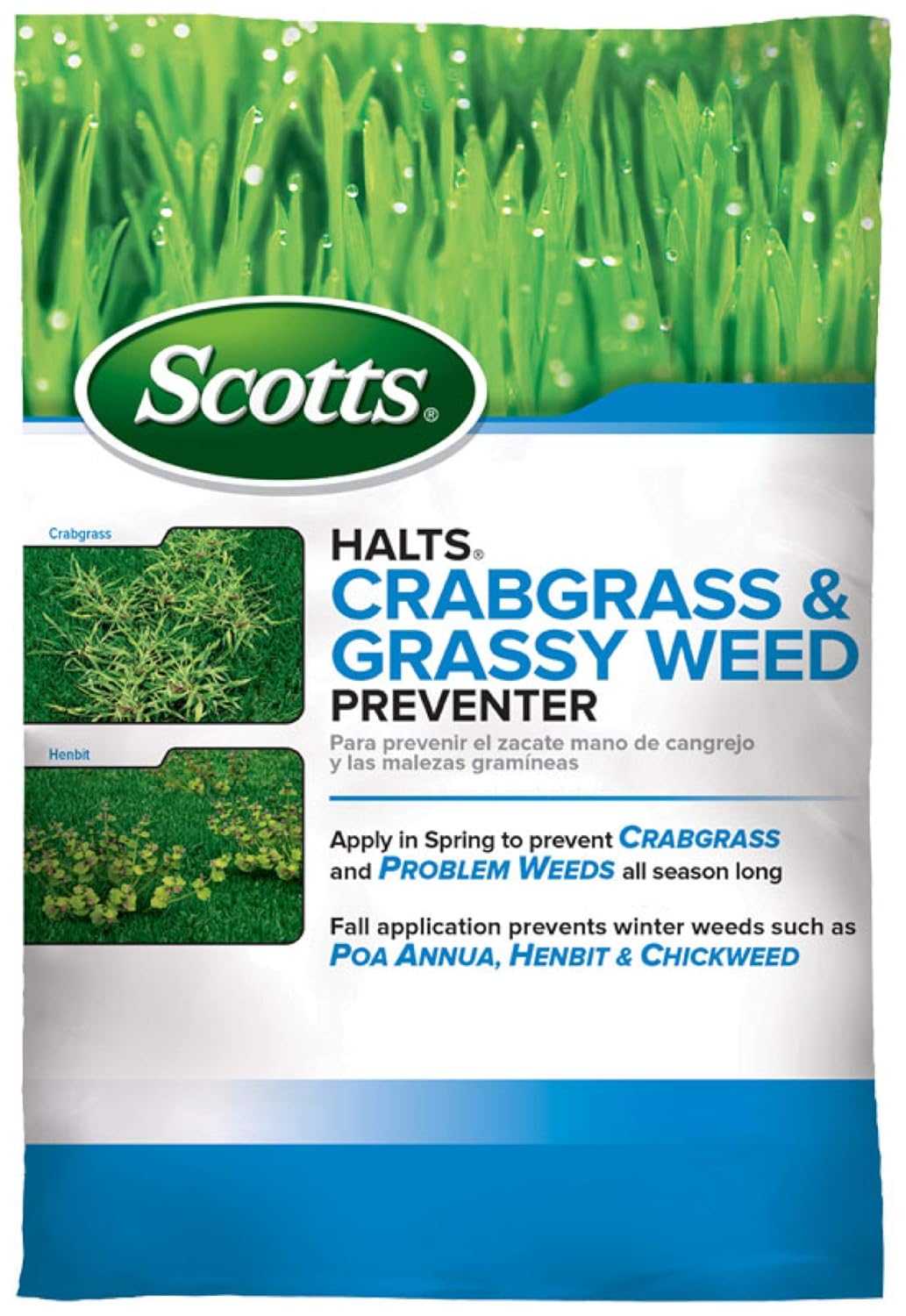
Scotts Halts Crabgrass & Grassy Weed Preventer, 10.06 lb.
| Item Form | Granule |
|---|---|
| Coverage | 5000 square_feet |
| Active Ingredients | Pendimethalin 1.71% |
Scotts Halts is a granular pre-emergent formulated to stop crabgrass and seeded grassy weeds from germinating across established lawns. You apply it dry with a broadcast spreader in early spring or fall, then water it in as directed; the active ingredient pendimethalin forms a soil barrier that prevents weed seedlings from emerging and is advertised as resistant to rain, snow, or freezing after application. This bag treats up to 5,000 square feet and is intended for use on most turf types except Dichondra and Bentgrass. The practical benefits are straightforward: a single timed application protects turf from several common annual weeds without needing spot herbicide treatments, and the granule form makes even coverage with a spreader easy. Important limitations are that it does not kill existing mature weeds and cannot be used on newly seeded or sprigged areas until months later, so timing and measuring lawn area matter. Also repeat applications for certain weeds like goosegrass may be necessary according to label instructions.
Best for: Homeowners who plan lawn care around seasonal timing and want a preventive, low-effort way to stop annual grassy weeds before they emerge.
Less Ideal for: People needing to remove existing weed infestations, those reseeding or establishing new turf within months, or gardeners who require immediate weed knockdown.
- Pre-emergent action prevents crabgrass and listed grassy weeds before they germinate
- Covers up to 5,000 sq ft per bag for single-application protection
- Granule form designed for even spreader application and easy watering activation
- Rain, snow, or freezing after application will not reduce effectiveness
- Does not control existing mature weeds so not useful for established infestations
- Not safe for newly seeded or freshly sprigged lawns for several months
Verdict: Use this granular pre-emergent if you want a seasonal, preventative barrier against crabgrass and common grassy weeds on an established lawn up to 5,000 sq ft.
Choosing the Right Herbicide for Poa Annua Grass: Key Factors to Consider
Mode of Action and Contact Vs Systemic Control
How a herbicide kills plants determines whether it controls only aboveground growth or eliminates the root and meristem. Contact herbicides scorch leaves and act quickly but often leave roots or crowns intact, which can allow Poa annua to regrow. Systemic herbicides move inside the plant and can provide more thorough control of established clumps and root systems.
Knowing the mode of action also helps avoid resistance buildup. Repeated use of the same mechanism increases selection pressure. Rotate chemistries or use mixes with different modes when the label permits. For targeted Poa annua control, understand whether you need immediate visible knockdown or sustained root-level suppression and choose products that match that need.
Turf Species Compatibility and Safety
Different turfgrasses have varying tolerance to herbicides. A product that is safe on warm-season grasses may injure cool-season varieties and vice versa. Some herbicides are labeled for a narrow set of turf species; others are broad-spectrum. Always match the product label with the species in your lawn to avoid thinning, discoloration, or long-term damage.
Consider the age and condition of the turf as well. Newly sodded or thin lawns are more vulnerable to injury. If your goal is selective removal of Poa annua from a desirable stand, choose products with proven selectivity for that turf type and follow lower-rate recommendations on fragile turf.
Timing Relative to Poa Annua Life Cycle
Poa annua has distinct germination and flowering periods that influence treatment effectiveness. Pre-emergent treatments work best before seed germination, while post-emergent options are needed for actively growing plants. Applying a post-emergent herbicide when plants are stressed by drought or extreme heat reduces uptake and efficacy.
Plan treatments around cooler, actively growing periods for best results. For long-term suppression, combine timely pre-emergent applications with targeted post-emergent follow-ups when seedlings or mature plants appear. Proper timing reduces repeat applications and improves control.
Application Method and Coverage
Uniform coverage is essential for contact herbicides and still very important for systemic products. Spray equipment, nozzle selection, and water volume affect droplet size and coverage. Hand-held sprayers may be sufficient for small patches, while a push sprayer or professional boom is better for larger areas to achieve even distribution.
Calibration matters. Overapplication risks turf injury and environmental impact, while underapplication reduces control and promotes resistance. Read the label for recommended spray volumes and equipment settings. Consider ease of rinsing and cleaning applicators when switching chemistries to prevent accidental damage to sensitive plants.
Reentry Interval and Post-Application Care
Labels often require specific reentry intervals for safety and to avoid spreading treated clippings. Mowing restrictions after treatment may influence when you can resume normal lawn care. Some products suggest waiting several days before mowing to allow translocation; others have short or no mowing restrictions.
Post-application care also includes watering recommendations. Some systems require rain-free windows after application, while others benefit from activation by irrigation. Follow label directions for overseeding, fertilization, and irrigation after treatment to protect desirable turf recovery and to avoid disrupting residual activity.
Environmental and Regulatory Considerations
Think about runoff risk, proximity to water bodies, and local regulations that may limit certain active ingredients or application rates. Some herbicides have label restrictions near irrigation ditches, wells, or aquatic habitats. Residual products can persist in soil and affect nearby plantings or seeded areas.
If you are managing turf near vulnerable areas, choose products with lower runoff potential and follow buffer requirements. Proper storage, mixing, and disposal of leftover product and rinse water are also important to minimize environmental impact and comply with local rules.
When To Use Pre-emergent Vs Post-emergent Treatments
Pre-emergent herbicides prevent Poa annua seed from germinating and are most effective when applied before the typical germination window in your region. Use pre-emergents as part of a seasonal prevention plan to reduce seedling flushes.
Post-emergent products are necessary when established plants are visible. Target young, actively growing plants for better uptake. In many lawns, a combined strategy of timed pre-emergent applications followed by spot post-emergent treatments provides the best balance of prevention and control.
- Pre-emergents reduce new seedlings but will not kill existing Poa annua.
- Post-emergents work best on actively growing plants and may require repeat treatments.
Spot Treatment Strategies for Isolated Patches
For small patches, spot treating concentrates product where it is needed and reduces overall chemical load. Use a hand-held sprayer or pump applicator for precise coverage and avoid drift onto desirable grass.
Combine physical removal with herbicide where appropriate. In dense clumps, cutting or pulling followed by a targeted post-emergent application on the remaining plants can be more effective than chemical means alone.
- Mark and treat patches on calm, low-wind days.
- Rinse equipment between treatments to avoid cross-contamination.
Integrating Cultural Practices With Chemical Control
Improving cultural practices reduces the conditions that favor Poa annua. Raise mowing height within recommended ranges for your turf species to shade the soil and reduce seedling establishment. Proper irrigation that favors deeper roots in desirable turf also limits spaces where Poa thrives.
Aeration, overseeding with competitive desirable species, and balanced fertility help maintain a dense turf canopy that suppresses Poa annua over time. Chemical controls are most durable when combined with a strong cultural program.
- Adjust irrigation timing to avoid frequent shallow watering.
- Use overseeding windows when the herbicide label permits reseeding safely.
Safety Precautions and Personal Protective Equipment
Always follow label instructions for protective equipment. Typical recommendations include protective gloves, long sleeves, eye protection, and sometimes respiratory protection depending on formulation and application method.
Keep children and pets off treated areas for the period specified on the label and store products securely. Proper mixing and disposal of rinse water and unused product prevents accidental exposure and environmental harm.
- Use waterproof gloves when handling concentrates.
- Avoid application on windy days to reduce drift.
Managing Resistance and Long-term Control
Repeated reliance on a single mode of action increases the risk of herbicide resistance in Poa annua populations. Rotate products with different mechanisms when possible and follow label guidance on maximum annual use rates.
Monitor treated areas and record what you applied and when. If control declines over seasons, consider integrating non-chemical measures and consult local extension resources for resistance management strategies.
- Alternate application timing and modes of action across seasons.
- Keep records of treatments to spot patterns of declining efficacy.
How We Chose the Best Herbicide for Poa Annua Grass
We prioritized options that offer reliable activity on Poa annua while limiting harm to common lawn grasses. Evaluation focused on specific control characteristics relevant to this weed and real-world lawn care schedules. Key criteria included mode of action and contact versus systemic control to assess how thoroughly the product controls existing plants and seedlings. Turf safety and selectivity were crucial because treatments that damage desirable grass defeat the purpose of control. Timing and seasonal effectiveness were considered to match lifecycle stages of Poa annua, including pre-emergent and post-emergent windows. Application practicality covered tank-mix compatibility, required reapplications, and label clarity for homeowners and turf managers. Environmental considerations included runoff risk and restrictions on use in certain turf types. We excluded products lacking clear label guidance for Poa annua or those primarily intended for non-turf settings. We did not include experimental or unregistered chemistries. The final shortlist reflects products that meet the above filters and perform across the dimensions that matter most for effective, safe Poa annua management.
FAQ
When is the best time to apply a herbicide for Poa annua control?
It depends on the product type. Pre-emergent products should go down before the local germination window, typically in cooler fall or spring periods depending on region. Post-emergent treatments are best on actively growing plants during mild weather when uptake is highest.
Will a single treatment eliminate Poa annua from my lawn?
Often it does not. Poa annua produces persistent seed and may require a combination of pre-emergent and post-emergent treatments, plus cultural practices, to reduce populations over multiple seasons.
Can I overseed or reseed after treating for Poa annua?
That depends on the herbicide used. Some products have long residual activity that prevents seeding for weeks or months. Check label guidance for recommended waiting periods before overseeding to avoid seedling injury.
Are there safe options for use on common turf types?
Yes, but safety varies by product and turf species. Some herbicides are selective and labeled for specific warm- or cool-season grasses. Always match the product label to your turf species and follow lower-rate recommendations on stressed or newly established lawns.
How can I reduce environmental risks when applying herbicides?
Apply on calm days, avoid treating near water bodies, follow buffer zone requirements, and handle rinse water and leftover product according to label instructions. Use spot treatments where possible to limit area treated.
What should I do if treated turf shows signs of injury?
Stop further applications and provide supportive care such as appropriate watering and avoiding additional stress. Review the label for recommended recovery steps and contact local extension services if injury is severe or widespread.
Final Verdict
Choose a herbicide for Poa annua based on the weed stage you are targeting, the compatibility with your turf species, and the seasonal timing that maximizes uptake and control. Balance the need for effective knockdown with turf safety and environmental precautions. Long-term success usually combines correctly timed chemical treatments with improved cultural practices and occasional spot treatments. Prioritize products and practices that fit your lawn type and maintenance schedule to reduce Poa annua while protecting desirable grass.
