

Note: This article contains affiliate links. If you click on these links and make a purchase, I may earn a small commission at no extra cost to you. This helps support my research and content. Read my full affiliate disclosure here.
Purslane spreads quickly across lawns, flower beds, and vegetable patches, so picking the right herbicide for purslane matters for long-term control and plant safety. You want a product that kills purslane effectively without leaving your desirable turf or garden plants weak or discolored. This guide reviews five top-rated herbicide options shortlisted for their real-garden performance and predictable results. We evaluate each product on how fast it acts, how selective it is around desirable plants, and how easy it is to apply and follow up. Read on to understand the practical tradeoffs and which attributes matter most for lawn and garden recovery.
Top Picks at a Glance
| Best Value The sweet spot between price and what you get | Atticus Torocity Mesotrione Herbicide, 8 oz |  |
| Best Budget The cheapest option that still gets the job done reliably | Primesource Meso 4SC Select Herbicide (8 fl oz) |  |
| Highest Rated A top-rated pick with lots of positive feedback | Bayer Celsius WG Herbicide, 10 oz |  |
| Most Popular A crowd favorite that many people choose with confidence | Syngenta Tenacity Turf Herbicide, 8 oz |  |
| Best Seller A high-volume bestseller chosen again and again | Roundup Weed & Grass Killer with Comfort Wand, 1.33 gal. |  |
Atticus Torocity Mesotrione Herbicide, 8 oz

| Active Ingredients | Mesotrione |
|---|---|
| Item Form | Liquid |
| Coverage | 1000 square feet |
| Unit Count | 8 Ounce |
Torocity is a liquid herbicide concentrate built around 40% mesotrione that works as both a pre-emergent and post-emergent treatment for lawns. You measure and dilute the concentrate in a sprayer or watering can, then apply to target areas to prevent weed germination or to knock back existing infestations. The product lists coverage of roughly 1000 square feet per bottle and specifically names problem plants such as crabgrass, clover, dandelion, nutsedge and ground ivy, making it suitable when you need targeted control of stubborn broadleaf and grassy weeds. It is also labeled for use on newly seeded Kentucky bluegrass, tall fescue, perennial ryegrass and centipedegrass, which helps when renovating turf. Important limitations are that it is not labeled for some turf types like bentgrass, zoysiagrass and actively growing bermudagrass and it requires following application timing and watering instructions on the label for effective control. Users should follow safety and label directions when mixing and applying concentrated herbicides.
Best for: Gardeners and lawn-care pros who prioritize strong, reliable control of persistent lawn weeds and want a single product that works both before and after weeds emerge.
Less Ideal for: Homeowners seeking an all-purpose, ready-to-use spot treatment or those who have turf species not listed as tolerant should look for alternate options.
- Dual action formula provides both pre-emergent and post-emergent control
- Contains mesotrione, a proven active ingredient for broadleaf and grassy weeds including ground ivy
- Concentrated liquid form is easy to measure and mix for spray applications
- Label permits use on newly seeded common lawn grasses, aiding turf renovation
- Not labeled for use on certain turf types such as bentgrass, zoysiagrass, and active bermudagrass
- Requires careful dilution, application timing, and post-application watering for best results
Verdict: If you need performance-grade control of ground ivy and other difficult lawn weeds, Torocity delivers reliable pre- and post-emergent action with a mesotrione concentrate.
Primesource Meso 4SC Select Herbicide (8 fl oz)

| Liquid Volume | 8 fluid ounces |
|---|---|
| Unit Count | 4 Ounce |
| Item Form | Liquid |
| Coverage | 4000-8000 square feet |
| Active Ingredients | Mesotrione |
Primesource Meso 4SC Select is a concentrated liquid herbicide formulated around mesotrione for both pre- and post-emergent weed control in turf. It is intended for use on lawns when seeding, overseeding, or renovating turf and targets more than 45 broadleaf weeds and certain grasses through systemic uptake and inhibition of photosynthesis. Typical use involves diluting the product to the label rate and applying with a sprayer to affected areas; the listing includes a syringe for measuring small doses. Practical benefits include good activity on tough species commonly found in lawns and the ability to apply around times when seeding is necessary, which simplifies renovation tasks. Limitations are that it is a turf-specific chemistry so it is not a one-size-fits-all landscape herbicide and it is restricted from sale in several states, so check local regulations before planning use. Also, handling and accurate mixing matter because it is a concentrated liquid and coverage claims span a wide range depending on application rate and turf conditions.
Best for: Homeowners and renters on a budget who need a single, concentrated product to handle common lawn weeds and who are comfortable following label directions and mixing concentrated herbicides.
Less Ideal for: Landscapers managing non-turf ornamental beds or gardeners who need a broad-spectrum solution for garden vegetables and ornamentals should look for products labeled for those uses.
- Active ingredient mesotrione effective on many common broadleaf weeds and some grasses
- Usable for both pre-emergent and post-emergent applications, including when seeding turf
- Concentrated liquid format allows treating large areas from a small bottle
- Includes a measuring syringe to help with accurate dosing
- Not labeled for use or sale in several states, limiting availability and legal use
- Requires careful mixing and correct application rates for safe and effective results
Verdict: A cost-effective, concentrated mesotrione herbicide for homeowners who need reliable pre- and post-emergent control of common turf weeds during seeding and renovation.
Bayer Celsius WG Herbicide, 10 oz

| Unit Count | 10 Fluid Ounces |
|---|---|
| Item Form | Granule |
| Coverage | selective |
| Active Ingredients | Thiencarbazone-methyl; odosulfuron-methyl-sodium; Dicamba |
Celsius WG is a granular, post-emergent herbicide designed to control more than 150 weeds, including several spurge species and other broadleaf weeds common in warm-season lawns. It is typically mixed and applied with a sprayer as a wettable granule formulation and is sold in a 10-ounce bottle for small to medium treatment areas. Notable features include selective turf safety on St. Augustine and centipede grasses and no high-temperature application limit, which gives flexible timing for treatments. The label recommends using a nonionic surfactant such as Pen-A-Trate II to boost uptake except when air temperature exceeds 90 degrees F. Practical benefits include strong activity on hard-to-control weeds and a convenient application window for many climates. Important limitations are that it contains multiple active ingredients including dicamba, so care is needed to avoid off-target movement and follow label directions closely; it also suppresses but may not fully eliminate certain grasses like Dallisgrass, and is packaged in a small volume that may require multiple bottles for larger lawns.
Best for: Buyers who prioritize dependable, label-driven weed control for warm-season turf and need a product that handles stubborn broadleaf weeds with flexible application timing.
Less Ideal for: Homeowners managing large-acreage turf who need bulk coverage or those with many nearby sensitive broadleaf ornamentals that could be harmed by herbicide drift.
- Selective formulation safe on St. Augustine and centipede grasses when used as directed
- Wettable granule form mixes for sprayer application and good coverage
- Effective on many hard-to-control broadleaf weeds including spurge species
- No high-temperature application restriction increases scheduling flexibility
- Small 10 oz bottle may not cover large lawns without multiple purchases
- Contains dicamba which requires careful application to avoid drift and damage to nearby sensitive plants
Verdict: Choose Celsius WG when you want a reliable, selective post-emergent herbicide that controls spurge and other tough broadleaf weeds in warm-season lawns.
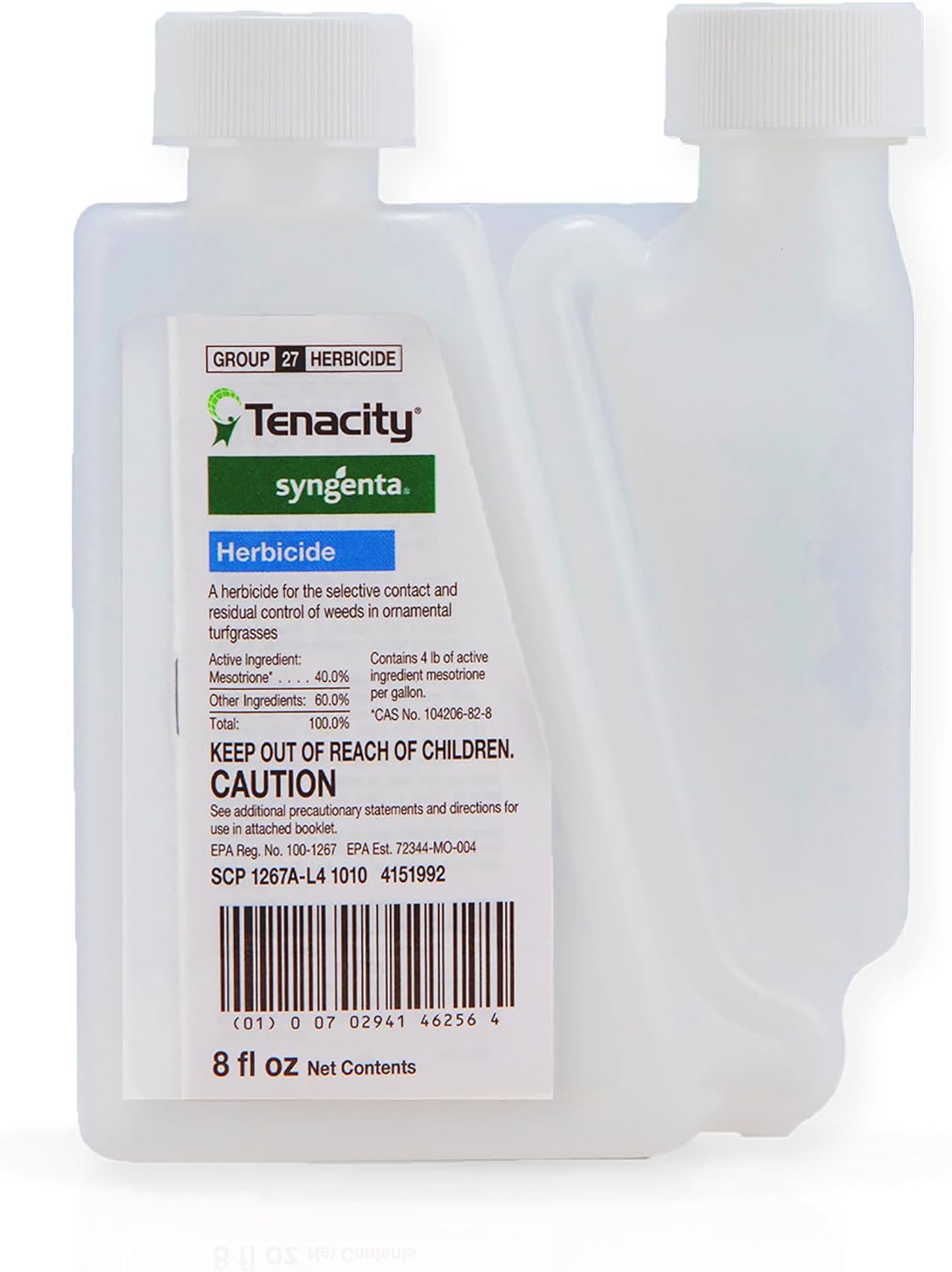
Syngenta Tenacity Turf Herbicide, 8 oz
| Unit Count | 8 Fluid Ounces |
|---|---|
| Item Form | Liquid |
| Coverage | 2000 ft^2 per 1sp of product |
| Active Ingredients | Mesotrione |
Tenacity Turf Herbicide is a concentrated mesotrione-based liquid designed for both pre-emergent and post-emergent control of common lawn weeds including crabgrass, clover, chickweed and dandelions. You apply it diluted according to label rates with a handheld or hose-end sprayer to target problem areas or broadcast across the lawn; when used as a pre-emergent it is taken up as weeds emerge and when applied post-emergent it acts systemically for selective control. The product covers a large area per bottle and the active ingredient provides residual control so you can expect longer suppression than a contact-only herbicide. Important practical points are that it is turf-selective so follow the label for grass species and mixing instructions to avoid turf injury, and results can take several days to appear. Also this is a concentrated chemical intended for careful, measured application rather than spot-use by people who prefer non-chemical methods.
Best for: Gardeners focused on strong, reliable crabgrass and broadleaf weed control who are comfortable using concentrated herbicides and following label directions for turf safety.
Less Ideal for: People seeking organic, mechanical, or spot-only solutions or those unwilling to follow detailed mixing and application instructions should consider other options.
- Systemic mesotrione active ingredient controls both pre- and post-emergent weeds
- Selective to turf when used per label, allowing treatment without killing desirable grass species
- Concentrated 8 oz liquid provides wide coverage per bottle
- Provides residual suppression, reducing frequency of repeat applications
- Requires careful mixing and adherence to label for turf safety
- Not a non-chemical or organic option for weed control
Verdict: Choose Tenacity when you want a concentrated, turf-selective herbicide that delivers pre- and post-emergent control of crabgrass and other common lawn weeds.
Roundup Weed & Grass Killer with Comfort Wand, 1.33 gal.

| Item Form | Liquid |
|---|---|
| Coverage | 400 sq. ft. |
| Liquid Volume | 1.33 gallons |
This Roundup package pairs a 1.33 gallon liquid formulation with a Comfort Wand for easier spraying around beds, walkways, and foundations. It is formulated to kill common broadleaf weeds and grasses down to the root, with visible wilting in hours and rainfast protection in about 30 minutes, so treated areas are less likely to wash away after a brief rain. The wand offers one-touch continuous spray, which reduces hand fatigue during spot treatments and makes edging and targeted applications simpler than using a separate sprayer. Coverage is listed at about 400 sq. ft., appropriate for small yards, beds, or multiple spot-treatment sessions. Important limitations are that this is a nonselective herbicide so it will damage desirable plants if contacted and the product directions include replanting wait times of 1 to 30 days depending on use. Users should follow label precautions about keeping people and pets away until spray has dried and applying only in calm conditions to avoid drift.
Best for: Buyers who want a straightforward, ready-to-use herbicide for targeted spot treatments and edging where quick, reliable weed control is the priority and minimizing application fuss matters.
Less Ideal for: Large properties or users who need selective lawn-safe control should consider professional application methods or products formulated specifically for turf.
- Fast visible results in hours and rainproof in as fast as 30 minutes
- Comfort Wand with one-touch continuous spray reduces hand fatigue and improves targeting
- Kills a wide range of broadleaf weeds and grasses to the root
- Ready-to-use liquid requires no mixing and covers up to 400 sq. ft.
- Nonselective formula will damage desirable plants if contacted
- Container and wand limit treatment area per refill compared with larger tank sprayers
Verdict: A convenient, ready-to-use herbicide with a Comfort Wand that delivers fast, reliable spot control of broadleaf weeds and grasses for homeowners who want an easy, low-fuss solution.
Choosing the Right Herbicide for Purslane: Key Factors to Consider
Kill Speed and Visible Control
How quickly a herbicide stops purslane growth matters for gardeners dealing with an active infestation. Faster knockdown reduces seeding and spread, lowers the chance of manual removal becoming impractical, and gives you a clearer sense of whether the treatment worked. Some formulations show wilting within hours while others require several days for full necrosis. Consider the growth stage of the purslane: young succulent rosettes often respond faster than large, established patches.
Keep in mind that rapid visual decline does not always equal complete root kill. For persistent patches you may need follow-up applications or complementary cultural control to prevent regrowth from surviving root crowns.
Turf and Ornamental Plant Selectivity
Selectivity determines whether a herbicide will harm the lawn or nearby ornamentals while targeting purslane. Some active ingredients are broad-spectrum and will injure or kill many desirable plants if applied as a broadcast spray. Others are labeled for spot treatments and are safer around certain turf grasses or established perennials when used according to directions.
Read and follow label restrictions on spray patterns, application rates, and safe distances from sensitive plants. Where complete selectivity is not possible, plan for targeted spot treatment, physical barriers, or hand removal in priority planting areas.
Residual Activity and Reapplication Needs
Residual control describes how long the herbicide affects new weed growth after the initial application. A short-residual product kills existing purslane but leaves soil ready for reseeding, which may be useful in vegetable patches. A longer-residual option can suppress reinfestation but may limit when you can reseed or plant transplants.
Consider your seasonal planting schedule and whether you need a product that allows immediate planting of desirable species. Follow label guidance on planting intervals to avoid harming new seedlings or transplants.
Application Method and Ease of Use
Application requirements influence how practical a herbicide is for home gardeners. Some products come ready-to-use for spot spraying, while others require precise mixing in a backpack or hose-end sprayer. Ease of achieving full coverage on low, prostrate purslane is important because gaps in coverage lead to live plants that reestablish quickly.
Also factor in nozzle type, recommended droplet size, and whether surfactants or adjuvants are needed. Simpler application reduces user error and helps ensure safer outcomes.
Safety, Environmental Impact, and Label Restrictions
Safety covers personal protective equipment, reentry intervals, and restrictions near water, edible gardens, or pollinator-attractive plants. Environmental impact includes persistence in soil, mobility to waterways, and toxicity to non-target organisms. Labels will detail buffer zones and whether the product is appropriate for use where bees or aquatic life may be exposed.
Gardeners should weigh these factors against the severity of the purslane problem. When controlling purslane in or near vegetable beds, choose products with clear edible-crop instructions or rely on nonchemical control if label restrictions are too limiting.
When to Treat Purslane Versus Hand Pulling
Purslane is a succulent that roots at nodes and produces seed prolifically, so timing matters. For small patches in ornamental beds or within accessible garden plots, hand pulling can be quick and eliminates the need for chemicals if you remove the entire root crown. However, large infestations in lawns or tight cracks in paving are better handled with herbicide options that provide broader coverage.
Consider weather when planning treatment. Warm, actively growing purslane takes up herbicide more effectively than stressed or droughted plants. Apply when soil moisture is adequate and leaves are turgid for the best absorption.
- Pull small isolated plants after watering to loosen soil and reduce breakage.
- Reserve chemical control for dense patches or areas where physical removal is impractical.
Spot Treatment Techniques for Prostrate Weeds
Spot treatments focus product where it is needed, reducing collateral damage to turf and ornamentals. Use a targeted nozzle or a shielded sprayer to avoid drift onto sensitive plants. For low-growing purslane, getting good coverage of the succulent leaves and stems is essential because contact is the primary mode of action for many control agents.
For best results, treat in calm conditions and avoid mowing immediately before or after application so leaves are intact to intercept spray.
- Use a shield or cardboard to protect nearby plants when spraying.
- Apply during calm wind conditions early in the day to minimize drift.
Managing Reestablishment and Seed Banks
Purslane produces many seeds and establishes quickly in disturbed or bare soils. After a chemical or manual control, reduce bare soil by overseeding turf, mulching beds, or maintaining dense groundcover to limit opportunities for seedlings. Regular monitoring and quick spot treatments of new seedlings prevent the seed bank from rebuilding.
In vegetable plots, plan crop rotations and use mulch to suppress seedlings. Cultivation that disturbs soil can bring buried seed to the surface, so limit unnecessary tillage where purslane seed is present.
- Overseed thin lawn areas promptly after control to shade out seedlings.
- Use organic mulch in beds to block light and prevent new germination.
Safe Use Around Edible Gardens
If you need to control purslane near vegetable beds, verify label permissions for use adjacent to edible crops. Some herbicides are allowed for use in ornamental areas but restrict application near food-bearing plants. When label directions are restrictive, use physical barriers, spot treat only nonproductive areas, or remove plants by hand.
For any product used near edibles, follow reentry and harvest interval instructions to avoid residue exposure. Washing and peeling do not replace adherence to label intervals.
- Check planting and harvest interval statements before applying near food crops.
- Use barrier methods or hand removal for beds where label restrictions prevent chemical use.
How We Chose the Best Herbicide for Purslane
Our selections focused on products that deliver reliable control of purslane in typical home lawn and garden situations. We prioritized documented efficacy against succulent broadleaf weeds, compatibility with common turf grasses and ornamental plants, and clear application instructions that homeowners can follow safely. Evaluation criteria included kill speed and visible control, selectivity and turf safety, required application frequency and residual activity, ease of use and mixing, and environmental and safety considerations such as labeled buffer distances and reentry intervals. We favored formulations with straightforward coverage recommendations and flexible tank-mix options for spot treatments versus blanket applications. We excluded products labeled only for agricultural or industrial uses, items with incomplete label guidance for small-plot use, and any herbicide lacking standard safety directions. We also filtered out materials that rely solely on nonchemical methods, since this roundup is specifically about chemical herbicides suited to controlling purslane. The result is a short list that balances quick, measurable control with practical handling and safety in home lawns, beds, and edible gardens where labels permit use.
FAQ
Can I use a purslane herbicide on my entire lawn safely?
It depends on the product label and your turf species. Some herbicides are formulated for broadcast lawn use and are safe on specific turf grasses, while others are intended only for spot treatment. Always confirm label turf compatibility before applying widely.
How soon will I see purslane die after application?
Many contact herbicides cause visible wilting within hours and full necrosis within a few days, but systemic products may take longer. Weather and plant size influence response time, so expect variation between treatments.
Is it safe to spray herbicide for purslane near vegetable plants?
Safety depends on the label. Some products restrict use near edible plants or require specific buffer zones and wait times before harvest. When in doubt, avoid spraying directly adjacent to vegetables and use nonchemical methods in that zone.
Will a single treatment permanently eliminate purslane?
Often it will not. Because purslane can regrow from remaining root crowns and seed, multiple applications or combined cultural controls are usually needed to prevent reestablishment. Monitor treated areas and follow label guidance for retreatment intervals.
Can I seed or plant immediately after using a herbicide for purslane?
This depends on the residual activity and label planting restrictions. Some products allow quick reseeding, while others require a waiting period. Check the label for safe replanting intervals to avoid harming new seedlings.
Final Verdict
Choosing the right herbicide for purslane requires weighing how fast you need control against the risk to turf, ornamentals, and edible plantings. Prioritize products that match your use scenario: a fast-acting contact option for urgent knockdown, a selective lawn-safe formula for broadcast use, or a targeted spot-treatment formulation near sensitive plants. Plan for follow-up control and cultural practices that reduce the seed bank and reestablishment. With careful label reading and sensible application technique, you can regain control of purslane while protecting the rest of your garden.
