

Note: This article contains affiliate links. If you click on these links and make a purchase, I may earn a small commission at no extra cost to you. This helps support my research and content. Read my full affiliate disclosure here.
If wild violets have taken hold in your lawn or garden beds, choosing the right herbicide matters for long-term control and for protecting nearby plants. You need treatments that reach the violet root system, limit reseeding, and fit the setting where you will spray-turf, ornamental beds, or shaded patches. This guide collects seven top herbicide options tailored for wild violets and similar perennial broadleaf weeds. We shortlisted products that offer reliable uptake, manageable residual activity, and straightforward application in real garden conditions. Below you will find practical evaluation notes on application style, selectivity, and follow-up care to help you decide which approach suits your yard. Read on for criteria we used and answers to common gardener questions before the product summaries.
Top Picks at a Glance
| Best Overall The best all-around choice for most situations | Hi-Yield Triclopyr Ester Concentrate, 16 oz |  |
| Best Quality Built to a higher standard if you want something more solid | PBI/Gordon T-Zone SE Turf Herbicide, 1 Gallon |  |
| Best Value The sweet spot between price and what you get | Select Source Triad TZ 4-Way Herbicide, Quart |  |
| Best Budget The cheapest option that still gets the job done reliably | Monterey Spurge Power Post Emergent Herbicide, 8 oz |  |
| Highest Rated A top-rated pick with lots of positive feedback | Monterey Spurge Power Herbicide, 1 Pint (2 Pack) |  |
| Most Popular A crowd favorite that many people choose with confidence | T-Zone Broadleaf Herbicide for Tough Weeds, 1 Quart (PBI Gordon) |  |
| Best Seller A high-volume bestseller chosen again and again | Roundup Weed & Grass Killer with Comfort Wand, 1.33 gal. |  |
Hi-Yield Triclopyr Ester Concentrate, 16 oz

| Unit Count | 16 Ounce |
|---|---|
| Item Form | Liquid |
| Active Ingredients | triclopyr |
| Coverage | Medium |
Hi-Yield Triclopyr Ester is a 16 ounce liquid concentrate designed to target woody plants, brush, vines and broadleaf weeds such as oxalis and wild violets. You dilute the concentrate according to the label and apply it to affected areas of turf or non-crop sites where triclopyr is labeled; it is commonly used as a spot treatment or for larger patch control on compatible grasses. Notable features include the active ingredient triclopyr, a formulation intended to suppress bluegrass and control perennial broadleaf weeds, and a medium coverage classification that makes the bottle useful for multiple small-to-medium jobs. Practical benefits are precise control of broadleaf targets without relying on a broad-spectrum herbicide and the convenience of a concentrated bottle that lasts through several treatments. Important limitations are strict turf compatibility rules — it must not be used on certain grasses such as bermudagrass, bahiagrass, centipedegrass, St. Augustine or zoysia — and you must follow label directions for dilution and safety handling.
Best for: Gardeners and property owners who want a targeted solution for persistent broadleaf weeds and brush and who are willing to follow label directions for safe, selective applications.
Less Ideal for: Homeowners with warm-season lawns listed as incompatible or those seeking an all-purpose, nonselective herbicide for every turf type should consider other products.
- Contains triclopyr, an effective active ingredient against woody plants and broadleaf weeds including wild violets
- Concentrated 16 oz bottle covers multiple spot treatments and small-to-medium areas
- Suitable for use on several cool-season turfgrasses and as a bluegrass suppressor when used per label
- Not labeled for use on several common warm-season grasses, limiting where it can be applied
- Requires careful dilution and strict adherence to label safety and application instructions
Verdict: Choose this triclopyr concentrate if you need an effective, selective treatment for wild violets and other broadleaf weeds in compatible turf and non-crop areas.
PBI/Gordon T-Zone SE Turf Herbicide, 1 Gallon

| Unit Count | 128 Fluid Ounces |
|---|---|
| Item Form | Liquid |
| Coverage | Broadleaf Weeds and Nutsedge |
| Active Ingredients | Sulfentrazone, triclopyr |
T-Zone SE is designed for performance-minded turf managers who need reliable control of difficult broadleaf weeds such as wild violets, ground ivy, oxalis and clover. It is a one-gallon liquid concentrate that mixes for broadcast or spot applications on turf and relies on a blend of active ingredients including triclopyr and sulfentrazone to improve cool-weather activity and speed of control. In practice it reduces persistent patches of hard-to-kill species and gives good suppression of actively growing yellow nutsedge when applied at the correct stage. The label notes state restrictions for parts of New York, so check local rules before use. This product is focused on weed control and will not selectively improve turf quality or feed the lawn, so integrate it into a broader cultural program for best results. Proper mixing, targeted application, and observing temperature and turf health guidelines are important to avoid off-target damage.
Best for: Buyers seeking a high-performance herbicide to remove persistent broadleaf weeds from established lawns, especially when cool-weather control and quick results are priorities.
Less Ideal for: Homeowners who want an all-in-one lawn care product that also feeds or improves turf vigor, or those in regions with legal restrictions on this product.
- Specifically formulated to kill tough broadleaf weeds including wild violets and ground ivy
- Contains multiple active ingredients for improved cool-weather performance and faster control
- Provides suppression of young and actively growing yellow nutsedge
- Available as a concentrated liquid for broadcast or spot treatment flexibility
- Restricted for sale or use in parts of New York, limiting availability in those areas
- Does not improve turf health or act as a fertilizer so must be used alongside cultural care
Verdict: Choose T-Zone SE when you need a concentrated, cool-weather herbicide that reliably tackles persistent broadleaf weeds like wild violets.
Select Source Triad TZ 4-Way Herbicide, Quart

| Unit Count | 32 Fluid Ounces |
|---|---|
| Item Form | Liquid |
| Coverage | 48 to 96 fluid_ounces per acre |
| Active Ingredients | triclopyr |
Select Source Triad TZ is a concentrated, post‑emergent liquid herbicide designed to knock back difficult broadleaf weeds in lawns and turf. It combines four active ingredients, including triclopyr, to provide two modes of action that are taken up through leaves and stems; treated weeds usually stop growing within hours and die over one to four weeks depending on rate and conditions. Typical use is with a calibrated sprayer at 1.5 to 3 quarts per acre, applied when weeds are actively growing and not recently mowed. The product lists control for species such as wild violet, dandelion, plantain, and ground ivy and can be used on residential lawns, athletic fields, and commercial turf sites. Practical benefits include broad spectrum activity, relatively fast visible effects, and flexible application rates for different infestation levels. Important limitations are the need for careful calibration and protective equipment, restrictions around food crops and some non‑turf areas, and the wait time for full plant death which can vary by species and conditions.
Best for: Homeowners or turf managers who want a practical, multi‑mode post‑emergent herbicide to reduce persistent broadleaf weeds like wild violet in lawn and turf settings.
Less Ideal for: People seeking organic or nonchemical weed control methods or those needing an all‑purpose product for food gardens and edible plantings should look elsewhere.
- Four active ingredients with two modes of action for dependable control of broadleaf weeds
- Labelled for control or suppression of tough weeds including wild violet and dandelion
- Rapid uptake by foliage so growth cessation is visible within hours to days
- Flexible application rates (1.5 to 3 quarts per acre) to match infestation severity
- Requires a properly calibrated sprayer and careful handling with personal protective equipment
- Not for use where food crops are grown and must be stored away from heat or flames
Verdict: Choose Triad TZ when you need a chemical solution that reliably targets stubborn broadleaf weeds like wild violet across lawns and turf.
Monterey Spurge Power Post Emergent Herbicide, 8 oz

| Item Form | Spray |
|---|---|
| Coverage | 16,000 sq ft |
| Liquid Volume | 8 fluid ounces |
| Active Ingredients | MCPA, Triclopyr, Dicamba |
Monterey Spurge Power is a concentrated post-emergent herbicide formulated with MCPA, triclopyr, and dicamba to target tough broadleaf weeds such as spurge, dandelion, oxalis, creeping Charlie, clover, and wild violet. You mix the measured concentrate with water using the included spoon and apply it to lawn areas when weeds are actively growing, avoiding windy days. The product claims coverage up to 16,000 sq ft from an 8 ounce bottle, which makes it economical for treating medium-sized yards. It is labeled for both warm and cool season grasses, so it fits a variety of lawn types. Important limitations are the usual safety precautions for synthetic phenoxy and auxin herbicides and the need to follow label directions precisely to avoid damage to desirable plants; it can harm broadleaf ornamentals if drift occurs. For wild violet control specifically, repeated applications and good timing may be required because violets can be persistent and often need follow-up treatments for complete suppression.
Best for: Homeowners who want a concentrated, budget-friendly post-emergent herbicide to reduce broadleaf weeds across a typical lawn and are willing to follow label instructions and re-treat persistent patches.
Less Ideal for: Gardeners who need a selective solution safe around ornamentals, or those who prefer organic or non-chemical weed control methods.
- Contains three active ingredients (MCPA, triclopyr, dicamba) for broad-spectrum control of common broadleaf weeds
- Concentrated formula with coverage up to 16,000 sq ft from an 8 oz bottle
- Labeled for use on both warm- and cool-season lawns, increasing versatility
- Includes a measuring spoon to ensure accurate mixing
- Can damage desirable broadleaf plants if applied carelessly or if drift occurs
- May require multiple applications to fully suppress persistent weeds like wild violet
Verdict: A concentrated, cost-conscious post-emergent herbicide that offers broadleaf weed control across many lawn types and good coverage from a small bottle.
Monterey Spurge Power Herbicide, 1 Pint (2 Pack)

| Unit Count | 16 Fluid Ounces |
|---|---|
| Number of Packs | 2 |
| Item Form | Spray |
| Coverage | 16000 square feet |
Monterey Spurge Power is a concentrated liquid herbicide formulated to tackle difficult broadleaf weeds such as spurge, wild violet, dandelion and creeping Charlie in turf. It is used post-emergence: mix the measured dose with water using the included spoon and apply over the lawn to treat targeted patches or larger areas. The product lists three active ingredients, which broadens its spectrum and helps with tougher weeds, and a single 16-ounce bottle (sold as a two-pack) claims coverage up to 16,000 square feet, making it economical for whole-yard applications. It is labeled for both warm- and cool-season grasses, so you can use it on bluegrass, fescue, bermuda and similar lawns. Practical downsides to keep in mind are the safety precautions: avoid application where food crops are grown and use protective clothing to prevent skin or eye contact, and it is a post-emergent product so it will not prevent future weed seeds from germinating. For reliable knockdown of established broadleaf weeds in maintained turf, this offers a concentrated, wide-coverage option.
Best for: Homeowners and lawn stewards who prioritize dependable, chemical control of established broadleaf weeds across an entire lawn and want a concentrated product that treats large areas.
Less Ideal for: Gardeners seeking an all-in-one preventive herbicide for seedling control or those who prefer non-chemical weed management methods.
- Controls a wide range of hard-to-kill broadleaf weeds including wild violet and spurge
- Concentrated formula that covers up to 16,000 square feet per unit
- Labeled for use on both warm- and cool-season turfgrass types
- Includes a measuring spoon for accurate dilution and application
- Requires protective gear and care around edible planting areas due to toxicity warnings
- Post-emergent only so it will not provide residual pre-emergent control of new weeds
Verdict: A concentrated, wide-coverage post-emergent herbicide well suited for reliably knocking back established wild violets and other tough broadleaf weeds in maintained lawns.
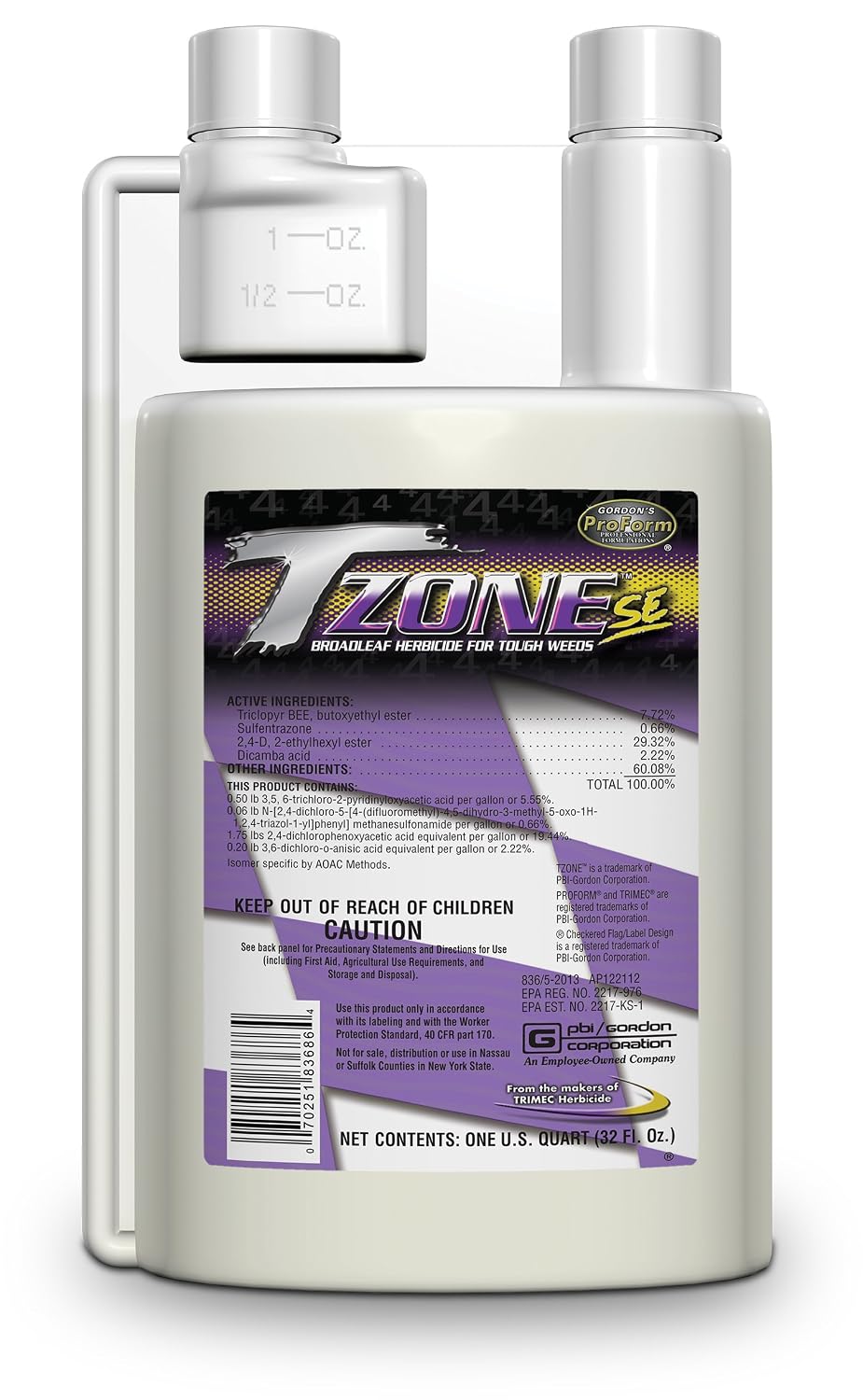
T-Zone Broadleaf Herbicide for Tough Weeds, 1 Quart (PBI Gordon)
| Unit Count | 32 Fluid Ounces |
|---|---|
| Item Form | Liquid |
| Coverage | broad-leaf weeds, grassy weeds |
| Active Ingredients | Dicamba, triclopyr |
T-Zone is a concentrated liquid herbicide made for spot and broadcast control of stubborn broadleaf weeds and some grasses in turf. It is typically mixed and applied with a sprayer to lawns, commercial turf, or golf sites and is marketed for cool-weather use down to about 50°F. The formula lists triclopyr, dicamba and other actives that give fast visual response on many tough weeds and can suppress yellow nutsedge. Practical benefits include strong activity on woody and deep-rooted broadleaves where typical 2,4-D products struggle and utility across residential and commercial settings. Important limitations are that it contains multiple powerful active ingredients so protective gear and careful drift management are required, and it may not be labeled for all turfgrass species or sensitive ornamentals nearby. Expect to follow label restrictions for re-entry and overseeding windows and to avoid use where off-target movement could harm desirable plants.
Best for: Gardeners and turf managers who prioritize proven efficacy and want a product that handles stubborn broadleaf weeds and cool-season applications with predictable performance.
Less Ideal for: Small ornamental gardens or users who need a low-risk, non-chemical option; avoid if you cannot prevent drift onto nearby sensitive plants.
- Contains triclopyr and dicamba for effective control of tough broadleaf weeds
- Suitable for residential, commercial, and golf turf applications
- Works at lower temperatures (around 50°F) for extended seasonal use
- Provides visible results quickly which can reduce repeat treatments
- Contains multiple potent active ingredients so careful handling and PPE are required
- Potential for off-target damage to desirable plants if drift or runoff occurs
Verdict: Choose T-Zone when you need a reliable, fast-acting herbicide for persistent broadleaf weeds in turf where strong chemical control is acceptable.
Roundup Weed & Grass Killer with Comfort Wand, 1.33 gal.

| Item Form | Liquid |
|---|---|
| Liquid Volume | 1.33 gallons |
| Coverage | 400 sq. ft. |
This Roundup Weed & Grass Killer comes as a 1.33 gallon liquid jug with an integrated Comfort Wand for handheld spraying around beds, walkways, and foundations. The formula targets both broadleaf weeds and grasses down to the root, naming common problems such as dandelion, crabgrass, poison ivy, clover, and spotted spurge. It is rainproof in as fast as 30 minutes and shows visible dieback within hours, which makes timing applications easier for homeowners. The Comfort Wand offers one-touch continuous spray to reduce hand fatigue and simplifies treating edges and small patches without mixing concentrates. Coverage is stated at about 400 sq. ft., suitable for small to medium problem areas. Important limitations to note are typical herbicide precautions: avoid drift to desirable plants, keep people and pets away until spray dries, and follow label timing before replanting. It is not a selective spot-treatment for delicate landscapes, so careful aiming and calm weather are important to protect nearby ornamentals.
Best for: Homeowners who want a convenient, no-mix herbicide for spot treatments and perimeter weed control and who prioritize fast visible results and easy application.
Less Ideal for: People managing large turf areas who need repeated selective control or gardeners who cannot risk any drift onto nearby ornamentals.
- Kills a wide range of broadleaf weeds and grasses down to the root
- Visible results in hours and becomes rainproof in about 30 minutes
- Comfort Wand with one-touch continuous spray reduces hand fatigue and makes edging easier
- Ready-to-use jug removes the need to mix concentrates for straightforward application
- Covers up to 400 sq. ft., suitable for treating multiple small patches
- Nonselective formula can damage desirable plants if drift or overspray occurs
- Single-size ready-to-use container may be less economical for large lawns
Verdict: Choose this ready-to-use Roundup when you want a fast, easy handheld solution to knock out patches of persistent weeds with minimal prep.
Choosing the Right Herbicide for Wild Violets: Key Factors to Consider
Mode of Action and Uptake
Understanding how an herbicide works is central to controlling wild violets. Violets are perennial and often regrow from crowns or root systems, so products that translocate into those structures are more likely to provide lasting control. Systemic herbicides that are absorbed through leaves and move to roots will outperform contact-only sprays in established infestations.
Mode of action also affects resistance risk and what you can tank-mix. Choosing a product with a documented systemic mode and following label rotation recommendations reduces the chance of reduced effectiveness over seasons. Read the label to confirm whether the product requires adjuvants, surfactants, or particular weather windows for reliable uptake.
Selectivity and Plant Safety
Selectivity determines whether you can treat violets in turf without harming grass or whether you need spot treatments in beds. Some herbicides are formulated to target broadleaf weeds while leaving grasses largely unaffected, which makes them suitable for lawn applications. Others are nonselective and will damage or kill desirable ornamentals if overspray occurs.
Consider proximity to sensitive plants, planned reseeding, or landscapes with mixed plantings. Where selectivity is limited, plan for spot treatments, physical barriers, or temporary removal of nearby desirable plants before application.
Residual Soil Activity and Timing
Residual activity describes how long an herbicide persists in the soil and continues to affect emerging plants. For wild violets, some residual action can help prevent reseeding and new seedlings, but long soil persistence can interfere with planting desirable seedlings or reseeding lawn areas.
Match residual expectations to your management plan. Use shorter-residual options where you will replant soon, and choose longer-residual formulations only when you need season-long suppression. Also factor in timing: applications during active growth in spring or fall generally give the best translocation into perennial tissues.
Application Method and Equipment
Application method affects accuracy, coverage, and the amount of herbicide used. Ready-to-use trigger sprayers or hose-end applicators are convenient for spot work on scattered violets, while pump or backpack sprayers give more consistent coverage for larger patches. Some granular products can be easier for lawn-wide application but may require incorporation or watering to activate.
Consider the nozzle type, droplet size, and whether a surfactant is recommended. Small droplets increase leaf coverage but also raise drift risk. For precision in mixed landscapes, a handheld sprayer with a narrow spray or a wicking applicator for spot treatment can reduce the chance of harming nearby plants.
Safety, Environmental Impact, and Regulations
Herbicide safety matters for people, pets, and non-target plants. Look for clear label instructions on re-entry intervals, pet-safe waiting times, and disposal. Some active ingredients have restrictions for use near water or in certain climatic zones; check local guidance and the product label before applying near streams, ponds, or drainage routes.
Wear recommended protective gear and follow mixing guidelines to reduce runoff. Consider buffer zones and avoid spraying on windy days. If you have pollinator plantings near treatment areas, time applications when pollinator activity is low and avoid spraying blooms.
Treatment Frequency and Follow-up
Single applications rarely eliminate established wild violets. Expect a management plan that includes repeated applications spaced according to label guidance, plus cultural measures such as improved mowing height, increased shade management, or soil modification where practical. Monitoring treated patches and retreating basally sprouting crowns can prevent recovery.
Also plan for removal of dead plant material where seed heads could persist, and adjust expectations for recovery time. Combining targeted herbicide work with cultural adjustments will deliver the most durable results.
When To Treat Wild Violets
Treat violets when they are actively growing and before heavy seed set for best systemic uptake. Spring and fall are often the most effective windows because plants are moving nutrients between roots and shoots, improving herbicide translocation.
Avoid treating during drought stress or extreme heat, which can reduce absorption and increase risk to surrounding plants. If you must treat in marginal weather, prioritize spot applications to minimize exposure.
- Spring and fall treatments usually give stronger uptake
- Avoid applications during heat waves or prolonged drought
- Delay treatment until after heavy bloom if protecting pollinator flowers nearby
Spot Treatment Techniques
For scattered violets in lawns or beds, spot treatments limit herbicide exposure to desirable plants. Use a handheld sprayer, wicking applicator, or a piece of cardboard as a shield behind the target plant to prevent drift.
Apply to fully wetted foliage but avoid runoff. If using a surfactant or sticker, follow label instructions so you do not increase damage to nearby plants.
- Use narrow spray tips or wicking for precision
- Shield sensitive plants during application
- Apply when leaves are dry from morning dew to reduce drift
Integrating Cultural Controls
Herbicide treatment is more successful when combined with cultural practices that reduce violet-friendly conditions. Raising mowing height, improving drainage, and increasing shade management can reduce the niches where violets thrive.
Dense, healthy turf competes better with violets, so address soil compaction and fertility imbalances. In beds, refresh mulch to suppress seedlings and remove mature seed heads before they set seed.
- Adjust mowing and irrigation to favor desirable plants
- Control compaction and thin, shaded patches where violets persist
- Remove seed heads after bloom to reduce reseeding
Safety Precautions During Application
Always follow the product label for protective equipment, mixing ratios, and re-entry intervals. Keep children and pets out of treated areas until the spray has dried or the label-specified waiting period has passed.
Prevent drift by avoiding windy conditions and using low-pressure settings on sprayers. Clean equipment thoroughly after use to avoid contaminating other garden areas or tanks.
- Wear gloves, long sleeves, and eye protection as recommended
- Do not apply near open water unless the label allows it
- Store and dispose of unused product per label directions
Timing Follow-Up Applications
Plan follow-up applications based on the product label and observation. Newly treated plants may show decline in days to weeks, but leftover crowns can reshoot and need retreatment once fresh growth appears.
Stagger repeat applications to avoid overuse of the same active ingredient in a season when label rotation guidance recommends alternation to manage resistance risk.
- Monitor treated areas for resprouts and seedling emergence
- Space follow-ups per label to allow translocation
- Rotate modes of action when label guidance suggests doing so
How We Chose the Best Herbicide for Wild Violets
We focused on attributes that determine real-world control of wild violets rather than abstract popularity. Our primary evaluation criteria were herbicide mode of action and uptake, selectivity for lawns or ornamentals, application method and ease, residual soil activity, and safety precautions for nearby plants and pets. Each product was considered for how well it penetrates perennial rootstocks or translocates to crowns, since surface contact alone rarely controls violets long-term. We excluded products labeled only for annual broadleaf weeds or those lacking clear instructions for use in turf or ornamental beds. We also filtered out non-chemical options that require extensive cultural overhaul; this roundup is focused on treatment products. Practical factors such as label directions, re-entry intervals, tank-mix compatibility, and equipment needs were weighted so a gardener can compare how each herbicide will fit into their maintenance routine.
FAQ
Can I spot-treat violets in a mixed perennial bed without harming ornamentals?
Often you can if you use a selective product or precise spot application. Shield nearby plants, apply on calm days, and use a narrow spray or wicking applicator. When in doubt, remove the ornamental temporarily or treat violets by hand pulling followed by a targeted treatment away from roots of desirable plants.
How long before I can reseed or plant after applying a herbicide?
It depends on the product and its residual soil activity. Some formulations allow planting within a few days, while others recommend a waiting period of weeks or months. Check the label for planting intervals and choose a shorter-residual option if you plan to reseed soon.
Will a single application eliminate established wild violets?
Usually not. Established violets often require multiple applications timed to active growth, combined with cultural steps like improving turf vigor or removing seed heads. Expect a management plan over the season rather than a one-time fix.
Is it safe to treat violets near water or pollinator plantings?
Some herbicides are restricted near water and many labels recommend avoiding flowering plants to protect pollinators. Always consult the label for aquatic use restrictions and avoid spraying blooms. Time applications when pollinator activity is low and follow buffer zone guidance.
Should I use a surfactant or stick agent when treating violets?
Some systemic herbicides benefit from a surfactant to improve leaf coverage and uptake, but not all labels allow added adjuvants. Follow label directions; using an unapproved adjuvant can reduce effectiveness or increase harm to non-target plants.
Final Verdict
Control of wild violets is a multi-step process that balances herbicide uptake, selectivity, and follow-up cultural work. Prioritize products with systemic uptake and an application method that fits your landscape, then plan for repeated treatments and cultural adjustments to limit reinfestation. Decide based on where the violets grow, how close desirable plants are, and whether you will reseed or replant soon. With the right product choice and a sensible follow-up plan, you can reduce violet populations while protecting the rest of your garden.
