

Note: This article contains affiliate links. If you click on these links and make a purchase, I may earn a small commission at no extra cost to you. This helps support my research and content. Read my full affiliate disclosure here.
If you want to remove broadleaf weeds without damaging lawn grasses, choosing the right selective herbicide matters. The wrong product can thin turf, leave bare patches, or fail to control the species you care about. This guide focuses on herbicides formulated to kill weeds but not grass, with picks suitable for common lawn situations and maintenance plans. We shortlisted seven top options and evaluated them on real gardener concerns like selectivity, turf safety, and application ease. Read on to understand the tradeoffs and which features matter for your lawn type and weed problem before you inspect the product blocks below.
Top Picks at a Glance
| Best Overall The best all-around choice for most situations | Ortho WeedClear Lawn Weed Killer Ready-to-Use with Comfort Wand, 1 gal. |  |
| Best Quality Built to a higher standard if you want something more solid | Monterey Turflon Ester Specialty Herbicide Concentrate (8 oz) |  |
| Best Value The sweet spot between price and what you get | Spectracide Weed Stop for Lawns Concentrate, 40 oz |  |
| Best Budget The cheapest option that still gets the job done reliably | Spectracide Weed Stop for Lawns Plus Crabgrass Killer, Ready-to-Use, 1 Gallon |  |
| Highest Rated A top-rated pick with lots of positive feedback | Tenacity Turf Herbicide (8 fl oz) |  |
| Most Popular A crowd favorite that many people choose with confidence | Scotts Liquid Turf Builder Plus 2 Weed Control, 32 fl. oz. |  |
| Best Seller A high-volume bestseller chosen again and again | Ortho WeedClear Ready-To-Spray Lawn Weed Killer, 32 fl. oz. |  |
Ortho WeedClear Lawn Weed Killer Ready-to-Use with Comfort Wand, 1 gal.

| Unit Count | 128 Fluid Ounces |
|---|---|
| Item Form | Liquid |
| Coverage | 20480 sq. ft. |
| Active Ingredients | 2,4-D; Quinclorac; Dicamba (percentages listed in product) |
Ortho WeedClear Ready-to-Use is a 1 gallon, spot-treatment herbicide that targets more than 200 common lawn weeds while aiming to spare established turf when applied correctly. It ships with a battery-powered Comfort Wand that makes it easy to target individual dandelions, clover, crabgrass and creeping charlie without over-spraying surrounding grass. The formula is fast-acting and rainproof after one hour, so you can expect visible dieback after a single application on actively growing weeds. It lists compatibility with common lawn grasses such as fescue, Kentucky bluegrass, ryegrass, zoysiagrass and bermudagrass within temperature limits, and the coverage claim is large enough for multiple seasons of spot work. Practical downsides are that it is for spot treatment only so it is not for blanket applications, and you must avoid use on certain grasses at high temperatures and keep people and pets off treated areas until dry. Follow the directions carefully to get reliable weed control without damaging the lawn.
Best for: Homeowners who want a practical, all-purpose spot herbicide to remove individual weeds while preserving their lawn and who value targeted application over turf-wide treatments.
Less Ideal for: People seeking a lawn-wide weed-and-feed solution or those who want an organic or non-chemical approach should consider other options.
- Ready-to-use with battery-powered Comfort Wand for precise spot application
- Kills over 200 broadleaf and grass weeds down to the root with one application
- Rainproof in one hour so results are not easily lost to light showers
- Formulated to be safe on listed lawn grasses when directions and temperature limits are followed
- Intended only for spot treatment so not suitable for treating entire lawns
- Contains active herbicide ingredients that require following safety precautions and avoiding contact with skin or eyes
Verdict: Use this as a precise, ready-to-use spot treatment when you want fast, root-killing control of common lawn weeds without harming listed turf when applied as directed.
Monterey Turflon Ester Specialty Herbicide Concentrate (8 oz)

| Unit Count | 8 Ounce |
|---|---|
| Item Form | Liquid |
| Coverage | 20,000 square feet per pint |
| Liquid Volume | 8 quarts |
| Active Ingredients | Turflon |
Monterey Turflon Ester is a liquid, post-emergent herbicide concentrated for spot or broadcast spray applications on cool-season lawns. It targets tough broadleaf weeds and invasive grasses such as oxalis, ground ivy, wild violet, clover, ragweed and certain bermudagrass and kikuyugrass when they are actively growing. Use requires diluting the concentrate according to the label and applying with a spray tank; one pint claims coverage up to 20,000 sq ft which makes it efficient for larger lawns. The product is formulated specifically for perennial bluegrass, perennial ryegrass and tall fescue, so it works without harming those cool-season turf types when used as directed. Important practical cautions are that it is not selective around flowerbeds or other non-target broadleaf plants and spray drift can cause damage, and it only controls weeds that are present at time of application. For homeowners focused on performance, it delivers targeted control on the weeds listed but demands careful mixing, application technique and attention to the label to avoid off-target injury.
Best for: Homeowners and property managers who need a strong post-emergent solution for persistent broadleaf weeds in cool-season lawns and who are comfortable mixing and applying concentrated sprays.
Less Ideal for: Gardeners with mixed plantings or many nearby ornamental broadleaf plants where any spray drift would be unacceptable, and those who prefer ready-to-use products or who manage warm-season turf types.
- Concentrated formula allows large coverage from a small bottle
- Effective on a wide range of listed broadleaf weeds and some invasive grasses
- Designed for cool-season turf types so it can remove weeds without harming those grasses when used correctly
- Must be diluted and applied with a spray tank which adds setup and skill requirements
- Not safe for flowerbeds or non-target broadleaf plants due to spray drift risk
- Only controls weeds that are actively growing at the time of application
Verdict: Choose Turflon Ester if you need a concentrated, high-coverage post-emergent herbicide that reliably removes broadleaf weeds from cool-season lawns when mixed and applied correctly.
Spectracide Weed Stop for Lawns Concentrate, 40 oz

| Item Form | Liquid |
|---|---|
| Coverage | 20000 square_feet |
| Unit Count | 40 Fluid Ounces |
Spectracide Weed Stop for Lawns is a concentrated liquid herbicide designed to be mixed with water and applied with a garden sprayer to target broadleaf lawn weeds. It claims control of more than 200 weed types including dandelion, chickweed and clover and works by contact to kill down to the root with visible results in hours. Typical use is to mow first, mix according to the label, and spray weeds in spring or fall when plants are actively growing; the formula becomes rainfast in about six hours so normal watering or light rain will not wash it away. The product treats a large area from a single 40 oz bottle and is practical for spot treatments or full-lawn applications. Important limitations are that you must follow label directions carefully to avoid off-target contact and some tough weeds may require a repeat application after a few weeks. Also you need a separate sprayer because the bottle is a concentrate.
Best for: Buyers who want a cost-effective, fast-acting herbicide to control common broadleaf weeds across a lawn and prefer treating weeds themselves with measured applications.
Less Ideal for: People who need an all-in-one ready-to-spray bottle or who only want a non-chemical weed control method should look elsewhere.
- Concentrated formula covers a lot of ground from one 40 oz bottle
- Kills over 200 listed broadleaf weeds and works down to the root
- Rainfast in about 6 hours so treatment is not easily washed off
- Produces visible results within hours for fast feedback
- Requires a separate garden sprayer because it is a concentrate
- Some tough or persistent weeds may need repeat spot treatments
Verdict: A concentrated, fast-acting lawn herbicide that lets practical gardeners treat large areas and knock down common broadleaf weeds without harming grass when used as directed.
Spectracide Weed Stop for Lawns Plus Crabgrass Killer, Ready-to-Use, 1 Gallon

| Item Form | Spray |
|---|---|
| Coverage | Up to 5,000 sq ft |
| Liquid Volume | 1 gallons |
This ready-to-use Spectracide formula is designed to target more than 470 listed weeds, including dandelion, clover and crabgrass, and it works by contact to produce visible results in about five hours. It comes in a one-gallon spray container intended for spot or broadcast application across a lawn and covers up to 5,000 square feet. The product is simple to use because there is no mixing and the spray delivery lets you treat individual patches or larger areas quickly. Important features include temperature guidance for safe application and a label note that Bermudagrass may show temporary yellowing. In practice you get fast knockdown of common lawn weeds and the convenience of a premixed spray, but you must follow label directions on temperature and grass types to avoid stress. For gardeners on a budget who want quick visible control without complicated mixing, this is a practical, easy-to-use option, though careful timing and adherence to the label are required for best lawn safety.
Best for: Homeowners who want a low-effort, inexpensive solution to remove common lawn weeds quickly without complex preparation and who will follow label timing and usage instructions.
Less Ideal for: Those managing sensitive turf species year-round or professional applicators needing concentrated formulations and precise dosing control should consider other products.
- Ready-to-use spray requires no measuring or mixing and is easy to apply
- Kills a wide range of listed weeds, including crabgrass, with visible results in about five hours
- Covers up to 5,000 sq ft from a single container, suitable for typical yard sizes
- Label guidance aims to protect lawns when used within recommended temperature ranges
- May cause temporary yellowing on Bermudagrass and has temperature limits for safe use
Verdict: A budget-friendly, ready-to-use lawn spray that delivers fast visible control of common weeds while being formulated to protect most grasses when applied as directed.
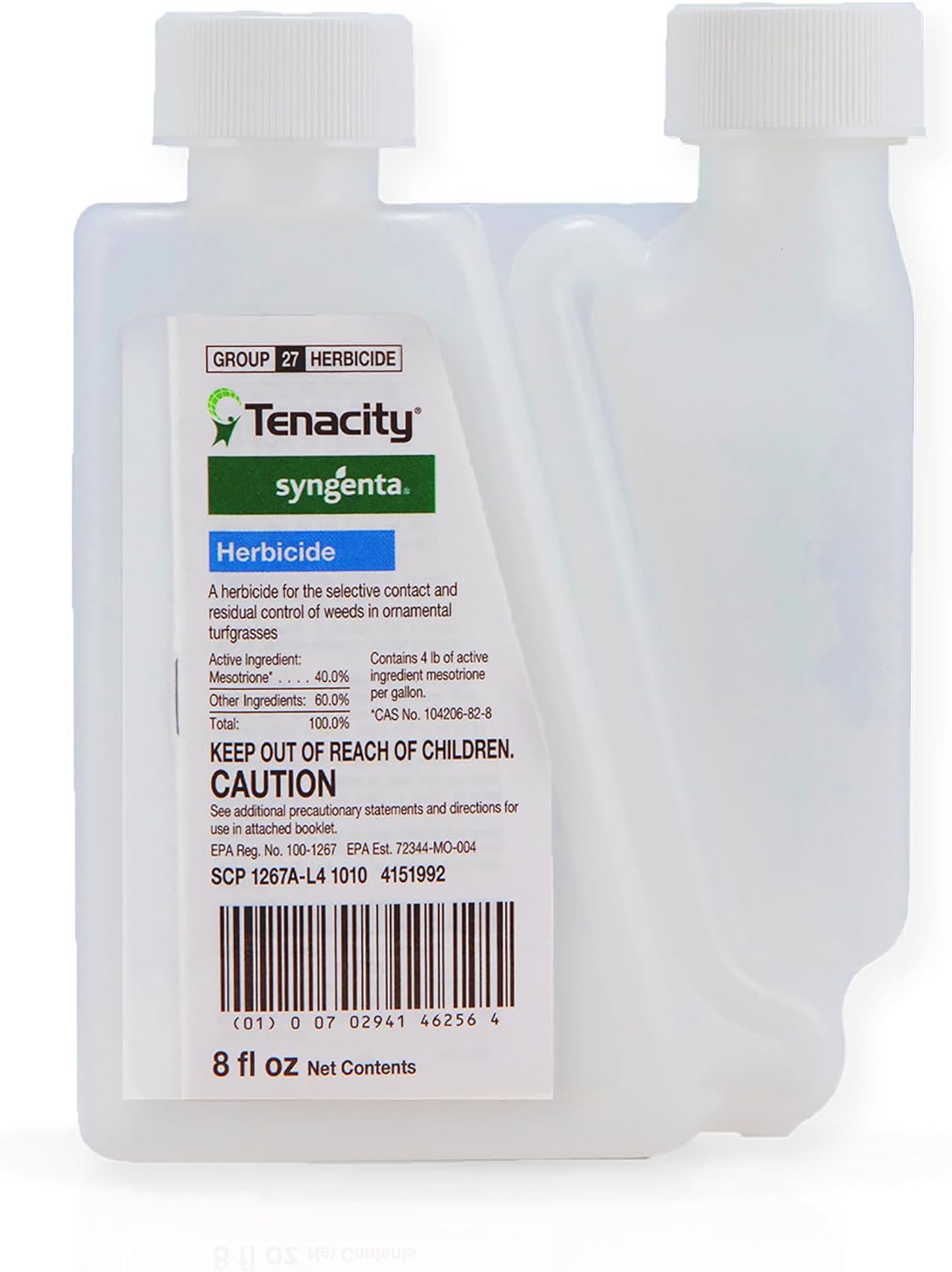
Tenacity Turf Herbicide (8 fl oz)
| Unit Count | 8 Fluid Ounces |
|---|---|
| Item Form | Liquid |
| Coverage | 2000 ft^2 per 1sp of product |
| Active Ingredients | Mesotrione |
Tenacity is a concentrated liquid herbicide used to control many common lawn weeds while preserving desirable turf. It works both as a pre-emergent by being taken up during weed emergence and as a post-emergent contact and residual treatment that continues to suppress regrowth. The active ingredient mesotrione provides control of crabgrass, dandelion, clover, chickweed, henbit and several other weeds named on the label, and one 8 ounce bottle treats roughly 2,000 square feet per labeled application. Typical use involves mixing with water in a sprayer and applying to lawns when weeds are actively growing or before expected germination for seasonal grasses listed on the label. Practical benefits include long residual activity that reduces repeat applications and selective action that minimizes damage to many turf species when used according to directions. Important limitations are that label directions and timing vary by turf species and climate, tank mixes or mowing practices can affect performance, and it is not a nonselective brush-and-kill product so it will not eradicate weeds outside labeled turf uses.
Best for: For homeowners and lawn caretakers who prioritize dependable, selective weed control in maintained turf and want a product that offers both immediate and residual suppression when applied correctly.
Less Ideal for: Not a good choice for people needing a nonselective weed eliminator for driveways, flower beds, or areas with desirable broadleaf ornamentals outside turf; those users should consider targeted nonselective options.
- Selective activity against many grassy and broadleaf lawn weeds, preserving common turf species when used as directed.
- Works both pre-emergent and post-emergent, offering immediate knockdown plus residual control.
- High active ingredient concentration means a small bottle covers a large area when mixed per label rates.
- Liquid formulation is easy to measure and mix into a handheld or backpack sprayer.
- Requires careful timing and adherence to label for safe use on different turf species.
- Performance can depend on application technique and environmental conditions such as temperature and moisture.
Verdict: Choose Tenacity when you need reliable, selective pre- and post-emergent control of common lawn weeds while preserving turf when used according to the label.
Scotts Liquid Turf Builder Plus 2 Weed Control, 32 fl. oz.

| Item Form | Spray |
|---|---|
| Coverage | 6000 square_feet |
| Liquid Volume | 32 fluid ounces |
| Active Ingredients | Nitrogen |
This ready-to-use hose-end bottle combines a liquid fertilizer with a broadleaf weed control formula so you can feed your lawn and spot-treat weeds in one pass. You connect the bottle to a garden hose, spray when weeds are actively growing and avoid watering for 48 hours to let the herbicide work. Notable features include a 25-0-2 NPK nitrogen-forward formula, kill activity on common weeds like dandelions and clover, and manufacturer coverage estimates of up to 6,000 sq ft for warm-season lawns (4,000 sq ft for cool-season). In practice it is very convenient for homeowners who want a quick application without measuring or mixing. The product starts to curl listed weeds within days and may be repeated in 3 to 4 weeks for stubborn infestations. Important limitations are that it is only labeled for specific grass types and some bermudagrass varieties may show temporary injury, and it is not intended for use in garden beds or right up against ornamental plants. For buyers who value straightforward, proven results, this is an effective combination option when used exactly as directed.
Best for: Homeowners who want a simple, single-step solution to both fertilize lawn turf and reduce common broadleaf weeds without mixing chemicals, and who follow label directions carefully.
Less Ideal for: Gardeners who need selective herbicides for ornamentals or want a product labeled for use around vegetable beds should choose a different targeted option.
- Ready-to-spray hose-end applicator requires no mixing or special equipment
- Provides a quick nitrogen boost with a 25-0-2 formulation for greener turf
- Controls many common broadleaf weeds such as dandelions and clover
- Manufacturer-stated coverage up to 6,000 sq ft on warm-season lawns
- Label restricts use to listed grass types and may harm plants outside those lawns
- Some bermudagrass varieties can show temporary injury after application
- Not suitable for use near garden beds, flowers, or vegetables
Verdict: A convenient ready-to-spray lawn food plus weed-control that feeds turf and knocks back common broadleaf weeds in one easy application when used on labeled grasses.
Ortho WeedClear Ready-To-Spray Lawn Weed Killer, 32 fl. oz.

| Item Form | Liquid |
|---|---|
| Coverage | 16000 square_feet |
| Liquid Volume | 32 fluid ounces |
| Active Ingredients | Herbicide |
Ortho WeedClear Ready-To-Spray is a hose‑end herbicide designed for homeowners who want fast broadleaf weed control without harming their grass when directions are followed. The bottle connects to a garden hose and sprays a liquid formulation that targets over 250 common lawn weeds, including dandelions, clover, chickweed, and dollarweed, with visible wilting in hours and rainproof protection once dry. Its ready-to-use sprayer makes application straightforward for spot or area treatments and one 32 fl. oz. bottle claims coverage up to 16,000 sq. ft. in southern lawns (8,000 sq. ft. in northern lawns). Practical benefits include the convenience of not mixing concentrate, quick visible results, and clear re-entry guidance for people and pets after drying. Important limitations are that effectiveness is best when weeds are small and actively growing, long grasses or thick thatch can reduce contact, and the product is formulated for broadleaf weeds only so it will not control grassy weeds like crabgrass. As with any herbicide, careful nozzle control and following label safety instructions are essential to avoid unintended damage to desired plants.
Best for: Homeowners who prioritize a simple, low-risk solution to remove broadleaf weeds from established lawns and value an easy hose‑end application with clear safety guidance.
Less Ideal for: Gardners needing preemergent control or solutions for grassy weeds and those who require professional‑strength or year‑long prevention in bare ground areas.
- Ready-to-use hose sprayer for quick, low-effort application
- Targets over 250 common broadleaf lawn weeds and works down to the root
- Visible results in hours and becomes rainproof after drying
- Large stated coverage: up to 16,000 sq. ft. for southern lawns
- Not formulated to control grassy weeds like crabgrass
- Best results require treating small, actively growing weeds
- Effectiveness can be reduced by heavy thatch or improper spray technique
Verdict: A convenient, ready-to-spray herbicide that safely removes broadleaf weeds from lawns for risk-conscious homeowners who want fast, low-effort results.
Choosing the Right Herbicide That Kills Weeds But Not Grass: Key Factors to Consider
Selectivity and Target Spectrum
Selectivity determines whether a product will affect weeds while leaving lawn grasses unharmed. Herbicides labeled for broadleaf weeds typically target biochemical pathways unique to those species, reducing risk to grasses. Understanding the product's target spectrum is essential because some selective products control only certain families of weeds and will miss grassy weeds or sedges.
When choosing, check whether the herbicide is labeled for your turfgrass species and the specific weeds you have. Using a product outside its labeled target spectrum can lead to poor control or unintended turf damage.
Timing and Turf Condition
The timing of application affects both efficacy and turf safety. Many selective herbicides work best on actively growing weeds in cool or warm seasons depending on the chemistry. Applying during turf dormancy or under heat stress can increase the risk of grass injury or reduce weed uptake.
Also consider recent lawn care activities. Newly seeded or sodded lawns often have restrictions on herbicide use for several weeks. Read label guidance on how long to wait after seeding or aeration, because timing influences whether you can safely treat without affecting grass establishment.
Application Method and Coverage
How you apply a selective herbicide changes outcomes. Broadcast spraying covers large areas efficiently but requires careful calibration to avoid overapplication. Spot treatments let you concentrate product on individual weeds, reducing overall chemical load on the lawn.
Nozzle choice, spray pressure, and water carrier volume affect droplet size and coverage. Drift management is also important near garden beds or ornamental plants. Practical application considerations determine both efficacy and the risk of off-target injury.
Residual Activity and Replanting
Some selective herbicides leave residues that persist in the soil and can affect subsequent planting or overseeding. Short-residual products allow faster replanting or overseeding after treatment, while longer-residual chemistry may protect against new weed flushes but delay lawn repair.
Consider whether you plan to overseed, renovate, or plant nearby ornamentals. If you expect to reseed or plant susceptible species soon, choose a product with minimal residual activity or follow label intervals for safe replanting.
Safety, Environmental Considerations, and Legal Use
Herbicide safety involves personal protective equipment, accurate mixing, and proper disposal of leftover solution. Read the label for required gloves, eye protection, and any respiratory recommendations. Responsible use also means following runoff and waterbody precautions to protect aquatic life.
Local regulations or municipal restrictions can limit the use of certain active ingredients. Always follow label directions and any local rules to reduce drift, runoff, and unintended exposure to pets or beneficial insects.
Compatibility With Lawn Care Practices
Herbicide choice should fit your broader lawn care program. Certain products pair well with regular mowing, fertilization schedules, and integrated pest management strategies, while others are better for occasional spot control. Compatibility with common turf fertilizers and soil amendments can simplify timing and reduce operational steps.
Think about your maintenance rhythm: if you overseed every fall, choose a product that allows safe seeding intervals. If you rely on organic inputs or have pollinator areas nearby, select chemistries and application patterns that align with those priorities.
Common Turf Weeds and How Selectivity Works
Different weeds respond to different active ingredients. Broadleaf weeds like dandelion and clover absorb systemic broadleaf herbicides that travel to roots, while grassy weeds or sedges may require different chemistries. Recognizing the species in your lawn helps you pick a product labeled to control those targets without harming turfgrasses.
Selectivity is often a function of the plant's biology and the herbicide's mode of action. Products that bind to pathways specific to broadleaf plants allow grasses to survive when the label instructions are followed.
- Systemic broadleaf herbicides move inside the weed and control roots and crowns.
- Contact herbicides destroy foliage on contact and are not selective for grass.
- Sedge and grassy weeds may need specialist treatments rather than broadleaf-selective options.
Preparing Your Lawn Before Treatment
Inspect the lawn to identify dominant weed species and note recently seeded areas or thin patches. Mow to the recommended height a few days before application so weeds are actively growing but not heavily shaded by long turf blades.
Remove yard debris and avoid irrigating just before treatment unless the label specifies a water carrier requirement. Preparing the lawn increases spray contact with target weeds and improves uptake for systemic products.
- Mark seeded or newly sodded areas to avoid accidental treatment.
- Avoid applying during drought stress or extreme heat for better turf safety.
Safe Application Techniques for Home Gardeners
Calibrate your sprayer and use the recommended nozzle for even coverage. For spot treatments, reduce total product by focusing on weed clusters rather than broadcasting over the entire lawn. Wear recommended protective equipment and mix concentrates precisely to label rates.
Monitor wind conditions to prevent drift toward flower beds and ornamental plantings. Clean application equipment thoroughly after use to avoid cross-contamination with other garden products.
- Use low-drift nozzles and spray early morning or late evening when winds are light.
- Rinse sprayers and dispose of rinse water according to label instructions.
When to Expect Results and Follow-Up Care
Visible weed decline varies by chemistry and weed species. Some systemic broadleaf herbicides take one to three weeks for noticeable symptoms, while contact products act faster but may not control the rootstock. Plan to wait the recommended interval before retreating or overseeding.
After weeds decline, continue routine lawn care-mowing, irrigation, and fertilization-to help grass recover and close any gaps. Persistent weed problems may need follow-up treatments timed to label guidance rather than immediate repeat spraying.
- Track treatment dates to respect reapplication and reseeding intervals.
- Use cultural controls such as proper mowing height and fertility to reduce weed recurrence.
Integrating Chemical Control With Cultural Practices
Selective herbicides are one tool in an integrated approach. Combine targeted treatments with cultural improvements such as adjusting mowing height, correcting soil fertility, and improving drainage. Strong, dense turf is the best long-term defense against many weeds.
Use herbicides strategically for problem spots or seasonal flushes while maintaining a lawn care program that reduces the need for frequent chemical intervention.
- Aerate compacted soil and overseed thin areas during appropriate seasons.
- Match fertilizer timing to turf growth cycles to encourage competition against weeds.
How We Chose the Best Herbicide That Kills Weeds But Not Grass
We focused on products designed to kill weeds but spare common turfgrasses, so selectivity and predictable turf safety were the primary filters. We evaluated each herbicide on specific, measurable dimensions that matter in a real lawn: chemical selectivity for broadleaf species versus grasses, the speed and completeness of visible weed control, label-recommended application windows and turf type compatibility, and the practical safety and handling guidance for home gardeners. Other considerations included the ease of mixing and applying at home, persistence in the soil and risk to desirable plants, and compatibility with overseeding or lawn repair timelines. We excluded nonselective contact herbicides and gardeners-only cultural controls because they do not fit the objective of killing weeds while preserving grass. We also omitted products with unclear label directions or those not labeled for common turfgrass species. The final list reflects options that balance efficacy against target weeds with conservative turf safety and clear, usable instructions.
FAQ
Can I use selective herbicide right after seeding my lawn?
It depends on the product and the seed establishment timeline. Many selective herbicides have label restrictions that require waiting several weeks after seeding. Check the product label for the exact interval to avoid harming young grass seedlings.
Will a selective herbicide control grassy weeds and sedges?
Most broadleaf-selective herbicides do not control grassy weeds or sedges. Those species often require different active ingredients or specialist products labeled for sedge or grassy weed control. Identify the weed first to choose an appropriate chemistry.
How soon can I overseed after applying a selective herbicide?
Replanting intervals vary by active ingredient and product formulation. Some herbicides allow overseeding within a few weeks, while others require longer waiting periods. Follow label guidance to ensure new seed germination is not harmed.
Are spot treatments better than broadcast spraying for selective control?
Spot treatments reduce overall chemical use and lower the risk to nearby desirable plants, making them a good choice for localized infestations. Broadcast applications are useful for widespread problems but need careful calibration to avoid overapplication.
Will applying a selective herbicide harm pollinators in my yard?
Selective herbicides applied to the turf canopy generally have limited direct impact on pollinators if used according to label instructions and applied when flowering weeds are not in bloom. Reducing off-target spray and avoiding treatments near flowering ornamentals further lowers risk.
Final Verdict
Choosing an herbicide that kills weeds but not grass requires balancing selectivity, timing, and application technique. Prioritize products labeled for your turf species and the specific weeds you face, and plan applications around turf health and seeding schedules. Combine chemical control with cultural practices like proper mowing and overseeding to reduce future weed pressure. When in doubt, prefer conservative application patterns, spot treatments, and clear label-following to protect your lawn while removing unwanted plants. That approach gives the best chance of restoring dense, healthy turf without unnecessary damage.
