

Note: This article contains affiliate links. If you click on these links and make a purchase, I may earn a small commission at no extra cost to you. This helps support my research and content. Read my full affiliate disclosure here.
Picking the right light bulb insect killer makes evenings on the patio and nights in the garage more comfortable without adding bulky gear. These screw-in or plug-in bulb-style devices behave like ordinary lighting while reducing flying insects, so the right choice depends on how you use the space, what pests you commonly see, and whether the fixture will be exposed to weather. This guide covers six shortlisted light bulb insect killers that suit a range of outdoor and indoor situations. We evaluated them on practical, gardener-relevant criteria like effective coverage, durability in outdoor conditions, and user safety. Read on to find which features matter most for your space before checking the product blocks below.
Top Picks at a Glance
| Best Overall The best all-around choice for most situations | Wiyifada A19 Amber LED Bug Light Bulbs, 9W (2-Pack) |  |
| Best Quality Built to a higher standard if you want something more solid | Forhimn Bug Zapper Light Bulb (LED UV insect killer, 3 modes) |  |
| Best Value The sweet spot between price and what you get | BANPESTT 2-in-1 Bug Zapper Light Bulb (E26) |  |
| Best Budget The cheapest option that still gets the job done reliably | KQHBEN LED Yellow Bug Light Bulbs, 9W (60W Equivalent) E26 Base, 4-Pack |  |
| Highest Rated A top-rated pick with lots of positive feedback | Calutite EL-22 9W BL350 Replacement Fluorescent Black Light Bulb (G23 base) |  |
| Most Popular A crowd favorite that many people choose with confidence | JAHEKS A19 9W 2000K Yellow LED Bug Light Bulb — 2-Pack |  |
Wiyifada A19 Amber LED Bug Light Bulbs, 9W (2-Pack)

| Light Type | LED |
|---|---|
| Wattage | 9 watts |
| Color Temperature | 2000 Kelvin |
| White Brightness | 720 lumens |
| Bulb Base | E26 |
These Wiyifada amber A19 bulbs are designed to light porches, patios, and entryways while reducing flying insects. They screw into any standard E26 socket and produce warm 2000K amber light with about 720 lumens output per bulb, using 9 watts to approximate a 100W incandescent. The amber color and reduced blue spectrum make these practical for outdoor seating and holiday or party decoration where you want visible light without attracting bugs. The bulbs are rated dimmable and list a 20,000 hour life, so they can be used for seasonal or year‑round outdoor fixtures and swapped into lamps or ceiling sockets. Expect plastic construction and typical LED directional spread of roughly 150 degrees, so they work best for localized illumination rather than wide area flood lighting. Control options are basic push button or app-capable depending on fixture, and the bulbs meet common certifications. If your priority is bright white task lighting or wide area security coverage, these amber bug bulbs will feel noticeably warmer and less intense.
Best for: Buyers who want pleasant, low‑attraction outdoor or porch lighting that prioritizes comfort and atmosphere over maximum brightness. Ideal for homeowners who value easy installation and energy savings for evening seating areas.
Less Ideal for: Not a good fit for users needing bright white task lighting, commercial security illumination, or broad floodlight coverage for large yards.
- Amber 2000K light reduces attraction of flying insects for outdoor seating areas
- Energy efficient 9W LED that replaces up to 100W incandescent for lower power use
- Standard E26 A19 form factor fits most indoor and outdoor fixtures without adapters
- Rated dimmable and listed 20,000 hour operating life for flexible use and longevity
- Plastic body and moderate lumen output are not suited for large area security or task lighting
- 720 lumens may be insufficient where high brightness or cool white color is required
Verdict: Choose these amber A19 LEDs when you want energy efficient porch or patio light that keeps flying insects away while creating warm, comfortable evening ambience.
Forhimn Bug Zapper Light Bulb (LED UV insect killer, 3 modes)
| Power Source | ac_dc |
|---|---|
| Material Type | ABS Plastic |
| Unit Count | 1 Count |
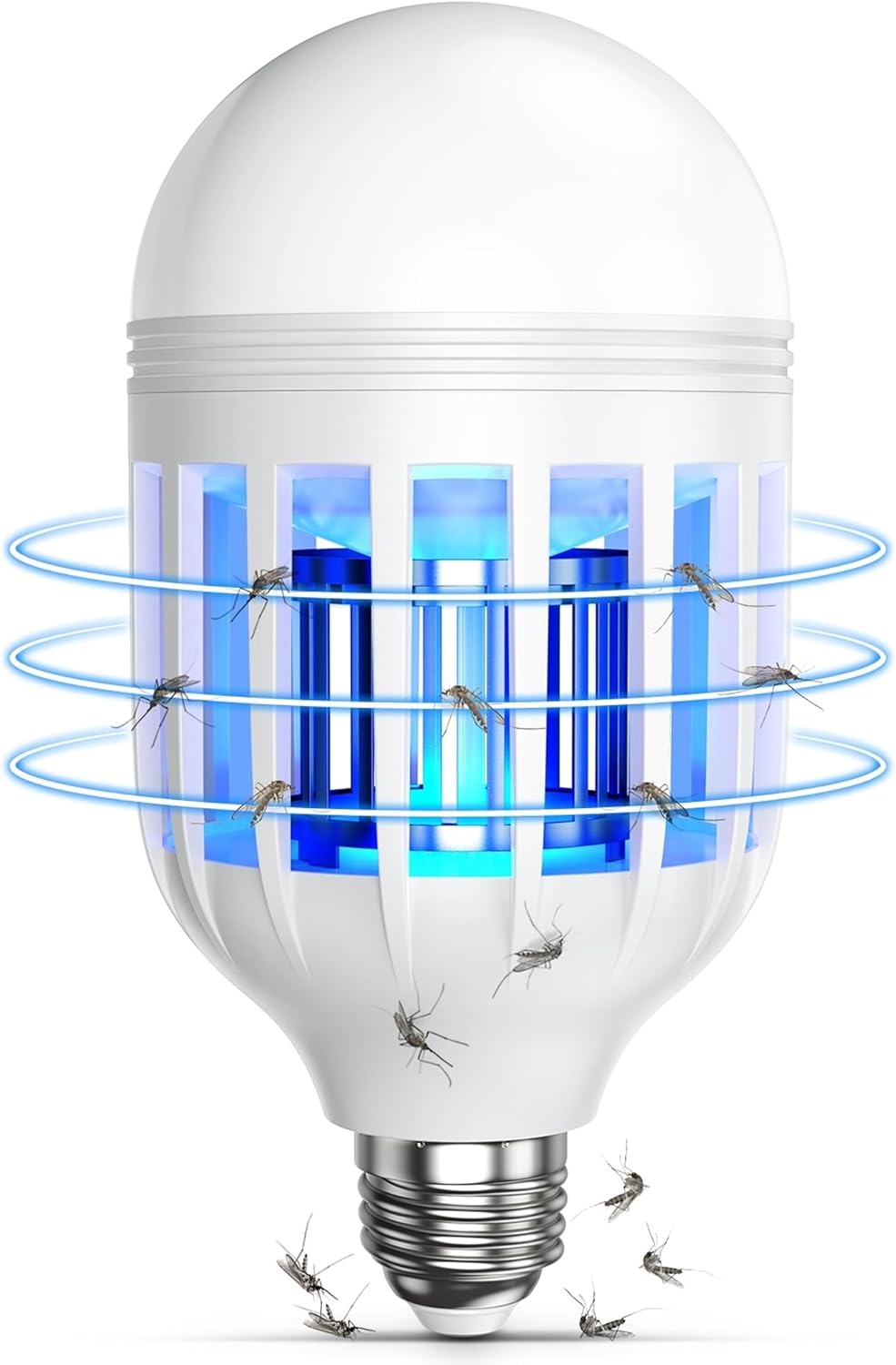
This Forhimn bug zapper light bulb replaces a standard bulb and combines LED UV attraction with a high-voltage grid to kill mosquitoes and other flying insects. It is typically used in outdoor or indoor covered fixtures where a standard E26-style bulb fits; a three-position switch lets you choose full light plus zapper, low light only, or zapper-only operation. The blue-violet LED band (365–420 nm) attracts a range of insects and the charged metal grid delivers an instant kill, while the 45 degree slope design encourages dead insects to fall away. Because it uses a physical electrocution method and ABS housing, it avoids sprays and sticky traps and is suitable where chemical control is undesirable. Practical limits are that it needs a compatible socket and AC power, the grid can require occasional cleaning if heavy insect traffic collects, and effectiveness depends on attracting insects in the bulb's immediate range rather than providing area-wide control.
Best for: Buyers who prioritize fast, chemical-free insect control and want a plug-and-play replacement bulb that zaps bugs at the fixture without changing outdoor routines.
Less Ideal for: People needing wide-area or commercial-level insect control or those who cannot access a standard screw socket for installation.
- LED emits 365–420 nm UV band designed to attract mosquitoes and other flying insects
- Three selectable modes (full light+zapper, low light, zapper-only) for flexible use
- Screw-in bulb form factor fits standard lamp sockets for easy installation
- Physical electric grid kills insects without chemicals or sticky traps
- Requires a compatible AC socket and only covers a limited immediate area
- Electrified grid can accumulate dead insects and needs occasional cleaning
Verdict: If you want an easy, chemical-free screw-in solution to reduce mosquitoes and flying insects near a light fixture, this bulb delivers targeted, plug-and-play zapper performance.
BANPESTT 2-in-1 Bug Zapper Light Bulb (E26)

| Target Species | Flying insects |
|---|---|
| Power Source | AC |
| Unit Count | 1 Count |
| Material Type | Plastic |
The BANPESTT 2-in-1 Bug Zapper Light Bulb combines a 260-lumen LED lamp with an electric high-voltage grid to attract and kill flying insects such as gnats, moths, fruit flies, and mosquitoes. It screws into a standard E26 socket so installation is tool-free and quick, and a two-mode power switch lets you run light-only or light-plus-zap. The design emphasizes low maintenance: a sloped interior helps dead insects slide away and the LED is rated for long life, avoiding frequent replacements. The bulb claims coverage up to about 500 sq ft and uses AC power, so it is best for fixed indoor and sheltered outdoor fixtures like porches or covered patios. Practical materials and a fire-resistant plastic housing reduce corrosion concerns, but it is not fully waterproof so avoid exposure to heavy rain. It does not target nonflying pests and will be less effective in very large open outdoor areas versus enclosed spaces. For someone who wants a low-effort, chemical-free way to reduce flying insects around a light source, this is a sensible choice.
Best for: Buyers who want a convenient, low-effort way to reduce flying insects around indoor rooms, porches, or covered outdoor fixtures while keeping a usable light source.
Less Ideal for: People needing full outdoor weatherproof protection or those who require control of nonflying pests or very large open-yard coverage.
- Two-in-one design provides LED illumination plus an electric insect grid from a single E26 socket
- Tool-free installation fits standard household light fixtures
- Low-maintenance interior slope helps dead insects fall away and simplifies cleaning
- Long-life LED (advertised ~30,000 hours) reduces bulb replacement frequency
- Not fully waterproof so unsuitable for exposed outdoor locations
- May be less effective in very large or wide-open outdoor areas compared with dedicated outdoor zapper units
Verdict: A practical, easy-to-install E26 LED bulb that gives continuous chemical-free control of flying insects while doubling as a soft indoor or sheltered-outdoor light.
KQHBEN LED Yellow Bug Light Bulbs, 9W (60W Equivalent) E26 Base, 4-Pack

| Wattage | 9 watts |
|---|---|
| Bulb Base | E26 |
| Color Temperature | 2000 Kelvin |
| Indoor Outdoor Usage | Outdoor |
| Light Source Operating Life | 30000 hours |
These KQHBEN yellow LED bulbs are built for outdoor decorative fixtures where you want to cut insect attraction and save energy. Each E26 bulb produces a warm 2000K amber light while consuming 9 watts (60W incandescent equivalent), so they work as replacements in porch fixtures, pendant lights, and outdoor sconces. The bulbs are rated for 30,000 hours and list features such as waterproofing, shatter resistance, and flicker-free operation, which makes them suitable for seasonal displays and year-round exterior use. They are not dimmable and use a simple push-button controller or standard switch rather than advanced smart controls, so installation is plug-and-play with typical sockets. Practical limits are the fixed yellow color and no dimming, which is fine for insect-reduction purposes but not for tasks needing bright white illumination or adjustable ambiance. For a budget-focused buyer looking to reduce bugs and lower running costs, this 4-pack covers multiple fixtures and offers straightforward, durable performance.
Best for: Buyers who want an inexpensive, no-frills way to light porches and patios while reducing bugs and cutting energy use; ideal for seasonal decorators and homeowners fitting several outdoor fixtures on a budget.
Less Ideal for: People who need bright white task lighting, color-adjustable bulbs, or dimmable fixtures should look for other LED options.
- Yellow 2000K light reduces insect attraction compared with white bulbs
- Low power draw at 9W while matching a 60W incandescent equivalent
- Rated 30,000 hours for long service life
- Waterproof and shatter resistant for outdoor use
- Sold as a 4-pack to outfit multiple fixtures affordably
- Not dimmable so cannot be used where adjustable brightness is needed
- Fixed amber color limits use for general task lighting
Verdict: A cost-conscious four-pack of durable yellow LED bulbs that cuts insect attraction and electricity use while covering multiple outdoor fixtures.
Calutite EL-22 9W BL350 Replacement Fluorescent Black Light Bulb (G23 base)

| Light Type | Fluorescent |
|---|---|
| Wattage | 9 watts |
| Bulb Base | G23 |
| Light Color | Blue (BL350) |
| Light Source Operating Life | 8000 hours |
This Calutite EL-22 replacement is a 9 watt fluorescent black light tube made to fit EL-22 classic Flyweb/Spek lighting fixtures with a G23 base. It produces a high-intensity blue/black light (BL350, 368 nm peak) that attracts flying insects when used in indoor insect killer lamps. Typical use is straightforward: swap the lamp into the fixture as a direct replacement and run it as part of the trap; the bulb is rated for roughly 6000 to 8000 hours and the listing recommends replacement every 3000 to 4000 hours for best performance. Notable features include its energy-efficient 9W consumption and glass tubular construction that matches standard EL-22 form factors. In practice this means lower power draw compared with higher-wattage tubes while still delivering the UV output needed to lure insects. Limitations are its compatibility: it is intended for specific EL-22/Flyweb fixtures with a G23 socket and indoor use only, so it will not work in different bases or outdoor traps. Expect to replace bulbs periodically to maintain peak attraction.
Best for: Buyers who want a reliable, drop-in replacement bulb for an indoor EL-22 style insect killer and prioritize consistent UV output and low energy use to keep traps effective over time.
Less Ideal for: People who need bulbs for outdoor traps, fixtures with a different base, or those seeking a longer-lifetime LED alternative.
- High-intensity BL350 peak wavelength optimized for attracting flying insects
- Low power consumption at 9 watts for energy-efficient operation
- Designed as a direct replacement for EL-22/Flyweb fixtures with G23 base
- Listed operating life up to about 6000 to 8000 hours for reasonable durability
- Only compatible with specific EL-22/Flyweb/Spek fixtures using a G23 base
- Rated for indoor use only so not suitable for outdoor insect traps
Verdict: A dependable, energy-efficient direct replacement black light tube for indoor EL-22 insect killer lamps that delivers targeted UV output to attract flying insects.
JAHEKS A19 9W 2000K Yellow LED Bug Light Bulb — 2-Pack

| Wattage | 9 watts |
|---|---|
| Bulb Shape Size | A19 |
| Bulb Base | E26 |
| Color Temperature | 2000 Kelvin |
| Light Source Operating Life | 20000 hours |
These JAHEKS yellow bug bulbs are standard A19 LEDs that trade white light for a 2000K amber glow intended to reduce insect attraction around porches, patios, and entryways. They screw into any E26 fixture and deliver roughly the brightness of a 60W incandescent while using 9 watts, so they work as direct replacements in ceiling fixtures, wall sconces, and outdoor porch lights. Notable features include an advertised 20,000-hour life, 600-lumen output, and shatter-resistant construction that suits semi-exposed outdoor fixtures. The amber color is useful for outdoor social spaces and bedroom night lights because it is less attractive to many flying insects and is gentler on the eyes at night. Limitations to note are that the bulbs are specialized for insect reduction rather than task lighting, so colors and detail will be muted under their light, and the claimed app/control wording is confusing since the bulb functions as a plain E26 LED without smart connectivity. For buyers focused on reducing bugs while keeping simple, energy-efficient lighting, these provide an easy, low-maintenance option; they are not a substitute for insect traps or heavy-duty outdoor-rated fixtures in exposed locations.
Best for: Buyers who want a simple, plug-and-play bulb to reduce nighttime insects around porches and patios while keeping energy use low and maintenance minimal.
Less Ideal for: People who need bright, color-accurate lighting for workspaces or those who require rugged, fully weatherproof fixtures for exposed outdoor installations.
- Amber 2000K light that reduces attraction to many flying insects
- Compatible with standard E26 sockets for easy replacement
- Low power consumption at 9W with 60W incandescent equivalent brightness
- Shatter-resistant construction suitable for outdoor-rated fixtures
- Advertised 20,000-hour operating life reduces bulb changes
- Not intended for accurate color rendering or task lighting due to amber tint
- No true smart or app control despite 'Control Method' listing
Verdict: A straightforward, energy-efficient amber A19 bulb that cuts insect attraction and drops into standard E26 fixtures for easy outdoor or porch use.
Choosing the Right Light Bulb Insect Killer: Key Factors to Consider
Coverage Area and Light Spread
Coverage area matters because bulb-style insect killers rely on light intensity and distribution to lure flying pests from across a space. A bulb with higher lumen output and broader beam angle will affect a wider radius on a porch or patio, while narrow-beam designs concentrate attraction directly beneath the fixture.
Think about where people sit or enter the space. For a small balcony you may prefer focused coverage that protects a limited zone. For an open backyard seating area, choose a bulb rated for larger coverage or plan to use multiple fixtures so insects are drawn away from people rather than toward them.
Attraction Wavelength and Insect Types
Different insects are attracted to different parts of the light spectrum. Many nuisance flies and moths respond strongly to UV-A and blue-violet light, while other species react to broader white light. Bulbs that advertise a specific insect-attracting wavelength tend to be more effective at drawing common night-flying pests.
Consider the pests you most often encounter. If moths and small flies dominate, a bulb emphasizing UV output may perform better. For mixed insect problems, a balanced spectrum that still includes UV components gives broader control without drastically altering ambient light quality.
Weather Resistance and Outdoor Durability
Bulb-style insect killers used outdoors must stand up to temperature swings, humidity, and occasional direct exposure to rain or drizzle. Look for sealed housings, IP ratings, and corrosion-resistant materials that protect internal components. Fixtures intended for covered porches differ from those meant to hang in open eaves.
Durability affects long-term value and safety. A fragile globe or poor sealing can let moisture reach live parts, shortening lifespan and increasing maintenance. For winter or wet climates, select bulbs designed for outdoor-rated sockets or plan to move them indoors when severe weather is expected.
Safety and Non-Target Impact
Safety covers both user risk and non-target effects. Bulb insect killers that use enclosed electric grids or adhesive capture reduce the chance of accidental contact, important in family yards or where pets roam. Low-voltage and properly insulated components minimize shock risk during routine handling.
Also weigh impacts on beneficial insects. Bulbs that emit broad-spectrum light can attract pollinators at night and disrupt local insect ecology. Choosing fixtures with targeted wavelengths or deploying them away from garden beds helps limit unintended captures.
Installation Compatibility and Ease
Most light bulb insect killers are designed to fit common sockets, but compatibility with fixtures, dimmers, and timers varies. Confirm the base type, whether the bulb will operate correctly with existing dimmer circuits, and if any adapters are needed for hanging or recessed fixtures.
Ease of installation influences how readily you can reposition the bulb for seasonality or special events. Plug-and-play designs that use standard screw bases or simple plug adapters make it easy to trial different locations without electrician help.
Maintenance and Lifespan
Maintenance frequency affects ongoing convenience. Some bulb killers collect insects on glue boards that need periodic replacement, while electrified grids or enclosed kill chambers require occasional cleaning. Consider how easy it is to access capture surfaces and whether parts are washable or disposable.
Also compare rated bulb life and how often the light source itself needs replacement. Energy-efficient LEDs often last longer and lower operating costs, but check that the insect-attracting wavelengths remain stable over time so effectiveness does not degrade early in the bulb life.
Where to Place a Light Bulb Insect Killer
Placement determines whether a bulb protects people or merely concentrates insects near seating and doorways. Position fixtures slightly away from gathering spots so insects are drawn to the bulb and not into the main living area. For entryways, place the bulb a few feet from the door to create a buffer zone.
Hang or mount bulbs at a moderate height where they are visible across the intended coverage area but out of reach of curious hands or paws. If using multiple bulbs, stagger them to avoid creating bright corridors that pull insects through seating areas.
- Mount several low-powered bulbs for even coverage in large patios
- Place units away from flower beds to protect pollinators
- Keep bulbs out of reach of children and pets
LED Versus Traditional Light Sources
LED-based insect bulbs offer energy efficiency and longer rated life, and many manufacturers tune LEDs to emit insect-attracting wavelengths while still providing usable white light. Traditional fluorescent or incandescent-style insect lights can be effective at attraction but often use more energy and may need replacement sooner.
Consider whether the light quality will be acceptable for the space. Some insect-targeted LEDs balance function and ambiance so the area remains pleasant for evening activities, while older lamp types may throw a colder or more unnatural color.
- LEDs: lower energy use, longer life, tunable spectrum
- Traditional lamps: sometimes stronger UV output but shorter lifespan
Power Options and Controls
Look for bulbs that work with timers, photocells, or smart plugs so you can limit operation to dusk-to-midnight hours when most flying pests are active. Timed operation reduces energy use and lessens impact on nocturnal beneficials. Photocell-equipped units automatically switch on at dusk, which is convenient for unsupervised outdoor spaces.
If you need dimming or color control for ambiance, verify compatibility with dimmer switches and any smart-home systems. Some insect-attracting bulbs are not dimmable and may perform poorly if used with variable voltage.
- Use timers to target peak insect activity evenings
- Photocells save on manual switching
- Check dimmer compatibility before installing
Cleaning and Upkeep Tips
Establish a simple routine: inspect capture surfaces weekly during peak season, empty or replace trays as needed, and wipe external housing to remove dust that can reduce light output. For electrified grids, always disconnect power before cleaning and use brushes designed for that purpose.
If glue boards are used, replace them before they become saturated to maintain attraction effectiveness. Keep spare replacement parts on hand to avoid downtime during busy insect months.
- Disconnect power before maintenance
- Replace glue boards on a schedule
- Store bulbs indoors during winter if not rated for freezing temps
Legal and Environmental Considerations
Local regulations rarely restrict household insect light use, but if you live near protected habitats or areas with sensitive insect populations, aim to minimize non-target captures. Place bulbs away from flowering plants and avoid leaving them running all night in high-pollinator seasons.
Consider integrated pest management practices as part of a larger plan: reduce standing water, cover compost, and use targeted repellents to lower insect pressure so bulb-style devices can do a smaller, more effective job.
- Avoid long, continuous operation during pollinator seasons
- Combine with habitat management for best results
How We Chose the Best Light Bulb Insect Killer
We prioritized attributes that matter in real garden and outdoor-living use. Key evaluation criteria included effective coverage area and attraction spectrum, to estimate how well a bulb draws common nuisance flies and moths across a defined space. We tested reported lumen and wavelength specs and considered how those relate to typical insect behavior. Durability and weather resistance were important for bulbs intended for porches, eaves, and patios; we focused on IP ratings, housing materials, and whether the design protects electrical parts from moisture. Safety and ease of use were also assessed, including whether the bulb uses low-voltage elements, has an enclosed kill chamber, and fits standard light sockets. Maintenance and cleaning expectations influenced selection, so we considered whether debris is easy to remove and whether bulbs require frequent replacement. Energy use and runtime were checked against typical evening use to favor efficient options. We excluded fixtures that are clearly designed for industrial settings or that require specialized hardwiring, concentrating on homeowner-friendly, socket-fit solutions.
FAQ
Will a light bulb insect killer harm beneficial insects like moths or pollinators?
It depends on placement and spectrum. Bulbs that emit broad-spectrum or strong UV light can attract non-target insects. Positioning units away from flower beds and limiting operation to evening hours reduces impacts on pollinators.
Can I use a light bulb insect killer indoors near food prep areas?
You can, but choose a design with an enclosed capture method to prevent debris from falling into food spaces. Regular cleaning is important indoors to avoid odor and hygiene issues.
Do LED insect bulbs actually attract insects as well as traditional UV lamps?
Often yes. LEDs can be engineered to emit the wavelengths insects respond to and usually last longer while using less energy. Effectiveness varies by wavelength output and bulb placement.
How often should I replace glue boards or capture trays?
Replacement frequency depends on insect pressure but usually ranges from weekly to monthly during peak season. Replace boards before they become saturated to keep attraction strong and to maintain sanitary conditions.
Are these bulbs safe to use around children and pets?
Many designs prioritize safety with enclosed capture chambers and low-voltage components, but you should mount bulbs out of reach and follow manufacturer safety instructions. Disconnect power before cleaning.
Will the bulb attract more insects to my yard overall?
A correctly placed bulb draws insects toward itself, which can reduce activity in nearby seating areas. Poor placement can concentrate insects near entryways or people, so position units to lure pests away from high-traffic zones.
Final Verdict
When choosing a light bulb insect killer, prioritize where you will use it and which insects you need to control. Coverage area, attraction spectrum, and weather resistance determine real-world effectiveness, while safety and maintenance affect daily convenience. Balance operation times and placement to protect people and limit non-target captures. With those tradeoffs in mind, pick a socket-compatible, outdoor-rated option if you need porch protection, or a lower-powered indoor design for garages and screened rooms.
