

Note: This article contains affiliate links. If you click on these links and make a purchase, I may earn a small commission at no extra cost to you. This helps support my research and content. Read my full affiliate disclosure here.
If you maintain a large yard, heavy tree cover, or frequent wet leaf fall, a high power leaf blower changes how much time you spend on cleanup. The right blower moves dense piles, blows damp leaves, and reduces repetitive passes so you finish jobs faster and with less fatigue. This guide covers six shortlisted high power leaf blowers suited to heavy yard work and commercial-style chores. We evaluate each on airflow, endurance, handling, and maintenance needs so you can pick the tool that matches the scale of your property and how often you use it. Read on for practical notes about power, control, and long-term reliability before the product reviews below.
Top Picks at a Glance
| Best Overall The best all-around choice for most situations | Husqvarna 350iB Cordless Leaf Blower with Battery and Charger |  |
| Best Quality Built to a higher standard if you want something more solid | EGO POWER+ LB7654 56V Cordless Leaf Blower with 5.0Ah Battery |  |
| Best Value The sweet spot between price and what you get | Greenworks 80V Axial Cordless Leaf Blower with 2.5Ah Battery and Charger |  |
| Best Budget The cheapest option that still gets the job done reliably | WORX WG520 600 CFM Turbine Corded Leaf Blower |  |
| Highest Rated A top-rated pick with lots of positive feedback | PTBGLV Cordless Leaf Blower SF-019 with Dual 21V 6.0Ah Batteries |  |
| Most Popular A crowd favorite that many people choose with confidence | VIBOGEN HG0645 Cordless Electric Leaf Blower with Dual Batteries |  |
Husqvarna 350iB Cordless Leaf Blower with Battery and Charger

| Power Source | Battery Powered |
|---|---|
| Voltage | 40 volts |
| Air Flow Capacity | 800 cfm |
| Noise Level | 65 db |
The Husqvarna 350iB is a cordless handheld leaf blower built to move large volumes of debris without the noise and fumes of a gas machine. It pairs a brushless motor with a 40V 7.5 Ah battery to produce up to 200 MPH wind speed and 800 CFM airflow, which clears leaves, grass clippings, and light debris quickly on driveways, patios, and lawns. Practical features include cruise control to hold a steady output for long runs, a power boost mode for short bursts of extra force, and a built-in debris scraper to loosen wet or sticky material. The blower is designed to be relatively light and well balanced for handheld use, helping reduce arm fatigue during typical yard sessions. Battery operation means quieter use and no emissions, but runtime will depend on the workload and selected power mode, and heavier commercial jobs may demand a more continuous power source. For homeowners who want high blowing performance with the convenience of a cordless system, this model is a strong pick.
Best for: Homeowners who want a powerful cordless blower that balances high performance and quiet operation for regular yard and driveway cleanup.
Less Ideal for: Landscapers or users who need long uninterrupted runtime for large commercial properties should consider backpack or corded commercial-grade blowers instead.
- High airflow and wind speed (800 CFM, 200 MPH) clears debris quickly
- Brushless motor and power boost mode deliver strong, consistent performance
- Includes 40V lithium-ion battery and charger for cordless convenience
- Cruise control maintains steady output during longer clearing tasks
- Built-in debris scraper helps remove wet or stuck leaves
- Battery runtime varies with power mode and heavy tasks may drain the battery quickly
- Handheld design and battery weight can limit continuous use compared with backpack commercial blowers
Verdict: Choose the 350iB if you want a top-performing cordless handheld blower that delivers near-professional airflow for homeowner cleanup without gas engine noise or emissions.
EGO POWER+ LB7654 56V Cordless Leaf Blower with 5.0Ah Battery

| Power Source | Battery Powered |
|---|---|
| Voltage | 56 volts |
| Air Flow Capacity | 765 cfm |
| Noise Level | 64 db |
| Included Components | Blower, 5.0Ah battery, 320W charger, tapered and spread nozzles |
The EGO POWER+ LB7654 is a cordless, performance‑focused handheld blower built to replace gas models for heavy yard cleanup. It produces up to 765 CFM and 200 MPH in turbo, while a variable speed cruise dial lets you dial output between gentler and high‑power settings for tasks like clearing lawns, driveways, or wet leaves. The package includes a 5.0Ah ARC Lithium battery and a 320W charger; EGO claims up to 90 minutes runtime on the included battery and a 70‑minute recharge. Notable features are turbine fan engineering for strong airflow, a brushless motor for lower vibration and longer motor life, and two nozzles for spread or focused air. In practice this blower offers gas‑comparable push with the convenience of battery operation and quieter 64 dB noise level, making longer sessions more pleasant. It is relatively lightweight for its class and ergonomically balanced. Limitations to consider are that peak runtime and performance depend on battery condition and that truly continuous heavy commercial use would benefit from spare batteries for extended jobs.
Best for: Buyers who prioritize raw clearing power and gas‑level performance but want the convenience and lower noise of a cordless unit for residential or large‑property maintenance.
Less Ideal for: Casual users with only small yards who want the cheapest occasional blower or contractors who need continuous all‑day operation without carrying spare batteries.
- High peak airflow of 765 CFM with 200 MPH top speed for moving wet leaves and dense debris
- Variable speed cruise dial for precise control and more efficient battery use
- Includes 5.0Ah battery and 320W charger for up to claimed 90 minutes runtime out of the box
- Brushless motor reduces vibration and improves durability compared with brushed designs
- Interchangeable tapered and spread nozzles let you switch between concentrated and wide airflow patterns
- Actual long runtimes require careful speed management and will drop at higher power settings
- Not intended for continuous commercial shifts without extra batteries
Verdict: If you want a cordless blower that delivers near‑gas power for heavy residential cleanup, the LB7654 gives strong airflow, variable control, and long runtime right out of the box.
Greenworks 80V Axial Cordless Leaf Blower with 2.5Ah Battery and Charger

| Power Source | Battery Powered |
|---|---|
| Voltage | 80 volts |
| Air Flow Capacity | 700 cfm |
| Noise Level | 74 db |
| Additional Features | Adjustable Speed, Turbo |
This Greenworks 80V axial blower brings gas-level clearing power to a cordless, low-maintenance package. It uses an 80V brushless motor to produce up to 700 CFM and 170 MPH for moving heavy or wet leaves, with a Turbo mode for stubborn debris. The included 2.5Ah battery and 4A rapid charger let you tackle typical large-yard jobs on a single charge at low to medium settings, and the tool is part of Greenworks' 80V battery ecosystem so the same pack works across other yard tools. Variable speed, cruise control, and a tapered nozzle give practical control for driveways, gutters, and beds while a 74 dB noise rating keeps the blower noticeably quieter than gas models. Expect shorter runtime in Turbo or on the highest setting and consider a higher-capacity battery if you need extended continuous use. The handheld form and balanced ergonomics make it comfortable for regular homeowner chores, while zero gas maintenance and quick start-up simplify routine cleanup.
Best for: Homeowners who want near-gas power without maintenance or fumes and who value quiet, cordless operation for regular yard cleanup across a range of Greenworks 80V tools.
Less Ideal for: Landscape professionals or users who need multi-hour continuous operation without swapping batteries should consider backpack gas or higher-capacity battery systems.
- High airflow and speed (700 CFM, 170 MPH) for clearing heavy or wet debris
- Brushless 80V motor for stronger performance and longer motor life
- Includes 2.5Ah battery and 4A rapid charger for ready-to-use cordless operation
- Variable speed with cruise control and tapered nozzle for precise control
- Quieter operation (74 dB) compared with typical gas blowers
- Runtime is limited on high or Turbo mode and may require a larger battery for long continuous jobs
- Handheld design can still cause fatigue during very long sessions compared with backpack models
Verdict: A powerful, quiet cordless blower that delivers gas-level clearing for large home yards while eliminating fuel and maintenance hassles.
WORX WG520 600 CFM Turbine Corded Leaf Blower

| Power Source | Corded Electric |
|---|---|
| Air Flow Capacity | 600 cfm |
| Maximum Speed | 110 miles_per_hour |
| Additional Features | Adjustable Speed, One-hand Operation |
The WORX WG520 is a corded electric handheld blower built to move large amounts of leaves and yard debris without the hassle of gas or batteries. Its 12 amp motor and TURBINE fan design produce up to 600 CFM and 110 MPH, which makes quick work of open lawns, driveways, patios, and sidewalks. Two-speed variable control lets you dial back airflow for delicate areas like flowerbeds or ramp up for big piles. The tapered hyper-stream nozzle concentrates the airflow for better directional push while the lightweight one-hand design reduces fatigue during longer sessions. Being corded means continuous power for extended jobs but you are limited by cord length and need an outdoor outlet. It is quieter and lower maintenance than comparable gas models, though it lacks the absolute mobility of cordless battery or gas blowers. For routine seasonal leaf removal and everyday yard tidying, the WG520 balances strong performance with simple, low-upkeep operation.
Best for: Buyers who want powerful, low-maintenance yard equipment and prioritize continuous corded performance over cordless mobility for regular leaf and debris cleanup.
Less Ideal for: People who need untethered mobility for large properties without convenient outdoor outlets or who prefer the extended range of gas-powered tools.
- High airflow capacity (600 CFM) suitable for large piles and open areas
- Two-speed variable control for precision in tight or delicate spaces
- Corded design provides continuous power without recharging or fuel
- Lightweight one-hand operation reduces user fatigue during extended use
- Cord limits range compared with cordless or gas blowers
- Requires access to outdoor power outlet for extended jobs
Verdict: If you want high continuous blowing power and low upkeep for routine yard cleanup, the WG520 delivers strong, reliable corded performance.
PTBGLV Cordless Leaf Blower SF-019 with Dual 21V 6.0Ah Batteries

| Power Source | Battery Powered |
|---|---|
| Form Factor | Handheld |
| Additional Features | Portable |
| Item Highlight | 6‑Speed, 600CFM, 200MPH |
The PTBGLV SF-019 is a battery-powered handheld leaf blower designed for regular yard cleanup where reliable runtime and adjustable power matter. It ships with two 21V 6.0Ah batteries and a fast charger so you can swap batteries for extended runs and recharge fully in about 2 to 3 hours. The upgraded axial turbine motor produces up to 200 MPH wind speed and roughly 600 CFM airflow, and six variable speeds let you dial back for light dusting or crank up for wet leaves and heavier debris. At about 3.8 pounds with an ergonomic grip and an adjustable shoulder strap, it is comfortable for one-handed use and reduces fatigue during longer sessions. Practical benefits include solid clearing performance for yards, patios, driveways and even light snow plus the convenience of portable cordless operation. Limitations to note are typical for cordless blowers: top power and runtime depend on speed setting, and you will rely on battery management for full-day jobs rather than continuous plug-in power.
Best for: Buyers who prioritize a dependable cordless blower for frequent residential cleanup and value long runtime from included spare batteries and fast recharging.
Less Ideal for: Professional landscapers or users who need uninterrupted, all-day high-power operation should consider corded or gas-powered commercial blowers instead.
- Includes two 21V 6.0Ah batteries and a fast charger for extended runtime and minimal downtime
- High-efficiency axial turbine motor rated to 200 MPH and about 600 CFM for strong clearing power
- Six variable speed settings let you match airflow to the job and conserve battery when possible
- Lightweight design and adjustable shoulder strap enable comfortable one-handed operation
- Runtime at top speed will be limited compared with corded or larger gas models
- No explicit weatherproofing or commercial-use specification provided
Verdict: This cordless blower is a reliable choice for homeowners who need strong, adjustable airflow and extended runtime from dual 6.0Ah batteries.
VIBOGEN HG0645 Cordless Electric Leaf Blower with Dual Batteries
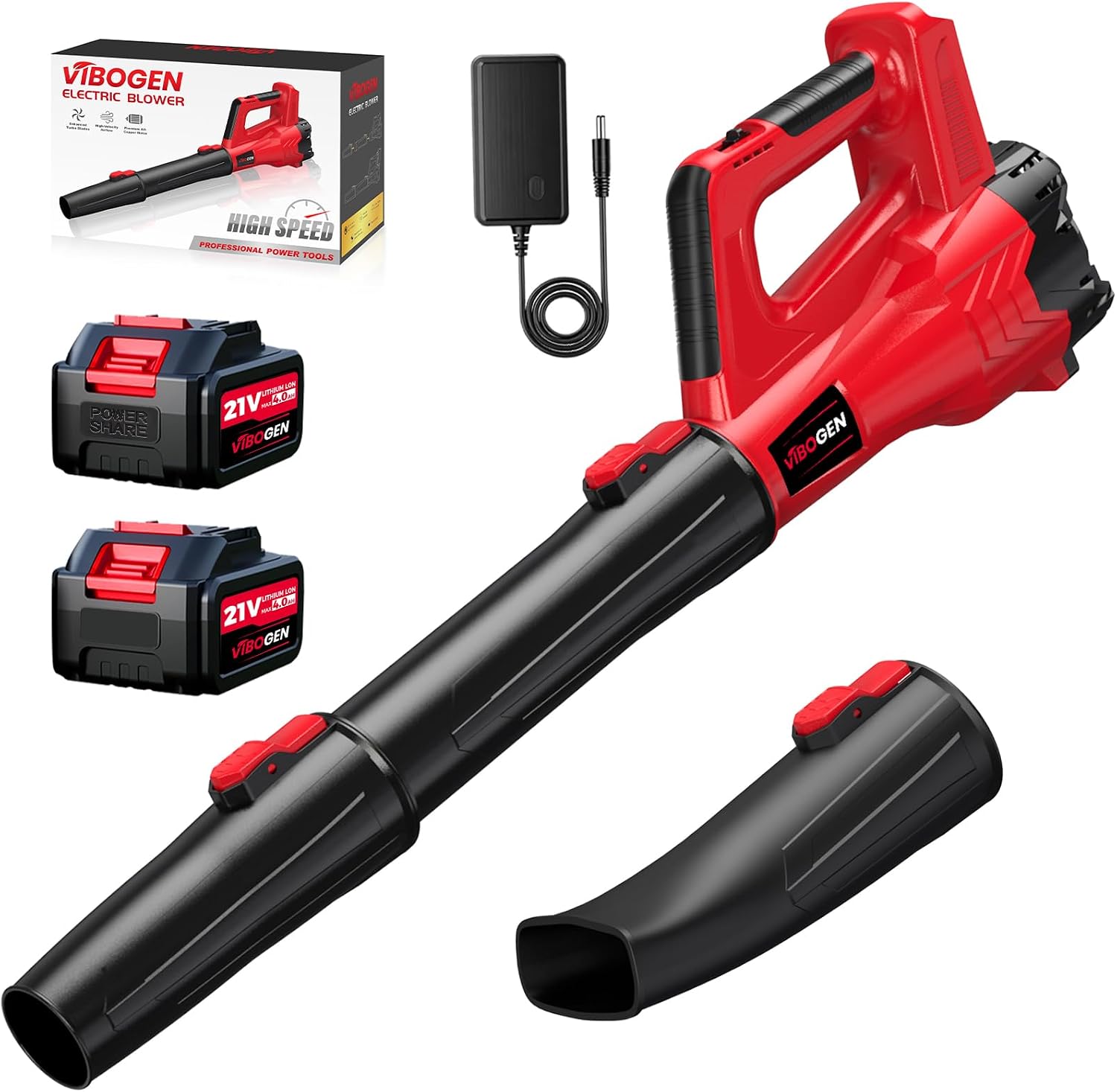
| Power Source | Battery Powered |
|---|---|
| Voltage | 21 volts_of_direct_current |
| Air Flow Capacity | 420 cfm |
| Noise Level | 75 db |
| Included Components | Battery, Charger, Extension Nozzle |
The VIBOGEN HG0645 is a handheld cordless leaf blower designed for quick residential cleanup. It produces up to 420 CFM and 150 MPH wind speed, with two 21V 4.0Ah batteries included so you can work longer between charges. Two-speed control and interchangeable nozzles (round for focused airflow and flat for wider coverage) make it suitable for patios, driveways, decks, and sidewalks. At about 2.7 pounds without the battery the unit is easy to maneuver for short jobs and helps reduce arm fatigue during routine maintenance. Practical benefits include cordless freedom, a compact form that stores easily, and a charge indicator so you can monitor remaining battery. Limitations are typical of compact cordless blowers: it is aimed at light-to-moderate yard debris rather than heavy wet leaves or commercial tasks, and runtime will depend on chosen speed and battery condition. Noise is moderate at about 75 dB, so hearing protection is advisable for extended use.
Best for: Buyers who want a lightweight, ready-to-use cordless blower for regular residential cleanup and value included batteries and simple controls for fast, fuss-free tasks.
Less Ideal for: Property owners with large lawns, heavily matted or wet debris, or professionals who need sustained high-power runtime should consider more powerful backpack or gas models.
- Delivers up to 420 CFM and 150 MPH for fast clearing of dry leaves and debris
- Includes two 21V 4.0Ah batteries and charger for longer continuous runtime
- Two-speed control and two nozzle options for focused or wide coverage
- Lightweight handheld design reduces arm fatigue and is easy to maneuver
- Compact design stores neatly and comes ready to use with accessories
- Not intended for heavy commercial use or blowing wet, matted leaves
- Runtime will vary significantly between low and high speed and with battery age
Verdict: A lightweight, cordless blower with dual batteries and 420 CFM airflow that makes quick residential cleanup fast and convenient.
Choosing the Right High Power Leaf Blower: Key Factors to Consider
Airflow and Nozzle Velocity
Airflow measured in cubic feet per minute and nozzle velocity determine how effectively a blower moves damp leaves, wet debris, and compacted piles. Higher airflow lets you shift larger volumes in a single pass while higher velocity helps break up mats and push debris through vegetation.
Consider whether you need peak burst power for occasional heavy piles or sustained airflow for long continuous work. Nozzles and tube shape also affect how that airflow translates to real clearing power at different distances and in narrow spaces.
Runtime and Endurance
For large properties or commercial use, runtime matters more than peak specs. Battery systems vary by pack capacity and how they sustain power under load, while gas units offer refueling portability but require fuel management and routine tune-ups.
Think about typical job length and whether you can swap batteries or refuel between areas. Continuous-run cooling, heat dissipation, and fuel consumption rates affect how long a blower can work before performance drops or maintenance is needed.
Weight, Balance, and User Comfort
A high power blower that is heavy or poorly balanced increases operator fatigue and reduces control. Consider the total handheld weight, center of gravity, and how the handle and trigger are positioned for both short bursts and sustained use.
Vibration isolation, padded grips, and adjustable handles reduce strain on wrists and shoulders. For frequent multi-hour tasks, prioritize a model that eases load on common stress points and allows comfortable posture changes during extended runs.
Durability and Serviceability
Durable housings, reinforced impellers, and cooling systems that prevent overheating are key for blowers used in heavy conditions. Exposure to dust, moisture, and occasional knocks means materials and seals matter.
Serviceability affects long-term cost and uptime. Easy access to filters, simple maintenance points, and availability of replaceable wear parts help keep a blower productive for seasons rather than being retired after a few repairs.
Noise, Controls, and Precision
Higher power often means higher noise, which affects both comfort and local regulations. Variable speed controls and cruise features let you dial power down for precise work near plants or up for clearing wide areas.
A blower that offers multiple nozzles or adjustable air modes gives more precise results around flower beds and paved surfaces while still providing the raw force needed for heavy piles.
Maintenance Needs and Running Costs
Different drive systems imply different upkeep. Gas engines require fuel, periodic tune-ups, and more safety checks, while electric brushless motors reduce mechanical wear but need battery replacement over many cycles.
Evaluate how much routine maintenance you are willing to perform and whether you prefer simple swap-and-go power sources or the long-term simplicity of electric drivetrains. Consider parts availability and how easily filters, spark plugs, or batteries can be serviced or replaced.
When a High Power Blower Is Worth It
If your landscape includes dense shade trees, large expanses of turf, or wet autumn leaf fall, a high power leaf blower reduces the number of passes needed and handles heavier, compacted debris that lighter models struggle with. It is also useful for clearing driveways, gutters, and gravel areas where leaves collect in drifts.
High power units are not always the best choice for small patios or delicate garden beds. Use them where the extra airflow provides a real time savings or where the ability to move heavier material is necessary.
- Large yards and estates with frequent heavy leaf fall
- Commercial or contractor use with long daily runtimes
- Tasks that require moving wet or compacted debris
Electric Vs Gas Drive Systems for High Power
Electric high power blowers, especially those with high-capacity batteries and brushless motors, deliver strong airflow with lower vibration and simpler maintenance. They are quieter and easier to start than gas models and remove the need for fuel mixing and carburetor upkeep.
Gas blowers can provide longer continuous runtime and higher peak power, which is useful for remote sites without battery swaps or for extended commercial shifts. Gas units require more maintenance and produce more noise and emissions, so weigh those tradeoffs based on how and where you work.
- Electric: lower maintenance, quieter, battery limits runtime
- Gas: longer continuous work, higher maintenance, more noise
Practical Nozzle Choices and Attachment Use
Nozzles concentrate airflow for focused clearing and can increase velocity for removing stuck debris. Flat or tapered tubes help direct air along driveways or between plants while wider round tubes move larger volumes more gently.
Attachments such as collection kits, vacuum kits, or mulching options can change how you use the blower. Decide whether you need a pure blower for speed or added attachments for leaf collection and debris reduction.
- Tapered nozzles increase reach and velocity
- Wide nozzles move more volume at lower speed
- Vacuum or mulching attachments add cleanup versatility
Safety and Local Considerations
High power blowers can fling debris at greater distances and create more noise. Wear eye and ear protection and be mindful of bystanders, pets, and delicate plants when working. Consider wind direction and avoid blowing debris onto neighbors' property.
Check local noise ordinances or community rules if you plan to use a powerful unit in close residential areas. Timing your work for less busy hours and choosing lower power settings for sensitive zones reduces disturbance.
- Use appropriate PPE: eye and ear protection
- Avoid working toward people, pets, or fragile plants
- Respect neighborhood noise guidelines
Tips for Extending Service Life
Regularly clean air intakes, remove debris from impellers, and inspect housings and seals for cracks to keep performance steady. For gas models, follow proper fuel storage and change spark plugs and filters on schedule. For battery systems, keep packs cool, store them partially charged for long storage, and rotate drives to avoid deep cycling a single pack.
Store units in a dry, ventilated space away from high humidity. Tighten fasteners and check mounts after heavy use. Small seasonal checks prevent most performance drops and keep the blower ready when the work returns.
- Clean intakes and impellers after heavy debris use
- Follow fuel and battery storage best practices
- Inspect and tighten mounts and fasteners seasonally
How We Chose the Best High Power Leaf Blower
We looked for high power leaf blowers that deliver consistent, usable airflow for demanding yard work while remaining serviceable over seasons. Editorial filters prioritized machines with documented airflow and speed figures, robust motor or engine design, durable housing and impellers, and user-centered features such as variable speed control and cruise settings. Concrete evaluation criteria included measured airflow and nozzle velocity for clearing capacity, continuous runtime or fuel efficiency for job coverage, durability of build materials and cooling systems for long service life, vibration and weight distribution for operator fatigue, and ease of maintenance including access to filters and spark plugs or brushless motor design. We also considered control features that improve precision during edging and mulch management. We excluded lightweight consumer blowers meant only for small lawns and products with unclear performance data or poor serviceability. Units without realistic cooling or secondary support parts were not shortlisted. The final list focuses on tools that balance raw power with the practical handling and upkeep gardeners need for repeated heavy-duty use.
FAQ
How much air volume do I need for a large yard?
For large yards or dense leaf fall, higher airflow ratings and nozzle velocity are beneficial. Look for units with strong CFM and mph figures or sustained output that can move wet leaves and compacted piles in fewer passes.
Can battery-powered high power blowers match gas performance?
Battery systems with high-capacity packs and efficient brushless motors can approach gas-level clearing for many jobs, but continuous runtime depends on battery capacity and whether you can swap packs. For very long, uninterrupted work, gas still provides longer single-session operation.
Are there special maintenance tasks for high power blowers?
Yes. Keep air intakes clear, inspect impellers for damage, and follow recommended service intervals. Gas models need fuel system checks and spark plug changes while electric models need battery care to preserve overall lifespan.
Will a high power blower damage plants or mulch?
High power airflow can displace lightweight mulch and damage delicate plants if used too close. Use lower speed settings near beds, adjust the nozzle angle, and keep more distance when working around fragile planting areas.
How loud are high power leaf blowers and are there quieter options?
High power blowers tend to be louder, though some electric models are noticeably quieter than gas units. If noise is a concern, prioritize electric options with lower decibel ratings and use lower speeds for noise-sensitive times.
Final Verdict
Pick a high power leaf blower that matches the scale and frequency of your cleanup tasks. Prioritize airflow and nozzle velocity if you need raw clearing force, and favor runtime or serviceability if you work long shifts or remote properties. Balance those needs with ergonomics and noise considerations to minimize fatigue and community impact. Ultimately, choose the tool that provides the right combination of sustained power, manageable weight, and straightforward maintenance so you complete heavy yard work faster and keep the machine working season after season.
