

Note: This article contains affiliate links. If you click on these links and make a purchase, I may earn a small commission at no extra cost to you. This helps support my research and content. Read my full affiliate disclosure here.
If you handle large volumes of firewood or run a small milling or landscaping operation, the right high speed commercial log splitter makes a measurable difference in throughput and safety. These machines are built for repeated cycling, faster ram return, and sturdier frames than homeowner models. Choosing correctly reduces downtime, lowers operator fatigue, and helps you meet production targets. This guide covers six shortlisted high speed commercial log splitters chosen for real-work performance. We evaluate cycle speed, duty cycle and durability, hydraulic system design, and serviceability so you can match a splitter to your workload and maintenance capacity. Read on to find the configuration that fits your daily output needs and site constraints.
Top Picks at a Glance
| Best Overall The best all-around choice for most situations | BILT HARD 35-Ton Gas Hydraulic Log Splitter with 301cc OHV Engine |  |
| Best Quality Built to a higher standard if you want something more solid | YHT 45T Firewood Processor with 20HP GX630 Engine and 25" Chainsaw |  |
| Best Value The sweet spot between price and what you get | BILT HARD 30-Ton Full Beam Gas Hydraulic Log Splitter (223cc OHV, Horizontal/Vertical) |  |
| Best Budget The cheapest option that still gets the job done reliably | FULL BOAR 33-Ton Gas Log Splitter with 223cc Engine |  |
| Highest Rated A top-rated pick with lots of positive feedback | BILT HARD 35-Ton Towable Gas Log Splitter with 10 HP Engine and Log Lift |  |
| Most Popular A crowd favorite that many people choose with confidence | BILT HARD 40-Ton Gas Log Splitter with 389cc 13 HP Engine (Horizontal/Vertical) |  |
BILT HARD 35-Ton Gas Hydraulic Log Splitter with 301cc OHV Engine

| Engine | 301cc 10 HP OHV |
|---|---|
| Splitting force | 35T |
| Cycle time | 16 Second |
| Hydraulic reservoir capacity | 7 Gallons |
This BILT HARD 35-ton log splitter is built for heavy-duty, high-throughput splitting where speed and portability matter. Driven by a 301cc 10 HP OHV engine and a 2-stage hydraulic pump, it produces 35 tons of force and completes full split cycles in about 16 seconds, making it suitable for processing hardwoods and long runs of firewood. The unit converts from horizontal to vertical operation quickly so you can handle both small rounds and large, awkward logs without excessive bending. Tow-ready features include DOT-rated tires, a 2-inch ball coupler, and safety chain attachments so the splitter can be moved behind ATVs or trucks and towed at highway-capable speeds. Practical touches include a heavy-duty 8-inch steel wedge, a 7-gallon hydraulic reservoir for longer continuous operation, and a log catcher to reduce stooping. Downsides to consider are the substantial weight and crate-style delivery logistics that require a commercial or lift-capable address for receiving and setup. Expect some assembly and space for storage and fueling when using this on a regular basis.
Best for: Buyers who need a fast, commercial-capacity splitter for regular high-volume firewood work and who can accommodate a heavy, towable gas machine and its servicing needs.
Less Ideal for: Casual users with small yards, occasional splitting needs, or limited storage who prefer lightweight electric models or rental equipment.
- High splitting force (35 tons) and 16 second cycle time for fast, continuous splitting
- 301cc 10 HP OHV engine with 2-stage hydraulic pump supports heavy hardwood and long runs
- Switches between horizontal and vertical modes for versatile log handling
- Towable design with DOT-rated tires and 2" ball coupler for easy transport
- Very heavy and large which complicates delivery, setup, and storage
- Requires fuel, routine maintenance, and space for safe operation
Verdict: If you need a towable, high-speed splitter that handles heavy hardwood and long production runs, this 35-ton BILT HARD unit delivers the power and cycle speed to get the job done.
YHT 45T Firewood Processor with 20HP GX630 Engine and 25" Chainsaw

| Power Source | gas_powered |
|---|---|
| Operation Mode | Hydraulic |
| Splitting Force | 45 Tons |
| Max Cutting Diameter | 500mm (19.6 inches) |
This YHT firewood processor is a commercial-style machine built to cut and split high volumes of wood. It pairs a 20HP GX630 gas engine with a 25" chainsaw and a hydraulic control system to feed, cut, and split logs up to roughly 19.6" diameter and just under 23" length. A 3 meter conveyor and a 9.84 ft belt let you move logs continuously into the cutting chamber, while a 4/6-way wedge and 45 tons of splitting force produce consistent multi-piece splits for air-drying or bulk firewood. The control panel includes manual hydraulic adjustment and an emergency stop for safer operation, and the manufacturer supplies assembly instructions and videos. Practical benefits are clear for someone processing large amounts of hardwood: high power, integrated cutting and splitting, and continuous feeding speed up throughput. Important limitations are its size and weight which require a dedicated outdoor workspace and likely equipment to move and set up, plus routine engine and hydraulic maintenance for reliable long-term use.
Best for: Buyers who need a robust processor for high-volume firewood production and who have space and equipment to handle a commercial-grade machine.
Less Ideal for: Casual homeowners with occasional firewood needs or limited outdoor space should consider smaller, trailerable splitters instead.
- Powerful 20HP GX630 gas engine provides strong cutting and splitting capability
- 45 tons of splitting force with 4/6-way wedge produces uniform multi-piece splits
- Integrated 25" chainsaw and 9.84 ft conveyor enable continuous feed and faster throughput
- Hydraulic manual controls and emergency stop improve operational control and safety
- Very large and heavy requiring significant space and likely mechanical help to move
- Requires regular engine and hydraulic maintenance to remain reliable
Verdict: Choose this processor if you need a high-capacity, integrated cut-and-split machine for large volumes of firewood.
BILT HARD 30-Ton Full Beam Gas Hydraulic Log Splitter (223cc OHV, Horizontal/Vertical)

| Engine | 223cc OHV (7.5 HP) |
|---|---|
| Cycle time | 11 seconds |
| Max log length | 24 inches |
| Hydraulic flow | 14 GPM |
| Hitch | 2" ball coupler |
This BILT HARD 30-ton full beam log splitter is built for heavy, repetitive splitting tasks where speed and towability matter. It pairs a 223cc OHV gas engine with a two-stage gear pump and a 14 GPM hydraulic system to deliver 11-second cycle times and up to 300 cycles per hour, so it moves through large loads of hardwood quickly. The machine converts between horizontal and vertical positions in a few steps, making it easier to handle long or awkward logs, and an 8-inch hardened steel wedge handles logs up to 24 inches. Transport features include DOT-approved 16-inch tires and a 2-inch ball coupler so you can tow it behind an ATV, UTV, or truck. Practical touches like a log catcher and auto-return valve reduce bending and improve workflow during long sessions. Expect a heavy assembly and a sizable unit that requires a commercial-style delivery setup and basic maintenance of fuel, oil, and hydraulic fluid, so it is best matched to users prepared for regular engine upkeep and storage space for a large machine.
Best for: Buyers who need a high-speed, workhorse splitter for frequent commercial or large-property use and prioritize throughput and towability over compactness. Ideal for users who plan regular splitting sessions and can handle basic engine and hydraulic maintenance.
Less Ideal for: Not a good fit for occasional homeowners who need a compact or portable electric splitter or for those lacking space to store a heavy machine. Avoid if you cannot accommodate palletized freight delivery or do not want engine maintenance responsibilities.
- Industrial 30-ton splitting force suitable for hardwood and large logs
- Fast 11-second cycle time for high throughput up to about 300 cycles per hour
- Dual horizontal/vertical configuration eases handling of long or heavy logs
- Tow-ready design with DOT-approved tires and a 2" ball coupler for easy transport
- Auto-return valve and log catcher improve safety and reduce repetitive bending
- Heavy and large unit that requires significant space for storage and transport
- Requires routine engine and hydraulic maintenance and initial assembly
- Palletized delivery may require a commercial address or pickup arrangements
Verdict: Choose this splitter when you need a towable, high-speed 30-ton machine that handles large hardwood volumes with commercial-level throughput.
FULL BOAR 33-Ton Gas Log Splitter with 223cc Engine
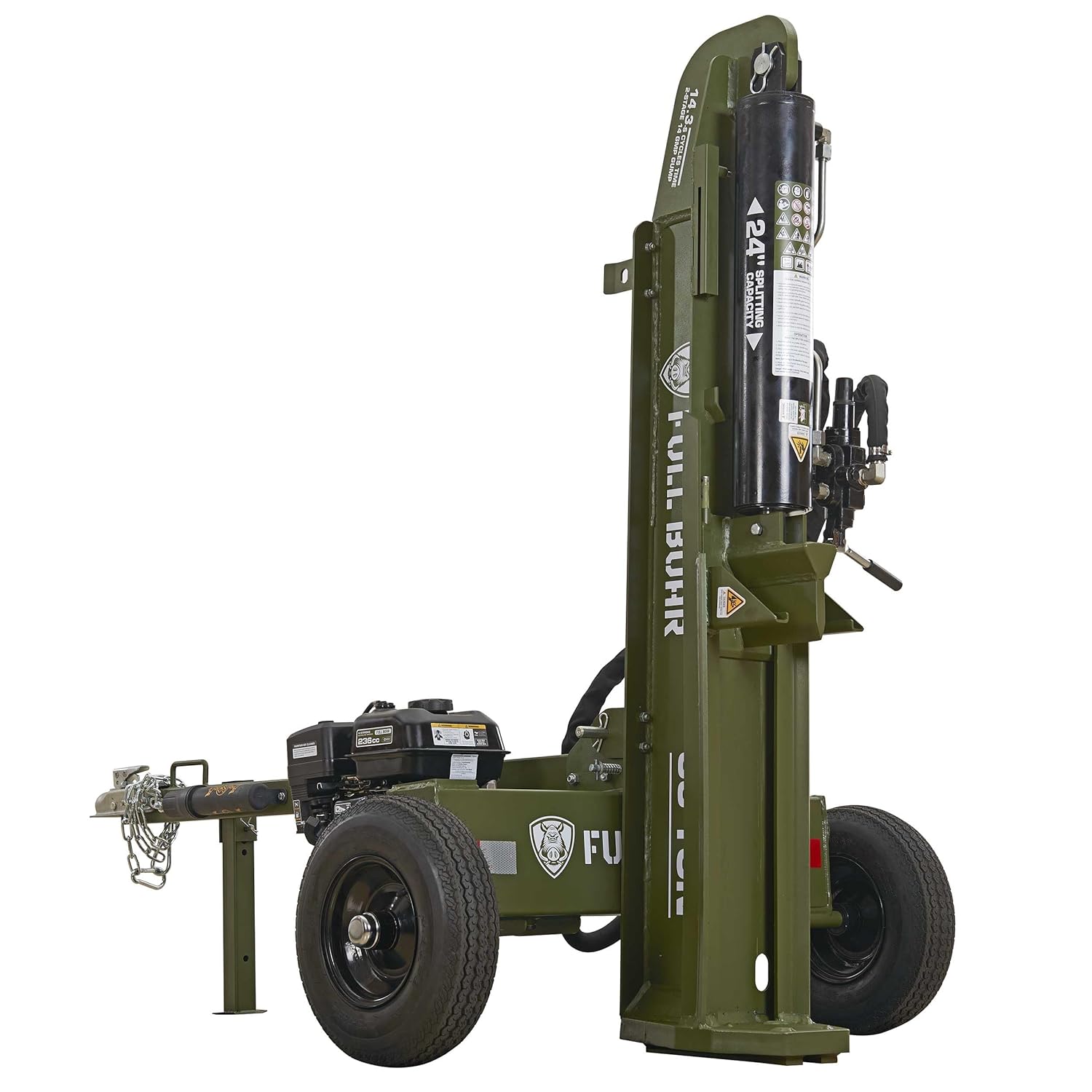
| Splitting force | 33 tons |
|---|---|
| Engine | 223cc OHV |
| Cycle time | 14.3 seconds |
| Stroke | 22.75 inches |
The FULL BOAR 33-ton log splitter is a towable gas-powered machine designed for heavy-duty, on-site splitting. It uses a 223cc OHV engine driving a hydraulic system that produces 33 tons of force and a 14.3 second cycle time along a 22.75-inch stroke, making it capable of splitting logs up to 24 inches long. Built on a heavy-duty H-beam frame with a two-way wedge, it handles large, dense rounds and reduces beam deflection during repeated use. The unit pivots between vertical and horizontal positions to move and position larger logs without lifting, and DOT-approved tires plus a 2-inch ball hitch let you tow it to job sites. Practical touches include an internal hydraulic oil filter and an auto-return control valve with adjustable detent for more efficient single-operator work. The main compromises are size and transport weight, which require a vehicle capable of towing and a bit of assembly and maintenance typical for gas hydraulic splitters, but for demanding, frequent splitting tasks this splitter offers commercial-level throughput at a competitive price point.
Best for: Buyers who need a powerful, mobile splitter for frequent commercial or heavy residential work and who prioritize fast cycle times and robust construction on a budget.
Less Ideal for: Casual users with only occasional light splitting needs or those who lack towing capacity and space for a large, heavy machine.
- High 33-ton splitting force and 14.3 second cycle time for fast throughput
- Heavy-duty H-beam construction and two-way wedge improve durability and splitting efficiency
- Pivoting hydraulic cylinder lets one person switch between vertical and horizontal operation
- Towable design with DOT-approved tires and 2-inch ball hitch for on-site use
- Internal hydraulic oil filter reduces risk of damage from falling debris
- Large and heavy unit requires a capable tow vehicle and storage space
- Gas engine and hydraulic system need regular maintenance and fuel handling
Verdict: A heavy-duty, towable splitter that delivers commercial-level speed and force for frequent on-site log processing at a budget-friendly value.
BILT HARD 35-Ton Towable Gas Log Splitter with 10 HP Engine and Log Lift

| Splitting force | 35 Ton |
|---|---|
| Engine | 10 HP, 306cc OHV 4-stroke |
| Cycle time | 15 second |
| Maximum log diameter | 20'' |
| Hydraulic capacity | 7.4 gal |
The BILT HARD 35-ton gas log splitter is built for high-volume, heavy-duty wood processing. It uses a 10 HP, 306cc OHV engine paired with a Bucher 2-stage hydraulic pump to deliver a fast 15-second cycle time and steady 18 GPM flow, letting you split through large, dense logs efficiently. The unit accepts logs up to 20 in diameter and 24 in length and ships with interchangeable 4-way and 6-way 12-inch wedges so you can tailor split size and throughput. A powered 700 lb log lift and 5-inch hydraulic lifting stroke reduce manual handling and speed staging. The towable design, DOT tires, 2-inch ball coupler, and safety chains make it straightforward to move between sites. Practical limitations are its large footprint and over-1000-pound weight, which require a suitable vehicle or freight delivery and space for storage and assembly, and the machine’s size makes it more than most homeowners need for occasional light use. For users focused on sustained, performance-oriented splitting, it delivers power and throughput in a durable package.
Best for: Buyers who need a high-capacity, durable splitter for frequent or commercial-style wood processing and who prioritize power and steady throughput over portability or occasional use convenience.
Less Ideal for: Casual users with small yards, infrequent splitting needs, or those who cannot accommodate freight delivery and a heavy machine should consider smaller, lighter options.
- High splitting force rated at 35 tons for tackling large, hard logs.
- Fast 15-second cycle time driven by a 2-stage hydraulic pump for high throughput.
- Interchangeable 4-way and 6-way wedges for flexible split sizes and increased productivity.
- Integrated 700 lb log lift and hydraulic lift stroke reduce manual handling and speed workflow.
- Towable with DOT tires, 2-inch coupler, and safety chains for easy transport between sites.
- Very heavy and large, requiring freight delivery, a towing vehicle, and significant storage space.
- Fuel and hydraulic fluid capacities are modest, so expect periodic refueling and maintenance during long jobs.
Verdict: If you need a rugged, high-throughput splitter that can handle large logs day after day, this 35-ton towable machine delivers the power and features to get the job done.
BILT HARD 40-Ton Gas Log Splitter with 389cc 13 HP Engine (Horizontal/Vertical)

| Splitting force | 40T |
|---|---|
| Engine | 389cc 13 HP OHV |
| Cycle time | 16 Second |
| Hydraulic reservoir capacity | 6 Gallons |
This BILT HARD 40-ton gas log splitter is built for fast, demanding work: a 389cc 13 HP OHV engine powers a hydraulic system that produces 40 tons of splitting force and completes a full cycle in about 16 seconds. It runs in both horizontal and vertical positions, so you can process large, heavy logs without constant lifting, and the hardened 8-inch steel wedge handles tough hardwoods up to roughly 24 inches long. Designed to be towable, it includes a 2-inch ball coupler, DOT-approved tires, and a sturdy frame for moving between sites. The large hydraulic reservoir and 14 GPM operating speed support continuous splitting with less heat and contamination risk. Expect a substantial machine that boosts throughput for homeowners or small contractors who need high-speed, heavy-duty splitting; assembly and initial setup require space and mechanical familiarity and the unit is heavy to maneuver when unhitched. Regular maintenance of the engine and hydraulic system is important to sustain cycle speed and longevity.
Best for: Buyers who prioritize throughput and power for frequent heavy-duty splitting, such as homeowners with large woodlots or small operators who need a fast, towable splitter that handles dense hardwoods.
Less Ideal for: Casual users who split only occasionally or those without space and means to handle a very large, heavy machine should consider smaller electric or lower-tonnage models.
- Very high splitting force suitable for dense hardwoods (40 tons)
- Fast cycle time (approximately 16 seconds) for high-volume firewood processing
- Dual-position horizontal and vertical operation reduces lifting and speeds large-log handling
- Towable design with DOT-approved tires and 2" ball coupler for easy transport to job sites
- Heavy and bulky which makes solo moving and setup difficult
- Requires routine engine and hydraulic maintenance to preserve performance
Verdict: Choose this splitter when you need maximum power and high-speed cycles for heavy, high-volume firewood production.
Choosing the Right High Speed Commercial Log Splitter: Key Factors to Consider
Cycle Speed and Throughput
Cycle speed determines how many logs you can split in an hour. A faster forward and return stroke reduces the operator idle time between placements, which is crucial when splitting by the cord or for paying customers. In a commercial setting small differences in return time add up over a shift, so consider measured strokes per minute or manufacturer flow ratings.
Higher cycle speed needs to be balanced with hydraulic system sizing and heat management. Running a splitter faster than its rated duty cycle can overheat the pump and shorten component life, so pick a machine with flow and cooling capacity that matches your expected workload.
Hydraulic Flow, Pressure, and Cylinder Specs
Hydraulic flow (gallons per minute) and working pressure determine how quickly the ram moves and how much force it can deliver. For commercial splitting you want a pump and valve setup that provides consistent flow under load and avoids stalling on larger, knotty rounds.
Cylinder bore and stroke length affect both splitting force and maximum log length. A larger bore increases force at a given pressure, while the stroke sets the maximum log size you can process without repositioning. Check published flow and pressure ratings and think about how they translate to real-world performance on the wood types you handle.
Duty Cycle and Thermal Management
Duty cycle describes how long a machine can run before requiring a cool-down period. Commercial operations demand high duty cycles or continuous-run capability to avoid frequent rests that interrupt production.
Good thermal management includes adequate oil capacity, cooling systems, and pumps rated for extended use. Machines with larger oil reservoirs and optional coolers will hold up better under commercial loads. Confirm recommended duty cycles and plan workflows that allow heat dissipation if the splitter is not rated for continuous operation.
Construction Quality and Frame Design
A commercial splitter must stand up to repeated impact, side loads, and the occasional misfeed. Look for heavy-gauge steel rails, gusseting at high-stress points, and clean welds. Bolt patterns and pin connections should be robust to avoid loosening under vibration.
A rigid frame reduces alignment issues that cause premature wear on cylinders, wedges, and rails. Consider how the machine mounts to a trailer or pad and whether its footprint suits your work area for stable, safe operation.
Serviceability and Parts Access
Downtime costs more in a commercial setting than a higher initial purchase price. Serviceability covers how easy it is to inspect, change, or replace common wear items like hoses, seals, pumps, filters, and the wedge.
Accessible bleed ports, clear routing of hoses, standard fittings, and readily available replacement parts shorten repair time. Machines with straightforward control layouts and simple hydraulic schematics are easier for shop technicians to diagnose and maintain.
Operator Ergonomics and Safety Features
Ergonomics affect productivity and injury rates when operators handle hundreds of logs a day. Controls should be reachable from a safe stance and allow quick, predictable operation. Platforms or log tables that reduce bending and lifting lower fatigue and speed throughput.
Safety features for commercial use include dual-hand controls or guarded levers, secure wedge mounting, stable stands or outriggers, and effective emergency stop options. Consider how the machine handles kickback and whether guards direct split pieces away from the operator.
Choosing Capacity for Your Workload
Estimate how much wood you will process per day and match capacity to that output rather than to occasional peak loads. For light commercial routes a machine rated for moderate continuous duty may suffice, while sawyers and producers who split cords daily need higher-flow, higher-duty units that tolerate long run times.
- Estimate cords per day and convert to logs per hour to size cycle speed needs.
- Account for wood species and knot frequency, which slow effective throughput.
- Plan for a safety margin above your typical daily volume to avoid overheating and extra maintenance.
Setup and Site Considerations
Think about where the splitter will live during operation. Hard, level surfaces ease footing and setup, while soft ground can allow jacks to sink and change alignment. If you move the splitter between sites, check towing setup, tongue weight, and legal road-ready configurations where applicable.
- Allow room for loading and discharge paths to avoid material jams.
- Provide a dedicated maintenance area with proper spill containment and storage for hydraulic oil.
- Ensure electrical supply or power-take-off compatibility if the unit uses auxiliary systems.
Hydraulic System Maintenance Basics
Routine hydraulic maintenance extends component life and keeps cycle speed consistent. That means regular oil checks, scheduled filter changes, and careful inspection of hoses and fittings for chafe or leaks. Keep a record of operating hours and service events to anticipate parts replacement before failure.
- Use the manufacturer-recommended fluid grade and monitor temperature during heavy use.
- Replace hoses on a schedule in commercial settings, not only after visible wear appears.
- Inspect the wedge and cylinder seals after high-impact jobs and address leaks immediately.
Wedge Types and Splitting Efficiency
Wedge geometry affects how aggressively a splitter bites and how much force is directed into separating a log versus forcing it past a seam. Some wedge profiles require less force but more strokes, while others split quickly but may need larger hydraulic capacity to avoid stalling. Consider whether you process many knotty or irregular logs. A wedge that staggers or steps can help open tricky grain, reducing the need to flip and reorient logs and improving effective throughput.
- Narrow, sharp wedges cut quickly on straight-grain rounds.
- Stepped or expanding wedges help with cross-grain and knotted wood.
- Wedge maintenance and sharpening are part of routine service.
Trailer and Transport Options for Mobile Work
If you will transport the splitter between jobs, evaluate integrated trailer frames, separate trailers, or stationary pad mounts. Mobile setups should balance tongue weight and braking requirements so towing is stable under road conditions. Check how fast the unit rigs up on-site and whether stabilization jacks or outriggers are included. A faster setup reduces labor costs at each job and increases daily productive time.
- Look for lockable storage for tools and wedges on mobile units.
- Confirm required towing class and hitch ratings.
- Consider integrated ramps or helpers for loading heavy logs safely.
How We Chose the Best High Speed Commercial Log Splitter
Our selection focused on machines intended for daily commercial use rather than occasional homeowner tasks. We prioritized splitters with documented heavy-duty duty cycles, robust hydraulic systems sized for frequent operation, and frames and components rated for commercial loads. Cycle speed and return time were key because they directly affect throughput for paid work. We also assessed construction materials and connection points that influence long-term durability in a working yard. We excluded light-duty and cordless consumer models, single-season hobby units, and equipment lacking clear serviceability or parts support. Final candidates were evaluated for hydraulic pump size and relief settings, cylinder bore and stroke that determine force and travel, recommended oil flow rates, and ease of routine maintenance like filter and hose access. Safety features important for commercial settings were another filter, including stable stands, strong wedge mounting, and reliable controls.
FAQ
How fast should a commercial log splitter cycle for steady production?
Cycle speed depends on hydraulic flow and valve design, but for steady commercial production look for models with quick return times and pumps sized to maintain rated flow under load. The right speed balances throughput with thermal limits and consistent splitting force.
Can I run a high-speed commercial splitter continuously?
Some commercial splitters are built for near-continuous use, but many have recommended duty cycles. Continuous operation depends on oil capacity, cooling, and pump ratings. Check the machine's duty cycle and plan breaks or cooling systems if needed.
What hydraulic fluid should I use for a commercial splitter?
Use the fluid grade the manufacturer specifies for commercial duty, typically an industrial hydraulic oil with the right viscosity and anti-wear additives. Maintain fluid cleanliness and change intervals to protect pumps and valves under heavy use.
How do I reduce operator fatigue during long splitting shifts?
Reduce lifting and bending with log tables, loaders, or infeed conveyors. Ergonomic control placement and routine rotation of tasks help. Also match cycle speed to a comfortable rhythm so operators are not racing the machine.
What maintenance tasks prevent unplanned downtime?
Regularly check hydraulic oil level and condition, replace filters on schedule, inspect hoses and fittings, and keep the wedge and cylinder clean. A small stock of common wear parts such as seals and hoses minimizes repair time.
Are there safety practices specific to commercial splitting sites?
Establish clear zones for feeding and discharge, require PPE like eye protection and gloves, and use guards or barriers to keep bystanders away. Train operators on emergency stops and safe entry and exit around the machine.
Final Verdict
Match the splitter to actual daily output rather than occasional peaks. Prioritize adequate hydraulic flow, a duty cycle that fits your shift lengths, and a robust frame that resists vibration and impact. Factor in serviceability and parts access since downtime is the real cost in a commercial setting. Decide which tradeoffs matter most for your operation: higher cycle speed with active cooling for maximum throughput, or a slightly slower but simpler system that is easier to maintain in the field. With clear expectations about workload and maintenance capacity you can pick a commercial splitter that reliably meets your production targets.
