

Note: This article contains affiliate links. If you click on these links and make a purchase, I may earn a small commission at no extra cost to you. This helps support my research and content. Read my full affiliate disclosure here.
If you need a surface that tolerates frequent footsteps, pets, or heavy garden use, picking the right high traffic ground cover matters. The wrong cover compacts, thins out, or becomes a maintenance burden in months. This guide focuses on high traffic ground covers that hold up under repeated use while protecting soil and looking tidy. We shortlisted five top options for busy yards and pathways and evaluated them on durability, maintenance, and environmental fit. Read on to understand how each type behaves in a real garden and what to prioritize for long-term performance.
Top Picks at a Glance
| Best Overall The best all-around choice for most situations | Jonathan Green Black Beauty Heavy Traffic Grass Seed, 3 lb |  |
| Best Budget The cheapest option that still gets the job done reliably | 22000‑count Creeping Thyme (Thymus serpyllum) Seeds |  |
| Highest Rated A top-rated pick with lots of positive feedback | Isotoma fluviatilis (Blue Star Creeper) Groundcover, 1 Quart |  |
| Most Popular A crowd favorite that many people choose with confidence | Pennington Kentucky 31 Tall Fescue Grass Seed, 3 lb |  |
| Best Seller A high-volume bestseller chosen again and again | KVITER Purple Rock Cress (Aubrieta deltoidea) Heirloom Flower Seeds — 1,000 Count |  |
Jonathan Green Black Beauty Heavy Traffic Grass Seed, 3 lb

| Grass Type | Tall Fescues, Perennial Rye |
|---|---|
| Germination Time | 7 – 14 Days |
| Indoor Outdoor Usage | Outdoor |
| Unit Count | 48 Ounce |
Jonathan Green Black Beauty Heavy Traffic is a cool‑season seed mix made from tall fescues and perennial rye intended for yards, sports fields, and other areas that get repeated foot traffic. You use it like any overseeding or new‑lawn seed: clear thatch, spread with a hand or rotary spreader, press seed for good soil contact, and keep the surface consistently moist while seedlings establish. Notable features include relatively fast germination typically within 7–14 days, deep-rooting fescues that improve drought tolerance, and a naturally dark green appearance for a uniform turf. Practical benefits are its wear tolerance and uniform texture that help balls roll true on small playing areas and that recover better from compaction than many fine‑bluegrass mixes. Important limitations are its regional suitability—it performs best in the northern half of the U.S.—and the need for regular watering during the first month to achieve consistent establishment; it is a cool‑season mix so it is not ideal for warm‑season lawns.
Best for: Buyers who need a durable, attractive lawn in high‑traffic spots and prioritize recovery and uniform texture for family yards or informal play areas.
Less Ideal for: Users in warm‑season climates or those who want a low‑water, no‑maintenance lawn should consider warm‑season or drought‑native ground covers instead.
- Designed for heavy foot traffic with wear‑tolerant tall fescues and perennial rye.
- Relatively fast germination, typically within 7–14 days, for quicker establishment.
- Deep‑rooting mix increases drought tolerance and resilience to compaction.
- Produces a uniform, dark‑green turf useful for small sports areas and busy yards.
- Best suited to cooler climates in the northern U.S. and may underperform in warm‑season regions.
- Requires frequent watering during the first 4 weeks for reliable germination and establishment.
Verdict: Choose this mix when you want a cool‑season lawn that tolerates heavy use and establishes quickly for durable, uniform turf.
22000‑count Creeping Thyme (Thymus serpyllum) Seeds

| Indoor Outdoor Usage | Outdoor |
|---|---|
| Other Special Features of the Product | Attracts Pollinators |
| Expected Blooming Period | Year Round |
| Sunlight Exposure | Full Sun |
| Material Features | GMO Free |
This seed packet supplies a very large quantity of Thymus serpyllum seeds for establishing creeping thyme as a groundcover. It is typically broadcast over prepared soil in spring or fall, lightly covered, and kept moist until germination; plants prefer full sun and will tolerate some light shade. Notable product points are the non‑GMO seed source, a stated attraction for pollinators, and year‑round blooming potential in favorable climates. In practice the variety works well between bulbs or in rock garden edges where a low, fragrant mat is desired and it suppresses weeds once established. Because the packet is extremely large it is cost‑efficient for covering bigger areas or for multiple beds, but buyers should allow time for seedlings to fill in and plan for initial watering during establishment. Seed quality and germination can vary with cheap bulk lots, so expect uneven patches and be ready to reseed thin areas or overseed in subsequent seasons.
Best for: Gardeners working on a budget who want an inexpensive way to cover a tulip bed or larger sunny area with a low, pollinator‑friendly groundcover and who are willing to oversee initial establishment.
Less Ideal for: Those who need an instant, fully filled planting right away or who prefer guaranteed high germination rates from premium, tested seed lots.
- Very high seed count makes it economical for large areas or multiple beds
- Non‑GMO seeds and plants that attract pollinators
- Suitable for dry, sunny sites and useful between bulbs or in rock gardens
- Can form a low, weed‑suppressing mat once established
- Germination and seedling uniformity can be inconsistent in bulk packets
- Requires patience and extra watering during establishment before it fully fills in
Verdict: If you need a very affordable way to establish a low, sun‑loving groundcover across a tulip bed or larger area, this bulk packet delivers the seed quantity to do it.
Isotoma fluviatilis (Blue Star Creeper) Groundcover, 1 Quart

| Manufacturer | Perennial Farm Marketplace |
|---|---|
| Pot size | 1 Quart |
| Flower color | Sky-blue |
Isotoma fluviatilis (Blue Star Creeper) is a hardy, low-growing groundcover that forms a 2–3 inch dense mat dotted with sky-blue, star-shaped flowers from late spring through summer. It is typically planted in 1-quart pots around stepping stones, in small sunny patches, or as a replacement for small lawn areas where a fine-textured groundcover is desired. Key features are its tolerance of varied moisture levels and heavy foot traffic, plus its ability to creep into tight joints which helps suppress weeds and soften pathways. The immediate benefit is quick visual fill-in and seasonal color without frequent mowing. Limitations are that this is a shallow, mat-forming plant so it is best for small areas rather than large lawns, and it requires establishment time before it can handle regular traffic at full density. Expect to give it a season to spread and occasional trimming at edges to keep it neat.
Best for: Gardeners who need a tough, low-growing groundcover for sunny spots and want quick seasonal blooms and a durable mat for pathways or small lawn replacements.
Less Ideal for: People looking to cover large lawn areas quickly or those who need a tall, plush turf substitute for heavy continuous use.
- Produces sky-blue star-shaped flowers from late spring through summer for seasonal interest
- Forms a dense 2–3 inch mat that creeps between stepping stones to reduce weed growth
- Tolerant of heavy foot traffic once established, suitable for pathways and small lawn replacements
- Adapts to a range of moisture levels and soil types, easing site selection
- Slow to fully establish across larger areas so not ideal for instant full coverage
- Best suited to small patches rather than large lawns due to low mat height
Verdict: Choose this Blue Star Creeper when you want a durable, flowering low mat that fills gaps between stepping stones and handles occasional foot traffic in sunny small areas.
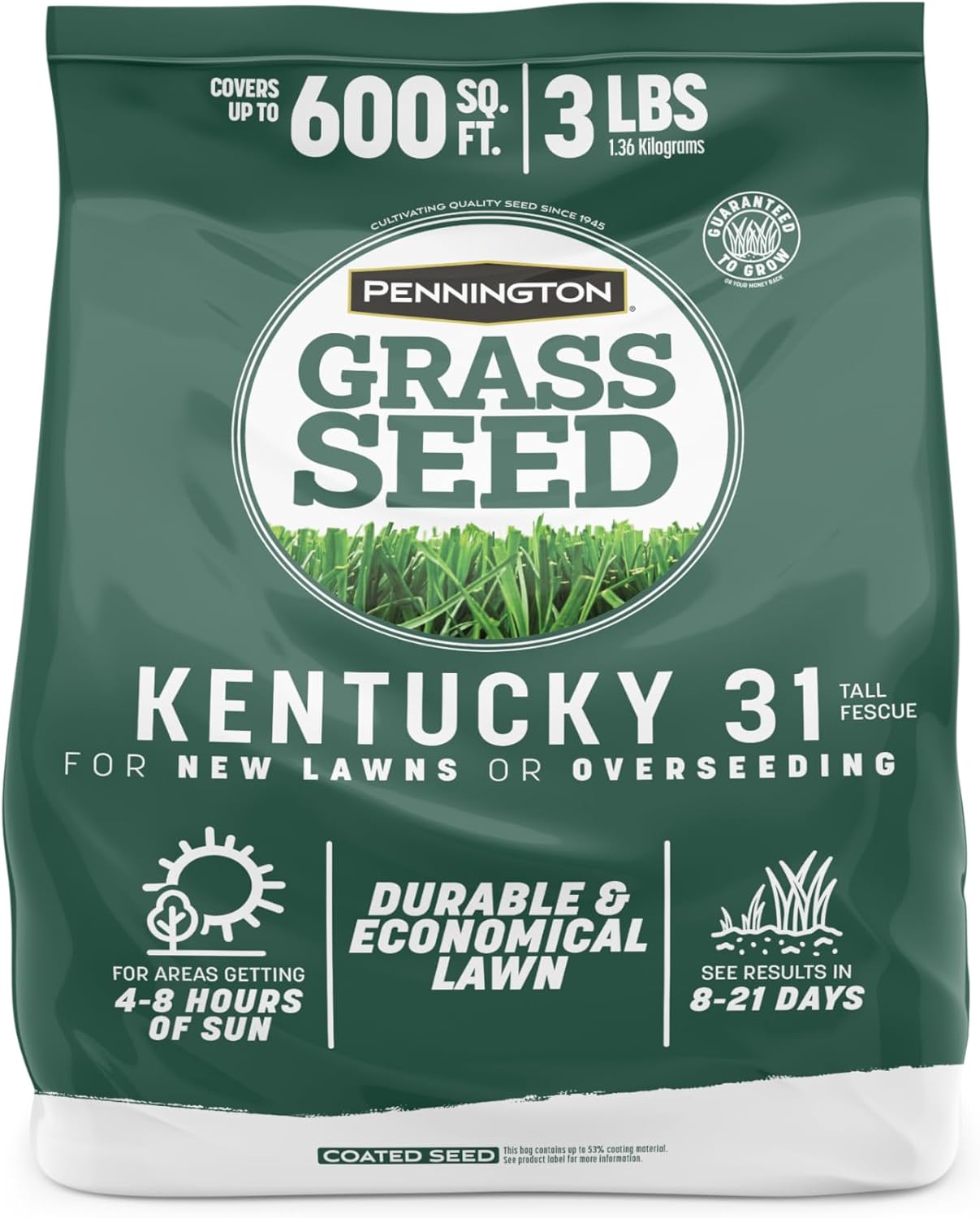
Pennington Kentucky 31 Tall Fescue Grass Seed, 3 lb
| Seed Treatment Method | Coated |
|---|---|
| Sunlight Exposure | 4-8 Hours of Sun |
| USDA Hardiness Zone | 1, 2, 3, 4, 5, 6, 7, 8 |
| Moisture Needs | Regular Watering |
| Intended Usage | Outdoor |
Pennington Kentucky 31 is a traditional tall fescue lawn seed sold as a coated, pure Kentucky 31 blend intended for residential lawns, patching bare spots, and overseeding. It is typically planted in early spring or early fall and germinates within about 8 to 21 days under recommended conditions. The seed is described as drought and heat tolerant and stands up well to foot traffic, making it useful for low‑maintenance yards and mixed sun to moderate shade exposures. The coated seed helps with handling and even spreading, and a single 3 lb bag is sized to cover large areas for overseeding or create a new lawn from scratch. Limitations to consider are that Kentucky 31 is a coarser, tall fescue variety so it will not match the fine texture of some cool‑season blends and it prefers sites with at least 4 hours of sun, so it is not ideal in deep shade. Expect a conventional tall fescue appearance and maintenance routine rather than a fine, carpetlike turf in shaded garden spots.
Best for: Homeowners who want a low‑maintenance, durable cool‑season lawn that tolerates occasional dryness and moderate shade and who prioritize dependable germination and resilience over a fine turf appearance.
Less Ideal for: Gardeners seeking a fine‑textured, carpetlike lawn in heavily shaded areas or those needing a seed mix specifically optimized for dense shade.
- Drought and heat tolerant for resilient lawns in variable conditions
- Coated seed for easier handling and more uniform spreading
- Durable under heavy foot traffic, suitable for active family yards
- Large coverage from a 3 lb bag for overseeding or establishing lawns
- Coarser texture of Kentucky 31 may look different than fine fescue or turfgrass mixes
- Requires at least moderate sunlight and is not suited to deep shade
Verdict: Choose this seed when you want a reliable, tough tall fescue lawn that establishes predictably in sun to moderate shade and holds up to wear.
KVITER Purple Rock Cress (Aubrieta deltoidea) Heirloom Flower Seeds — 1,000 Count

| Unit Count | 1000 Count |
|---|---|
| USDA Hardiness Zone | 3-10 |
| Sunlight Exposure | Full Sun |
| Expected Blooming Period | Spring to Summer |
| Material Features | GMO Free, Heirloom |
These KVITER Aubrieta (purple rock cress) seed packets supply 1,000 heirloom seeds for establishing a low, drought-tolerant ground cover. The seeds are surface-sown and need light to germinate, typically sprouting in 10–14 days around 60–65°F, and can be started indoors about six weeks before the last frost. Once established the plants form 6-inch mats with a cascading habit that works well in rock gardens, along paths, or on low walls. Key product features include a detailed growing guide in each packet, non-GMO heirloom seed, and suitability across USDA zones 3–10. Practical benefits are long seasonal color in late spring, low maintenance after establishment, and good tolerance of well-drained, sandy soils, which matches drought-tolerant plantings. Limitations to expect are the need for careful surface sowing and consistent moisture during germination, and that it performs best in full sun to part sun so shadier sites may underperform. Seed quantity is generous but germination rates in real gardens can vary, so plan accordingly.
Best for: Buyers who want a low-growing, drought-tolerant ground cover for rock gardens or sunny slopes and prefer a straightforward seed option with clear instructions and broad climate tolerance.
Less Ideal for: Gardeners seeking instant mature cover or those with heavily shaded, clay or poorly drained sites should consider plugs or different shade-tolerant species instead.
- Large 1,000-count pack suitable for covering larger areas or multiple plantings
- Heirloom non-GMO seeds with a growing guide included for step-by-step planting
- Adapted to USDA zones 3–10, making it usable across a wide range of climates
- Forms low, spreading mats that work well as drought-tolerant ground cover in well-drained soils
- Requires light for germination and consistent moisture during the seedling stage
- Performs best in full sun to part sun so heavily shaded spots may not thrive
Verdict: A cost-effective seed option for establishing low, drought-tolerant purple ground cover across a wide range of climates when planted in sunny, well-drained spots.
Choosing the Right High Traffic Ground Cover: Key Factors to Consider
Wear Resistance and Recovery
High traffic ground covers face repeated compression and abrasion. A cover with strong wear resistance will tolerate trampling without thinning out quickly. Equally important is recovery ability: some plants resist damage but resprout or spread to fill thin patches, while others simply decline under constant use.
When assessing options, think about how quickly bare spots will appear and whether the cover spreads from runners, reseeds, or relies on clumping that can be reestablished. Recovery affects long-term appearance and the need for spot replacement or replanting after heavy use.
Root Structure and Soil Stabilization
Ground covers for busy areas should bind soil to resist erosion and compaction. Plants with dense fibrous root mats or spreading underground stems hold soil particles together and reduce washouts on slopes or along pathways.
If erosion control is a priority, choose covers with a proven ability to form a continuous mat. Consider how deep the roots go and whether the cover tolerates shallow, compacted soils. Good soil stabilization reduces maintenance and keeps adjacent landscape elements cleaner.
Maintenance Requirements
Maintenance ranges from nearly none to frequent intervention. Low-maintenance covers need little mowing, trimming, or feeding and can be revived with simple measures like light overseeding or hand-pressing soil into divots. Higher-maintenance varieties may require regular cutting back, division, or replacement of worn patches.
Think about the tools you already have and how much time you want to spend managing the area. Also consider seasonal chores: some covers drop debris or go dormant in winter, creating temporary bare patches that may need attention come spring.
Tolerance to Compaction and Soil Conditions
Soil compaction from foot traffic or equipment reduces aeration and water movement. The best high traffic covers tolerate compacted soils or help alleviate compaction through their root habit. Evaluate how a cover performs in heavy clay, sandy, or compacted loam common in pathways and play areas.
If your site is frequently wet or has poor drainage, prioritize covers known to tolerate occasional saturation. Conversely, dry, sunny paths need drought-tolerant covers that resist thinning in summer.
Sunlight and Shade Compatibility
Light availability strongly influences success. Some high traffic ground covers thrive in full sun and can withstand heat and drought stress, while others perform better in partial shade and are more sensitive to direct afternoon sun.
Map the light conditions of the planned area at different seasons before choosing a cover. A mismatch between plant light needs and site conditions accelerates decline under heavy use and raises maintenance needs.
Aesthetic and Functional Fit
Beyond durability, consider texture, height, and color. A low, fine-textured cover may feel pleasant underfoot and keep a neat look, while taller or coarser varieties may trap debris or look unkempt when worn.
Also weigh functional attributes like permeability for water infiltration, compatibility with edging and paving, and whether pets will traffic the area. The aesthetic should match the surrounding landscape while still meeting the practical demands of heavy use.
Paths and Play Areas
Ground covers used for informal paths and play zones must balance softness, drainage, and the ability to bounce back from repeated footsteps. In these spots, compacted soil and concentrated wear create narrow runnels of damage, so choose covers that spread to close gaps quickly or that tolerate periodic replacement.
For play areas, permeability matters. Covers that allow water to infiltrate prevent puddling and muddy patches. Consider a maintenance plan of light overseeding in spring and reestablishing edges after heavy use periods.
- Prefer covers that form a dense, interconnected mat along the path.
- Expect to perform seasonal touch-ups rather than complete overhauls.
Slopes and Erosion-Prone Sites
On slopes, stabilization is the priority. A cover that roots deeply or spreads laterally will anchor soil and reduce surface runoff. Look for options that tolerate variable moisture because slope bases often remain wetter than upper sections.
Installation technique matters on inclines: staggered planting and retaining edges can help young plants establish before heavy rains. Mulch or temporary erosion control fabric can protect seedlings until the cover is established.
- Focus on covers with aggressive lateral spread for quick ground-hugging coverage.
- Consider seasonal timing so plants establish before the wettest months.
Integrated Hardscape Edges
When ground cover meets paving or stepping stones, edge behavior determines long-term neatness. Some covers creep over edges for a soft, natural look; others stay put, requiring manual trimming to maintain a crisp boundary.
Think about how much edging you want to maintain. If you prefer a tidy line against pavers, choose a cover that is less aggressive at overrunning hard edges or plan for physical edging to contain spread.
- Select covers that either naturally respect edges or are easy to shear back.
- Edge containment reduces the need for frequent trimming in high-traffic border areas.
Pet and Child-Friendly Considerations
Pets and children add unique demands. Covers must resist digging, frequent pawing, and concentrated wear. Non-toxic, low-allergen species that tolerate repeated disturbance are preferable.
Durability is often more important than perfect aesthetic in these areas. Choosing a forgiving cover that tolerates rough use reduces long-term repair and keeps activity areas functional.
- Avoid fragile, easily uprooted plants in high-traffic play zones.
- Plan for rapid reestablishment methods like plug replacement or quick-spreading varieties.
Seasonal Performance and Dormancy
Many ground covers change dramatically with the seasons. Some may brown back in winter or go dormant during dry spells, creating temporary bare patches where traffic intensifies wear. Understanding seasonal behavior helps set realistic expectations.
If year-round green cover is important, favor evergreen or winter-active options where climate allows. Otherwise, plan for seasonal maintenance such as overseeding or protective mulching to minimize visible decline.
- Match plant seasonal cycles to your aesthetic priorities.
- Prepare for increased maintenance during recovery periods in spring or after droughts.
How We Chose the Best High Traffic Ground Cover
We selected the five entries by focusing on characteristics that predict long-term performance under frequent use. Key evaluation criteria included wear resistance, recovery and longevity, root structure and soil holding, maintenance demands, and suitability to common site conditions like sun, shade, and compaction. Products or types that are only appropriate for decorative or occasional use were excluded, as were options that need constant replacement or intensive seasonal rebuilding. We also filtered out choices that require specialist installation or frequent chemical inputs to remain functional. Our goal was to include covers that are realistic for homeowners maintaining active yards: options that resist trampling, suppress erosion, tolerate variable moisture, and can be maintained with ordinary gardening tools and routines. Each candidate was scored against the same set of practical, gardener-focused dimensions so that tradeoffs between durability, upkeep, and site fit are clear.
FAQ
Can ground cover survive heavy foot traffic year-round?
Some ground covers are bred or known for high wear tolerance and can survive year-round traffic, but performance depends on soil health, moisture, and seasonal dormancy. Expect the best results with species that spread to close gaps and with periodic maintenance such as overseeding and soil aeration.
How should I repair a worn patch in a busy area?
Repair by preparing the soil in the patch, adding fresh plugs or seed of the same cover, and lightly firming the surface. For quick recovery, use plugs or runners rather than seed. Temporary protection from traffic until roots re-establish speeds success.
Is soil compaction inevitable in high-traffic zones?
Compaction is common but not inevitable. Using covers with robust root systems helps mitigate compaction, and simple practices like occasional aeration, adding organic matter, and redirecting heavy traffic reduce long-term compaction effects.
Will ground cover prevent muddy spots after rain?
A dense, permeable ground cover improves infiltration and reduces mud, but badly compacted or poorly drained subsoil can still create puddles. Improving drainage and choosing covers that tolerate occasional saturation will reduce muddy patches.
How much maintenance do high-traffic covers need compared to turfgrass?
Many high-traffic covers require less routine mowing than turf but need more targeted interventions like spot-replanting, trimming edge runners, or light overseeding. Overall maintenance time can be lower, but the tasks differ from lawn care.
Final Verdict
Choosing the right high traffic ground cover means balancing durability, recovery ability, and how the site behaves seasonally. Prioritize covers that form dense mats or spread quickly, tolerate your soil and light conditions, and match the level of maintenance you are willing to do. Expect tradeoffs: the toughest covers may be less ornamental, while more attractive options can need more upkeep. Decide which attributes matter most for your yard and use the evaluation criteria here to pick the option that will stay functional and low-effort under frequent use.
