

Note: This article contains affiliate links. If you click on these links and make a purchase, I may earn a small commission at no extra cost to you. This helps support my research and content. Read my full affiliate disclosure here.
If you manage a smallholding, hobby farm, or rural property you need a chainsaw that can handle fence repairs, firewood, pruning, and storm cleanup without constant tinkering. The right homestead chainsaw makes routine tasks faster and safer while reducing maintenance time across the seasons. This guide covers five top-rated homestead chainsaws shortlisted for reliability, serviceability, and cutting performance. We evaluate each option on real-garden criteria like sustained power, ease of maintenance, bar and chain durability, and ergonomics so you can match a tool to the chores you face. Read on for the factors we used to choose these picks and practical buying guidance.
Top Picks at a Glance
| Best Overall The best all-around choice for most situations | Husqvarna 120 Mark III 14" Gas Chainsaw |  |
| Best Quality Built to a higher standard if you want something more solid | Husqvarna 460 Rancher 24-Inch Gas Chainsaw |  |
| Best Value The sweet spot between price and what you get | Oregon CS1500 18" Corded Electric Chainsaw with PowerSharp Self-Sharpening |  |
| Highest Rated A top-rated pick with lots of positive feedback | Milwaukee M18 FUEL 16 in. Cordless Chainsaw (Tool Only) |  |
| Best Seller A high-volume bestseller chosen again and again | SEESII 12-Inch Cordless Brushless Chainsaw |  |
Husqvarna 120 Mark III 14" Gas Chainsaw

| Power Source | Gas Powered |
|---|---|
| Horsepower | 1.88 hp |
| Chain Length | 14 inches |
The Husqvarna 120 Mark III is a straightforward gas chainsaw that delivers solid cutting performance for pruning, limb work, and small tree felling. Powered by a 38-cc X-Torq two-cycle engine and a 14-inch bar, it provides enough torque and cleaner combustion for efficient cuts without complicated features. Notable design elements include Air Injection to keep debris away from the air filter, LowVib vibration damping for more comfortable handling during extended use, an inertia-activated chain brake for safety, and an automatic oiler for continuous chain lubrication. It is typically used by homeowners tackling yard cleanup, firewood prep, and occasional property maintenance where portability and raw power matter more than pro-level features. Limitations are its 14-inch bar which constrains maximum log diameter and the inherent maintenance needs of a gas engine compared with battery models. For buyers seeking a simple, durable gas saw that emphasizes cutting performance and fuel efficiency, this model is a practical choice under $300.
Best for: Buyers who prioritize cutting performance and dependable gas power for regular homeowner tasks like pruning, small tree work, and firewood prep.
Less Ideal for: If you need to cut large-diameter trees frequently or prefer low-maintenance, emissions-free operation, a larger gas saw or a battery/electric model would be a better fit.
- Efficient 38-cc X-Torq engine for good power and improved fuel economy
- Air Injection system reduces debris reaching the air filter to extend engine life
- LowVib technology reduces vibration for more comfortable handling
- Inertia-activated chain brake and automatic oiler add practical safety and convenience
- 14-inch bar limits cutting capacity for larger trees or thick logs
- Requires regular gas engine maintenance and fuel handling
Verdict: A capable, fuel-efficient 14-inch gas saw that delivers reliable cutting performance for homeowners who want straightforward, power-focused results.
Husqvarna 460 Rancher 24-Inch Gas Chainsaw

| Power Source | Gas Powered |
|---|---|
| Horsepower | 3.6 |
| Chain Length | 24 inches |
The Husqvarna 460 Rancher is a workhorse 24-inch gas chainsaw designed for heavy cutting jobs like felling medium to large trees and preparing firewood on acreage. It uses a 60.3-cc, 3.6-HP X-Torq two-stroke engine with Smart Start for easier ignition and an Air Injection centrifugal system that helps keep the air filter cleaner for longer service intervals. Ergonomic touches such as LowVib anti-vibration, a 7-degree offset front handle, side-mounted chain tensioning and an inertia-activated chain brake make long sessions more manageable and adjustments quicker in the field. Practical benefits include strong cutting power at low RPM, replaceable bar and chain, and an adjustable oil pump for proper lubrication during heavy use. Expect typical gas-saw care needs such as fuel mixing, periodic filter and spark plug maintenance, and the added noise and emissions of a gas engine. This is a substantial saw that performs well for owners who need sustained power and durability rather than a lightweight occasional-use option.
Best for: Landowners, small farm operators, and homeowners with extensive woodcutting needs who want a durable, high‑power saw for sustained felling and firewood preparation.
Less Ideal for: Casual users with light pruning or occasional cutting needs and those who prefer low-noise, low-maintenance electric or battery options.
- High power 60.3-cc X-Torq engine delivers strong cutting performance for large logs
- Smart Start and combined choke/stop control make starting quicker and reduce flooding
- Air Injection centrifugal system helps extend air filter life under dusty conditions
- Ergonomic design with LowVib technology and offset front handle reduces user fatigue
- Gas engine requires fuel mixing and regular maintenance compared with battery models
- Large 24-inch bar makes the saw heavier and less maneuverable for tight or overhead work
Verdict: Choose the 460 Rancher if you need a powerful, durable gas chainsaw built to handle large logs and sustained heavy-duty cutting.
Oregon CS1500 18" Corded Electric Chainsaw with PowerSharp Self-Sharpening

| Power Source | Corded Electric |
|---|---|
| Horsepower | 2400 watts |
| Chain Length | 18 inches |
| Manufacturer Warranty Description | 2 year |
The Oregon CS1500 is a homeowner-focused corded electric chainsaw designed for regular tree trimming, limb removal, and general yard cleanup. It delivers strong electric power and starts instantly so you avoid engine maintenance or gas mixing. The standout feature is the integrated PowerSharp self-sharpening system that sharpens the chain in a few seconds without removing it, which cuts downtime and keeps cuts consistent. Tool-less chain tensioning and an automatic oiler simplify upkeep, making the saw easy to maintain between uses. Safety-oriented elements such as a chain brake and a lower-noise corded motor suit suburban settings and neighbors. Limitations include dependence on a power cord, which restricts reach compared with cordless or gas saws, and a fixed 18-inch bar that is less suitable for very large trunks. For routine tree cutting on a small to medium property this model balances power, low maintenance, and safety in a package aimed at cautious, practical users.
Best for: Homeowners who want a reliable, low-maintenance chainsaw for regular pruning, limb removal, and small-to-medium tree cutting without dealing with gas engines.
Less Ideal for: Landscapers, remote jobs, or users who need cordless portability or a saw for frequent heavy-duty felling of very large trees.
- Integrated PowerSharp self-sharpening sharpens the chain in seconds without removal
- Instant corded electric start avoids gas mixing and engine maintenance
- Automatic oiler keeps bar and chain lubricated during use
- Tool-less tensioning makes chain adjustments quick and simple
- Lower noise and built-in chain brake improve safety for residential use
- Corded power limits mobility and requires access to an extension cord
- 18-inch bar is not ideal for cutting very large tree trunks
Verdict: If you want a safe, low-maintenance chainsaw for routine tree cutting around the yard, the Oregon CS1500 delivers instant corded power and a unique self-sharpening chain that keeps you cutting with minimal fuss.
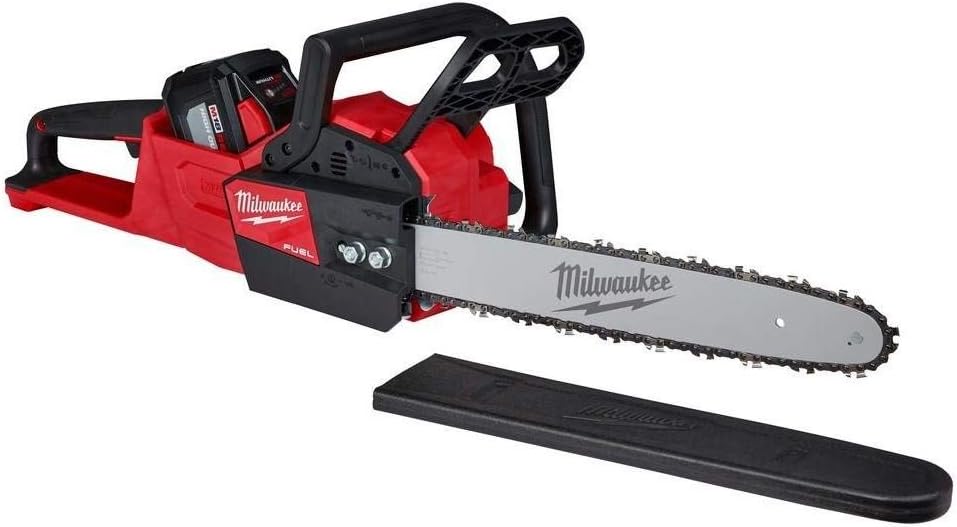
Milwaukee M18 FUEL 16 in. Cordless Chainsaw (Tool Only)
| Power Source | Battery Powered |
|---|---|
| Horsepower | 5.3 hp |
| Chain Length | 16 inches |
The Milwaukee M18 FUEL 16 in. cordless chainsaw is a tool-focused model that brings high power and convenient cordless operation to homeowner cutting tasks. It uses the M18 battery platform (battery and charger sold separately) and is built around a 16-inch Oregon bar and chain with an automatic oiler and variable speed trigger so you can control cut speed for different wood types. In practice this saw handles hardwood and mid-size logs quickly and is reported to deliver many cuts per charge with higher-capacity M18 packs. Notable features include the brushless FUEL motor for stronger acceleration and reduced maintenance compared with brushed motors, and a compact build that makes limbing and pruning easier in tight spaces. Important limitations are that the battery and charger are not included so you must already own or purchase compatible M18 batteries to realize the reliability benefits, and run time depends heavily on battery capacity. For homeowners who want near-professional cutting performance without gas fuss, this is a dependable cordless option when paired with a robust M18 battery.
Best for: Homeowners who prioritize a reliable, high-performance cordless saw and either already own M18 batteries or are prepared to invest in them for consistent, gas-free cutting around the yard.
Less Ideal for: Casual users who want an all-in-one package with battery and charger included or people needing very long continuous cutting sessions without spare batteries.
- Powerful brushless motor claims faster cuts than gas models for efficient work
- Automatic oiler maintains chain lubrication for consistent cutting performance
- Variable speed trigger gives precise control for pruning or larger cuts
- Compatible with the M18 battery ecosystem so higher-capacity packs boost runtime
- Battery and charger are not included so additional purchase is required
- Run time and cutting output depend on which M18 battery you use
Verdict: Choose this Milwaukee M18 FUEL 16 in. cordless chainsaw if you want near-professional cordless cutting performance and already use or plan to buy M18 batteries for dependable, gas-free operation.
SEESII 12-Inch Cordless Brushless Chainsaw

| Power Source | Battery Powered |
|---|---|
| Horsepower | 1200 watts |
| Chain Length | 12 inches |
| Included Components | chainsaw |
The SEESII 12-inch cordless chainsaw is designed for homeowners and pros who need portable, high-power cutting without a generator. It pairs a 1200W brushless motor with two 4.0Ah batteries to deliver sustained cutting power for pruning, cutting storm debris, and working on small to medium logs. The tool-free chain tension system and automatic lubrication reduce downtime and routine maintenance, and the 60 mL oil tank helps keep the chain running smoothly during longer sessions. Because it is cordless and relatively lightweight for its class, it is easy to move around the yard or use at remote sites where cords are impractical. Important limits to note are the 12-inch bar, which constrains maximum log diameter compared with full-size saws, and battery reliance for very long jobs where alternating charged packs or a backup power source is needed. For straightforward woodcutting tasks this model balances cutting performance, convenience, and low maintenance.
Best for: Buyers who prioritize efficient, portable wood cutting for yard cleanup, pruning, and medium DIY projects and want a low-maintenance cordless saw they can move around the property easily.
Less Ideal for: Contractors or users who regularly need to fell large trees or process large-diameter logs should choose a full-size gas or professional electric chainsaw instead.
- 1200W brushless motor provides strong, efficient cutting power for hardwood and storm debris
- Two 4.0Ah batteries extend runtime for longer jobs and include a built-in charge indicator
- Automatic oiling with a 60 mL tank reduces frequent stops for lubrication
- Tool-free chain tensioning simplifies on-the-job adjustments
- Cordless, relatively lightweight design improves portability and use at remote sites
- 12-inch bar limits the maximum log diameter compared with larger professional chainsaws
- Runtime depends on battery swapping for extended heavy-duty cutting sessions
Verdict: A powerful, low-maintenance cordless 12-inch saw that maximizes portable cutting performance for homeowners and weekend woodworkers.
Choosing the Right Homestead Chainsaw: Key Factors to Consider
Cutting Capacity and Power
How much wood you can cut per session depends on the saw's power source and displacement or motor rating. A chainsaw with ample torque slices through thicker trunks and knotty hardwoods without bogging. Consider typical log diameter on your property and whether you regularly tackle standing deadwood or large limbs. A saw undersized for the work will overheat and wear faster, while an oversized saw can be unnecessarily heavy for light chores.
Also think about the bar length you need. Longer bars let you cut bigger pieces in a single pass but increase weight and vibration. Matching bar length to your typical cutting diameter keeps jobs efficient and safer.
Runtime, Refueling, and Battery Options
On a homestead you may work far from power, so runtime and how quickly you can restore it matter. Gas models offer quick refills and long runtime but require mixing fuel or managing two-stroke engines. Battery systems provide quieter operation and simpler maintenance but need spare batteries or access to charging between jobs. Compare typical runtime under cutting load, not just idle figures, and consider how many cycles you can expect before performance drops.
Also account for fuel storage, battery charging locations, and the logistics of carrying spare fuel or packs across fields. A reliable refueling plan keeps work flowing on larger properties.
Durability of Bar, Chain, and Drive Components
The wear life of the bar and chain determines long-term cost and downtime. Chains that hold sharpness and bars with robust rails and sprocket tips last longer when cutting dirty, gritty, or frozen wood. Examine how easy the chain is to tension, whether the bar nose uses a replaceable sprocket, and the expected stretching behavior of the chain.
Drive components like the clutch, sprocket, and chain brake should resist contamination and be serviceable without special tools. Durable components reduce the frequency of shop repairs and keep the saw productive during busy seasons.
Serviceability and Parts Availability
Homesteaders often repair tools in the field or with a basic workshop. Look for saws with straightforward access to filters, spark plugs, chain tensioners, and clutch assemblies. Standardized parts and widely available replacement chains and bars simplify upkeep.
Also consider whether common wear items can be serviced with basic hand tools and whether the manufacturer or third-party vendors supply parts at reasonable intervals. Good documentation and an active parts ecosystem reduce downtime.
Ergonomics, Balance, and Vibration Control
You may be running the saw for extended periods when bucking a winter's worth of firewood. Comfortable handle geometry, sensible weight distribution, and vibration damping matter for user fatigue and control. Saws with anti-vibration mounts, reachable controls, and a balanced center of gravity let you work longer with better accuracy.
Pay attention to how the saw sits when cutting at chest height, overhand, and near the ground. A saw that feels awkward in one common working position will slow you down and increase fatigue over a long day.
Safety Features and Stopping Controls
Effective chain brakes, responsive throttle cutoff, and predictable kickback behavior are critical on a homestead where you may cut alone or in uneven terrain. Safety features that are simple to test and maintain reduce the chance of failures during urgent tasks.
Evaluate how quickly a chain brake activates, whether chain catchers are present, and how easy it is to reach the kill switch. Familiarity with these systems and regular functional checks are as important as their presence on the saw.
Sizing a Chainsaw to Your Homestead Workload
Consider the full range of chores you handle across seasons before choosing bar length and power. If you mostly split firewood from pre-felled logs and trim small limbs, a mid-size bar in the 14 to 18 inch range keeps the saw light and maneuverable. For occasional large-diameter trees or clearing after storms, a 20-inch bar or larger gives reach but increases weight and fuel consumption.
- Match bar length to the largest log you cut most frequently.
- Balance power needs against user strength and dexterity.
- Plan for occasional heavier duty with a slightly larger saw rather than always pushing a small one beyond its limits.
Maintaining Chainsaw Health on the Farm
A regular maintenance routine prevents most breakdowns and keeps cutting predictable. Daily checks should include chain tension, bar lubrication, and a quick inspection for damage to the chain or bar nose. Clean air filters and proper carburetor or fuel system care reduce rough running and prolong engine life.
- Keep spare chains and a sharpening file in the shed.
- Use the correct bar oil and check the oiler feed periodically.
- Clean the cooling fins and remove debris from the clutch area after heavy use.
Safe Operating Practices for Solo Work
Many homestead tasks are done without a second person nearby. Prioritize safe setups: stable footing, chokers or wedges for controlled cuts, and a plan for dispatching limbs or trunks. When working alone, position tools and fuel so you can pause and retreat quickly if a limb shifts. Regularly rehearse how you would stop work and move to safety in case of an accident.
- Wear protective clothing and hearing protection on every job.
- Use wedges to prevent bar pinching when bucking.
- Keep a charged phone or radio in a waterproof pocket for emergencies.
Choosing Between Gas and Battery Power
Gas chainsaws still lead for long runtimes and quick refueling in remote homesteads. They are typically heavier to maintain but deliver consistent power for large, continuous jobs. Battery chainsaws offer quieter starts, lower routine maintenance, and instant throttle response but require battery management and usually have shorter runtime under heavy load. For many homesteads, a combination of a larger gas saw for heavy work and a battery saw for quick trim jobs provides the best flexibility.
- Factor in whether you have charging infrastructure near work sites.
- Think about seasonal cold weather, which can reduce battery performance.
- Consider carrying an extra battery or fuel canister for extended sessions.
Storage and Winterizing Your Chainsaw
Proper storage extends the life of fuel systems, gaskets, and bar components. For gas saws, drain fuel or add stabilizer before long storage, and fog the cylinder if recommended. For battery models, store packs at moderate charge and in a cool, dry place to preserve capacity. Regular off-season inspection makes spring startup faster and safer.
- Clean and lightly oil the chain before storage to prevent rust.
- Inspect seals, fuel lines, and cables for cracks during fall maintenance.
- Label spare parts and keep them with the saw to simplify spring repairs.
How We Chose the Best Homestead Chainsaw
We narrowed candidates using criteria that reflect how a chainsaw performs on a real homestead. Primary filters included engine or motor reliability under load and consistent throttle response so the saw can cut green and dry wood without bogging. Serviceability and parts availability were important because homestead users often repair and maintain tools on-site. Bar and chain durability under repeated cutting determined real lifespan and replacement frequency. Ergonomics and vibration levels were assessed for extended tasks like splitting and limbing. Fuel or battery runtime and refill or recharge logistics were evaluated to match different property sizes and access to power. Exclusions removed highly specialized competition saws intended only for professional tree work or ultra-light homeowner models that lack the durability for frequent use. The final list favors balanced machines that offer robust cutting ability, straightforward maintenance, and predictable performance for homestead chores.
FAQ
What bar length is best for general homestead use?
For most homestead chores a bar between 14 and 20 inches covers routine trimming, firewood, and smaller tree work. Choose the shorter end of that range for frequent trimming and the longer end if you occasionally buck large logs.
How often should I sharpen or replace a chain?
Sharpen a chain whenever cutting performance drops noticeably, typically after a few hours of heavy cutting or sooner if cutting dirty wood. Replace the chain when sharpening no longer restores cutting efficiency or when there is visible damage to teeth or drive links.
Can battery chainsaws handle large firewood jobs?
Battery chainsaws can handle moderate firewood tasks but their runtime and power depend heavily on battery capacity and load. For large, continuous bucking sessions a gas saw or multiple high-capacity batteries are usually more practical.
How do I reduce kickback risk when cutting limbs?
Use proper cutting technique by planning relief cuts, keeping the bar tip clear of contact, and using a reduced-kickback chain if available. Maintain sharp chains and a well-tensioned setup, since dull chains increase the likelihood of sudden binding and kickback.
What maintenance items should I carry in the field?
Carry a spare chain, a portable sharpener or files, a small toolkit for bar removal and tensioning, and spare fuel or a charged battery. Also bring chain oil, a rag, and a basic first-aid kit.
Final Verdict
Prioritize the chores you do most often when choosing a homestead chainsaw. Focus first on cutting capacity and runtime so the tool can handle typical logs and the length of your sessions. Balance durability and serviceability against weight and ergonomics to reduce downtime and fatigue. A saw that is simple to maintain, with readily available parts and clear safety systems, will be the most useful long-term on a homestead. Decide between gas and battery based on how often you work away from power and whether quiet, low-maintenance operation or continuous high-power cutting matters more to you.
