

Note: This article contains affiliate links. If you click on these links and make a purchase, I may earn a small commission at no extra cost to you. This helps support my research and content. Read my full affiliate disclosure here.
Ants move quickly from entry points into kitchens, pantries, and laundry rooms, and the right bait changes their behavior at the source. You want products that attract the colony, deliver a slow-acting toxin back to the nest, and stay effective in real indoor conditions. This guide shortlists the top house ant bait options for indoor use and explains the practical differences that matter in a home setting. Below we cover bait types, placement tactics, and the performance traits we used to select the top choices so you can pick an option that fits your household layout and pest pressure.
Top Picks at a Glance
| Best Overall The best all-around choice for most situations | TERRO Liquid Ant Bait Stations, 18 Count (3 Pack) |  |
| Best Quality Built to a higher standard if you want something more solid | Syngenta Advion Ant Gel (4 Tubes, 30 g each) |  |
| Best Value The sweet spot between price and what you get | Combat Max 2‑in‑1 Ant Bait Station, 4 Count |  |
| Best Budget The cheapest option that still gets the job done reliably | Raid MAX Liquid Ant Baits, 4 Count |  |
| Highest Rated A top-rated pick with lots of positive feedback | Maxforce FC Ant Bait Stations (24 Count) by Envu |  |
| Most Popular A crowd favorite that many people choose with confidence | TERRO Liquid Ant Killer Bait Stations, 12-Pack (T300B) |  |
| Best Seller A high-volume bestseller chosen again and again | TERRO Liquid Ant Killer 3-Pack (T200-3SR) |  |
TERRO Liquid Ant Bait Stations, 18 Count (3 Pack)

| Unit Count | 18 Count |
|---|---|
| Item Form | Liquid |
| Target Species | Insects |
| Active Ingredients | Sodium Tetraborate Decahydrate (Borax) |
| Specification Met | EPA |
TERRO Liquid Ant Bait Stations are compact, ready-to-use traps that use a sweet liquid bait containing borax to attract foraging ants and carry the poison back to the colony. Typical use is placing the small stations along baseboards, in corners, behind appliances, or on counters where you see ant trails; no mixing or setup is required beyond opening the tab. The kit includes 18 bait stations (three packs of six) and the liquid formula is kept from drying by the sealed station design so it stays attractive for extended periods. Practical benefits include quick visible reduction in worker ants within a few days and the potential to eliminate the colony if placements are maintained until the bait is gone. Limitations: it is for indoor use only and works on ants that take sweet baits, so species that prefer greasy or protein foods may be less affected; results can take up to two to four weeks for full control and you should remove competing food sources for best results.
Best for: Homeowners or renters who want a low-effort, evidence-backed way to target kitchen ant trails and remove colonies without sprays, and who prefer products with a strong track record and social proof.
Less Ideal for: People needing immediate knockdown of visible ants or those dealing with species that avoid sweet baits should consider fast-acting sprays or alternative bait types instead.
- Ready-to-use stations require no mixing or tools
- Sealed liquid design resists drying so bait remains attractive over time
- Attracts worker ants that share bait, which can eliminate the colony
- Includes multiple stations for widespread placement around a kitchen
- Indoor-only product not formulated for outdoor use
- Relies on ants accepting a sweet bait so may be less effective on non-sugar-seeking species
Verdict: A ready-to-use, proven liquid bait kit that targets kitchen ant trails and can eliminate colonies with minimal effort.
Syngenta Advion Ant Gel (4 Tubes, 30 g each)

| Unit Count | 4.23 Ounce |
|---|---|
| Included Components | 4 Tubes x 30-Grams, 1 Plunger and 2 Tips |
| Item Form | Gel |
| Active Ingredients | 0.05% indoxacarb |
| Target Species | Insects |
Advion Ant Gel is a user-friendly gel bait intended to control common household and structural ant species by exploiting worker foraging behavior. You apply small spots or short lines of the odorless gel along active trails, in cracks and crevices, and near entry points; foraging workers consume the bait and carry it back to the nest where it is shared, helping to eliminate the queen and other nestmates. The kit ships with four 30 g tubes plus an applicator plunger and tips for precise placement, which makes targeting tight spaces straightforward. Its non-repellent formula with 0.05% indoxacarb is formulated to be attractive to a range of species including Argentine and carpenter ants, and it is labeled for both indoor and outdoor use. Limitations to note are that it is a chemical bait so safety precautions are needed around children and pets and efficacy depends on ants accepting the bait matrix versus other available food sources.
Best for: Homeowners and renters who want a targeted, easy-to-apply solution to eliminate established ant infestations and prefer a bait that works via worker-mediated transfer to treat whole colonies.
Less Ideal for: People seeking non-chemical or immediate-contact kill methods or those who need a one-time spray rather than ongoing baiting strategies should consider other options.
- Non-repellent gel formulation designed for worker ants to feed and transfer bait to the colony
- Includes four 30 g tubes plus a plunger and application tips for precise placement
- Labelled for both indoor and outdoor use, suitable for common pest species
- Odorless formula that is easy to place along trails, cracks, and crevices
- Contains a chemical active ingredient so it must be kept away from children and pets
- Effectiveness depends on ants preferring the bait over other available food sources
Verdict: Choose Advion Ant Gel when you want a precise, bait-based solution that encourages workers to carry poison back to the nest for colony-level control.
Combat Max 2‑in‑1 Ant Bait Station, 4 Count

| Unit Count | 4 Count |
|---|---|
| Item Form | Gel |
| Target Species | Ant |
| Active Ingredients | Fipronil |
Combat Max 2‑in‑1 Ant Bait Station is a simple, ready-to-use solution for bringing ant trails under control. Each compact station contains one of two gel formulas—one sugar‑based and one protein‑based—so it attracts ants across feeding cycles and lets foragers carry bait back to the nest. The snap‑off tab design and transparent housing make setup and monitoring easy without mess or tools. Because the active ingredient is fipronil at very low concentrations, bait stations begin affecting colonies within hours and the product is intended to eliminate the queen and colony over time. Practical benefits include discreet placement under sinks or behind appliances, no odors, and four stations per pack for treating multiple entry points. Limitations are that it excludes certain ant types such as carpenter and pharaoh ants, and stations need replacement about monthly or when empty, so ongoing purchases may be needed for long infestations.
Best for: Buyers who need an inexpensive, easy-to-deploy solution for common household sugar and protein-feeding ants and prefer minimal setup and monitoring.
Less Ideal for: Homes dealing specifically with carpenter or pharaoh ant infestations or users who want a single, long-term treatment without periodic replacement.
- Two bait formulas (sugar and protein) attract ants in different feeding cycles
- Transparent station lets you see bait level for timely replacement
- Compact, snap-off design provides quick, mess-free setup
- Includes four ready-to-use stations to treat multiple trails
- Does not target harvester, carpenter, or pharaoh ants
- Stations require replacement roughly every month or when empty
Verdict: A budget-friendly, no-fuss four-pack of bait stations that uses sugar and protein gels to attract and eliminate common household ants.
Raid MAX Liquid Ant Baits, 4 Count

| Unit Count | 4 Count |
|---|---|
| Item Form | LIQUID |
| Target Species | Insects |
| Active Ingredients | Spinosad |
Raid MAX Liquid Ant Baits are small pre-filled liquid stations intended to be placed where ants are active indoors or at entry points outdoors. The bait attracts sweet-feeding and foraging ants which drink the liquid and carry it back to the nest, so the product targets the colony rather than only killing visible workers. Typical use is to set the stations along baseboards, in pantries, near trash or along ant trails; they are spill-proof and come ready to use so there is no measuring or mixing. The active ingredient listed is spinosad which is effective against many common household ants but is explicitly not for fire ants, carpenter ants, harvester ants or pharaoh ants. Practical benefits are ease of placement, low handling, and colony-level control when the target species are present. Limitations include a narrow list of excluded ant species, small individual bait volume that may need frequent replacement in heavy infestations, and the need to identify ant type for best results.
Best for: Homeowners or renters who want an inexpensive, low-effort way to reduce common household ant colonies around kitchens, pantries, and entryways.
Less Ideal for: People dealing with infestations of fire ants, carpenter ants, pharaoh ants, or large outdoor mound infestations should choose a product formulated for those species or consult a pest professional.
- Ready-to-use, pre-filled liquid stations require no mixing or measuring
- Designed for indoor and outdoor placement to treat ant activity at entry points
- Targets the colony by having worker ants carry bait back to the queen
- Spill-proof station design reduces mess and exposure during use
- Not effective against several ant species including fire ants and carpenter ants
- Small bait volume may require multiple units or frequent replacement in heavy infestations
Verdict: An easy, budget-friendly liquid bait for homeowners who need simple indoor and perimeter control of common household ants by knocking out colonies from the inside.
Maxforce FC Ant Bait Stations (24 Count) by Envu
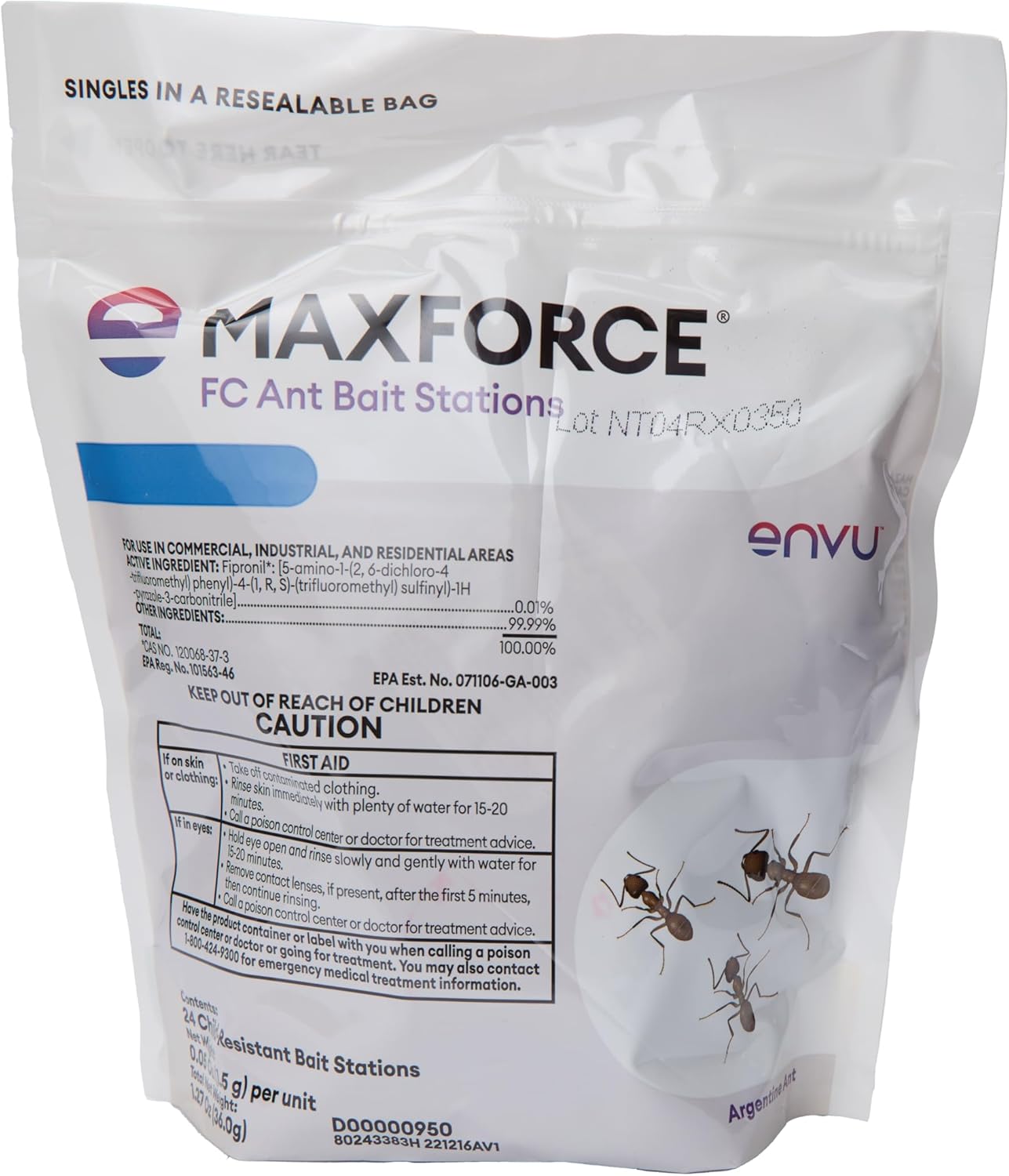
| Unit Count | 24 Count |
|---|---|
| Target Species | Insects |
| Active Ingredient | 0.01% Fipronil |
| Number of Pieces | 24 |
Maxforce FC Ant Bait Stations are ready-to-use, child-resistant stations prefilled with a slow-acting fipronil bait designed to be placed along ant trails, cracks, and entry points. In practice you set the small clear stations where you see worker ants; they feed on the bait, return to the nest, and transfer the active ingredient to other colony members which can lead to colony elimination rather than just killing foragers. The stations are odorless and contained, so they are easy to use in kitchens and living areas without spills or strong smells, and the clear housing makes it simple to monitor activity. The formulation is labeled effective against common household species including pharaoh ants, making this pack useful for treating multiple rooms or ongoing activity. Important limitations are that results are not immediate since the bait relies on worker transfer and that success depends on correct placement and continued monitoring; very large or heavily infested nests may require professional follow up.
Best for: Buyers who prioritize dependable colony-level control and want a low-maintenance, contained option for treating pharaoh ants and other household species inside and around the home.
Less Ideal for: People needing immediate knockdown of visible ants or those unwilling to place multiple stations and monitor activity may prefer contact sprays or professional services instead.
- Prefilled, child-resistant stations for safe indoor placement and easy monitoring
- Slow-acting fipronil formula designed to be carried back to the nest for colony-level control
- Odorless, contained design prevents spills and makes indoor use practical
- 24 stations provide enough placements for multiple rooms or ongoing treatments
- Action is slow because control depends on worker ants taking bait back to the colony
- Effectiveness depends on correct placement and ant feeding preferences which may require some trial and error
Verdict: Use these prefilled, child-resistant bait stations when you want a practical, colony-focused solution for persistent pharaoh ant problems.
TERRO Liquid Ant Killer Bait Stations, 12-Pack (T300B)

| Unit Count | 12 Count |
|---|---|
| Item Form | Liquid |
| Target Species | Insects |
| Active Ingredients | Sodium Tetraborate Decahydrate (Borax), 5.40% |
Terro Liquid Ant Killer bait stations are prefilled, single-use traps designed for indoor control of common sugar-loving ants. You place the small stations along baseboards, in corners, under appliances, or on countertops where you see ant activity. Worker ants are drawn to the sweet liquid, feed on it, and take it back to the nest so the borax-based active ingredient can eliminate the colony over days to weeks. The product is easy to use with no mixing or setup and the 12-pack gives coverage for several rooms. Because the bait is contained inside a low-profile plastic station, it reduces incidental contact risk compared with loose sprays or powders and lasts for weeks while ants continue to visit. Limitations are that the formula targets sugar-preferring species so very protein- or grease-attracted ants may ignore it, and control can take 2 to 4 weeks for larger infestations. Also stations should be placed away from pets and children despite the contained design since the bait contains borax.
Best for: Homeowners who prioritize an easy, low-hassle indoor solution and want a bait that works at the colony level with minimal hands-on pest handling.
Less Ideal for: People who need immediate knockdown of ants or who have pets or children that frequently access treated areas and cannot reliably keep them away from placed stations.
- Ready-to-use stations require no mixing or setup
- Designed to be carried back to the nest for colony-level control
- Low-profile enclosed bait reduces messy exposure compared with loose liquids or sprays
- 12 stations provide coverage for multiple rooms or hotspots
- Formulation is sugar-based so less effective on ants that prefer protein or grease
- Control can take 2–4 weeks for large or established colonies
Verdict: A simple, low-contact indoor bait system that reliably reduces sugar-loving ant infestations by getting worker ants to carry borax back to the colony.
TERRO Liquid Ant Killer 3-Pack (T200-3SR)

| Item Form | Liquid |
|---|---|
| Active Ingredients | Sodium Tetraborate Decahydrate (Borax) 5.40% |
| Target Species | Insects |
| Specification Met | EPA |
TERRO Liquid Ant Killer is a straightforward indoor bait system designed to eliminate common household ants by having workers feed on a borax-based liquid and transfer it to the colony. You apply drops of the bait onto the included cardboard tiles and place them along ant trails, baseboards, counters, and other activity hotspots. The 3-pack gives multiple bait stations for treating several rooms or repeated placements. The active ingredient, sodium tetraborate decahydrate, works slowly enough to be shared among nestmates so the queen and hidden workers are affected, which can produce visible reductions in a few days. Because the formulation is liquid and comes in drip bottles, placement and reapplication are simple and low-mess compared with granular or spray options. Limitations are that the product is intended for indoor use only and requires ants to find and feed on the bait, so heavily contaminated or outdoor nests may need additional measures. When used as directed it is a practical, low-effort solution for routine household infestations.
Best for: Homeowners wanting a low-effort, indoor-focused solution to eliminate sugar ants and other household species who prefer baiting over sprays.
Less Ideal for: People who need immediate knockdown of visible ants outdoors or who require a product for large external infestations should look at targeted outdoor nest treatments.
- Borax-based liquid attracts worker ants and allows transfer to the colony for more complete elimination
- Three 2 oz bottles provide multiple placements for whole-house coverage
- Simple drop application on included cardboard tiles makes setup and reapplication low-mess
- EPA specification met and formulated for common household ant species including sugar and ghost ants
- Only effective if ants discover and consume the bait, so results depend on placement and ant behavior
- Designed for indoor use and may not address outdoor nests feeding into the house
Verdict: A simple, effective indoor bait that uses borax to knock out sugar ant colonies by relying on worker-to-colony transfer.
Choosing the Right House Ant Bait: Key Factors to Consider
Bait Formulation and Active Ingredient
The active ingredient determines how quickly ants die after feeding and whether workers can carry the bait back to the nest. Slow-acting actives allow worker ants to feed and transport toxic bait to queens and larvae, increasing the chance of colony elimination. Fast-killing actives can eliminate visible workers quickly but often fail to stop the colony if workers die before returning to the nest.
Formulation type matters too. Gel and liquid baits are usually preferred for sugar-loving species because they mimic nectar or honeydew. Granules or solid baits can be better for protein- or grease-seeking ants. Consider the ant species behavior in your home when choosing a formulation.
Attractant Strength and Species Preference
Different ant species prefer carbohydrates, proteins, or greasy foods at different times of year or during life stages. A bait with a strong carbohydrate attractant works well when ants forage for sugars, while protein-focused baits may be more effective when colonies are rearing brood. Effective indoor baits match the food preference of the target species and maintain that attractiveness over time.
If you are unsure which species you have, look at trail behavior and the foods ants are visiting. Rotate lure types or use a product labeled for multiple food preferences to increase the chance of uptake.
Placement, Access, and Household Safety
Correct placement determines whether worker ants find and feed on the bait. Place bait along ant trails, near entry points, and in protected locations where pets and children cannot disturb it. Indoor environments introduce challenges such as frequent cleaning, spills, and humidity that can degrade baits; choose products with packaging or designs that protect the formulation.
Consider tamper-resistant housings or bait stations for high-traffic areas. Also factor in ventilation and proximity to food-prep surfaces so baits do not contaminate open food or utensils.
Longevity and Resistance to Indoor Conditions
A bait that dries out, spoils, or becomes contaminated will lose attractiveness quickly. Indoor humidity, temperature fluctuations, and routine cleaning practices influence how long a particular bait remains effective. Look for formulations and delivery systems designed to remain palatable for days to weeks under household conditions.
Products with sealed reservoirs or slow-release gels typically outlast exposed drops or smeared gels. Longevity reduces the need for frequent replacement and helps maintain continuous pressure on the colony.
Application Ease and Maintenance
Homeowners often prefer baits that are straightforward to place and require minimal upkeep. Preloaded bait stations, squeeze-tube gels, and single-dose reservoirs are easier to deploy correctly than loose granules or homemade mixes. Consider how often you are willing to check and replace bait and whether the product allows discreet placement in narrow cracks and behind appliances.
Also think about cleanup and disposal. Use products with clear instructions for safe removal and replacement, and avoid formulations that leave sticky residues on floors or counters.
Understanding How Baits Work in a Home
Baits rely on worker ants finding a food source, feeding, and then carrying that food back to the colony. In a house setting, bait success depends on matching the bait to the ants' current food cravings and placing it where they already travel. Indoor foraging patterns are often predictable along baseboards, under sinks, and near appliances that produce food residue.
Expect a delay between deployment and visible results. If the bait is effective, worker numbers will often decline over days to weeks as the colony receives toxic doses indirectly. Rapid disappearance of workers at the bait site can be a good sign, but it is not definitive proof the colony is eliminated because some actives kill too quickly for transfer.
- Place baits on or directly adjacent to ant trails for fastest detection
- Avoid using general sprays in the same area as baiting; sprays can repel workers
- Monitor baits daily during the first week, then weekly until activity stops
Placement Tips for High-Traffic Indoor Areas
Kitchens, pantries, and utility rooms are common hotspots. In these areas, place bait in hidden spots such as behind appliances, along cabinet kickboards, and inside tamper-resistant stations near the base of ant trails. Keep bait away from open food and cooking surfaces to reduce contamination risk.
For multiunit housing, place baits at likely ingress points such as door thresholds, around pipes, and near window sills. Coordinated placement across units is more effective when infestations are connected through building structure.
- Use small amounts to avoid spillage and contamination
- Keep bait dry and away from cleaning products that could mask the attractant
- Secure baits where pets and children cannot access them
Nonchemical Supportive Measures
Sanitation and exclusion complement baiting. Eliminate crumbs, store dry goods in sealed containers, and wipe sticky residues from counters. Seal gaps and cracks around doors, windows, and where utilities enter to reduce new entry points.
Removing alternate food sources makes baits more attractive. Clean pet feeding areas and promptly remove ripe fruit or spills. Traps and baits work best when ants have limited alternatives.
- Inspect outdoor landscaping that touches the foundation; trim vegetation that creates bridges
- Redirect pet food and water bowls away from walls at night
- Use weather stripping and caulk to close small entry gaps
Dealing With Different Ant Behaviors
Slow-moving, sugar-seeking ants respond best to sweet gels and liquids, while fast-moving hunters or grease-preferring species may ignore sugary baits. If you see ants carrying bits of food or foraging on protein sources, choose a bait formulation that mimics that preference. Watching what ants feed on during a 24-hour period helps you pick the right attractant.
For very large or widely dispersed colonies, multiple bait placements may be necessary to reach different nest sites. Persistence and correct bait choice are more important than swapping products frequently.
- Observe at different times of day to catch shifts in food preference
- Use multiple, small bait stations rather than one large deposit
- Be patient-colony-level effects can take weeks
When to Call Professional Help
If ant activity persists despite proper bait placement, or if you find multiple nest sites in structural cavities, a professional assessment can identify entry vectors and nesting areas that are hard to reach. Professionals can also diagnose species that require specialized treatment strategies.
Consider a pro when infestations affect multiple rooms or units, when children or immunocompromised household members are present, or when structural damage is suspected from nesting behaviors.
- Request a thorough inspection before agreeing to broad interior treatments
- Ask about nonrepellent baiting strategies that target colonies rather than repelling workers
- Coordinate treatments with neighbors in shared buildings for best results
How We Chose the Best House Ant Bait
We started by focusing on products formulated specifically for indoor ant control and evaluated items that can be safely placed near food-prep zones, along baseboards, and at common entry points. Our selection criteria prioritized bait formulations that remain attractive to common indoor ant species, delivery methods suitable for household use, and proven modes of transfer to the colony. We compared longevity under typical indoor conditions, how well baits resist drying and contamination, and ease of placement for homeowners and renters. Excluded from consideration were outdoor-only baits, general-purpose insecticides not designed for baiting behavior, and products intended solely for professional application. We gave extra weight to products that balance strong attractants with slow-acting active ingredients that allow worker ants to return baits to the nest. Finally, we filtered out formulations that require specialized protective equipment or complex setup so the final list stays practical for ordinary home use.
FAQ
How long does it usually take for ant bait to reduce visible activity?
Visible declines often occur within a few days to a couple of weeks. Colony suppression depends on bait uptake, transfer to the nest, and the ant species' life cycle. Be patient and maintain bait for at least two weeks before concluding it is ineffective.
Can I use indoor bait around pets and children?
Many indoor bait systems are designed for household use and include tamper-resistant housings, but no bait is hazard-free. Place stations where pets and children cannot reach them and follow label instructions for placement and disposal. Consider nonaccessible stations in busy homes.
Should I clean the area where ants are active before placing bait?
Avoid heavy cleaning that removes scent trails immediately before placing bait because trails help workers find it. Lightly clear loose crumbs, then set bait along existing trails. After bait uptake is established, maintain good sanitation to reduce alternative food sources.
What if baits dry out or get contaminated quickly in my kitchen?
Choose sealed or reservoir-style baits and place them in protected locations such as behind appliances or inside cabinets. Replace exposed gels or liquids more frequently and avoid placing bait where routine spills or cleaning will interfere.
Can one type of bait handle all indoor ant species?
No single bait is ideal for every species because food preferences vary. Some products are formulated to attract multiple diet types, but observing ant behavior and adjusting bait type accordingly improves success.
Final Verdict
Choose a bait that matches the feeding preferences of the ants you see and prioritize placement that protects household members and pets. Balance attractant strength with a slow-acting active ingredient so workers can carry the bait back to the nest, and select delivery systems that resist drying and contamination. Expect gradual results and be ready to maintain multiple small stations in heavy infestations. If activity continues despite correct baiting and sanitation, seek a professional inspection to find hidden nests and structural entry points.
