

Note: This article contains affiliate links. If you click on these links and make a purchase, I may earn a small commission at no extra cost to you. This helps support my research and content. Read my full affiliate disclosure here.
Picking the right indoor grow light changes how well your plants germinate, stretch, flower, and yield in a small space. Whether you are starting seeds on a windowsill, running a multi-shelf propagation rack, or lighting a compact flowering cabinet, the fixture you choose affects light quality, heat management, and electricity use. This guide shortlists the top indoor grow lights across common uses and grows. We evaluate fixtures on the factors that matter in real indoor gardens, including spectrum coverage, output per watt, footprint and mounting options, heat behavior, and ease of use. Read on for practical notes that make comparing the shortlisted lights faster and more relevant to your setup.
Top Picks at a Glance
| Best Overall The best all-around choice for most situations | LBW Tri-Head Full Spectrum LED Grow Light with Adjustable Tripod Stand |  |
| Best Quality Built to a higher standard if you want something more solid | Spider Farmer SF1000 100W LED Grow Light (Dimmable, Full Spectrum) |  |
| Best Value The sweet spot between price and what you get | Barrina T5 LED Grow Lights for Indoor Plants, 1 ft, 4-Pack (5000K Full Spectrum) |  |
| Best Budget The cheapest option that still gets the job done reliably | Qicodu Compact Full-Spectrum Table Grow Light with Timer and Dimming |  |
| Highest Rated A top-rated pick with lots of positive feedback | GLOWRIUM G2 Pro 48W Full‑Spectrum LED Floor Grow Light with Adjustable Stand |  |
| Most Popular A crowd favorite that many people choose with confidence | GooingTop HY-021 Clip-On Full Spectrum LED Grow Light (6000K) |  |
| Best Seller A high-volume bestseller chosen again and again | Briignite A19 Full Spectrum LED Grow Light Bulb (2-Pack) |  |
LBW Tri-Head Full Spectrum LED Grow Light with Adjustable Tripod Stand

| Light Source Type | LED |
|---|---|
| Number of Light Sources | 641 |
| Wattage | 39 watts |
| Control Method | Remote |
| Power Source | Corded Electric |
This LBW tri-head grow light is built for indoor plant care where adjustable, full-spectrum light is needed across multiple pots or tall plants. The unit uses 642 LEDs across three panels and delivers a broad spectrum that includes red, blue, white, UV, and IR to support photosynthesis at different growth stages. Each head mounts on a stable tripod that extends to accommodate taller specimens and lets you angle panels independently for wider coverage. Controls include a remote, six dimming levels and a 3/6/12 hour timer for simple automated schedules. Practical benefits are strong: the waterproof, lightweight construction with aluminum panels keeps heat down while the high lumen output lights several plants at once. Important limitations are its 39 W power rating, which is modest for dense canopy setups, and the 24 V/USB connectivity choices that may require close outlet placement or adapters for some setups. Assembly and positioning are straightforward but the finish is matte black so it is utilitarian rather than decorative.
Best for: Buyers who want a versatile, easy-to-use indoor grow light to support multiple houseplants or taller specimens without complicated setup and who value automated timers and adjustable coverage.
Less Ideal for: Growers planning intense, high-yield or multi-tiered cultivation who need very high wattage or professional PPFD levels should consider more powerful panel fixtures.
- Full spectrum output including red, blue, UV and IR for all growth stages
- Three adjustable panels on a height-adjustable tripod for broad, customizable coverage
- Remote control with six dimming levels plus 3/6/12H timer for easy scheduling
- Waterproof design and aluminum panels help with heat dissipation and durability
- 39 W total is relatively low for large or high-density grow setups
- Requires nearby power/USB connection which can limit placement options
Verdict: A flexible, full-spectrum tri-head grow light on a height-adjustable tripod that makes reliable, low-effort indoor plant lighting simple.
Spider Farmer SF1000 100W LED Grow Light (Dimmable, Full Spectrum)

| Light Source Type | LED |
|---|---|
| Light Output Maximum | 10000 lumens |
| Wattage | 100.5 watts |
| Light Source Special Features | Dimmable |
| Specification Met | IP67 |
The Spider Farmer SF1000 is a 100W full-spectrum LED grow light intended for 2×2 to 3×3 grow tents and small indoor setups. It uses a high diode count and an upgraded LED array to deliver broad-spectrum output with a stronger blue band for veg and red/IR for bloom, and a dimmer knob lets you dial intensity anywhere from 0 to 100% for different growth stages. The unit is fanless and relies on a thick aluminum heat sink for passive cooling, so it runs quietly and can sit close to plants without adding noise. Practical benefits include straightforward ceiling mounting, daisy-chaining multiple units for larger setups, and IP67-rated components for durability. Limitations to note are that the SF1000 is aimed at small footprint grows so it will not cover larger rooms efficiently and it does not include a built-in controller or app connectivity. For growers focused on maximizing PAR per watt in a compact tent, the SF1000 offers efficient, adjustable light in a well-built, low-noise package, but you may need additional fixtures or controllers for larger or more automated grows.
Best for: Growers who prioritize efficient light output and quiet, hands-on control in a small indoor tent and want a compact fixture that delivers strong PAR for veg and bloom stages.
Less Ideal for: People wanting a single light to cover a large room, fully automated smart control out of the box, or a plug-and-play solution for multi-level shelving without adding extra fixtures.
- Full-spectrum LED array with added blue and red/IR bands for all growth stages
- Dimmable 0–100% knob for precise light intensity control
- Fanless design and thick aluminum heatsink provide silent passive cooling
- Compact footprint suitable for 2×2 to 3×3 grow tents and easy ceiling mounting
- IP67 specification and robust construction increase durability in humid grow environments
- Coverage is optimized for small tents and not suitable alone for larger grows
- No built-in smart controller or app connectivity for scheduling or remote control
- Manufacturer specs list weight and dimensions but those may limit placement options in very small or crowded tents
Verdict: Choose the SF1000 if you need a quiet, efficient 100W full-spectrum LED that delivers adjustable, high-quality light for a 2×2–3×3 indoor tent.
Barrina T5 LED Grow Lights for Indoor Plants, 1 ft, 4-Pack (5000K Full Spectrum)

| Wattage | 5W |
|---|---|
| Color temperature | 5000K |
| Linkable | Link up to 16 lights |
| Controls | Separate on/off switches |
The Barrina T5 1 ft grow light 4-pack is a plug-and-play full-spectrum LED kit built for supplementing indoor light for seedlings, vegetative plants, and flowering stages. Each fixture delivers 5000K full spectrum light and has an on/off switch so you can run individual tubes as needed. The set includes power cords, connecting cords, clips, double-sided tape, and cable ties for quick installation and lets you link up to 16 fixtures in series for larger shelves or racks. At low power draw the LEDs produce high PPFD relative to their wattage, making them energy-efficient for continuous use. Practical touches like separate controls and multiple mounting options simplify staged lighting setups. Limitations are that the fixtures are compact so you may need multiple units to cover wide areas and the included adhesive may not hold on rough or dusty surfaces, so more robust mounting hardware could be necessary for some installations.
Best for: Buyers who want an efficient, easy-to-install grow-light setup for indoor shelves or small racks and prefer scalable lighting they can control fixture-by-fixture.
Less Ideal for: Large single-canopy growers or users needing a single high-output fixture for wide coverage should consider longer or higher-output alternatives.
- Full-spectrum 5000K output suitable for seedlings through flowering
- Individual on/off switches let you control fixtures separately
- Linkable design supports up to 16 lights for scalable coverage
- Includes cords, clips, tapes, and connectors for fast installation
- Low power draw with high light output makes it energy-efficient
- Compact 1 ft length means several units are required for broad coverage
- Double-sided tape may not adhere reliably to rough or dusty surfaces
Verdict: A practical, energy-efficient, and easy-to-install full-spectrum T5 kit for building scalable shelf or rack lighting for indoor plants.
Qicodu Compact Full-Spectrum Table Grow Light with Timer and Dimming

| Light Source Type | Light Emitting Diode |
|---|---|
| Power Source | Corded Electric |
| Color Temperature | 4500 Kelvin |
| Number of Light Sources | 48 |
| Wattage | 10 watts |
This Qicodu grow light is built for small indoor plants like succulents, herbs, and foliage on a desk or windowsill. It provides a 380–800nm full spectrum from 48 LEDs and a 10 watt output, and you control brightness across ten levels to suit seedlings through mature plants. A built-in auto timer offers 3, 9, or 12-hour daily cycles so lights can run on a predictable schedule while you are away. The telescoping arm adjusts the lamp height so you can set an appropriate distance for different pots and avoid scorching. The lamp is made of aluminum and mounts as a table fixture, so it is stable and compact where space is limited. Limitations to note are modest total power and light spread, so it is best for single pots or a small shelf rather than covering multiple large containers, and the GU10-style base means replacement parts are less common than standard integrated arrays. For plant parents on a budget who need a simple, energy-efficient solution for a few indoor plants, this covers the basics well.
Best for: Ideal for budget-minded indoor gardeners who want an energy-efficient, space-saving lamp to keep a few small potted herbs, succulents, or foliage plants healthy with minimal fuss.
Less Ideal for: Not a good fit for users who need to light large collections, multiple shelves, or full-size seedlings for transplanting; those buyers should consider higher-power fixtures with wider coverage.
- Full-spectrum 380–800nm LED array suitable for promoting compact growth and reducing legginess
- 10-level dimming for precise brightness control through seedling to mature stages
- Auto 3/9/12-hour timer for reliable daily on/off cycles without external timers
- Adjustable telescopic arm to position light at the right distance for small pots
- Aluminum construction and table-mount design keep the unit compact and stable on shelves or desks
- Low total wattage and limited beam spread make it unsuitable for multiple large pots or whole shelf racks
- Uses a GU10-type bulb base which may limit replacement options compared with fully integrated LED panels
Verdict: A compact, energy-efficient grow light that gives budget-conscious plant owners full-spectrum light, adjustable brightness, and an automatic timer for reliable care of a few small indoor pots.
GLOWRIUM G2 Pro 48W Full‑Spectrum LED Floor Grow Light with Adjustable Stand

| Light Source Type | LED |
|---|---|
| Additional Features | Adjustable Height, Dimmable, Dual Heads, Full Spectrum, Timer |
| Power Source | Corded Electric |
| Voltage | 24 volts_of_direct_current |
| Mounting Type | Freestanding |
The GLOWRIUM G2 Pro is a freestanding floor grow light designed to provide consistent, full‑spectrum illumination for indoor plants from seedling through flowering. It uses LED strips and a wide lamp head on a four‑section adjustable pole so you can raise or lower the light for short seedlings or taller houseplants. Controls include stepless dimming, three color modes, and a built‑in timer with 3/9/12/16‑hour cycles, which makes daily scheduling simple. Notable extras are the plant care assistant functions such as light measurement, watering reminders, and growth records that help standardize care. The unit runs on a low‑voltage 24V supply and has an aluminum construction with a heavier base for stability, so it feels safer and more durable than cheaper clip lights. Expect good coverage for a small to medium cluster of pots, but the light is a floor lamp form factor so it takes floor space and is not ideal for mounting over wide racks or whole‑room installs. If you need app control or a wall/ceiling mounting solution, look at other form factors instead.
Best for: Buyers who prioritize a reliable, sturdily built grow light that maintains consistent schedules and plant care routines with minimal fuss, especially for small to medium indoor collections.
Less Ideal for: Growers who need ceiling or rack‑mounted fixtures to cover large multi‑shelf setups or who require integrated app/remote control for remote management.
- Full spectrum LED with stepless dimming and three modes to match seedling, vegetative, and flowering stages
- Adjustable four‑section pole and 360° gooseneck for precise positioning and wider coverage
- Built‑in timer and plant care assistant features for automated schedules and care reminders
- Aluminum construction with a heavier base and 24V low‑voltage supply for stable, durable, and safer operation
- Freestanding floor design requires floor space and is less suitable for wide or multi‑tier rack installations
- No explicit app or remote control on this model so remote scheduling options are limited
Verdict: Choose this GLOWRIUM floor grow light if you want a stable, full‑spectrum LED unit with adjustable height, dependable timer functions, and built‑in plant care tools for consistent indoor plant growth.
GooingTop HY-021 Clip-On Full Spectrum LED Grow Light (6000K)
| Power Source | Corded Electric |
|---|---|
| Color Temperature | 6000 Kelvin |
| Light Output Maximum | 2500 lumens |
| Light Source Special Features | Dimmable |
| Number of Light Sources | 84 |
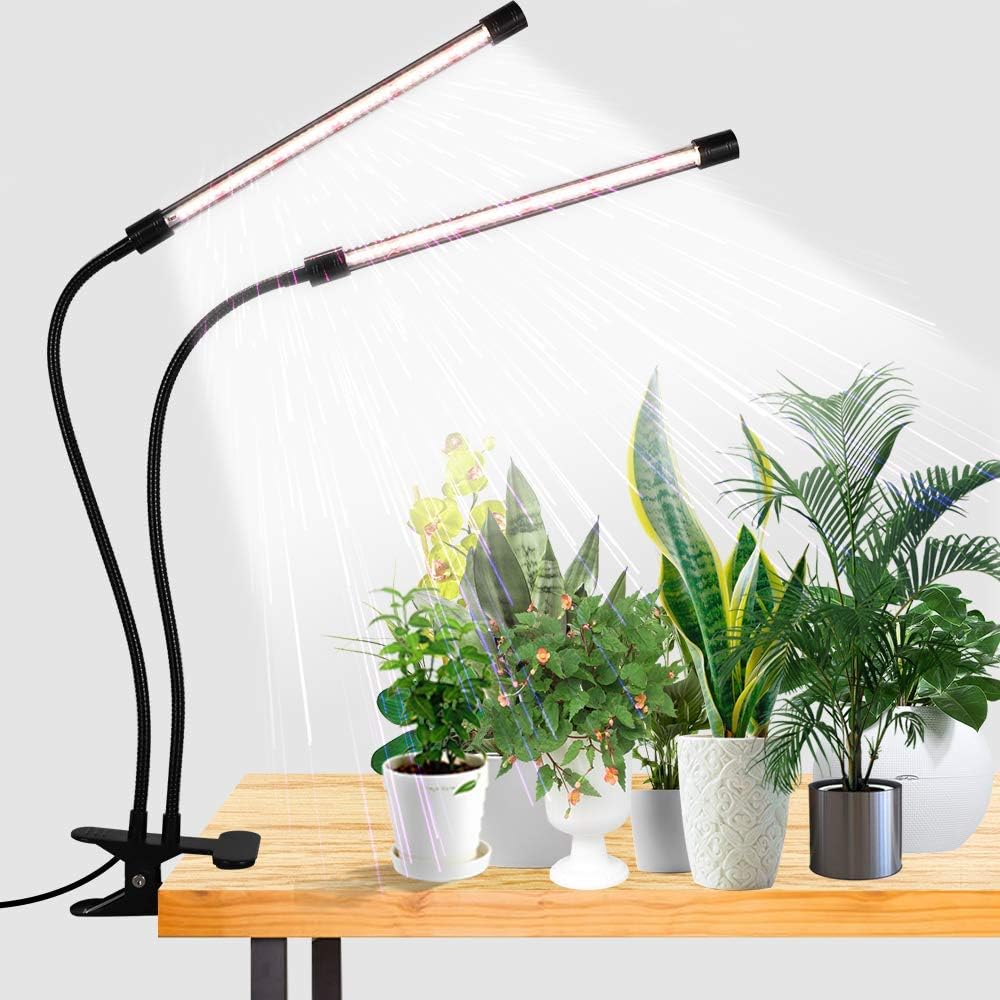
This GooingTop clip-on grow light is built for small indoor gardens, seed starting, and supplementary lighting for houseplants. It uses 84 LEDs (white plus red) to deliver a 6000K full-spectrum output and claims a high color-rendering index for natural-looking light. The flexible goosenecks and sturdy clamp make it easy to position over seedlings, microgreens, or a row of potted herbs on a shelf, and the attached remote controls two brightness settings plus a repeatable 4/8/12-hour timer so you can automate daily cycles. At roughly 10 watts of LED draw it is energy efficient for continuous use and the manufacturer lists a long lifetime. Practical benefits include precise directional lighting, simple installation without tools, and timer/dim control to match growth stages. Limitations to note are the modest coverage area suited to one or two small pots rather than larger grow tents and the clamp-style mount which requires an edge to attach; users needing broad, high-intensity coverage for many plants will need a larger fixture.
Best for: Buyers who want an affordable, easy-to-use grow light for seedlings, herbs, and a few houseplants and who value a plug-and-play solution with timer and dim controls.
Less Ideal for: Growers planning to light large racks, multiple shelves, or full grow tents should choose a wider-panel or higher-output fixture instead.
- Full-spectrum 6000K output with both white and red LEDs to support vegetative growth and flowering
- Flexible dual goosenecks and strong clamp allow precise placement over small plants and seed trays
- Built-in remote with dimming (50%/100%) and repeatable 4/8/12-hour timer for simple automation
- Low power draw (about 10W) for energy-efficient continuous operation
- Coverage is limited to approximately 1–2 square meters so not ideal for larger staging or multiple shelves
- Clamp mount requires an edge or shelf to attach, limiting placement options in some setups
Verdict: A compact, energy-efficient clip-on grow light with timer and dim controls that is ideal for seed starting and small indoor plant setups.
Briignite A19 Full Spectrum LED Grow Light Bulb (2-Pack)

| Light Type | LED |
|---|---|
| Additional Features | Full Spectrum |
| Bulb Base | E26 |
| Light Output Maximum | 1000 lumens |
| Light Source Operating Life | 30000 hours |
These Briignite A19 grow bulbs are straightforward LED replacements for standard E26 fixtures that provide full-spectrum light optimized for indoor plants. In everyday use you screw them into desk lamps, overhead fixtures, or simple grow lamp fittings to give seedlings, herbs, and leafy greens consistent light without the purple/red color of many grow-specific bulbs. Each bulb produces about 1000 lumens at roughly 11 to 12 watts, mimicking daylight at 3500 to 4000 K while claiming a high CRI of 90 for accurate color. The bulbs run cool compared with incandescent equivalents and list a long rated life suitable for seasonal indoor gardens. They are useful when you want a natural-looking light that blends with home lighting and can be left on for extended periods without excessive heat. Limitations are that they are not a high-power fixture for large or light-hungry fruiting crops and they do not include integrated dimming hardware beyond app/control method notes, so more advanced timing or spectrum control will require additional gear.
Best for: Home gardeners who want a low-risk, easy-to-install grow light that looks natural in living spaces and reliably supports seedlings, herbs, and leafy greens.
Less Ideal for: Growers managing large indoor gardens, commercial setups, or plants requiring high-intensity, spectrum-tuned lighting should consider purpose-built fixtures instead.
- Full spectrum output that looks like natural daylight (around 3500–4000 K) so plants and room colors appear normal
- Fits standard E26 sockets for easy plug-and-play installation in common fixtures
- High lumen output (about 1000 lm) at low power draw (11–12 W) for energy-efficient operation
- High color rendering index (CRI 90) for accurate color rendering and pleasant indoor lighting
- Designed to run cool with aluminum and plastic construction for heat dissipation and a long rated life
- Not powerful enough alone for large canopies or flowering/fruiting crops that need high PPFD
- No built-in advanced controls or proven smart app integration for spectrum/timing in the package
Verdict: A simple, natural-looking full-spectrum A19 LED that makes it easy to add reliable light for seedlings and small indoor gardens without altering room lighting.
Choosing the Right Indoor Grow Light: Key Factors to Consider
Spectrum and Plant Stage Match
Light spectrum directly influences how plants grow. Blue-rich light encourages compact vegetative growth and strong leaf development, while red and far-red wavelengths help trigger flowering and fruiting. Full-spectrum fixtures aim to cover both phases, but some indoor growers prefer adjustable or switchable spectrums so they can optimize light for seedlings, veg, or bloom.
Choosing a fixture with the right spectrum matters because it reduces the need for multiple fixtures or additional supplemental bulbs. For seedlings and clones, prioritize balanced blue output and gentle intensity. For flowering or fruiting, ensure the fixture provides adequate red light without forcing excessive heat into the canopy.
Light Intensity and Footprint
Intensity determines how much usable light reaches plant leaves and is usually expressed as PPFD in professional setups. For hobby indoor gardening, intensity correlates with how close fixtures must be hung and how dense your canopy can be.
Consider the fixture's effective footprint at recommended hang heights. A powerful unit that covers a large area may be ideal for a single canopy, while multiple lower-output fixtures arranged across shelves often work better for multi-tier racks. Matching output to your grow footprint prevents hotspots and uneven growth.
Energy Efficiency and Operating Costs
Energy efficiency affects long-term cost and heat production. Fixtures that deliver higher light output per watt reduce electricity draw for the same plant response, which matters for year-round growing or larger arrays.
Look beyond initial purchase cost and consider rated input wattage, driver efficiency, and expected lumen or PAR maintenance over time. Efficient fixtures also typically run cooler, which can simplify ventilation and reduce stress on plants from heat.
Thermal Behavior and Ventilation Needs
How a light handles heat affects placement and the surrounding microclimate. Some fixtures produce significant surface heat and need generous clearance or active fans, while others run cool enough for close canopy placement. Excess heat can increase transpiration and force plants to stretch or bolt.
Evaluate whether your space can provide the ventilation required. In small closets or tented setups, a low-heat option or one with integrated, quiet cooling is often preferable. For larger rooms with good air circulation, higher-heat fixtures may be manageable with external ventilation.
Form Factor and Mounting Options
Fixture shape and mounting hardware determine how easily a light integrates into existing setups. Slim linear bars work well over wide trays and multi-shelf racks, while rectangular panels may suit single-canopy tents. Consider whether the unit supports daisy-chaining, adjustable hang points, or vertical mounting for cloning racks.
Ease of mounting also affects adjustability. Look for hardware that allows precise height adjustments so you can maintain an optimal distance as plants grow without frequent reinstallation.
Controls, Dimming, and Scheduling
Built-in controls and compatibility with external timers make daily management simpler. Dimming allows you to back off intensity when seedlings are young or to step up power for flowering without changing fixtures. Integrated timers or digital controls help reproduce consistent photoperiods for flowering or vegetative cycles.
Consider whether you need wifi or app control, simple manual knobs, or compatibility with standard plug timers. The right control features reduce maintenance and help you fine-tune light exposure to plant needs.
Matching Lights to Common Indoor Growing Spaces
Different indoor spaces impose different constraints. A sunny window tray with supplemental lighting needs a compact, low-heat fixture that can sit close to seedlings. A single small tent generally benefits from a central panel that balances intensity and footprint. Multi-shelf propagation racks require several slim fixtures that provide even coverage across tiers.
Measure your available vertical space and plan how many fixtures you can hang without compromising plant stretch. When retrofitting shelving, prioritize low-profile lights and those designed for daisy-chaining to simplify wiring.
- Window trays: low-heat bars or LED panels that can be positioned close
- Single tents: medium-output panels with even PAR across the canopy
- Multi-shelf racks: multiple thin bars or low-profile panels per shelf
Managing Heat and Airflow in Tight Spaces
Keep heat from accumulating at the canopy by combining proper fixture selection with targeted airflow. Position intake and exhaust fans to move air across the top of the canopy and around hot driver compartments. If fans are noisy, consider ducting or acoustic enclosures for the ventilation equipment rather than overcooling the light.
When using higher-output fixtures, use a thermometer and an infrared surface thermometer to check leaf and canopy temperature. Adjust hang height or fan speed if leaves feel warm or if transpiration visibly increases.
- Monitor canopy temperature, not just air temperature
- Aim for gentle crossflow rather than direct high-speed blasts on leaves
- Allow clearance for fixtures with built-in fans or bulky drivers
Light Placement and Canopy Training Tips
Uniformity matters. Move lights or rotate trays to avoid edge-to-center differences in growth. For tall plants, raise the light gradually while pruning a few lower branches to maintain an even top canopy. Low-stretch growth often results from keeping lights close enough for usable PAR but far enough to avoid heat stress.
Combine simple canopy training methods such as low-stress training and topping with adjustable hang points to shape the canopy to your fixture's sweet spot.
- Use adjustable hangers to fine-tune distance during growth stages
- Rotate plants or move trays weekly for even exposure
- Pair pruning with light adjustments to promote uniform canopy density
Lighting Schedules and Photoperiod Strategies
Different crops require different day lengths. Many leafy greens thrive with long photoperiods, while flowering crops often need a timed switch to a shorter day length to initiate bloom. Use reliable timers to maintain stable day-night cycles and reduce stress from inconsistent lighting.
When increasing light hours for vegetative growth, monitor plant stretch and adjust light intensity as needed. For flowering transitions, reduce light hours according to crop requirements while gradually increasing red-rich light if your fixture supports spectrum shifts.
- Leafy greens: longer daily light (12 to 18 hours) at moderate intensity
- Flowering crops: switch to shorter days while monitoring stress
- Use timers to avoid manual errors and maintain consistent cycles
Maintenance and Longevity Considerations
Routine maintenance keeps output consistent over time. Dust accumulates on lenses and panels and can reduce usable light, so schedule regular cleaning with a soft brush or microfiber cloth while the fixture is off and cool. Inspect drivers, cords, and connectors for signs of wear or heat stress.
Consider fixtures with replaceable drivers or modules if you expect heavy use. Long-lived optics and sealed electronics perform better in humid propagation areas and reduce the risk of premature failure.
- Clean panels regularly to maintain light output
- Check electrical connections and cable insulation periodically
- Prefer fixtures with serviceable parts for heavy-use setups
How We Chose the Best Indoor Grow Light
We focused on practical performance and real-world usability for indoor gardening across a range of spaces from small closets to multi-shelf racks. The shortlist favors fixtures that deliver usable light spectrum for different growth stages and that maintain stable output without excessive heat buildup. Concrete evaluation criteria included light spectrum and par distribution, measured output relative to wattage, thermal management and mounting versatility, build durability and insect/pest resilience, and controls and programmability for timing and dimming. We also considered electrical efficiency and useful lifetime to reflect running costs for indoor environments. Excluded items included purely decorative bulbs, low-intensity plant lights intended only for houseplant accenting, and fixtures that lack stable specification data. We avoided fixtures that require extensive modification to be functional indoors. The selected metrics align to help gardeners compare tradeoffs between raw output, energy use, and the practicalities of installation and heat control.
FAQ
How close should an indoor grow light be to seedlings?
Seedlings usually need lower intensity and should be placed closer than mature plants but not so close that they overheat. A good starting point is the manufacturer-recommended hang height for young plants and then adjust if seedlings stretch or become pale. Monitor leaf response and back the light further if leaves show heat stress.
Can I use an indoor grow light for all growth stages?
Many modern full-spectrum fixtures work across stages, but the most efficient approach is to match spectrum and intensity to stage. Adjustable or multi-channel lights let you favor blue for vegetative growth and increase red for flowering, reducing the need for multiple fixtures.
Will higher wattage always mean better plant growth?
Higher wattage can produce more light but only if the fixture converts that power efficiently into usable wavelengths. Output per watt and the fixture's footprint matter more than raw wattage. Inefficient high-watt fixtures may generate excess heat without proportionally increasing usable light.
How do I reduce heat from grow lights in a small closet?
Choose low-heat fixtures or ones with integrated cooling, increase ventilation with a small inline fan, and position intake and exhaust to move air across the canopy. Also consider dimming when possible and using multiple lower-wattage fixtures instead of a single high-heat unit.
Do I need special timers or controllers for indoor grow lights?
Basic plug-in timers work for steady photoperiods, while programmable controllers are useful for dimming schedules, sunrise/sunset ramps, or multi-channel spectrum control. The complexity depends on your crop and how much control you want over daily light patterns.
How often should I replace or upgrade my grow light?
Replacement depends on runtime and fixture quality. LEDs can last many years but gradually lose output. Monitor plant response and measured light over time. If you notice reduced vigor or significant drops in measured PPFD, consider servicing or upgrading the fixture.
Final Verdict
Prioritize the light characteristics that matter for your specific indoor setup: match spectrum to plant stage, size the fixture to your canopy footprint, and balance output with energy use and heat management. For tight spaces, give extra weight to low-heat designs and mounting flexibility. For larger single canopies, aim for uniform PAR across the canopy and reliable controls. Weigh the tradeoffs between raw output, operating cost, and ventilation needs to pick the best indoor grow light for your goals. Choosing the right combination of spectrum, intensity, and form factor makes the biggest difference in consistent, healthy indoor harvests.
