

Note: This article contains affiliate links. If you click on these links and make a purchase, I may earn a small commission at no extra cost to you. This helps support my research and content. Read my full affiliate disclosure here.
When fleas appear in carpets, pet bedding, or yard edges, killing adults is only half the job. An insect growth regulator for fleas interrupts the life cycle so larvae and pupae never become biting adults, which reduces repeat treatments and household stress. This guide shortlists seven top options suited to indoor and perimeter use and evaluates them on factors gardeners and pet owners care about, such as residual control, application method, and safety around animals and plants. Below you will find the editorial picks and a practical explanation of what to expect from each style of regulator, plus guidance on how to apply these products safely and where they fit in an integrated flea-control plan.
Top Picks at a Glance
| Best Overall The best all-around choice for most situations | MGK NyGuard IGR Concentrate (4.73 fl oz) |  |
| Best Quality Built to a higher standard if you want something more solid | ZOECON Precor IGR Insect Growth Regulator, 16 fl oz |  |
| Best Value The sweet spot between price and what you get | Precor 2000 Plus Premise Spray Flea Control (16 oz) |  |
| Best Budget The cheapest option that still gets the job done reliably | Martin's I.G. Regulator, 4 oz |  |
| Highest Rated A top-rated pick with lots of positive feedback | Control Solutions Tekko Pro Insect Growth Regulator Concentrate, 16 fl oz |  |
MGK NyGuard IGR Concentrate (4.73 fl oz)

| Unit Count | 4.73 Fluid Ounces |
|---|---|
| Item Form | Gel |
| Target Species | Insects |
| Liquid Volume | 4.73 fluid ounces |
MGK NyGuard IGR is a pyriproxyfen-based concentrate designed to interrupt the life cycle of more than 50 pest species, including fleas, cockroaches, ants and mosquitoes. You mix the concentrate into a spray solution and apply it to areas where immature stages develop, such as lawns, patios, cracks and crevices around structures. Its insect growth regulator mode of action prevents larvae and pupae from maturing rather than killing adults outright, which makes it especially useful as part of a longer-term flea control plan. The formula is photo-stable so it holds up in sunlight and can be tank-mixed with other insecticides for faster adult knockdown while the IGR stops future generations. Because it is labeled for food and non-food areas and carries an EPA reduced risk designation for certain uses, it fits integrated pest management programs. Expect control to be gradual rather than immediate, and plan to combine treatments with mechanical cleaning and adulticide applications if you need rapid reduction of an active infestation.
Best for: Buyers who want a balanced, long-term approach to flea control and are willing to integrate an IGR into regular treatment routines to prevent re-infestation.
Less Ideal for: Those needing instant elimination of adult fleas or users unwilling to follow mixing and targeted application instructions should consider a fast-acting adulticide instead.
- Targets immature stages of 50+ common pests including fleas so it reduces future generations
- Concentrated formulation allows mixing to cover larger areas from a small bottle
- Photo-stable formula suitable for outdoor applications in sunlight
- EPA reduced risk status permits use in some food handling and non-food areas
- Can be tank-mixed with other insecticides for combined IGR plus adulticide control
- Does not provide immediate adult kill so additional adulticide may be needed for fast knockdown
- Requires correct mixing and application to larval development sites to be effective
Verdict: Use NyGuard IGR when you need a reliable, photo-stable concentrate that stops flea reproduction and protects against future generations.
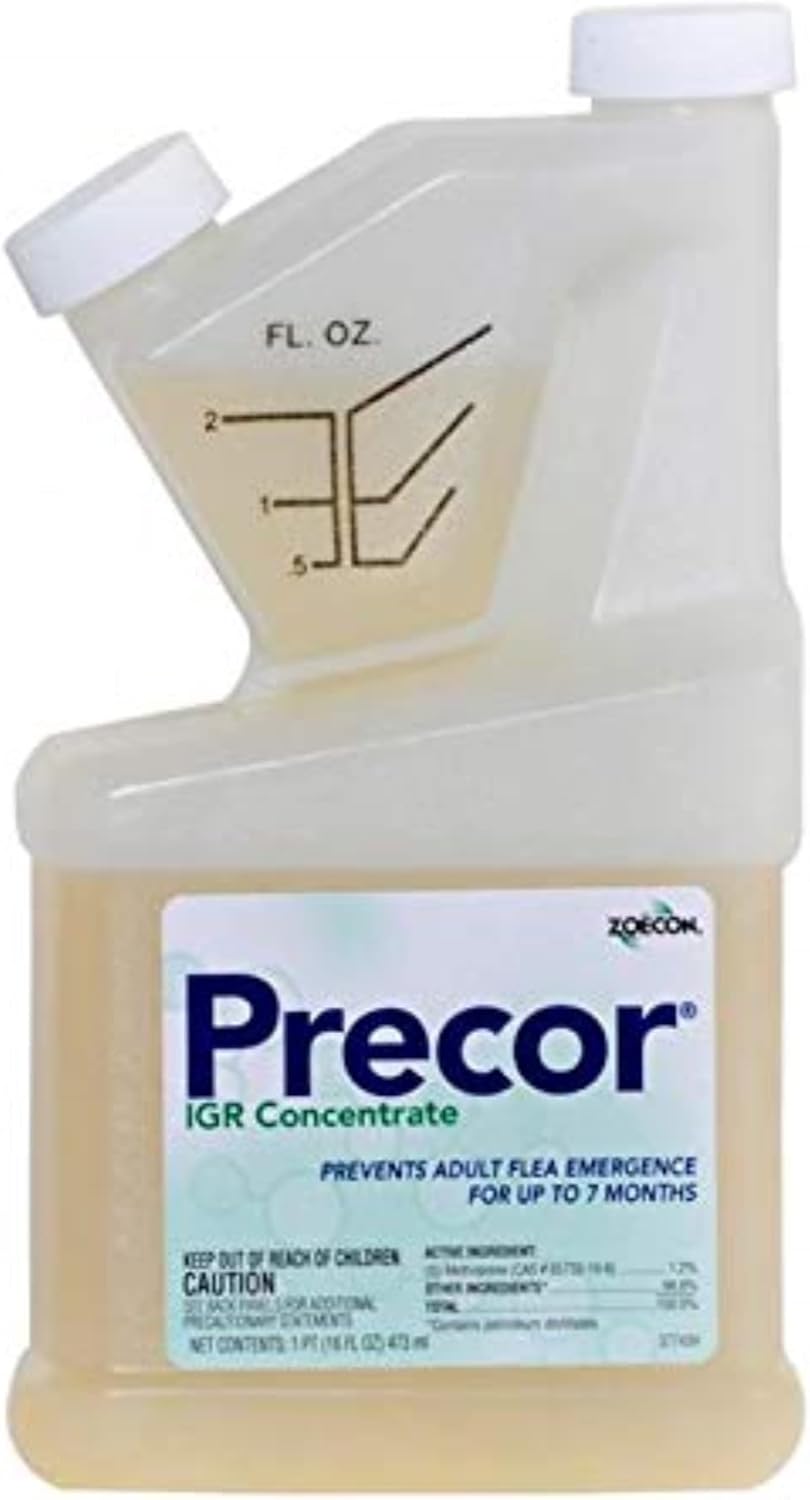
ZOECON Precor IGR Insect Growth Regulator, 16 fl oz
| Item Volume | 16 fluid ounces |
|---|---|
| Item Form | Liquid |
| Scent Name | Lemon |
| Material Features | Fragrance Free |
| Item Nype Name | Insect Growth Regulator |
ZOECON Precor IGR is a liquid concentrate that prevents flea eggs and larvae from developing, giving long-lasting indoor control when used as directed. You dilute 1 ounce per gallon and apply with a low-pressure fan-tip sprayer to treated surfaces such as carpets and upholstery; one 16 fl oz bottle treats large areas because the concentrate is designed to cover about 1500 sq ft per ounce of diluted mix. The product targets pre-adult fleas only and provides control for up to seven months provided carpets are not shampooed or steam cleaned. Notable features include a clear yellow, fragrance-free formulation and a three-year shelf life. Important limitations are that it is effective only against flea eggs and larvae, it is not effective on ticks, and pets should be kept off treated surfaces until they are fully dry. For someone chasing measurable, season-long reduction in household flea populations, the strength here is the concentrate’s persistence and coverage; users must follow dilution and indoor-use instructions and expect to combine this with adulticide or mechanical cleaning for full flea removal.
Best for: A homeowner or caretaker seeking a performance-focused, long-duration solution to break the flea life cycle indoors and willing to follow dilution and application guidelines.
Less Ideal for: People who need immediate adult flea knockdown, treatment for ticks, or an outdoor solution should look for different products.
- Concentrated formula that dilutes to treat large indoor areas
- Targets flea eggs and larvae for up to seven months when surfaces remain undisturbed
- Fragrance-free formulation and long three-year shelf life
- Clear directions for indoor application with standard low-pressure sprayers
- Does not kill adult fleas so a complementary adulticide or vacuuming is required
- Not effective on ticks and unsuitable for outdoor use in direct sun
Verdict: Choose this concentrated IGR when you want a long-lasting, indoor-focused way to stop flea eggs and larvae from developing across large treated areas.
Precor 2000 Plus Premise Spray Flea Control (16 oz)

| Unit Count | 16 Ounce |
|---|---|
| Item Form | Spray |
| Scent Name | Unscented |
| Target Species | Flea |
| Active Ingredients | Methoprene |
Precor 2000 Plus is a 16-ounce premise spray that combines a fast-acting pesticide with methoprene, an insect growth regulator, to interrupt the flea life cycle in indoor environments. It is applied to carpets, upholstery, and other flea harboring areas where the IGR penetrates fiber bases to target pre-adult stages while the spray knocks down adults. Typical use is spot or whole-room treatments after vacuuming, focusing on pet resting areas and floor edges. The unscented formula and aerosol delivery make application straightforward for a homeowner who wants a targeted indoor treatment without mixing concentrates. Important limitations are that it is a pesticide product requiring careful following of label directions and that a single can covers a limited area, so larger homes may need multiple cans or repeat applications. This product works best as part of an integrated program that includes vacuuming, treating pets with veterinarian-recommended products, and reapplying as directed to break the flea life cycle.
Best for: Homeowners who need a simple, indoor flea control product to treat carpets and furniture and who plan to combine it with cleaning and pet treatments to manage infestations.
Less Ideal for: People looking for an all-in-one solution for large properties or outdoor yard treatment should consider products specifically formulated for exterior use or larger coverage options.
- Contains methoprene IGR to stop flea development at the pre-adult stage
- Aerosol spray penetrates carpet and upholstery fibers where immature fleas live
- Unscented formula suitable for indoor use around living areas
- Ready-to-use can simplifies application with no mixing required
- Single 16 oz can provides limited coverage and may require multiple cans for larger homes
- Must be used according to pesticide label instructions and kept away from pets and occupants during application
Verdict: A convenient, unscented premise spray with methoprene IGR that targets fleas in carpets and upholstery as part of an indoor control plan.
Martin's I.G. Regulator, 4 oz

| Size | 4_Ounce |
|---|---|
| Target uses | coat |
| Photostability | up to 14 days |
| Intended locations | Indoor/Outdoor use |
Martin's I.G. Regulator is a compact insect growth regulator formulated to disrupt the immature stages of fleas and reduce future infestations. It is typically applied to carpets, furniture, animal quarters, kennels and poultry houses as part of a broader flea control plan. The product advertises photostability for up to 14 days and claims activity that helps prevent flea development for up to seven months when used correctly. In practice the small 4 oz bottle is easy to handle for spot treatments and treating tight areas around bedding and baseboards. Because it targets development rather than killing adults, expect slower visible results and plan to use it alongside an adulticide if immediate knockdown is needed. The plastic bottle and label directions make application straightforward, but the limited volume means you may need multiple bottles for whole-house or multi-animal facilities. Good for steady preventative use but not a standalone fast-acting solution.
Best for: Buyers who want an inexpensive, preventive product to suppress flea reproduction around pet areas and spot-treat problem zones without needing immediate adult flea knockdown.
Less Ideal for: People who need fast elimination of adult fleas across large homes or multi-pet facilities should consider a product that includes a fast-acting adulticide or larger-volume treatments.
- Specifically inhibits flea development to reduce future generations
- Photostable for up to 14 days, maintaining activity after application
- Suitable for indoor and outdoor use including kennels and furniture
- Small 4 oz bottle is easy to handle for spot treatments
- Targets immature stages only so it does not provide rapid adult flea knockdown
- 4 oz volume may require multiple bottles for whole-house or multi-animal applications
Verdict: A budget-friendly small-bottle IGR for preventive spot treatment that helps stop flea reproduction around pet areas.
Control Solutions Tekko Pro Insect Growth Regulator Concentrate, 16 fl oz

| Unit Count | 16 Fluid Ounces |
|---|---|
| Item Form | Liquid |
| Target Species | Insects |
Tekko Pro is a concentrate insect growth regulator designed to disrupt insect life cycles so juveniles fail to develop into reproductive adults. You dilute and apply it to indoor or outdoor sites where immature stages occur, such as carpets, furniture, kennels and poultry houses, or around flea harborage areas. The formula combines a juvenile hormone analog (pyriproxyfen) and a chitin synthesis inhibitor (novaluron), which together prevent molting and maturation and can help inhibit flea re-infestation for months when applied to appropriate surfaces. Practical benefits include long residual control of developing stages and broad activity against many stored-product and household pests. Important limitations are that it does not kill adult insects on contact and must be used as part of an integrated approach that includes adulticides or mechanical cleaning for immediate knockdown. As a concentrated liquid it requires careful dilution and correct application to be effective and safe.
Best for: People who prioritize dependable, long-term interruption of flea breeding and want a product to reduce re-infestation when used as part of a control plan.
Less Ideal for: Users who need a fast-acting, one-step kill of adult fleas or who are unwilling to follow dilution and application instructions.
- Contains two complementary active ingredients (pyriproxyfen and novaluron) that block development and molting
- Label allows indoor and outdoor use on carpets, furniture, kennels and poultry houses
- Concentrate format provides extended residual protection against re-infestation when applied correctly
- Broad-spectrum activity against many household and stored-product insect juveniles including fleas
- Does not provide immediate adult knockdown and should be paired with an adulticide for fast control
- Requires proper dilution and targeted application to be effective, increasing complexity for casual users
Verdict: Use Tekko Pro when you want reliable, long-lasting disruption of flea development as part of a multi-step control program.
Choosing the Right Insect Growth Regulator for Fleas: Key Factors to Consider
Residual Control Duration
How long an insect growth regulator remains active where flea eggs, larvae, and pupae occur directly affects how often you need to treat. Longer residual activity reduces the number of repeat applications but can also increase environmental exposure. Consider the labeled residual period and whether that duration fits your infestation level and tolerance for repeat treatments.
Residual performance can vary by surface and environmental conditions. Sunlight, heavy rain in outdoor use, and frequent vacuuming or cleaning indoors will shorten effective life. Choose a product whose expected duration matches the realities of the treated area so you are not under- or over-treating.
Application Method and Coverage
Insect growth regulators come as concentrates for sprayers, ready-to-use aerosols, or combined formulations with adulticides. The method influences how evenly you can treat carpets, pet bedding, baseboards, and yard margins. Concentrates and hose-end sprayers cover larger outdoor areas with less effort, while aerosols and pump sprays can target cracks and crevices indoors.
Think about the surfaces you need to reach and whether you have appropriate application equipment. Easy-to-measure mixes and clear dilution instructions reduce the risk of mistakes that lower effectiveness or increase safety hazards.
Safety Around Pets and People
Because flea hotspots are often where pets and people spend time, safety labeling and re-entry intervals are critical. Some regulators are designed to be low in acute toxicity but still require pets to avoid treated surfaces until dry. Check whether the product has explicit guidance for treating animal bedding, indoor carpets, or turf where pets roam.
Also consider sensitivities in households with young children, nursing animals, or wildlife. Look for products with clear, conservative re-entry and pet-contact instructions and follow them precisely to minimize exposure risks.
Surface Compatibility and Indoor Use
Different formulations interact with materials in different ways. Some liquids may stain fabrics or degrade finishes, while others are formulated to be safe on upholstery and carpeting. For outdoor use, compatibility with grass, ornamental beds, and mulch is important to avoid plant damage.
Assess the most common surfaces in your home and yard before choosing a product. A regulator that is safe for pet bedding and carpets may be the best choice for indoor infestations, while a turf-compatible concentrate is often better for perimeter treatments.
Environmental Persistence and Non-Target Impact
Consider how long the active ingredient persists in soil and on surfaces and whether that persistence might affect non-target insects such as beneficial predators or pollinators. Some regulators break down faster under sunlight or microbial action, reducing long-term exposure but also shortening effective control.
Match persistence characteristics to the treatment zone. For perimeter or foundation sprays, a longer-lived product may be acceptable. For flowering beds or areas frequented by pollinators, choose a product with lower non-target risk and follow label guidance to avoid application at bloom.
How Insect Growth Regulators Work in a Flea Life Cycle
Insect growth regulators interfere with normal development, preventing eggs and larvae from maturing into reproductive adults. They do not typically kill adult fleas on contact, so they are most effective when combined with adult-control measures during an infestation.
Understanding this mode of action helps set expectations. Expect a lag between treatment and visible reductions in adult flea numbers because the regulator is preventing new adults from emerging rather than immediately eliminating existing ones.
- Targets eggs, larvae, or molting processes rather than adult nervous systems
- Works over time to reduce reinfestation from hidden immature stages
- Best used as part of an integrated plan alongside vacuuming and adulticides when needed
Indoor Treatment Tips
Treat indoor hot spots such as carpets, under furniture, pet bedding, and along baseboards. Vacuum thoroughly before application to remove debris and expose eggs and larvae to the treated surface. After treatment, follow label re-entry and pet-contact directions until surfaces are dry.
When treating indoors, use lower-residue formulations designed for fabrics and floor coverings. Spot-treat rather than blanket-spraying where possible, and wash pet bedding separately after the contact interval indicated on the product label.
- Vacuum first to reduce pupae shielded by debris
- Treat pet sleeping areas and carpet edges where larvae feed
- Keep pets off treated areas until they are dry and within labeled timeframes
Perimeter and Yard Applications
For yard and perimeter use, focus on shady, humid locations where flea larvae thrive: under decks, around foundation edges, in leaf litter, and along fence lines. Use concentrates compatible with turf and ornamental plants, and avoid treating flowering plants to protect pollinators.
Apply to a band around the foundation and to pet run areas rather than indiscriminately treating the entire lawn. After rainfall, expect reduced residual activity and plan reapplication in line with the product's labeled persistence.
- Target shaded, moist areas where larvae develop
- Avoid treating open bloom to protect beneficial insects
- Reapply based on labeled residual time and after heavy rain
Combining Regulators with Other Control Methods
An effective flea program often combines an insect growth regulator with adulticides, mechanical cleaning, and pet-focused treatments. The regulator prevents the next generation while adult controls reduce current biting fleas, giving faster relief and longer-term suppression.
Coordinate timing so that adulticides reduce immediate pressure and the regulator addresses immature stages. Maintain regular vacuuming and laundering of pet linens to interrupt the flea life cycle and remove organic matter that supports larvae.
- Use adult-targeting sprays or spot treatments for immediate reduction
- Keep up housekeeping routines to remove larvae habitats
- Follow label intervals when rotating or combining products
Safety and Storage Best Practices
Store concentrates and mixed solutions in labeled containers away from children and pets. Keep products in their original packaging when possible so first-aid and dilution instructions are always available. Dispose of unused mixes per label directions rather than pouring them into garden soil or drains.
When applying, wear recommended protective clothing and avoid inhaling sprays. Rinse application equipment after use and prevent runoff into storm drains or ornamental ponds to minimize environmental impact.
- Store products securely and in original containers
- Follow personal protective equipment guidance on the label
- Prevent runoff and dispose of leftovers responsibly
How We Chose the Best Insect Growth Regulator for Fleas
We focused on products that specifically target flea development stages rather than only knocking down adults. Primary evaluation criteria included residual activity duration, formulation and application flexibility, pet and family safety labeling, environmental persistence and degradation, and compatibility with common yard and indoor surfaces. We also assessed ease of mixing and applying for typical homeowners, as well as whether a product is suitable for combined indoor and perimeter use. Excluded from consideration were treatments that only provide brief adulticide knockdown without any growth-regulating active ingredient, products intended strictly for livestock or agricultural mass-spray operations, and formulations that require specialized commercial equipment. The final list favors solutions that balance measurable residual control with practical application methods and clear safety guidance for home and garden settings.
FAQ
How long after treatment will I see fewer adult fleas?
You may not see a dramatic drop in adults immediately because regulators block development rather than killing adults. Expect gradual reductions over several weeks as existing adults die off and fewer new adults emerge.
Can I use an insect growth regulator directly on my pet?
Most insect growth regulators are not intended for direct application to animals unless specifically labeled for pet use. Use veterinary-approved products for on-animal treatments and follow a veterinarian's guidance when combining treatments.
Is it safe to apply these products around vegetable gardens or flower beds?
Many regulators are labeled for perimeter and turf use but may have restrictions for edible gardens or flowering plants. Avoid treating crops and open blooms and read label precautions regarding vegetable beds and pollinator exposure.
How often should I reapply a regulator outdoors after heavy rain?
Reapplication depends on the product's residual label and the intensity of rain. Heavy rain can shorten effective life, so plan to reassess treated zones and reapply according to label guidance when residual protection drops below the recommended interval.
Will using an insect growth regulator eliminate the need for vacuuming and cleaning?
No. Regulators work best when combined with cleaning. Vacuuming removes organic matter, eggs, and pupae shields and exposes immature stages to treated surfaces, improving overall control and speeding recovery from infestations.
Are insect growth regulators harmful to beneficial insects?
Some regulators can affect non-target arthropods, particularly those with similar development pathways. Minimize exposure to pollinators and beneficial predators by avoiding applications to open blooms and adhering to label guidance.
Final Verdict
When selecting an insect growth regulator for fleas, prioritize the right balance between residual control and safety for pets and people. Match the formulation and application method to where fleas are breeding in your home or yard, and integrate regulator use with vacuuming and adult flea control for faster relief. Accept that regulators are a long-term suppression tool rather than an instant fix. Choose a solution with the residual duration and surface compatibility that suit your situation, follow label directions carefully, and plan follow-up treatments based on the product's stated persistence to keep fleas from returning.
