

Note: This article contains affiliate links. If you click on these links and make a purchase, I may earn a small commission at no extra cost to you. This helps support my research and content. Read my full affiliate disclosure here.
A pest outbreak can turn a tidy lawn into patchy, stressed turf fast. Choosing the right insect killer for lawns matters because different products behave differently on turf, with tradeoffs in how quickly pests die, how long protection lasts, and how safe your grass and nearby plants remain. This guide covers six shortlisted options suitable for lawn use and explains the factors we evaluated, from application coverage to post-treatment care. Read on to understand how each type performs in real yard conditions so you can pick an approach that fits your maintenance style and turf needs.
Top Picks at a Glance
| Best Overall The best all-around choice for most situations | Ortho BugClear Lawn Insect Killer, 20 lb |  |
| Best Quality Built to a higher standard if you want something more solid | The Andersons DuoCide Lawn Insect Control Granules (18 lb) |  |
| Best Value The sweet spot between price and what you get | Ortho BugClear Lawn Insect Killer, 10 lb. granules |  |
| Best Budget The cheapest option that still gets the job done reliably | Spectracide Triazicide Insect Killer for Lawns & Landscapes, 32 oz |  |
| Highest Rated A top-rated pick with lots of positive feedback | Quali-Pro Bifenthrin I/T 7.9F Flowable Insecticide, 1 Gallon |  |
| Most Popular A crowd favorite that many people choose with confidence | Cutter Backyard Bug Control Spray Concentrate, 32 fl oz (2-Pack) |  |
Ortho BugClear Lawn Insect Killer, 20 lb

| Item Form | Granules |
|---|---|
| Target Species | Insects |
| Unit Count | 1 Count |
| Coverage | Up to 33,000 sq. ft. |
Ortho BugClear Lawn Insect Killer is a 20 lb granular treatment designed for broad application across lawns, ornamental beds, and around home perimeters to reduce ants, ticks, fleas, spiders, armyworms, grubs and other listed insects. You apply it with a broadcast spreader, then water it in to activate fast-acting contact control; the product claims knockdown in minutes for many pests and residual control up to six months for ants and three months for other insects. Its main benefit is coverage: one bag treats very large areas, which makes routine seasonal treatment straightforward for homeowners with medium to large yards. Practical use is simple but requires a compatible spreader and prompt watering after application to get the intended residual effect. Limitations to be aware of are the need to follow label directions for safe use around edible plants and that effectiveness varies by species (some ants are excluded) so it is not a one-size-fits-all solution for every pest problem. Treating proactively at first signs of activity yields the best results.
Best for: Homeowners who want a straightforward, season-long approach to protect medium to large lawns from common lawn pests and who prefer a granular product applied with a spreader.
Less Ideal for: People with very small yards who prefer spot treatments or those seeking a product that targets every ant species or specific hard-to-control pests should consider alternate formulations.
- Wide spectrum labeled for many common lawn pests including ants, ticks, fleas and grubs
- Large coverage per bag suitable for medium to large yards
- Granular form is easy to apply with standard broadcast spreaders
- Provides multi-month residual control for ants and shorter residual protection for other listed insects
- Requires a spreader and immediate watering-in to activate and get full residual performance
- Does not control all ant species listed as exclusions and performance can vary by pest
Verdict: A high-coverage granular insect killer that makes seasonal protection of medium to large lawns simple and efficient.
The Andersons DuoCide Lawn Insect Control Granules (18 lb)

| Item Form | Granule |
|---|---|
| Coverage | 9000 sq ft |
| Active Ingredients | bifenthrin |
| Unit Count | 288 Ounce |
The Andersons DuoCide is a granular lawn insect control product designed to kill pests both above and below the turf with a single application. You spread the DG granules evenly over the lawn and water them in so the active ingredients move into the soil and the turf surface, which targets grubs, ticks, fleas, fire ants, mole crickets and many other listed pests. The formula combines bifenthrin and carbaryl, giving broad-spectrum knockdown and residual activity that suits season-long problem control when applied according to label directions. The 18 lb bag covers up to 9,000 square feet, so it is practical for large yards and properties where professional‑level performance is the priority. Important limitations are that it contains professional insecticides and requires careful handling and protective gear, and it is not labeled for sale in California, so users must follow all safety and local-use restrictions. Expect effective, long-lasting pest reduction when used as directed and integrated with proper watering and turf care.
Best for: Buyers who prioritize professional-grade, broad-spectrum pest control for medium to large lawns and want a single application solution for both surface and soil pests.
Less Ideal for: Homeowners seeking organic or low-toxicity pest control, owners of very small or containerized lawns, or anyone unable to follow safety precautions for concentrated insecticides.
- Broad-spectrum control targeting more than 50 common lawn pests including grubs, ticks and fire ants
- Dual active ingredients (bifenthrin and carbaryl) for contact and soil activity
- DG granule formulation disperses quickly and is moved into the soil with watering
- Large coverage per bag suitable for up to 9,000 sq ft, good for large lawns
- Contains strong insecticides that require protective equipment and careful handling
- Not available for sale in California
Verdict: Choose DuoCide when you need a single, professional‑strength granular treatment that controls a wide range of lawn pests across a large yard.
Ortho BugClear Lawn Insect Killer, 10 lb. granules

| Unit Count | 160 Ounce |
|---|---|
| Item Form | Granules |
| Target Species | Insects |
Ortho BugClear Lawn Insect Killer is a granular lawn treatment designed to reduce ants, ticks, fleas, spiders, armyworms, grubs and other listed pests across lawns and landscape beds. You apply it with a broadcast spreader (Scotts or compatible), then water the treated area to activate the product. The granules start killing by contact within minutes for most pests and provide longer residual control—up to six months for many ant species and about three months for other listed insects. Practical features include easy broadcast application for medium to large yards and coverage up to roughly 16,500 sq ft per 10 lb. bag. Important limitations are that it excludes control of certain ant species and fire ants respond slower, and the product requires watering after application and a calm day to avoid drift. Also it is a general-use insecticide so careful placement is needed around edible plants and pollinator-attractive flowers according to label directions. For homeowners who want a straightforward, long-lasting granular solution, this handles broad seasonal lawn pest defense with standard spreader use.
Best for: Homeowners who prioritize efficient, low-effort protection for medium to large lawns and want a single granular product they can broadcast and forget for the season.
Less Ideal for: People who need targeted control of fire ants or specific ant species, or who prefer non-chemical or spot treatments for small yards or pollinator-focused beds.
- Broad-spectrum control for many common lawn pests including ants, ticks, fleas and grubs
- Long residual protection up to six months for many ants and about three months for other listed insects
- Designed for easy application with a Scotts or compatible broadcast spreader
- Covers a large area from a single 10 lb. bag (up to ~16,500 sq ft)
- Not effective against some ant species and slower against fire ants
- Requires watering-in after application and calm weather for safe, effective use
Verdict: A practical granular option for homeowners who want broad, long-lasting lawn insect control applied quickly with a spreader.
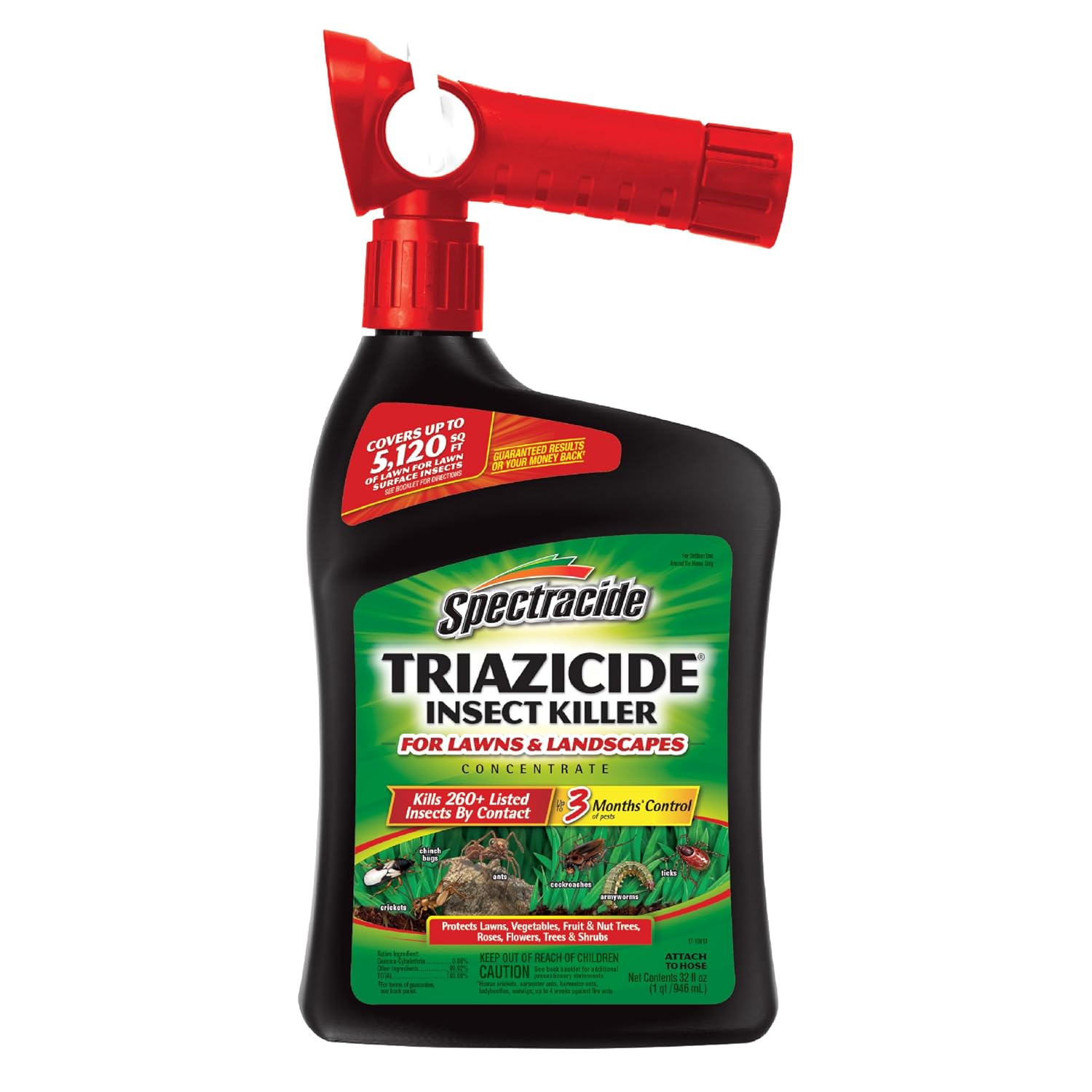
Spectracide Triazicide Insect Killer for Lawns & Landscapes, 32 oz
| Unit Count | 32 Ounce |
|---|---|
| Item Type Name | Lawn Insect Killer |
| Item Form | Spray |
| Target Species | Insects |
| Active Ingredients | Gamma-Cyhalothrin (0.08%) |
Spectracide Triazicide is a 32 oz concentrate designed to treat lawns, flower beds, shrubs, trees and edible gardens by mixing with water and applying with a tank or hose-end sprayer. The formula claims contact control of more than 260 insects including grubs, ants, fleas, deer ticks and Japanese beetles and can protect treated areas for up to three months when used as directed. It is offered as a ready-to-spray concentrate that covers large areas, with manufacturer guidance for specific mixes such as fire ant mound treatments. Practical benefits include wide-spectrum control above and below ground, compatibility with common sprayers and non-staining performance when applied correctly. Important limitations are safety and environmental concerns: it is highly toxic to fish and bees and requires careful application to avoid runoff and drift; follow label directions closely. For budget-minded gardeners this concentrate stretches to cover many square feet per bottle, but users must invest time in correct mixing, equipment and safety precautions.
Best for: Gardeners who need an economical, broad‑spectrum insect control for lawns and landscapes and are willing to follow label safety and mixing instructions to treat large areas efficiently.
Less Ideal for: People who prioritize organic or pollinator‑safe pest control methods or who lack the equipment or willingness to handle concentrated pesticides safely.
- Broad-spectrum concentrate that targets 260+ listed insects above and below ground
- Covers large treatment areas when mixed correctly, making it cost-effective per square foot
- Works by contact and can show results within 24 hours for many pests
- Can be used on lawns, vegetables, trees, shrubs, roses and flower beds
- Highly toxic to aquatic life and bees so it requires careful application and weather awareness
- Requires proper mixing and an external sprayer rather than a ready-to-use bottle
- Contains a synthetic pyrethroid active ingredient that may not be suitable for organic gardeners
Verdict: A concentrated, budget-friendly option for homeowners who need broad, fast insect control across lawns and landscape plants when applied responsibly.
Quali-Pro Bifenthrin I/T 7.9F Flowable Insecticide, 1 Gallon

| Item Form | Spray |
|---|---|
| Target Species | Termites, Carpenter Ants |
| Liquid Volume | 1 gallons |
| Active Ingredients | Bifenthrin |
Quali-Pro Bifenthrin I/T 7.9F is a concentrated flowable insecticide designed to provide long-lasting residual control of termites, carpenter ants and a wide range of turf and structural pests. It is mixed and applied as a spray over lawns, ornamentals or around structures and is compatible with many herbicides, fungicides and liquid fertilizers so it can be integrated into existing treatment programs. The formula is described as non-irritating with no odor and leaves no visible residue, which reduces concern about plant damage during routine landscape applications. Its broad label and reported university specification mean it is suitable for professional or serious home use where dependable, extended control is the priority. Important limitations are that it is a chemical insecticide requiring careful handling and adherence to label directions for safety and use rates, and it is not a targeted biological control so it will affect a broad range of arthropods rather than species-specific management.
Best for: Buyers who prioritize dependable, long-lasting pest control for lawns and landscape ornamentals and who plan to follow professional application practices.
Less Ideal for: Those seeking organic, species-specific or DIY low-toxicity solutions should consider alternatives better suited to minimal chemical use or targeted biological control.
- Long-lasting residual control effective against termites, carpenter ants and many turf pests
- Compatible with herbicides, fungicides, insecticides and liquid fertilizers for integrated applications
- Non-irritating, low-odor formula that dries with no visible residue
- Concentrated 1 gallon size suitable for treating larger lawn areas or multiple applications
- Requires strict adherence to label safety directions and protective equipment during mixing and application
- Broad-spectrum chemistry will impact non-target arthropods rather than offering species-specific control
Verdict: Choose this product when you need a proven, long-lasting chemical treatment to reliably suppress turf and structural pest infestations.
Cutter Backyard Bug Control Spray Concentrate, 32 fl oz (2-Pack)

| Unit Count | 64 Fluid Ounces |
|---|---|
| Item Form | Spray |
| Target Species | Insects |
| Active Ingredients | Lambda Cyhalothrin |
This Cutter Backyard Bug Control Spray Concentrate is a hose-end ready insecticide meant for treating lawns, trees, shrubs and other outdoor surfaces to reduce mosquitoes, ants, fleas and a variety of listed insects. You connect the included QuickFlip hose-end sprayer and walk the yard while spraying; the water mixes with the concentrate automatically so there is no measuring. The label claims up to 12 weeks of control for some pests and coverage of about 5,000 square feet per bottle, which makes it practical for medium to large yards. Notable features are the convenient hose-end nozzle and the active ingredient lambda-cyhalothrin, a synthetic pyrethroid that kills on contact. Practical benefits include easy application without measuring and thorough coverage when following the directions. Important limitations are that it must be kept away from children and pets until dry, stringently applied according to label instructions to protect waterways and non-targets, and it may require reapplication for high pest pressure or different pest types not listed on the label.
Best for: Buyers who want an easy-to-use, broad-spectrum lawn insect control they can apply themselves and who prioritize products with demonstrated customer acceptance and clear usage directions.
Less Ideal for: People who prefer organic or non-synthetic pest control methods or who need treatments safe for immediate use around pets, children, or aquatic habitats should consider other options.
- Hose-end QuickFlip sprayer for no-mess, no-measure application
- Claims up to 12 weeks control for certain listed pests, reducing treatment frequency
- Covers large areas up to 5,000 sq ft per bottle when applied as directed
- Effective active ingredient (lambda-cyhalothrin) that kills on contact
- Contains a synthetic pyrethroid so care is needed to avoid exposure to people, pets and aquatic life
- Must be applied strictly per label restrictions and cannot be used during rain or where runoff to water bodies can occur
Verdict: A convenient hose-end concentrate that delivers broad, long-lasting control for lawns and landscapes when applied according to label directions.
Choosing the Right Insect Killer for Lawns: Key Factors to Consider
Target Pest Spectrum
Different insect killers address different pest groups. Some are formulated to control root-feeding grubs, others excel on surface-feeding insects such as chinch bugs, sod webworms, or armyworms. Knowing which pests are causing damage on your lawn guides whether you need a systemic product that moves into plant tissue and roots, or a contact product that kills on touch.
Misidentifying the pest can lead to poor results and unnecessary applications. Inspect lawn damage patterns, look for larvae in the thatch and soil, and time treatment for the pest life stage the product targets to maximize effectiveness.
Coverage Rate and Application Method
Coverage determines how much area a given container will treat and how evenly the active ingredient is distributed. Granular products spread differently than liquid sprays; broadcast spreaders and drop spreaders deliver different uniformity. Liquid concentrates applied through hose-end sprayers or handheld pump sprayers can give finer control but require mixing and calibration.
Consider the size of your lawn and the precision you need. Large yards benefit from products with higher coverage per unit and equipment-compatible formulations. Small lawns or patch treatments can use smaller containers or spot-spray options for better economy and reduced waste.
Turf Safety and Timing
Some active ingredients can stress new seed, thin turf, or cause discoloration under heat stress. Turf safety varies by species, cultural condition, and weather at application. Apply during recommended temperature windows and avoid treating recently seeded areas unless the product label explicitly allows it.
Timing also affects efficacy. Many lawn pests are most vulnerable at specific life stages, so applying at the right time reduces retreatments and limits turf exposure. Follow label guidance on mowing and irrigation intervals after application to protect grass health.
Residual Protection and Repetition Needs
Residual protection measures how long a treated area remains defended against reinfestation. Products with long residual activity reduce the frequency of applications but may have greater non-target exposure. Short-residual contact products require more frequent spot treatments but may be preferable where minimizing environmental persistence is a priority.
Match residual expectations to your tolerance for repeated treatments and to the pest pressure in your area. Combining a one-time systemic application with good cultural practices can sometimes reduce long-term chemical use.
Environmental and Non-Target Considerations
Runoff, nearby water bodies, and pollinator presence influence product choice. Some treatments pose higher risks to beneficial insects or aquatic life if allowed to drift or wash away. Consider buffer zones, avoid treating flowering plants, and choose formulations or application timings that minimize exposure to bees and other pollinators.
Also account for local regulations and recommended best practices for responsible application near sensitive areas. Using targeted spot applications and mechanical controls where possible reduces non-target impact.
Compatibility With Lawn Care Practices
Your routine lawn care affects what product fits best. If you overseed or aerate in spring or fall, choose products compatible with those practices to avoid harming new seedlings. Consider irrigation scheduling since some products require watering-in while others advise against irrigation for a set period.
If you follow an organic or reduced-chemical program, look into low-toxicity or biological options that fit into integrated pest management. Equipment needs such as spreaders or sprayers also influence the practicality of a chosen product.
When To Treat and How To Scout
Inspecting the lawn regularly will let you catch pests early. Look for irregular browning, thinning grass, or patches that lift easily from the soil. Dig a small plug or rake through the thatch layer to find larvae or adults that indicate whether the problem is root feeding or surface activity.
- Check for loose turf and roots chewed near the soil for grub activity.
- Watch for small pale insects or stippling on blades with chinch bug infestations.
- Time scouting after warm, moist spells when many pests are most active.
Application Tools and Calibration
Getting dosage right is as important as picking the product. Use a calibrated spreader for granular materials and practice mixing and flow-rate checks for liquids. Many application errors come from over- or under-dosing when users rely on guesswork rather than measuring coverage and adjusting equipment settings.
- Calibrate spreaders on a test strip before treating the whole lawn.
- Mark the pattern lines for even coverage and avoid overlap or misses.
- Record coverage per container to estimate future needs more accurately.
Integrating Treatments With Cultural Controls
Chemical controls are most effective as part of a broader turf health plan. Improve drainage, maintain proper mowing height, and feed appropriately to reduce pest susceptibility. Healthy turf can tolerate some insect damage without long-term decline, so use treatments to bring pest levels below damaging thresholds rather than aiming for total eradication.
- Raise mowing height slightly during hot spells to reduce stress.
- Improve thatch management to reduce habitat for larvae.
- Rotate treatment types where appropriate to avoid overreliance on one mode of action.
Spot Treatments Vs Whole-Lawn Programs
Small infestations can often be handled with spot treatments, which reduce product use and non-target exposure. For widespread or persistent outbreaks, whole-lawn applications provide more consistent coverage and can be more efficient on a per-area basis. Choose the approach that matches the infestation pattern and your environmental priorities.
- Use a hose-end or handheld sprayer for targeted spots.
- Reserve broadcast applications for confirmed, widespread pest pressure.
- Combine spot treatment with monitoring to catch new outbreaks early.
Post-Application Lawn Care
After treating, follow label instructions for irrigation, mowing, and reentry intervals if applicable. Some products are more effective when watered in; others require a dry period. Mowing too soon after application can remove active residues or spread treated clippings around the lawn.
- Delay mowing for the period recommended on the product label where indicated.
- Adjust irrigation according to whether the product needs watering-in or drying time.
- Monitor treated areas over the weeks following application and re-treat only if threshold damage returns.
How We Chose the Best Insect Killer for Lawns
We started by focusing on products formulated or commonly used specifically for lawn turf, and excluded treatments designed only for ornamental beds, houseplants, or indoor use. Our editorial filters favored options that provide wide surface or root-zone coverage appropriate to common lawn pests such as grubs, chinch bugs, and surface-feeding caterpillars. We prioritized formulations and delivery methods that offer predictable coverage across typical yard sizes and that integrate with standard lawn care schedules. Key evaluation criteria included coverage and effective range, which matters for treating larger lawns without excessive overlap; turf safety and phytotoxicity risk under normal summer and spring conditions; residual protection duration to judge how often retreatment is needed; ease and precision of application, because consistent dosing affects results; and environmental exposure factors such as runoff risk and pollinator impact. We also noted compatibility with irrigation and seeding windows. Exclusions: products intended exclusively for hardscape cracks, indoor use, or for pest species that do not affect turf were not considered.
FAQ
How do I know if I have grubs or surface-feeding insects?
Look at the damage pattern. Grub damage often shows as irregular dead patches that can be lifted like a carpet because roots are eaten. Surface-feeding insects typically cause more uniform thinning, stippling, or visible small insect activity on blades. Digging into the soil and thatch reveals larvae for confirmation.
Can I apply insect killer right after seeding my lawn?
It depends on the product. Many insect killers can harm seedlings, so avoid treating newly seeded areas unless the label specifies compatibility. If you must protect new seed, choose products labeled safe for use around seedlings or delay treatment until the grass is well established.
Will irrigation reduce effectiveness of a granular insect killer?
Some granular products are designed to be watered in and require irrigation to activate. Others should remain dry for a period to allow turf uptake or to avoid runoff. Follow product directions on timing and amount of irrigation to preserve efficacy and limit environmental movement.
Are there low-toxicity options for treating lawn insects?
Yes, there are biological and reduced-toxicity formulations that target specific pests with lower non-target effects. These can be effective for light to moderate infestations and fit well into integrated pest management, though they may require more precise timing or repeated applications.
How often should I re-treat for recurring pests?
Re-treatment intervals vary by active ingredient and residual life. Some products protect turf for weeks, while contact treatments may last only days. Re-treat based on monitoring and visible damage thresholds, and follow label guidance on maximum seasonal application frequency.
Will treating for insects harm pollinators in my yard?
The risk to pollinators depends on product choice, application timing, and whether flowering plants are present. Avoid treating when flowers are in bloom and choose formulations with lower pollinator risk when possible. Targeted spot treatments reduce overall exposure compared with broadcast applications.
Final Verdict
Treating lawn pests effectively depends on correctly identifying the pest, matching the treatment type to that pest, and applying products in a way that protects turf health and the broader landscape. Prioritize turf-safe timing, proper calibration of application equipment, and an understanding of residual protection when choosing among options. Balance effectiveness with environmental considerations and your lawn care calendar. With clear scouting and a plan for spot or whole-lawn application based on infestation extent, you can restore turf vigor while minimizing unnecessary treatments.
