

Note: This article contains affiliate links. If you click on these links and make a purchase, I may earn a small commission at no extra cost to you. This helps support my research and content. Read my full affiliate disclosure here.
If lawn-feeding insects are leaving brown patches, thinning turf, or unwelcome tunnels, choosing the right grass insect killer makes the difference between a quick recovery and months of extra work. You want a product that controls the specific pest, acts quickly enough to stop damage, and limits stress on grass and soil biology. This guide presents seven shortlisted options that suit common lawn situations. We summarize how each product behaves in a real yard and evaluate them on practical performance factors like how fast they act and how safe they are for turf. Read on to see which type of treatment best fits your lawn's pest problem and management style.
Top Picks at a Glance
| Best Overall The best all-around choice for most situations | Ortho BugClear Lawn Insect Killer, 20 lb Granules |  |
| Best Quality Built to a higher standard if you want something more solid | The Andersons DuoCide Professional-Grade Lawn Insect Control (18 lb) |  |
| Best Value The sweet spot between price and what you get | Ortho BugClear Lawn Insect Killer, 10 lb. granules |  |
| Best Budget The cheapest option that still gets the job done reliably | Spectracide Triazicide Insect Killer Concentrate, 32 oz |  |
| Highest Rated A top-rated pick with lots of positive feedback | Ortho Orthene Fire Ant Killer, 14 oz |  |
| Most Popular A crowd favorite that many people choose with confidence | TERRO Ant Killer Plus Granules, 3 lb Shaker Bag |  |
| Best Seller A high-volume bestseller chosen again and again | Atticus Talak 7.9% Bifenthrin Indoor/Outdoor Insecticide Concentrate (32 oz) |  |
Ortho BugClear Lawn Insect Killer, 20 lb Granules

| Item Form | Granules |
|---|---|
| Target Species | Insects |
| Coverage | Up to 33,000 sq. ft. |
| Residual Control | Up to 6 months (ants); 3 months (other listed insects) |
Ortho BugClear Lawn Insect Killer is a granular treatment designed for broadcast application to lawns, ornamental beds, and around a home perimeter to knock down ants, spiders, ticks, fleas, armyworms, grubs, and other listed pests. You apply it with a compatible spreader (Scotts spreaders are recommended), then water the treated area to activate the product. The granules begin killing by contact within minutes for most pests and provide longer residual control—up to six months for many ants and about three months for other insects. The practical benefits are broad coverage for large yards and a proven brand formulation that works across common lawn pests, which simplifies seasonal maintenance for a typical homeowner. Important limitations are that a spreader is required for even distribution, some ant species are excluded from the six-month claim, and treated areas should be kept dry until granules are watered in and then allowed to dry before letting people or pets re-enter. This product is best used as part of a regular lawn care routine rather than as a one-off emergency fix for isolated problems.
Best for: Homeowners who want a single granular product to manage a variety of common lawn pests across medium to large yards and who prefer scheduled seasonal treatments as part of lawn care.
Less Ideal for: People who need an immediate spot treatment without a spreader or those managing only a small container or indoor garden where granular lawn products are unsuitable.
- Broad-spectrum control covering ants, ticks, fleas, grubs, armyworms and other common lawn pests
- Long residual protection up to 6 months against many ant species and 3 months for other listed insects
- Designed for use with broadcast spreaders for even coverage across large lawns
- Granule form allows treatment of lawns, ornamental beds, perimeter areas and listed vegetables
- Requires a compatible spreader and post-application watering to activate
- Does not provide the six-month claim for some ant species and excludes fire ants from fast action
Verdict: A reliable granular option for homeowners who want broad, long-lasting lawn pest control across large areas.
The Andersons DuoCide Professional-Grade Lawn Insect Control (18 lb)

| Item Form | Granule |
|---|---|
| Coverage | 9000 sq ft |
| Active Ingredients | bifenthrin |
| Unit Count | 288 Ounce |
DuoCide is a dual‑action granular insect control designed to eliminate both surface and soil pests across a large lawn area. You broadcast the granules evenly, water them in, and the DG granules disperse to move active ingredients into the soil while providing residual contact control above ground. The formula combines bifenthrin and carbaryl, which gives knockdown of surface insects like ticks, fleas, ants, and mole crickets as well as activity on grubs below the turf. Its 9,000 sq ft coverage from one 18 lb bag makes it practical for medium to large yards and reduces application frequency. Practical benefits include straightforward spread-and-water use, wide pest spectrum, and visible results when pests are active. Important limitations are that it is a chemical control requiring protective handling and adherence to label restrictions, it is not approved for sale in California, and it may not be appropriate near pollinator plantings or where a nonchemical approach is preferred.
Best for: Buyers who want a high‑performance, chemical solution to quickly reduce both surface and below‑ground lawn pests across medium to large yards and who prioritize fast, reliable results.
Less Ideal for: People managing pollinator‑focused lawns, seeking organic or nonchemical pest control, or who need a product approved for use in California should consider alternatives.
- Broad pest control spectrum including grubs, ticks, fleas, ants and mole crickets
- Dual active ingredients for both contact knockdown and soil activity
- Large 9,000 sq ft coverage per bag reduces reapplication frequency
- Contains professional‑grade insecticides that require protective handling and careful follow‑up watering
- Not labeled for sale in California
Verdict: Choose DuoCide when you need a powerful, single‑application granular treatment to rapidly cut both surface and soil lawn pests across a large yard.
Ortho BugClear Lawn Insect Killer, 10 lb. granules

| Unit Count | 160 Ounce |
|---|---|
| Item Form | Granules |
| Target Species | Insects |
Ortho BugClear Lawn Insect Killer is a granular treatment designed to protect lawns, ornamental beds and perimeter areas from ants, ticks, fleas, armyworms, grubs and other listed insects. You apply it with a broadcast spreader (Scotts-compatible) when you first notice insect activity, then water the treated area to activate the product. The formula starts killing on contact in minutes for most pests and offers longer residual control — up to six months for many ants and about three months for other listed insects. Practical features include a coverage claim that treats up to roughly 16,500 sq ft from the 10 lb. bag and straightforward timing guidance for spring and summer use. Limitations to keep in mind are that it excludes certain ant species and fire ants may not be controlled quickly, and it requires proper spreading and watering for full effectiveness. It is a DIY-friendly option when you want a broad, season-long defense across medium to large yards rather than spot treatments.
Best for: Buyers who want a single granular product to regularly protect medium to large yards and flower beds, and who prefer scheduled preventive treatments over frequent spot-spraying.
Less Ideal for: People seeking immediate knockdown of fire ant mounds or those who need an indoor-safe or non-chemical option should consider alternative targeted treatments or non-chemical controls.
- Fast contact action on most listed lawn pests
- Provides long residual control for ants up to six months
- Covers a large area from a single 10 lb. bag (up to 16,500 sq ft)
- Easy to apply with standard Scotts-compatible spreaders
- Does not control all ant species and is slower or limited against fire ants
- Requires watering-in after application to activate and achieve labeled control
Verdict: Choose this granular formula when you need broad, long-lasting lawn protection across a medium to large yard with simple spreader application.
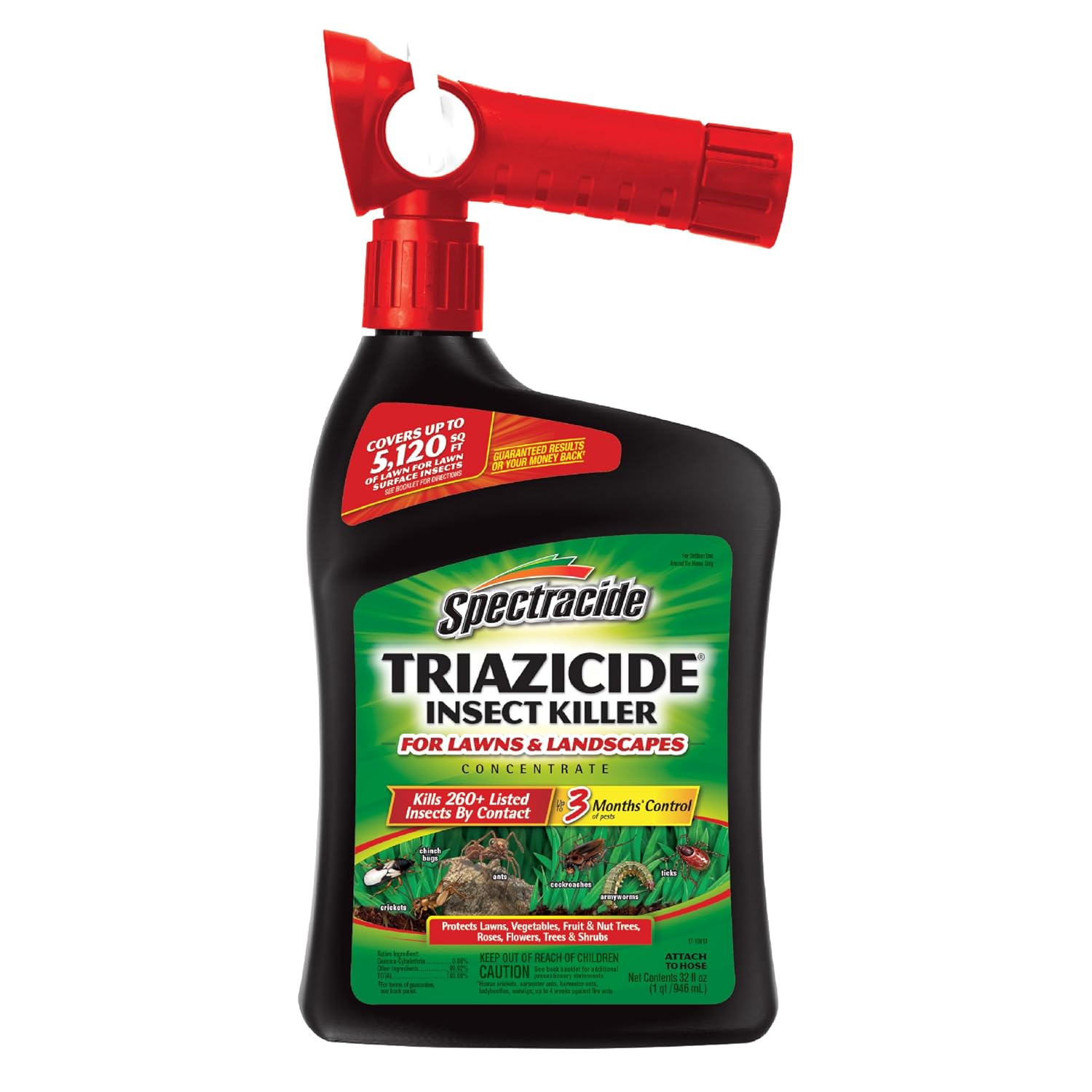
Spectracide Triazicide Insect Killer Concentrate, 32 oz
| Unit Count | 32 Ounce |
|---|---|
| Item Form | Spray concentrate |
| Target Species | Insects |
| Active Ingredients | Gamma-Cyhalothrin (0.08%) |
Spectracide Triazicide is a liquid concentrate designed to mix with water and apply with a tank or hose-end sprayer to treat lawns, garden beds, trees and shrubs. It targets more than 260 insects including grubs, ants, fleas, deer ticks and Japanese beetles and claims knockdown within 24 hours and residual protection lasting up to three months when used as directed. Typical use is diluting the concentrate to cover large areas or spot-treating problem zones such as fire ant mounds or perimeter beds; the label lists specific rates for surface pests and mound treatments. The practical benefits are wide-spectrum control, flexible application methods, and high coverage per bottle when mixed correctly. Important limitations are safety and environmental concerns: the formula is highly toxic to fish and bees and requires careful timing, drift avoidance and adherence to label directions; users should avoid applying near water or blooming plants. It is not a granular or systemic option, so repeated applications may be needed for long-term grub control and careful mixing is required for correct coverage.
Best for: Gardeners and homeowners who need an affordable, versatile concentrate to treat active insect problems across lawns and landscape beds and who are willing to follow label safety instructions.
Less Ideal for: People who need a pet-safe, bee-friendly, or water-adjacent solution or those who prefer granular or systemic grub controls for long-term soil protection.
- Broad-spectrum formula that lists control for over 260 insect species including surface and below-ground pests
- Concentrate mixes with water so one bottle can treat a large area when applied correctly
- Works quickly with reported knockdown in about 24 hours and residual control up to three months
- Can be applied with common equipment (tank sprayer or hose-end) and includes specific rates for fire ant mound treatment
- Highly toxic to aquatic life and bees so it requires careful application timing and buffers from water and blooming plants
- Not systemic so may not provide long-term protection of roots without repeat treatments
Verdict: A budget-friendly, high-coverage concentrate that delivers fast, broad-spectrum control for lawns and landscapes when applied responsibly.
Ortho Orthene Fire Ant Killer, 14 oz

| Item Form | Powder |
|---|---|
| Target Species | Ants |
| Active Ingredients | Acephate (50%); Other / Inert ingredients (50%) |
| Unit Count | 1 Count |
Ortho Orthene Fire Ant Killer is a shaker‑style powder formulated to kill fire ants at the mound by targeting workers and the queen. You apply it by sprinkling the dry granules directly onto active mounds while ants are foraging, then leaving the mound undisturbed and dry so the product moves through the colony. The formula begins eliminating ants in about 60 minutes and typically destroys the colony within 3 to 7 days when applied per label instructions. Notable features include a ready‑to‑use powder form with no mixing or watering required and enough product in a 14 oz bottle to treat many mounds. Practical benefits are quick visible reduction of mound activity and a simple one‑person application that suits routine yard maintenance. Important limitations are typical of spot mound treatments: it is designed for killing existing mounds rather than providing broad, long‑term yard protection, and safety precautions are required because the active ingredient can irritate eyes and is harmful if inhaled or swallowed.
Best for: Homeowners who need a reliable, quick solution to eliminate active fire ant mounds and prefer a simple, no‑mix spot treatment they can apply themselves.
Less Ideal for: Users seeking extended yardwide protection or a nonchemical approach should consider broadcast prevention products or alternative methods instead.
- Starts killing fire ants within about 60 minutes for fast visible results
- Powder form requires no mixing or watering for straightforward application
- Formulation targets the queen to destroy the entire colony
- One 14 oz bottle can treat a large number of individual mounds
- Designed for spot treatment of existing mounds and not for long‑term lawnwide prevention
- Contains an active insecticide that requires careful handling and adherence to safety instructions
Verdict: Choose this product when you want a dependable, fast spot treatment to kill active fire ant mounds and eliminate the queen with minimal fuss.
TERRO Ant Killer Plus Granules, 3 lb Shaker Bag

| Item Form | Granules |
|---|---|
| Target Species | Insects |
| Active Ingredients | Lambda-cyhalothri (0.04%) |
| Specification Met | Epa Standards |
TERRO Ant Killer Plus is a ready-to-use granular insecticide designed for outdoor use on lawns, around foundations, and as a spot treatment on ant hills and fire ant mounds. The resealable shaker bag makes it simple to broadcast a 3 to 10 foot perimeter band or to apply measured amounts directly to mounds without a spreader. The formula contains a low percentage of lambda-cyhalothrin and claims knockdown within 24 hours plus residual activity, so you can expect quick reduction of visible ants and other listed pests followed by ongoing control. Directions call for light watering after application to activate the granules, and specific instructions are provided for regular ant hills versus fire ant mounds. Important considerations are the outdoor-only use and proximity restrictions near water and sensitive habitats, and users must follow label limits on annual application rates. For homeowners who want a straightforward perimeter or mound treatment that produces fast visible results, this product is an effective, easy-to-apply option, but care around water and strict adherence to the label are necessary.
Best for: Homeowners who want a simple, fast-acting outdoor treatment to reduce ants and common lawn insects and who will follow label directions and safety precautions.
Less Ideal for: People managing sensitive aquatic-edge lawns, those growing edible crops, or buyers preferring non-chemical or organic pest control methods.
- Fast-acting granules that claim insect knockdown within 24 hours
- Resealable shaker bag lets you apply perimeter bands or spot treatments without a spreader
- Works on a range of listed pests including ants, fire ants, roaches, fleas, and earwigs
- Provides residual control after application when watered in as directed
- Contains a synthetic pyrethroid active ingredient that requires careful handling and label compliance
- Not safe for use near aquatic habitats or on edible crops
Verdict: A straightforward, easy-to-apply granular option for homeowners who need fast, residual outdoor control of ants and other common lawn insects.
Atticus Talak 7.9% Bifenthrin Indoor/Outdoor Insecticide Concentrate (32 oz)

| Active ingredient | Bifenthrin |
|---|---|
| Formulation | Suspension concentrate |
| Liquid volume | 32 fluid ounces |
| Target species | Insects |
| Length of control | Up to three months |
Talak 7.9% is a concentrated liquid insecticide that mixes with water to treat lawns, landscapes, outdoor surfaces and indoor perimeter areas. It contains 7.9% bifenthrin and is labeled to control more than 75 pests including ants, ticks, mosquitoes, grubs and many common turf and landscape insects. Typical use is dilution into a pump sprayer or hose‑end sprayer at rates on the label, with one gallon of mixed solution covering roughly 1,000 sq ft at recommended rates for lawn and turf. The formula is water‑based, dries clear, leaves no odor or residue, and is designed to be safe around plants when applied as directed. Notable benefits are long residual control of up to three months and flexible use indoors and outdoors, including mound drenches for fire ants. Important limitations are that it is a professional‑strength pesticide that requires careful handling and strict adherence to label directions, it cannot be used in foggers, and mixed solutions should not be stored for reuse. It is also restricted in a few states so check label restrictions before purchase.
Best for: Homeowners who want a proven, long‑lasting lawn and perimeter insect control solution and who are comfortable following label directions and safety precautions.
Less Ideal for: Gardeners seeking organic, non‑chemical pest control or users who prefer ready‑to‑use sprays rather than a concentrate and mixing step.
- Broad-spectrum control of 75+ indoor and outdoor insect species including mosquitoes, ants, ticks and mites
- Long residual activity up to three months per label when applied at recommended rates
- Water-based formula that dilutes easily, dries clear and leaves no odor or visible residue
- Versatile for lawns, landscapes, perimeter sprays and indoor crack-and-crevice applications
- Concentrate requires correct dilution and handling; mixed solution cannot be stored for later use
- Not approved for use in foggers and has state restrictions in Connecticut, New York and Vermont
Verdict: Choose Talak 7.9% if you need a flexible, water‑based concentrate that delivers broad, long‑lasting control of common grass and landscape insects.
Choosing the Right Grass Insect Killer: Key Factors to Consider
Target Pest Identification
Knowing which insect is damaging your lawn is the single most important starting point. Different pests-grubs, chinch bugs, sod webworms, armyworms, or surface-feeding beetles-behave and feed differently, and a product effective against one may be ineffective against another.
Misidentifying the pest leads to wasted treatments and prolonged damage. Inspect turf for signs such as brown patch patterns, pulled-up grass with intact roots, dried-out grass blades, or visible larvae at night. Also consider seasonal timing because many turf insects peak at predictable times of year; matching treatment timing to pest life stage improves control and reduces unnecessary applications.
Speed Of Control And Visible Results
How quickly a treatment reduces insect activity matters when damage is ongoing. Fast knockdown is important for stopping active feeding and limiting patch expansion, especially for surface-feeding pests that can defoliate turf quickly.
Some products give near-immediate reduction in visible insects, while others require uptake or depend on pests ingesting treated grass over several days. Faster action is useful for emergency responses, but you should balance that with turf safety and residual needs. For healing and reseeding plans, quicker knockdown often shortens the window before you can repair damaged areas.
Turf Safety And Phytotoxicity Risk
Any chemical or biological treatment interacts with grass physiology, and some formulations can stress or scorch sensitive turfgrass under hot, sunny, or drought conditions. Turf safety depends on label directions, active ingredient concentration, application rate, and environmental conditions at the time of application.
Consider grass species tolerance, recent cultural practices like fertilization, and whether you will be seeding or aerating soon. Choosing a product with low phytotoxicity for your grass type reduces the risk of trading insect damage for chemical injury. Always follow label temperature and watering guidance to minimize risk.
Application Method And User Safety
Application format-granular spreader, liquid hose-end sprayer, concentrate for tank mixing, or ready-to-use trigger spray-affects both effectiveness and user convenience. Granules often provide longer residual control with simpler equipment, while sprays can give quicker coverage and contact kill.
User safety considerations include personal protective equipment recommendations, re-entry intervals for children and pets, and drift risk. If you are uncomfortable mixing or handling concentrated liquids, choose pre-measured or ready-to-use options. Application precision matters in small yards and near ornamental beds to avoid non-target exposure.
Residual Protection And Reapplication Frequency
Some treatments provide only short-term protection and require frequent reapplication, while others leave a longer residual that limits reinfestation. Residual duration affects maintenance workload and cost over a season and plays into timing for overseeding and irrigation.
Longer residuals can reduce the number of applications needed, but they may also have greater impacts on beneficial organisms. Match the residual profile to your pest pressure and lawn management plan. For example, if grubs are a predictable annual problem, a longer residual product timed to larvae emergence can be more effective than repeated short-acting spot treatments.
Compatibility With Lawn Care Activities
Think about how the treatment fits into your regular schedule. Some products require withholding mowing, irrigation, or rainfall for a period after application to be effective. Others may interfere with seeding or organic matter incorporation.
If you plan aeration, overseeding, or fertilizer application, coordinate those activities with the product label intervals. Compatibility also includes whether the treatment can be used near ornamentals, vegetable beds, or waterways. Choosing a product that integrates smoothly with your cultural practices reduces unintended setbacks.
Common Lawn Pests And How They Damage Turf
Different insect pests leave diagnostic signs. Grubs feeding below the surface often cause irregular brown patches that lift easily because roots are eaten, while surface feeders create thinning, chewed blades, or frass. Recognizing the damage pattern helps narrow treatments and timing.
- Grubs: root feeding, turf lifts when pulled
- Chinch bugs: yellowing and uniform browning in sunny areas
- Sod webworms and cutworms: irregular holes and night-time feeding
- Armyworms: rapid striping and defoliation over large areas
Timing Treatments For Life Stage Effectiveness
Treating at the pest life stage that is most vulnerable increases success. For example, young larvae are typically easier to control than mature larvae. Some products target adults or provide systemic protection that must be applied before egg hatch. Check seasonal activity charts for the pests common in your region and time treatments accordingly.
- Apply systemic products before heavy larval feeding begins
- Spot-treat visible outbreaks immediately for surface feeders
- Use preventive residuals timed to expected grub hatch windows
Safe Application Practices For Home Lawns
Follow label directions precisely to protect grass, beneficial insects, pets, and people. Calibrate spreaders and sprayers so you do not overapply. Avoid treating during high heat or drought unless the product label permits it, and consider watering instructions that activate or fix the treatment in the turf without increasing runoff risk.
- Wear recommended personal protective equipment
- Keep children and pets off treated areas for the labeled re-entry interval
- Avoid treating just before heavy rain to prevent runoff
Nonchemical Options And Integrated Approaches
While chemical or biological insecticides are often necessary for severe outbreaks, cultural and mechanical methods reduce reliance on treatments. Improving turf vigor through proper mowing, irrigation, and fertility makes grass less susceptible to insect damage. Biological controls and beneficial nematodes can suppress certain soil-dwelling pests without chemical residues.
- Maintain appropriate mowing height and avoid scalping
- Improve soil drainage and organic matter to support root health
- Consider targeted biological agents for soil pests
How We Chose the Best Grass Insect Killer
To compile this list we focused on treatments and formulations that are realistic options for homeowners and groundskeepers managing lawn-feeding insects. We prioritized products that demonstrably control the insects commonly responsible for turf decline, while also considering how treatments affect grass health and routine lawn care. Evaluation rested on several concrete criteria: how quickly the product reduces active insect populations, the breadth of pests controlled, the potential for turf injury or scorch, handling and application ease, and how the product interacts with mowing, irrigation, and overseeding schedules. We also considered residual activity and reapplication intervals, since long gaps of protection matter for many yards. We excluded experimental compounds, products intended only for ornamental beds, and formulations unsuitable for turf use. We filtered out options that require specialized licensing or professional-only application. The final selections are practical, lawn-appropriate choices that reflect common gardener priorities and constraints.
FAQ
How can I tell if my lawn has grubs or a surface-feeding insect?
Grub damage usually shows as irregular brown patches that peel up like sod because roots are eaten. Surface-feeders cause chewed blades, thinning, or visible frass. Inspect soil by cutting a small square of turf to check for larvae and note when and where damage appears.
When is the best time to apply a grub-control treatment?
Timing depends on the local lifecycle of the target species, but the most effective window is often when eggs have hatched and larvae are small and actively feeding. For many regions that is late summer to early fall. Check regional pest calendars for precise timing.
Will treatments harm earthworms and beneficial insects?
Some broad-spectrum treatments can reduce non-target insects, including beneficials and soil organisms. Choosing targeted products, following label rates, and applying only where necessary reduces non-target impacts. Biological options and spot treatments are gentler on beneficial populations.
Can I overseed or aerate shortly after applying an insect control?
It depends on the product. Some treatments allow seeding or aeration after a short interval, while others require waiting for a label-specified period. Plan cultural work around the product's reapplication and activity windows to avoid seedling damage.
Are granular applications better than sprays for lawns?
Granules often give longer residual control with less drift and simpler equipment, while sprays can provide faster contact kill and more uniform coverage. The best choice depends on the pest, yard size, and your comfort with mixing and applying liquids.
Final Verdict
Choose a grass insect killer by matching the active control profile to the pest and timing treatments for the most vulnerable life stages. Prioritize turf-safe formulations and application methods that fit your mowing, seeding, and irrigation schedule to avoid causing extra stress to the lawn. Focus on speed of knockdown when active feeding is damaging turf, and prefer longer residuals or preventive timing for predictable seasonal pests. With clear pest ID and attention to turf safety, you can restore lawn vigor while minimizing reapplications and non-target impacts.
