

Note: This article contains affiliate links. If you click on these links and make a purchase, I may earn a small commission at no extra cost to you. This helps support my research and content. Read my full affiliate disclosure here.
Picking the right insect control for an outdoor yard changes how you manage pests around turf, flower beds, patios, and play areas. The right product gives quick knockdown for nuisance pests and provides enough residual protection so you do not need to reapply every few days. You also need to consider safety around pets and pollinators, the treated area size, and whether the product works for both perimeter and landscape spots. This guide covers the top shortlisted insect killers for yards and explains why each type made the list. We evaluate coverage, residual protection, ease of application, and safety considerations to help you choose the best fit for your outdoor space.
Top Picks at a Glance
| Best Overall The best all-around choice for most situations | Ortho Home Defense Insect Killer for Lawn & Landscape Ready-to-Spray, 32 fl oz |  |
| Best Quality Built to a higher standard if you want something more solid | Atticus Talak 7.9% Indoor/Outdoor Bifenthrin Insecticide Concentrate (1 gal) |  |
| Best Value The sweet spot between price and what you get | Ortho BugClear Lawn Insect Killer, 20 lb |  |
| Best Budget The cheapest option that still gets the job done reliably | Spectracide Triazicide Insect Killer Concentrate, 32 oz |  |
| Highest Rated A top-rated pick with lots of positive feedback | Talstar One Insecticide Concentrate, 1 Gallon |  |
| Best Seller A high-volume bestseller chosen again and again | Ortho Home Defense Insect Killer for Indoor & Perimeter, 1.33 gal. with Comfort Wand |  |
Ortho Home Defense Insect Killer for Lawn & Landscape Ready-to-Spray, 32 fl oz

| Item Form | Spray |
|---|---|
| Liquid Volume | 32 fluid ounces |
| Target Species | Dog |
Ortho Home Defense is a hose-end ready-to-spray insect killer designed to treat lawns, home perimeters, and landscape plants without mixing. You attach the bottle to a garden hose, turn on the water and flip the lever to apply an even spray across turf, foundations, shrubs and ornamentals. The formula claims quick knockdown of many common pests and provides residual prevention against ants, fleas, spiders (excluding black widow) and American dog ticks for up to three months, which reduces how often you need to reapply. Coverage figures are clear: one 32 fl oz bottle treats up to 5,300 sq ft of lawn or 2,700 sq ft of foliage. Practical conveniences include a nonstaining, low-odor formula and fast visible results. Important limits to note are standard pesticide precautions — keep people and pets off treated areas until dry and wear protective clothing — and that this product is intended for outdoor perimeter and landscape use only, not for indoor use or for pests excluded from the label. For homeowners wanting an easy-to-use, broad-spectrum yard treatment, this simplifies seasonal pest control.
Best for: Homeowners who want a straightforward, low-effort solution to reduce common yard pests and protect lawns and landscape plantings across a single season.
Less Ideal for: People who need indoor pest control, need targeted treatment for excluded species, or who prefer non-chemical or organic pest management approaches.
- Ready-to-spray hose-end applicator makes application fast and eliminates measuring or mixing
- Broad spectrum label that targets around 235 listed outdoor pests and provides up to three months of residual protection for several common species
- Clear coverage estimates allow planning for yards, foundations, and foliage from a single 32 fl oz bottle
- Nonstaining and low-odor formula suitable for treating ornamental beds and around homes
- Requires access to a garden hose and cannot be used where hose hookup is impractical
- Not intended for indoor use and excludes some species such as black widow spiders
Verdict: A simple, hose-end-ready insecticide that gives broad, season-long yard protection with minimal effort.
Atticus Talak 7.9% Indoor/Outdoor Bifenthrin Insecticide Concentrate (1 gal)

| Active Ingredients | Bifenthrin |
|---|---|
| Unit Count | 128 Fluid Ounces |
| Formulation | Suspension Concentrate |
| Length of Control | Up to three months |
Talak 7.9% is a water-based bifenthrin concentrate intended for broad-spectrum insect control around lawns, landscapes, and living areas. You mix the concentrate with water and apply with a pump or hose sprayer to treat turf, shrubs, trees, foundation perimeters, patios, baseboards, and other surfaces. The formula targets more than 75 pests including ants, ticks, mosquitoes, roaches, spiders, and mites, and the label states a residual effect that can last up to three months. Practical benefits include a clear-drying, odor-free mix that the manufacturer says will not cause phytotoxicity to plants and allows pets to re-enter once treated areas are dry. The product offers flexible dilution rates for lawn, landscape, surface barrier, and mosquito treatments, and the bottle has pour markings to help measure small amounts. Important limitations are that mixed solutions should be used the same day and cannot be applied with foggers, and users must follow label directions for safe indoor and food-handling area use. This is a performance-focused option for seasonal perimeter and landscape pest control when a long-lasting residual is desired.
Best for: Buyers who prioritize strong, long-lasting insect control for yards and perimeter defenses and want a single concentrate they can dilute for multiple outdoor and indoor tasks.
Less Ideal for: People who need a ready-to-use aerosol or fogger solution or who prefer products that can be premixed and stored for later use.
- Broad-spectrum control listed for 75+ common indoor and outdoor pests.
- Long residual activity up to three months per application.
- Water-based formula that dries clear and is odor-free and non-phytotoxic to plants.
- Flexible dilution rates for turf, landscapes, and perimeter treatments making it adaptable to different tasks.
- Mixed spray cannot be stored and must be used the same day.
- Not approved for fogger application which limits some application methods.
Verdict: Choose Talak 7.9% when you want a single, high-performance concentrate that delivers broad-spectrum, long-lasting perimeter and landscape pest control.
Ortho BugClear Lawn Insect Killer, 20 lb

| Item Form | Granules |
|---|---|
| Target Species | Insects |
| Coverage | Up to 33,000 sq. ft. |
| Residual Control | Up to 6 months (ants); 3 months (other listed insects) |
Ortho BugClear Lawn Insect Killer is a ready-to-use granular product for broad yard and landscape pest control. It is applied with a broadcast spreader and then watered in to activate, which makes it straightforward for typical DIY lawn care routines. The formula begins killing many listed pests on contact and offers residual control up to six months for ants and about three months for other listed insects, so one application can cover an entire season in many areas. It is labeled for use on lawns, ornamental plants, around the home perimeter, flower beds, and certain outdoor vegetables, giving flexible placement for whole-yard protection. Practical advantages include large coverage per bag and compatibility with standard spreaders. Important limitations are that it does not control every ant species and it requires correct application rate and immediate watering to achieve labeled results; it is a chemical control so follow label safety precautions around children, pets, and edible crops. For gardeners who want a straightforward granular option to reduce common lawn pests, this product performs as advertised when used as directed.
Best for: Buyers who want a practical, one-application seasonal solution to reduce common lawn and perimeter insects and who prefer granular products they can apply themselves.
Less Ideal for: People seeking organic or non-chemical pest control methods or those who need a product specifically for immediate fire ant mound treatment should consider alternatives.
- Broad list of target pests including ants, ticks, fleas, armyworms and grubs
- Long residual control up to 6 months for ants and about 3 months for other listed insects
- Easy to apply with a standard broadcast spreader and activated by watering in
- Large coverage from a single 20 lb. bag suitable for extensive yards
- Does not control some ant species listed on the label and not effective against fire ants for rapid mound knockdown
- Requires correct spreader settings and immediate watering to reach full effectiveness
Verdict: A no-fuss granular solution for DIY gardeners who want broad, season-long control of common lawn pests with a single application.
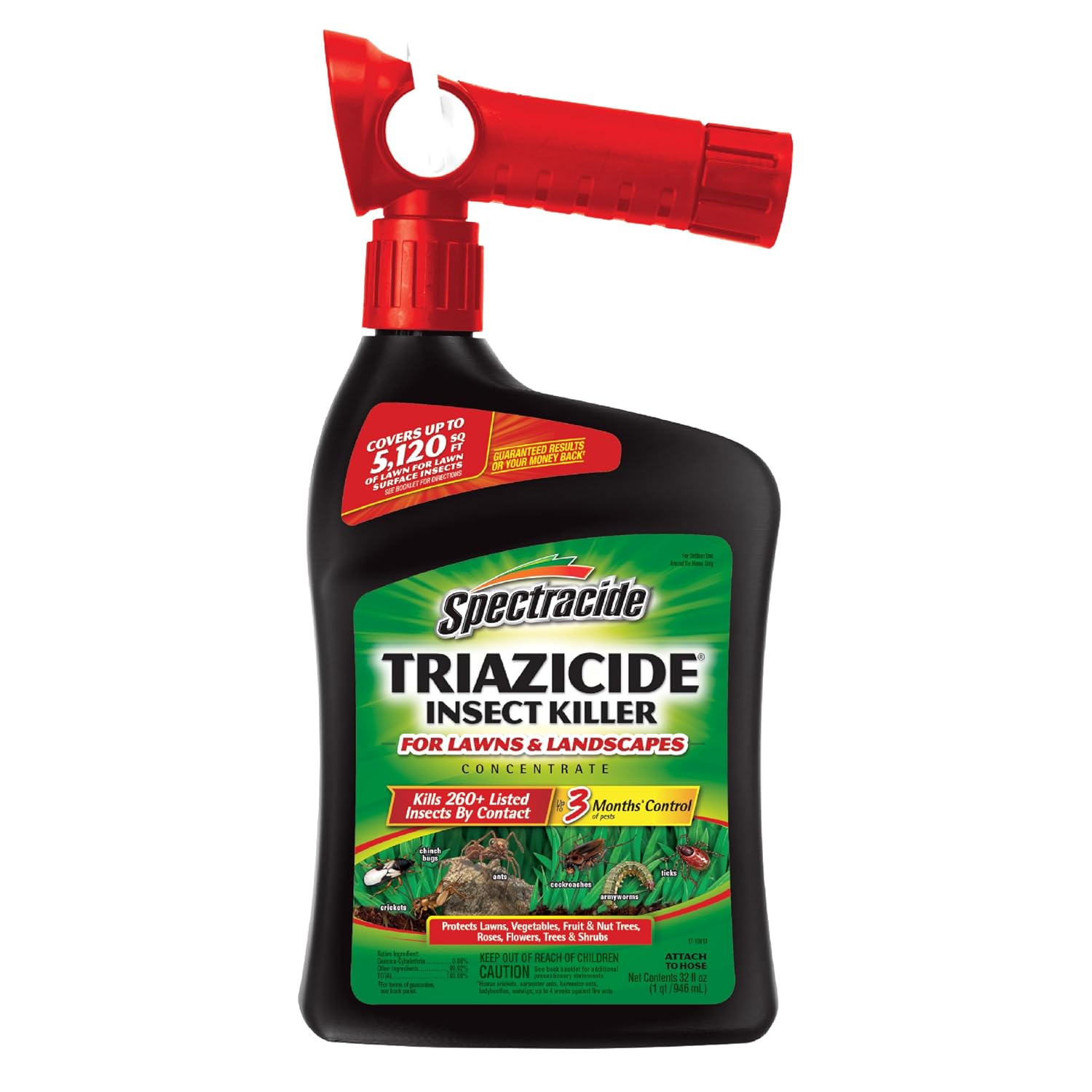
Spectracide Triazicide Insect Killer Concentrate, 32 oz
| Unit Count | 32 Ounce |
|---|---|
| Item Type Name | Lawn Insect Killer |
| Item Form | Spray |
| Active Ingredients | Gamma-Cyhalothrin (0.08%) |
| Target Species | Insects |
Spectracide Triazicide is a liquid concentrate designed to control more than 260 listed insects across lawns, flower beds, shrubs and around trees and vegetables. You mix the concentrate with water and apply with a tank or hose-end sprayer to treat surface pests like ants, fleas, ticks and Japanese beetles and to target soil pests such as grubs. The formula contains gamma-cyhalothrin (0.08%) and is fast acting, with many users seeing activity within 24 hours and residual control up to about three months when used as directed. Practical benefits include broad-spectrum control, flexible application (tank or hose-end), and coverage sufficient for several thousand square feet from a single bottle when diluted to label rates. Important limitations are its toxicity to fish and bees so it must not be applied near water or blooming plants, and standard safety precautions are required for handling and application. This product is most useful when strategically applied before pest populations spike and where non-target exposure can be managed.
Best for: Homeowners who need an economical, broad-spectrum solution for yard and landscape pests and are comfortable mixing and applying a concentrate product responsibly.
Less Ideal for: People with small container gardens, lawns adjacent to ponds or waterways, or those who prefer ready-to-use, low-toxicity alternatives should consider other options.
- Broad-spectrum control listed for 260+ insects including fleas, ticks, grubs and Japanese beetles
- Concentrate formula lets you treat large areas with one bottle when mixed to label rates
- Fast knockdown with residual protection up to roughly three months when applied correctly
- Highly toxic to aquatic life and bees so it requires careful avoidance of water bodies and blooming plants
- Requires mixing and appropriate protective handling rather than being ready-to-use
Verdict: A cost-effective concentrate that delivers fast, wide-ranging insect control for yards when used with proper precautions.
Talstar One Insecticide Concentrate, 1 Gallon

| Active ingredient | Bifenthrin 7.9% |
|---|---|
| Formulation | Concentrate, water-based |
| Use | Indoor and outdoor perimeter and structural applications |
Talstar One is a professional-style bifenthrin concentrate intended for broad-spectrum control of ants, spiders, roaches, fleas, ticks, mosquitoes and many other listed pests around homes and yards. You mix the concentrate with water and apply it as a perimeter barrier on foundations, doors and eaves or use spot treatments indoors for cracks and crevices. The formulation is water-based, low-odor and clears when dry, so treated patios and entryways remain presentable. Its residual activity means fewer repeat applications over the season, which is useful for large properties or routine maintenance. Important practical limits are that it is a pesticide that must be used strictly according to the label, requires mixing and application equipment, and is not a ready-to-use spray out of the bottle. For gardeners and homeowners wanting a dependable, long-lasting perimeter treatment for yards and structures, Talstar One is a strong option; those seeking an effortless, no-mix product or an organic approach should consider alternatives.
Best for: Homeowners and property managers who prioritize a reliable, long-lasting perimeter and structural insect control solution for yards and entryways and who are comfortable with mixing and applying concentrated products.
Less Ideal for: People who want an organic or ready-to-use spray with no mixing, or those unwilling to follow pesticide label directions and safety precautions.
- Broad-spectrum control listed for over 75 pests including ants, spiders, mosquitoes and ticks
- Concentrate mixes with water so one gallon covers large perimeters and multiple treatments
- Water-based, low-odor formula that dries clear for better appearance around outdoor living spaces
- Provides residual protection to reduce application frequency during a season
- Requires mixing and proper application equipment rather than being ready-to-use
- Contains bifenthrin so must be used carefully around water features, pollinators and per label restrictions
Verdict: Choose Talstar One when you need a dependable, long-lasting concentrate for broad-spectrum perimeter and yard insect control.
Ortho Home Defense Insect Killer for Indoor & Perimeter, 1.33 gal. with Comfort Wand

| Item Form | Spray |
|---|---|
| Target Species | Insects |
| Liquid Volume | 1.33 gallons |
| Active Ingredients | Bifenthrin 0.05%, Zeta-Cypermethrin 0.0125% |
This ready-to-use Ortho Home Defense bottle is designed to treat both indoor problem spots and the perimeter around a house, using a battery-powered Comfort Wand for continuous spray without bending or pumping. It targets a long list of pests including ants, roaches, spiders, mosquitoes, and ticks, and its formula claims up to 12 months of barrier protection on non-porous indoor surfaces for ants, roaches and spiders. Practical features include the large 1.33-gallon capacity so you cover more area between refills and an Invisi-Shield Technology that dries clear and with minimal odor. Typical use is a band application along foundations, entry points and in kitchens or bathrooms where insects are seen or as a preventative perimeter treatment. Important limitations are that the long-duration claim applies to specific indoor, non-porous applications and not all species, and it contains synthetic pyrethroids so users should follow label safety instructions and keep children and pets away until surfaces are dry. The Comfort Wand speeds application but adds battery dependency for continuous operation.
Best for: Homeowners who prioritize a straightforward, professional-style perimeter treatment and want an easy-to-use product for routine prevention and spot control around yards and entryways.
Less Ideal for: People seeking organic or non-chemical pest control methods or those who need a product specifically labeled for broad outdoor residual protection across all insect types.
- Ready-to-use 1.33 gal. volume lets you treat large perimeters without mixing
- Included Comfort Wand provides continuous spray for easier, less-fatiguing application
- Targets a wide range of common indoor and outdoor insects
- Formula dries clear with low fumes for less noticeable residue indoors
- Long-lasting 12-month barrier protection applies only to specified indoor non-porous surfaces and select pests
- Contains synthetic insecticides requiring careful handling and strict adherence to label directions
Verdict: A large ready-to-use perimeter spray with a comfort wand that makes reliable, professional-style yard and entryway pest control quick and easy.
Choosing the Right Insect Killer for Yards: Key Factors to Consider
Coverage Area and Dilution Rate
Coverage area determines how much yard you can treat per container and directly affects cost per application. A product with a high dilution ratio that covers many square feet per gallon is more practical for larger lawns. Conversely, concentrated formulations can be economical but require accurate measuring and mixing.
Understand the label's stated square-foot coverage for broadcast versus spot treatments. Coverage can vary with nozzle type, spray pressure, and whether you are treating turf, mulch, or vertical shrub foliage. Always calculate the volume needed for your specific yard layout to avoid multiple partial applications that waste product.
Residual Protection Vs Immediate Knockdown
Residual protection refers to how long the active ingredient keeps killing insects after application. Longer residuals reduce application frequency, which is helpful for season-long pressure from pests like grubs or leaf-feeding insects. Immediate knockdown matters for nuisance flying insects and sudden outbreaks where you need rapid relief.
Some formulations prioritize quick contact kill but have short residual life; others provide modest immediate control with longer-lasting activity. Choose based on whether you need temporary relief for a one-time event or ongoing control through a pest season.
Safety for People, Pets, and Pollinators
Label directions and reentry intervals are critical for protecting children and pets after application. Some products require keeping people and pets off treated turf until it dries, while others have longer restricted-entry intervals. Consider where family members and pets spend time in the yard and whether treated areas overlap with play zones.
Also review guidance about flowering plants and pollinators. Many yard insect control products advise avoiding direct application to open flowers or recommend application times when pollinators are inactive. Selecting a formulation with targeted residual action or spot-treatment instructions can reduce non-target impacts.
Application Method and Equipment Compatibility
How you apply a product affects coverage consistency and ease of use. Options include ready-to-use hose-end sprayers, concentrated liquids for pump or backpack sprayers, granular spreads, and aerosol or fogger devices. Hose-end and ready-to-use sprays are convenient for small areas, but concentrates let you treat larger yards more economically.
Check compatibility with typical garden equipment, required nozzle types, and whether the product mixes well in common sprayers. Look for clear mixing tables on the label and instructions for calibrating application rate to your sprayer to avoid under- or over-treating.
Target Pests and Mode of Action
Different products are optimized for different pest groups such as biting flies, caterpillars, surface-feeding beetles, chiggers, or soil-stage pests. Choosing a product labeled for the specific pests you encounter ensures the active ingredient will have the right contact or residual effect.
Understanding mode of action also helps manage resistance and non-target effects. Some active ingredients act on the nervous system for quick knockdown, while others are stomach poisons for chewing insects. Match the product to the pest's biology for more effective control.
Environmental Persistence and Weather Sensitivity
Residual activity can be shortened by rain, irrigation, and sunlight exposure. Some formulations bind tightly to soil or plant surfaces and resist wash-off, while others break down quickly after wetting. Consider typical weather patterns in your area and the timing of irrigation schedules when planning applications.
If rain is likely within 24 to 48 hours, choose products with rainfastness on the label or wait for a dry window. For areas with heavy sun exposure, consider granular options or products formulated to resist UV breakdown.
Choosing Between Liquid and Granular Formats
Liquid sprays cover foliage and turf evenly and are usually better for targeting insects on plant surfaces and in thatch. They provide faster knockdown on contact and are easier to direct into shrub canopies or beneath eaves. Concentrated liquids give flexibility in mixing rates for large yards but require accurate measuring.
Granular products are straightforward to apply with a broadcast spreader and are often preferred for turf-only treatments. Granules reduce drift and can provide longer residual activity in the soil profile for pests with below-surface life stages. They are less suitable for treating vertical foliage or targeted shrub infestations.
- Use liquid sprays for foliage pests and quick action
- Choose granules for turf-focused, low-drift treatments
- Combine formats for a perimeter spray plus turf granular treatment when needed
Timing Applications for Pest Activity and Pollinator Safety
Apply treatments when target pests are most active to increase effectiveness and reduce unnecessary applications. Many flying insects are most active at dawn and dusk, while chewing pests feed during the day. Observe pest behavior in your yard over a few days to identify optimal timing.
To protect pollinators, avoid spraying open flowers and apply treatments in the evening when bees are less active. If treating flowering shrubs is unavoidable, consider spot-treating foliage rather than blooms, or use products with lower toxicity to beneficial insects.
- Target applications to pest activity peaks
- Avoid spraying during bloom or when pollinators are active
- Plan treatments around irrigation and expected rainfall
Spot Treatment Strategies to Minimize Chemical Use
Spot treating localized infestations limits overall chemical use and reduces exposure to non-targets. Use a focused spray or bent-tip nozzle to treat under shrubs, around foundation lines, or in shady, moist pockets where pests congregate. For turf, treat narrow bands along borders instead of blanket applications if the problem is limited.
Combine physical controls like hand-picking, pruning, and improving drainage with targeted treatments to reduce reliance on repeat insecticide applications. Recording where and when you treat helps track effectiveness and avoid unnecessary retreatment.
- Treat only affected zones rather than whole yards when possible
- Pair spot treatments with cultural controls
- Keep a treatment log to assess long-term needs
Protecting Children and Pets After Treatment
Follow label reentry intervals and drying-time guidance. For many liquid sprays, the turf must be dry before children and pets can safely resume play in treated areas. Granular products often show different precautions, such as sweeping granules off hard surfaces and keeping animals off until absorbed.
Limit treated play areas and consider temporary barriers or signage if you frequently host children or pets outdoors. Choose application methods and timings that minimize direct exposure, such as treating when the yard is empty for several hours.
- Observe label reentry and drying-time instructions
- Restrict access to recently treated areas until safe
- Prefer targeted spot applications in high-use zones
Integrating Nonchemical Controls
Nonchemical methods reduce the frequency and scale of insecticide use. Encourage natural predators by providing habitat, maintain healthy turf through proper mowing and irrigation, and remove debris that shelters pests. Using pest-resistant plant varieties and repairing irrigation problems reduces pest pressure over time.
Physical barriers, traps, and manual removal are valuable tools for managing low-level infestations. When chemical control is necessary, use it as part of an integrated approach to keep long-term reliance to a minimum.
- Use habitat and cultural tactics to lower pest pressure
- Combine traps and manual removal with targeted pesticide use
- Review landscape practices that encourage pests and correct them
How We Chose the Best Insect Killer for Yards
We focused on practical, garden-ready performance that matters in yards. Selection began with products designed for outdoor turf and landscape use rather than indoor-only or narrow-use insecticides. We prioritized options that offer measurable treated area per container and clear instructions for broadcast or targeted spot applications. Evaluation criteria included coverage area and application flexibility, because yards vary from small turf strips to larger lawns and beds. Residual protection and knockdown speed were assessed to balance immediate control with how often gardeners need to reapply. We also considered safety guidance and label restrictions for use around pets, children, and pollinator-attractive plants. Ease of mixing and application, including compatibility with common hose-end or pump sprayers, was another filter. Finally, we excluded products labeled only for agricultural use, fog-only devices that lack residual control, and treatments intended strictly for structural pest control rather than landscape treatment.
FAQ
How often should I reapply insect control in a typical yard?
Reapplication frequency depends on the product's residual label claim and pest pressure. Many garden-oriented sprays need reapplication every 2 to 4 weeks under active pressure, while some granular or extended-residual formulations can last longer. Always follow label guidance and adjust timing based on observed pest activity and recent weather.
Can I use the same insect killer on turf and ornamental beds?
Some products are labeled for both turf and ornamentals, but not all. Check the label for specific crop and site approvals. When using a broad-application product, use lower rates or spot treatments for delicate ornamentals to avoid spray burn or phytotoxicity.
Is it safe to treat my yard if I have blooming plants?
Treating near blooms increases risk to pollinators. If treatment is necessary, avoid spraying open flowers, apply in the evening when pollinators are inactive, or use targeted applications to foliage rather than blooms. Follow label pollinator protection recommendations.
What equipment gives the most consistent yard coverage?
For liquids, a calibrated pump or backpack sprayer with the correct nozzle provides uniform coverage and accurate application rates for larger yards. Hose-end sprayers are convenient for small areas. For granules, a broadcast spreader with proper calibration ensures even distribution.
Will rain reduce the effectiveness of an application?
Yes, rain can wash away sprays and reduce residual activity. Many labels specify a rainfast period, often a few hours to a day. If heavy rain is expected within 24 hours, delay treatment or choose a formulation with label rainfast claims.
How can I reduce chemical use while keeping pests under control?
Use spot treatments, integrate cultural controls like proper mowing and irrigation, encourage beneficial predators, and monitor pest populations before treating. Choosing products with longer residuals can also reduce application frequency while maintaining control.
Final Verdict
Prioritize the combination of coverage and residual protection that matches your yard size and the pests you see most often. Smaller yards and spot infestations benefit from ready-to-use sprays and precise spot treatments, while larger lawns often justify concentrates or granular options for broader coverage. Always weigh knockdown speed against how long protection lasts, and factor label safety instructions into plans for children, pets, and pollinators. Make decisions based on your yard layout, typical weather, and which pests are the primary issue. Thoughtful timing, targeted application, and integrating nonchemical measures will let you control insects effectively while minimizing unnecessary exposures.
