

Note: This article contains affiliate links. If you click on these links and make a purchase, I may earn a small commission at no extra cost to you. This helps support my research and content. Read my full affiliate disclosure here.
If you grow tomatoes, insects are one of the most common threats to yield and fruit quality. The right insect killer for tomatoes gives you fast, targeted control of chewing and sap-sucking pests while keeping foliage, pollinators, and fruit safety in mind. This guide covers six carefully shortlisted options that work well in vegetable beds, containers, and small urban plots. We evaluated products on how quickly they reduce pest populations, how safe they are for tomato foliage and beneficial insects, and how easy they are to use in a real garden. Read on to understand the tradeoffs so you can pick the solution that fits your growing style and pest pressure.
Top Picks at a Glance
| Best Overall The best all-around choice for most situations | BioAdvanced Tomato & Vegetable Insect Killer, 32 fl oz Ready-to-Spray |  |
| Best Quality Built to a higher standard if you want something more solid | BioAdvanced Vegetable & Garden Insect Spray Concentrate, 32 fl oz |  |
| Best Value The sweet spot between price and what you get | BioAdvanced Tomato & Vegetable Insect Killer, 24 fl oz Ready-to-Use |  |
| Best Budget The cheapest option that still gets the job done reliably | Bonide Captain Jack's Tomato & Vegetable 3-in-1 Ready-to-Use Spray, 32 oz |  |
| Highest Rated A top-rated pick with lots of positive feedback | Bonide Captain Jack's Bt Thuricide Ready-to-Use Spray, 32 oz |  |
| Most Popular A crowd favorite that many people choose with confidence | BioAdvanced Fruit, Citrus & Vegetable Insect Control Concentrate, 32 oz |  |
BioAdvanced Tomato & Vegetable Insect Killer, 32 fl oz Ready-to-Spray

| Unit Count | 32 Fluid Ounces |
|---|---|
| Item Form | Spray |
| Target Species | Insects |
| Active Ingredient | Cyfluthrin 0.75% |
This ready-to-spray BioAdvanced formula targets common garden pests such as aphids, Japanese beetles, cutworms, and tomato hornworms and is formulated for use on tomatoes and other vegetables. You use it as a topical spray directly on foliage and fruiting plants when insects or damage first appear; the bottle is ready to use so there is no mixing required. Notable features include a fast-acting pyrethroid active ingredient (cyfluthrin 0.75%), rainproof protection within an hour, and label guidance that allows use up to the day of harvest where permitted. In practice it delivers quick knockdown and short-term residual control, which is helpful for protecting a small to medium vegetable patch between targeted treatments. Important limitations are that it is a conventional synthetic insecticide, so it is not an organic option and it can affect non-target insects including pollinators if applied while they are active. Follow the label for pre-harvest intervals and safety precautions when using around edible crops.
Best for: Gardeners who want a straightforward, fast-acting spray to protect tomato plants and mixed vegetable beds with minimal prep and clear label directions for use up to harvest.
Less Ideal for: Growers seeking organic or insect-friendly approaches or those managing large acreage who need long-term systemic control should consider alternative products or methods.
- Ready-to-spray bottle requires no mixing and is simple to apply
- Fast-acting formula kills listed pests on contact for quick damage control
- Rainproof within one hour so treatment holds up against light rain
- Label allows use on many vegetables up to the day of harvest where allowed
- Contains a synthetic pyrethroid so it is not appropriate for organic gardens
- May harm beneficial insects and pollinators if not applied carefully
Verdict: A convenient, ready-to-use spray that quickly knocks down common tomato pests and protects produce with minimal fuss.
BioAdvanced Vegetable & Garden Insect Spray Concentrate, 32 fl oz
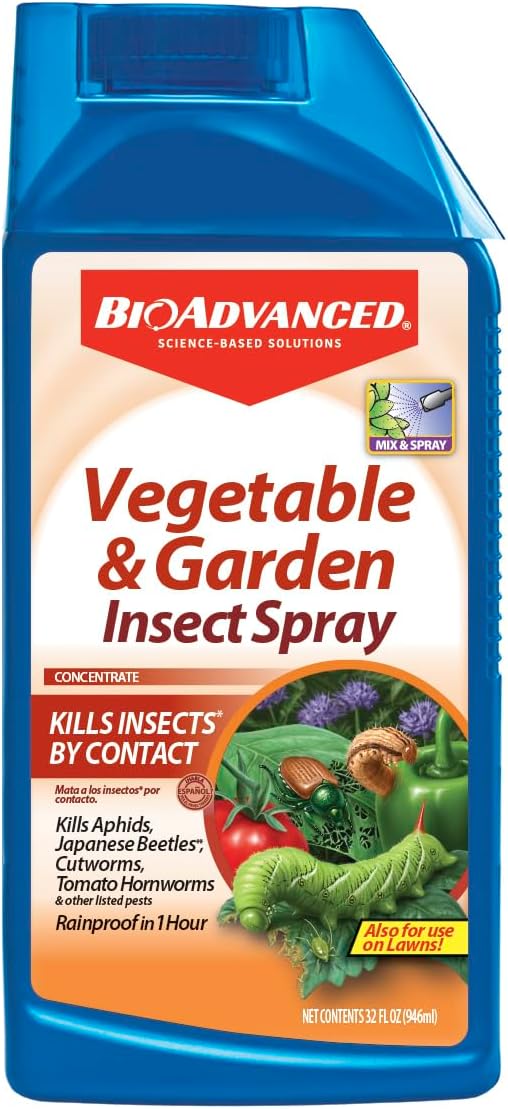
| Item Form | Spray |
|---|---|
| Target Species | Insects |
| Liquid Volume | 32 fluid ounces |
| Active Ingredients | Cyfluthrin |
This BioAdvanced concentrate is designed for gardeners who need a versatile, broad-spectrum insect control for outdoor plants. The bottle mixes into a ready spray that kills common pests on contact, including aphids, caterpillars, whiteflies, and tomato hornworms, and the formula becomes rainproof in about an hour so treatments hold up to light rain. Because it is a concentrate, one 32-ounce bottle makes up to 64 gallons of spray, which is convenient for treating larger beds or multiple plantings without frequent repurchasing. Typical use is diluting to label rates, filling a garden sprayer, and coating leaves until wet but not dripping. The main limitation is that it uses a synthetic pyrethroid active ingredient so it will also affect nontarget insects including beneficials if oversprayed, and label precautions must be followed for edible crops and pollinators. It is not a selective or organic option, but for balanced gardeners wanting an effective, easy-to-apply contact insecticide for outdoor plants, it provides strong, reliable control.
Best for: Gardeners who want a single, effective contact insecticide to protect vegetables, fruits, and ornamentals across a typical backyard garden and value ease of use and wide pest coverage.
Less Ideal for: Growers who prioritize organic methods, pollinator-safe selective controls, or those managing very small container plantings where concentrate dilution is inconvenient.
- Concentrate mixes to make up to 64 gallons, suitable for treating large areas
- Kills a wide range of listed garden pests on contact, including common vegetable pests
- Rainproof protection within one hour helps treatments withstand light rain
- Can be applied with most common garden sprayers for straightforward use
- Contains a synthetic pyrethroid (cyfluthrin) that can harm beneficial insects if not used carefully
- Not an organic or selective option for gardeners seeking softer pest control
Verdict: A productive, rainproof concentrate that delivers broad, contact insect control for gardeners who need reliable protection across vegetable and outdoor plantings.
BioAdvanced Tomato & Vegetable Insect Killer, 24 fl oz Ready-to-Use

| Unit Count | 24 Fluid Ounces |
|---|---|
| Item Form | Spray |
| Target Species | Insects |
| Active Ingredient | Cyfluthrin 0.003% |
| Included Components | Ready-to-Use Bottle |
BioAdvanced Tomato & Vegetable Insect Killer is a ready-to-spray insect control for vegetable gardens that targets aphids, Japanese beetles, cutworms, tomato hornworms and other listed pests. You simply point and spray plants when pests or damage first appear; the product claims fast knockdown on contact and becomes rainproof within an hour, so treated foliage stays protected after light rain. The bottle is intended for direct use on leafy greens, fruiting vegetables, root crops and cucurbits, and the label allows applications up to the day of harvest where permitted. Practical benefits include a broad pest list, simple application without mixing, and quick protection that reduces the need for immediate reapplication. Important limitations are that it contains a pyrethroid active ingredient and is not labeled for sale in some states, and it will affect beneficial insects if applied indiscriminately, so careful spot treatment and timing are necessary. For gardeners seeking a straightforward, effective spray to manage visible insect problems, this is a convenient option.
Best for: Gardeners who want a practical, no-fuss spray to quickly control visible insect pests on vegetable beds and protect harvest-ready plants without mixing concentrates.
Less Ideal for: Organic growers or those prioritizing minimal impact on beneficial insects should consider organic or targeted biological controls instead.
- Ready-to-use spray that requires no mixing for quick application
- Kills listed garden pests on contact, including aphids and tomato hornworms
- Becomes rainproof in about one hour to maintain protection after light rain
- Label allows use up to the day of harvest where permitted
- Contains a synthetic pyrethroid active ingredient which can harm beneficial insects
- Not labeled for sale in all states
- Will require careful spot application to avoid non-target exposure
Verdict: A convenient ready-to-use spray that quickly knocks down common vegetable pests and provides short-term, rainproof protection for harvestable crops.
Bonide Captain Jack's Tomato & Vegetable 3-in-1 Ready-to-Use Spray, 32 oz
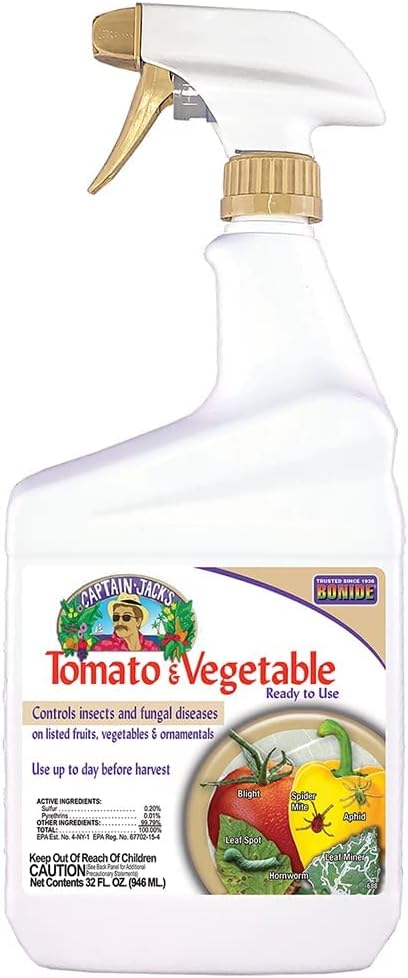
| Unit Count | 32 Ounce |
|---|---|
| Active Ingredients | sulfur |
| Item Type Name | Tomato & Vegetable 3-in-1 Ready-To-Use |
| Special Features | organic |
Bonide Captain Jack's Tomato & Vegetable Ready-to-Use is a 32 oz spray formulated to control common insect pests and a range of fungal diseases on tomatoes and other garden plants. It is used as a contact spray applied to foliage and new growth with a trigger nozzle that makes spot or whole-plant coverage straightforward. The product lists sulfur as an active ingredient and claims control of aphids, spider mites, caterpillars and more while also suppressing problems like powdery mildew, leaf spot and blight when applied preventively. Practical benefits include the convenience of a pre-mixed bottle, suitability for many listed vegetables and ornamentals, and a broad target list that lets one treat mixed beds without swapping products. Limitations are that it works by contact so thorough coverage is required and it is intended for preventive or early-season use rather than curing severe established infections. Users who need systemic control or highly targeted biological products may prefer an alternative formula.
Best for: Gardeners who want a simple, all-in-one spray to prevent and manage common insect pests and early fungal problems on tomatoes and mixed vegetable beds.
Less Ideal for: Growers seeking systemic fungicides, targeted biological controls, or solutions for severe, established diseases should consider other products.
- Ready-to-use bottle with trigger nozzle for quick application
- Controls a broad range of common garden insects and several fungal diseases
- Suitable for use on tomatoes, many vegetables and ornamentals
- Contains sulfur, a long-established option for organic-compatible fungal control
- Contact-only action requires thorough coverage and repeat applications for good control
- Not formulated for systemic action so it will not cure deep or established infections
Verdict: Pick this ready-to-use spray if you want a convenient, broad-spectrum preventive product to manage common tomato pests and early fungal issues.
Bonide Captain Jack's Bt Thuricide Ready-to-Use Spray, 32 oz

| Unit Count | 32 Ounce |
|---|---|
| Item Form | Spray |
| Target Species | Insects |
| Active Ingredients | Bacillus Thuringiensi,Lapidapteran Active Toxins |
Bonide Captain Jack's Bt Thuricide is a ready-to-use biological spray that delivers Bacillus thuringiensis (Bt) to control caterpillars and worm-stage insects. You apply it with the trigger sprayer directly to the tops and undersides of leaves when you first see feeding damage; it is labeled for use on vegetables, fruit, shade trees and ornamentals and can be used up to the day of harvest on edibles. Because it kills by ingestion, treated pests stop feeding within a couple of days while birds, earthworms and many beneficial insects are largely unharmed. The product is convenient for small-to-medium infestations since it needs thorough coverage and repeat applications for new larvae. It is approved for organic gardening and comes in a 32-ounce bottle that is easier to use than concentrates for spot treatments, but using a ready-to-use bottle across a large property can become time consuming compared with hose-end or pressurized sprayers.
Best for: Gardeners who prioritize proven, low-risk biological control and want an easy spray for spot treating caterpillars on edible and ornamental plants; ideal for those who value safety around beneficials and pets.
Less Ideal for: People needing fast-contact knockdown for a large-scale outbreak or who must treat many acres quickly should consider concentrates or professional application methods instead.
- Targets caterpillars and worm-stage pests with a proven Bt active ingredient
- Safe for use on edible plants up to day of harvest when label directions are followed
- Ready-to-use trigger bottle requires no mixing for quick spot treatments
- Labeled for a wide range of plants including vegetables, ornamentals and shade trees
- Requires insects to ingest product so results are not immediate and depend on good spray coverage
- Ready-to-use bottle is less efficient for treating large areas compared with concentrates or hose-end applicators
Verdict: A convenient, organic-ready Bt spray that reliably controls caterpillars and worm pests while protecting beneficials, ideal for careful gardeners treating spot infestations.
BioAdvanced Fruit, Citrus & Vegetable Insect Control Concentrate, 32 oz
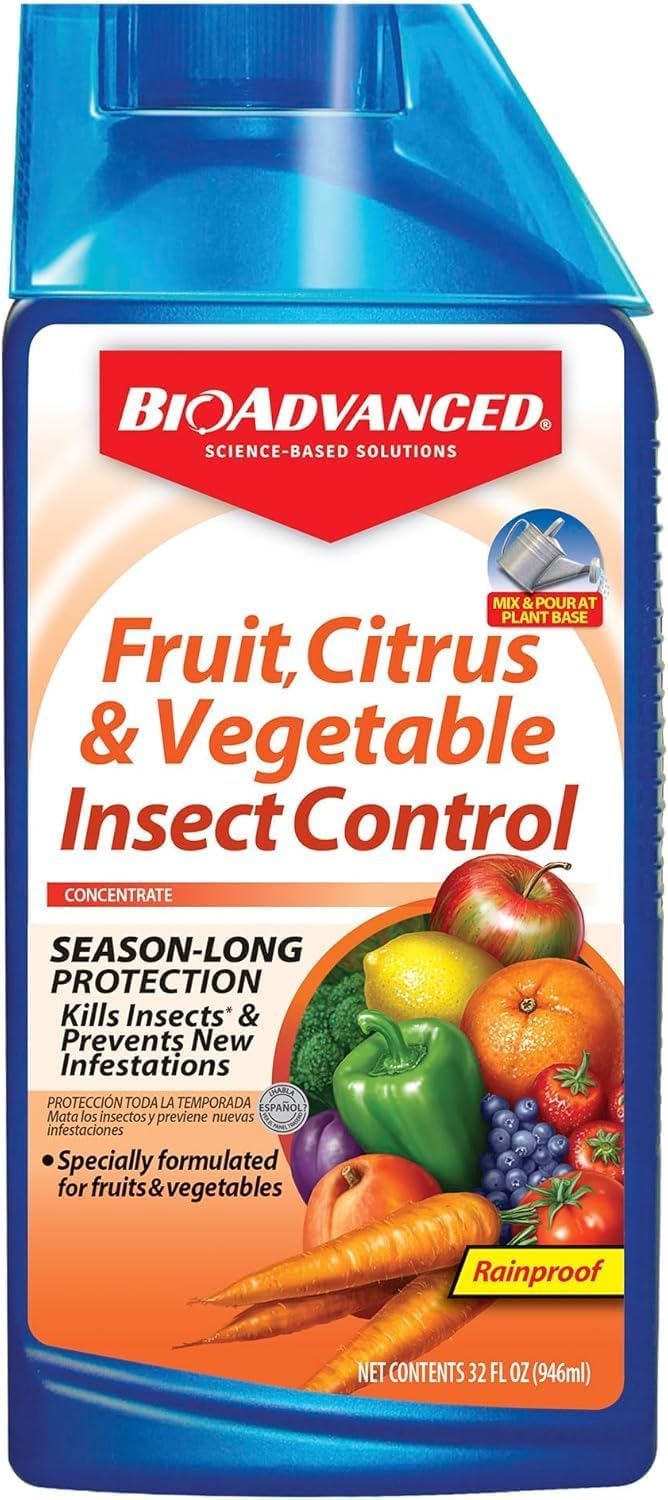
| Item Form | Concentrate |
|---|---|
| Target Species | Aphid, Whiteflies, Japanese Beetles, Mealybugs, Asian Citrus Psyllid |
| Liquid Volume | 32 fluid ounces |
| Specification Met | EPA |
| Active Ingredients | avocado |
This BioAdvanced concentrate is designed as a season-long, systemic insect control for edible gardens. You mix the concentrate with water and pour it around the root zone, so no foliar spraying is required; after uptake the product protects plants from feeding pests such as aphids, whiteflies, leafhoppers, scale and Japanese beetles and is rainproof after one hour. A single application covers large areas and the label states protection for up to two months, which makes it useful for producers who want durable control without repeated sprays. Because it is systemic the active ingredient is taken up by the plant, protecting new growth as well as existing foliage. Important limitations are regulatory restrictions in several U.S. states and the fact that systemic chemistry can affect nontarget insects, so follow label directions and harvest intervals carefully. For gardeners focused on strong, low-effort insect control for edible crops, this product delivers predictable season-long protection when used as directed.
Best for: Gardeners and small-scale growers who prioritize reliable, low-effort, season-long protection for edible vegetables and fruit and who want a pour-in-root treatment instead of repeated foliar sprays.
Less Ideal for: People who prefer organic contact-only treatments or who manage pollinator-heavy plantings where nontarget exposure must be minimized should consider alternative products.
- Systemic mode of action protects new growth and does not require foliar spraying
- Provides rainproof protection one hour after application
- Single application gives season-long control for up to two months
- Covers a wide range of listed pests relevant to vegetables and fruit
- Not permitted for sale or use in several U.S. states and some New York counties
- Contains systemic insecticide chemistry that can impact nontarget insects if misused
Verdict: Choose this concentrate if you want dependable, season-long systemic protection for vegetables and fruit with a single pour-in application.
Choosing the Right Insect Killer for Tomatoes: Key Factors to Consider
Target Pest Spectrum
Different insect killers act on different groups of pests. Some are primarily effective against chewing caterpillars and beetles, while others target sucking pests like aphids and whiteflies. Knowing the dominant pests in your tomato bed matters because a product effective against caterpillars may do little against sap feeders.
Matching the control spectrum to the pest you see reduces wasted applications and speeds recovery. Inspect undersides of leaves and stems to identify damage patterns before choosing a treatment. For mixed infestations, select a product or a rotation that covers the main pest types you typically encounter.
Plant Safety and Phytotoxicity
Tomato foliage and fruit can be sensitive to some insect control materials, especially under hot, sunny conditions. Plant safety means the treatment controls pests without causing leaf burn, fruit spotting, or stunted growth. Pay attention to label warnings about temperature, application timing, and dilution rates because improper use is a common cause of phytotoxicity.
Test sprays on a few leaves or treat a small area first when trying a new product. Also consider whether the product lists tomatoes explicitly on the label; labeled crops have been evaluated for safety during registration.
Impact on Beneficials and Pollinators
Tomato flowers rely on pollinators for good fruit set in some varieties, and beneficial predators and parasitoids help keep pest populations in check. Some insect killers are highly toxic to bees, lacewings, lady beetles, and parasitic wasps, while others have low non-target impacts when used correctly. Timing applications for early morning or late evening and avoiding bloom periods can reduce harm to pollinators.
If you rely on biological control or want to encourage pollinators, prefer options with selective action or short residual toxicity. Integrating mechanical controls and row covers can also reduce reliance on broad-spectrum treatments.
Residual Activity and Reapplication Frequency
Residual protection determines how long a product continues to suppress pests after application. Short-residual materials require more frequent applications but often have lower non-target impact. Long-residual options reduce application frequency but may pose higher risk to beneficial insects and can leave residues on fruit or foliage.
Plan applications around weather and harvest timing. Heavy rain can wash away contact treatments, necessitating reapplication. Read label intervals carefully to avoid overuse and to maintain effectiveness without exceeding recommended application rates.
Ease of Use in Home Gardens
How a product is applied affects whether you will use it correctly. Ready-to-use sprays, hose-end applicators, concentrates that require precise measuring, or wettable powders each come with different convenience and accuracy tradeoffs. For small patios or container growers, low-volume ready-to-use sprays minimize mix-up risk and make spot treatments easier.
Consider storage, mixing equipment, and whether the product requires protective gear beyond basic gloves and eye protection. Practicality in a backyard setting often determines whether treatments happen on schedule.
Residue, Re-entry, and Harvest Intervals
Tomatoes are eaten fresh, so residue limits and harvest intervals are important. Labels specify how long to wait between the last application and harvest to ensure residues decline below safety thresholds. Re-entry intervals also tell you when it is safe to work among treated plants without protective equipment.
Follow these intervals strictly. For crops destined for immediate consumption, choose products with short harvest intervals or use non-chemical controls during ripening to avoid unnecessary waiting periods.
Identifying the Real Culprits
Before applying any insect killer for tomatoes, spend time scouting plants. Look for chewing holes, skeletonized leaves, sticky honeydew, or tiny white specks on leaves. Caterpillars, flea beetles, aphids, and whiteflies each leave different signatures that point to the right control approach.
Hand removal and targeted spot treatment work well when pest pressure is low. For larger infestations, choose a control whose mode of action matches the pest biology to get faster, longer-lasting results.
- Caterpillars and hornworms: large chewing damage and frass.
- Aphids and whiteflies: sticky honeydew and curled leaves.
- Flea beetles: small shot-hole damage on young foliage.
Timing Applications to Weather and Bloom
Apply treatments during cooler parts of the day to reduce plant stress and minimize exposure to foraging pollinators. Avoid spraying when temperatures are very high or when rain is expected within 24 hours, as heat and moisture can increase phytotoxic risk or wash away contact materials.
Delay nonessential sprays during heavy bloom to protect pollinators, or use targeted spot applications on heavily damaged plants instead of blanket sprays across an entire bed.
- Spray early morning or late evening to avoid pollinators.
- Skip full-bed treatments during bloom when possible.
Integrating Cultural and Mechanical Controls
Using insect killers alongside cultural tactics lowers overall pesticide need and improves long-term control. Practices like crop rotation, removing diseased or heavily infested plant material, and keeping weeds under control reduce pest habitat and pressure.
Physical barriers such as row covers protect young plants from early-season pests but must be removed during flowering for pollination. Handpicking larger pests and pruning infested growth are low-cost measures that work well in small plots.
- Rotate planting locations to interrupt pest life cycles.
- Sanitize stakes and tools to reduce spread of pests and eggs.
Spot Treatment and Threshold-Based Use
Rather than routine full-bed spraying, adopt a threshold-based approach. Treat when pest numbers or damage reach a level likely to reduce yield or fruit quality. This conserves beneficials and limits chemical exposure of fruit.
For small numbers of pests, spot-treating individual plants is often sufficient and keeps the rest of the bed intact for natural enemies to act.
- Treat individual plants showing heavy damage first.
- Monitor beds regularly so you can act before infestations explode.
Post-Application Care and Monitoring
After applying an insect killer, monitor plants over the next week to confirm pest reduction and watch for unintended plant reactions. Look for new feeding, changes in leaf color, or signs of beneficial insect decline.
Adjust your program based on observations: switch tactics if pests rebound quickly, and always respect reapplication intervals to avoid resistance buildup.
- Check treated plants every 3 to 7 days to assess effectiveness.
- Rotate active ingredients when repeat applications are necessary.
How We Chose the Best Insect Killer for Tomatoes
We focused on practical, gardener-facing criteria that matter when protecting tomato plants. Primary filters included documented effectiveness against common tomato pests such as tomato hornworms, aphids, whiteflies, and flea beetles, plus evidence of minimal phytotoxicity on foliage and developing fruit. We prioritized solutions with clear application guidance and realistic re-entry and harvest intervals so gardeners can plan safe treatments. Environmental considerations were important: we evaluated compatibility with beneficial insects, pollinators, and integrated pest management approaches. Ease of use in backyard settings, including readiness-to-use formulations or straightforward dilution instructions, was also a selection filter. Products lacking clear label directions for tomato crops, or those with high risk of burning foliage under normal garden conditions, were excluded. The criteria we applied are reflected in the scoring metrics below and guided which insect control methods made the shortlist.
FAQ
Can I use insect killers on tomatoes when they are flowering?
It depends. Applying during heavy bloom increases risk to pollinators. If treatment is necessary, use spot applications in the evening and choose materials known to be less toxic to bees. Avoid broad-spray applications across the whole bed during peak flowering.
How long should I wait to harvest after applying an insect treatment?
Wait times vary with the product and active ingredient. Many garden-friendly options list short harvest intervals, but always follow the label directions. For low-residue treatments, waiting several days is often sufficient, while some chemistries require longer intervals.
Will repeated use of the same insect killer cause resistance?
Repeated use of the same mode of action can encourage resistance in pest populations. Rotate products with different modes of action and combine chemical controls with cultural and mechanical tactics to slow resistance development.
Are organic insect killers safer for tomatoes than synthetic ones?
Organic options often have lower persistence and different non-target profiles, but safety depends on the active ingredient and how it is used. Some organic materials can still burn foliage if applied in hot sun or at too high a rate. Read labels and follow application guidance regardless of classification.
Can I spray insect killers on tomato seedlings and transplants?
Seedlings and young transplants are more sensitive to phytotoxicity. Use milder options at reduced rates or test on a small area first. Cultural controls and physical barriers are especially useful while plants are small and more vulnerable.
Final Verdict
Choosing the right insect killer for tomatoes means balancing fast pest suppression with plant safety and protection of beneficial insects. Prioritize products that match the specific pests you face, have clear label directions for tomatoes, and fit your garden routine in terms of application and reapplication. Use spot treatments, integrate cultural controls, and follow harvest and re-entry intervals to protect fruit quality and pollinators. With a targeted approach you can keep tomato plants productive while minimizing unintended impacts.
