

Note: This article contains affiliate links. If you click on these links and make a purchase, I may earn a small commission at no extra cost to you. This helps support my research and content. Read my full affiliate disclosure here.
If you grow vegetables you know pests can wipe out weeks of work in a few nights. Picking the right insect killer for vegetable gardens matters because you need effective pest control that also preserves pollinators, soil health, and the safety of your harvest. This guide covers six shortlisted options suited to vegetable beds, containers, and raised planters. We evaluate each option for how well it suppresses common chewing and sucking pests, residue and reentry safety, and ease of application in an edible landscape. Read on to match product features to the pest pressures in your garden and move quickly from problem to control.
Top Picks at a Glance
| Best Overall The best all-around choice for most situations | Sevin Insect Killer Ready-to-Use, 1 Gallon |  |
| Best Quality Built to a higher standard if you want something more solid | Sevin Insect Killer Concentrate II, 32 oz |  |
| Best Value The sweet spot between price and what you get | BioAdvanced Vegetable & Garden Insect Spray Concentrate, 32 fl oz |  |
| Best Budget The cheapest option that still gets the job done reliably | GardenTech Sevin Insect Killer Dust, 1 lb |  |
| Highest Rated A top-rated pick with lots of positive feedback | Monterey Spinosad Insecticide, 32 oz (concentrate) |  |
| Most Popular A crowd favorite that many people choose with confidence | Garden Safe Insecticidal Soap Ready-to-Use Spray, 32 oz |  |
Sevin Insect Killer Ready-to-Use, 1 Gallon

| Unit Count | 127.82 Fluid Ounces |
|---|---|
| Item Form | Liquid |
| Target Species | Insects |
| Active Ingredients | Lambda-Cyhalothrin |
Sevin Insect Killer Ready-to-Use is a one-gallon liquid insecticide designed for home vegetable and ornamental gardens. It comes premixed in a bottle with a nozzle and sprayer tube so you can attach and spray without measuring concentrates. The formula lists lambda-cyhalothrin as the active ingredient and claims contact kill for hundreds of garden pests, which makes it useful at early signs of infestation on tomatoes, brassicas, lettuce and other edibles as well as on roses and shrubs. Typical use is a narrow fan spray held about a foot from foliage to coat leaves evenly; the label notes not to spray open blooms to protect pollinators and to wait 24 hours before watering. Practical benefits include fast visible knockdown of many chewing and sucking insects and broad crop coverage that reduces the need for multiple products. Important limitations are that it is a broad-spectrum synthetic pyrethroid so it can harm beneficial insects if misapplied and it requires following label timing and reentry instructions carefully to protect people, pets and pollinators.
Best for: Home vegetable gardeners who want an easy, ready-to-spray solution that quickly knocks down a wide range of common pests and covers multiple crops and ornamentals.
Less Ideal for: Gardeners prioritizing organic or pollinator-safe approaches or those who prefer spot treatments with minimal impact on beneficial insects should consider other options.
- Ready-to-use bottle with sprayer attachment for immediate application without mixing
- Broad-spectrum activity that lists over 700 labeled insect pests including aphids, Japanese beetles and hornworms
- Fast contact kill with visible results in minutes for quick control of active infestations
- Labelled for use on many fruits, vegetables, flowers and ornamentals so one product covers multiple garden needs
- Contains a synthetic pyrethroid that can harm beneficial insects and pollinators if sprayed on open blooms
- Requires careful timing and adherence to label safety and reentry instructions to protect people and pets
Verdict: A convenient, broad-spectrum ready-to-spray insecticide for gardeners who need fast, reliable control across vegetables and ornamentals.
Sevin Insect Killer Concentrate II, 32 oz

| Item Form | Liquid |
|---|---|
| Target Species | Insects |
| Liquid Volume | 32 fluid ounces |
| Active Ingredients | Zeta Cypermethrin |
Sevin Insect Killer Concentrate II is a garden spray concentrate you mix with water and apply with a handheld, tank, or hose-end sprayer to control insects on lawns, vegetables, fruits, shrubs, and ornamentals. The label rate (for example 4 fl oz per gallon) and included measuring cap make mixing straightforward for routine applications. It kills by contact more than 500 listed pests and claims residual control for up to three months on most insects, which reduces how often you need to reapply. The formula lists zeta-cypermethrin as the active ingredient, so it is fast acting against chewing and sap-sucking pests but you must avoid spraying open blooms to protect pollinators and follow label precautions for personal safety. It is versatile for spot treatments or broader landscape use, but users should follow label restrictions for certain pests and regional regulations. Practical gardeners will appreciate the concentrated format and multi-plant label, while those needing an organic or pollinator-safe option will want alternatives.
Best for: Gardeners who want a practical, no-nonsense concentrate to control a wide range of insect pests across vegetable beds, ornamentals, and lawns and who prioritize effective, infrequent applications.
Less Ideal for: People seeking organic, pollinator-safe, or aquatic-friendly pest control should consider non-synthetic or targeted biological options instead.
- Concentrated formula lets you treat large areas from a single bottle when mixed as directed
- Kills over 500 listed insect pests by contact, covering many common garden problems
- Measuring cap and clear mixing instructions make preparation simple and consistent
- Works on both ornamental and edible plants so one product covers multiple garden zones
- Contains a synthetic pyrethroid (zeta-cypermethrin) which can harm pollinators and aquatic life if misused
- Not registered for certain pests or regions so users must check local label restrictions
Verdict: A versatile, concentrated insecticide that gives practical gardeners broad-spectrum, long-lasting control when used according to the label.
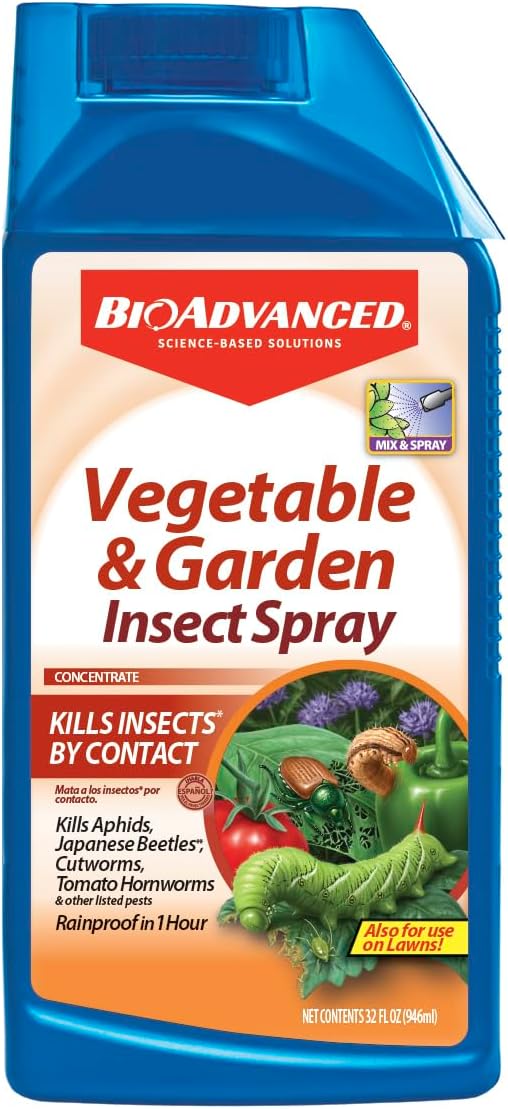
BioAdvanced Vegetable & Garden Insect Spray Concentrate, 32 fl oz
| Item Form | Spray |
|---|---|
| Target Species | Insects |
| Liquid Volume | 32 fluid ounces |
| Active Ingredients | Cyfluthrin |
This BioAdvanced concentrate is designed for gardeners who need a versatile, broad-spectrum insect control for outdoor plants. The bottle mixes into a ready spray that kills common pests on contact, including aphids, caterpillars, whiteflies, and tomato hornworms, and the formula becomes rainproof in about an hour so treatments hold up to light rain. Because it is a concentrate, one 32-ounce bottle makes up to 64 gallons of spray, which is convenient for treating larger beds or multiple plantings without frequent repurchasing. Typical use is diluting to label rates, filling a garden sprayer, and coating leaves until wet but not dripping. The main limitation is that it uses a synthetic pyrethroid active ingredient so it will also affect nontarget insects including beneficials if oversprayed, and label precautions must be followed for edible crops and pollinators. It is not a selective or organic option, but for balanced gardeners wanting an effective, easy-to-apply contact insecticide for outdoor plants, it provides strong, reliable control.
Best for: Gardeners who want a single, effective contact insecticide to protect vegetables, fruits, and ornamentals across a typical backyard garden and value ease of use and wide pest coverage.
Less Ideal for: Growers who prioritize organic methods, pollinator-safe selective controls, or those managing very small container plantings where concentrate dilution is inconvenient.
- Concentrate mixes to make up to 64 gallons, suitable for treating large areas
- Kills a wide range of listed garden pests on contact, including common vegetable pests
- Rainproof protection within one hour helps treatments withstand light rain
- Can be applied with most common garden sprayers for straightforward use
- Contains a synthetic pyrethroid (cyfluthrin) that can harm beneficial insects if not used carefully
- Not an organic or selective option for gardeners seeking softer pest control
Verdict: A productive, rainproof concentrate that delivers broad, contact insect control for gardeners who need reliable protection across vegetable and outdoor plantings.
GardenTech Sevin Insect Killer Dust, 1 lb

| Item Form | Dust |
|---|---|
| Target Species | Insects |
| Active Ingredients | Bifenthrin |
| Unit Count | 1 Count |
Sevin Insect Killer Dust is a handheld dust formulation of bifenthrin for spot and perimeter treatment of garden pests, including Japanese beetles. You apply it by shaking a thin, uniform layer onto leaves, stems and around plants as a preventative or when you first see damage. The product kills by contact and lists more than 150 target insects, so it works across vegetables, fruit, ornamentals and turf. Practical features include a flip-open cap for easy dispensing and a 1 pound container sized for small-to-medium beds; the manufacturer states one pound treats about 2,000 sq. ft. The dust does not require mixing and settles quickly so treated areas can be reoccupied after it dries. Important limitations are typical for contact insecticides: it should not be applied to open blooms to protect pollinators and it provides little residual control if plants are watered or receive heavy rain within 24 hours of application. Users must follow label safety steps like avoiding the eyes and washing hands after use.
Best for: Gardeners who want a straightforward, no-mix contact treatment to quickly reduce visible beetle and chewing insect pressure in mixed vegetable, fruit and ornamental plantings.
Less Ideal for: People prioritizing pollinator-safe or long-residual biological controls should choose targeted or non-chemical methods instead.
- Kills by contact a wide range of garden pests including Japanese beetles and aphids
- Ready-to-use dust needs no mixing and is simple to apply with a flip-open cap
- Label lists use on vegetables, fruits, ornamentals and lawns so it fits mixed garden beds
- Contains bifenthrin which can harm beneficial insects if applied to open blooms or overused
Verdict: If you need a simple, ready-to-use contact treatment to quickly knock down Japanese beetles and other common garden pests, Sevin dust delivers fast, broad-spectrum control.
Monterey Spinosad Insecticide, 32 oz (concentrate)

| Unit Count | 32 Fluid Ounces |
|---|---|
| Item Form | Oil |
| Target Species | Insects |
Monterey Spinosad is a concentrated, spinosad‑based insecticide designed for home garden use to control caterpillars, leafminers, borers, thrips and many other chewing and crawling pests. Mixed into a trigger, backpack, or hose‑end sprayer, it can be applied to ornamentals, vegetables, lawns, citrus and fruit trees; the concentrate format makes it easy to cover larger areas on a schedule. The product is OMRI listed, fast acting, and practically odorless since spinosad is derived from naturally occurring bacteria. Safety directions on the label are clear and recommend protective clothing and thorough washing after handling. Limitations are that it is a broad contact toxin so beneficial insects like bees and predatory insects can be affected if applied during bloom or while pollinators are active, and you must follow label rates and reentry intervals for edible crops. For gardeners who prioritize reliable, organic‑approved control of chewing insects, this concentrate is a practical tool; those wanting an ant‑specific baiting strategy or systemic option will need a different product.
Best for: Gardeners who want a reliable, organic‑approved concentrate to quickly reduce chewing and boring insect populations across vegetables, ornamentals and fruit trees and who are comfortable following label safety and mixing instructions.
Less Ideal for: People seeking a targeted ant bait or a systemic insecticide for soilborne pests or those who need a product safe to spray during active bloom are better off with specialist ant baits or systemic products.
- OMRI listed for use in organic gardening
- Effective against a wide range of chewing and boring insects including caterpillars and leafminers
- Concentrate format works with trigger, backpack, or hose‑end sprayers for flexible coverage
- Fast acting and essentially odorless when applied properly
- Contact action can harm beneficial insects if applied when pollinators are active
- Requires mixing and careful adherence to label instructions for safe use
Verdict: Choose this OMRI‑listed spinosad concentrate when you need dependable, fast control of chewing garden pests across vegetables, ornamentals and fruit trees.
Garden Safe Insecticidal Soap Ready-to-Use Spray, 32 oz

| Item Form | Spray |
|---|---|
| Target Species | Insects |
| Liquid Volume | 32 fluid ounces |
| Active Ingredients | Potassium Salts Of Fatty Acids |
Garden Safe Insecticidal Soap is a ready-to-use contact spray formulated with potassium salts of fatty acids to control aphids, mealybugs, mites, whiteflies and similar soft-bodied pests. You use it like a normal garden spray: thoroughly coat insects and all plant surfaces including undersides of leaves, ideally in calm weather and not in full sun. It is safe for use on vegetables, fruit trees, ornamentals, shrubs, flowers and in greenhouses and may be applied to edibles up to the day of harvest, which simplifies timing for vegetable growers. The spray works on direct contact so thorough coverage is essential and multiple applications may be needed for heavy infestations. The product is convenient because no mixing is required, but it can be washed off by rain and is hazardous to aquatic invertebrates so care is needed to avoid runoff into water. For routine control of common garden pests this soap is a practical, low-toxicity option when used as part of an integrated pest management approach.
Best for: Gardeners who prioritize practical, low-toxicity pest control and want a ready-made spray that can be used on edible crops without pre-harvest delays.
Less Ideal for: People needing a long-residual or systemic pesticide for heavy infestations or for pests hidden inside plant tissues should consider other control methods.
- Ready-to-use formula requires no mixing for quick spot treatments
- Labeled for use on vegetables and may be applied up to the day of harvest
- Controls a broad list of soft-bodied pests including aphids, mites and whiteflies
- Plant-safe when used as directed and usable indoors, outdoors and in greenhouses
- Only kills pests by direct contact so it has limited residual or systemic activity
- Can be washed off by rain and must be reapplied after watering or heavy rainfall
- Harmful to aquatic invertebrates so it requires careful application near water
Verdict: A convenient, low-toxicity ready-to-use soap spray that gives effective contact control of common soft-bodied garden pests and is safe to use up to harvest.
Choosing the Right Insect Killer for Vegetable Gardens: Key Factors to Consider
Pest Spectrum and Target Pests
Different insect killers work on different groups of pests. Some are broad-spectrum and will affect chewing insects and sap feeders, while others target a narrower set such as caterpillars or aphids. Knowing which pests are active in your beds during the season helps you pick a product that will reduce damage quickly without unnecessary non-target impacts.
Matching the mode of action to the pest reduces wasted applications and limits the chance of resistance. Also consider whether the product is contact-only or translaminar; contact sprays need direct coverage while systemic or translaminar materials can protect new growth and concealed feeding sites.
Residue Period and Preharvest Interval (PHI)
Any product used on vegetables must list a preharvest interval or harvest restriction. Short PHIs let you treat late-season problems without delaying harvest, while long waiting periods can make a product impractical for frequently harvested crops. Check label guidance for each crop and follow the maximum allowable harvest interval.
Residues also affect post-application handling. Water-soluble materials may wash off with heavy rain, reducing effectiveness, whereas residual chemistries persist longer and may require more caution around pollinator visits and reentry times.
Safety for Handlers, Children, and Pets
Vegetable gardens are family spaces. Choose formulations and application methods that match your comfort level for safety. Ready-to-use sprays, wettable powders, and baits vary in inhalation and dermal exposure risk. Look for clear personal protective equipment recommendations and consider low-exposure options such as granulars or targeted bait stations when children or pets use the garden area frequently.
Also review reentry intervals and whether treated foliage should be washed before harvest. Safer products reduce setup friction when you need to apply treatments midseason.
Impact on Beneficial Insects and Pollinators
Many vegetables depend on pollinators, and predatory insects help keep pest populations in check. Products that are highly toxic to bees, lacewings, lady beetles, and parasitoids can create secondary pest outbreaks by removing natural controls. Choose materials with lower toxicity to pollinators or apply treatments in the evening when bees are less active. Some formulations and baits can be targeted to minimize fallout on beneficials.
Integrating cultural controls such as trap cropping and row covers reduces reliance on broad-spectrum insect killers and preserves beneficial insect communities in the long term.
Application Method and Garden Scale
The most effective product is the one you will apply correctly. Handheld hose-end sprayers, pump-up sprayers, concentrate mixes, granular spreaders, and bait stations each suit different garden sizes and layouts. Small raised beds and containers often do better with spot treatments or ready-to-use spray bottles, while larger plots may justify pump-up sprayers for even coverage.
Consider mixing accuracy, nozzle types for droplet size, and the ability to reach undersides of leaves. Ease of cleanup and measuring also matters to avoid accidental overapplication.
Resistance Management and Rotation
Repeated use of a single mode of action drives resistance in pest populations. Rotate among materials with different modes of action or alternate biological controls and cultural tactics to preserve control efficacy. For chronic problems, integrate nonchemical measures such as row covers, crop rotation, and sanitation to reduce selection pressure.
Follow label guidance on application frequency and do not exceed recommended rates. Keeping detailed notes on what you used, when, and how pests responded helps you spot resistance early and adjust strategies.
Common Vegetable Garden Pests and Signs of Damage
Knowing which pest is at work narrows treatment choices. Chewing damage with ragged holes usually points to beetles, caterpillars, or slugs. Skeletonized leaves or shot-holing suggest flea beetles. Stippled or curled foliage and sticky honeydew are classic signs of sap-feeding insects like aphids, whiteflies, or leafhoppers. Finding frass, webbing, or folded leaves can indicate caterpillar activity or leafroller species.
- Inspect both leaf surfaces, especially the undersides where many pests hide.
- Check stems and terminal growth for wilting or hollowed areas that indicate boring insects.
- Look for clustered eggs, frass piles, or molted skins as clues to the pest life stage.
Timing Treatments to Protect Pollinators
Apply insect killers when beneficial insect activity is lowest to reduce non-target harm. Early morning and late evening applications are generally better for protecting daytime pollinators. Avoid applying to open flowers; if a treatment is necessary during bloom, target only foliage and use the gentlest effective material.
- Remove or cover flowering plants if possible before spraying.
- Use spot treatments instead of blanket sprays when damage is localized.
- Allow sprayed foliage to dry before allowing pollinator access.
Cultural and Mechanical Alternatives
Nonchemical tactics reduce the need for repeated insect-killer applications. Row covers exclude many chewing pests during vulnerable growth stages and work well for small transplants. Handpicking large caterpillars and beetles can be highly effective in small beds. Maintaining healthy soil and plant vigor makes vegetables less attractive to many pests.
- Rotate crops and avoid planting the same family in the same bed year after year.
- Use trap crops to divert pests away from main plantings.
- Keep beds free of weeds and crop residues that harbor overwintering pests.
Safe Application Practices
Read and follow label directions precisely for mixing, application rate, and personal protective equipment. Measure concentrates carefully and never mix different products unless the labels explicitly allow tank mixes. Rinse application equipment in an area where runoff will not reach edible crops or water bodies.
- Wear recommended gloves and eye protection when handling concentrates.
- Mix only the amount you will use that day to avoid storage risks.
- Store materials in original containers out of reach of children and pets.
How We Chose the Best Insect Killer for Vegetable Gardens
We selected products that strike a balance between effective pest suppression and edible-plant safety. Editorial filters required demonstrated activity against common vegetable pests such as aphids, flea beetles, caterpillars, and beetles, plus formulations or application methods that reduce harm to beneficial insects when used correctly. We prioritized options with clear label directions for vegetables, rated modes of action that limit resistance development, and preferred materials compatible with integrated pest management tactics. Evaluation criteria focused on measurable, gardener-relevant dimensions: pest spectrum and knockdown speed, residual activity and preharvest interval guidance, application safety for handlers and pollinators, ease of use in small plots and containers, and compatibility with organic or low-toxicity approaches when applicable. We excluded products without vegetable-use instructions, unclear pesticide registration, or formulations with unusually long harvest restrictions that make them impractical for home growers. The final list reflects choices that gardeners can deploy confidently in backyard and community vegetable plots.
FAQ
Can I use the same insect killer on all my vegetable crops?
It depends. Some products are labeled for many vegetables while others restrict use to specific crops. Always read the label for crop-specific instructions and preharvest intervals before treating different vegetables.
How soon after spraying can I harvest vegetables?
Harvest intervals vary by product. Many low-residue options have short preharvest intervals of a few days or less, while others require longer wait times. Check the label for the exact PHI for each crop and follow washing guidance before eating.
Will insect killers harm earthworms and soil microbes?
Effects vary. Some materials applied to foliage have minimal soil activity, while systemic or soil-applied chemistries can affect non-target soil organisms. Choose low-impact or targeted options and avoid excessive soil drenches to preserve soil biology.
Are organic insect killers safer for pollinators and beneficials?
Organic options often have lower persistence and can be less harmful to beneficials, but they are not inherently benign. Some organic sprays can still kill pollinators on contact. Use them judiciously and follow timing recommendations to reduce non-target impacts.
How do I handle resistance if treatments stop working?
Rotate materials with different modes of action and integrate cultural controls. Reducing reliance on a single chemistry, adjusting timing to target vulnerable life stages, and using biological agents can slow resistance development.
Can I use insect killers in container vegetable gardens?
Yes. Containers often need smaller, targeted applications and can benefit from localized treatments like spot sprays or baits. Pay attention to runoff into surrounding soil and avoid overwatering after application if the product advises caution.
Final Verdict
Selecting an insect killer for vegetable gardens is about balancing fast, reliable pest control with safety for people, pollinators, and soil life. Prioritize products with clear vegetable-use directions, short or acceptable harvest intervals, and modes of action that fit into a rotation plan. For most home vegetable gardeners the best choice is the option that addresses the specific pest problem, matches your application style, and minimizes non-target impacts. Use cultural and mechanical tactics alongside chemical controls to reduce dependence on any single solution and protect future effectiveness.
