

Note: This article contains affiliate links. If you click on these links and make a purchase, I may earn a small commission at no extra cost to you. This helps support my research and content. Read my full affiliate disclosure here.
Bagworms can strip foliage quickly and leave shrubs or small trees looking bare within a single season. Choosing the right insecticide for bagworm infestation matters because timing, active ingredient, and application method determine whether you stop feeding caterpillars before they cause lasting damage. This guide covers seven shortlisted insecticides suited to managing bagworms on ornamental trees and shrubs. We evaluate each option across practical criteria gardeners care about, including speed of control and plant safety, to help you pick a product that fits your situation and application method.
Top Picks at a Glance
| Best Overall The best all-around choice for most situations | ferti-lome Spinosad Insecticide Concentrate (16 fl. oz.) |  |
| Best Quality Built to a higher standard if you want something more solid | Quali-Pro Bifenthrin I/T 7.9F Insecticide, 1 Gallon |  |
| Best Value The sweet spot between price and what you get | Bonide Captain Jack's Deadbug Brew 16 oz Concentrate |  |
| Best Budget The cheapest option that still gets the job done reliably | Southern Ag Thuricide BT Caterpillar Control, 16 oz |  |
| Highest Rated A top-rated pick with lots of positive feedback | Atticus Contraxio SC Spinosad Insecticide Concentrate (32 oz) |  |
| Most Popular A crowd favorite that many people choose with confidence | Atticus Talak 7.9% Bifenthrin Indoor/Outdoor Insecticide Concentrate, 32 oz |  |
| Best Seller A high-volume bestseller chosen again and again | Bonide Captain Jack's Deadbug Brew Ready-to-Use Spray, 32 oz |  |
ferti-lome Spinosad Insecticide Concentrate (16 fl. oz.)

| Unit Count | 16 Fluid Ounces |
|---|---|
| Item Form | Oil |
| Target Species | Foliage feeding worms, thrips and other listed pests |
| Specification Met | OMRI |
| Active Ingredients | Spinosad |
This ferti-lome spinosad concentrate is a water-soluble, OMRI-listed insecticide formulated to control bagworms, tent caterpillars, armyworms and a wide range of foliage-feeding pests on vegetables, trees, shrubs, flowers and fruit. You dilute the concentrate (label recommends about 4 tablespoons per gallon) and apply it as a spray to affected foliage, which makes it convenient for spot treatments or whole-plant coverage. The active ingredient spinosad is effective against chewing insects while being approved for organic gardening, so it fits into integrated pest management plans. Practical benefits include broad-spectrum control of caterpillars and similar pests, compatibility with many outdoor uses, and a concentrate format that stretches farther than ready-to-spray alternatives. Important limitations are that it targets primarily chewing and foliage-feeding insects rather than sap-sucking pests, and label directions and safety precautions must be followed for timing and application to protect pollinators and beneficial insects.
Best for: Gardeners who prioritize practical, cost-effective pest control for outdoor plants and want an organic-approved concentrate to treat bagworms and other caterpillars across trees, shrubs and edibles.
Less Ideal for: People seeking an all-in-one product for sucking pests or those who want a pre-mixed spray with no measuring and mixing steps.
- OMRI listed so suitable for organic gardening and certified operations
- Concentrate form lets you dilute for multiple applications and spot treatments
- Effective against bagworms, tent caterpillars and a broad range of chewing foliage pests
- Water-soluble formulation is easy to mix into spray equipment
- Targets primarily chewing insects and is not intended for sap-sucking pests like aphids
- Requires mixing and correct dilution which adds preparation time compared with ready-to-spray products
Verdict: A concentrated, OMRI-listed spinosad solution that gives practical, organic-approved control of bagworms and other chewing caterpillars across outdoor plants.
Quali-Pro Bifenthrin I/T 7.9F Insecticide, 1 Gallon

| Item Form | Spray |
|---|---|
| Target Species | Termites, Carpenter Ants |
| Liquid Volume | 1 gallons |
| Active Ingredients | Bifenthrin |
This one-gallon Quali-Pro Bifenthrin I/T 7.9F is a flowable pyrethroid designed for preventive and residual control of a broad range of pests in lawns and landscaped areas. It is typically mixed and applied as a spray to turf, ornamental beds, foundations and around structures to suppress termites, carpenter ants, fleas, ticks, mites and similar pests. Key features include a long-lasting residual, compatibility with many turf and ornamental tank-mix partners, and a no-odor, non-irritating formulation that dries without visible residue. In practice it provides dependable knockdown and weeks of protection when applied at recommended rates, making it suited for routine perimeter treatments and spot-control of persistent infestations. Important limitations are that it is a concentrated professional-style product requiring careful dilution, protective equipment, and adherence to label directions for safe use around people, pets and desirable plants. It is not a ready-to-use consumer spray and should be used only where labeled.
Best for: Buyers who prioritize a reliable, long-lasting perimeter or spot-treatment solution for recurring or hard-to-control outdoor pests and who are comfortable following label directions and using concentrated products.
Less Ideal for: Casual users who want a simple ready-to-use spray for occasional bug bites or very small lawns should consider consumer-grade aerosols or hose-end products instead.
- Long-lasting residual control effective against termites, carpenter ants and other pests
- Compatible with herbicides, fungicides, insecticides and liquid fertilizers for tank mixes
- No-odor, non-irritating formula that dries with no visible residue
- Available in a one-gallon concentrated flowable for multiple applications
- Concentrated product requires dilution and protective equipment for safe handling
- Not intended as a ready-to-use consumer spray and may be overkill for very small yards
Verdict: Choose this product when you need a dependable, long-lasting concentrated insecticide for routine perimeter and spot treatments in lawns and ornamentals.
Bonide Captain Jack's Deadbug Brew 16 oz Concentrate

| Unit Count | 16 Ounce |
|---|---|
| Item Form | Spray |
| Target Species | Insects |
| Active Ingredients | Spinosad (Mixture of Spinosyn A and Spinosad D) |
Bonide Captain Jack's Deadbug Brew is a concentrated spinosad insecticide designed for use on vegetables, fruits, ornamentals, and other garden plants. You mix the 16 fl oz concentrate with water and apply it with a trigger, hand-held, backpack, or hose-end sprayer to target caterpillars, beetles, borers, leaf miners, and similar chewing pests. Because the active ingredient is spinosad, the product is approved for organic gardening and is selective enough that it does not significantly impact many predatory beneficial insects and mites when used as directed. In practical use it provides quick knockdown of listed pests and is suitable for protecting squash and other cucurbits from feeding damage. The main limitations are that it must be mixed and applied correctly following label rates and safety instructions and that repeated broad use can still affect non-target insects if timing and coverage are not careful. For gardeners focused on protecting food crops, it is a straightforward, effective option when integrated with scouting and spot treatments.
Best for: Gardeners who prioritize practical, effective pest control for edible gardens and want an organic-approved concentrate they can mix and apply themselves to protect squash and other crops.
Less Ideal for: Gardeners seeking a ready-to-use spray or those unwilling to follow label mixing and safety instructions should consider alternative formats or professional application.
- Contains spinosad, an active ingredient approved for organic gardening and effective against caterpillars and beetles
- Concentrate mixes with water for use with trigger, backpack, hand-held, or hose‑end sprayers
- Labeled for use on a wide range of vegetables, fruits, and ornamentals including cucurbits
- Designed to minimize impact on many predatory beneficial insects and mites when used as directed
- Requires careful mixing and application per label to avoid harming non-target insects
- Not a residual solution for all pests so repeat applications or scouting are often necessary
Verdict: A practical, organic-approved spinosad concentrate that reliably controls chewing pests on squash and other garden crops when mixed and applied correctly.
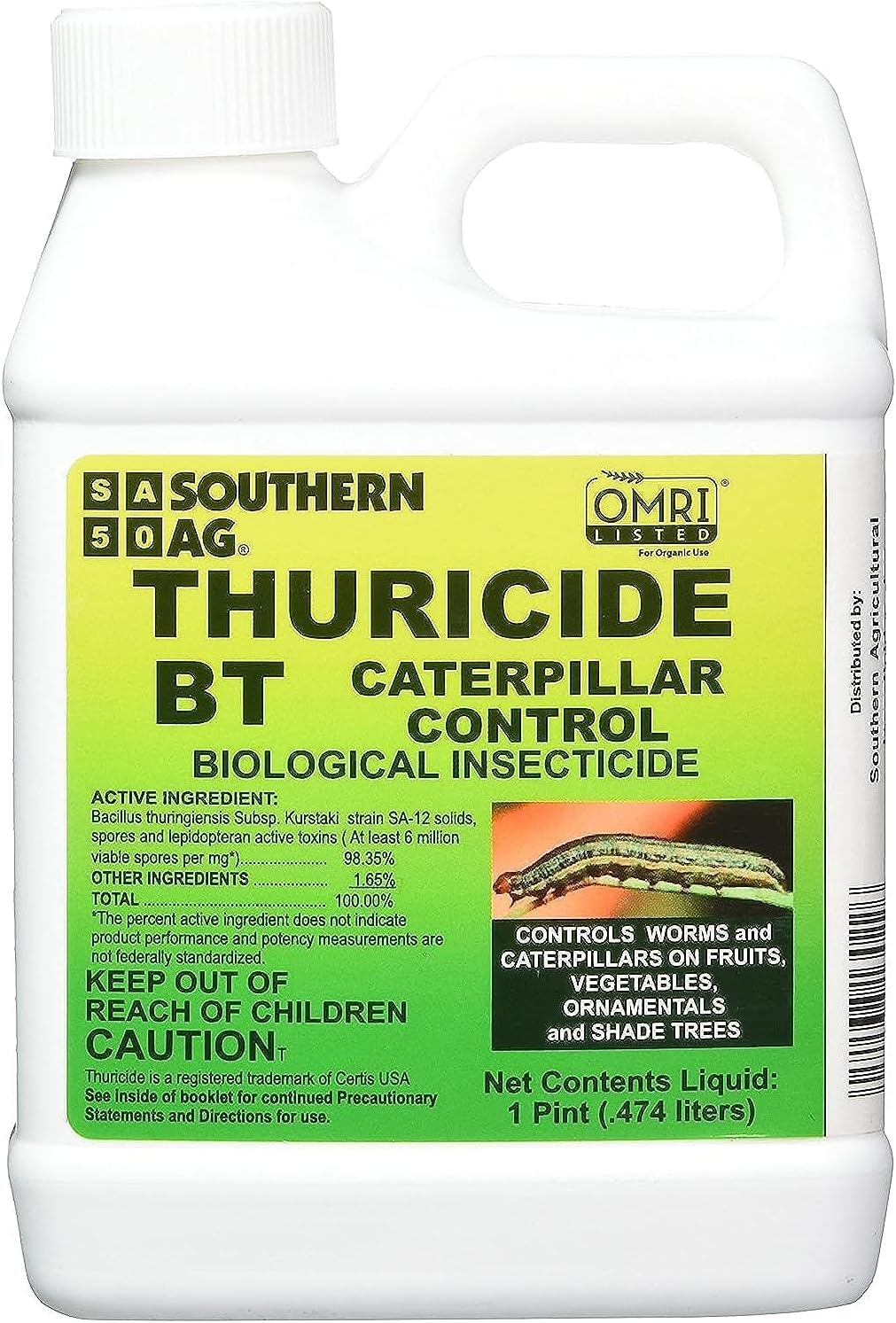
Southern Ag Thuricide BT Caterpillar Control, 16 oz
| Item Form | Liquid |
|---|---|
| Target Species | Caterpillar |
| Specification Met | OMRI |
| Active Ingredients | Bacillus Thuringiensis Kurstaki |
| Liquid Volume | 16 fluid ounces |
Southern Ag Thuricide is a liquid BT concentrate that targets lepidopteran larvae such as caterpillars and worms and is widely used in organic gardens. You mix 2 to 4 teaspoons per gallon of water, add a spreader-sticker if desired, and apply as a thorough cover spray to leaves where larvae feed. The active ingredient is Bacillus thuringiensis kurstaki, an OMRI-listed biological control with very low toxicity to humans and pets, which makes it safe to use on vegetables, citrus, nuts, shrubs and flowering plants. Its concentrate format means a single 16 oz bottle will treat multiple applications, which helps stretch a limited budget when treating recurring infestations. Limitations are that BT only affects feeding caterpillars and must be ingested to work, so timing sprays when larvae are actively feeding is essential; it will not control non-lepidopteran pests or egg stages. Because it is a biological microbial product, effectiveness can be reduced by heavy rain or UV exposure and repeated applications may be required for complete control.
Best for: Home gardeners working on a limited budget who need an organic, low-toxicity option to treat active caterpillar infestations on trees and ornamentals.
Less Ideal for: People who need a broad-spectrum fast kill for mixed pest problems or a product that controls eggs and non-feeding life stages should consider other options.
- OMRI-approved biological insecticide safe for use on edible crops
- Targets common caterpillars that cause defoliation of trees and shrubs
- Concentrated liquid allows multiple mixes from one bottle, cost-effective for repeated treatments
- Very low toxicity to humans and pets compared with synthetic insecticides
- Only effective when larvae ingest the product so timing and coverage are critical
- Not active against non-lepidopteran pests, eggs, or pupae
Verdict: A budget-friendly, OMRI-listed BT concentrate that reliably controls feeding caterpillars when applied with good coverage and correct timing.
Atticus Contraxio SC Spinosad Insecticide Concentrate (32 oz)

| Item Form | Liquid |
|---|---|
| Liquid Volume | 32 fluid ounces |
| Active Ingredients | Spinosad |
| Specification Met | EPA |
| Target Species | Insects |
Contraxio SC is a suspension concentrate formulated with 11.6% spinosad that delivers fast, targeted control of thrips and many other chewing and sucking pests in lawns, ornamentals, and edible gardens. You mix small measured amounts with water and spray foliage or drench specific areas according to label rates; for thrips the product recommends low-rate foliar sprays that reach upper and lower leaf surfaces. Its on-contact action often stops visible feeding within minutes and typically achieves full control in 1 to 3 days, with up to two weeks of residual activity against pests that ingest treated tissue. The product is labeled for broad use across turf, landscape ornamentals, greenhouse/nursery, and 100+ edible crops, which makes it useful for performance-minded gardeners who need one solution for multiple areas. Limitations to note are that it is a concentrated liquid that requires careful measuring and mixing and you must follow label directions for crop-specific rates and reentry intervals; also environmental conditions and very large infestations can reduce how quickly populations collapse. Pets may re-enter only after sprays are fully dry so plan applications accordingly.
Best for: Gardeners and turf managers who prioritize fast, reliable knockdown of thrips and other pests across multiple planting areas and want a single versatile product for edible and ornamental uses.
Less Ideal for: Casual users who prefer ready-to-spray formulations or those unwilling to follow specific label mixing rates and application precautions.
- Fast on-contact activity that typically stops feeding within minutes and controls pests in 1–3 days
- Effective against more than 50 pests including thrips, mites, caterpillars, and leafminers
- Versatile label for use on turf, ornamentals, greenhouse/nursery plants, and 100+ edible crops
- Provides up to two weeks of residual control against pests that ingest treated tissue
- Concentrated liquid requires precise measuring and mixing to achieve correct application rates
- Performance can be reduced in very heavy infestations or under unfavorable environmental conditions
Verdict: Choose Contraxio SC when you need a high-performance, spinosad concentrate that quickly knocks down thrips and protects edible and ornamental plantings with short residual control.
Atticus Talak 7.9% Bifenthrin Indoor/Outdoor Insecticide Concentrate, 32 oz

| Active Ingredient | Bifenthrin |
|---|---|
| Formulation | Suspension Concentrate |
| Liquid Volume | 32 fluid ounces |
| Length of Control | Up to three months |
| Target Species | Insects |
Talak 7.9% is a liquid concentrate for treating lawns, landscaping, outdoor living areas and indoor perimeter spots like baseboards and cabinets. You dilute the concentrate with water to create a spray for barrier treatments, spot applications or lawn mixes; label rates explain how much to mix per gallon depending on the use. The product uses bifenthrin, a proven broad-spectrum active ingredient, and the manufacturer states it controls over 75 species and can give residual control for as long as three months. Its water-based formula dries clear, leaves no odor or visible residue, and is not phytotoxic on plants when used per label. Practical benefits include flexible indoor and outdoor use, clear drying, and a bottle designed for easier pouring. Important limitations are that solutions should be mixed only for same-day use, it is not registered for sale in a few states, and it is not approved for fogger application, so professional-style misting methods are not appropriate.
Best for: Buyers who want a single, reliable product to protect yards, patios and building perimeters from a wide range of common pests and prefer conservative, label-driven application practices.
Less Ideal for: People seeking ready-to-use sprays or fogger-compatible products or those in states where this formulation is not registered should look at alternatives.
- Broad-spectrum control listed for 75+ indoor and outdoor pest species
- Water-based formula that dries clear and leaves no odor or residue
- Flexible label directions for lawns, landscapes, hardscapes and indoor perimeter treatments
- Long residual activity up to three months when applied at recommended rates
- Mixed spray solutions cannot be stored and must be used the same day
- Not approved for fogger application and not available for sale in some states
Verdict: A versatile, water-based bifenthrin concentrate that delivers long-lasting, broad-spectrum outdoor (and perimeter indoor) control when used according to the label.
Bonide Captain Jack's Deadbug Brew Ready-to-Use Spray, 32 oz

| Item Form | Spray |
|---|---|
| Target Species | Insects |
| Liquid Volume | 32 fluid ounces |
| Active Ingredients | Spinosad 0.5% |
Bonide Captain Jack's Deadbug Brew is a 32 oz ready-to-use spinosad spray formulated for organic gardening and aimed at controlling chewing and some leaf-feeding insects. You use it like a typical foliar spray, shaking the bottle and applying thoroughly to the tops and undersides of leaves on vegetables, fruit trees, and ornamentals. The active ingredient spinosad is effective against caterpillars, beetles, loopers, thrips, and similar pests and is labeled to spare many predatory beneficial insects when used as directed, which helps maintain biological control in the garden. The built-in spray nozzle makes application quick for small to medium beds and container crops. Limitations are that it is a contact and stomach poison so thorough coverage is required and repeat applications may be necessary for heavy infestations; it is not systemic and will not protect new growth after application. Also users must follow safety directions and avoid use when pollinators are active.
Best for: Gardeners who prioritize practical, low-fuss pest control for vegetables and fruit and who want an organic-approved spray they can apply quickly without mixing.
Less Ideal for: Large acreage growers or those who need long-lasting systemic protection should look for professional or systemic options instead.
- Contains spinosad, an approved active ingredient for organic gardening that targets many chewing pests
- Ready-to-use spray with integrated nozzle for simple, no-mixing application
- Label supports use on a wide variety of vegetables and fruit crops
- Designed to have limited impact on many predatory beneficial insects when used properly
- Works by contact and ingestion so thorough coverage and repeat applications are necessary
- Not systemic, so new growth after treatment is unprotected
Verdict: A convenient, organic-approved spinosad spray that delivers effective contact control of common foliage-feeding pests on cucurbits and other garden crops.
Choosing the Right Insecticide for Bagworm Infestation: Key Factors to Consider
Timing and Targeted Life Stage
Bagworm control depends heavily on timing because the effectiveness of most insecticides varies by larval stage. Young larvae are easier to control with contact and stomach-active materials, while older, larger caterpillars may be less susceptible and require products with longer residual or systemic activity.
Assess your infestation early in the season. Inspect trees for egg sacs or newly hatched larvae and plan applications when most individuals are small. Multiple treatments spaced according to label directions are often needed to cover a prolonged hatch period.
Active Ingredient Mode of Action
Different active ingredients act in different ways: some work on contact, others must be ingested, and some are systemic. Contact insecticides can give rapid visible knockdown but may miss protected caterpillars tucked in bags. Stomach-active or systemic options can be taken up by foliage or ingested during feeding for better control of concealed individuals.
Choosing an appropriate mode of action helps match the product to infestation severity and the plant's growth habit. Rotate between modes of action across seasons to reduce the risk of resistance developing in local populations.
Plant Safety and Labeled Uses
Not all insecticides are licensed for every ornamental species or for use on larger landscape trees. Label directions specify which plants are safe to treat, maximum application rates, and any restrictions on repeat treatments. Following label instructions protects tree health and avoids phytotoxicity on sensitive species.
Check label guidance on timing relative to flowering, as applications during bloom can raise pollinator exposure. When treating mature trees, consider product delivery methods that reach the canopy without damaging bark or foliage through overapplication.
Application Method and Reach
Application practicality matters when you are treating tall shrubs or small trees. Backpack sprayers, hose-end sprayers, and concentrate-to-sprayer mixes each have tradeoffs in reach, coverage, and drift control. Backpack or powered sprayers give better canopy penetration, while hose-end options are quick for small shrubs but may not reach higher branches.
Think about nozzle selection, droplet size, and spray pressure to maximize coverage of foliage and bags. Proper personal protective equipment and calibration of equipment are essential to deliver labeled rates effectively.
Residual Protection and Re-treatment Interval
Residual control determines how long a single application suppresses new hatch and feeding. Short-residual contact products may require follow-up treatments at shorter intervals, whereas longer-residual or systemic options can reduce application frequency.
Plan treatments around the bagworm lifecycle and expected hatch windows. Conservatively estimate follow-up timing and adhere to the maximum allowed applications per season on the product label.
Non-target and Pollinator Safety
Many insecticides can harm beneficial insects, especially if applied during bloom. Consider products with a narrower caterpillar-specific spectrum or those with reduced toxicity to pollinators when trees or nearby plants are flowering. Application timing that avoids bloom and early-morning or late-evening sprays can further limit exposure.
Also factor in impacts on predatory insects and parasitoids that naturally suppress bagworms. Minimizing broad-spectrum foliar sprays and integrating cultural controls will help preserve beneficial populations.
Recognizing Bagworm Damage and Infestation Signs
Bagworms create distinctive conical bags made from silk and plant material that hang from branches. Early-season defoliation appears as thinning foliage, chewed leaf margins, and the presence of small bags clustered on twigs and branch terminals.
Inspect the entire plant, including the underside of leaves and inner canopy, because early-stage larvae and egg cases can be hidden. Record infestation density and distribution to decide whether spot treatments or whole-plant sprays are necessary.
- Look for bags ranging from a few millimeters to several centimeters.
- Newly hatched larvae are tiny and often near older bags that overwintered.
- High-density infestations can cause complete defoliation in a single season.
Cultural and Mechanical Controls to Complement Insecticides
Non-chemical tactics reduce population pressure and improve long-term control. Hand-removing overwintering bags and destroying them during dormant season is highly effective for small trees and shrubs because it removes the next season's emerging larvae before they hatch.
Maintain plant vigor through proper irrigation and fertilization so hosts can better tolerate some defoliation. Prune out heavily infested branches to reduce localized populations and improve spray coverage when you do apply insecticide.
- Collect and destroy bags in winter or early spring.
- Avoid moving infested plant material between sites.
- Encourage natural enemies by minimizing broad-spectrum insecticide use when possible.
Application Best Practices for Safe and Effective Control
Follow label rates precisely and calibrate your sprayer so you deliver even coverage. Coverage is critical because bagworm larvae feed inside protective bags and only exposed body parts receive contact insecticide. Aim for thorough wetting of foliage and bags without excessive runoff.
Time treatments for when most larvae are small and feeding actively. If flowering is present, delay or avoid foliar applications until blooms fade to reduce pollinator exposure. Wear appropriate protective equipment and avoid spraying in windy conditions to limit drift.
- Target spray droplets to penetrate into the canopy.
- Record treatment dates and follow re-treatment intervals from the label.
- Consider spot-treating heavily infested areas to limit non-target exposure.
Integrating Biological Options and Conservation Practices
Biological controls such as Bacillus thuringiensis formulations can be effective against young caterpillars and are relatively selective for lepidopteran larvae. These options work best when applied early in a hatch and require ingestion by the larvae to be effective.
Conserving predators and parasitoids by avoiding unnecessary broad-spectrum sprays improves long-term suppression. Plant diverse flowering species away from treated trees to provide alternate forage for beneficial insects outside treatment windows.
- Apply biologicals while larvae are small for best results.
- Avoid applying biologicals in direct sunlight or high temperatures as efficacy can degrade.
- Use cultural measures alongside biologicals for multi-year population reduction.
Managing Severe Infestations and When to Re-treat
Severe infestations with many large larvae may need repeated applications and close monitoring. If initial treatments show slow decline in feeding activity, verify that application coverage was adequate and that timing matched the larval stages targeted.
Watch for signs of renewed activity after the labelled residual period ends and follow label guidance for maximum applications per season. For dense canopies, consider professional application methods to reach higher foliage safely and effectively.
- Inspect treated areas 7 to 14 days after application for control progress.
- Rotate modes of action between seasons to reduce resistance risk.
- Document infestation levels to inform next-season management planning.
How We Chose the Best Insecticide for Bagworm Infestation
To compile this list we focused on products and formulations that are appropriate for treating bagworm outbreaks on landscape trees and shrubs. We prioritized efficacy against caterpillar larvae at common infestation stages and looked for evidence that a product provides residual control long enough to cover the typical bagworm feeding window. Application flexibility was important, so we favored insecticides available in sprayable, concentrate, or hose-end formats that suit homeowners and pros alike. Plant safety and labeled uses were key filters. We excluded materials that lack clear labeling for ornamental trees, shrubs, or the specific life stage targeted. We also screened for reasonable re-entry and pollinator-safety guidance to minimize unintended impacts. The editorial criteria used were: speed of larval knockdown, residual protection period, spectrum and selectivity for caterpillars, labeled plant safety, and ease of application. Products missing clear label instructions for bagworm control or for common landscape use were not considered for the shortlist.
FAQ
When is the best time to apply an insecticide for bagworm infestation?
The best time is early in the season when most larvae are newly hatched and small. Treatments are most effective against young caterpillars because they are more exposed and easier to control. Monitor for egg sacs and early hatch and plan follow-up sprays according to the product label during extended hatch periods.
Can I treat flowering trees without harming pollinators?
Treating during bloom increases risk to pollinators. If possible, avoid foliar insecticide applications while trees or nearby plants are in flower. If treatment is essential during bloom, choose products with lower pollinator toxicity and apply in the evening when pollinator activity is reduced.
How many treatments will I likely need to control bagworms?
The number depends on hatch timing and product residual. Some materials require a single well-timed application while others need two or more treatments spaced per label directions to cover prolonged hatching. Inspect plants regularly and follow label re-treatment intervals.
Are biological insecticides effective against bagworms?
Biologicals can be effective, especially against very young larvae, because they require ingestion to work. They are generally selective and safer for beneficial insects but must be applied early and with good coverage to be successful.
Will treating prevent bagworms next season?
Treating this season reduces current populations but does not guarantee no infestation next year. Removing overwintering bags, monitoring, and combining cultural practices with targeted treatments lowers the risk of recurrence.
How should I protect nearby plants during treatment?
Limit spray drift by avoiding windy conditions, use directed spray techniques, and consider spot-treating heavily infested areas. Shield non-target plants when possible and follow label instructions for buffer zones and application restrictions.
Final Verdict
When tackling bagworm infestations, prioritize timing, coverage, and product selection based on the life stage and the plant being treated. Early-season applications against small larvae, good canopy coverage, and attention to label safety constraints will give you the best chance of stopping severe defoliation. Balance quick knockdown with considerations for pollinators and plant safety. Use mechanical and biological measures alongside chemical options to reduce reliance on repeated sprays and improve long-term control.
