

Note: This article contains affiliate links. If you click on these links and make a purchase, I may earn a small commission at no extra cost to you. This helps support my research and content. Read my full affiliate disclosure here.
Choosing the right insecticide for indoors matters because what works in the yard can be unsafe or ineffective inside living spaces. You want products that knock down the specific pests you see, limit lingering odor, and leave minimal surface residue where children or pets might contact it. This guide shortlists the top picks for indoor use and explains how we judged each option on effectiveness, safety, and ease of application. Read on to understand the tradeoffs so you can pick a solution that treats the problem without creating new household concerns.
Top Picks at a Glance
| Best Overall The best all-around choice for most situations | Atticus Talak 7.9% Indoor/Outdoor Bifenthrin Insecticide Concentrate (1 gal) |  |
| Best Quality Built to a higher standard if you want something more solid | Talstar One Insecticide Concentrate, 1 Gallon |  |
| Best Value The sweet spot between price and what you get | Compare-N-Save Bifenthrin Concentrate Indoor & Outdoor Insect Control, 16 fl oz |  |
| Best Budget The cheapest option that still gets the job done reliably | Raid Ant & Roach Killer Spray, Lemon Scent, 17.5 oz |  |
| Highest Rated A top-rated pick with lots of positive feedback | Envu Suspend SC Insecticide Concentrate, 16 oz |  |
| Most Popular A crowd favorite that many people choose with confidence | Ortho Home Defense Insect Killer for Indoor & Perimeter, 1.33 gal. with Comfort Wand |  |
| Best Seller A high-volume bestseller chosen again and again | HOT SHOT Total Release Fogger with Odor Neutralizer, 2 oz cans (12-count) |  |
Atticus Talak 7.9% Indoor/Outdoor Bifenthrin Insecticide Concentrate (1 gal)

| Active Ingredients | Bifenthrin |
|---|---|
| Formulation | Suspension Concentrate |
| Unit Count | 128 Fluid Ounces |
| Specification Met | EPA |
Talak 7.9% is a water-based bifenthrin concentrate meant as a flexible indoor and outdoor insect control product. You dilute the concentrate with water and apply it as a spray for perimeter barrier treatments, to turf, to ornamentals, or to interior baseboards and other problem areas. The label lists control of more than 75 pests including mosquitoes and ticks, and the formula is designed to kill on contact and provide residual control for up to three months. Practical benefits include a clear, odor-free spray that dries without staining and a bottle that allows easier small pours for accurate mixing. Important limitations are that mixed solutions should be used the same day and it is not approved for fogger use, so it is best for targeted spray applications rather than broadcast fogging. As with any bifenthrin product, users should follow label directions closely and consider nonchemical options for integrated mosquito management.
Best for: Buyers who want a single, versatile insecticide to treat both perimeter and landscape mosquito problems and prefer a product that delivers residual control without odors or visible residue.
Less Ideal for: People seeking a ready-to-use fogging or misting solution or those who need an insecticide they can pre-mix and store for later use.
- Broad-spectrum control listing more than 75 indoor and outdoor pests including mosquitoes and ticks.
- Water-based formula that dries clear, leaves no residue, and is odor-free for use around living areas.
- Long residual effect with label claim of up to three months of control per application.
- Mixes with water for adjustable application rates across lawns, landscapes, and surfaces.
- Bottle design supports easier small pours to reduce mess when measuring concentrate.
- Mixed spray cannot be stored and must be used the same day.
- Not approved for use in foggers, limiting application methods to direct sprays.
Verdict: A versatile, long-lasting bifenthrin concentrate that provides broad-spectrum mosquito and perimeter control for users who want one product for indoor and outdoor applications.
Talstar One Insecticide Concentrate, 1 Gallon

| Active ingredient | Bifenthrin 7.9% |
|---|---|
| Formulation | Concentrate, water-based |
| Coverage intent | Perimeter and structural applications |
| Pest range | Controls 75+ pests including ticks |
Talstar One is a professional-strength bifenthrin concentrate designed to provide broad-spectrum control of ants, spiders, roaches, fleas, ticks, mosquitoes, and many other pests. You mix the concentrate with water and apply it as a perimeter spray around foundations, doors, and windows or to targeted cracks and crevices indoors. Notable features include a water-based, low-odor formula that dries clear and a residual effect that reduces the need for frequent reapplications on lawns, ornamentals, shrubs, and structural surfaces. For yards with tick pressure, treating perimeters and vegetation provides a dependable barrier that helps reduce tick encounters when applied according to label directions. The product is concentrated so one gallon treats large areas, which makes it efficient for seasonal maintenance across multiple structures. Important limitations are that it is a pesticide that requires careful handling and strict adherence to label rates and application restrictions, and it is not a ready-to-use spray so you will need appropriate mixing and application equipment for safe, effective coverage.
Best for: Buyers who prioritize reliable, residual pest control for yards and perimeters and who are comfortable using concentrated pesticides with proper safety practices.
Less Ideal for: Casual users who want a ready-to-use product or those unwilling to follow pesticide label precautions and use appropriate application equipment.
- Broad-spectrum control that includes ticks and common yard pests
- Concentrated formula covers large areas and is cost-efficient for seasonal treatments
- Water-based, low-odor formula dries clear and is suitable for outdoor living spaces
- Suitable for both perimeter and targeted indoor/structural applications
- Concentrate requires proper mixing and application equipment for safe use
- Contains bifenthrin so users must follow label precautions to protect people, pets, and beneficial insects
Verdict: Choose Talstar One when you need a concentrated, long-lasting perimeter treatment that reliably reduces tick pressure across yards and structures.
Compare-N-Save Bifenthrin Concentrate Indoor & Outdoor Insect Control, 16 fl oz

| Unit Count | 16 Fluid Ounces |
|---|---|
| Item Type Name | Insecticide |
| Active Ingredients | Bifenthrin |
| Specification Met | Epa 84009-32 |
This Compare-N-Save concentrate is a high-strength bifenthrin insecticide intended for both indoor and outdoor use and is formulated to be diluted into ready-to-use spray. Typical use is mixing the concentrate with water in a pump sprayer or tank to treat baseboards, entry points, crawl spaces and perimeter areas where spiders, ants, cockroaches and fleas travel. Notable features include a 7.9 percent active ingredient, compatibility with tank-mixing other pesticides or insect growth regulators, and stated coverage that converts the bottle into many gallons of ready-to-use spray for large areas. Practical benefits are cost-efficiency for homeowners or pros who need to treat many square feet and the versatility to protect ornamentals, trees and shrubs as well as indoor harborage sites. Important limitations are that this is a concentrated pesticide requiring correct dilution and protective handling, it is not a ready-to-spray aerosol for spot treatments, and care is needed when applying indoors around people and pets.
Best for: Buyers who prioritize economical, large-area spider and general pest control and are comfortable mixing concentrates and using a pump sprayer for perimeter and indoor treatments.
Less Ideal for: People who want a ready-to-use or aerosol product for quick spot treatments or those who prefer pesticide-free approaches.
- High active ingredient (bifenthrin 7.9%) for effective knockdown and residual control
- Concentrate converts to many gallons of ready-to-use spray for treating large areas
- Label allows tank mixing with other pesticides and insect growth regulators
- Suitable for both indoor perimeter treatments and outdoor ornamental/tree use
- Requires careful dilution and personal protective equipment for safe use
- Not convenient for quick spot treatments because it must be mixed before use
Verdict: If you need an economical, high-strength concentrate to treat large indoor perimeters and outdoor areas for spiders, this bifenthrin product delivers broad residual control when mixed and applied correctly.
Raid Ant & Roach Killer Spray, Lemon Scent, 17.5 oz

| Unit Count | 17.5 Ounce |
|---|---|
| Item Form | LIQUID |
| Active Ingredients | IMIPROTHRIN 0.060%, CYPERMETHRIN 0.100% |
| Residual Control | Up to 13 weeks (listed) |
Raid Ant & Roach Killer is an easy-to-use aerosol spray designed to kill ants, roaches and many other crawling pests on contact and leave a residual barrier on treated surfaces. You shake and spray directly onto baseboards, under sinks, garbage cans and other problem areas; the formula lists imiprothrin and cypermethrin as active ingredients and promises up to 13 weeks of residual control for roaches and carpenter ants. In practice it works well for spot treatments and quick knockdown of visible insects and is useful for keeping treated cracks and crevices hostile to re-infestation. The lemon scent reduces chemical odor compared with some alternatives, but it is still an insecticide so use with ventilation and keep away from food and pets. This product is primarily for indoor surface applications rather than outdoor broadcast use, and repeated treatments are needed over time to maintain control in heavy infestations.
Best for: Buyers looking for an affordable, no-fuss indoor spray to quickly stop visible ants and roaches and maintain treated surfaces between deeper control measures.
Less Ideal for: Homeowners facing large or persistent infestations who need professional-grade or long-term structural solutions should consider integrated pest control options instead.
- Kills a wide range of crawling insects on contact including ants and roaches
- Residual action up to 13 weeks helps reduce follow-up treatments on treated surfaces
- Simple aerosol application for spot treatments and hard-to-reach baseboards
- Lemon scent mutes strong chemical smell compared with unscented sprays
- Contains synthetic insecticides so requires ventilation and pet/child precautions
- Not intended for broad outdoor perimeter use or as a long-term structural treatment
Verdict: A straightforward, budget-friendly indoor spray that quickly kills crawling pests and provides weeks of residual control for routine home spot treatments.
Envu Suspend SC Insecticide Concentrate, 16 oz

| Item Form | Spray |
|---|---|
| Target Species | Ants, Bed Bugs, Cockroaches, Fleas, Mosquitoes, Scorpions, Spiders, Ticks, Wasps, Yellow Jackets |
| Liquid Volume | 16 fluid ounces |
| Specification Met | EPA |
| Active Ingredients | Deltamethrin |
Suspend SC is a concentrated deltamethrin suspension concentrate designed for perimeter, crack-and-crevice and spot treatments to stop crawling pests before they enter structures. Mixed with water, the concentrate covers large areas around foundations, doors, windows, patios and landscaping and can also be used in garages, basements and crawl spaces. Its low-odor, water-based formulation and label flexibility allow indoor spot applications in tight areas and on some fabrics when used exactly as directed. The main practical benefit is the long residual control on treated surfaces, which reduces the need for frequent reapplication compared with short‑acting knockdown sprays. Because it targets a broad list of crawling pests, it fits into routine prevention programs aimed at cockroaches, ants, spiders and similar pests. Important limitations are that this is a professional‑strength insecticide that requires careful dilution and label-following for safe indoor use and that it does not provide immediate broad-area aerosol knockdown like ready-to-use sprays.
Best for: Buyers who prioritize reliable, long-lasting perimeter control and are willing to mix and apply a concentrated product correctly for ongoing cockroach prevention.
Less Ideal for: People who want simple ready-to-use aerosols or need instant knockdown across large indoor living spaces should consider alternative formulations.
- Concentrated formulation mixes with water to treat large perimeter and exterior areas
- Contains deltamethrin for long residual control on treated surfaces
- Low-odor, water-based formula suitable for indoor crack-and-crevice and spot use when label directions are followed
- Broad-spectrum efficacy against common crawling pests including cockroaches, ants and spiders
- Requires dilution and careful handling, so it is less convenient than ready-to-use sprays
- Not intended as an immediate aerosol knockdown product for open-area spraying
Verdict: Choose Suspend SC if you want a concentrated, long‑residual deltamethrin treatment to reliably protect perimeters and reduce repeat applications against cockroaches.
Ortho Home Defense Insect Killer for Indoor & Perimeter, 1.33 gal. with Comfort Wand

| Item Form | Spray |
|---|---|
| Target Species | Insects |
| Liquid Volume | 1.33 gallons |
| Active Ingredients | Bifenthrin 0.05%, Zeta-Cypermethrin 0.0125% |
This 1.33 gallon Ortho Home Defense spray is designed to treat both indoor problem spots and the outdoor perimeter of a home to reduce ants, roaches, spiders and many other crawling and flying insects. It comes with a battery-powered Comfort Wand that delivers a continuous spray so you can apply a uniform band around foundations, patios and entry points without bending or pumping. The formula with bifenthrin and zeta-cypermethrin is intended to kill on contact and establish a barrier that the manufacturer says lasts up to 12 months for ants, roaches and spiders on non-porous indoor surfaces. In real-world use that means fewer repeat treatments in busy yard perimeters and around doors and windows. The spray dries clear with minimal fumes which helps for indoor use near kitchens and living areas. Limitations are that this is a chemical insecticide so users should follow safety directions around children, pets and plants and it is not a specific solution for pests not listed on the label. For homeowners focused on strong, perimeter-level protection this product simplifies application and covers a large area per container.
Best for: Homeowners who want a performance-focused perimeter treatment to reduce recurring yard and entry-point insect problems and prefer a ready-to-use product that is easy to apply.
Less Ideal for: People seeking organic or non-chemical control methods or those who need a targeted solution for pests not listed on the label should consider alternative products.
- Includes battery-powered Comfort Wand for continuous, fatigue-free application
- Ready-to-use 1.33 gallon container covers large perimeters without mixing
- Formula creates a barrier claimed to provide up to 12 months protection against ants, roaches and spiders on non-porous indoor surfaces
- Dries clear and gives off minimal fumes, making indoor use more practical
- Contains synthetic insecticides so precautions are required around children, pets and ornamentals
- Protection claims are specific to certain species and surfaces so results vary by pest and conditions
Verdict: A powerful, ready-to-use perimeter and indoor spray for homeowners who want long-lasting, performance-oriented protection against common yard and household insects.
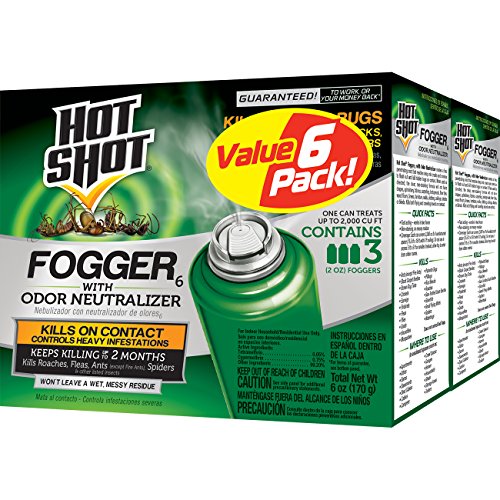
HOT SHOT Total Release Fogger with Odor Neutralizer, 2 oz cans (12-count)
| Item Form | Aerosol |
|---|---|
| Target Species | Insects |
| Unit Count | 12 Ounce |
| Active Ingredients | Tetramethrin, Cypermethrin |
The HOT SHOT Total Release Fogger delivers a fine aerosol mist that penetrates cracks and crevices to kill many common household insects on contact and provide residual control for up to two months. It is used by placing a covered stand in the center of the room, activating a single can, exiting the area, and allowing the mist to settle and work in enclosed spaces such as basements, attics, garages, sheds and campers. Notable features include a clear, non-staining formula that the manufacturer says will not harm fabrics or most furnishings and an odor neutralizer to reduce lingering smell. Practical benefits are rapid knockdown of visible infestations, reach into hidden hiding spots, and a long residual effect that helps suppress re-emergence. Important limitations are that it is a broad-spectrum insecticide containing tetramethrin and cypermethrin so safety precautions are required, it is not labeled for bed bug control, and it should not be used in very small or poorly ventilated spaces or near ignition sources. Follow all label directions before use.
Best for: A cautious homeowner who wants a product that quickly treats visible and hidden infestations in enclosed rooms and values a non-staining formula and reduced odor.
Less Ideal for: People seeking a pesticide-free, low-toxicity option or a targeted solution for bed bugs should consider alternative control methods or specialist treatments.
- Penetrating fine mist reaches cracks and crevices to target hidden insects.
- Clears a wide range of flying and crawling pests on contact and provides up to two months residual activity.
- Clear non-staining formula safe for most fabrics and household surfaces when used as directed.
- Includes an odor neutralizer to reduce chemical smell after application.
- Contains synthetic insecticides (tetramethrin and cypermethrin) requiring strict safety and ventilation precautions.
- Not effective or labeled for bed bug control.
Verdict: Choose this fogger when you need a fast, wide-reaching treatment that knocks down and helps suppress common household spiders and other insects in enclosed spaces.
Choosing the Right Insecticide for Indoors: Key Factors to Consider
Target Pest Specificity
Different indoor pests respond to different active ingredients. Cockroaches, ants, flies, and stored-product pests each have control methods that work better for their biology. Choosing a product with labeled efficacy for the pest you are seeing increases the chance of a quick resolution and reduces unnecessary chemical exposure.
Using a broad-spectrum product can be convenient but may be less effective against certain pests or create unnecessary residues. Read the label to confirm the product lists your target pest and any life stages covered, such as eggs or larvae, because that affects how many treatments you will need.
Safety for Occupants and Pets
Indoor insecticides must be used with occupant safety in mind. Look for products with explicit reentry times, clear instructions for airing out treated rooms, and guidance on cleaning treated surfaces. Choose formulations with lower inhalation risk and minimal skin-transfer potential when possible.
Consider how people in the home use rooms: high-traffic living areas, food-preparation surfaces, and children's play zones require stricter safety choices and may be better served by baits or edge-targeted treatments rather than widespread sprays.
Application Method and Coverage
How you apply an insecticide affects both performance and safety. Ready-to-use sprays are convenient for spot treatment but can be less precise. Aerosols reach cracks and voids but can spread fine droplets that linger in air. Baits and stations reduce non-target exposure by isolating the active ingredient where pests travel.
Think about the surfaces you will treat. Porous materials absorb some formulations and may retain odor or residue longer. Choose a delivery method that suits the area being treated and follow label directions on surface compatibility.
Residual Activity and Reapplication Needs
Residual activity determines how long a treated area remains protected. Some products provide quick knockdown but little residual control, which is useful for immediate problems. Others leave an effective residue that continues to control pests for weeks, reducing the number of treatments needed.
Longer residuals are helpful in low-disturbance areas like behind appliances, but in frequently cleaned or touched zones you may prefer shorter residuals to avoid repeated human contact with residues.
Odor and Indoor Air Considerations
Odor and vapor pressure matter indoors because strong smells can be unpleasant and indicate lingering volatile compounds. Low-odor formulations reduce complaints and speed reoccupation of treated rooms. Ventilation recommendations on the label tell you how long to air out a space after treatment.
If anyone in the home has respiratory sensitivity, select options with low volatility and follow ventilation instructions closely. Masking fragrances can hide chemistry but do not reduce exposure, so prioritize low-odor active formulations over scented products.
Surface Residue and Cleanup
Indoor treatments often leave residues on counters, floors, and baseboards. The label should specify whether treated surfaces need to be wiped before contact with food or children and how to clean up spills safely. Some formulations bind to surfaces and resist removal, while others are water-cleanable.
Plan for cleanup when choosing a product. For kitchens and food areas, prefer treatments that permit easy wiping of surfaces or that are applied out of reach in cracks and crevices rather than directly on food-preparation surfaces.
Choosing Between Baits, Sprays, and Traps
Delivery method affects where and how you can use an insecticide indoors. Baits and stations are best for ants and roaches because they encourage pests to take active ingredients back to nests. Spot sprays work well for immediate visible infestations where you can target the insect directly. Traps provide monitoring data and can reduce populations with minimal chemical exposure.
Match the method to the room and pest behavior. In kitchens and food prep areas, baits or crack-and-crevice gels limit surface contamination. In basements or attics, aerosols or residual sprays applied along baseboards and entry points can create a barrier. Always follow label instructions about reentry and surface contact.
- Baits: low non-target exposure, good for foraging pests
- Ready-to-use sprays: quick knockdown for visible insects
- Aerosols: reach voids and tight spaces but increase air movement
- Traps: monitoring and supplemental control with minimal chemistry
Reducing Exposure During and After Treatment
Plan treatments to minimize human and pet exposure. Remove food, dishes, and toys from the treatment area if the label requires it. Increase ventilation during and after application as directed and keep children and pets out until the product is dry or the specified reentry time has passed.
Wipe treated surfaces that will come into contact with food or skin if the product label recommends cleaning. For ongoing pest pressure, consider integrated measures like sealing entry points, improving sanitation, and using non-chemical traps alongside targeted insecticide use.
- Follow reentry times and ventilation guidance
- Store products out of reach and in original containers
- Use gloves when applying products that list dermal precautions
Managing Specific Indoor Pest Scenarios
Identify common scenarios and match tactics to behavior. For crawling insects found near sinks or appliances, treat baseboards, cracks, and bait them where they forage. For flying insects, focus on point-of-entry exclusion and localized sprays or trapped lures in waste and light areas.
Persistent infestations often require a combination approach: sanitation to remove food sources, exclusion to block access, and targeted insecticide use to reduce population quickly. Avoid blanket sprays across living surfaces when targeted options will do the job more safely.
- Crawlers: baiting and crack treatments
- Fliers: entry-point control and targeted spray near breeding sites
- Stored pests: inspect and discard infested goods, use targeted measures
Safe Storage and Disposal
Store indoor insecticides in a locked cabinet away from food and children. Keep them in original containers so label instructions and emergency information remain available. Do not transfer products to unmarked containers where accidental ingestion is more likely.
Follow local guidance for disposing of unused or empty product containers. Do not pour concentrated materials down drains or into the environment. Empty aerosol cans should be disposed of according to municipal rules for pressurized containers.
- Keep original labels intact
- Store away from heat and out of reach
- Dispose of containers per local regulations
Nonchemical Alternatives to Consider
Before reaching for chemical controls, evaluate nonchemical measures that can reduce pest pressure. Improved sanitation, sealing cracks and crevices, repairing screens, and reducing moisture often eliminate the conditions pests exploit. Sticky traps and mechanical removal work for monitoring and small problems.
Integrating these approaches lowers reliance on insecticides and reduces the frequency of reapplication needed. When chemicals are necessary, use them as part of an integrated plan to minimize long-term indoor exposure.
- Sanitation and food storage improvements
- Exclusion and repair of entry points
- Monitoring traps to track activity
How We Chose the Best Insecticide for Indoors
We focused on products formulated for indoor use and evaluated items against criteria that reflect real home situations. Key evaluation points included contact and residual effectiveness against common indoor pests, labeled safety precautions and low-odor formulations, ease of application and compatibility with typical indoor surfaces, and clear instructions for use around people and pets. We also checked whether products provided targeted delivery options such as aerosols, ready-to-use sprays, or baits suitable for kitchen and living areas. Products that required specialized equipment or were labeled only for outdoor or agricultural use were excluded. We prioritized items with straightforward reentry times, clear surface-cleaning guidance, and packaging that minimized accidental exposure. Final selections balance fast knockdown with responsible indoor stewardship and worker safety considerations.
FAQ
How soon can I reenter a room after treating it with an indoor insecticide?
Reentry times vary by product. Many ready-to-use sprays allow reentry after the spray has dried and the room has been ventilated, while some aerosol or concentrated treatments recommend longer ventilation. Always follow the label's reentry instructions and air out treated spaces until odors subside if the label suggests doing so.
Are baits safe to use around children and pets?
Baits and enclosed stations typically reduce non-target exposure because the active ingredient is contained where pests access it. However, follow label guidance on placement and keep stations out of reach of children and pets. If a pet or child contacts or ingests bait, follow first-aid instructions on the label and seek medical advice.
Can I use outdoor insecticide products inside my home?
Products labeled for outdoor use only are not formulated for indoor air and surface conditions and may present greater inhalation or residue risks. Do not use outdoor-only insecticides indoors. Choose products labeled specifically for indoor use to ensure appropriate safety instructions and reentry guidance.
Will frequent cleaning remove insecticide residues?
Cleaning can remove certain water-cleanable residues, but some formulations bind to porous surfaces and resist wiping. The label will indicate whether treated surfaces should be wiped before contact with food or children. Use cleaning to reduce residues when the product label allows and follow recommended wait times.
How do I choose a product for a persistent cockroach problem?
For persistent infestations, use a multi-pronged approach: sanitation to eliminate food and water, exclusion of entry points, targeted baiting where roaches forage, and residual crack-and-crevice treatments if needed. Select products labeled for cockroach control and follow reapplication intervals on the label.
Final Verdict
Pick an indoor insecticide based on the pest you are targeting, the room being treated, and the safety needs of occupants and pets. Favor targeted methods like baits or crack-and-crevice gels in kitchens and living spaces, and reserve broad sprays for areas where you can ventilate and control exposure. Balance quick knockdown with residual needs and always follow label directions to minimize indoor exposure and residue. With the right approach you can control pests effectively while keeping your home safe.
