

Note: This article contains affiliate links. If you click on these links and make a purchase, I may earn a small commission at no extra cost to you. This helps support my research and content. Read my full affiliate disclosure here.
Magnolia scale can quickly weaken ornamental magnolias, leaving sticky honeydew and sooty mold that reduce vigor and appearance. Choosing the right insecticide for magnolia scale matters because different active ingredients, application timings, and spray methods deliver very different levels of control and risk to beneficial insects or the tree itself. This guide covers six shortlisted insecticides suited for magnolia scale and explains the practical tradeoffs you should weigh in the yard or landscape. We evaluate each option for how well it controls the pest, how safe it is for the tree and surroundings, and how easy it is to apply.
Top Picks at a Glance
| Best Overall The best all-around choice for most situations | Bonide Annual Tree & Shrub Insect Control Concentrate, 128 oz |  |
| Best Quality Built to a higher standard if you want something more solid | BioAdvanced 3-in-1 Insect, Disease & Mite Control Concentrate, 32 oz |  |
| Best Budget The cheapest option that still gets the job done reliably | Garden Safe Insecticidal Soap Ready-to-Use Spray, 32 oz |  |
| Highest Rated A top-rated pick with lots of positive feedback | ferti-lome Horticulture Oil Ready to Spray, Canola Oil Concentrate (32 oz) |  |
| Most Popular A crowd favorite that many people choose with confidence | Bonide Systemic Insect Control Granules, 4 lb |  |
| Best Seller A high-volume bestseller chosen again and again | BioAdvanced 12 Month Tree & Shrub Protect and Feed Concentrate, 32 oz |  |
Bonide Annual Tree & Shrub Insect Control Concentrate, 128 oz

| Unit Count | 128 Fluid Ounces |
|---|---|
| Item Form | Spray |
| Target Species | Insects |
| Active Ingredients | Imidacloprid 1.47% |
Bonide Annual Tree & Shrub is a concentrated imidacloprid treatment formulated to protect established trees and shrubs from a range of sap-feeding and boring insects. You mix the concentrate with water and apply it as a soil drench or spray at the base of the plant so the chemical is taken up through the roots and distributed into new and existing growth. Key features are its long-lasting, systemic action that claims up to one-year protection and a formulation designed to be rainproof once dry. For gardeners this means fewer repeat treatments over the growing season and targeted control of pests that feed internally or on new shoots. Important limitations are that it contains imidacloprid, a neonicotinoid that can affect pollinators if misused, and it is intended for listed trees and shrubs rather than for broad landscape broadcast use. Careful adherence to label directions and timing is needed to protect beneficial insects and follow safety guidance.
Best for: Gardeners who want season-long, low-maintenance protection for individual trees and shrubs and are comfortable following label directions to minimize risks to pollinators.
Less Ideal for: Homeowners seeking immediate contact-kill sprays for lawn pests or those who prefer only non-neonicotinoid or organic insect controls.
- Systemic soil-applied formulation provides long residual control up to one year
- Concentrate offers flexibility to mix volumes for multiple trees and shrubs
- Rainproof after drying so protection is not easily washed away
- Specifically labeled for fruit, nut and ornamental trees and shrubs, including roses
- Contains imidacloprid, which requires careful use to avoid harm to pollinators and non-target insects
- Not designed for instant knockdown of foliage insects that require contact sprays
Verdict: Choose this concentrate when you want a single, systemic treatment to protect trees and shrubs for an extended season with minimal repeat applications.
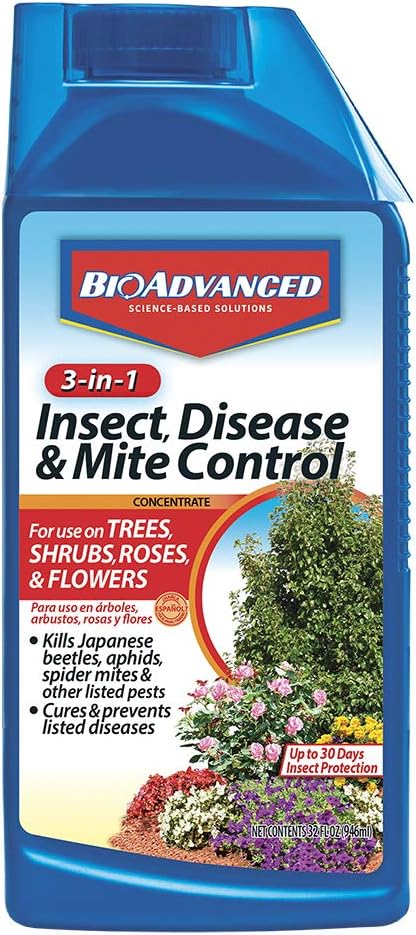
BioAdvanced 3-in-1 Insect, Disease & Mite Control Concentrate, 32 oz
| Unit Count | 32 Fluid Ounces |
|---|---|
| Item Type Name | Concentrate |
| Liquid Volume | 32 fluid ounces |
| Active Ingredients | Imidacloprid, Tau-fluvalinate, Tebuconazole |
| Specification Met | EPA |
This BioAdvanced concentrate is designed as an all-purpose plant treatment that kills listed insects on contact, controls common fungal diseases, and suppresses spider mites in one product. You mix the concentrate with water to make spray solution (it yields up to about 12 gallons), then apply to roses, flowers, shrubs, trees, and other ornamentals. Key active ingredients—imidacloprid, tau-fluvalinate, and tebuconazole—deliver systemic, rainproof protection that the label says can last up to 30 days. For mite control specifically, the miticide component gives both suppression and residual activity, so it is useful for follow-up sprays during an outbreak. Practical benefits include fewer separate products to buy and the convenience of treating multiple problems with one application. Important limitations are regulatory restrictions that make it unavailable in several states and the need to follow label safety precautions because it contains systemic insecticide active ingredients that can affect non-target insects if misused.
Best for: Gardeners who want a single, practical product to manage insect pests, fungal diseases, and spider mites on roses and ornamentals and who prefer a preventive residual treatment.
Less Ideal for: Organic gardeners or those managing pollinator-attractive plantings who avoid systemic insecticides should choose non-systemic or organic miticide and fungicide options instead.
- Combines insecticide, fungicide, and miticide in one concentrate for fewer products to store and apply
- Systemic formulation with rainproof protection that can last up to 30 days after application
- Makes up to 12 gallons of spray from a 32 fl oz bottle, suitable for treating multiple plants or repeat applications
- Active ingredients target a broad list of pests including aphids, spider mites, Japanese beetles and common foliar diseases
- Not available for sale in several U.S. states, limiting where it can be used
- Contains systemic insecticides that require careful adherence to label directions to avoid harming beneficial insects
Verdict: If you want one dependable product to both kill spider mites and prevent common foliar diseases across roses and ornamentals, this 3-in-1 concentrate simplifies treatment with a month-long systemic residual.
Garden Safe Insecticidal Soap Ready-to-Use Spray, 32 oz

| Item Form | Spray |
|---|---|
| Target Species | Insects |
| Liquid Volume | 32 fluid ounces |
| Active Ingredients | Potassium Salts Of Fatty Acids |
Garden Safe Insecticidal Soap is a ready-to-use contact spray formulated with potassium salts of fatty acids to control aphids, mealybugs, mites, whiteflies and similar soft-bodied pests. You use it like a normal garden spray: thoroughly coat insects and all plant surfaces including undersides of leaves, ideally in calm weather and not in full sun. It is safe for use on vegetables, fruit trees, ornamentals, shrubs, flowers and in greenhouses and may be applied to edibles up to the day of harvest, which simplifies timing for vegetable growers. The spray works on direct contact so thorough coverage is essential and multiple applications may be needed for heavy infestations. The product is convenient because no mixing is required, but it can be washed off by rain and is hazardous to aquatic invertebrates so care is needed to avoid runoff into water. For routine control of common garden pests this soap is a practical, low-toxicity option when used as part of an integrated pest management approach.
Best for: Gardeners who prioritize practical, low-toxicity pest control and want a ready-made spray that can be used on edible crops without pre-harvest delays.
Less Ideal for: People needing a long-residual or systemic pesticide for heavy infestations or for pests hidden inside plant tissues should consider other control methods.
- Ready-to-use formula requires no mixing for quick spot treatments
- Labeled for use on vegetables and may be applied up to the day of harvest
- Controls a broad list of soft-bodied pests including aphids, mites and whiteflies
- Plant-safe when used as directed and usable indoors, outdoors and in greenhouses
- Only kills pests by direct contact so it has limited residual or systemic activity
- Can be washed off by rain and must be reapplied after watering or heavy rainfall
- Harmful to aquatic invertebrates so it requires careful application near water
Verdict: A convenient, low-toxicity ready-to-use soap spray that gives effective contact control of common soft-bodied garden pests and is safe to use up to harvest.
ferti-lome Horticulture Oil Ready to Spray, Canola Oil Concentrate (32 oz)

| Unit Count | 32 Fluid Ounces |
|---|---|
| Item Form | Oil |
| Target Species | Fungus |
| Specification Met | OMRI |
This ferti-lome horticulture oil is a canola-oil based concentrate intended for routine pest and mildew management on ornamentals and edibles. Mixed to label strength and applied as a foliar spray, it smothers soft-bodied insects and can help suppress powdery mildew, making it useful for treating scale and other sap-sucking pests on magnolia. The product is OMRI listed which supports use in organic systems, and the concentrate format lets you treat multiple trees or repeat applications through the season. Practical benefits include flexible use on roses, flowers, vegetables and trees plus a straightforward dilution rate printed on the label. Limitations to consider are that horticultural oil works best with thorough coverage and during appropriate temperature windows to avoid plant stress, and it is a contact control so it may require repeat applications to handle established infestations. For reliability-focused gardeners it is a predictable, organically acceptable option when used according to directions.
Best for: Gardeners who prioritize dependable, organically acceptable treatments for recurring scale and other sap‑sucking pests and who are willing to follow label dilution and timing for repeat sprays.
Less Ideal for: People wanting a one‑and‑done systemic solution or those who cannot apply thorough foliar coverage during recommended temperature windows.
- OMRI listed for use in organic gardening
- Controls a variety of crawling insects and suppresses powdery mildew
- Concentrate allows multiple treatments from a single bottle
- Suitable for use on trees, roses, flowers, fruits and vegetables
- Requires thorough coverage and proper timing for effective control
- Contact‑only action means multiple applications may be needed for heavy infestations
Verdict: A reliable OMRI‑listed horticultural oil concentrate for gardeners who need an organic, repeatable foliar treatment to control magnolia scale and similar pests.
Bonide Systemic Insect Control Granules, 4 lb

| Unit Count | 64 Ounce |
|---|---|
| Item Form | Granules |
| Target Species | Insects |
| Special Features | Ready-to-Use |
| Active Ingredients | Imidacloprid |
Bonide Systemic Insect Control Granules are a low-odor, ready-to-use granular treatment that you apply to the soil around outdoor ornamental plants to protect them from sap-feeding pests such as scale, aphids, mealybugs, and whiteflies. The granules are absorbed by roots and move through the plant, so insects are controlled when they feed rather than by contact. It is simple to use: sprinkle the product on the soil, mix in lightly, water to activate, and reapply about every eight weeks if needed. The systemic action means protection is not removed by watering and gives multi-week control without frequent spraying. Important limitations are that it contains imidacloprid and is not labeled for edible plants, and it can affect insects that feed on treated plants so care is needed around pollinator-friendly plantings. For gardeners managing recurring scale infestations on ornamentals, this product offers straightforward, long-lasting control, but it should be used according to label directions to minimize non-target impacts.
Best for: Gardeners who want an easy, low-maintenance way to protect ornamental shrubs and potted plants from recurring sap-feeding insects and prioritize multi-week control with minimal repeat applications.
Less Ideal for: People who need insect control for vegetables, herbs, or fruit-bearing plants or who must avoid neonicotinoid insecticides for pollinator-sensitive plantings.
- Systemic action provides plant-wide protection for up to eight weeks after application
- Ready-to-use granules are low odor and simple to apply to soil around ornamentals
- Effective against common sap-feeding pests including scale, aphids, mealybugs, and whiteflies
- Contains imidacloprid and is not for use on edible plants
- Will not control pests that do not feed on plant sap or pests on non-treated surfaces
Verdict: A convenient, long-lasting granular systemic treatment for controlling scale and other sap-feeding insects on ornamental plants.
BioAdvanced 12 Month Tree & Shrub Protect and Feed Concentrate, 32 oz

| Item Form | Liquid |
|---|---|
| Target Species | Adelgids, Aphids, Japanese Beetles, Whiteflies, Scale |
| Liquid Volume | 32 fluid ounces |
| Specification Met | EPA |
This concentrate is a root-applied systemic insecticide and fertilizer designed to protect trees and shrubs for up to one year with a single application. You mix the product and apply it to the soil around the root zone so the active ingredient is taken up and distributed through the plant, which means no foliar spraying is needed. It targets sap-sucking and chewing pests listed on the label, including adelgids and scale, and supplies slow-release nitrogen to support plant vigor and new growth. For someone dealing with recurring scale problems on magnolia, the systemic action and long protection period reduce the need for frequent treatments and reach new growth that foliar sprays can miss. Limitations include legal restrictions in several states where the product cannot be sold or used and the inclusion of imidacloprid as the active ingredient, which some gardeners avoid for environmental reasons. Read and follow label directions carefully to ensure correct dosing and site eligibility.
Best for: Gardeners who prefer a low‑maintenance, long‑lasting systemic treatment for recurring scale on ornamental trees and shrubs and who prioritize convenience and season‑long protection.
Less Ideal for: People in states or counties where the product is restricted, or gardeners who want insecticides without neonicotinoid active ingredients should look for alternatives.
- Systemic uptake provides season‑long protection to new growth without foliar spraying
- Single application lasts up to 12 months, reducing repeat treatments
- Includes slow‑release fertilizer to improve tree and shrub vigor
- Soil application is straightforward to mix and apply to the root zone
- Contains imidacloprid, which some gardeners limit due to environmental concerns
- Not legal for sale or use in multiple states and some New York counties
Verdict: Use this product when you want a single, root‑applied systemic treatment that protects magnolias and other shrubs from scale and restores vigor for up to a year.
Choosing the Right Insecticide for Magnolia Scale: Key Factors to Consider
Mode of Action and Targeted Life Stage
Magnolia scale has distinct life stages, and insecticide effectiveness often depends on hitting the vulnerable crawler stage. Some active ingredients work primarily on contact and require direct spray of crawlers, while others are systemic and can be taken up by the tree to affect feeding adults. Understanding which stage the product controls determines timing and whether multiple treatments will be needed.
If you treat only when adults are present with a contact spray, you may miss the microscopic crawlers that reinfest. Systemic options can extend protection through the feeding cycle but require proper timing for uptake and movement within the tree. Match the mode of action to the scale biology in your region for the best results.
Tree Size, Age, and Application Rate
Application rates and techniques differ for saplings, small ornamental magnolias, and large established trees. A product labeled for trunk and soil drench may be suitable for a mature specimen if you can apply the recommended volume for the root zone. Foliar sprays work for smaller trees where thorough canopy coverage is achievable.
Overdosing on a mature tree can increase phytotoxicity risk, and underdosing on a large root zone may produce poor control. Consider how you will reach the canopy, whether you can safely spray from the ground or need professional equipment, and whether the label provides clear guidance for tree size.
Residual Activity and Reapplication Interval
Residual duration determines how often you need to reapply and whether a single season of treatment will cover the scale life cycle. Short-residual contact products can provide quick knockdown but often require timed follow-up to catch later crawlers. Longer-residual or systemic chemistries reduce reapplications but may take longer to show visible decline in scale populations.
Plan treatments around crawler timing in your area and check label guidance on intervals. Longer residuals help manage reinfestation pressure from neighboring trees but may increase non-target exposure.
Non-target Effects and Pollinator Safety
Many insecticides can harm beneficial insects, including predatory beetles and parasitoids that naturally reduce scale populations, plus pollinators if sprays contact blooms. Consider product labels for pollinator protection statements and avoid spraying flowering tree parts when pollinators are active. Products applied as soil drenches or systemic trunk applications can lower direct contact risk to foraging insects but still may be present in nectar or pollen depending on chemistry.
Use targeted application methods and timing to minimize harm. Read label restrictions on flowering periods and buffer zones, and prefer options with a lower documented impact on beneficials when available.
Application Method and Equipment Needs
Different formulations require different equipment and skill. Ready-to-use hose-end or spray concentrates are convenient for small yards, while soil drenches, trunk injections, or professional sprays may need specialized gear. The chosen method affects how uniformly the product reaches feeding scale on branches, trunks, and the canopy.
Think about access to the tree, ability to achieve thorough coverage, and whether you can meet dwell time, agitation, or surfactant requirements. The easiest product to apply often leads to better real-world control because treatments are more likely to be done correctly and on time.
Environmental Conditions and Plant Stress
Heat, drought, and recent transplanting change how a magnolia responds to insecticide treatment. Stressed trees are more prone to phytotoxicity and may absorb systemic products differently, altering efficacy. Rain can wash off contact sprays and shorten residual activity, while cold snaps can slow systemic uptake.
Plan applications during favorable weather windows and follow label guidance about stress conditions. Avoid treatments during extreme heat or drought unless the label explicitly permits it.
Timing Treatments Around Scale Activity
Effective control starts with timing. Magnolia scale produces crawlers at specific times of year depending on climate, and contact insecticides are most effective when crawlers are active and exposed.
Monitor your tree for new sticky honeydew, cast skins, or tiny moving crawlers on the undersides of leaves and stems. If you cannot confirm crawler activity, consider systemic options timed to precede feeding or consult local extension resources for phenology in your area.
- Look for honeydew and sooty mold as early warning signs
- Use sticky tape or a hand lens to check for crawlers beneath leaves
- Coordinate follow-up treatments to catch late-emerging crawlers
Application Techniques for Canopy and Trunk
Getting product to the feeding site matters. For small trees, a thorough foliar spray that wets branches and undersides of leaves can reach many scale insects. For larger trees, trunk sprays, basal soil drenches, or systemic options that move in the sap stream may be more practical.
When spraying, aim for even coverage while avoiding runoff. For soil drenches, follow label directions for the water volume needed to move the active ingredient into the root zone without causing pooling or runoff.
- Use adjustable nozzles to reach different canopy heights
- Consider a surfactant if the label permits to improve wetting
- Avoid spraying during high wind or rain to reduce drift
Minimizing Harm to Beneficial Insects
Beneficial predators and parasitoids help suppress scale populations naturally. Opt for treatment timings and methods that reduce exposure to foraging beneficials and pollinators. Avoid foliar sprays during bloom and apply late in the day when pollinator activity is lower.
If you use systemic treatments, be aware of label guidance on flowering and nectar safety. Combining targeted application with cultural practices such as pruning heavily infested limbs can reduce the need for broad sprays.
- Apply treatments when pollinators are least active
- Target trunk or soil applications to reduce direct contact
- Record treatment dates to avoid overlapping with bloom periods
Integrating Cultural Controls
Chemical control is most effective when combined with cultural practices. Regular pruning to remove heavily infested branches reduces the population and improves spray penetration. Maintaining tree health with proper watering and mulching makes magnolias less susceptible to severe scale outbreaks.
Sanitation around the tree, including cleaning sticky honeydew from surfaces and removing dropped infested material, reduces local reinfestation sources and supports long-term management.
- Prune out heavily infested limbs during dormancy or when safe
- Keep trees well watered during heat to reduce stress
- Clean up fallen debris that may harbor scale stages
Recordkeeping and Follow-up Inspections
Track what you applied, when, and where on the tree. Detailed records help you evaluate whether the chosen approach is reducing scale numbers and inform timing for follow-up treatments. Inspect the tree at regular intervals after treatment to catch survivors or new crawler waves.
If control is incomplete after the recommended interval, consider whether application coverage, timing, or product selection explains the shortfall before reapplying. Repeated unnecessary applications can increase non-target impacts and stress the tree.
- Log dates, formulations, dilution rates, and weather at application
- Inspect monthly during active seasons for signs of new activity
- Adjust timing based on observed crawler emergence, not fixed calendar dates
How We Chose the Best Insecticide for Magnolia Scale
We focused on products and formulations that are commonly recommended by plant health specialists for armored and soft scales on ornamental trees and that offer practical use in home landscapes. Evaluation emphasized modes of action effective against crawler stages and adults, application formats gardeners can use on established magnolias, and documented residual activity appropriate for the typical scale life cycle. We also weighed plant safety, including labeled rates for mature ornamentals and known phytotoxicity risks under heat or drought stress. Application safety for non-targets and restrictions around pollinators were another key filter, as was the availability of formulations that allow targeted trunk or canopy treatment. Exclusions included products without clear labeling for ornamental trees, insecticides formulated only for agricultural use without homeowner directions, and dormant oils or biologicals that lack sufficient residual control for larger infestations. The final shortlist balances contact and systemic chemistries, different carrier formats, and practical pros and cons gardeners face when treating magnolia scale. This approach ensures the scoring criteria reflect real decisions: efficacy against magnolia scale life stages, tree safety, application ease, residual duration, and non-target impact.
FAQ
When is the best time to treat magnolia scale?
Treatment timing depends on crawler emergence, which varies by region. Often the most effective time is during the crawler period when young scales are mobile and vulnerable. If you cannot monitor crawlers directly, target systemic applications ahead of expected feeding windows or follow local extension recommendations.
Can I use dormant oil alone to control magnolia scale?
Dormant oils can suppress exposed eggs and some overwintering stages but often do not provide sufficient season-long control against heavy infestations. Dormant oil is most effective as part of an integrated plan paired with timed summer treatments aimed at crawlers.
Will systemic insecticides harm my magnolia tree?
Systemic insecticides are generally safe when used at labeled rates, but stressed trees can be more sensitive. Follow label directions for application timing and rates, and avoid treating during extreme heat or drought unless the product label explicitly allows it.
How many treatments are typically needed to control an outbreak?
Control often requires at least one properly timed treatment during crawler activity and possibly a follow-up to catch late-emerging individuals. The exact number depends on infestation severity, product residual, and how well the application reached feeding sites.
Are there non-chemical ways to reduce magnolia scale?
Yes. Pruning out heavily infested branches, improving tree vigor with proper watering and mulching, and encouraging natural enemies can reduce scale pressure. These approaches work best combined with targeted chemical treatments when needed.
How can I protect pollinators when treating my magnolia?
Avoid spraying during bloom and apply treatments late in the day when pollinator activity is lower. Choose application methods that limit drift and direct contact, such as trunk or soil applications if the label allows.
Final Verdict
Choosing an insecticide for magnolia scale requires balancing rapid knockdown with long-term control and minimizing harm to the tree and beneficial insects. Prioritize treatments that match the pest life stage, fit your tree size and access, and offer an acceptable residual duration for your infestation level. Combine chemical options with cultural practices like pruning and sanitation to reduce reinfestation and the number of treatments needed. With careful timing, application, and recordkeeping you can regain tree vigor while limiting non-target impacts.
