

Note: This article contains affiliate links. If you click on these links and make a purchase, I may earn a small commission at no extra cost to you. This helps support my research and content. Read my full affiliate disclosure here.
If you are dealing with wood-boring insects in decks, fence posts, gazebo timbers, or ornamental trees, the right insecticide can stop further damage and protect exposed wood. You need products that reach larvae inside wood, provide lasting residual protection, and are safe to apply in the intended setting. This guide shortlists the top seven insecticide options for wood borers and explains the practical differences that matter in the garden and around structures. Below we evaluate each product for penetration, residual activity, ease of application, and site safety so you can pick the option best suited to the infestation type and location.
Top Picks at a Glance
| Best Overall The best all-around choice for most situations | BASF Termidor Foam 20 oz Termiticide/Insecticide |  |
| Best Quality Built to a higher standard if you want something more solid | Bora-Care Borate Wood Treatment Concentrate by Nisus |  |
| Best Value The sweet spot between price and what you get | Rust-Oleum Wolman WOODLIFE CopperCoat Green Wood Preservative (Quart) |  |
| Best Budget The cheapest option that still gets the job done reliably | Nisus Tim-BOR Professional Borate Powder, 1.5 lb |  |
| Highest Rated A top-rated pick with lots of positive feedback | Bora-Care Borate Termiticide/Insecticide Concentrate (4 gallons) |  |
| Most Popular A crowd favorite that many people choose with confidence | Nisus Bora-Care Termiticide & Wood Treatment Concentrate, 1 Gallon |  |
| Best Seller A high-volume bestseller chosen again and again | Ferti-lome Tree & Shrub Drench Systemic Insecticide, 1 gal |  |
BASF Termidor Foam 20 oz Termiticide/Insecticide

| Item Form | Spray |
|---|---|
| Target Species | Insects, Termite, Ant, Wood Boring Bugs |
| Special Features | Fast-Acting, Long-Lasting, Non-Staining |
| Liquid Volume | 20 fluid ounces |
| Specification Met | EPA |
Termidor Foam is a professional-grade ready-to-use foam termiticide and insecticide that expands to reach voids, galleries, and nests where wood-destroying pests hide. You apply it directly from the can into wall voids, damaged wood, fence posts, tree cavities, and other hard-to-reach harborages; the formula sprays as a dry foam that expands about 30:1 so a small amount covers a relatively large area. The active ingredient fipronil is non-repellent, which means insects do not detect it and can transfer it through contact or ingestion for colony-level control. Notable strengths are the foam’s strong cell walls that resist breaking and the long-lasting action suitable for spot treatments and targeted remediation of carpenter ants and termites. Important limitations are that this is a spot-treatment product rather than a perimeter or whole-structure soil treatment and it requires careful reading of label directions and safety precautions before indoor or outdoor use. Users seeking a single-spray full-structure barrier should consider complementary products or professional application.
Best for: Buyers who prioritize fast, professional-level elimination of carpenter ants and termites in localized infestations and who are comfortable following label directions for targeted spot treatments.
Less Ideal for: Homeowners needing a whole-structure or soil barrier treatment or those who prefer non-chemical control methods should consider other approaches or professional services.
- Ready-to-use foam expands 30:1 to penetrate voids and galleries for targeted application
- Contains fipronil non-repellent active ingredient for contact and transfer effects against colonies
- Dry foam formulation with thicker cell walls resists breaking and remains in place longer than many aerosols
- Designed for localized spot treatments rather than full perimeter or soil applications
- Contains a professional-grade insecticide that requires strict adherence to label safety and application rules
Verdict: For precision, professional-strength spot treatment of carpenter ants and termites, Termidor Foam delivers fast, non-repellent colony control in hard-to-reach voids.
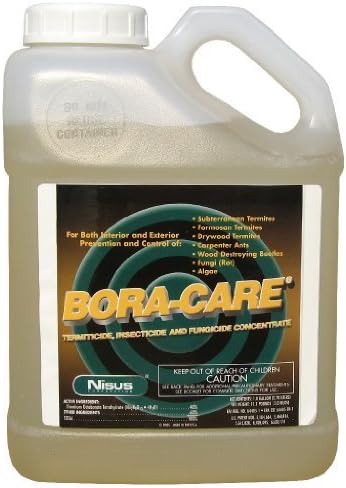
Bora-Care Borate Wood Treatment Concentrate by Nisus
| Brand | Nisus |
|---|---|
| Unit Count | 128 Fluid Ounces |
| Target Species | Insects |
Bora-Care is a professional-strength borate concentrate intended for treating and protecting structural wood against drywood termites, wood-boring beetles, carpenter ants, and decay fungi. Mixed with water and applied to exposed wood or injected into galleries, it penetrates wood fibers to provide long-lasting protection rather than just surface kill. The product is commonly used during construction, for remediation of infested framing, or as a preventive treatment in attics, crawl spaces, and exposed timbers. Its key advantage is residual efficacy reported for decades because borates remain in the wood and are not repelled by water once absorbed. Practical benefits include broad insect and fungal coverage and suitability for both residential and commercial applications. Important limitations are that it requires correct mixing and application equipment, does not provide a quick-contact spray for foraging insects, and treated wood must be exposed or accessible for thorough penetration to be effective.
Best for: Buyers who prioritize long-term, performance-oriented protection for structural wood and need a professional-strength treatment for new construction or remediation projects.
Less Ideal for: Casual homeowners wanting a ready-to-use surface spray for immediate control or those who need treatment where wood is inaccessible or already sealed.
- Borate chemistry penetrates and remains in wood for long-term protection
- Effective against a broad range of wood-destroying pests and decay fungi
- Concentrated formula suitable for treating large areas or structural timbers
- Appropriate for use in both residential and commercial building applications
- Requires correct mixing and application method to achieve penetration and effectiveness
- Not a quick-contact surface spray for active, foraging insects
Verdict: Choose Bora-Care when you need a professional-grade, long-lasting borate treatment to protect structural wood from borers, termites, and decay fungi.
Rust-Oleum Wolman WOODLIFE CopperCoat Green Wood Preservative (Quart)

| Unit Count | 32 Fluid Ounces |
|---|---|
| Coating Description | Green Wood Protective, Water-Based, Insecticidal, Fungicidal |
| Coverage | 30-100 square foot |
| Recommended Uses For Product | Exterior, below-ground, ground-contact, fresh-water contact |
Rust-Oleum Wolman WOODLIFE CopperCoat is a ready-to-use, water-based preservative designed to protect both untreated and pressure-treated exterior wood where insect and fungal attack is a concern. It is typically brushed, rolled, or dipped onto posts, landscape timbers, fence end cuts, docks and similar installations to inhibit termites, powderpost beetles, carpenter ants and decay fungi. The formula includes insecticidal and fungicidal actives and leaves a transparent green tint that fades with weathering; the product is paintable or stainable after application. Coverage is listed roughly 30 to 100 sq ft per quart depending on wood porosity, so a quart suits spot treatments, end cuts and small projects rather than large decks. Because it is water-based it is easier to clean up and safer to handle than solvent products, but multiple coats or generous application may be needed for long-term below-ground protection. The preservative is versatile for below-ground and fresh-water contact use but does not replace pressure treatment for structural lumber in heavy-exposure settings.
Best for: Buyers who want a practical, ready-to-use preservative to treat end cuts, posts and small exterior wood projects to reduce insect and fungal damage without specialized equipment.
Less Ideal for: Contractors or homeowners planning to preserve large structures or replace pressure-treated lumber should consider commercial pressure treatments or larger-volume industrial preservatives.
- EPA-registered insecticidal and fungicidal formula targets termites and common wood-boring insects
- Ready-to-use water-based product simplifies application and cleanup
- Transparent green tint makes coverage visible while remaining paintable and stainable
- Suitable for below-ground, ground-contact and fresh-water contact applications
- Quart size provides limited coverage so multiple cans are needed for large projects
- Visible tint may not be desirable for finished or decorative wood surfaces
Verdict: Use this ready-to-use, EPA-registered, water-based preservative when you need a practical, easy-to-apply treatment to protect small exterior or ground-contact wood pieces from termites and decay.
Nisus Tim-BOR Professional Borate Powder, 1.5 lb

| Unit Count | 24 Ounce |
|---|---|
| Item Form | Powder |
| Target Species | Fungus |
| Liquid Volume | 1.5 liters |
| Specification Met | EPA |
Tim-BOR Professional is a borate-based powder formulated to protect and remediate wood against drywood termites, carpenter ants, wood-boring beetles, and wood decay fungi. You can mix it into a 15% liquid solution for pressure treatment or new construction, apply it as a dust into cracks and voids, or use it in foam and mist equipment to reach hidden cavities. Because it is water-soluble and borate-based it penetrates cellulose and remains active in untreated wood without staining or corroding fasteners. Practical benefits include long-term preventive protection on new lumber and targeted control in infestations where direct wood contact is possible. Limitations are that it must be used only on bare, unsealed wood and is less effective where wood is painted, heavily varnished, or inaccessible without drilling or opening structures. Also it requires careful mixing and label compliance for safe, effective results.
Best for: Homeowners and small contractors looking for an affordable, long-lasting wood preservative to prevent or treat wood-boring insects in exposed or accessible wood, especially during new construction or repairs.
Less Ideal for: Those needing a surface-only spray for painted or sealed wood or users who cannot access interior voids without structural work should consider other solutions.
- Multiple application methods: dust, liquid, foam, or mist to reach surface and hidden wood areas
- Penetrating borate formula provides long-lasting protection against wood decay and common wood-boring insects
- Won't discolor or corrode wood fasteners so treated lumber stays visually and structurally intact
- Only effective on bare, untreated wood and cannot be used on painted or sealed surfaces
- Requires correct mixing and application equipment for liquid or foam uses
Verdict: Choose Tim-BOR if you want a cost-effective, penetrating borate treatment that delivers durable protection and control for exposed or accessible wood against wood-boring insects.
Bora-Care Borate Termiticide/Insecticide Concentrate (4 gallons)

| Brand | ARTSTAR |
|---|---|
| Unit Count | 1 Count |
| Item Weight | 12 pounds |
| ASIN | B004HFVFLC |
Bora-Care is a borate concentrate formulated to protect wood from termites, wood-boring beetles, and decay fungi. It is designed to be mixed and applied to structural lumber, timbers, or infested wood surfaces using a sprayer or similar application equipment. The active borate penetrates wood fibers to create a long-lasting toxic barrier that resists insect attack and fungal growth rather than merely repelling pests. Practical benefits include broad activity against common wood-destroying insects and a preservative effect that can extend the usable life of treated wood. Because it is a concentrate, a single 4-gallon container supplies a large treatment area, which is economical for whole-structure or larger restoration projects. Important limitations are that it requires proper mixing and application equipment and protective measures, and it only protects wood that it contacts or penetrates so existing deep infestations may need removal or supplemental treatments. It is not a quick surface spray solution for general household pests and is intended for targeted wood preservation and remedial work.
Best for: For homeowners, contractors, or restorers who prioritize a proven, preservative-grade solution for protecting structural wood and want a product that delivers long-term insect and fungal control when properly applied.
Less Ideal for: Not the best choice for casual spot treatments of household pests, small DIY jobs without proper application gear, or users seeking an immediate knockdown surface spray.
- Borate chemistry provides long-lasting protection against termites, wood-boring beetles, and decay fungi
- Concentrated 4-gallon supply is economical for treating large areas or entire structures
- Penetrates and preserves wood fibers rather than only masking infestations
- Suitable for preventive treatment of new lumber and remedial treatment of exposed wood surfaces
- Requires correct dilution and application equipment and safety precautions
- Will only protect wood that it directly contacts or penetrates, not hidden voids or inaccessible galleries
Verdict: Choose this concentrated borate treatment when you need a reliable, long-lasting preservative that protects wood from borers and decay across large or structural projects.
Nisus Bora-Care Termiticide & Wood Treatment Concentrate, 1 Gallon

| Unit Count | 128 Fluid Ounces |
|---|---|
| Item Form | Spray |
| Target Species | Insects |
| Active Ingredients | disodium octoborate tetrahydrate |
Bora-Care is a professional-strength borate concentrate designed to treat wood directly for long-term protection against dry wood and subterranean termites as well as wood-boring insects and decay fungi. You mix the concentrate and apply it to exposed framing, sills, joists, and other accessible wood areas using a sprayer or brush, treating key entry points with a two-foot band or whole-structure applications during construction. The active ingredient disodium octoborate tetrahydrate penetrates the wood and remains active for the life of the treated wood, so a single properly applied treatment provides lasting residual protection without repeated soil injections. It is advantageous for both new construction and retrofits because it keeps chemicals out of the soil and is suitable for sensitive sites like lakeside properties. Important limitations are that it only protects treated wood surfaces and requires correct mixing and application technique to reach labeled coverage rates, and it will not control termites already established inside inaccessible wood without professional inspection and corrective work.
Best for: Homeowners focused on long-term structural protection who want a professional-grade wood treatment to prevent termite and wood-destroying insect damage, especially during construction or when treating exposed structural members.
Less Ideal for: Those who need a fast-acting surface spray or a treatment for termites already deep inside concealed wood where structural repairs or fumigation are required; inexperienced users uncomfortable with mixing concentrates may prefer professional application.
- Penetrating borate chemistry provides long-lasting residual protection in treated wood.
- Concentrated formula covers large areas (about 800 sq ft per gallon concentrate) when mixed correctly.
- Suitable for new construction and retrofit applications, including sensitive sites where soil treatments are undesirable.
- Applies with standard sprayers or brushes for targeted band or whole-member treatments.
- Only protects wood that is directly treated and will not reach concealed infestations.
- Requires proper mixing, application rate, and safety precautions to be effective.
- Not a quick knockdown insecticide for live active infestations inside inaccessible voids.
Verdict: Buy this if you want a single professional-strength wood treatment that provides long-lasting, in-wood protection against termites and other wood-destroying insects.
Ferti-lome Tree & Shrub Drench Systemic Insecticide, 1 gal

| Item Form | Liquid |
|---|---|
| Target Species | Insects |
| Liquid Volume | 128 fluid ounces |
| Unit Count | 128 Fluid Ounces |
Ferti-lome Tree & Shrub Drench is a liquid concentrate designed to be mixed with water and poured around the base of trees or shrubs so the active ingredient is taken up systemically. It is typically used once a year in early spring or early fall to protect woody plants from a range of insects including aphids and psyllids, with label claims of up to 12 months of protection. The product comes as a 1 gallon concentrate that lets you measure dilution per the label (trees: 1 oz per inch of trunk circumference per gallon; shrubs: 3 oz per foot of height per gallon) and treat multiple plants. Practical benefits include long residual protection that reduces repeat spraying and a simple soil drench application that avoids foliar contact. Important limitations are that you must follow label directions for rates and safety, it is intended for outdoor residential use only, and systemic uptake means results vary with tree health and soil conditions. It is not a spot spray solution for immediate knockdown and is only one application per year when used as directed.
Best for: Buyers who want a low-effort, once-a-year preventive treatment for landscape trees and shrubs and who prioritize products with documented label directions and long residual control.
Less Ideal for: Gardeners who need rapid knockdown, spot treatments, or products for indoor plants should consider alternatives designed for fast contact control or different application methods.
- Systemic formulation provides up to 12 months of protection after a single drench
- Concentrated 1 gallon size treats multiple trees and shrubs when mixed per label
- Simple soil drench application avoids foliar spraying and is easy to apply
- Label includes clear dilution guidance for trees and shrubs
- Effectiveness depends on tree health and soil uptake so results can vary
- Not intended for immediate knockdown of active infestations or indoor use
Verdict: Choose this systemic drench if you want a single annual, soil-applied treatment to provide season-long insect protection for landscape trees and shrubs.
Choosing the Right Insecticide for Wood Borers: Key Factors to Consider
Penetration and Wood Uptake
Wood-boring larvae live inside wood where surface-only treatments often fail. A product that penetrates sapwood or is absorbed by timber reaches larvae deeper in galleries. Consider whether the formulation is labeled for surface spray, pressure injection, or systemic uptake through living trees. For structural timbers, look for treatments that mention deep penetration or that are formulated to move into the wood grain.
Even when a product lists penetration properties, actual uptake depends on wood species, moisture content, and the age of the timber. Seasoned, dry wood is harder to impregnate than fresh or moisture-rich wood, so application method and frequency may need adjustment depending on site conditions.
Residual Duration and Environmental Persistence
Residual duration determines how long the product continues to kill newly emerging adults or newly hatched larvae after application. Longer residuals reduce the need for repeat treatments but can increase environmental exposure. Assess how long the active ingredient remains effective on or in wood under sun, rain, and temperature extremes common in your area.
For outdoor structural wood, UV breakdown and wash-off from rain will shorten surface residuals. Products designed for deeper penetration or labeled for injection often offer longer effective protection. Balance the desired residual length with the setting: shorter residuals may be preferable near pollinator-attractive plants, while longer residuals matter in inaccessible timbers.
Application Method and Accessibility
The available application methods-brush-on, spray, pressure injection, or trunk injection-affect how well you can treat the infested area. Surface sprays are easiest for homeowners but may not reach bored galleries. Injection or pressure-applied treatments require more equipment and sometimes a professional but deliver active ingredient inside the wood where larvae reside.
Think about access to the infestation. For small sections of damaged decking, spot treatments or injected applications may be practical. For large structures or trees, consider whether the product is compatible with common application tools and whether repeated access to the site is feasible.
Target Species and Mode of Action
Wood-boring insects include a range of species with different life cycles and behaviors. Some respond best to contact toxins while others are controlled by systemic products that are taken up by living wood. Choose a product whose label lists the specific borer species or at least the borer type you are facing.
Understanding mode of action also helps manage resistance and non-target impacts. Rotating between modes of action for repeated treatments may be necessary in areas with persistent infestations. Always follow label guidance on retreatment intervals and resistance management where provided.
Site Safety and Label Restrictions
Safety on the application site matters for both people and desirable plants. Read label restrictions about use near edible crops, water bodies, and pollinator-attractive vegetation. Some formulations carry limits on use around children, pets, or occupied structures and require personal protective equipment during application.
Professional-only or restricted-use products may be more potent but can require certified applicators. For homeowner-applied treatments, prefer products with clear, practical directions and safety margins appropriate for residential and landscape settings.
When to Treat Versus When to Replace
Assess the extent of structural damage before committing to insecticide treatment. Small, localized galleries and active infestation signs such as fresh frass or new emergence holes can often be controlled with targeted treatments. When wood is structurally compromised, repair or replacement is usually safer than relying solely on chemical control.
For landscape trees, evaluate whether the infestation is limited to a few limbs or is systemic through the trunk. Treatments can save trees with limited damage, but heavily weakened trees may not recover even after successful pest control.
- Treat when infestation is recent and wood retains structural integrity.
- Replace severely weakened or crumbling timbers rather than relying only on chemicals.
- Combine removal of heavily infested material with targeted insecticide application to limit spread.
Application Safety and PPE Essentials
Follow label directions for personal protective equipment. For concentrated liquids, this typically includes gloves, long sleeves, eye protection, and sometimes a respirator. Proper PPE reduces exposure risk, especially during mixing and pressure applications.
Keep people and pets away from treated areas until the product has dried or according to label reentry intervals. For treatments near edible plants, adhere to harvest interval instructions or use physical barriers to prevent contamination.
- Wear chemical-resistant gloves and eye protection when mixing or applying.
- Avoid windy days for sprays to reduce drift onto non-target plants or areas.
- Plan containment for rinse water and avoid washing residues into storm drains.
Combining Mechanical and Chemical Controls
Mechanical removal of heavily infested wood, pruning of affected limbs, and exposing galleries to sunlight can improve treatment outcomes. Chemical controls are most effective when they have direct access to active larvae or freshly exposed wood.
In many cases, a combination approach reduces the number of applications needed and addresses both the current infestation and future reinfestation risk.
- Remove and replace severely damaged wood before treating surrounding areas.
- Prune and isolate infested tree sections to limit spread.
- Use targeted injections into galleries after removing loose frass for better penetration.
Treating Ornamental Trees Versus Structural Wood
Products intended for living trees often differ from those formulated for nonliving structural wood. Systemic injections and trunk drenches are common in arboricultural practice and can protect trees by moving active ingredients through living tissues. Structural wood treatments focus on residual surface or injected protection without relying on plant uptake.
Choose a product labeled for the exact use case. Misapplying a structural wood treatment to living trees can reduce effectiveness and create unnecessary exposure risks, while using a tree systemic on nonliving timber may not deliver the intended protection.
- Verify labeling for use on living trees when treating ornamental species.
- Use wood-specific formulations for decks, fences, and exposed timbers.
- Consider weather and seasonal timing for tree treatments to maximize uptake.
Timing and Seasonal Considerations
Apply treatments when the target life stage is most vulnerable. For many wood borers, adults are active in warm months and lay eggs in crevices; treating before peak adult emergence or during larval feeding windows increases effectiveness. Seasonal timing also affects wood moisture and therefore penetration.
In colder climates, perform structural treatments during dry seasons when wood is accessible and when application conditions minimize runoff. For trees, follow best-practice windows for trunk injections to support uptake without stressing the plant.
- Treat before or during early larval activity when control is most effective.
- Avoid treatments during heavy rain or extreme heat that can reduce efficacy.
- Schedule follow-up inspections aligned with the pest life cycle.
How We Chose the Best Insecticide for Wood Borers
We started by focusing on formulations and application methods that address the biology of wood-boring insects. Key evaluation criteria included contact and systemic activity to reach tunneling larvae, ability to penetrate or be absorbed by wood, and length of residual protection under outdoor conditions. We also measured practical application factors such as whether the product is suitable for spray, injection, or surface treatment, and how easily a typical homeowner or landscaper can apply it. Additional filters excluded products designed solely for foliage pests or for indoors-only use. We did not include products unsuitable for structural wood or those lacking clear directions for use against wood borers. Safety considerations were applied: products with restricted or professional-only labels for the same target pest were deprioritized unless they offered clear advantages for serious infestations. The final selection balances efficacy against wood-boring life stages, realistic on-site application, and safety and labeling appropriate for residential and landscape use.
FAQ
How do I know if the infestation is active or old damage?
Look for fresh, powdery frass, new emergence holes with clean edges, or active adults nearby. Old damage often has weathered hole edges and compacted frass. Regular inspections during the species' active season help identify fresh activity.
Can I treat borers in dry, weathered structural wood effectively?
Dry, seasoned wood is harder to impregnate, so surface treatments may be less effective. Injection or pressure-applied methods deliver active ingredient deeper, but accessibility and label directions determine viability. For extensively weathered wood, repair or replacement may be necessary.
Are systemic tree treatments better than surface sprays for borers?
Systemics can be more effective for living trees because they move through tissues to reach feeding larvae. Surface sprays may control adults and protect exposed wood but often do not reach internal galleries. The best choice depends on whether you are treating a living tree or nonliving timber.
How often should I reapply treatments to prevent reinfestation?
Reapplication intervals depend on product residual duration and environmental exposure. Some products require annual applications while others provide multi-year protection when properly applied. Follow label directions and inspect treated areas annually or after severe weather.
Can I use insecticide treatments near pollinator plants or vegetable gardens?
Many products have restrictions for use near pollinator-attractive plants or edible crops. Avoid spraying during bloom and follow label buffer zone and pollinator protection directions. When in doubt, use targeted applications and physical barriers to limit exposure to non-target plants.
Final Verdict
Choosing the right insecticide for wood borers depends on where the infestation is located, how deep the larvae are, and whether the wood is living or nonliving. Prioritize products that penetrate or are labeled for the specific use case, balance desired residual length with site safety, and select application methods you can perform correctly. When damage is extensive, combine chemical control with mechanical removal or replacement of compromised wood. Use labeling and safety guidance to minimize non-target impacts and to ensure treatments are applied effectively and responsibly.
