

Note: This article contains affiliate links. If you click on these links and make a purchase, I may earn a small commission at no extra cost to you. This helps support my research and content. Read my full affiliate disclosure here.
If your property includes steep slopes, choosing the right riding lawn mower for hills changes a routine chore into a safer, more controlled job. Mowing on inclines stresses the engine, transmission, and braking system more than flat turf, and the wrong machine makes footing, cut quality, and operator safety worse. This guide presents our shortlisted picks for riding lawn mowers for hills and explains the most important traits gardeners should weigh. We evaluated machines across traction, power delivery, deck control, and safety features to surface options suited to sloped yards. Read on to understand what matters and which features to prioritize before you pick a mower for steep terrain.
Top Picks at a Glance
| Best Overall The best all-around choice for most situations | Husqvarna TS354XD Riding Lawn Mower, 24 HP, 54-inch Deck |  |
| Best Quality Built to a higher standard if you want something more solid | Husqvarna TS 375XD Riding Lawn Mower, 54-inch Deck |  |
| Best Value The sweet spot between price and what you get | EGO Power+ TR4204 42" Electric Riding Lawn Mower |  |
| Best Budget The cheapest option that still gets the job done reliably | GIYI Electric Riding Lawn Mower with 42" Deck and Six 40V Batteries |  |
| Highest Rated A top-rated pick with lots of positive feedback | Husqvarna TS 120 42" Riding Lawn Tractor (19 HP Briggs & Stratton) |  |
Husqvarna TS354XD Riding Lawn Mower, 24 HP, 54-inch Deck

| Power Source | gasoline-powered |
|---|---|
| Cutting width | 54 inches |
| Operation Mode | Automatic |
| Maximum Adjustable Cutting Height | 10.2 centimeters |
| Material Type | Alloy Steel |
This Husqvarna TS354XD is a heavy-duty riding mower built for large yards and demanding conditions. It pairs a 24 horsepower engine with a 54-inch ClearCut cutting deck to cover ground quickly and deliver an even cut across wide swaths. The hydrostatic transmission and dash-operated electronic differential lock improve traction and control on slopes and uneven terrain, while the alloy steel frame, brush-guard bumper, and commercial-grade components are designed for frequent use. Comfort features such as a high vinyl seat and overmolded steering wheel make longer jobs less fatiguing. Practical limitations include its large footprint, which reduces maneuverability in tight yards, and its gasoline power and weight that require more maintenance and storage space than smaller electric or walk-behind mowers. This model is best when you need fast, consistent mowing and robust traction on hills rather than a compact machine for intricate landscaping tasks.
Best for: Homeowners with sizable, uneven or hilly lawns who prioritize speed, traction, and durability for regular heavy-duty mowing.
Less Ideal for: Owners of small, tightly landscaped yards or those seeking a lightweight, low-maintenance electric option should consider smaller or different mower types.
- Powerful 24 HP engine for fast mowing and handling thick grass
- Wide 54-inch ClearCut deck reduces passes and yields an even cut
- Hydrostatic transmission with electronic differential lock for improved traction on slopes
- Commercial-grade alloy steel frame and protective bumper for durability
- Comfort features like high vinyl seat and overmolded steering wheel for longer sessions
- Large footprint limits maneuverability in tight or densely landscaped yards
- Gasoline-powered design requires regular maintenance and dedicated storage
Verdict: Choose this mower if you need a powerful, durable machine that covers large, hilly lawns quickly with strong traction and commercial-style components.
Husqvarna TS 375XD Riding Lawn Mower, 54-inch Deck

| Power Source | Gas Powered |
|---|---|
| Cutting width | 54 |
| Operation Mode | Manual |
The Husqvarna TS 375XD is a purpose-built riding mower for heavy-duty yards and hilly properties. It pairs a 24 hp Kaw V-twin gasoline engine with a 54-inch three-blade fabricated deck to cover ground quickly while producing a clean cut. Notable user-facing features include dial-adjustable seat suspension for comfort over rough ground and a push-button locking differential to improve traction and control when climbing slopes or navigating uneven surfaces. In practice this mower is used for large properties where speed, stability, and operator comfort matter: the wide deck reduces mowing passes, the robust engine maintains speed under load, and the differential lock helps get through tricky spots. Important limitations are its size and weight, which require ample storage space and limit maneuverability in very tight yards, and the manual operation means basic controls rather than hydrostatic transmission automations. Expect solid hill performance and durable build quality at the expense of compactness and simplicity.
Best for: Buyers who prioritize performance and hill-handling for large, uneven properties and want a durable, operator-focused mower that maintains speed under load.
Less Ideal for: Small-lot owners, gardeners with many tight obstacles, or those who prefer compact, highly maneuverable or fully automated transaxle systems.
- Powerful 24 hp V-twin engine sustains speed under heavy load and on slopes
- 54-inch fabricated three-blade deck covers large areas quickly
- Dial-adjustable seat suspension improves operator comfort on rough terrain
- Push-button locking differential enhances traction and control on hills
- Large footprint and substantial weight make storage and tight-turn maneuvering difficult
- Manual operation lacks some convenience features found on higher-end hydrostatic models
Verdict: Choose the Husqvarna TS 375XD if you need a powerful, hill-capable riding mower that prioritizes speed, traction, and operator comfort on large, uneven lawns.
EGO Power+ TR4204 42" Electric Riding Lawn Mower

| Power Source | Battery Powered |
|---|---|
| Cutting width | 42 inches |
| Battery Average Life | 60 minutes |
| Number of Positions | 12 |
The EGO Power+ TR4204 is a cordless 42-inch riding mower designed to replace a gas tractor for homeowners who want quieter, lower-maintenance mowing. It combines up to six 56V ARC Lithium batteries to produce peak power the manufacturer says equals about 21 horsepower and can mow up to 1.5 acres on a single charge with the six included 6.0Ah batteries. Typical use is straightforward: mount the tractor, choose one of three blade settings and drive speeds on the digital LCD, set cruise control for long runs, and adjust the stamped-steel deck across 12 height positions from 1.5 to 4.5 inches. Practical advantages include dual brushless cutting motors that reduce belt maintenance, integrated LED lights and USB charging, and a rear hitch for hauling. On steep, hilly terrain you get instant torque from the batteries and multiple drive speeds for control, but battery life will depend on slope and workload and you may need additional batteries or recharges for large or very steep lots. The tractor comes with a five-year tool warranty and is best for owners prioritizing lower noise and simpler upkeep over traditional gas refueling.
Best for: Homeowners who want to replace a gas riding mower with a quieter, lower-maintenance electric tractor and who value configurable controls and decent single-charge range for about 1 to 1.5 acre properties.
Less Ideal for: Owners with large properties well over 1.5 acres, consistently steep or commercial-grade hills, or those who prefer unlimited runtime without managing battery swaps.
- Battery peak power up to the equivalent of a 21 HP gas engine using up to six 56V ARC Lithium batteries
- Dual brushless, belt-free cutting motors reduce routine maintenance
- Digital display with three blade settings, three drive speeds, and cruise control for easy customization
- 42-inch stamped steel deck with 12 height positions for versatile cut control
- Premium features such as LED lights, USB charging port, Bluetooth, and a rear tow hitch
- Runtime on hilly or heavy-cut conditions is limited and may require extra batteries for larger properties
- Relatively heavy unit may be harder to transport or store compared with compact mowers
Verdict: A practical electric substitute for a gas tractor that gives strong instant torque and easy customization for owners who need a low-maintenance mower for up to about 1.5 acres.
GIYI Electric Riding Lawn Mower with 42" Deck and Six 40V Batteries

| Power Source | Battery Powered |
|---|---|
| Cutting width | 42 inches |
| Number of Positions | 9 |
| Maximum Adjustable Cutting Height | 4.52 inches |
| Minimum Adjustable Cutting Height | 1.37 inches |
The GIYI electric riding mower is a battery-powered lawn tractor built for residential yards that need a capable, low-maintenance alternative to gas machines. It uses six 40V 6.0Ah lithium-ion batteries and a brushless motor to deliver up to 60–80 minutes of runtime and a top mowing speed near 6 mph, which the manufacturer says covers roughly 1.2 acres per charge. The 42-inch stamped-steel deck offers nine cutting height positions (about 1.5 to 4.5 inches) so you can adapt to different turf conditions, and the ergonomic low-back seat plus selectable speeds make it easier to work on gentle slopes. Because it is belt-free and brushless, upkeep is simpler than on comparable gas tractors and there is no fuel handling. Important limitations: battery runtime will vary with terrain and grass conditions, and the machine’s stated 15° slope capability means very steep hills or wet slopes may still be challenging. This model is substantial in size and intended to replace smaller ride-ons rather than push mowers.
Best for: Homeowners who prioritize lower operating upkeep and want an electric ride-on that can handle roughly an acre of lawn and light-to-moderate slopes while avoiding gas maintenance.
Less Ideal for: People with very large properties, frequent mowing on steep or slippery hills, or users who need continuous all-day operation without recharging or swapping large battery packs.
- Long battery pack with six 40V 6.0Ah cells for extended runtime
- Brushless motor and belt-free design reduce routine maintenance
- 42-inch deck balances cutting width and maneuverability for medium yards
- Nine height settings let you adjust to different grass lengths and conditions
- Runtime and coverage depend heavily on slope, grass density, and speed settings
Verdict: A low-maintenance electric riding mower designed to cover about an acre and handle moderate hills while cutting out gas and engine upkeep.
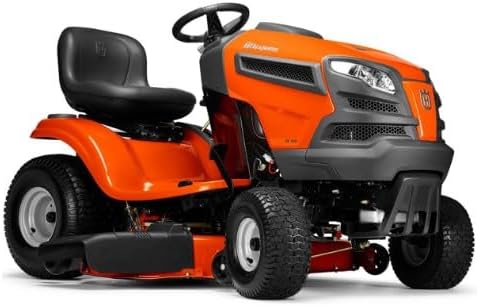
Husqvarna TS 120 42" Riding Lawn Tractor (19 HP Briggs & Stratton)
| Cutting width | 42 inches |
|---|---|
| Power Source | Gas Powered |
| Operation Mode | Manual |
| Model Number | 970846301 |
The Husqvarna TS 120 is a homeowner-oriented riding tractor that pairs a 19 HP Briggs & Stratton engine with a 42-inch twin-blade stamped deck to handle regular mowing on small to mid-size properties. It uses a pedal-operated hydrostatic transmission so you can keep both hands on the wheel while smoothly adjusting speed, which makes steering and speed control easier on slopes and uneven terrain. The tractor is offered with side ejection as standard and has optional mulching or grass collection accessories for different finish preferences. Practical benefits include ergonomic seating and intuitive controls that reduce fatigue during longer mowing sessions and a robust engine that delivers consistent cutting power. Important limitations are that it is a compact model intended for homeowner use rather than heavy commercial workloads and it does not list advanced hill-specific features such as differential locks or specialized traction tires, so very steep or frequently wet hills may require a more heavy-duty machine. Regular maintenance of the gas engine is necessary to maintain reliable performance.
Best for: Buyers who prioritize a reliable, easy-to-operate riding mower for regular maintenance of small to mid-size lawns and want straightforward controls and consistent engine performance.
Less Ideal for: Not a good fit for commercial landscapers or properties with very steep, frequently muddy slopes where heavier-duty traction and hill-control features are needed.
- Hydrostatic pedal transmission for smooth, hands-on-wheel speed control
- 19 HP Briggs & Stratton engine offers dependable, consistent power for routine mowing
- 42-inch twin-blade deck covers ground efficiently for small to mid-size lawns
- Optional mulching and collector accessories let you switch between bagging and mulching
- Ergonomic seating and intuitive controls reduce operator fatigue on longer jobs
- Designed for homeowner use so not suited for heavy commercial or very large acreage tasks
- No listed specialized hill-traction features such as differential lock or turf-specific rear tires
Verdict: A dependable, easy-to-drive riding tractor that delivers reliable power and smooth hydrostatic control for homeowners maintaining small to mid-size, hilly lawns.
Choosing the Right Riding Lawn Mower for Hills: Key Factors to Consider
Engine Torque and Power Delivery
On steep ground raw horsepower is less useful than how the engine delivers torque at working rpm. A mower that produces steady torque under load holds blade speed and forward momentum while climbing. Look for engines with wider torque bands and reliable cooling, because working uphill commonly raises engine temperature and creates repeated load spikes.
Smooth power delivery also reduces the need to constantly feather the throttle, letting you focus on line control. Engines with proven torque characteristics make towing small attachments on moderate slopes safer and keep cut quality consistent when the grass gets thick.
Traction Systems and Tire Selection
Tire size, tread pattern, and inflation pressure dramatically affect grip on slopes. Wider rear tires with aggressive tread and lower pressure increase the contact patch and reduce slippage. Some machines offer differential locks, limited-slip differentials, or selectable traction modes that help when one wheel lifts or slips on uneven terrain.
Consider how the mower's weight distribution interacts with tire choice. Heavy front loads or rear-mounted attachments can change traction dynamics, so choose a combination that maintains rear-wheel bite without overly compacting soil.
Braking and Downhill Control
Controlled descent is critical for safety. Reliable service brakes that bite predictably and systems that allow engine braking reduce the risk of runaway speed on a downgrade. Parking brakes should hold securely on a slope and be easy to engage from the operator seat.
Some mowers include mechanical aids such as hill-hold features or parking pawls that prevent the machine from rolling when stopped. Evaluate whether a transmission offers a low enough gear to descend in control and whether the brake layout lets you apply pressure smoothly while steering.
Transmission Type and Gear Range
Transmission design affects how well a mower crawls uphill and manages variable slope angles. Hydrostatic drives provide smooth, stepless speed control and can be easier to modulate on slopes, while gear or electric-shuttle transmissions offer defined ranges that help with heavy towing or repeated climbs.
Look for transmissions with a wide low-speed range so you can maintain power without lugging the engine. Ease of service and cooling for the transmission matter too, since steep-use duty cycles can push driveline temperatures higher than steady, flat mowing.
Deck Stability and Lift System
Blade contact and deck level affect cut quality on uneven ground. A stable deck that resists rocking and a reliable lift system let you adjust cutting height quickly when hitting dips or rises. Loose or floppy decks produce striping and scalping on slopes, making your lawn look uneven.
Check for anti-scalp wheels, reinforced crossmembers, and lift mechanisms that lock securely. A deck that is easy to raise for crossing rough patches without losing position is valuable when mowing hilly terrain.
How Slope Angle Affects Mower Choice
Not all slopes are equal. Gentle grades under 10 degrees mostly change traction demands, but as angles increase you must prioritize braking and transmission control. Extremely steep sections may be unsafe for riding mowers regardless of features, so map your property to identify the longest continuous slopes and steepest pitches before choosing a machine.
Break a mowing plan into sections: flatter plateaus, moderate inclines, and steep runs. You may find a single machine covers most needs if it has strong torque and good brakes, but very steep or irregular terrain sometimes requires dismounting and finishing with a walk-behind or hand tool for safety and cut quality.
- Measure slopes with a smartphone app or handheld inclinometer.
- Note how long steep runs are; short steep sections are easier to manage.
- Flag any areas with hidden obstacles or soft ground that reduce traction.
Tire Upgrades and Traction Accessories
Tire upgrades are a cost-effective way to improve slope performance. Switching to tires with deeper lugs, wider footprints, or specialty turf profiles can increase grip without changing the mower. Lowering pressure slightly can also improve contact patch, but avoid going so low that rims risk damage or steering becomes vague.
In extreme cases consider traction aids such as tire chains, ballast in the front or rear, or installing a limited-slip differential if available. Each modification changes handling, so plan to practice on a safe slope to learn the mower's new behavior before working near obstacles or people.
- Avoid chains designed only for snow; they can damage turf.
- Test traction changes on a gentle slope first.
- Document original tire pressure settings before experimenting.
Safe Mowing Technique on Slopes
Adopt a mowing pattern that reduces risk. Whenever possible mow across the slope rather than up and down to decrease the length of uncontrolled descent. Keep speed low, maintain a steady throttle, and avoid sharp steering inputs or abrupt brake application that can unsettle the mower.
When crossing a steep incline, shut off PTO-driven implements and lower the deck slightly to avoid scalping. Always survey the slope for wet or loose areas, rocks, and hidden depressions that can cause loss of traction or tip the machine.
- Mow across the slope for stability when conditions permit.
- Keep bystanders well clear and avoid mowing wet grass on steep grades.
- Use seat belts only if the machine is equipped with rollover protective structure and manufacturer guidance permits.
Maintenance Practices That Matter for Hilly Use
Mowers used on slopes face higher loads and temperature cycles. Maintain cooling fins, clean debris from radiators and engine compartments, and check oil and transmission fluid levels more frequently. Warmer running temperatures and heavier load cycles accelerate wear.
Tire wear and brake inspection should be part of a pre-season and mid-season checklist. Replace worn treads, bleed hydraulic brakes if they feel spongy, and tighten steering linkages to prevent vague handling on inclines.
- Inspect brakes and tire condition monthly during high-use seasons.
- Keep belts and blade spindles adjusted to reduce slipping under load.
- Service hydraulic systems per the manufacturer's intervals when using steep terrain often.
When to Consider Alternatives to a Riding Mower
There are situations where a riding lawn mower for hills is not the best choice. Very steep, narrow, or rocky terrain can exceed the safe operating envelope of any ride-on machine. If slopes are continuous and beyond recommended angles, a walk-behind mower, string trimmer, or professional hillside service may be safer.
Also consider splitting work across machines: use a ride-on for flatter sections and a lighter tool for steep parts. That keeps the ride-on in its strength zone and reduces wear and safety risk.
- Evaluate whether slopes exceed manufacturer slope limits.
- Consider modular approaches combining ride-on and walk-behind tools.
- Hire professional help for complex or unsafe hillside jobs.
How We Chose the Best Riding Lawn Mower for Hills
We focused editorial selection on attributes that directly affect performance and safety on slopes. Core evaluation criteria included sustained torque and horsepower at working rpm to ensure mowers can climb and maintain cutting speed under load; traction systems such as rear-wheel drive, differential lock, low-pressure tires, and tread pattern to reduce slipping; braking and downhill control features including service brakes and engine braking to manage descent; transmission type and gear range to match slow, powerful climbs; and deck stability and lift systems that keep blades level on uneven ground. We excluded machines intended solely for flat, ornamental lawns, zero-turn mowers without slope stability features, and compact garden tractors rated below the torque and braking thresholds we set. We prioritized durable construction, accessible maintenance, and practical safety features that gardeners can use without professional modification. The scoring labels reflect these same dimensions so each shortlisted mower is judged on how it behaves on real slopes, not just flat performance.
FAQ
How steep is too steep for a riding lawn mower?
It depends on the mower and its features, but many manufacturers advise caution above moderate slopes. Continuous, steep pitches increase rollover risk and may exceed braking capacity. Measure angles and consult machine operating limits rather than guessing.
Are hydrostatic transmissions better for slopes?
Hydrostatic drives give smooth, stepless speed control that can be easier to modulate on inclines, which helps maintain torque and avoid lugging. However, transmission cooling and overall gearing also matter, so hydrostatic is not the only workable option.
Can I improve traction without buying a new mower?
Yes. Upgrading to wider or more aggressive tires, adjusting inflation pressure, and adding ballast in appropriate locations can improve grip. Test changes on gentle slopes first and avoid adjustments that compromise steering or damage turf.
Should I use a seat belt when mowing hills?
Use seat belts only when the mower has a rollover protective structure and manufacturer guidance permits. Seat belts can keep you securely in a protected zone during a rollover, but they are not a substitute for safe slope operation and appropriate machine selection.
How often should I check brakes and tires if I mow on slopes frequently?
Inspect brakes and tires more often than for flat use, typically monthly during heavy season or after any unusually hard run. Look for reduced braking bite, uneven tire wear, and signs of fluid overheating in transmissions or hydraulics.
Final Verdict
Prioritize features that reduce slipping and improve descent control when choosing a riding lawn mower for hills. Strong, sustained torque, predictable braking, and traction-focused tires will have the most impact on safety and cut quality. Be realistic about slope angles and use technique and maintenance to extend the life and performance of whichever mower you choose. If your property has only occasional mild inclines you can favor comfort and deck quality; for regular, steep slopes focus on drivetrain and braking. Match the machine to the steepest, longest runs on your land and plan for safe operating habits so you can mow confidently.
