

Note: This article contains affiliate links. If you click on these links and make a purchase, I may earn a small commission at no extra cost to you. This helps support my research and content. Read my full affiliate disclosure here.
If you manage a lawn, mixed garden beds, or container plantings, an irrigation controller with wifi can save time and water while keeping plants healthy. The right unit makes it easy to adjust schedules from your phone, respond to weather changes, and coordinate multiple zones without walking back to a control box. This guide covers our shortlisted top options for homes and small properties. We evaluated setup, connection stability, scheduling flexibility, and practical features that matter in real garden use so you can pick a controller that fits your landscape and tech comfort level.
Top Picks at a Glance
| Best Overall The best all-around choice for most situations | Hunter PRO-HC PHC-1200 12-Station Wi‑Fi Irrigation Controller with Hydrawise |  |
| Best Quality Built to a higher standard if you want something more solid | Hunter PRO‑HC 6‑Zone Wi‑Fi Smart Irrigation Controller (Hydrawise) |  |
| Best Value The sweet spot between price and what you get | Orbit B-hyve Indoor Smart Sprinkler Controller (8-Zone) |  |
| Best Budget The cheapest option that still gets the job done reliably | XinFuture WiFi Sprinkler Timer (1‑Zone) with Long‑Range RF Gateway |  |
| Highest Rated A top-rated pick with lots of positive feedback | HiOazo Outdoor Smart Sprinkler Controller, Wi‑Fi, 12‑Zone |  |
| Most Popular A crowd favorite that many people choose with confidence | Rachio 3 Smart Sprinkler Controller, 8-Zone |  |
| Best Seller A high-volume bestseller chosen again and again | Rachio 3 Smart Sprinkler Controller, 16-Zone |  |
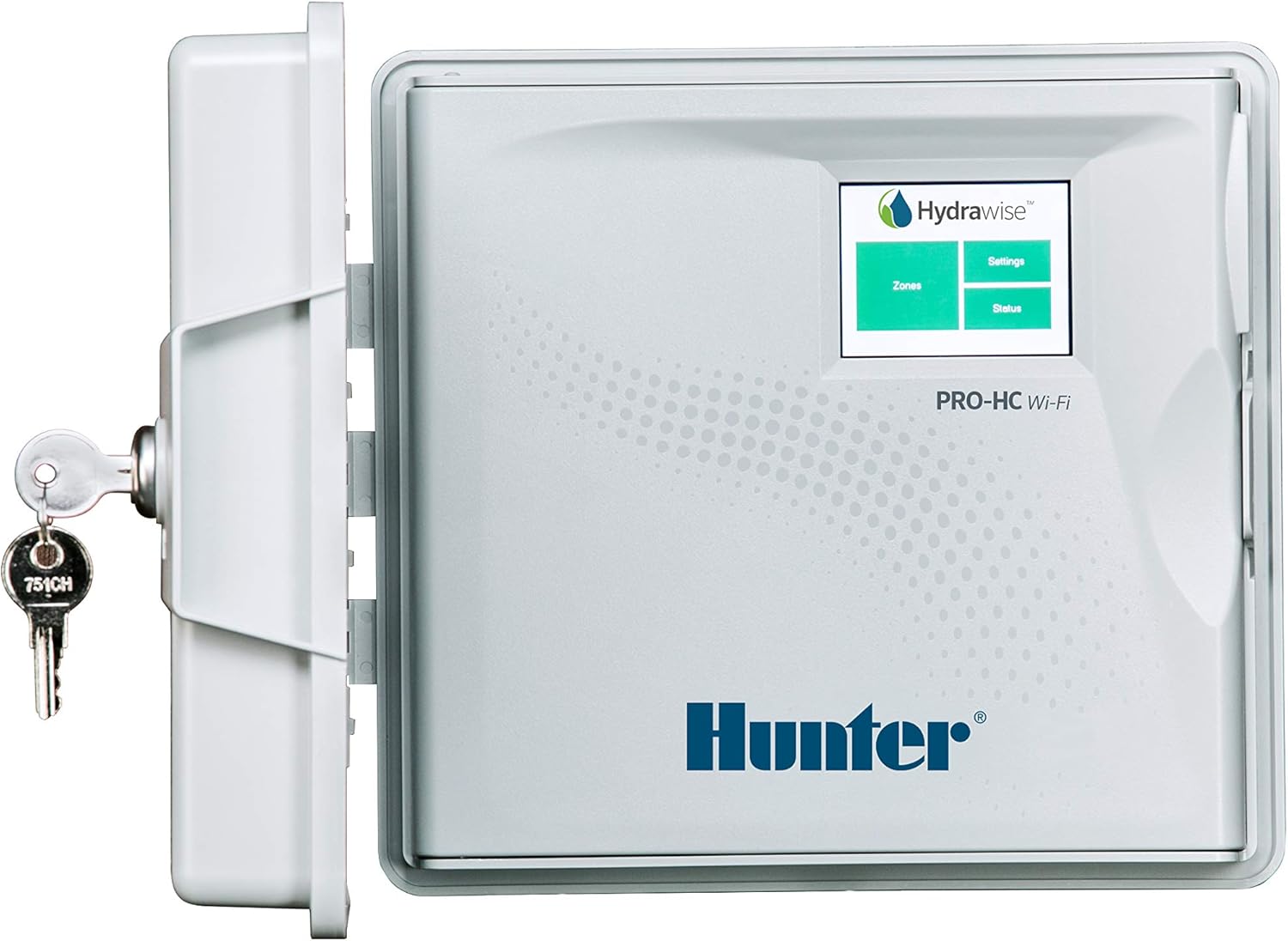
Hunter PRO-HC PHC-1200 12-Station Wi‑Fi Irrigation Controller with Hydrawise
| Unit Count | 12 Count |
|---|---|
| Voltage | 120 volts |
| Display Type | LCD or LED |
| Material Type | Plastic |
The Hunter PRO-HC PHC-1200 is a professional-grade 12-station Wi‑Fi irrigation controller designed for reliable residential use. It connects to Hunter's Hydrawise web-based platform so you can create and adjust schedules remotely, monitor run times, and receive system warnings. The unit installs in place of a standard controller and provides an LCD display for local programming plus automatic seasonal adjustments when linked to weather data. Build quality is typical of Hunter equipment with a plastic enclosure and standard 120V power. Practical benefits include centralized control of multiple zones, reduced manual visits to the timer, and the ability to fine-tune watering based on weather forecasts. Limitations are that this model is focused on automated scheduling rather than advanced on-site diagnostics and it requires a stable Wi‑Fi connection and account setup to access the cloud features. It is best for users who prioritize dependable, remote-managed irrigation rather than ultra-simple analog timers.
Best for: Homeowners who need a dependable multi-zone controller and want to manage watering remotely using weather-based schedules and a web interface.
Less Ideal for: People who want a completely offline or ultra-simple mechanical timer or those without stable home Wi‑Fi who cannot use cloud features.
- Controls up to 12 irrigation stations for multi-zone yards
- Wi‑Fi connectivity with Hydrawise web software for remote scheduling and seasonal adjustments
- LCD display for clear local programming and status
- Standard 120V power compatibility for residential electrical systems
- Requires a reliable Wi‑Fi connection and Hydrawise account to access full remote features
- Plastic enclosure offers less ruggedness than metal weatherproof housings
Verdict: Buy this if you want a reliable 12‑station Wi‑Fi controller that puts remote, weather‑aware scheduling and centralized zone control at the center of your irrigation system.
Hunter PRO‑HC 6‑Zone Wi‑Fi Smart Irrigation Controller (Hydrawise)

| Zones | 6 stations |
|---|---|
| Wi‑Fi | Built‑in 2.4 GHz |
| Display | 2.75 inch full‑color touchscreen |
| Sensor ports | Two sensor inputs |
| P/MV output | One pump/master valve output |
The Hunter PRO‑HC600 is a 6‑station smart irrigation controller built for reliable, water‑efficient landscape management. It connects to the Hydrawise platform over built‑in 2.4 GHz Wi‑Fi so you can monitor and adjust schedules from a phone, tablet, or desktop, while the full‑color 2.75 inch touchscreen lets you program and test zones at the panel without the app. Hydrawise applies predictive weather data and local station inputs to automatically change run times, and the system supports flow meters, Clik rain sensors, and a pump/master valve output for professional installs. The controller includes wiring diagnostics via a milliamp sensor to speed troubleshooting and an IP44‑rated UV resistant cabinet for indoor or outdoor mounting. For performance‑focused users this translates to precise zone control, fewer callbacks, and measurable water savings, though advanced features require time to configure and optional sensors to realize full leak detection and flow monitoring capability.
Best for: Buyers who prioritize efficient, professional‑level irrigation control and remote management for small to medium landscapes; ideal for contractors or committed homeowners who want precise, data‑driven watering.
Less Ideal for: Casual gardeners who want a simple plug‑and‑play timer without network setup or those who do not plan to add optional sensors for flow monitoring.
- Hydrawise weather‑based scheduling adjusts watering automatically for local conditions
- Built‑in Wi‑Fi and remote app control for on‑the‑go adjustments and monitoring
- Full‑color touchscreen enables quick on‑site programming and zone testing
- Supports flow meters and sensor inputs for leak detection and automated shutoff
- Milliamp wiring sensor provides continuous diagnostics to simplify maintenance
- Advanced features like flow monitoring and full leak protection require buying and installing optional sensors
Verdict: Choose the Hunter PRO‑HC600 if you want professional, weather‑driven irrigation control with on‑site touchscreen programming and full remote management via Hydrawise.
Orbit B-hyve Indoor Smart Sprinkler Controller (8-Zone)

| Stations | 8 zones |
|---|---|
| Connectivity | Wi‑Fi, Bluetooth |
| Display Type | LCD |
| Voltage | 120 volts |
The Orbit B-hyve Indoor Smart Sprinkler Controller is a Wi‑Fi and Bluetooth enabled timer designed to automate underground sprinkler systems for homeowners. You set up programs and zones in the free B‑hyve app or on the console, then let the controller adjust runtimes using WeatherSense local weather data to avoid overwatering after rain and add water during hot spells. Typical use is mounting the unit indoors, connecting to household Wi‑Fi, assigning each valve to a zone, and creating either fixed schedules or letting the app manage watering based on weather. Notable features include an LCD console for local control, voice assistant compatibility, and both remote control and Bluetooth setup for areas with weak Wi‑Fi. Practical benefits are consistent, zone‑specific watering that can reduce water waste and hands‑on time caring for lawns, beds, and vegetable plots. Important limitations are that it is an indoor enclosure model so it still requires wiring to existing valves and a powered 120V supply, and advanced integrations may need familiarity with smart home assistants.
Best for: Homeowners who want to cut watering time and water use by automating multi‑zone irrigation with weather‑aware schedules and remote control.
Less Ideal for: People who need an outdoor‑rated standalone controller or who prefer a simple battery‑powered hose timer for a single faucet and no wiring.
- Wi‑Fi and Bluetooth connectivity for remote setup and control
- WeatherSense automatically adjusts schedules to local conditions
- Supports independent programming for up to eight zones
- LCD console allows local control without the app
- Indoor enclosure requires wiring to outdoor valves and a nearby power source
- Setup and smart‑home linking can be confusing for users unfamiliar with apps and voice assistants
Verdict: Choose the B‑hyve 8‑zone controller if you want a weather‑aware, app‑controlled system that simplifies multi‑zone irrigation and reduces unnecessary watering.
XinFuture WiFi Sprinkler Timer (1‑Zone) with Long‑Range RF Gateway

| Unit Count | 1 Count |
|---|---|
| RF range | 984 FT / 300 M |
| Wi‑Fi | 2.4 GHz required |
| Number of settings | 5 |
This XinFuture WiFi sprinkler timer pairs a single-zone hose controller with an RF gateway to give remote app control, voice commands, and extended wireless range. Install it on a faucet and connect the timer to a 2.4 GHz network via the Smart Life/Tuya app after an initial Bluetooth setup. The unit supports multiple schedules and modes including standard watering, gentle misting, manual on for tasks like filling a pool, and a 1–7 day rain delay with session logs. The standout is the claimed 984 ft/300 m RF link and stronger wall penetration so the gateway can stay in a garage or shed while the timer remains at the spigot. For everyday garden use it simplifies routine watering and lets you share access with family members. Limitations to note are that it is essentially a single-zone hose timer (designed for one outlet) rather than a full multi-station sprinkler controller and it relies on a 2.4 GHz WiFi network for remote operation, so cellular-only or Bluetooth-only setups will not work.
Best for: Home gardeners who want a low-cost smart hose timer to automate a single faucet or small irrigation run and prefer easy app control and voice commands over complex multi-station systems.
Less Ideal for: Property owners who need to run multiple independent sprinkler zones or who require a wired professional-grade multi-valve controller should consider multi-station controllers instead.
- Long RF range and improved wall penetration for stable connectivity across obstacles
- Remote scheduling and control via Smart Life/Tuya app with voice assistant support
- Multiple watering modes including misting, recirculating schedules, and manual override
- Built-in rain delay and watering records to prevent overwatering
- Single faucet/zone design rather than a multi-station sprinkler controller
- Requires a 2.4 GHz WiFi network for normal operation; Bluetooth only used for setup
Verdict: Choose this timer if you want an affordable, app- and voice‑controlled hose timer with unusually long RF range for reliable remote irrigation control.
HiOazo Outdoor Smart Sprinkler Controller, Wi‑Fi, 12‑Zone

| Wi‑Fi frequency | 2.4GHz |
|---|---|
| Zones supported | 12 zones |
| Programmable plans | 16 plans |
| Irrigation modes | Standard and Soak |
The HiOazo Outdoor Smart Sprinkler Controller replaces a traditional timer with a cloud‑connected controller you manage from the HiOazo app over 2.4 GHz Wi‑Fi. It is typically installed at the irrigation control panel and used to schedule watering across multiple zones, with options for Standard or Soak irrigation modes. Notable features include support for up to 12 zones and 16 separate watering plans so you can tailor schedules for different plant beds, plus automatic skipping for rain, freeze, and wind to avoid unnecessary runs. The app control makes remote adjustments and monitoring straightforward, and the company advertises a quick DIY install that should fit most existing systems. Limitations to consider are dependence on 2.4 GHz Wi‑Fi and the app ecosystem for smart features, so local manual control is less convenient if your network is unreliable. The controller appears aimed at homeowners who want flexible, weather‑aware scheduling without professional setup, but expect connectivity and app reliance to be central to day‑to‑day use.
Best for: Homeowners who prioritize a dependable, weather‑smart irrigation schedule and want remote control to reduce overwatering without hiring a pro.
Less Ideal for: People with unreliable Wi‑Fi, those who need purely local/manual controllers, or users who prefer controllers that operate without any app dependency.
- Supports up to 12 irrigation zones and 16 separate watering plans for flexible scheduling
- Weather‑aware auto skip for rain, freeze, and wind helps conserve water and protect plants
- App control over 2.4 GHz Wi‑Fi lets you monitor and adjust schedules remotely
- Two irrigation modes (Standard and Soak) allow better soil absorption management
- Requires a 2.4 GHz Wi‑Fi network and app for full smart functionality
- Relies on cloud/app ecosystem so offline/manual operation is limited
Verdict: Choose this controller if you want a dependable, weather‑sensing Wi‑Fi system that simplifies hands‑off irrigation across many zones.
Rachio 3 Smart Sprinkler Controller, 8-Zone

| Item Highlight | 8 Zones, App Control, Rain Skips, Local Weather Scheduling |
|---|---|
| Voltage | 120 volts |
| Display Type | LED |
| Operating Temperature | 4 °F |
The Rachio 3 Smart Sprinkler Controller gives you app-first control of an existing 8-zone irrigation system and uses local weather data to adjust watering automatically. You set schedules in the Rachio app for iOS or Android, then let the controller skip runs for rain, freeze, wind or saturated soil and make seasonal adjustments so you do not overwater. Typical use is straightforward: mount the indoor unit, wire it to zone valves, connect Wi-Fi and configure zones in the app; Quick Run buttons let you manually water a zone from the controller when needed. Notable features include dual-band Wi-Fi, compatibility with Alexa, Google Home and IFTTT, LED status display and grow-in scheduling for new lawns. Practical benefits are reduced water use, simpler remote management, and easier setup compared with legacy dial timers. Limitations: the unit is indoor rated so outdoor installs require a weatherproof enclosure and some advanced setups such as well systems may need a pump for proper pressure. The controller also relies on the app for detailed schedule edits rather than full on-device programming.
Best for: Homeowners who want to reduce water use and move away from manual dial timers, and who prefer a proven smart-home controller with easy app-based setup and integrations.
Less Ideal for: People who need a fully outdoor-rated controller without adding an enclosure or who want complete on-device programming without using a smartphone app.
- Weather Intelligence automatically skips watering for rain, freeze, wind and saturation
- App-based scheduling with Quick Run and grow-in options simplifies remote control
- Works with voice assistants and IFTTT for smart-home integration
- Fast DIY install that fits most existing 8-zone systems
- Indoor-rated unit requires a separate weatherproof enclosure for outdoor mounting
- Relies on the mobile app for most scheduling tasks rather than full on-device controls
Verdict: Choose the Rachio 3 if you want a reliable, app-driven 8-zone controller that cuts wasted watering with automatic weather-aware schedules.
Rachio 3 Smart Sprinkler Controller, 16-Zone

| Zones supported | 16 |
|---|---|
| Voltage | 110 volts AC |
| Display type | LED |
| Operating temperature | 15 °C |
The Rachio 3 is a WiFi-enabled sprinkler controller designed to replace conventional dial timers and automate watering across up to 16 zones. It is typically wall-mounted indoors or placed in a weatherproof enclosure outdoors and is set up through the Rachio mobile app, which walks you through wiring, zone naming, and schedule creation. Key features include patented Weather Intelligence that skips runs for rain, freeze, wind and soil saturation, grow-in schedules for new grass, Quick Run buttons for manual zone activation, and compatibility with Alexa, Google Home and IFTTT. In practice this delivers consistent, hands-off watering, fewer unnecessary runs, and easier seasonal adjustments compared with manual timers. Installation is straightforward for anyone comfortable with basic wiring and the app makes troubleshooting and remote control simple. Limitations are that scheduling is primarily app-driven so basic on-device customization is limited, and systems on well pumps may need an additional pump start relay to work reliably. The controller is indoor rated unless you buy a separate weatherproof enclosure.
Best for: Homeowners who want a reliable, low-maintenance irrigation controller that reduces wasted water and simplifies seasonal scheduling without constant manual intervention.
Less Ideal for: Users who need full control from the device itself or who prefer a completely offline mechanical timer; those with specialized commercial irrigation needs should consider professional controllers.
- Local Weather Intelligence automatically adjusts and skips watering for rain, freeze, wind and saturation
- Supports large systems with up to 16 zones for flexible yard layouts
- Dual-band WiFi and wide smart-home compatibility for remote control and voice assistants
- Quick Run manual buttons let you run zones on demand without the app
- App-guided setup and grow-in schedules simplify installation and establishing new turf
- Most scheduling and advanced controls require the mobile app rather than on-device menus
- Indoor-rated unit requires a separate weatherproof enclosure for outdoor mounting
- May need an external pump start relay for some well systems
Verdict: If you want dependable, water-saving automatic irrigation for a typical home landscape, the Rachio 3 delivers smart weather-driven schedules and easy app control for up to 16 zones.
Choosing the Right Irrigation Controller with Wifi: Key Factors to Consider
Connection Reliability
A controller that loses wifi frequently undermines the whole point of remote control. Assess whether the unit supports both 2.4 GHz and 5 GHz networks if your home uses modern bands, and whether it can maintain a local connection without constant cloud dependence. Reliable reconnection behavior after power interruptions is important so scheduled events resume correctly.
Look for controllers that provide status feedback in the app and a predictable fall-back mode if the network is down. For gardens with weak wifi at the controller location, consider whether the product supports a wired ethernet bridge or accepts a small wifi repeater to improve signal without complex rewiring.
Scheduling Features and Flexibility
Different gardens need different schedules: flower beds often require short, frequent watering while lawns might need longer, less frequent cycles. Check that the controller allows multiple programs, multiple start times per program, and per-zone run-time tuning. Seasonal adjustment tools or percentage-based weekly changes help adapt watering through the year without rebuilding programs each month.
Also verify the granularity of run times and whether the controller supports odd watering constraints like cycle-and-soak (short cycles with rests to reduce runoff) or custom days-of-week patterns. The more flexible the scheduler, the more precisely you can match irrigation to soil type and plant needs.
Sensor and Weather Integration
Automatic pause or adjustment based on local weather or sensor input prevents wasted water. Controllers that integrate with local weather services can suspend watering during rain or high humidity periods. Soil moisture sensor compatibility gives the most direct feedback from the root zone and avoids assumptions based on forecast alone.
Confirm whether the controller accepts wired sensors, wireless sensors, or both, and how the app presents sensor data. Some systems only use weather data from distant stations, which can misrepresent microclimates, so local sensor options are preferable for accuracy.
Installation and Compatibility With Existing Systems
A controller should fit into your existing irrigation wiring and zone count without major modifications. Check the supported number of zones and whether additional modules or expansion are required. Verify transformer voltage, mounting options for indoor or exterior enclosures, and whether the unit requires a neutral wire or other special wiring.
Also consider compatibility with common valve types and whether the controller supplies enough power for your valve solenoids. Ease of wiring, clear terminal labeling, and accessible enclosure design reduce installation time and errors.
Power and Backup Behavior
Controllers respond differently to power loss. Some keep schedules in nonvolatile memory and resume normally; others need cloud re-authentication. Evaluate how long battery-backed real-time clocks hold time, whether the device supports local manual control, and whether important settings persist through outages.
If your area has frequent outages, a controller with robust local scheduling and manual run options is preferable. Consider whether a small uninterruptible power source for the controller is practical for your installation to avoid missed cycles.
Security and Privacy
Because wifi controllers connect to home networks, basic security matters. Look for products with secure authentication, support for strong passwords, and regular firmware updates. Check the vendor stance on data handling if cloud services are used and whether local control or LAN-only modes are available.
Avoid controllers that require open network access or outdated encryption. Regular firmware patches and transparent privacy policies reduce the risk of unauthorized access to your irrigation system or network.
How Wi‑Fi Controllers Change Garden Watering
Wifi-enabled controllers let you change schedules from anywhere, react to unexpected weather, and fine-tune multiple zones without returning to the control box. That convenience translates into less overwatering and more consistent moisture for plant roots when used thoughtfully.
Beyond remote control, many modern controllers add helpful features like seasonal adjustment, cycle-and-soak programming, and push notifications for sensor alerts. Those features turn a basic timer into a tool for adaptive water management across different plant types and microclimates.
- Remote adjustments reduce the need for manual visits to the controller.
- Notifications help catch stuck valves, frozen lines, or sensor failures early.
- Advanced scheduling options let you match irrigation to soil and plant needs.
Placement and Wi‑Fi Planning
Placement matters because distance and obstructions can degrade wifi signals. Ideally mount the controller where it receives the strongest signal from your router or where a wired connection is practical. Exterior-rated enclosures should be used if the controller sits outside.
If signal strength at the irrigation controller location is weak, plan for a wifi extender, a small access point, or an ethernet bridge. Test connectivity before sealing up enclosures so you do not discover a dead zone after installation.
- Avoid metal enclosures that block signals unless an external antenna is supported.
- Place the router or extender to minimize walls and interference between it and the controller.
- Label wiring during installation to simplify future troubleshooting.
Integrating Sensors and Local Weather Data
Pairing a controller with a rain sensor or soil moisture probe provides the most reliable cutoffs to prevent unnecessary watering. Weather integrations are useful, but they can report conditions that differ from your yard, so local sensors improve accuracy.
Decide early whether you want wired sensors for reliability or wireless sensors for flexibility. Wired sensors are more consistent long term but require routing cable; wireless sensors offer placement freedom but need battery management.
- Soil probes placed in representative zones yield the best moisture readouts.
- Rain sensors should be roof- or gutter-mounted where they see true precipitation.
- Check how the controller displays and logs sensor data in the app.
Power Options and Resilience
Consider how the controller behaves during outages. Units that retain full scheduling locally continue operating, while those that rely heavily on cloud authentication may miss events if the internet is down. A small backup power source can keep the controller clock running and prevent missed cycles during short outages.
Also check transformer placement and secure mounting to reduce accidental disconnection. Outdoor-rated transformers and strain-relief fittings extend reliability in exposed installations.
- Verify whether settings are stored locally or only in the cloud.
- Use outdoor-rated enclosures and connectors for exposed installations.
- Plan for periodic firmware updates and how you will apply them if internet access is intermittent.
Maintenance and Long-Term Operation
Routine checks keep a wifi controller functioning smoothly: examine valve operation each season, check sensor batteries, and confirm that schedules reflect seasonal plant needs. Firmware updates can add features and fix connectivity bugs, so note the update process and frequency.
Document your wiring and any custom schedules so future adjustments are faster and less error-prone. Treat the controller as part of your regular garden maintenance checklist rather than a set-and-forget device.
- Test manual run for each zone after installation and before peak season.
- Replace sensor batteries annually or when alerts indicate low power.
- Keep a log of firmware updates and any changes to network credentials.
How We Chose the Best Irrigation Controller with Wifi
We focused on features and real-world behavior that affect day-to-day irrigation management. Key evaluation criteria included ease of setup and app usability to reflect how quickly a gardener can get remote control working. Connectivity and firmware reliability assessed how consistently units stay online and react to schedule changes. Scheduling flexibility looked at custom program options, seasonal adjustments, and the ability to handle multiple zones with different run times. Sensor and weather integration measured support for local forecasts, rain sensors, and soil-moisture inputs that prevent overwatering. Installation and compatibility checked mounting options, transformer wiring, and integration with existing valves and zone counts. We excluded units designed exclusively for commercial or agricultural farms and controllers that require proprietary cloud services without local control options. We prioritized products that are practical for home gardeners, easy to install or migrate into an existing system, and that offer transparent connectivity behavior and clear scheduling controls.
FAQ
Will a wifi controller work if my home internet goes down?
It depends on the model. Many wifi controllers retain schedules and run locally during internet outages, while others require cloud access to operate. Check whether the controller stores programs locally and how it handles temporary disconnections.
Can I use a wifi controller with my existing sprinkler valves?
Most controllers are designed to work with standard solenoid valves and common voltages. Confirm the supported zone count and that the controller supplies adequate power for your valve type. Wiring compatibility is typically straightforward for residential systems.
Do I need a special app or subscription for weather-based adjustments?
Some controllers include basic weather adjustments in the app without extra fees, while others offer optional subscription services for advanced forecast data. Review the product documentation to see which features are included and whether local sensor support is built in.
How many zones should my controller support?
Choose a controller with at least as many zones as you currently use, plus capacity for future expansion. If you plan to subdivide beds or add drip lines, allow extra zones to keep each irrigated area tuned to its water needs.
Are wireless soil sensors reliable long term?
Wireless sensors are convenient but rely on batteries and signal quality. They are reliable when placed correctly and maintained, but wired probes tend to be more stable over the long term if you can install them.
Final Verdict
Pick an irrigation controller with wifi that matches your network environment, zone count, and appetite for automation. Prioritize connection reliability, scheduling flexibility, and sensor integration if you want adaptive control that reduces water waste and supports plant health. If your site has weak wifi or frequent outages, favor controllers with strong local scheduling and manual run options. Weigh the tradeoffs between advanced cloud features and the ability to run independently. With the right balance of connectivity and local control, a wifi controller becomes a valuable tool for consistent, efficient watering across your garden.
