

Note: This article contains affiliate links. If you click on these links and make a purchase, I may earn a small commission at no extra cost to you. This helps support my research and content. Read my full affiliate disclosure here.
Choosing the right kill mouse trap matters because placement, trigger sensitivity, and construction determine how effectively you stop infestations and where you can safely use a trap. If you have indoor living spaces, garages, attics, or outbuildings where mice are active, the right trap reduces repeated visits and the chance of wounded animals. This guide covers seven shortlisted kill mouse traps that perform well in typical home and garden settings. We explain how we evaluated each option and the practical tradeoffs to consider, including lethality, safety around pets and children, setup and baiting, and durability. Read on to see which features matter most for your situation before you review the individual product summaries below.
Top Picks at a Glance
| Best Overall The best all-around choice for most situations | Victor Power-Kill Mouse Traps, 6-Pack |  |
| Best Quality Built to a higher standard if you want something more solid | OWLTRA OW-2 Indoor Electric Mouse Trap, 2-Pack |  |
| Best Value The sweet spot between price and what you get | Victor Quick-Kill Mouse Traps, 6-Pack |  |
| Best Budget The cheapest option that still gets the job done reliably | Tomcat Wooden Mouse Traps, 4 Pack |  |
| Highest Rated A top-rated pick with lots of positive feedback | Lycxbfjia 2-Pack Electric Rat and Mouse Traps (High-Voltage, Reusable) |  |
| Most Popular A crowd favorite that many people choose with confidence | Victor Metal Pedal Mouse Traps, 12-Pack (Wood Snap Traps) |  |
| Best Seller A high-volume bestseller chosen again and again | Catchmaster Extra Sticky Glue Traps, 60-Count Foldable Glue Boards |  |
Victor Power-Kill Mouse Traps, 6-Pack

| Unit Count | 6 Count |
|---|---|
| Target Species | Mouse |
| Power Source | Manual |
| Material Type | Plastic |
The Victor Power-Kill mouse trap is a snap-style trap designed for fast, humane kills and simple one-click setting. It is typically placed along walls, in corners, or near suspected runways and baited in the trough or bait cup with peanut butter or similar attractants. Notable features include a larger trip pedal that increases the chance a passing mouse will trigger the mechanism and a high-impact kill bar that snaps closed for an immediate result. The traps can be discarded after use for hands-free cleanup or the mouse can be removed and the durable plastic trap reused, which gives flexibility for different cleanup preferences. Setup is straightforward and fast, requiring a single click to arm or release the trap, and the compact footprint fits into tight spaces where mice travel. A limitation is that these are manual traps and require periodic checking and disposal; they are also not electronic and offer no remote alerts unless paired with an optional smart base sold separately.
Best for: Buyers who want a reliable, no-nonsense mechanical trap that delivers fast kills and can be reused or thrown away depending on cleanup preference.
Less Ideal for: People who need remote monitoring, automated alerts, or a hands-off electronic solution should consider electronic traps or integrated smart systems instead.
- Oversized trip pedal increases activation likelihood from investigating or passing mice
- High-impact kill bar designed for quick, humane elimination on contact
- Simple one-click set and release makes deployment fast and easy
- Reusable construction or disposable option for hands-free cleanup
- Manual operation requires regular physical checking and disposal
- No built-in alerting or electronic monitoring without an extra smart base
Verdict: A straightforward, high-catch snap trap that delivers quick kills and the flexibility to reuse or dispose for buyers who prioritize reliable, manual pest control.
OWLTRA OW-2 Indoor Electric Mouse Trap, 2-Pack

| Target Species | Mouse, Rat |
|---|---|
| Power Source | Battery Powered |
| Number of Pieces | 2 |
| Recommended Uses For Product | Indoor |
| Material Type | Plastic |
The OWLTRA OW-2 is a two-pack of battery-powered indoor electric traps designed to detect and kill mice or small rats quickly. Each unit uses dual infrared sensors to activate only when a rodent is fully inside, reducing accidental discharges and false triggers. The trap applies a high-voltage shock and holds the animal in a no-escape chamber so disposal is contained. Magnetic latches let you remove the lid and drop the contents into the trash without touching the carcass, and the unit automatically deactivates when opened for safer cleaning. Typical use is placing the traps along rodent runways indoors on dry surfaces, baiting the entrance, and swapping batteries as needed. Important limitations are that these units are for indoor, dry locations only and must be handled carefully because they deliver high voltage; they are not suited for wet, dusty, or outdoor spots and require keeping out of reach of children and pets when placed. They are plastic-bodied and run on AA batteries, so ongoing battery replacement is a maintenance consideration.
Best for: Buyers who want a quick, contained electric solution for indoor mice or small rats and who prioritize sensor safety and sanitary disposal backed by broad user adoption.
Less Ideal for: People who need outdoor or weather-resistant control, those who prefer reusable electric traps with wired power, or households that cannot safely keep battery-powered high-voltage devices away from children and pets.
- Dual infrared sensors reduce false activations and help protect children and small pets
- Magnetic lid and no-touch disposal make cleaning sanitary and simple
- Battery-powered operation lets you place traps without cords
- Designed chamber and no-escape geometry contain the rodent until disposal
- Intended for indoor dry use only and not weatherproof
- Requires periodic AA battery replacement which adds ongoing cost
Verdict: Choose the OWLTRA OW-2 if you want a compact, sensor-activated indoor electric trap that prioritizes hands-free disposal and reduced false activations.
Victor Quick-Kill Mouse Traps, 6-Pack
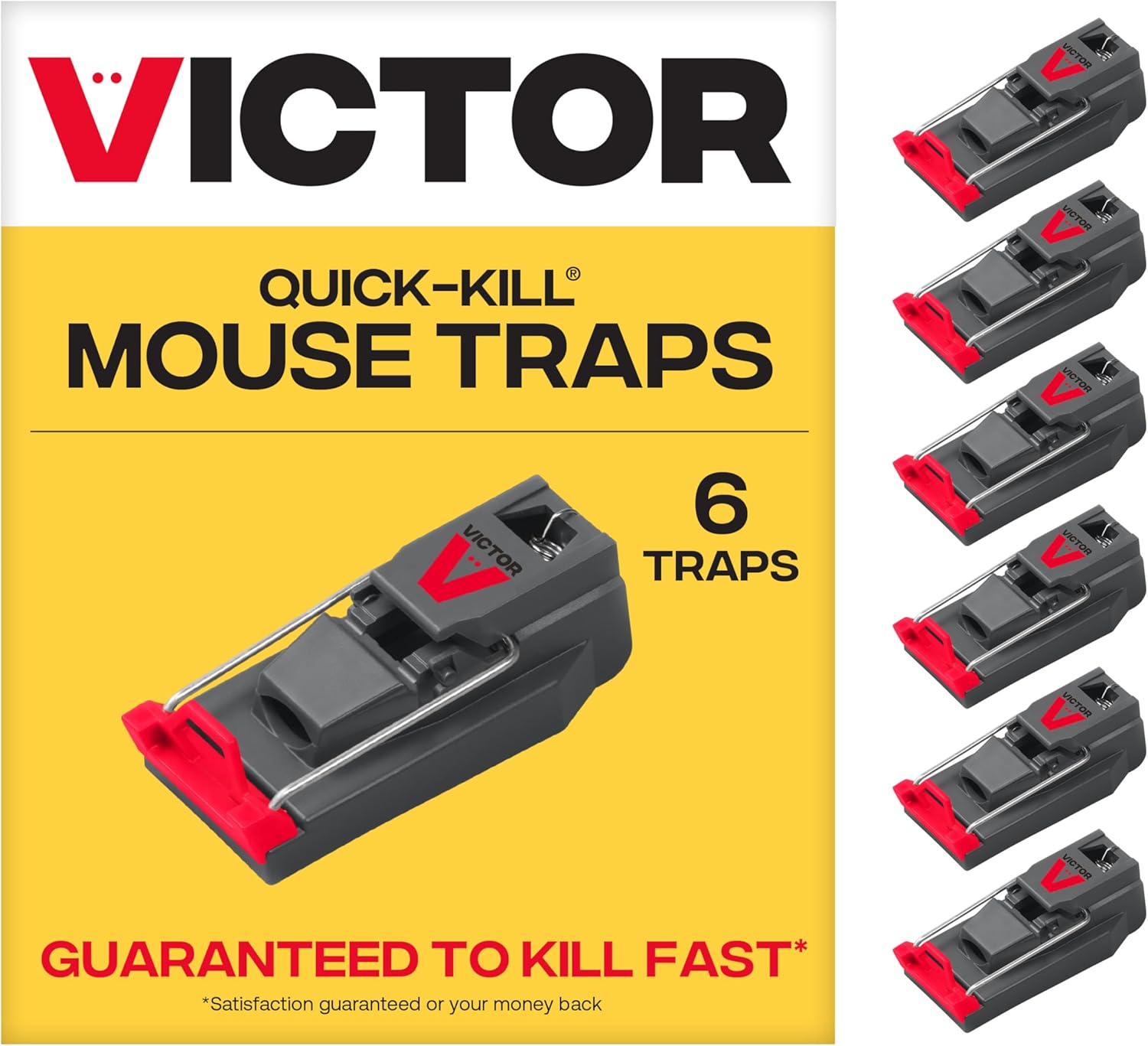
| Unit Count | 6 Count |
|---|---|
| Target Species | Mouse |
| Power Source | Manual |
| Material Type | Plastic |
The Victor Quick-Kill Mouse Traps are compact, reusable spring traps designed for fast home rodent control. You set each trap with a single click, load bait into the built-in covered bait cup, and place it along walls or where you see mouse activity. The covered bait area prevents bait theft and helps ensure the rodent triggers the high-impact kill bar at the correct point for a quick, humane kill. Traps are made of plastic, come in a six-pack, and include a release mechanism that opens the trap for no-touch disposal of caught rodents. Practical benefits include straightforward one-handed setting, clear bait placement, and the ability to reuse traps rather than replace them after each catch. Limitations are that the traps are manual so they require occasional inspection and disposal by the homeowner and the plastic body may be less durable than metal alternatives in heavy-use situations.
Best for: Homeowners who want an efficient, low-chemical method to control occasional mouse problems and prefer reusable, easy-to-set traps they can manage themselves.
Less Ideal for: People seeking a fully hands-off or high-capacity commercial solution should consider electronic or professional traps and services instead.
- One-click setting makes deployment quick and easy
- Covered bait cup prevents bait theft and guides proper placement
- Reusable design with a release mechanism enables no-touch disposal
- Precision Strike Technology targets a quick, humane kill
- Plastic construction may wear faster than metal with heavy repeated use
- Requires manual checking and disposal which may not suit users who want hands-off solutions
Verdict: A simple, reusable six-pack of manually set traps that delivers a quick, low-chemical solution for routine household mouse control.
Tomcat Wooden Mouse Traps, 4 Pack

| Unit Count | 4 Count |
|---|---|
| Target Species | Mouse |
| Power Source | manual |
| Material Type | Wooden,Gel |
These Tomcat wooden mouse traps are a basic, low-cost snap-trap intended for quick, single-capture mouse control in garages, basements, kitchens, and other sheltered spots. Use is straightforward: bait the trigger with peanut butter or attractant gel, set the U-shaped bar, and place the trap against walls where mice travel. The kit contains four ready-to-use traps with a traditional mechanical trigger so no electricity or bait stations are required. Practical benefits include a low per-trap cost, compact flat profile for tucking into tight gaps, and a familiar, easy-to-set design that most people find intuitive. Limitations are that they are single-use disposable traps and require safe handling and disposal after a catch, and they do not provide ongoing protection like enclosed bait stations or glue boards. For garage use they work best in sheltered, dry areas along baseboards or near entry points rather than out in open wet environments.
Best for: Garage owners who want an inexpensive, no-frills way to catch individual mice in sheltered areas and prefer quick setup over long-term containment.
Less Ideal for: People seeking continuous protection, tamper-resistant solutions around pets or children, or methods that avoid handling trapped rodents should consider enclosed stations or reusable traps instead.
- Low cost and simple design makes them economical for occasional problems
- Mechanical snap action requires no power source or special tools
- Compact and flat profile fits along walls, in cupboards, and tight garage spaces
- Ready to bait and set out of the package
- Single-use disposable design means recurring purchase if you have ongoing activity
- Requires manual handling and disposal after catching a mouse
Verdict: A very affordable, easy-to-use disposable snap trap that is well suited to catching individual mice in sheltered garage spots.
Lycxbfjia 2-Pack Electric Rat and Mouse Traps (High-Voltage, Reusable)

| Power Source | ac / USB-C or 4×AA batteries |
|---|---|
| Unit Count | 2 |
| Voltage | 8000V shock cycle |
This two-pack electric rat and mouse trap is designed for indoor use where you want a non-chemical kill method with reusable hardware. When a rodent triggers the internal sensor the motorized door closes and, after a two-second delay, the unit applies an 8000V shock cycle and signals completion with beeps and flashing LEDs. You can power each unit with four AA batteries for cordless placement or run them from a 5V USB-C source for permanent locations. The detachable bait compartment and removable collection chamber make emptying and rearming straightforward, and the audible and light alerts help you know when a catch needs attention. Practical benefits include flexible placement, a reusable design that avoids sticky glue or poison, and clear status indicators. Important limitations are the indoor, dry-surface requirement and reliance on either fresh batteries or a nearby USB power source for continuous operation, so plan placement accordingly.
Best for: Buyers who want a reliable, non-chemical indoor kill solution they can reuse and monitor easily, and who prioritize consistent performance over disposable or catch-and-release options.
Less Ideal for: People who need an outdoor, weatherproof solution or who prefer low-tech passive traps that do not require power management.
- Sensor-triggered automatic door reduces chances of escape once the rodent enters
- Dual power options: 5V USB-C for fixed setups or four AA batteries for cordless placement
- Reusable, detachable bait compartment and collection chamber for easy cleaning and resetting
- Audible beeps and red/green LED indicators clearly signal cycle completion and status
- Intended only for dry indoor locations and must be kept away from children and pets
- Requires batteries or a USB power source so continuous operation depends on power management
Verdict: Choose this two-pack if you want a dependable, reusable indoor electronic trap with sensor-activated doors and clear status alerts for consistent kill performance.
Victor Metal Pedal Mouse Traps, 12-Pack (Wood Snap Traps)

| Unit Count | 12 Count |
|---|---|
| Material Type | Metal, Wood |
| Target Species | Mouse |
| Power Source | manual |
The Victor Metal Pedal Mouse Traps are straightforward wooden snap traps built around a metal pedal trigger for quick activation and a decisive kill. They are typically used indoors along baseboards, in attics, basements, and near entry points where mice travel; bait with peanut butter on the pedal and set the arm bar per the instructions. Notable features include the metal pedal trigger for sensitive, instant snapping and sustainably sourced FSC wood construction. Practical benefits are immediate results when a rodent contacts the pedal, the option to dispose of the whole trap for fast cleanup or remove the catch and reset the trap for reuse, and a 12-pack quantity that lets you cover multiple hotspots. Limitations are the manual setting which requires care to avoid pinching, and these traps are single-catch devices that require resetting or replacement after each use. They are also designed specifically for mice rather than larger rodents, so placement and baiting technique matter for consistent success.
Best for: Buyers who prioritize decisive performance and want proven, no-frills indoor rodent control across multiple hotspots and prefer traps that deliver instant results.
Less Ideal for: People seeking a hands-off or multi-catch electronic solution or those who need traps sized for rats and larger rodents should consider different options.
- Metal pedal trigger provides sensitive, instant activation for fast kills
- Reusable or disposable use gives flexibility for cleanup and cost control
- Comes in a 12-pack so you can cover multiple infestation points
- Made from FSC certified wood for responsibly sourced materials
- Requires careful manual setting which can risk pinched fingers
- Designed for mice only and not effective for larger rodents
Verdict: Choose these traps when you want a proven, performance-focused snap trap that delivers quick, reliable kills for indoor mouse control.
Catchmaster Extra Sticky Glue Traps, 60-Count Foldable Glue Boards

| Unit Count | 60 Count |
|---|---|
| Target Species | Mouse |
| Number of Pieces | 60 |
| Material Type | Glue |
These Catchmaster glue traps are heavy-duty adhesive boards sold in a 60-count pack and intended for fast, pesticide-free mouse and insect control indoors. Each board is foldable so you can lay it flat along baseboards, fold it into a U-shape, or form a tunnel to reach narrow gaps behind appliances. The adhesive is extra-strong and pre-baited to attract rodents, and the perforations let you tear off individual boards for flexible placement. In practice the traps work well for monitoring and capturing mice in homes, commercial spaces, and sensitive areas where poisons or snap traps are undesirable. They are simple to set and disposable, and when left in normal conditions a board can remain effective for up to a year. Key limitations are that glue boards require careful placement to avoid contact with pets and children and can be messy to remove; cleaning adhesive off surfaces or skin needs oil or solvent. These are a performance-focused option for fast, non-toxic capture but demand cautious handling and periodic checks to maintain cleanliness and safety.
Best for: Buyers who prioritize fast, non-toxic capture and need a high-performance, ready-to-use monitoring or control solution for indoor rodent problems.
Less Ideal for: Households with curious pets or small children where traps cannot be reliably kept out of reach should consider alternative containment-style traps.
- Bulk 60-count pack supplies multiple rooms or long-term monitoring
- Foldable design allows flat, U-shape, or tunnel placement for tight spaces
- Extra-strong adhesive with bait attractant improves capture rates
- Perforated sheets make it easy to separate individual boards for targeted use
- Adhesive can stick to unintended surfaces and requires oil or solvent for cleanup
- Not safe to leave where children or pets can contact the glue
Verdict: Choose these Catchmaster glue boards if you want a high-adhesion, ready-to-use bulk solution for quickly monitoring and capturing mice without pesticides.
Choosing the Right Kill Mouse Trap: Key Factors to Consider
Lethality and Kill Consistency
A kill trap should dispatch quickly and reliably to minimize suffering and prevent injured animals from escaping into walls or ceilings. Look for mechanisms that deliver a decisive strike and a design that positions the strike where it incapacitates the mouse effectively. Consistency matters because an inconsistent trap causes more follow-up work and can prolong an infestation.
Consider how the strike mechanism is triggered and whether it is likely to maintain force over repeated use. Some traps lose tension over time or can be influenced by bait placement, so a design with robust spring action or a single-use proven trigger often performs better in high-traffic areas.
Trigger Sensitivity and Placement Flexibility
Trigger sensitivity dictates where you can place a trap and which mice it will catch. Highly sensitive triggers are good for shy or bait-averse mice and for corners where mice pass quickly. Less sensitive triggers reduce accidental trips but may miss cautious animals. Evaluate whether you need adjustable sensitivity or a known baseline setting for your environment.
Placement flexibility is tied to trap size and orientation. Low-profile traps work along baseboards and in tight crawl spaces while bulkier units suit open floors and garages. Think about the travel paths you observe and choose traps that can be placed directly on those paths without obstructing household activity.
Safety Around Pets and Children
Safety features are critical where pets or children might access traps. Some designs include bait compartments that keep hands and noses away from the strike area, while others use locking housings or tamper-resistant mounts. In households with curious pets, prefer traps that minimize exposed moving parts or that can be placed inside a secure bait station.
Even when a trap is labeled safe, you should plan placement and check frequency to avoid accidental interactions. Consider whether a trap can be anchored or enclosed to prevent pets from pawing or nudging it, and whether its mechanism could injure a small household animal.
Durability and Weather Resistance
If you need traps for garages, sheds, basements, or outdoor structures, materials and construction matter. Metal springs and thicker plastics resist repeated use and handle moist, cool conditions better than thin, brittle plastics. Weather-resistant finishes and rust-resistant components extend functional life in damp environments.
Durability also affects long-term cost and reliability. Traps intended for repeated deployment should maintain trigger sensitivity and structural integrity after multiple catches and cleanings. Single-use or disposable options can be useful for short-term problems but offer different tradeoffs in waste and ongoing expense.
Ease of Setup and Baiting
A trap that is quick to bait and reset reduces handling time and user error. Clear bait cups, intuitive trigger setups, and easy re-arming mechanisms matter when you are managing multiple placements around a property. Complicated setup increases the chance of incorrect baiting, which can reduce catch rates or cause misfires.
Also consider how easy the trap is to clean and dispose of after a catch. Some designs allow contact-free disposal or contain the carcass, which is helpful for hygiene and reduces direct handling. For gardeners placing traps in food-storage buildings or chicken coops, easy cleaning and non-absorbent materials are particularly relevant.
Attractiveness of Bait Interface
The way bait is presented affects whether a mouse will engage with the trap. A secure bait cup that holds greasy or sticky baits is often more effective than open bait platforms where the bait is easily stolen without triggering the mechanism. Scent retention and the ability to use a range of bait types are practical considerations when local mice show food preferences.
Also think about how the bait interface affects non-target access. Bait that is hidden behind a small entrance or inside a recessed cup can reduce theft by birds, ants, or larger rodents, and can encourage a mouse to fully enter the strike zone rather than grabbing food from outside.
Where to Place Kill Traps for Best Results
Place traps along walls, behind appliances, and near suspected entry points where droppings or grease marks indicate active runways. Mice travel the edges of rooms and rarely cross open center areas, so aligning the trap with the wall increases encounter rates.
Position traps so the strike zone faces the wall or the mouse travel path, and use multiple traps spaced a few feet apart when activity is concentrated. For attic or loft spaces, secure traps on stable plywood platforms to prevent tipping and to keep them out of reach of pets.
- Use baited traps in shallow corners rather than the middle of the room.
- Anchor traps or use adhesive bases where surfaces are uneven.
- Check traps daily in indoor living areas to remove catches promptly.
Baits and Scent Strategies That Work
Common bait choices include peanut butter, nut-based spreads, bacon, or high-fat seeds and nuts. Use a small, securely attached amount so the mouse must interact with the trigger to access the food. Fresh bait with a strong scent usually attracts more attention from wary mice.
Rotate bait types if a particular placement returns no activity over several nights. In dry climates, oily baits retain scent longer, while moist climates may benefit from solid bait placed in a protected bait cup to avoid mold and loss of attractiveness.
- Apply a pea-sized amount of sticky bait to a bait cup to prevent theft without triggering.
- Avoid touching bait with bare hands when possible; human scent can deter cautious mice.
- Use multiple bait types across traps to detect local preferences.
Handling and Disposal Best Practices
Check traps frequently and dispose of caught mice promptly to reduce odor and disease risk. Wear gloves when handling traps and carcasses, and use a sealed bag for disposal. Clean and disinfect reusable traps per manufacturer recommendations before resetting.
If a trap has an enclosed disposal feature, use it to limit direct contact. For single-use traps, follow local waste guidelines; for reusable units, inspect springs and trigger parts for wear and replace if components weaken.
- Wear disposable gloves when emptying traps.
- Disinfect surfaces around trap locations after removal.
- Inspect and replace weather-exposed traps more frequently.
Legal and Ethical Considerations
Check local regulations and community guidelines about rodent control methods, especially if you live in shared housing or near conservation areas. Some jurisdictions have specific rules about lethal trapping and carcass disposal.
Consider the ethical implications of lethal control and pair trap use with exclusion and sanitation measures. Removing food sources, sealing entry points, and reducing clutter will make traps more effective and reduce the need for prolonged trapping.
- Combine trapping with proofing to prevent reinfestation.
- Avoid placing traps where non-target wildlife or beneficial species can access them.
- Document trapping locations and check them regularly to minimize suffering.
Using Traps Around Garden Structures and Outbuildings
In sheds, barns, and garages you can use heavier-duty traps and place them where mice access stored bags, feed, or nesting material. Protect bait from rain and condensation by mounting traps under eaves or inside shallow boxes.
For chicken coops and feed rooms, prioritize tamper-resistant placements and enclosures to keep traps away from poultry. Use traps that can be secured to beams or held inside mesh cages so birds cannot reach the bait or mechanism.
- Elevate traps off dirt floors to reduce moisture damage.
- Use multiple traps around feed storage, not just one.
- Avoid placing traps where pests can easily drag bait away.
How We Chose the Best Kill Mouse Trap
We focused on real-world effectiveness and safety when narrowing the field to the seven kill mouse traps featured here. Evaluation prioritized clear, measurable dimensions gardeners and homeowners care about: lethality and kill consistency, trigger sensitivity and placement flexibility, durable materials and weather resistance for non-insulated spaces, ease of setup and reloading, and safety features that reduce accidental activation by pets or children. We also considered bait cup design and scent attraction because bait interface affects catch rates in experienced and cautious mice. Excluded from consideration were traps designed solely for catch-and-release, purely decorative rodent deterrents, and devices that rely only on ultrasonic or chemical repellents without a documented capture or kill mechanism. We focused on traps that are widely used in residential settings and that match the performance and safety metrics above. Our shortlist includes a range of mechanical kill mechanisms and construction types so readers can choose based on placement, target behavior, and safety requirements.
FAQ
How often should I check kill mouse traps?
Check traps at least once daily in living areas and every other day in low-traffic outbuildings. Frequent checks reduce odor, health risks, and the chance of scavenging by other animals.
Are metal snap traps better than plastic designs?
Metal snaps often deliver strong, reliable force and last longer, while some plastic mechanisms offer safer bait cups and easier disposal. The best choice depends on placement, durability needs, and safety around pets.
Can I reuse a kill trap after a catch?
Many reusable traps can be cleaned and reset, but inspect springs and triggers for wear before reusing. Follow sanitation steps such as glove use and disinfecting to reduce disease risk.
What bait works best for picky mice?
High-fat, strongly scented baits like peanut butter, bacon, or seed mixes usually attract picky mice. Try small amounts of different baits across traps to learn local preferences.
Will kill traps harm pets or backyard wildlife?
Unprotected traps can injure pets and non-target wildlife. Use tamper-resistant housings, place traps out of reach, or choose designs that conceal moving parts when animals other than mice are present.
How do I reduce the chance of catching non-target animals?
Place traps in enclosed runs, inside bait stations, or in tight gaps only accessible to mice. Avoid open placements and secure traps to surfaces so larger animals cannot nudge them.
Final Verdict
Prioritize the features that match your setting: reliable lethality and trigger sensitivity for quick control, safety measures where pets or children are present, and durable construction for outdoor or unheated spaces. Tradeoffs are common: features that improve safety or ease of use may slightly reduce sensitivity, while ultra-sensitive mechanisms require more careful placement. Decide which dimensions matter most for your situation and use multiple traps placed strategically along runways while combining trapping with proofing and sanitation. That approach gives you the best chance of resolving an infestation quickly and reducing the need for repeated trapping.
