

Note: This article contains affiliate links. If you click on these links and make a purchase, I may earn a small commission at no extra cost to you. This helps support my research and content. Read my full affiliate disclosure here.
Picking the right Koi pond filter with UV light matters because filtration and UV sterilization handle different cleanup tasks. Filtration traps debris and cultivates beneficial bacteria while the UV component controls free-floating algae and some pathogens. In a pond setting those two systems must match your pond size, fish load, and local sunlight to keep water clear and fish healthy. This guide shortlists seven top-rated Koi pond filters with UV light and explains the technical points that affect day-to-day pond health. We evaluate flow capacity, mechanical and biological filtration, UV wattage and exposure, ease of maintenance, and installation needs to help you find a system that fits your pond and routine.
Top Picks at a Glance
| Best Overall The best all-around choice for most situations | VIVOHOME 2640 GPH Auto‑Cleaning Pressurized Bio Pond Filter with 18W Light |  |
| Best Quality Built to a higher standard if you want something more solid | Aquascape UltraKlean 2000 Biological Pressure Pond Filter with 14W UV Clarifier |  |
| Best Value The sweet spot between price and what you get | VIVOHOME VH515 Pressurized Biological Pond Filter with 13W UV Light |  |
| Best Budget The cheapest option that still gets the job done reliably | NFESOLAR Large Pond Filter Fountain Kit with UV Clarifier (660 GPH) |  |
| Highest Rated A top-rated pick with lots of positive feedback | IRONMAX 2630 GPH Bio Pressure Pond Filter with 13W UV Light and Backflush |  |
| Most Popular A crowd favorite that many people choose with confidence | TotalPond Complete Pressurized Pond Filter with 9W UV Clarifier |  |
| Best Seller A high-volume bestseller chosen again and again | VIVOHOME VH556 530 GPH All-in-One Submersible Pond Filter Pump with Fountain |  |
VIVOHOME 2640 GPH Auto‑Cleaning Pressurized Bio Pond Filter with 18W Light

| Max flow | 2640 GPH |
|---|---|
| Suitable pond capacity | Up to 3170 gallons (ornamental) / 1585 gallons (koi) |
| Light power | 18W |
| Filter media | 20 PPI and 25 PPI sponges plus bio-balls |
The VIVOHOME 2640GPH pressurized bio pond filter is built to keep medium-sized freshwater ponds clear with minimal fuss. It combines coarse and fine sponge pads plus bio-balls for mechanical and biological filtration, and an internal 18W lamp with a simple 0/12/24-hour timer to help control algae and maintain water clarity. Installation is straightforward: attach the pump hose using the included adapters, set the timer, and use the FILTER/CLEAN lever when prompted. Cleaning is genuinely easier than many gravity filters because the motorized auto-clean cycle spins and flushes the sponges at the flip of a switch, then signals completion with a beep. The unit is weather-resistant and intended for ponds up to the stated capacities, so it suits decorative and koi setups in that range. Limitations to note are freshwater-only use and reliance on a compatible pump (pump not included). The light has a finite lifespan and will need replacement after several months of regular use, but a spare bulb and replacement guide are provided.
Best for: Homeowners who want a low-maintenance, reliable filter that balances automatic cleaning, biological filtration, and an integrated light for medium ornamental or koi ponds.
Less Ideal for: People maintaining saltwater systems or those who need filtration for very large koi ponds beyond the stated capacity should look at more heavy-duty or saltwater-rated solutions.
- Auto-cleaning motorized flush cycle reduces manual maintenance
- Multi-stage filtration (coarse and fine sponges plus bio-balls) for mechanical and biological clarity
- Built-in 18W lamp with 0/12/24H timer to help limit algae growth
- Includes multiple hose adapters for broad pump compatibility
- Durable ABS construction with IP44 splash protection for outdoor use
- Not suitable for saltwater ponds due to corrosion risk
- Requires a separate compatible pump which is not included
Verdict: Choose this filter if you want an easy-to-maintain, pressurized biological system with auto-cleaning and a timed light for medium-sized freshwater koi or ornamental ponds.
Aquascape UltraKlean 2000 Biological Pressure Pond Filter with 14W UV Clarifier

| Capacity | 2000 gallons |
|---|---|
| UV Clarifier | 14-Watt |
| Maximum Flow Rate | 2700 gpm |
| Filter Life Cycle | 3 years |
| Installation Type | Freestanding |
The Aquascape UltraKlean 2000 is a compact, freestanding pressure filter designed to deliver mechanical and biological filtration plus a 14-watt UV clarifier for clearer water in ponds up to about 2,000 gallons. Water enters the unit and is distributed through packed BioBalls that trap debris and provide high surface area for nitrifying bacteria, while an internal UV chamber reduces single-cell algae. The unit includes a built-in backwash function that lets you clean the filter in under five minutes without disassembly, and the design avoids sponge media so clogging is less of a problem. It runs on AC power and includes the fittings needed for installation. Practical benefits for a koi keeper include strong biological capacity, easy maintenance, and an integrated UV to cut green water between seasonal cleanings. Limitations are typical for pressure filters: it relies on an external pump sized to handle up to the listed max flow, the plastic housing is lightweight compared with heavy-duty commercial units, and the 14W UV is aimed at suspended algae rather than eliminating all algae types or pathogens.
Best for: For koi pond owners who prioritize reliable water clarity and biological filtration with low-maintenance servicing and straightforward installation.
Less Ideal for: Not the best choice for very large ponds, commercial installations, or users who need heavy-duty metal housings and industrial-scale flow rates.
- Three-in-one filtration: mechanical screening, biological BioBalls, plus a 14W UV clarifier in one compact unit
- Backwash self-cleaning feature that flushes debris in under five minutes without disassembly
- High-surface-area BioBalls provide robust biological filtration for beneficial bacteria colonization
- Requires a suitably sized external pump to reach the unit's maximum flow and proper circulation
- Plastic construction is lighter duty than some metal or commercial-grade housings
Verdict: Choose the UltraKlean 2000 if you want an all-in-one, low-maintenance filter that combines strong biological media with a built-in UV clarifier for clearer koi pond water.
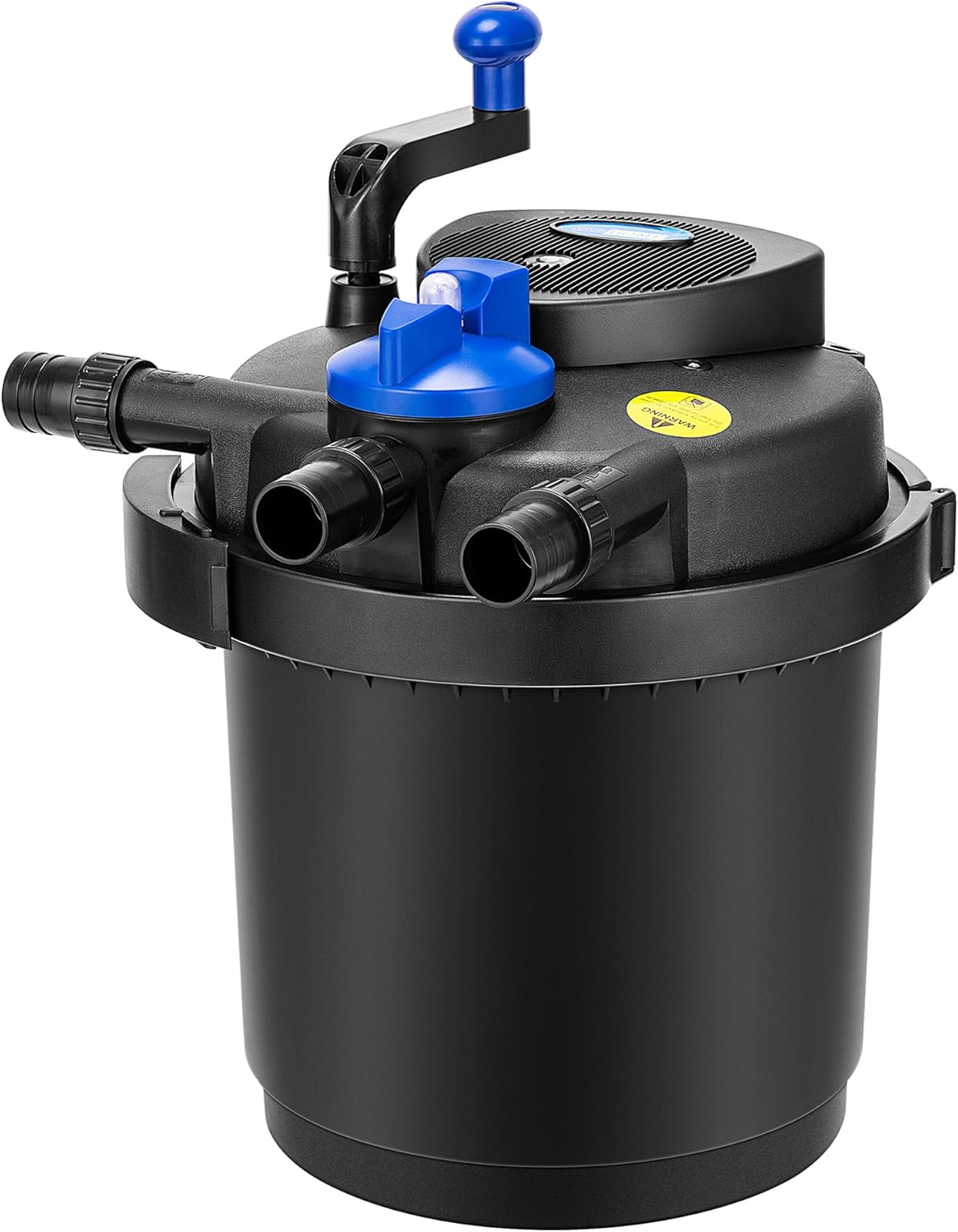
VIVOHOME VH515 Pressurized Biological Pond Filter with 13W UV Light
| Power Source | Electric |
|---|---|
| Voltage | 110 volts |
| Horsepower | 13 watts |
| Material Type | Acrylonitrile Butadiene Styrene (ABS) |
| Included Components | Filter, UV sterilizer light (13W) |
The VIVOHOME VH515 is a pressurized biological filter intended to keep koi and decorative ponds clear by combining mechanical sponge filtration with a 13W UV clarifying lamp. It is installed inline with a separate water pump and connects via the included multi-size hose adapters. Water passes through coarse and fine reusable sponges that trap debris while the lamp reduces free-floating algae, and a simple handle-driven backwash lets you switch to Clean mode and flush accumulated muck without disassembling the unit. The ABS, weather-resistant housing and clear inlet/outlet labels make outdoor siting straightforward and reduce installation guesswork. Practical benefits include low ongoing consumable cost because sponges are reusable, simple routine maintenance signaled by a red float, and compatibility with ponds up to about 1,600 gallons (ornamental) or 800 gallons with fish. Important limits are that the unit requires a separate pump and the UV bulb has a finite lifespan and must be replaced if water breaches the lamp seal; performance also depends on matching pump flow and hose size for steady filtration.
Best for: Buyers who want a low-maintenance, reliable filter for a small to mid-size koi or ornamental pond and prioritize simple installation and predictable upkeep.
Less Ideal for: Not the best choice for very large or heavily stocked ponds where industrial-scale filtration or integrated pumping is needed; pond owners who prefer fully submersible combo units should look elsewhere.
- Combined mechanical and UV clarification reduces both debris and free-floating algae
- Reusable coarse and fine sponge media lowers ongoing replacement costs
- Handle-driven backwash makes routine cleaning quick and tool-free
- Includes multiple hose adapters and clear inlet/outlet labeling for easier installation
- Weather-resistant ABS housing suited for year-round outdoor use
- Requires a separate water pump so total system cost and compatibility must be planned
- UV lamp has limited life and can fail if the lamp compartment seal is compromised
Verdict: A straightforward, low-maintenance pressurized biofilter that pairs with your pump to deliver clear water and easy weekly backflushing for small to mid-size koi and ornamental ponds.
NFESOLAR Large Pond Filter Fountain Kit with UV Clarifier (660 GPH)

| Power Source | Corded Electric |
|---|---|
| Max Flow Rate | 660GPH |
| Suitable for Ponds | Up to 2000 gallons |
| Other Special Features of the Product | Easy to Clean, Water Flowing |
This NFESOLAR pond filter fountain combines a 660 GPH submersible pump, three-layer mechanical/biological filtration and a built-in UV clarifier into a single compact unit intended for medium to large backyard ponds. It is used as a standalone filter and fountain: fit the unit in the pond, connect the corded power, choose one of the fountain nozzles and let the pump circulate water through the layered filters while the UV light reduces algae. Notable features include adjustable flow, multiple spray patterns, snap-on removable housing for easier rinsing and retractable nozzles for different water effects. In practice it saves space and avoids buying separate pump, filter and clarifier components, and the 660 GPH output is sufficient to keep water moving in ponds up to the advertised capacity when positioned correctly. Important limitations are that it is corded only so you need a safe outdoor power source and it may require occasional cleaning of the filter media and UV sleeve to maintain performance. For buyers on a budget it offers a straightforward, low-complication way to add filtration and a fountain to a koi or ornamental pond.
Best for: Buyers who want an affordable, space-saving all-in-one filtration and fountain solution for a backyard koi or ornamental pond and prioritize simple installation and basic algae control.
Less Ideal for: Those who need fully off-grid solar operation, heavy-duty commercial filtration, or advanced modular systems that allow separate upsizing of pump and filter components.
- Integrated pump, 3-layer filter and UV clarifier reduce the need for separate equipment
- 660 GPH pump provides strong circulation suitable for medium to large backyard ponds
- Snap-on removable housing and easy-to-clean design simplify maintenance
- Adjustable flow valve and multiple spray nozzles let you tune water display and circulation
- Requires a corded outdoor power connection rather than running on solar or battery
- May need regular cleaning of filter media and UV sleeve to keep clarity and flow
Verdict: A budget-friendly all-in-one pump, 3-stage filter and UV clarifier that simplifies pond upkeep and keeps water moving for medium to large backyard koi or ornamental ponds.
IRONMAX 2630 GPH Bio Pressure Pond Filter with 13W UV Light and Backflush

| Maximum flow | 2630 GPH (10,000 L/H) |
|---|---|
| UV lamp | 13W |
| Recommended pond size | Decorative ponds 2000-2600 gallons; fish ponds 1000-1300 gallons |
| Material | ABS |
This IRONMAX bio pressure filter combines mechanical and biological filtration with a 13W ultraviolet lamp and a convenient backflush function to keep pond water clear with less hands-on maintenance. It is used inline with a pump to pull water through layered sponges that trap debris while providing surface for beneficial bacteria, and the UV lamp helps control free-floating algae. Notable features include four interchangeable hose adapters for common pipe sizes, a transparent flow adapter to monitor water speed, and a float turbidity indicator that signals when backflushing is needed. The backflush knob allows cleaning the internals without disassembling the unit, which speeds routine upkeep. Constructed from ABS plastic, the unit is built for outdoor exposure and the sponge elements and lamp tube are replaceable to extend service life. Important limitations are that it requires a compatible pump sized for up to 2,630 GPH and replacement UV bulbs and sponges over time, so expect occasional parts maintenance and proper electrical protection for outdoor installation.
Best for: Buyers who prioritize a dependable, low-maintenance filtration system for a medium to large koi or decorative pond and want built-in UV clarification and easy cleaning features.
Less Ideal for: Small pond owners with low flow pumps or people who prefer simple gravity or DIY biofilters without electrical components should consider other options.
- Integrated 13W UV lamp reduces free-floating algae and helps clarify water
- Backflush valve lets you clean the filter interior without opening the unit
- Replaceable sponges and lamp tube extend usable life and simplify maintenance
- Includes four hose adapters plus a transparent flow adapter for easy plumbing
- Requires a pump capable of handling up to 2,630 GPH to reach rated flow
- UV bulb and sponges are consumables that must be replaced periodically
Verdict: A reliable, maintenance-friendly pressure filter with built-in UV clarification and backflush cleaning that suits medium to large koi ponds needing consistent water clarity.
TotalPond Complete Pressurized Pond Filter with 9W UV Clarifier

| Capacity | 1200 gallons |
|---|---|
| Other Special Features of the Product | UV Clarification |
| Purification Method | Ultraviolet |
| Power Source | Ac/DC |
| Included Components | Filter body, 9W UV Clarifier, 2 filter pads, 12 bio-balls |
The TotalPond Complete Pressurized Pond Filter combines mechanical pads, bio-balls and a 9W ultraviolet clarifier into a single freestanding unit for ponds and waterfalls up to 1200 gallons. You install your own pump and route water through the inlet so it passes the UV chamber, then two filter pads and the bio-ball chamber where beneficial bacteria establish. The enclosed, pressurized design keeps water moving and reduces clogging compared with open-media boxes, and the included stepped adapters accept 3/4 or 1 inch ID tubing for common pond setups. Practical benefits include simpler maintenance from the removable lid and preloaded media, plus UV-treated flow that helps clear green water and controls single-cell algae. Limitations are that the unit requires a separate pump sized to your pond and the 9W UV is modest for very high sunlight or larger koi ponds, so heavy algae pressure may need a stronger clarifier or supplemental filtration. The plastic housing is lightweight and easy to hide but not as rugged as heavy-duty commercial filters.
Best for: Buyers who want a single, compact filter that simplifies startup and maintenance while improving water clarity for backyard koi or decorative ponds and who prefer choices supported by established product reviews.
Less Ideal for: Large commercial koi collections, very high-biomass ponds, or owners who want an all-in-one pump-plus-filter solution without adding a pump.
- Integrated 9W UV clarifier to reduce green water and microscopic algae
- Pressurized design promotes steady flow and helps prevent debris settling
- Includes mechanical filter pads and bio-balls for combined mechanical and biological filtration
- Fits common tubing sizes with stepped adapters for straightforward plumbing
- Removable watertight lid and included media make initial setup and routine cleaning easier
- Requires a separate pond pump so additional cost and pump sizing are necessary
- 9W UV output is limited for very large or high-algae ponds
Verdict: A compact pressurized filter with UV and biological media that reliably improves clarity for backyard koi ponds up to 1200 gallons.
VIVOHOME VH556 530 GPH All-in-One Submersible Pond Filter Pump with Fountain

| Power Source | Corded Electric |
|---|---|
| Flow Rate | 2000 liters per hour |
| Maximum Lifting Height | 6.5 feet |
| Horsepower | 42 watts |
| Material Type | PP+ Copper |
The VIVOHOME VH556 is an all-in-one submersible filter pump designed to clean and circulate water while creating a decorative fountain. It houses a 42 W pump that moves up to 530 GPH (about 2000 L/h) through an internal sponge and bio-ball filter before returning water through one of three fountain nozzles. Typical use is simple: set the unit submerged in a backyard pond or water feature, choose a nozzle pattern, and plug in the long 33 ft cord. Notable features include multi-stage filtration to reduce debris and improve clarity, an integrated 9 W LED for nighttime display, and an IPX8 sealed design for weather resistance. Practical benefits are easy setup, reduced maintenance compared with separate pump and filter components, and added aeration from the fountain that helps pond health. Limitations are that it is sized for small to medium ponds and may need occasional cleaning of sponges and bio-balls; the unit is not intended for very large water gardens or heavily silted installations where a larger external filter would be better.
Best for: Buyers who want a low-hassle, single-unit solution to keep a small to medium garden pond clear and attractive with minimal installation and routine maintenance.
Less Ideal for: Gardeners with large water gardens, heavy fish loads, or ponds with substantial sediment buildup should consider a higher-capacity external filter and pump system instead.
- Integrated pump and multi-stage filtration simplifies setup and reduces equipment clutter
- 530 GPH (2000 L/h) flow rate suitable for aeration and circulation in small to medium ponds
- Three interchangeable nozzles let you change fountain patterns for decoration
- IPX8 sealed construction and a 33 ft UL-certified power cord for safe outdoor use
- Built-in LED light adds nighttime visual interest and shows when the light is functioning
- Not designed for very large ponds or heavy sediment where an external canister filter is preferable
- Requires periodic cleaning of sponge and bio-balls to maintain flow and filtration performance
Verdict: A convenient all-in-one pump and filter that adds aeration and a decorative fountain while keeping small to medium ponds cleaner with minimal fuss.
Choosing the Right Koi Pond Filter with UV Light: Key Factors to Consider
Pond Size and Fish Load
Pond volume and the number and size of koi directly determine how much water needs to be processed each hour. Larger ponds or heavy stocking require filters with higher flow capacity and more biological media to handle ammonia and nitrite production.
Underestimating fish load is a common mistake. Choose a system rated for a higher volume than your pond if you have many large koi or plan to add more fish. Also consider seasonal changes like spawning or feeding frequency, which raise waste production and may require temporary increases in cleaning and UV usage.
Balance Between Mechanical and Biological Filtration
Mechanical filtration removes solids and prevents media from clogging biological surfaces. The design should allow coarse debris to be trapped before water reaches the biological media so bacteria can process dissolved wastes effectively.
A filter with inadequate mechanical stages will foul quickly, shortening the useful life of biological media and increasing maintenance. Look for multi-stage systems that allow you to clean or replace mechanical pads without disturbing bio media.
UV Wattage and Contact Time
UV sterilization reduces free-floating algae and some microbes, but its effectiveness depends on lamp wattage and how long water is exposed in the UV chamber. Bright sunshine and high organic load demand stronger UV output or longer contact time to maintain clarity.
Higher wattage is not always better if the chamber design forces water to bypass the lamp or pass too quickly. Effective units combine appropriate wattage with baffled flow paths or coiled tubing so the water spends enough time near the lamp for meaningful sterilization.
Ease of Maintenance and Access
Routine cleaning frequency defines how much time you will spend maintaining the pond. Filters should offer easy access to mechanical pads, simple lamp replacement, and drain or backwash options to remove trapped debris quickly.
Consider how a unit performs during cold months when you may winterize equipment. Removable parts, clear sight glasses, and straightforward electrical and plumbing connections reduce the chance of repair mistakes and speed up seasonal care.
Durability and Materials
Materials that sit in or near water must resist UV, oxygen, and pond chemistry. Durable plastics, stainless fasteners, and UV-rated hoses last longer and minimize leaching that can stress koi.
Also think about how outdoor exposure affects seals and O-rings. Systems with replaceable seals and widely available lamp types reduce long-term service headaches and downtime.
Installation Flexibility and Plumbing
Some filters are best placed at pond level while others integrate into waterfall systems or remote filter bays. Check inlet and outlet sizes, pump placement options, and whether you can adapt the unit to existing plumbing without complex rework.
A filter that offers both vertical and horizontal plumbing orientations or multiple inlet ports will fit more setups. Also verify electrical safety and grounding needs for UV lamp housings when planning placement.
How UV Works Alongside Biological Filtration
UV light kills or inactivates free-floating algae cells and certain bacteria but does not remove settled debris or break down dissolved wastes. That is why UV should be treated as a complement to robust mechanical and biological filtration rather than a replacement.
In practice, you want mechanical stages to capture leaves and sludge first. Then water passes over biological media where nitrifying bacteria convert ammonia and nitrite to less harmful nitrate. The UV stage after those processes polishes the water by targeting suspended algae and microbes, producing clearer water and reducing greenwater events.
- Place UV after mechanical filtration to avoid lamp fouling by solids.
- UV reduces visible algae but not sludge or dissolved organics.
- Maintain both bio media and UV lamp schedules for best results.
Sizing a System to Your Pond
Calculate required flow rate in gallons per hour based on pond volume and desired turnovers. For koi ponds many keepers aim for one turnover every hour to two hours depending on fish load and features like waterfalls. Choose a filter and pump combination that can achieve that turnover without overworking the UV chamber.
Also assess biological media volume. A larger media chamber provides more surface area for beneficial bacteria and more buffering capacity against spikes in waste. If your pond experiences heavy feeding or seasonal algae spikes, opt for extra bio media rather than relying solely on higher flow.
- Target higher turnover for heavily stocked ponds.
- Oversize media capacity when in doubt to reduce maintenance frequency.
Common Installation Configurations
Filters with integrated UV chambers may sit at pond level, in a skimmer box, or in a separate filter bay. Each orientation affects plumbing runs and head pressure. Inline UV units usually require pump sizing that accounts for additional head loss through the UV chamber.
Think through winter procedures when installing. Units that are easy to drain and remove for lamp storage simplify winterization. Also check electrical routing so outlets and cords are protected from splash and weather.
- Inline UV sits after the pump and before return features like waterfalls.
- Skimmer-mounted filters combine debris capture and UV in one location.
- Plan for access to the lamp and mechanical media for quick service.
Maintenance Schedule Basics
Mechanical pads, brushes, and screens typically need cleaning every few weeks during heavy use and less frequently in cooler months. Biological media should be rinsed gently only when necessary to avoid removing beneficial bacteria. UV lamps degrade over time and usually need replacement annually even if they still light up.
Document a simple schedule for cleaning mechanical stages, checking seals and O-rings, and replacing the UV lamp. Regular inspections of flow rates and visible clarity will tell you when to step up maintenance or troubleshoot a component.
- Clean mechanical filters more often during spring and summer.
- Rinse bio media gently to preserve bacteria colonies.
- Replace the UV lamp on a schedule rather than waiting for failure.
Troubleshooting Poor Water Clarity
If water remains green despite a UV-equipped filter, the usual culprits are bypassing flow, undersized UV contact time, or heavy nutrient loads. Check that water actually flows through the UV chamber and not around it, and verify pump output against the filter's required flow range.
Also inspect for excessive nutrient sources such as overfeeding, decaying plant matter, or run-off from fertilized beds. Removing those inputs and improving mechanical debris removal will reduce the load on both biological media and the UV stage.
- Verify plumbing to ensure full flow through the UV chamber.
- Reduce nutrient inputs before increasing system power.
- Confirm lamp age and optical cleanliness if sterilization seems weak.
How We Chose the Best Koi Pond Filter with UV Light
We focused on features that actually change pond water quality and maintenance time. Key evaluation criteria included flow capacity relative to pond volume, the balance and capacity of mechanical versus biological media, UV lamp wattage and chamber design, ease of routine maintenance and lamp replacement, and the durability of wet-side materials against pond chemistry and weather. We also considered installation flexibility for different pump arrangements and how simple plumbing connections are. We excluded systems that only provide decorative features or those intended solely for small container ponds. Units lacking sufficient biological media, undersized UV chambers, or unclear maintenance access were not shortlisted. The final picks emphasize systems that combine sufficient mechanical trapping, ample biological surface area, and UV contact time appropriate for typical backyard koi stocking levels.
FAQ
Do I need a UV lamp for a small backyard koi pond?
A UV lamp helps control free-floating algae and can improve clarity even in small ponds, but it is not a substitute for good mechanical and biological filtration. For lightly stocked, shaded ponds you may manage with robust filtration alone.
How often should the UV bulb be replaced?
UV bulbs lose effectiveness over time and are usually replaced around once per year depending on runtime. Even if the bulb still glows, its sterilization output can be diminished and should be changed on a schedule.
Can I run the UV only during daylight hours?
Running UV during peak algae growth periods is common and can reduce runtime, but for consistent clarity many keepers run it continuously or on long daily cycles. Short runs may miss some algae cycles, so adjust based on pond response.
Will UV treatment harm my beneficial bacteria?
UV targets free-floating organisms in the water column and has little effect on bacteria established on biological media. Proper placement of the UV stage after mechanical filtration preserves biofilms on media and avoids disrupting nitrifying colonies.
How do I winterize a filter with a UV lamp?
Drain and store the UV lamp and housing if the unit cannot remain frost-free. Remove any water that could freeze in chambers and follow manufacturer guidelines for electrical disconnection. Leaving the lamp in a freezing environment risks cracking and seal damage.
Final Verdict
Match filtration capacity and biological media volume to your pond size and fish load, then use UV as a polishing stage to control free-floating algae and some microbes. Prioritize a system that lets you service mechanical pads and replace the UV lamp easily, because accessibility drives how consistently you will maintain the pond. The right setup balances flow, media surface area, and UV contact time. Focus on long-term durability and simple maintenance routines so your koi enjoy clearer water with less hands-on effort.
