

Note: This article contains affiliate links. If you click on these links and make a purchase, I may earn a small commission at no extra cost to you. This helps support my research and content. Read my full affiliate disclosure here.
A lawn feed moss killer does two jobs at once: feed your turf and reduce moss so grass can fill in thin patches. Choosing the right formulation matters because application method, nutrient balance, and timing determine whether you get lasting green-up or a short-lived boost followed by more moss. This guide covers seven shortlisted options that suit common lawn situations and explains the practical differences you need to consider. We evaluate ease of application, nutrient profile, and how each product behaves in typical garden conditions to help you choose the most suitable solution for your lawn. Read on to understand the tradeoffs and next steps after treatment.
Top Picks at a Glance
| Best Overall The best all-around choice for most situations | Scotts Turf Builder with Moss Control, 5,000 sq. ft. |  |
| Best Quality Built to a higher standard if you want something more solid | Lilly Miller Moss Out Lawn Granules, 20 lb |  |
| Best Value The sweet spot between price and what you get | Scotts Moss Control Granules for Lawns, 18.37 lb |  |
| Best Budget The cheapest option that still gets the job done reliably | Lilly Miller Moss Out for Lawns Ready-to-Spray, 32 oz |  |
| Highest Rated A top-rated pick with lots of positive feedback | Lilly Miller Moss Control Granules (2 × 20 lb) |  |
| Most Popular A crowd favorite that many people choose with confidence | Scotts Turf Builder Triple Action Moss Control, 40 lb |  |
| Best Seller A high-volume bestseller chosen again and again | Lilly Miller Moss Out for Lawns Concentrate, 1 gal |  |
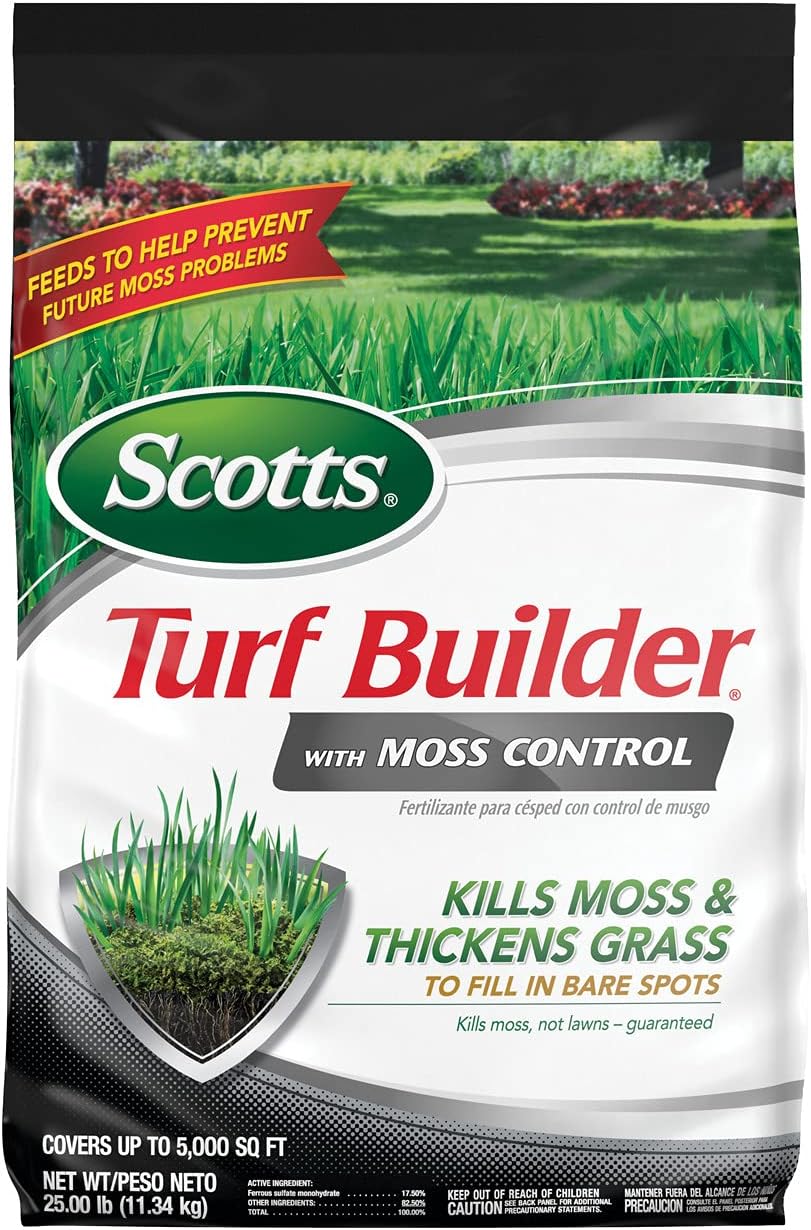
Scotts Turf Builder with Moss Control, 5,000 sq. ft.
| Item Form | Granule |
|---|---|
| Coverage | 5000 |
| Unit Count | 400 Ounce |
| Item Type Name | Lawn Food with Moss Control Fertilizer |
Scotts Turf Builder with Moss Control combines a granular fertilizer with a moss-killing ingredient so you can feed the lawn while treating moss patches in the same application. It is applied with a broadcast or drop spreader during winter or spring when moss is actively growing; Scotts provides spreader settings for regular and heavy rates. The fertilizer thickens grass to help fill bare spots and improve water and nutrient uptake, and treated moss will darken briefly before fading after mowing. One 25 lb. bag covers about 5,000 sq. ft., and the label recommends waiting 6 to 8 weeks between applications and avoiding newly seeded lawns until after the fourth mowing. Practical strengths are the combined treatment and clear application guidance, which simplify seasonal lawn maintenance. Limitations are that it is a preventative/curative lawn food rather than a fast-acting spot herbicide, and results depend on correct timing, spreader calibration, and follow-up cultural practices to reduce reestablishment of moss.
Best for: Gardeners who want a straightforward, seasonally timed product to both feed their lawn and reduce moss across an entire yard and who prefer following manufacturer guidance and community-tested settings.
Less Ideal for: People needing instant spot control or those managing newly seeded lawns or very small isolated patches where a targeted liquid or manual removal approach is preferable.
- Combines fertilizer and moss control so you treat and feed in one application
- Covers up to 5,000 sq. ft. per 25 lb. bag, suitable for small to medium lawns
- Clear spreader settings provided for both broadcast and drop spreaders
- Formulated to thicken grass and help fill bare spots over time
- Not a rapid spot-killer for heavy moss infestations since it relies on seasonal application and turf recovery
- Can temporarily darken grass blades after application which may concern appearance-sensitive users
Verdict: Choose this product if you want a single granular treatment that feeds your lawn while reducing moss across up to 5,000 sq. ft. in routine seasonal care.
Lilly Miller Moss Out Lawn Granules, 20 lb

| Item Form | Granule |
|---|---|
| Coverage | 5000 square_feet |
| Active Ingredients | sulfate |
| Unit Count | 320 Ounce |
Lilly Miller Moss Out comes as 20-pound granules formulated to kill moss quickly and encourage greener grass by supplying iron. It is applied to moist lawns after mowing, spread evenly, then watered in; instructions recommend 20 lb per 5,000 sq ft for light infestations or doubling that for heavier issues. The product visibly browns and weakens moss within a day, making raking and removal easier, and the iron content can tint surrounding turf a richer green without promoting excessive growth. Because it contains ferrous sulfate, spills can stain hard surfaces and it should be kept off driveways, patios, and clothing and away from children and pets. Practical users will appreciate the clear coverage guidance and fast action, but you must follow application and cleanup directions carefully to avoid staining and limit use to lawns only. This is a straightforward, no-frills option for treating moss while also giving a quick cosmetic boost to grass color.
Best for: Gardeners who want a practical, quick-acting solution to remove moss and improve lawn color with minimal fuss and clear application guidance.
Less Ideal for: People who need a non-staining or multi-surface product or those looking for an all-in-one fertilizer with broader nutrient balance.
- Fast visible action against moss, often browning moss within a day
- Provides iron to enhance grass color while treating moss
- Clear application rates and coverage up to 5,000 sq ft for straightforward planning
- Granular form is easy to spread with a broadcast spreader or by hand
- Contains ferrous sulfate which can stain hard surfaces and fabric if spilled
- Intended for lawns only and requires careful watering-in and cleanup to avoid unintended contact
Verdict: Choose this product if you want a fast, easy granular treatment that kills moss and gives lawns a quick green-up.
Scotts Moss Control Granules for Lawns, 18.37 lb

| Item Form | Granule |
|---|---|
| Coverage | 5000 square feet |
| Unit Count | 293.92 Fluid Ounces |
Scotts Moss Control Granules is a ready-to-spread treatment made to remove moss from lawns without killing grass and to leave turf greener after application. It is typically applied in winter or spring when moss is actively growing, best used on moist turf after mowing to expose low patches. The product is packaged for broadcast or drop spreaders and the label gives specific spreader settings for even coverage. In practice it turns moss black and causes it to disappear within a few weeks, and grass blades may show temporary darkening that disappears after mowing. One 18.37 pound bag covers up to 5,000 square feet, making it suitable for small to medium lawns or spot treatment of problem areas. Safety directions advise avoiding skin and eye contact and keeping it away from children. Limitations are that repeat applications may be needed with persistent moss and the product is designed for actively growing moss, so timing matters for best results.
Best for: Homeowners who want a straightforward, spreader-applied solution to remove moss and improve lawn color and who prioritize efficient coverage and clear usage instructions.
Less Ideal for: People needing an all-season preventive solution for moss on non-growing turf or who prefer a liquid spray option rather than a granular spreader application.
- Formulated to kill moss while supplying nutrients that help green the lawn
- Clear application guidance with spreader settings for consistent coverage
- Treats up to 5,000 square feet from a single 18.37 lb bag
- Works on moist, low-growing moss and is suitable for spot treatments
- Most effective only when moss is actively growing so seasonal timing matters
- May require repeat treatments 2 to 4 weeks apart for heavy infestations
- Temporary darkening of grass blades can occur after application
Verdict: A practical, spreader-friendly granular treatment that reliably kills active moss and greens lawn turf across up to 5,000 sq. ft.
Lilly Miller Moss Out for Lawns Ready-to-Spray, 32 oz

| Liquid Volume | 32 fluid ounces |
|---|---|
| Coverage | 500 square feet |
| Item Form | Spray |
| Active Ingredients | Iron |
Lilly Miller Moss Out Hose N Go is a ready-to-use liquid iron moss treatment that attaches to a garden hose for quick application across affected turf. You connect the bottle to a hose and spray the product over mossy areas; the active ingredient (ferric sulfate/iron) darkens and kills moss within hours and can help reduce regrowth when used as directed. The built-in hose connection makes treatment fast and simple without measuring or mixing, and the 32 ounce bottle is intended to cover roughly 500 square feet. Important practical points are the safety precautions and re-entry guidance printed on the label since the product is corrosive to some materials and should not contact skin, eyes, clothing, or allow people and pets onto wet grass. This is a straightforward choice for spot treatments or small lawns where ease of use matters, though larger properties will require multiple bottles or alternative delivery methods.
Best for: Homeowners looking for an easy, no-mix solution to remove moss from small lawns or to spot-treat problem patches while keeping application simple and fast.
Less Ideal for: Large properties, turf managers, or users who need an organic or non-iron moss control should consider concentrated or different-format products.
- Ready-to-spray hose-attach design eliminates measuring and simplifies application
- Active iron formula works quickly and shows results in hours
- Covers about 500 sq ft per 32 oz bottle, suitable for small lawns or spot treatment
- Contains ferric sulfate so it requires careful handling and protective gear
- Not intended for very large lawns without buying multiple bottles
Verdict: A hassle-free, ready-to-spray iron treatment that makes fast spot removal of lawn moss easy for small lawns and quick fixes.
Lilly Miller Moss Control Granules (2 × 20 lb)

| Unit Count | 320 Ounce |
|---|---|
| Number of Packs | 2 |
| Item Form | Granule |
| Active Ingredients | Ferrous Sulfate Monohydrate |
These Lilly Miller granules are an iron-based moss treatment sold as two 20 lb bags intended for large lawns or repeat treatments. The granules are formulated to target and reduce moss where shade, moisture, compaction, or acidic soil encourage its growth, and they are applied with a broadcast or drop spreader for even coverage. Because iron is the active ingredient, the product both suppresses moss and can darken turf color, giving affected areas a quicker visual improvement. Each bag is stated to cover up to 5,000 sq ft which makes the two-pack convenient for larger properties or for treating in multiple passes during the season. Expect visible moss decline rather than an immediate removal overnight; repeat or follow-up treatments may be necessary in persistently damp or heavily shaded spots. The granular form is easy to store and handle compared with liquids, but it does require a spreader for the most consistent results and care to avoid staining hard surfaces if spilled.
Best for: Buyers who prioritize a dependable, season-long solution for moss on medium to large lawns and want a product that is simple to apply with standard spreaders.
Less Ideal for: Homeowners with very small lawns who prefer spot treatments, or those who need an immediate cosmetic removal method without follow-up treatments.
- Two 20 lb bags provide coverage for large lawns or multiple treatments
- Granular formula spreads evenly with standard broadcast or drop spreaders
- Contains iron (ferrous sulfate monohydrate) to both control moss and enhance turf color
- Suitable for common moss conditions in shaded, moist, compacted, or acidic lawn areas
- May require repeat applications in persistently damp or heavily shaded locations
Verdict: A reliable, iron-based granular treatment packaged for large lawns that controls moss while improving turf color.
Scotts Turf Builder Triple Action Moss Control, 40 lb

| Item Form | Granule |
|---|---|
| Coverage | 8,000 sq. ft. |
Scotts Turf Builder Triple Action for Moss Control is a granular lawn treatment designed to kill active moss while feeding and thickening turf. You apply it in winter or spring to a moist, mowed lawn with a broadcast or drop spreader using the recommended settings; one 40 lb bag treats up to 8,000 square feet. In practice the product darkens affected grass briefly as it kills moss, and the built-in fertilizer promotes greener, denser growth after mowing. Notable features include explicit spreader settings for consistent coverage and a formulation intended for most grass types. Practical benefits are reduced moss patches combined with turf recovery from the added nutrients, making follow-up overseeding or spot treatments more effective. Important limitations are timing and safety: it works best when moss is actively growing so off-season use is less effective, and you must wait 6 to 8 weeks between applications and avoid treated turf until foliage is dry. For best distribution use a compatible Scotts spreader and follow label directions closely for even results.
Best for: Homeowners focused on measurable lawn performance who want to remove moss while improving turf density across medium to large lawns and who follow label directions and scheduled treatments.
Less Ideal for: Those needing an all-season or immediate moss fix on small patches should consider targeted spot treatments or liquid options instead.
- 3-in-1 formula kills moss while feeding and thickening grass
- Covers up to 8,000 sq. ft. per 40 lb bag for large-area treatment
- Includes specific spreader settings for consistent, even application
- Suitable for most grass types and intended for winter or spring use
- May temporarily blacken grass blades after application
- Effective only when moss is actively growing, limiting application window
Verdict: Choose this product if you want a single granular treatment that kills moss and simultaneously feeds and thickens turf across a multi-thousand-square-foot lawn.
Lilly Miller Moss Out for Lawns Concentrate, 1 gal

| Item Form | Liquid Concentrate |
|---|---|
| Coverage | 2000 square feet |
| Active Ingredients | Ferric Sulfate |
| Unit Count | 128 Fluid Ounces |
Lilly Miller Moss Out is a liquid ferric sulfate concentrate designed to rapidly kill moss on turf and help prevent new growth. You attach the bottle to a garden hose and spray treated areas without mixing, which makes it convenient for treating up to the stated coverage area. The product acts quickly, with visible moss browning and die-off within hours, and is formulated to avoid harming established grass when applied according to the label. Its concentrated formula covers a large area per bottle, reducing the number of refills for typical suburban lawns. Important limitations are the safety precautions and re-entry restrictions while sprays are wet, and the need to follow the label exactly to avoid contact with skin, eyes, or pets. Also, it targets moss specifically and will not address underlying drainage, shade, or soil pH issues that encourage moss to return, so it is best used as part of a broader lawn care routine.
Best for: Homeowners who want a straightforward, fast way to remove moss from an existing lawn and prefer a hose‑attached concentrate to simplify application.
Less Ideal for: People looking for a long-term cultural fix for moss related to shade or soil issues or those who prefer granular or non-chemical control methods.
- Concentrated liquid attaches to a garden hose for one-step application without mixing
- Fast-acting ferric sulfate formula produces visible moss die-off in hours
- Covers up to 2000 square feet per bottle, suitable for typical lawn sizes
- Formulated to kill moss while being safe for established grass when used as directed
- Contains ferric sulfate and requires careful handling and re-entry restrictions until sprays dry
- Does not solve underlying causes of moss such as shade, compaction, or poor drainage
Verdict: A fast, easy hose‑attached ferric sulfate concentrate for homeowners who need quick and effective moss control on established lawns.
Choosing the Right Lawn Feed Moss Killer: Key Factors to Consider
Application Method and Timing
How you apply a lawn feed moss killer affects its effectiveness and convenience. Granular formulations usually work through a spreader and provide even nutrient distribution, while liquid concentrates may give faster contact with moss but require a sprayer.
Timing matters because moss control is most effective when moss is actively growing but grass is also able to respond. Many gardeners get the best results in early spring or autumn when soil moisture is higher and temperature encourages both moss activity and grass recovery. Rain within 24 to 48 hours of application can help granules dissolve and move nutrients into the root zone, but heavy rain immediately after liquid application can wash treatment away.
Nutrient Ratio and Micronutrients
The N-P-K ratio determines how the lawn responds after moss suppression. A higher nitrogen component promotes rapid green-up, which helps grass outcompete moss in thin areas. However, too much quick-release nitrogen can burn stressed turf in hot conditions or promote excessive top growth.
Micronutrients such as iron and manganese can be particularly useful because iron stains and directly suppresses moss while giving turf a darker green appearance. Look for balanced formulations that include slow-release nitrogen options or follow-up feeding plans to maintain steady recovery rather than a single flush of growth.
Safety for Turf and Surrounding Plants
A lawn feed moss killer should target moss without damaging the grass or nearby ornamental plants. Active ingredients and application rates determine the margin of safety. Over-application or treating during extreme heat increases the risk of turf scorch.
Consider buffer distances for flower beds and vegetable areas and follow label directions about watering restrictions and re-entry times. Pet- and child-safety recommendations also vary between granular and liquid products, so factor in how soon the lawn will be used after treatment.
Coverage and Cost Efficiency
Coverage per treatment matters for larger lawns because it affects how often you need to buy product. Concentrated liquids often treat more area per container but require careful measurement; granules are simpler to calculate with spreader settings.
Also consider whether the product requires multiple applications in one season. Some treatments deliver a single strong effect, while others recommend repeat applications for ongoing suppression. Choosing a product with predictable coverage and a straightforward reapplication schedule helps with budgeting and scheduling.
Environmental and Soil Considerations
Soil pH, drainage, and shade influence moss presence and how a lawn feed moss killer performs. Acidic, compacted, or waterlogged soils favor moss growth; a feed-and-kill product treats the symptom but not always the cause.
Think about whether you will pair treatment with cultural fixes such as aeration, topdressing, liming, or improving drainage. A product that helps the turf recover quickly is valuable when you are prepared to address soil conditions that allowed moss to thrive in the first place.
When to Treat Your Lawn
Treating at the right time increases the chance the grass will reclaim space after moss dies back. Early spring or autumn are usually best because moss is active and grass can respond. Avoid treating during drought or extreme heat when turf recovery is unlikely.
Plan applications around weather forecasts. Moderate rain or watering within a day or two after a granular treatment helps move nutrients into the root zone. For liquid sprays, allow enough dry time to let the product contact moss before heavy rainfall.
- Spring: good for green-up and early moss growth
- Autumn: helps turf thicken before winter
- Avoid high heat or drought conditions
Preparing the Lawn Before Application
Mow the lawn to a recommended height and remove clippings if they would smother treated areas. Raking out heavy moss patches before applying improves product contact with surviving moss and exposes bare soil for seed or repair work.
Address compaction where possible. Aeration ahead of treatment helps roots take up nutrients after moss suppression and gives grass an advantage during recovery.
- Mow to standard height, then rake
- Core aerate compacted areas
- Water lightly if soil is very dry before treatment
Follow-up Care After Treatment
After moss control, support the lawn with repairs and steady nutrition. Overseed bare patches where grass density is low and keep soil consistently moist until seedlings establish. Avoid heavy foot traffic on newly treated or overseeded areas.
Implement routine maintenance such as proper mowing height, regular aeration, and balanced fertilizing to reduce the chance of moss returning. Cultural changes are essential to convert treatment into long-term improvement.
- Overseed and topdress thin spots
- Maintain consistent moisture for establishment
- Adopt a regular aeration and feeding cycle
Spreader and Sprayer Tips
Getting even coverage is one of the biggest practical challenges. Calibrate broadcast spreaders before applying granules and follow the recommended overlap pattern. For liquids, use a sprayer with uniform nozzles and keep a steady walking speed.
Clean equipment after use to prevent residue buildup and cross-contamination. Store remaining product according to label instructions in a dry, secure location.
- Calibrate spreader for even output
- Maintain consistent walking speed for sprays
- Clean and store equipment after each use
Cultural Strategies to Prevent Moss Return
Treatments work best when paired with long-term cultural fixes. Improving drainage, reducing shade where practical, and correcting soil pH can shift growing conditions away from moss favorability. Regular dethatching and avoiding overly low mowing heights also help.
Consider a seasonal maintenance plan that staggers aeration, feeding, and spot treatments so turf stays dense and less hospitable to moss in the years after initial control.
- Improve drainage and reduce compaction
- Address tree canopy or dense shade
- Avoid mowing too short and thatch build-up
How We Chose the Best Lawn Feed Moss Killer
We focused on selections that combine targeted moss control with effective lawn feeding because gardeners need both outcomes to restore density and reduce recurring moss. Our editorial filters prioritized products with clear application methods suitable for home lawns, balanced nutrient analysis for spring or autumn use, and active ingredients known for moss suppression while being compatible with turf recovery. Evaluation criteria included application ease and spreader compatibility, N-P-K balance and micronutrients for recovery, speed of moss suppression and visible turf response, and longevity of effect across a growing season. We excluded items intended solely as moss-only treatments without feeding value and products formulated only for sports fields or commercial applicators. We also filtered out treatments that require professional licensing or equipment not commonly owned by homeowners. The final shortlist emphasizes practical gardener concerns: how straightforward the treatment is to apply, how it fits into common lawn care calendars, and how it supports grass recovery after moss suppression.
FAQ
How soon will I see moss die after applying a lawn feed moss killer?
You will often see browning of moss within a few days to two weeks depending on the active ingredient and weather. Full cleanup and turf recovery can take several weeks as dead moss is raked out and grass fills bare spots.
Can I overseed immediately after applying a moss-killing feed?
It usually makes sense to clear out dead moss first, then overseed. Rake out the dead moss to expose soil and wait until any harsh contact-action residues have dissipated-often a week or two-before sowing new grass seed.
Will a lawn feed moss killer harm my flower beds or vegetable garden?
Drift or accidental overspread can affect nearby plants. Keep treatments off non-target beds and follow label buffer guidance. If product lands on desirable plants, rinse foliage promptly with water.
How often do I need to reapply to keep moss under control?
Frequency depends on underlying conditions; many homeowners use a targeted program of one to two treatments per year alongside cultural fixes. If soil and shade issues remain, repeated treatments may be necessary until conditions change.
Is iron-based feed alone enough to stop moss long term?
Iron can quickly darken turf and suppress moss temporarily, but long-term control usually requires improving grass vigor through balanced feeding, aeration, and addressing soil or shade that favors moss.
Final Verdict
Choose a lawn feed moss killer that matches how you prefer to apply treatments and the calendar windows when your lawn can recover. Prioritize formulations with a nutrient profile that supports steady recovery and an application method you can execute evenly across the lawn. Remember that products are only one part of the solution. Combine treatment with cultural repairs such as aeration, overseeding, and drainage or pH adjustments to convert short-term moss reduction into long-term, thicker turf that resists moss return.
