

Note: This article contains affiliate links. If you click on these links and make a purchase, I may earn a small commission at no extra cost to you. This helps support my research and content. Read my full affiliate disclosure here.
If dandelions are taking over patches of your grass, choosing the right lawn fertilizer for dandelions matters more than one-off weed sprays. A targeted fertilizer helps restore nutrient balance, encourages thicker turf that crowds out broadleaf weeds, and works alongside cultural practices to reduce dandelion reinfestation. This guide shortlists five top options suited for yards battling dandelions and explains how each was evaluated for nutrient ratio, release type, and turf-building benefits. Below you will find the best fertilizers we shortlisted for dandelion-prone lawns along with the decision criteria to help you pick the right approach for your yard and season.
Top Picks at a Glance
| Best Overall The best all-around choice for most situations | Scotts Turf Builder Triple Action Lawn Fertilizer and Weed Control, 11.31 lb |  |
| Best Quality Built to a higher standard if you want something more solid | Scotts Turf Builder Weed & Feed 3, Granular Lawn Fertilizer and Weed Killer, 14.29 lb |  |
| Best Value The sweet spot between price and what you get | GreenView Weed & Feed Lawn Fertilizer, 39 lb (Covers 15,000 sq ft) |  |
| Highest Rated A top-rated pick with lots of positive feedback | Scotts Turf Builder WinterGuard Fall Weed & Feed, 11.43 lb |  |
| Most Popular A crowd favorite that many people choose with confidence | Scotts Turf Builder Weed & Feed5 Granular Lawn Fertilizer (33.95 lb) |  |
Scotts Turf Builder Triple Action Lawn Fertilizer and Weed Control, 11.31 lb

| Item Form | Granule |
|---|---|
| Coverage | 4000 square_feet |
| Active Ingredients | Pendimethalin, Dicamba |
Scotts Turf Builder Triple Action combines fertilizer, broadleaf weed control, and a crabgrass pre-emergent into a single granular bag aimed at spring lawn care. You apply it with a broadcast spreader to a wet lawn, let granules sit for 24 hours, then water to move the active ingredients into the soil. Notable features are its 3-in-1 formulation and a coverage claim of 4,000 square feet from the 11.31 lb. bag, plus compatibility with common turf types such as Kentucky bluegrass, fescue, and bermudagrass. In practice it simplifies chores by replacing separate fertilizer and pre-emergent steps and helps prevent crabgrass for several months while also targeting common broadleaf weeds like dandelion and clover. Important limitations are that it will not kill existing crabgrass and it contains herbicides that require careful timing and following safety directions for people and pets. For a homeowner who wants a single spring treatment to strengthen turf and reduce weed pressure, this is a practical, time-saving option.
Best for: Homeowners who want a single spring treatment to both strengthen their lawn and reduce weed pressure without managing multiple products, and who follow label timing and safety instructions.
Less Ideal for: People needing a quick cure for established crabgrass or those who prefer separate targeted treatments for fertilizer and herbicide control.
- 3-in-1 formula feeds grass, kills listed broadleaf weeds, and prevents crabgrass
- Covers up to 4,000 square feet from a single 11.31 lb. bag
- Granular form works with broadcast spreaders for even application
- Suitable for a wide range of common turf types
- Does not control existing crabgrass since the product is a pre-emergent
- Contains herbicides that require strict timing, wet grass at application, and re-entry precautions
Verdict: Use this single-bag 3-in-1 granular treatment if you want an easy spring application that feeds your lawn while preventing crabgrass and treating common broadleaf weeds.
Scotts Turf Builder Weed & Feed 3, Granular Lawn Fertilizer and Weed Killer, 14.29 lb

| Item Form | Granule |
|---|---|
| Coverage | 5000 square_feet |
| Active Ingredients | 2,4-D 1.220%, Mecoprop 0.081% |
Scotts Turf Builder Weed & Feed3 is a granular lawn product that combines a fertilizer with broadleaf weed control for routine lawn maintenance. It is applied with a broadcast or drop spreader to a wet lawn when daytime temperatures are between 60 and 90°F, and it uses WeedGrip technology to help granules stick to weed leaves for better uptake. In practice it kills common weeds such as dandelion and clover while delivering nutrients to thicken grass, so treated areas often green up and look fuller over a few weeks. The package covers about 5,000 sq. ft. and manufacturer instructions recommend avoiding certain grass types and keeping people and pets off the lawn until dust settles. Important limitations are that it is not safe for some turf species and must not be watered for 24 hours after application; timing and correct spreader settings affect results. For homeowners wanting a combined feed-and-weed treatment for standard lawns, it simplifies two tasks into one application, but it requires following the label closely for safe and effective use.
Best for: Homeowners seeking a straightforward, combined fertilizer and weed-control treatment to maintain and thicken common cool- and warm-season turf in a typical yard.
Less Ideal for: Specialist turf managers, owners of sensitive turf varieties (listed on the label), or those who need spot treatment only rather than whole-lawn applications.
- Combines fertilizer and broadleaf weed control in one granular product
- WeedGrip formulation helps granules adhere to weed leaves for improved herbicide contact
- Covers approximately 5,000 sq. ft. per 14.29 lb bag, suitable for many small to medium lawns
- Clear application guidance for use with common spreaders and specific temperature/wetting windows
- Contains active herbicide ingredients not appropriate for all turf types and must be avoided on listed grasses
- Requires strict timing and no watering for 24 hours after application to be effective and safe
Verdict: A practical one-step weed-and-feed for typical lawns that feeds turf while targeting common broadleaf weeds across a 5,000 sq. ft. area.
GreenView Weed & Feed Lawn Fertilizer, 39 lb (Covers 15,000 sq ft)

| NPK | 27-0-4 |
|---|---|
| Form | Granule |
| Coverage | 15000 sq ft |
| Active Ingredient | Nitrogen |
| Unit Count | 624 Ounce |
GreenView Weed & Feed is a single-application granular product that combines a slow-release nitrogen fertilizer with a broadleaf herbicide to feed turf and control common lawn weeds. It is typically applied to established lawns when weeds are actively growing, using the recommended rate and watering in afterward; the bag covers up to 15,000 square feet at the stated application rate. Notable features include MESA controlled-release nitrogen for up to eight weeks of steady feeding and labeled control of over 250 weeds such as dandelion and clover. Practical benefits are faster, uniform green-up without a surge of growth, improved root development for heat and drought tolerance, and convenience from a combined weed-control plus fertilizer approach. Important limitations are that it is intended only for established turf and specific grass species, requires careful timing (do not mow two days before or after application) and is not suitable for some grasses like dichondra or certain St. Augustine varieties in Florida, so checking the label for species compatibility is essential.
Best for: A cautious buyer who values proven results and wants a convenient, evidence-backed product to maintain and improve established warm- or cool-season lawns while reducing application frequency.
Less Ideal for: Do not choose this if you are overseeding, establishing a new lawn, or managing grass types listed as incompatible such as certain Floratam St. Augustine selections or non-turf groundcovers.
- Combines fertilizer and herbicide so you treat weeds while feeding in one application
- MESA controlled-release nitrogen provides up to 8 weeks of steady feeding
- Labeled to control over 250 common broadleaf lawn weeds
- Large 39 lb bag covers up to 15,000 sq ft at the recommended rate
- Formulation is for established turf only and can harm non-listed species
- Requires precise timing and watering instructions to work effectively
Verdict: Choose this if you want a single, proven weed-and-feed product that delivers steady feeding and broadleaf weed control across common established turf.
Scotts Turf Builder WinterGuard Fall Weed & Feed, 11.43 lb

| Item Form | Granule |
|---|---|
| Coverage | 4000 square feet |
Scotts Turf Builder WinterGuard is a fall granular weed-and-feed formulated to kill common broadleaf weeds such as clover and dandelion while feeding cool- and warm-season grasses. It is applied with a broadcast or drop spreader to a moist lawn on a calm day when temperatures are between 60°F and 90°F. Notable features include WeedGrip Technology to improve granule adhesion to weed leaves, instructions tuned for Scotts spreaders, and coverage sized for about 4,000 square feet per 11.43 lb bag. In practice it simplifies a seasonal task by combining weed control and fertilization in one application, which helps build root strength and recover summer stress heading into winter. Important limitations are that it is labeled for specific grass types only and must not be used on St. Augustinegrass, bentgrass, or several groundcover species, and you must avoid watering for 24 hours after application for best effect. For homeowners who want a dependable, single-step fall treatment for typical lawn weeds, this performs as advertised; those with unsupported grass types or very large lawns will need a different product or multiple bags.
Best for: Homeowners who prioritize a reliable, low-effort fall solution to eliminate clover and other broadleaf weeds while feeding their lawn for winter hardiness.
Less Ideal for: Properties planted with unsupported turf species or buyers who need coverage for very large lawns without buying multiple bags.
- Kills over 50 listed lawn weeds including clover and dandelion
- Combined fertilizer and weed control saves an extra application
- WeedGrip Technology helps granules stick to moist weed leaves for better uptake
- Clear application guidance for use with Scotts spreaders and recommended timing
- Labeled for specific grass types only and should not be used on St. Augustinegrass, bentgrass, or certain groundcovers
Verdict: Choose this product if you want a dependable one-step fall treatment that both kills clover and feeds your lawn to build stronger roots for spring.
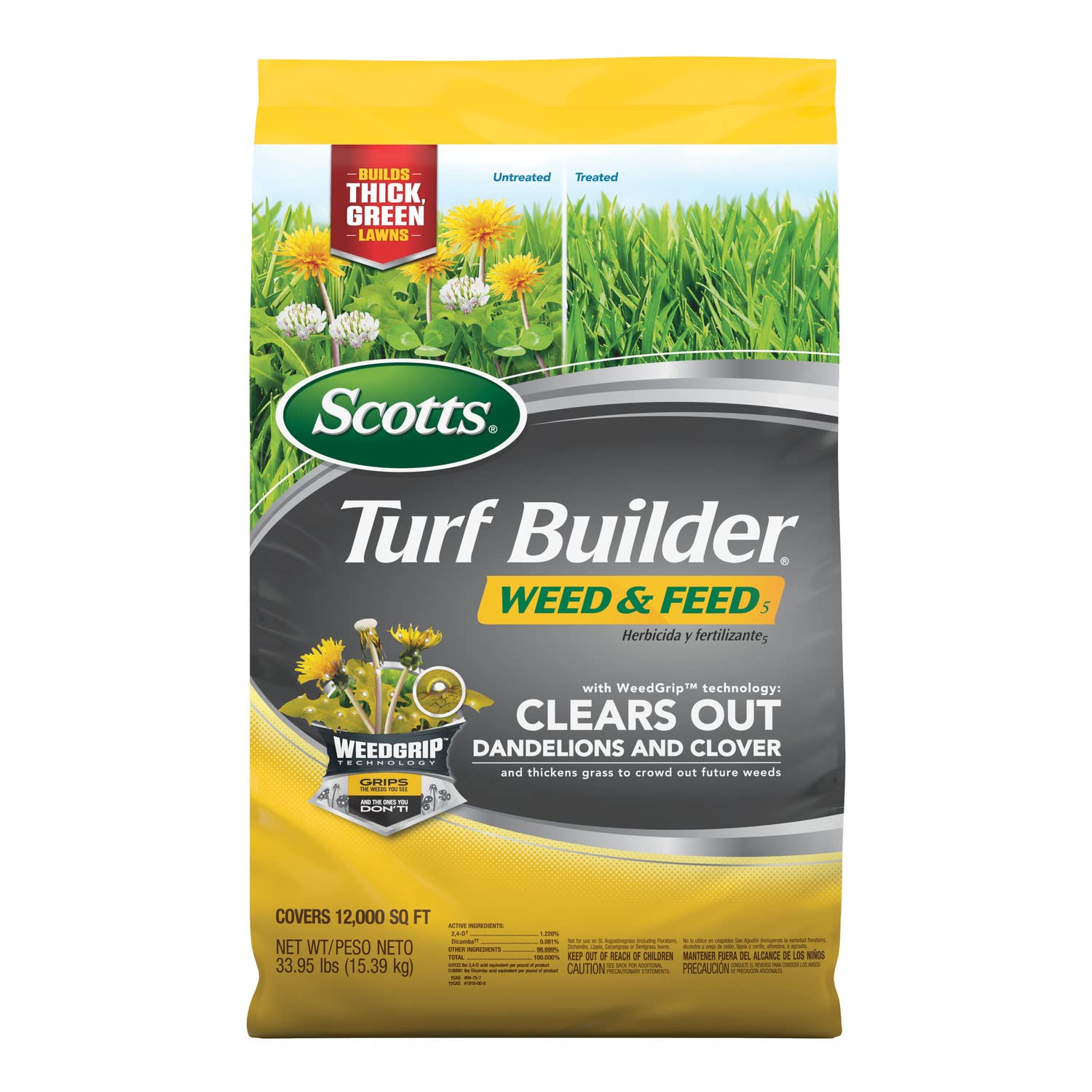
Scotts Turf Builder Weed & Feed5 Granular Lawn Fertilizer (33.95 lb)
| Item Form | Granule |
|---|---|
| Coverage | 12000 square feet |
| Active Ingredients | 2.4‑D and Dicamba |
| Unit Count | 1 Count |
Scotts Turf Builder Weed & Feed5 is a combined granular weed killer and lawn fertilizer intended for use when broadleaf weeds are actively growing and daytime temperatures are between 60°F and 90°F. You apply it to a wet lawn with a broadcast, drop, or hand spreader (Scotts publishes spreader settings) and then avoid watering for 24 hours to let granules stick to weed leaves. The formula uses WeedGrip technology and active ingredients 2,4‑D and dicamba to target common lawn weeds such as clover and dandelion while the fertilizer portion delivers nitrogen and potassium to thicken turf. A single 33.95 lb. bag is sized to cover about 12,000 square feet, making it convenient for medium to large yards. Important limits: do not use on St. Augustine, bentgrass, dichondra, carpetgrass, or lippia and do not apply if rain is expected within 24 hours; the product can also require keeping people and pets off treated turf until dust settles. For homeowners seeking a combined weed control plus feeding step, this simplifies late‑spring applications, but those with excluded grass types or who need precise spot treatments should consider alternatives.
Best for: Homeowners with warm‑season Bahia and other listed grass types who want a single late‑spring application to control broadleaf weeds while feeding the lawn and prefer products with established brand usage guidance.
Less Ideal for: Anyone growing St. Augustine, bentgrass, dichondra, carpetgrass, or lippia or gardeners who need spot treatments, organic options, or year‑round fertilization plans.
- Kills a wide range of listed broadleaf lawn weeds including clover and dandelion using WeedGrip technology
- Feeds lawn while treating weeds so it both reduces weeds and promotes thicker turf
- Large 33.95 lb. bag covers up to 12,000 sq ft, suitable for medium to large lawns
- Published application guidance and spreader settings make it straightforward to apply evenly
- Not safe for use on several turf types including St. Augustine and bentgrass
- Requires dry window after application and restriction on people and pets until dust settles
- Contains synthetic herbicides that require careful handling and label compliance
Verdict: A convenient, proven weed‑and‑feed option for Bahia and other compatible lawns that combines broadleaf weed control with feeding in one late‑spring application.
Choosing the Right Lawn Fertilizer for Dandelions: Key Factors to Consider
Nutrient Balance and Turf Recovery
A fertilizer that restores the right balance of nitrogen, phosphorus, and potassium helps turf outcompete dandelions. Nitrogen promotes rapid leaf growth so grass can shade the soil surface, reducing the light available to emerging weed seedlings. Phosphorus supports root establishment, which is important if you are reseeding thin patches after dandelion removal.
Choosing a mix with the right N-P-K ratio for your season and lawn type matters. Overapplication of nitrogen alone can create lush but shallow turf that still allows dandelions to establish, so integrated balance is the goal.
Nitrogen Release Profile
Release type determines how quickly grass responds and how long benefits last. Fast-release nitrogen gives a quick green-up and can temporarily outgrow weeds, but it can also stimulate shallow root growth and require more frequent mowing. Slow-release or controlled-release formulations feed grass steadily, improving root depth and long-term turf density that suppresses dandelions.
For dandelion-prone areas, a fertilizer that combines an initial quick feed with a longer-term slow-release fraction often offers the best balance between immediate improvement and sustained competition against broadleaf weeds.
Compatibility With Spot Weed Control
Many gardeners combine fertilization with targeted weed treatments. Select fertilizers that will not interfere with common spot applications, and follow timing recommendations to avoid overlapping treatments that stress turf. Some formulations are designed for spring or fall use and pair better with pre- or post-emergent programs, while others suit routine maintenance.
Planning the application calendar reduces turf stress and improves the effectiveness of both fertilizer and any additional weed controls.
Soil pH, Micronutrients, and Biology
Soil pH and a lack of micronutrients can make lawns more susceptible to dandelion invasion. A fertilizer that includes key micronutrients or is used alongside a soil amendment can correct deficiencies and improve turf vigor. Biological amendments that support beneficial microbes also contribute to healthier soil structure and nutrient cycling.
Testing soil pH and nutrient levels before choosing a fertilizer helps you target the right product and avoid feeding weeds unnecessarily.
Application Practicalities
Ease of application affects how consistently you can treat the lawn. Consider spreader compatibility, recommended application rate, and whether the product is granular, soluble, or a liquid concentrate. Granular slow-release options are convenient for larger areas, while soluble feeds or hose-end solutions may suit smaller lawns or precision work.
Also factor in cleanup, storage stability, and any re-entry or watering requirements listed on the label to ensure the product fits your schedule and equipment.
Environmental Risk and Timing
Timing fertilizer applications to avoid heavy rain reduces runoff and nutrient loss. Products with lower leaching potential and slow-release formulations are generally safer near water bodies. Seasonal timing also matters: early spring and early fall are prime times to strengthen turf, but exact timing depends on your grass species and local climate.
Mindful timing reduces environmental impact and improves the chance that turf will respond strongly enough to crowd out dandelions rather than simply encouraging temporary growth.
When To Fertilize For Best Dandelion Control
The timing of fertilizer applications changes how effectively turf can compete with dandelions. For cool-season grasses, early fall is a prime window because roots recover and thicken before winter dormancy. For warm-season lawns, late spring to early summer supports active growth and crowns the turf for summer competition.
Apply a maintenance feed when grass is actively growing rather than during stress periods. Pair heavier restorative feeds with overseeding when reseeding thin areas left after dandelion removal to get the most benefit.
- Early fall encourages root growth in cool-season lawns
- Late spring is best for warm-season grasses once they are fully active
- Avoid heavy feeding during drought or extreme heat
Combining Fertilizer With Cultural Practices
Fertilizer is most effective when combined with proper mowing, irrigation, and overseeding. Mow at the recommended height for your grass species to encourage leaf density that shades out dandelion seedlings. Correct irrigation schedules prevent shallow rooting that favors weeds.
Aeration and overseeding thin areas reduce the open soil that dandelions exploit. Address compacted soil and patchy turf first, then use the fertilizer to accelerate recovery and thickening.
- Mow higher during peak weed season to shade seedlings
- Aerate compacted areas before applying restorative fertilizers
- Overseed thin spots after dandelion removal for longer-term suppression
Interpreting Labels and N-P-K Ratios
Understanding the label helps you pick the right tool for dandelion control. Look beyond the headline N-P-K to the source of nitrogen and whether microelements are included. Labels also indicate the percentage of slow-release nitrogen which affects how long the fertilizer benefits the turf.
If soil tests show deficiencies, choose a product that addresses those specific needs rather than a generic high-nitrogen mix. Adjust rates to match recommended application per 1,000 square feet to avoid overfeeding.
- Check slow-release percentage on the label
- Match application rate to lawn size and condition
- Consider micro-nutrients if soil test shows deficit
Safe Use Near Landscapes And Water Features
When treating dandelions near flower beds or ponds, choose formulations with lower risk of drift and runoff. Granular products reduce immediate mobility if applied correctly and watered in according to label directions. Keep fertilizer off hard surfaces and sweep up any granules to prevent local contamination.
Follow recommended setback distances and avoid applications when heavy rain is forecast to minimize environmental impact.
- Use spreaders for even coverage and to avoid piles
- Water in granular fertilizer lightly to activate without washing away
- Avoid applications before heavy rains
Long-Term Lawn Health Versus Quick Fixes
Addressing dandelions with fertilizers is a long-term strategy, not an instant removal method. Products that build deeper roots and thicker turf reduce the need for repeated spot treatments over time. Quick high-nitrogen feeds can look good short-term but may not reduce dandelion pressure sustainably.
Plan a season-by-season approach: correct soil issues, follow recommended feeding windows, and maintain cultural practices. Over time you will see fewer dandelions as the lawn becomes denser and healthier.
- Prioritize steady turf-building over one-off green-ups
- Combine soil correction with consistent maintenance
- Track results seasonally and adjust feeding schedules as needed
How We Chose the Best Lawn Fertilizer for Dandelions
We focused on fertilizers that support turf recovery while minimizing conditions that favor dandelions. Evaluation emphasized nutrient balance relevant to lawn recovery, the presence and type of slow-release nitrogen, and any included broadleaf weed suppression components. We also considered formulary chemistry that affects root development and soil biology, such as phosphorus and potassium levels, and whether micronutrients or soil conditioners were present to address common deficiencies that encourage weeds. Application practicality was a criterion: spreader compatibility, recommended timing windows for dandelion control, and treatable lawn area per bag were weighed. Environmental considerations played a role too, including reduced leaching potential and guidelines for responsible use around water features. We excluded products marketed primarily as herbicides with minimal fertilizing value, and any formulations intended only for turf renovation rather than regular maintenance. The final picks balance turf-building nutrition, release profile, and practical application for gardeners fighting dandelions.
FAQ
Can fertilizer alone get rid of dandelions?
Fertilizer helps turf compete with dandelions but rarely eliminates mature plants on its own. Combining proper fertilization with targeted removal, overseeding, and improved cultural practices gives the best long-term reduction in dandelion numbers.
Is slow-release fertilizer better for dandelion control?
Slow-release fertilizers improve root development and sustain turf density, which helps suppress dandelion seedlings over time. They are generally preferable for steady competition but may be paired with a limited quick-release fraction for immediate green-up.
When should I apply fertilizer if I want fewer dandelions next season?
For cool-season lawns, apply a restorative fertilizer in early fall to promote root growth and fill thin spots before winter. For warm-season grasses, target late spring to early summer once the lawn is actively growing to build summer density that resists weeds.
Do I need a soil test before choosing a fertilizer?
A soil test is recommended because it reveals pH and nutrient deficiencies that influence which fertilizer will be most effective. Targeted amendments based on test results are more efficient than blanket applications and reduce the chance of feeding weeds.
How does mowing height affect dandelion suppression?
Mowing at the correct height for your grass species increases leaf area and light interception, which shades the soil and reduces opportunities for dandelion seedlings to establish. Avoid scalping the lawn, as lower heights can encourage weed growth.
Final Verdict
Prioritize fertilizers that build root depth and turf density when your goal is to reduce dandelion pressure. Balance immediate needs with slower-release nutrition, correct soil deficiencies identified by testing, and pair feeding with cultural practices like proper mowing, aeration, and overseeding. By focusing on long-term turf health and responsible timing, you will reduce dandelion recurrence and rely less on repeated spot treatments.
