

Note: This article contains affiliate links. If you click on these links and make a purchase, I may earn a small commission at no extra cost to you. This helps support my research and content. Read my full affiliate disclosure here.
When you care for a large, uneven garden you need a mower that will handle slopes, bumps, and variable turf without constant fuss. The right lawn mower for large uneven garden reduces physical strain, limits scalping and missed patches, and keeps mowing time reasonable across uneven ground. This guide covers the top shortlisted mowers suited to large, irregular lawns and explains the practical tradeoffs between traction, deck design, and cutting systems. Expect clear, gardener-focused criteria so you can pick a machine that matches your terrain and maintenance style.
Top Picks at a Glance
| Best Overall The best all-around choice for most situations | LYMOW One Plus Robot Lawn Mower with RTK+VSLAM Navigation and Tracked Drive |  |
| Best Quality Built to a higher standard if you want something more solid | roborock RockMow X130H Robot Lawn Mower with 4WD and Quad-Vision Navigation |  |
| Best Budget The cheapest option that still gets the job done reliably | HOOKII Neomow X SE Robotic Lawn Mower (3D LiDAR Navigation) |  |
| Highest Rated A top-rated pick with lots of positive feedback | GIYI 7.5HP Remote Control Tracked Lawn Mower (21.7" Cutting Width) |  |
| Most Popular A crowd favorite that many people choose with confidence | Greenworks 60V 21" Self-Propelled Lawn Mower with (2) 4.0Ah Batteries |  |
LYMOW One Plus Robot Lawn Mower with RTK+VSLAM Navigation and Tracked Drive

| Cutting width | 16 inches |
|---|---|
| Minimum Adjustable Cutting Height | 1.2 inches |
| Maximum Adjustable Cutting Height | 4 inches |
| Power Source | Battery Powered |
The LYMOW One Plus is a purpose-built robotic mower for large, hilly properties that combines high-precision RTK positioning with VSLAM visual mapping and a tracked drive system to handle very steep terrain. Setup is wire-free via smartphone and you define virtual boundaries and no-go zones in the app; once configured it runs autonomously, auto-recharges, and resumes tasks. Notable hardware includes a 16-inch dual-rotary blade deck with adjustable heights from 1.2 to 4 inches, a high-capacity LiFePO4 battery that supports multiple daily cycles, and a heavy-duty track drive that claims 45° slope capability and good obstacle-crossing. The onboard AI vision and ultrasonic sensors provide real-time obstacle detection, while the cyclone airflow and dual blades aim for even cuts and mulching of clippings. Trade-offs are its size and complexity: this is a premium, robust machine intended for large or challenging lawns rather than small plots, and initial mapping plus occasional maintenance of blades and tracks will be required to keep performance consistent.
Best for: Buyers who need a capable, low-supervision mower for large properties with steep slopes and complex boundaries and who value precise mapping and hands-off operation.
Less Ideal for: Those with small, simple lawns or buyers seeking a minimal-maintenance, budget entry-level robotic mower should consider simpler wheeled models instead.
- Tracked drive and reinforced motor enable climbing and stable operation on slopes up to 45°
- RTK plus VSLAM navigation provides precise, wire-free mapping and consistent coverage
- Large-capacity LiFePO4 battery supports multiple cycles per day for wide area coverage
- 16-inch dual rotary blades with airflow lift and mulching reduce missed cuts and return fine clippings to the lawn
- Designed for large, complex lawns so it may be oversized for small yards
- Higher mechanical complexity means more maintenance on tracks and blades than a basic wheeled mower
Verdict: If you need a robust, wire-free robot that can reliably mow steep, uneven lawns with high precision, the LYMOW One Plus is built for that job.
roborock RockMow X130H Robot Lawn Mower with 4WD and Quad-Vision Navigation
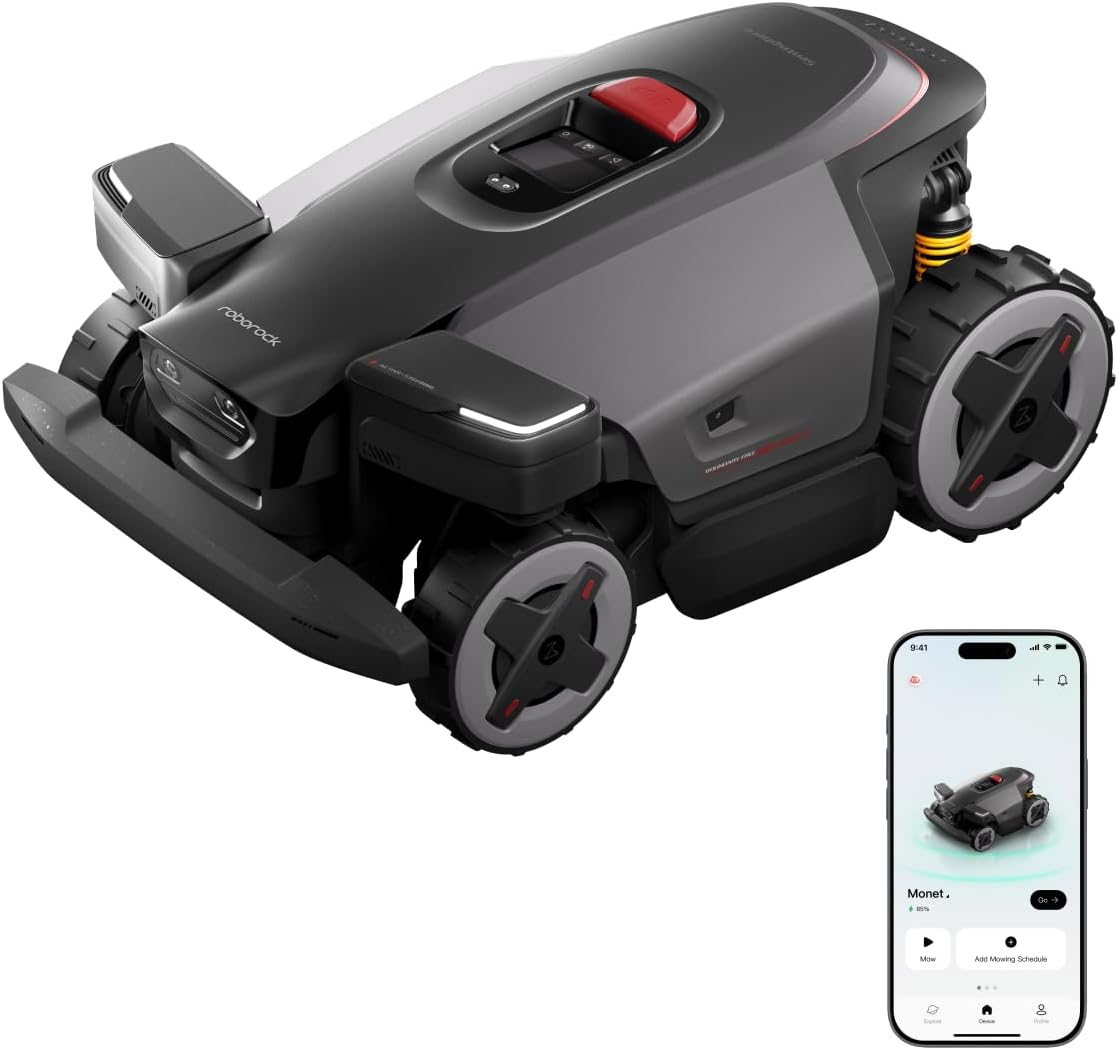
| Power Source | Battery Powered |
|---|---|
| Cutting width | 9.5 inches |
| Maximum Adjustable Cutting Height | 3.5 inches |
| Battery Average Life | 140 minutes |
The roborock RockMow X130H is a high-capability robot mower built to handle steep, uneven, and complex lawns without a buried perimeter wire. It uses Full-Band RTK plus a quad-camera AI vision system for precise positioning and dual mapping modes so you can either auto-map open areas or manually trace boundaries from the app. The pro-grade four-wheel drive, active steering, and dynamic suspension let it climb slopes up to 80% and roll over obstacles up to about 3.1 inches while keeping a floating cutting deck for consistent surface-following. Practical benefits include a relatively wide 9.5-inch cut to reduce runtime, multi-zone scheduling and a real-time app dashboard, plus anti-theft features and 4G connectivity. Important limitations are its weight and size for handling and storage, and the advanced navigation and connectivity mean a learning curve during setup and when customizing complex zones. For homeowners with steep or irregular yards who want largely hands-off mowing, this mower brings robust, reliable performance.
Best for: Homeowners with steep, irregular, or obstacle-filled lawns who want a durable, hands-off mower that prioritizes precise navigation and traction over simplicity.
Less Ideal for: Small, flat lawns or buyers who want a very lightweight, simple plug-and-play robot mower with minimal setup and fewer connectivity features.
- Four-wheel drive, active steering, and dynamic suspension that handle slopes up to 80% and 3.1-inch obstacles
- Full-Band RTK plus quad-camera AI vision for accurate positioning under trees and near fences
- Wire-free dual mapping options with app control and multi-zone scheduling for flexible setup
- 9.5-inch cutting width and floating deck for efficient, even mowing across contours
- Built-in anti-theft features including PIN lock, alarm, and GPS tracking
- Heavy and bulky compared with smaller robotic mowers, making manual transport and storage more cumbersome
- Advanced navigation and connectivity increase setup complexity and may require time to fine-tune for complex yards
Verdict: Choose the RockMow X130H if you need a wire-free, high-traction robot mower that can reliably conquer steep, uneven lawns with precise navigation.
HOOKII Neomow X SE Robotic Lawn Mower (3D LiDAR Navigation)

| Cutting Width | 11 in |
|---|---|
| Cutting Height Range | 1.18–3.35 in |
| Battery Capacity | 13,000 mAh |
| Mowing Time Per Charge | Approx. 120 minutes |
| Max. Mowing Area | 0.75 Acre |
The HOOKII Neomow X SE is a high-end robotic lawn mower built for large yards that need reliable autonomous mowing with minimal setup. It uses 360° 3D LiDAR combined with AI vision to map lawns, avoid more than 200 obstacle types, and deliver centimeter-level positioning without boundary wires or RTK stations. Typical use is set-and-forget: you map zones and no-go areas in the app, schedule mowing, and the mower repeatedly follows U-shaped or grid routes, returning to charge when needed. Notable features include an 11-inch cutting deck with floating design to handle uneven ground, adjustable cutting heights across seven positions, a 13,000 mAh battery that runs about two hours per charge, IPX5 water resistance for outdoor use, and multiple connectivity options (Wi-Fi, Bluetooth, 4G). Practical benefits are thorough coverage (claimed ≥95%), precise avoidance of small objects, and breakpoint resume so it finishes after charging. Limitations to consider are the stated maximum coverage per unit for continuous operation (about 0.17 acre per charge) which means larger properties will require longer or multiple charging cycles, and the product complexity which may require some app setup and occasional maintenance.
Best for: Homeowners with larger lawns who want a reliable, low-hands-on autonomous mower that navigates complex yards and prioritizes safe obstacle avoidance and precise mapping.
Less Ideal for: People who prefer the simplest possible plug-and-play solution or who need nonstop single-pass mowing of very large properties without periodic recharging.
- 3D LiDAR plus AI vision provides precise mapping and obstacle avoidance without external RTK hardware
- Supports mapping, multi-zone management, and no-go zones through app with Wi‑Fi, Bluetooth, and 4G
- Floating 11-inch cutting deck and adjustable heights adapt to uneven terrain for consistent cut
- IPX5 waterproofing and breakpoint resume let it operate in varied outdoor conditions and continue after charging
- Two-hour runtime covers about 0.17 acre per charge, so larger yards may need longer total mowing time
- Advanced sensors and app features add setup complexity compared with simple boundary-wire mowers
Verdict: Choose the Neomow X SE if you want a feature-rich, LiDAR-guided robotic mower that reliably maps and avoids obstacles for large, complex yards.
GIYI 7.5HP Remote Control Tracked Lawn Mower (21.7" Cutting Width)

| Power Source | Gas Powered |
|---|---|
| Operation Mode | Automatic |
| Cutting width | 21.65 inches |
| Maximum Adjustable Cutting Height | 15 centimeters |
| Minimum Adjustable Cutting Height | 20 millimeters |
This GIYI remote-control tracked mower is designed for large, uneven properties where steep slopes and thick vegetation are common. You operate it with a handheld remote to drive the tracked chassis, steer, and change the cutting deck height from 0.79 to 5.9 inches, which makes it useful for both regular lawn trimming and cutting taller grass or light brush. The 7.5 HP gas engine and 21.7-inch cutting width provide strong cutting performance and decent pass coverage on varied terrain, while the wide tracks give traction on wet or uneven ground and allow the unit to climb slopes up to 45 degrees. Construction prioritizes durability with a reinforced steel frame suitable for heavy outdoor use. Expect easier mowing on hills and less need for manual control, but also the typical maintenance and fuel handling of a gas engine and a bulky, heavy machine that requires secure storage and occasional service. This mower is a solid choice when reliable slope performance and a rugged build are the priority.
Best for: Buyers who need a dependable, heavy-duty mower for large, uneven properties and prioritize strong slope performance and durable construction over lightweight convenience.
Less Ideal for: Small urban yards, users wanting electric or low-maintenance battery options, or anyone needing a lightweight easily stored machine.
- Remote control operation for hands-off steering and height adjustment
- Tracked drive provides strong traction and stability on slopes up to 45°
- Adjustable cutting height from 20–150 mm for versatility across turf and taller growth
- 7.5 HP gas engine delivers reliable power for thick grass and brush
- Reinforced steel frame built for heavy-duty outdoor use
- Heavy and bulky which complicates transport and storage
- Gas engine requires regular fuel, oil, and maintenance
Verdict: Choose this mower when reliable, heavy-duty slope-climbing performance and rugged construction are the top priorities for maintaining a large, uneven garden.
Greenworks 60V 21" Self-Propelled Lawn Mower with (2) 4.0Ah Batteries

| Power Source | dc |
|---|---|
| Operation Mode | Manual |
| Maximum Adjustable Cutting Height | 4 inches |
| Minimum Adjustable Cutting Height | 1 inches |
| Number of Positions | 7 |
The Greenworks 60V 21" self-propelled mower delivers gas-like cutting power with a brushless motor and dual 4.0Ah batteries that together provide roughly 60+ minutes of runtime, enough to cover up to about 3/4 acre under typical conditions. It is used like a conventional walk-behind mower but with rear-wheel self-propulsion that you can adjust on the go for slopes or thick grass. Notable features include seven height positions for precise cutting, LED headlights for low-light work, a 4-in-1 discharge system for bagging, mulching, side-discharge and turbo leaf pickup, and foldable handles for compact storage. Practical benefits are quiet operation compared with gas mowers, simple electric starts, and battery compatibility across the Greenworks 60V ecosystem so you can share batteries with other tools. Important limitations are that runtime will vary with terrain and grass height, the included batteries are mid-capacity so very large properties may require spare packs or higher-capacity options, and the mower uses plastic and aluminum components that require reasonable care to avoid damage over time.
Best for: Buyers who want a quieter, low-maintenance alternative to gas mowers for medium-size lawns and value proven features and compatibility with a 60V battery ecosystem.
Less Ideal for: Those with very large properties who need continuous runtime without swapping batteries or buyers who prefer fully metal, commercial-grade construction.
- Brushless 60V motor provides strong, quiet cutting performance similar to gas models
- Two 4.0Ah batteries with auto switchover deliver about 60+ minutes runtime for up to 3/4 acre
- Self-propelled rear-wheel drive with adjustable pace makes slopes and thick grass easier to manage
- 7-position height adjustment and 4-in-1 deck versatility (mulch, bag, side discharge, turbo)
- LED headlights and foldable handles improve usability and storage
- Included 4.0Ah batteries may be undersized for very large yards without spare high-capacity packs
- Certain structural parts use plastic which can be less durable than full-metal alternatives
Verdict: A capable, quiet 60V self-propelled mower that covers medium lawns well while sharing batteries with a broad 60V tool ecosystem.
Choosing the Right Lawn Mower for Large Uneven Garden: Key Factors to Consider
Power and Torque
Power determines how well a mower climbs slopes and chops through dense or long grass. For large uneven gardens, rated horsepower or motor torque is less abstract than actual torque delivery under load, since weak engines stall on inclines or in heavy growth. Choose machines with a clear torque or power rating and a proven transmission design that keeps RPMs steady while cutting.
Higher torque also means fewer passes through thick patches, which saves time on large properties. Remember that higher power can increase fuel or battery use, so match power to the size and severity of your terrain rather than defaulting to the highest number.
Cutting Deck Design and Width
Deck width affects how quickly you cover ground and how the deck reacts to bumps. Wider decks reduce mowing time on large properties but can be harder to maneuver around tight obstacles and are more prone to uneven cuts on highly contoured ground. Deck rigidity and internal baffling affect airflow and clippings discharge; a stable deck gives a more even cut on slopes.
Material and reinforcement matter too. Steel decks are durable but heavier and resist flexing; stamped or fabricated designs influence how well the deck preserves blade-to-turf distance when crossing dips and rises.
Traction and Wheel Design
Traction is crucial on slopes, wet grass, and loose soil. Wider, aggressive-tread tires reduce slipping and prevent wheel spin that can tear turf. Self-propelled machines with variable drive or hydrostatic transmissions give finer speed control and better torque transfer to wheels, which is helpful when adjusting pace on uneven ground.
Consider tire size front to back and whether the machine offers differential locking or adjustable tire pressure. Good traction reduces the chance of wheel ruts and delivers safer, more consistent cuts.
Deck Float and Ground Following
A deck that can 'float' and follow ground contours helps avoid scalping on high spots and missed grass in hollows. Look for designs with articulated mounts, anti-scalp wheels, or independent deck leveling systems. The ability to fine-tune deck height across a wide range lets you set an optimal cut for variable turf.
Poor deck float leads to repeated lawn repairs and uneven regrowth patterns. On large properties with many undulations, a forgiving deck saves time and preserves lawn health.
Stability and Operator Control
Operator confidence matters when you spend hours mowing uneven territory. Handle ergonomics, steering feedback, and speed control affect how safely and accurately you navigate slopes and tight areas. A stable wheelbase and low center of gravity reduce tip risk on side slopes.
Controls that are easy to adjust without stopping-such as quick height changes or simple drive engagement-keep you working efficiently and reduce fatigue during long mowing sessions.
Maintenance and Serviceability
Large, uneven gardens demand more from a mower, so ease of maintenance affects uptime and long-term costs. Accessible blade mounting, simple deck-cleaning access, and clear points for oil or filter changes make routine care faster. Battery platforms should provide easy access if swapping cells, while combustion machines should have straightforward spark plug and air filter servicing.
Durable wear parts and replaceable trim components reduce downtime. If a mower is difficult to maintain, small issues compound quickly on large properties.
Mowing Techniques for Uneven Ground
Adjust your cutting height to the highest recommended setting for the first pass, then lower it gradually on follow-up passes. This staged approach reduces strain on the engine and lessens the chance of scalping high spots.
When tackling slopes, move slowly and avoid making sharp turns across steep banks. Where possible, mow up and down the slope rather than side to side to reduce rollover risk and improve traction.
- Overlap previous passes slightly to avoid missed strips
- Keep blades sharp to reduce tugging and uneven cuts
- Avoid mowing on very wet turf to reduce slipping and turf damage
Setting Up for Safety on Inclines
Inspect the lawn before mowing to remove hidden obstacles like rocks, roots, or bicycle parts that can cause sudden jolts. Use a string line or visual landmarks to plan safe lines of travel.
Wear appropriate footwear and consider a harness or strap if using a ride-on mower on steep banks. Make incremental passes and stay aware of the machine's center of gravity when crossing cambers or ridges.
- Avoid sudden steering inputs on slopes
- Use lower speeds to maintain control
- Make sure grass collection boxes are secure to avoid shifting weight
Dealing With Thick Grass and Patchy Areas
For areas with dense clumps or tall summer growth, use a higher cutting height and slow feed rate to let the mower process material without stalling. Multiple passes at progressively lower heights produce a cleaner finish.
Patchy turf may require alternating mowing directions on different passes to catch matted grass and produce a uniform look. Raking or dethatching before the mow season helps reduce clumping and improves blade effectiveness.
- Consider a mulching setup to return organic matter to the lawn
- Use a sharp, high-lift blade for better discharge in dense areas
Transporting and Storing Mowers for Large Properties
If you need to move a machine between sections of a large property or between yards, plan for a safe transport method that secures the mower and protects the deck. Keep fuel levels low for transport and engage parking brakes or blocks.
Store the mower in a dry, ventilated space when not in use and carry out seasonal maintenance such as blade sharpening, lubrication, and battery care. Proper storage prolongs service life and reduces midseason failures.
- Use a cover to protect electronics and exposed components
- Perform a quick inspection before each use to catch loose parts
When to Consider Professional Servicing
If your mower shows persistent vibration, uneven cutting despite tuning, or clutch and transmission noises, a professional inspection can prevent more serious failures. Professionals can diagnose wear in spindles, belts, and gearbox components that are hard to assess at home.
Annual tune-ups before the peak mowing season often include blade balancing, belt inspection, and carburetor or electronic system checks. On large properties that see heavy use, more frequent servicing can be justified to maintain performance.
- Document hours of use to guide service intervals
- Keep replacement parts on hand for common wear items
How We Chose the Best Lawn Mower for Large Uneven Garden
We focused on features that matter when mowing large, uneven gardens rather than general-purpose specs. Core evaluation criteria included engine or motor torque and throttle responsiveness for climbing and powering through thick or tall grass; cutting deck design and size to balance efficiency with maneuverability on slopes and around obstacles; traction and drive system performance, including wheel width, tread pattern, and drive type for steady grip on uneven surfaces; suspension and deck float to reduce scalping and follow ground contours; and durability of key wear parts like blades, wheels, and deck finish for long seasons of heavy use. We also evaluated maintenance ease, such as access for blade changes and cleaning, and safety features relevant to sloped mowing. We excluded machines intended only for small, flat lawns or specialty robotic units that cannot handle steep, irregular terrain. Products that lacked sufficient documentation on torque, drive system, or deck construction were not shortlisted.
FAQ
Should I use a wider deck or multiple passes on a large uneven lawn?
A wider deck reduces time spent mowing but can be harder to keep level on contoured ground. For very uneven lawns, a slightly narrower deck with good deck float delivers more consistent results, while wider decks suit gently rolling terrain.
Is a self-propelled mower necessary for steep sections?
Self-propelled or hydrostatic drive helps maintain steady speed and torque on slopes, which reduces operator fatigue. For very steep or soft areas, additional traction features or ride-on machines may be safer.
How often should I sharpen blades when mowing a large, rough garden?
Blade sharpening frequency depends on turf condition and debris. With heavy use on rough ground, check blades monthly and sharpen or replace as needed to avoid tearing grass and increasing fuel consumption.
Can battery-powered mowers handle large, uneven properties?
Battery machines have advanced and can handle many large lawns, but runtime and torque under load are limiting factors. Choose battery platforms with higher torque ratings and plan for battery swaps or a hybrid approach if runtimes are marginal.
What height should I set the deck for uneven turf?
Start with a higher setting to avoid scalping, then gradually lower by small increments on subsequent passes. The exact height depends on grass species and season, but erring high on the first pass protects the lawn and the mower.
Final Verdict
For large, uneven gardens prioritize machines that deliver steady torque, reliable traction, and a deck that follows ground contours. Expect tradeoffs between deck width and maneuverability; wider decks cut faster but can struggle on heavily contoured terrain. Maintenance accessibility and robust wear parts will keep a mower working through demanding seasons. Choose the features that match your terrain severity and time available for care to ensure safe, consistent results.
