

Note: This article contains affiliate links. If you click on these links and make a purchase, I may earn a small commission at no extra cost to you. This helps support my research and content. Read my full affiliate disclosure here.
If you grow orchids indoors, the right LED grow light changes how they grow, bloom, and stay healthy through seasonal light gaps. Orchids have specific light and temperature preferences that differ from most houseplants, so a general-purpose lamp often leaves them stretched, budless, or overheated. This guide shortlists six top LED grow lights for orchids and explains the practical strengths gardeners need to match light to species, location, and flowering goals. We evaluate spectrum control, heat output, dimming and mounting options, and reliability to help you pick the best fit for your greenhouse, windowsill, or indoor bench.
Top Picks at a Glance
| Best Overall The best all-around choice for most situations | SANSI Full-Spectrum LED Grow Light with Replaceable Bulbs |  |
| Best Quality Built to a higher standard if you want something more solid | GLOWRIUM Dual-Head 48W Full-Spectrum Tall Grow Light (Freestanding) |  |
| Best Value The sweet spot between price and what you get | Barrina T5 1ft LED Grow Lights, 5000K Full Spectrum — 4-Pack |  |
| Highest Rated A top-rated pick with lots of positive feedback | GLOWRIUM Full-Spectrum LED Grow Light Floor Lamp (Freestanding, App Control) |  |
| Most Popular A crowd favorite that many people choose with confidence | GooingTop HY-021 6000K Full-Spectrum Clip Grow Light |  |
| Best Seller A high-volume bestseller chosen again and again | Aokrean Halo Full-Spectrum LED Grow Light with Base (2-Pack) |  |
SANSI Full-Spectrum LED Grow Light with Replaceable Bulbs

| Spectrum range | 380nm–800nm |
|---|---|
| Luminous output | 2000 lm |
| Power consumption | 20W |
| Timer | 4/8/12-hour options |
| Safety listing | ETL listed |
This SANSI full-spectrum LED grow light is built to support all growth stages by emitting wavelengths from 380nm to 800nm and delivering a high PAR output in a white-light appearance. Typical use is over a desktop, plant stand, or hung above pots where it can replace sunlight for orchids, succulents, herbs, and other houseplants. Notable features include replaceable bulbs with a lifetime free replacement promise, a three-setting 24-hour auto timer (4/8/12 hours), ETL listing for safety, and a high lumen output (about 2000 lm) while drawing only 20W. In practice the light provides broad-spectrum coverage that encourages photosynthesis and flexible placement options, and the replaceable heads reduce waste and maintenance cost compared with sealed fixtures. Limitations are the modest power per head—the manufacturer notes a 10W safety rating per head—so larger collections or high-light orchids may need multiple units or closer placement to match intense sun requirements.
Best for: Buyers who want a reliable, energy-efficient full-spectrum light for a small-to-medium indoor orchid setup and value easy daily scheduling and low operating cost.
Less Ideal for: Growers with a large collection of high-light orchids or those needing intense, canopy-level light should consider higher-output fixtures or multiple units instead.
- Full spectrum output from 380nm to 800nm supports all growth stages
- Replaceable bulbs with lifetime free replacement reduce the need to buy a whole fixture
- Built-in 4/8/12-hour auto timer for hands-free daily light cycles
- High lumen output (around 2000 lm) while consuming only 20W for energy efficiency
- Maximum safe wattage per head is limited to 10W, so coverage per unit is modest
Verdict: A compact, energy-efficient full-spectrum grow light with replaceable bulbs and timer controls that suits small-to-medium indoor orchid setups.
GLOWRIUM Dual-Head 48W Full-Spectrum Tall Grow Light (Freestanding)

| Wattage | 48 watts |
|---|---|
| Light Source Type | LED |
| Number of Light Sources | 268 |
| Additional Features | Adjustable Arm, Adjustable Height, Dimmable, Full Spectrum, Timer |
| Power Source | Corded Electric |
The GLOWRIUM tall dual-head grow light is a freestanding LED lamp built to provide reliable, year-round supplemental light for indoor plants. It offers three preset spectrum modes for seedling, vegetative, and flowering stages and 268 LEDs driven by 48 watts for broad, efficient coverage. The pole extends to roughly 71 inches and each head has a 360° flexible gooseneck so you can direct light to multiple plants or taller specimens. The inline controller gives six preset brightness levels plus press-and-hold stepless dimming and selectable timers (3, 9, 12, 16 hours) so you can automate daily light cycles during the short days of winter. Practical advantages include a heavy iron base and metal pole for stability, a high light-transmitting cover over the LEDs, and claimed long life and energy efficiency. Important limits are that it is corded only and not water resistant, so it belongs indoors, and setup requires a small footprint for the base. For someone needing dependable, adjustable indoor lighting through winter, this model covers the essentials without complicated smart features.
Best for: Buyers who want a dependable, no-frills supplemental light that runs predictable timers and delivers adjustable coverage for winter plant care without needing app setup or complicated controls.
Less Ideal for: Growers who need outdoor-safe fixtures, integrated smart-home control, or a compact clip-on lamp for very small spaces should look elsewhere.
- Full-spectrum output with dedicated seedling, vegetative and flowering modes
- Adjustable height and dual 360° gooseneck heads for targeted coverage
- Built-in timers and multiple dimming options for automated daily schedules
- Sturdy metal pole and iron base improve stability for taller plants
- High LED count (268) and energy-efficient 48W power draw for sustained use
- Corded freestanding design is not water resistant so unsuitable for humid outdoor areas
- No smart app control for remote scheduling or grouping with other lights
Verdict: A sturdy, easy-to-use full-spectrum floor grow light that automates reliable winter lighting for indoor plants without extra smart features.
Barrina T5 1ft LED Grow Lights, 5000K Full Spectrum — 4-Pack

| Wattage | 5W |
|---|---|
| Color temperature | 5000K |
| Linkable | Link up to 16 lights |
| Control | Separate on/off switches |
The Barrina T5 1ft grow light 4-pack provides straightforward, energy-efficient supplemental lighting for seedlings, vegetative plants, and flowering houseplants. Each slim fixture produces a 5000K full spectrum output at 5W and includes an on/off switch so you can control lights individually or run them together. The lights are plug-and-play and come with power cords, connector cables, clips, double-sided tape, and cable ties for quick installation on shelves, racks, or small indoor shelving units. Because fixtures link up to 16 units, you can scale a multi-shelf setup without extra wiring. Practical benefits include low power draw, compact footprint that fits tight spaces, and a high PPFD-focused output that supports photosynthesis. Limitations are that these are short 1-foot fixtures intended for close-proximity use rather than lighting large rooms, the mounting relies on adhesive and clips rather than a heavy-duty mounting system, and they are not magnetic, which reduces some placement options. For growers who want an easy, modular lighting solution for small indoor setups, these deliver reliable light for everyday use.
Best for: Buyers who want a compact, energy-efficient grow-light system to brighten shelves or small indoor racks and who value easy installation and scalable setups.
Less Ideal for: Growers who need to light large rooms, tall plants, or wide benches should choose longer or higher-output fixtures instead.
- Full-spectrum 5000K output suitable for seedlings through flowering
- Individual on/off switches for each fixture allow flexible light scheduling
- Linkable design supports up to 16 lights for easy expansion
- Low power consumption (5W per 1ft fixture) reduces energy use
- Includes basic installation kit (power cords, connectors, clips, tape, cable ties)
- Short 1ft length limits coverage area per fixture
- Mounting depends on adhesive and clips rather than more secure hardware
- Not magnetic, reducing placement options on metal surfaces
Verdict: A compact, low-energy, and linkable 1ft grow light kit ideal for efficiently lighting shelves and small indoor plant setups.
GLOWRIUM Full-Spectrum LED Grow Light Floor Lamp (Freestanding, App Control)
| Additional Features | Adjustable Height, App Control, Dimmable, Full Spectrum, Timer |
|---|---|
| Light Source Type | LED |
| Power Source | Corded Electric |
| Wattage | 12 watts |
| Connectivity Protocol | Bluetooth |
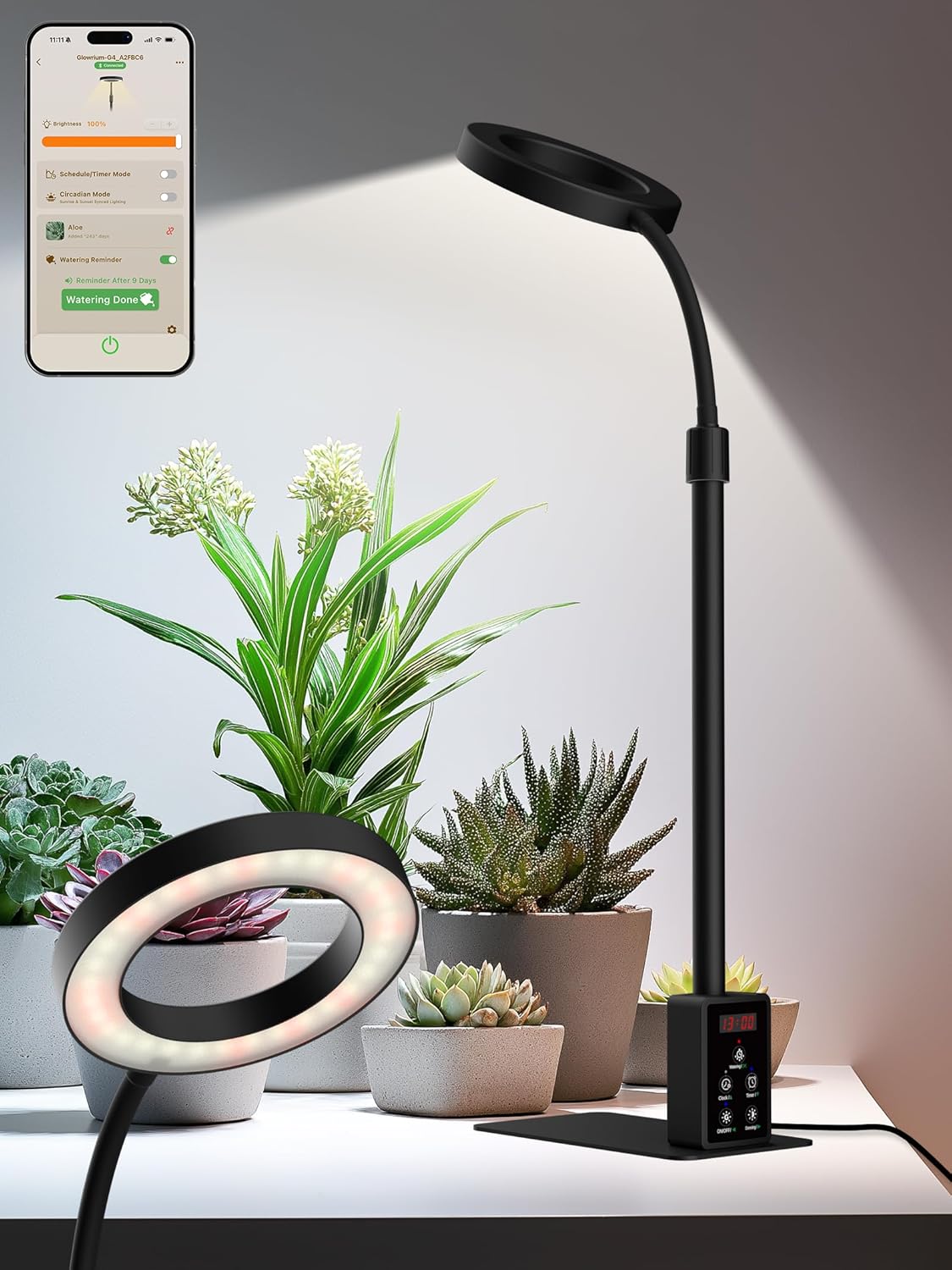
This GLOWRIUM grow light is a freestanding floor-style LED lamp meant to give indoor plants a controllable, reliable light source. It provides a full-spectrum beam with stepless dimming so you can dial intensity from a gentle glow up to stronger output for active photosynthesis, and the flexible gooseneck plus adjustable height helps position light over individual pots. The lamp pairs with a Bluetooth app for timers, sunrise/sunset syncing, watering reminders, and basic plant care records, which is useful for keeping a consistent schedule. It runs on a low-voltage 24V system with long-life LEDs and includes a frosted diffuser to soften light for living spaces. For orchids the focused coverage and adjustable scheduling make it easy to replicate daily light cycles. Expect straightforward setup and low day-to-day maintenance, but note the light is not water resistant so it should be kept away from humid misting or greenhouse conditions. The single-head design works best for one or a few nearby plants rather than a large grouping.
Best for: Orchid owners who prioritize a dependable, low-maintenance light they can schedule and fine-tune to maintain consistent daily cycles for one or a few plants.
Less Ideal for: Growers who need moisture-rated fixtures for humid propagation spaces or those wanting broad coverage for many plants should consider other options.
- Full-spectrum LEDs with stepless dimming let you match intensity to orchid growth stages
- Bluetooth app control with programmable timers and sunrise/sunset sync for consistent schedules
- Adjustable height and flexible gooseneck for precise placement over individual pots
- Low-voltage 24V design and long-life LEDs for safe, reliable daily use
- Not water resistant so it is unsuitable for wet or high-humidity setups
- Single light head limits coverage for multiple plants or large orchid displays
Verdict: A compact, app-controlled full-spectrum floor grow light that gives orchid growers consistent, tunable daily light with minimal fuss.
GooingTop HY-021 6000K Full-Spectrum Clip Grow Light
| Power Source | Corded Electric |
|---|---|
| Color Temperature | 6000 Kelvin |
| Light Output Maximum | 2500 lumens |
| Light Source Special Features | Dimmable |
| Number of Light Sources | 84 |
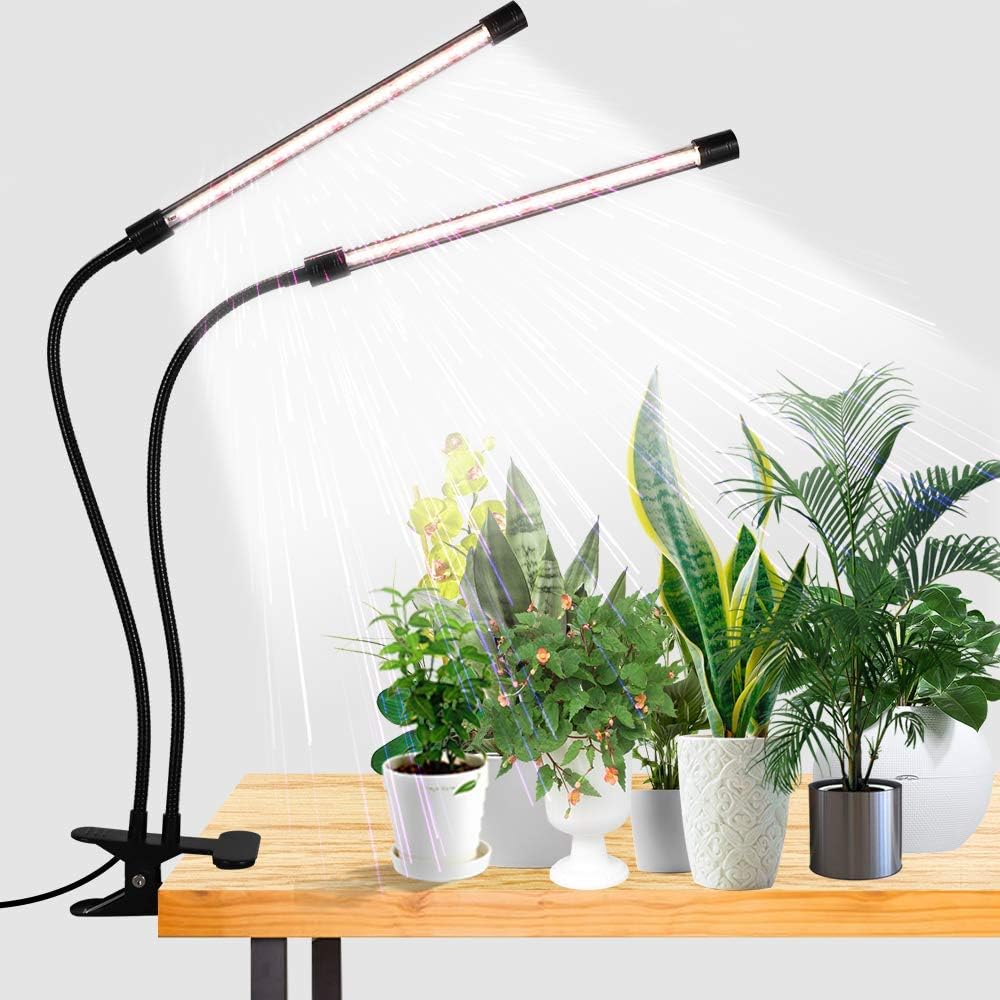
This GooingTop HY-021 is a compact clip-on grow light built for small houseplants, seedlings and shelf gardens. It uses 84 LEDs (white plus deep red) to deliver a 6000K full-spectrum output intended to mimic midday sun, with a high color-rendering output that also makes it pleasant as a reading lamp. Two flexible gooseneck heads and a strong clamp let you aim light precisely over pots and seed trays, while the attached remote provides 50%/100% dim levels and repeating timers at 4, 8 or 12 hours for hands-off scheduling. Practical benefits include low power draw (listed as roughly 10 W LED draw), a claimed 1 to 2 square meter coverage for seedlings, and an included timer that simplifies day/night cycles. Limitations are its design for small setups rather than large grow racks and the clip mounting limits placement compared with freestanding fixtures. The unit also relies on the corded remote instead of a smartphone app and the lifespan claim is typical of LEDs but not independently verifiable from the listing.
Best for: Buyers who want a simple, low-power, plug-and-play grow light to boost seedlings and a few houseplants on a desk or shelf and who value an easy-to-use timer and adjustable brightness.
Less Ideal for: Growers planning multi-shelf installations, larger vegetable grows, or who need networked or app-based control should consider larger bar lights or fixtures designed for commercial racks.
- Full-spectrum 6000K output with added 660 nm red LEDs to support vegetative growth and flowering
- Attached remote with dimming (50%/100%) and repeat timer settings (4/8/12 hours) for easy scheduling
- Flexible dual goosenecks and strong clamp enable precise positioning over small pots and seed trays
- High reported color rendering for comfortable viewing and accurate plant color assessment
- Low electrical draw around 10 W while covering small growing areas
- Clip-mount design and stated 1–2 m² coverage make it better suited to individual plants or small trays rather than large multi-shelf setups
- No smart app or wireless control option; remote is cord-attached which limits placement flexibility
Verdict: A compact, easy-to-use clip grow light that delivers full-spectrum light and convenient timer/dim controls for small indoor plant setups.
Aokrean Halo Full-Spectrum LED Grow Light with Base (2-Pack)

| Bulb Base | E26 |
|---|---|
| Number of Light Sources | 48 |
| Wattage | 10 watts |
| Power Source | Corded Electric |
| Timer | 3/9/12H |
The Aokrean Halo grow light is a compact LED lamp designed for indoor plant growth and decorative display. It ships as a two-pack and can be used either by inserting the stake into potting soil or by placing the pot on the supplied ABS base for a freestanding lamp. The unit uses 48 LEDs per light and offers three spectrum modes (white, warm white plus red, and mixed) plus ten brightness levels controlled by a touch/push button and a built-in timer with 3/9/12 hour cycling. The telescoping pole extends to cover taller small-to-medium pots and the 5V USB power and low 10W draw make it energy efficient and safe for continuous use. Practical benefits include flexible placement, multiple spectrum settings for seedlings through vegetative growth, and a small footprint that doubles as home decor. Limitations are its non-waterproof construction and modest light output suited to single pots or small clusters rather than a full grow shelf, and the base relies on pot weight for stability.
Best for: Buyers who want a simple, low-risk grow light for a few houseplants or seedlings and prefer plug-and-play controls, automatic timers, and a neat decorative look that fits on a windowsill or tabletop.
Less Ideal for: Gardeners who need high-intensity lighting for multiple larger plants, full shelves, or humid greenhouse conditions should choose a more powerful, waterproof fixture.
- Dual installation: stake into soil or place on included base for freestanding use
- Full-spectrum LEDs with three spectrum modes and 10 brightness levels for different growth stages
- Built-in timer with 3/9/12 hour cycles for automated daily light scheduling
- Low power draw (10 watts) and USB/5V power for efficient, low-heat operation
- Not water resistant so it must be kept away from wet environments
- Light output is modest and best for single small-to-medium pots rather than larger setups
Verdict: Aokrean Halo is a compact, easy-to-use full-spectrum grow light best suited to low-risk buyers who want a plug-and-play solution for a few indoor pots or seedlings.
Choosing the Right LED Grow Light for Orchids: Key Factors to Consider
Spectrum and Tunability
Orchids respond differently to wavelengths during vegetative growth and flowering. A fixture that offers adjustable or mixed spectrum output lets you shift toward blue-rich light for compact, leafy growth and toward red-rich light to encourage bud initiation and bloom. Fixed-spectrum lights can work if the balance matches the species, but tunable controls give you the flexibility to mimic seasonal shifts or correct stretch without changing fixtures.
Understanding the spectrum also helps you avoid wasting energy on wavelengths orchids do not use efficiently. Look for fixtures that publish spectral power distribution or list peak wavelengths rather than vague color descriptions.
Heat Output and Thermal Design
Even low-wattage LEDs produce localized heat that can raise pot and crown temperature. Orchids are prone to crown rot and heat stress if the fixture sits too close or lacks good thermal management. Heat sinks, active cooling, or driver placement affect how warm the canopy and media get during long photoperiods.
Consider fixtures with low radiant heat and the ability to dim or increase distance to reduce thermal load. If your growing area is small or poorly ventilated, prioritize lights designed for low-profile heat transfer to avoid hot spots on leaves or buds.
Light Intensity and Coverage
Appropriate light intensity depends on orchid type and location. Cattleyas and Vandas want higher PPFD than many Paphiopedilums. A good LED grow light should indicate output at common hanging heights so you can predict coverage and avoid stretch or sparse flowering.
Coverage pattern matters for benches, racks, or single plants. Wide, even distribution is better for grouped pots, while a focused beam works for single specimen plants. Consider whether you need one larger fixture or multiple smaller units to evenly light your collection.
Controls, Scheduling, and Dimming
Dimming and timing let you mimic seasonal daylength changes and fine-tune intensity without moving pots. Built-in dimmers, external controllers, or compatibility with common timers all affect convenience and plant response. Smooth dimming is useful for young growth and for staging higher light only when needed for bud initiation.
Remote controls or programmable schedules reduce daily fiddling and help maintain consistent photoperiods. Check how intuitive the controls are and whether presets match common orchid light cycles.
Form Factor and Mounting Options
How a fixture mounts matters in small indoor spaces. Hanging hardware, adjustable cables, or clip-on options let you position light at the right distance from crowns and leaves. Low-profile fixtures can be tucked under benches or mounted in greenhouse benches without blocking airflow.
Also consider the fixture footprint and pot spacing. Long linear fixtures work well over rows, while square panels suit grouped pots. The ability to daisy-chain or link multiple units simplifies installations for larger collections.
Matching Light to Orchid Type
Different orchid genera have distinct light preferences that affect how you choose a fixture. Determine whether your collection is dominated by high-light types that need brighter, more intense output, or low-light species that require gentler, diffused light. Adjustability in output and height helps make one fixture serve multiple types.
When planning, map pots by light need and place higher-intensity fixtures over those that require it. For mixed collections, use multiple smaller fixtures or zoned dimming to avoid overheating shade-loving plants while giving high-light types enough photons.
- High-light orchids: choose fixtures with higher PPFD and good heat dissipation.
- Medium-light orchids: favor even coverage and moderate intensity.
- Low-light orchids: opt for diffused output and the ability to lower intensity.
Placement, Distance, and Photoperiod
Correct placement prevents stretch and crown burn. Most LED grow lights perform best when hung at the manufacturer-recommended distance, but those recommendations differ by fixture intensity. Start at a conservative height and monitor plant posture and leaf color.
Photoperiod is as important as intensity. Many orchids do well on 12 to 14 hours of light during active growth, with shorter days to encourage bloom in some species. Use timers or programmable controllers to maintain consistent daylengths rather than relying on manual schedules.
- Measure distance from light to canopy, not to pot rim.
- Adjust photoperiod seasonally for flowering species.
- Increase night ventilation if fixtures raise nighttime temperatures.
Managing Heat and Humidity Under LEDs
LEDs are efficient but still add heat to enclosed spaces. Combine low-heat fixtures with adequate airflow to keep crowns cool and prevent humid, stagnant pockets that encourage disease. Fans, vents, and spacing between pots reduce humidity build-up and help evaporative cooling.
If you use more powerful fixtures, allow extra vertical clearance and monitor media temperature near the root zone. In tight greenhouse benches, consider fixtures with directional heat sinks or remote drivers to move heat away from plants.
- Use circulation fans to prevent hot spots.
- Leave space between pots to improve air movement.
- Monitor both leaf surface and media temperature during long photoperiods.
Energy Use and Long-Term Operation
Consider how many hours per day the lights will run and the cumulative energy draw. Efficient LEDs lower electricity use, but higher-output fixtures can still add to running costs if used continuously at full power. Balance initial fixture capability with realistic runtime needs.
Look for fixtures with efficient drivers and the option to dim or schedule lower-intensity periods during less critical growth stages to save power without sacrificing plant health.
- Use dimming and scheduling to reduce total on-time.
- Prefer fixtures with efficient drivers and good warranty coverage for long-term reliability.
Practical Setup Tips for Indoor Orchid Growers
Group plants with similar light requirements together and design your lighting plan around those zones. Use adjustable hangers and incremental height changes to fine-tune intensity without moving pots frequently.
Keep reflective surfaces or light-colored benches to improve uniformity, and use light meters or simple smartphone apps to verify intensity across the bench. Regularly inspect developing buds and new growth to detect early signs of too much or too little light.
- Zone by genus or light class to simplify adjustments.
- Measure light at canopy level after installation.
- Watch for leaf color and growth habit as quick health indicators.
How We Chose the Best LED Grow Light for Orchids
We focused on features and real-world performance that matter for orchid culture rather than marketing claims. Key evaluation criteria included spectral output and tunability to ensure lights deliver the red and blue balance orchids need for vegetative growth and flowering. We measured heat management and thermal design because orchids are sensitive to root and crown temperatures. Light intensity and distribution were assessed so fixtures can be used at typical hanging heights without causing stretch or uneven growth. Practical installation details such as mounting or hanging hardware, dimming controls, and footprint adaptability made the shortlist easier to recommend for varied setups. Reliability and power efficiency were also weighed to reflect long-term running costs and stable operation. Excluded items included general decorative lamps, full-room lighting fixtures that cannot be focused on plant benches, and products without clear spectrum specifications or usable mounting options. We prioritized fixtures with clear technical specs and features that let growers tailor light to specific orchid types and microclimates.
FAQ
How many hours a day should orchids be under LED grow lights?
Most orchids do well with 10 to 14 hours of light depending on species and season. Use shorter daylengths to encourage flowering in species that respond to reduced daylengths and longer periods for active vegetative growth.
Can I use a single LED panel for a mixed orchid collection?
You can if the panel offers adjustable output and even coverage, but mixed collections are easier to manage when grouped by light needs or lit with multiple fixtures to provide different intensities.
Will LED lights cause crown burn or overheating?
LEDs produce less radiant heat than many other lamps, but close mounting and poor ventilation can still cause crown warming. Maintain recommended distances, use fans, and monitor crown and media temperatures to avoid heat damage.
Do I need a full-spectrum light for orchids?
Full-spectrum fixtures simplify lighting by covering a broad range of wavelengths useful to plants, but fixtures that offer targeted red and blue peaks or tunable spectrum can be more effective for triggering specific growth phases.
How do I check if the light intensity is right for my orchids?
Use a PPFD meter or a light meter app that measures at canopy level. Observe plant responses too: compact growth and healthy leaf color indicate adequate light, while elongated stems and pale leaves suggest underlighting.
Final Verdict
Prioritize adjustable spectrum and reliable heat management when selecting an LED grow light for orchids. Decide whether you need higher intensity for sun-loving genera or gentler, more diffuse light for shade-adapted species, and plan fixtures to match those zones. Balancing coverage, mounting options, and dimming or scheduling features will let you fine-tune conditions for healthy growth and consistent flowering. With the right combination of spectrum, intensity, and thermal control, you can confidently support orchids through growth cycles without overcomplicating your setup.
