

Note: This article contains affiliate links. If you click on these links and make a purchase, I may earn a small commission at no extra cost to you. This helps support my research and content. Read my full affiliate disclosure here.
Choosing the right liquid fertilizer for flower beds matters because it directly affects bloom size, flowering frequency, and soil biology. When you use a product formulated for flower beds and apply it correctly, you can support stronger stems, richer color, and longer-lasting displays without overfertilizing tender plants. This guide shortlists six top options suited to flower beds and explains how we evaluated them. We focus on nutrient balance, application method, and how each fits common garden routines to help you pick a liquid fertilizer that matches your beds and season. Read on for practical tips before the product list.
Top Picks at a Glance
| Best Overall The best all-around choice for most situations | FoxFarm Tiger Bloom Liquid Plant Food (1 qt) |  |
| Best Quality Built to a higher standard if you want something more solid | FoxFarm Big Bloom Liquid Plant Food, 16 fl oz |  |
| Best Value The sweet spot between price and what you get | Farmer's Secret Fruit & Bloom Booster Liquid Fertilizer (16 oz) |  |
| Best Budget The cheapest option that still gets the job done reliably | Pegmapri Organic Liquid Plant Food, 8.45 fl oz Concentrated |  |
| Highest Rated A top-rated pick with lots of positive feedback | Miracle-Gro LiquaFeed Bloom Booster Liquid Plant Food (2 pack) |  |
| Most Popular A crowd favorite that many people choose with confidence | Miracle-Gro Liquid All Purpose Plant Food Concentrate, 32 oz |  |
FoxFarm Tiger Bloom Liquid Plant Food (1 qt)

| Item Form | Liquid |
|---|---|
| Specific Uses For Product | Hydroponic |
| Coverage | Medium |
| Mixing Ratio | 100:2 or 100:3 |
FoxFarm Tiger Bloom is a concentrated liquid bloom booster designed for use from the first signs of flowering through harvest. With a 2-8-4 N-P-K ratio and a low pH formulation, it supplies extra phosphorus and micronutrients that encourage larger flowers and better fruit set. Typical use is dilute feeding at 2 to 3 teaspoons per gallon every other watering, or foliar sprays applied early in the morning. Its liquid form makes it fast-acting and easy to mix for both soil and hydroponic setups, and the mixing ratio options let you adjust strength for heavier feeding. Important limitations are that it contains phosphorus, which may be restricted for lawn use in some areas, and that overuse can risk nutrient imbalance, so careful measuring is required. Safety precautions are recommended for handling and storage because it is a concentrated solution.
Best for: Growers focused on maximizing flower and fruit production who want a fast-acting, easy-to-dose bloom fertilizer for soil or hydroponic setups.
Less Ideal for: Casual gardeners who do not need high-phosphorus feedings or users who prefer slow-release granular fertilizers for low-maintenance lawns and beds.
- Phosphorus-rich 2-8-4 formula targets bud and bloom development
- Liquid concentrate mixes quickly for fast nutrient uptake
- Suitable for both soil and hydroponic systems
- Flexible mixing ratios allow light to heavy feeding schedules
- Contains phosphorus which may be restricted for non-agricultural turf in some jurisdictions
Verdict: Choose Tiger Bloom when you want a concentrated, phosphorus-focused liquid fertilizer to quickly boost buds and blooms.
FoxFarm Big Bloom Liquid Plant Food, 16 fl oz

| Item Form | Liquid |
|---|---|
| Specific Uses For Product | Organic |
| Application Method | watering can, sprayer, or drip system |
| Liquid Volume | 16 fluid ounces |
| Mixing Ratio | 4 |
Big Bloom is a concentrated liquid bloom fertilizer aimed at boosting flowers and fruit by supplying readily available organic nutrients. It mixes into water (manufacturer recommends 4 tablespoons per gallon) and can be applied with a watering can, sprayer, hose-end siphon, or through drip systems, so you can feed potted plants, beds, or containers without changing your routine. Notable features are its OMRI listing for organic use and the inclusion of bat guano and earthworm castings, which provide phosphorus and organic matter to encourage blooms and seed set. Because it is liquid and fast-acting, you can expect visible perk-up within a short time after feeding, and it is suitable for regular use at watering times to extend flowering. Limitations to consider are the small 16 fl oz size for larger gardens and the presence of phosphorus, which may be restricted in some locales and requires careful application to avoid runoff.
Best for: Gardeners focused on maximizing blooms and fruit who want an organic, fast-acting feed they can add to routine watering for container and bed-grown flowering plants.
Less Ideal for: Large-scale landscapers or very large perennial beds who need bulk fertilizer solutions or want to avoid phosphorus-based products due to local regulations.
- OMRI-listed organic formula with natural inputs like bat guano and earthworm castings
- Liquid concentrate allows fast nutrient uptake and flexible application methods
- Works with watering cans, sprayers, hose-end siphons, and drip systems for easy integration
- Small 16 fl oz bottle may require frequent repurchasing for larger flower beds
- Contains phosphorus so local restrictions on phosphorus fertilizers may apply
Verdict: Choose Big Bloom when you want an OMRI-listed, easy-to-apply liquid fertilizer that delivers fast organic nutrients to boost flowering and fruiting.
Farmer's Secret Fruit & Bloom Booster Liquid Fertilizer (16 oz)

| Item Form | Liquid |
|---|---|
| Specific Uses For Product | Organic |
| Application Method | pour or spray |
| Liquid Volume | 16 fluid ounces |
| Mixing Ratio | 1 teaspoon per 2 gallons of water |
Farmer’s Secret Fruit & Bloom Booster is a super‑concentrated liquid fertilizer designed to encourage blooms, stronger roots, and higher yields when applied as a foliar spray or soil drench. It is mixed at 1 teaspoon per 2 gallons of water and is intended for mid‑to‑late growth stages, applied every 1–2 weeks. The formula emphasizes phosphorus and potassium to support flowering and fruit set while supplying nitrogen and trace minerals to maintain overall plant health. Practical benefits include quick availability to plants compared with granular feeds, flexible application with a watering can, sprayer, or irrigation system, and a long shelf life. Limitations are that exact N‑P‑K percentages are not listed on the product page and dosing relies on the single recommended dilution, so careful measuring is needed to avoid overfeeding. For watermelons, using this during bloom and fruit set should promote stronger root systems and better fruit development, but pair it with a balanced program that meets seedlings' earlier nitrogen needs and with appropriate soil moisture management.
Best for: Gardeners who prioritize efficient, results‑driven feeding during bloom and fruit set and who want a concentrated liquid they can apply selectively to maximize yield.
Less Ideal for: Growers looking for detailed N‑P‑K labels or those who prefer slow‑release granular fertilizers for steady early‑season nitrogen feeding.
- Highly concentrated so a small amount treats a large area
- Formulated to boost flowering and fruit set with elevated phosphorus and potassium
- Can be applied as a soil drench, foliar spray, or through irrigation for flexible use
- Contains trace minerals in addition to primary macronutrients
- Long practical shelf life when stored properly
- No explicit N‑P‑K ratio printed in the provided product details
- Requires accurate dilution to avoid overapplication
Verdict: A concentrated, bloom‑focused liquid fertilizer that is ideal for gardeners wanting a targeted, easy‑to‑apply boost during watermelon bloom and fruit set.
Pegmapri Organic Liquid Plant Food, 8.45 fl oz Concentrated

| Item Form | Liquid |
|---|---|
| Specific Uses For Product | Plant Growth, Root Development, Seed Development, Soil Conditioning |
| Application Method | Watering can, Drip irrigation, Soil drenching |
| Target Species | Houseplants |
| Liquid Volume | 8.45 fluid ounces |
This Pegmapri liquid plant food is a small, concentrated bottle designed to stretch into multiple gallons of ready-to-use nutrient solution for houseplants, herbs, vegetables, and flowers. You use it by diluting the concentrate in water for routine watering, soil drenching, drip irrigation, or hydroponic feedings. Notable features include an all-purpose organic nutrient blend, fast root uptake compared with granular slow-release feeds, and a low-residue formula meant to avoid clogging pumps and lines. In practice it provides quick, visible green-up and supports root and stem development when applied at regular intervals. The compact, leak-resistant bottle is convenient for storage and precise pouring. Limitations are that the product listing does not show an NPK breakdown or specific dosing chart on the product page, so users should follow included directions carefully or start at reduced strength to avoid overfeeding sensitive plants.
Best for: Buyers who prioritize a dependable, easy-to-use feed for routine indoor container gardening and want a concentrated organic option that works across watering and hydroponic systems.
Less Ideal for: Growers who require exact nutrient formulations for advanced fertilization schedules or commercial-scale nutrient management should consider products with full lab-verified analyses and detailed dosing charts.
- Concentrated formula that dilutes to feed multiple gallons, saving shelf space
- Organic nutrient blend suitable for indoor and outdoor container plants
- Water-soluble and low-residue so it works with watering cans, drip systems, and hydroponics
- Fast root uptake to encourage quicker green-up and root development
- No explicit NPK ratio or full ingredient breakdown provided in the product details
Verdict: A compact, concentrated organic liquid fertilizer that reliably feeds indoor container plants and hydroponic setups for steady growth and stronger roots.
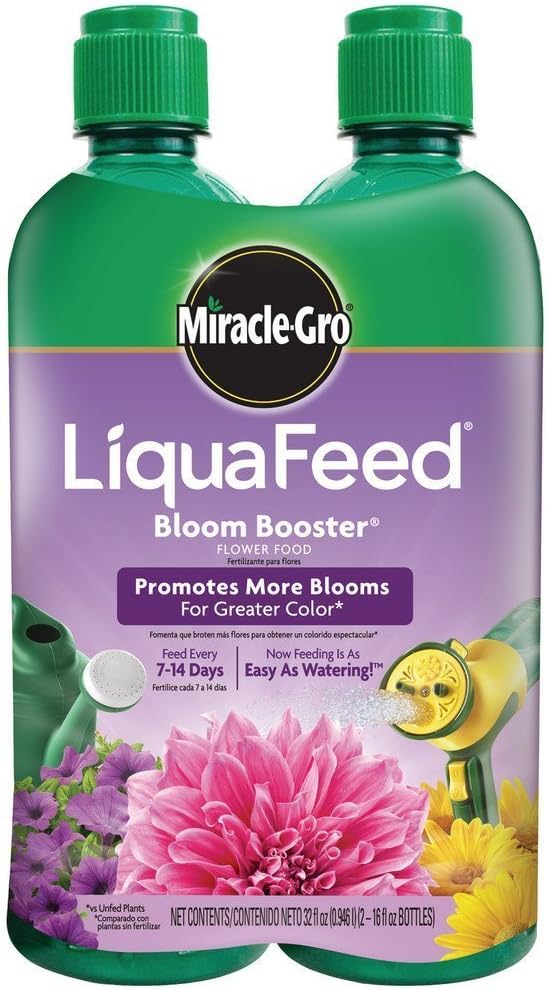
Miracle-Gro LiquaFeed Bloom Booster Liquid Plant Food (2 pack)
| Item Form | Liquid |
|---|---|
| Application Method | Water the plant using the feeder |
| Coverage | Medium |
| Target Species | flowers |
| Unit Count | 64 Fluid Ounces |
This LiquaFeed Bloom Booster is a liquid flower food sold as a two-pack of refill bottles that attach to the Miracle-Gro LiquaFeed feeder and deliver nutrients when you water. It is designed for both indoor and outdoor flowering plants and is applied by swapping the bottle into the feeder so feeding happens automatically each time you water. The liquid format enables faster uptake at the roots compared with dry granular fertilizers, and the product is intended for use every one to two weeks to encourage more blooms and stronger color. Notable features include the feeder-compatible bottle design and a medium coverage label suited to individual pots and beds rather than large landscapes. Important limitations are that it requires the LiquaFeed feeder system to work as intended and the product notes phosphorus-related runoff restrictions in some areas, so local rules should be checked before use. Follow handling instructions to avoid skin or eye contact and keep refills out of reach of children and pets.
Best for: Gardeners who prioritize reliable, regular feeding for flower beds and container blooms and want a low-effort system that delivers nutrients each time they water.
Less Ideal for: Those without the LiquaFeed feeder or who manage large flower beds where a spreadable granular fertilizer is more practical.
- Designed for hands-off feeding via the LiquaFeed feeder so plants get nutrients when watered
- Liquid formula for quicker root uptake and faster visible response
- Two-bottle pack gives enough supply for repeated feedings
- Suitable for indoor and outdoor flowering plants when used as directed
- Requires the MiracIe-Gro LiquaFeed feeder to deliver product automatically
Verdict: If you want consistent, low-effort feeding for flowering plants, this LiquaFeed bloom booster is the easiest way to deliver nutrients automatically when you water.
Miracle-Gro Liquid All Purpose Plant Food Concentrate, 32 oz

| Item Form | Liquid |
|---|---|
| Specific Uses For Product | Plant Growth, Root Development |
| Application Method | Mix with water in a watering can |
| Mixing Ratio | 1:10 (concentrate to water, estimate) |
Miracle-Gro Liquid All Purpose is a water-soluble concentrate you mix into a watering can and apply every 1 to 2 weeks to container and in-ground plants. It is formulated for general plant growth and root development and is marketed for flowers, vegetables, shrubs and houseplants, so it works as a straightforward feed for flowering bulbs like calla lilies. The bottle’s mixing guidance (cap measures for garden application and 1 teaspoon per gallon for containers) makes it easy to dose for pots or small beds. Practical benefits include fast uptake through the soil when applied as directed and compatibility with routine watering schedules. Limitations to note are that it is an all-purpose formula rather than a bloom-focused or calcium-rich fertilizer tailored specifically to calla lilies, so growers seeking targeted bloom enhancement or specialty nutrition may want a supplement. Also, frequent use at higher-than-recommended strength can risk fertilizer burn, so follow the mixing directions and schedule.
Best for: Buyers who want an affordable, easy-to-use liquid fertilizer to keep calla lilies and other flowering plants regularly fed without fuss.
Less Ideal for: Growers seeking a specialist bloom-boost or a fertilizer formulated for specific micronutrient needs should consider a targeted or bloom-specific product instead.
- Concentrated liquid mixes easily with water for quick application
- Clear dosing instructions for both garden beds and container plants
- Suitable for a wide range of plant types including flowering bulbs and houseplants
- General all-purpose formula not specifically formulated for enhancing blooms of calla lilies
Verdict: A budget-friendly, easy-to-use liquid concentrate that reliably feeds calla lilies and other common garden plants on a regular schedule.
Choosing the Right Liquid Fertilizer for Flower Beds: Key Factors to Consider
Nutrient Ratio and Bloom Focus
The ratio of nitrogen, phosphorus, and potassium determines how a fertilizer directs plant energy. For flower beds you usually want a formula that favors phosphorus and potassium enough to support bud set and flower longevity while supplying enough nitrogen for healthy foliage. Excessive nitrogen can produce lush leaves at the expense of blooms, while too little nitrogen delays growth.
Look for clear labeling and consider whether trace micronutrients like iron, magnesium, and boron are present, since deficiencies in these elements can cause poor color or weak stems. Understand how often the formula expects to be applied because concentration and frequency interact to produce results.
Application Method and Compatibility
Liquid fertilizers come with different recommended application methods, such as foliar spray, soil drench, or through irrigation. The method you choose affects how fast plants take up nutrients and how precise feeding can be. Foliar sprays give quick nutrient uptake for minor deficiencies or to boost flower color, while soil drenches feed roots and provide steadier supply.
Also evaluate dilution rates and whether the concentrate is compatible with your existing watering equipment. High-concentration products may require careful measuring and could clog fine nozzles. If you plan to feed many beds or use drip systems, prioritize formulas labeled for injector or irrigation compatibility.
Concentration, Solubility, and Clog Risk
How well a liquid fertilizer dissolves and how concentrated it is will determine ease of use. Highly soluble products that mix clearly with water reduce the chance of sediment that can block sprayer tips or drip emitters. Some organic or insoluble concentrates require shaking or straining before use and may be better for hand watering than for irrigation injection.
Concentration also affects storage and measuring safety. Very concentrated solutions are economical for large gardens but increase the risk of mixing errors that can damage plants. Choose a product whose handling and dilution instructions match your comfort level and equipment.
Plant Sensitivity and Timing
Flowering plants and newly planted transplants can be more sensitive to fertilizer salts than established perennials. The same feed rate can burn tender roots if applied at the wrong time or too frequently. Consider the stage of growth in your beds: lighter feeds during establishment and stronger bloom feeds during bud formation are common strategies.
Pay attention to temperature and moisture: fertilizing during drought or extreme heat increases burn risk, and cool, wet conditions reduce nutrient uptake. Match the fertilizer schedule to your local climate and the phenology of your plants.
Soil Biology and Long-Term Impact
Repeated use of high-salt synthetic concentrates can alter soil moisture relations and microbial communities if not balanced with organic matter and occasional slow-release inputs. Some liquid fertilizers include organic extracts or humic substances that support soil biology while feeding plants.
Think beyond immediate bloom response: healthier soil structure and microbial activity sustain flowering over multiple seasons. If your beds are low in organic matter, pair liquid feeding with compost or mulches to preserve long-term fertility and reduce dependency on constant soluble feeds.
Environmental Runoff and Safety
Because flower beds often border lawns, walkways, or water features, runoff risk is a practical consideration. Use products with clear application rates and avoid heavy feeds before heavy rain. Formulations with lower soluble salt levels and guidance for minimal repeated applications reduce nutrient loss to surrounding areas.
Also consider label guidance about pollinator safety and reentry intervals. While most flower-bed fertilizers are safe once diluted and dried, following instructions minimizes unintended impacts on beneficial insects and nearby plantings.
When to Use Foliar Feeding Versus Soil Drench
Foliar feeding delivers nutrients straight to leaf tissue and can correct sudden deficiencies or perk up showing blooms within days. It works best on cool mornings or evenings when stomata are open and leaves can absorb nutrients without burning. Foliar sprays are not a substitute for regular root feeding but are a useful short-term tool.
- Use foliar sprays for quick correction of micronutrient deficiencies.
- Avoid foliar feeding in direct midday sun to reduce burn risk.
- Reserve foliar feeds for small, targeted applications rather than whole-bed maintenance.
Preparing Your Beds Before Regular Liquid Feeding
Before starting a regular liquid feeding program check soil moisture and topdress beds with compost if organic matter is low. Liquids feed plant-available nutrients but do not replace the long-term benefits of improved soil texture and microbial life. A quick soil test can reveal pH and basic nutrient levels so you know whether a bloom-focused concentrate or a balanced feed is better.
- Pull weeds and lightly cultivate to improve water infiltration.
- Apply a thin layer of compost under mulch to enhance microbial uptake of soluble nutrients.
- Water thoroughly before applying concentrated feeds to reduce root stress.
Mixing and Handling Best Practices
Always follow dilution instructions and measure concentrates precisely. Use clean containers and strain mixes when working with coarser organic liquids to prevent sprayer clogging. Label any mixed solution with concentration and date and avoid storing mixtures longer than recommended by the manufacturer.
- Mix in a well-ventilated area and wear gloves if handling concentrated solutions.
- Rinse sprayer parts after each use to prevent residue build-up.
- Test a small area before broad application when using a new product.
Feeding Schedules by Bloom Stage
Adjust feeding frequency depending on growth stage. Light, regular feeds support vegetative growth early in the season, while slightly higher phosphorus and potassium during bud set can improve flower count and durability. Reduce or pause feeding after peak bloom to help plants transition into a post-bloom recovery phase.
- Early season: lighter balanced feeds to establish foliage.
- Bud formation: increase bloom-support nutrients moderately.
- After bloom: taper off feeds and focus on root recovery with lower nitrogen levels.
Tools and Equipment That Improve Application
A few basic tools make liquid fertilizing more reliable. A calibrated measuring cup or syringe, a pressure sprayer with adjustable nozzle, and a filter or strainer for mixes reduce mistakes and clogged tips. For larger beds, a hose-end injector that offers consistent dilution can save time and ensure even distribution.
- Use filters when mixing organic concentrates.
- Choose nozzles that produce a coarse spray for soil drench and finer mist for foliar sprays.
- Keep a maintenance routine for sprayers to avoid uneven application.
How We Chose the Best Liquid Fertilizer for Flower Beds
We selected products by focusing on practical, garden-centered criteria that predict real-world performance in flower beds. First, nutrient profile mattered: we favored formulas with clear N-P-K ratios and included secondary elements that support blooms and root health. Second, application flexibility was evaluated, including dilution rates, compatibility with hand-held sprayers or irrigation, and suitability for foliar versus soil feeding. Third, plant safety and sensitivity were assessed by checking recommended application rates for common bedding plants, annuals, and perennials to avoid burn risk. Fourth, formulation type and solubility were considered to ensure even feeding and to reduce clogging in small applicators. Finally, environmental and soil impacts were weighed, focusing on products with sensible salt levels and guidance for use on established beds versus newly planted areas. We excluded granular-only formulas, products intended solely for lawns or edibles, and any fertilizer without clear labeling on concentration and use instructions. The shortlisted items all met these practical criteria and are appropriate for routine flower-bed maintenance.
FAQ
How often should I apply liquid fertilizer to flower beds?
Frequency depends on product concentration and plant needs. Many concentrates are used every one to two weeks during active growth, while milder formulations may be applied every three to four weeks. Always follow label dilution and adjust based on plant response.
Can I use a liquid fertilizer through my drip irrigation system?
Some liquid concentrates are labeled for injector or irrigation use, but not all are suitable. Choose products specified as safe for drip systems and use appropriate filters to prevent clogging. Test a small run before treating entire beds.
Will liquid fertilizers burn my flowers?
Liquid feeds can burn if applied too concentrated, during drought, or in high heat. Mixing accurately, watering before application, and applying in cooler parts of the day reduce burn risk. Start with a lighter dose if you are unsure.
Are liquid fertilizers safe for pollinators?
Most diluted liquid fertilizers are safe for pollinators once foliage is dry, but avoid spraying open flowers directly. Check product guidance on pollinator safety and avoid application when bees are actively foraging.
Should I use organic or synthetic liquid fertilizer for flower beds?
Both types can support blooms; the choice depends on gardener priorities. Organic liquids often support soil biology and are gentler, while synthetic concentrates give precise nutrient ratios and quick results. Combining occasional organic matter with targeted liquid feeding balances immediate needs and long-term soil health.
Can I mix different liquid fertilizers together?
Mixing different products is not recommended unless labels explicitly state compatibility. Chemical interactions or excessive concentration can harm plants or clog equipment. When in doubt, apply different feeds on alternating days and flush equipment between uses.
Final Verdict
Choose a liquid fertilizer for flower beds by matching the nutrient profile and application method to your plants and equipment. Prioritize products with clear dilution instructions, good solubility, and guidance for timing around bloom stages. Balance short-term bloom goals with soil-building practices to sustain flowering over seasons. Ultimately, pick the feeding approach that fits your watering routine and comfort with mixing concentrates. Focus on nutrient balance, plant safety, and method compatibility to get strong, reliable blooms without stressing your beds.
