

Note: This article contains affiliate links. If you click on these links and make a purchase, I may earn a small commission at no extra cost to you. This helps support my research and content. Read my full affiliate disclosure here.
Picking the right liquid fertilizer for strawberries makes a real difference in bloom set, fruit size, and plant health. Strawberries have specific needs across the growing season: young plants need nitrogen for leaf growth, while flowering and fruiting phases need higher phosphorus and potassium to encourage blooms and develop sweet, firm berries. The best options deliver those nutrients in a form the plants can take up quickly and with minimal salt risk. This guide shortlists seven top liquid fertilizers for strawberries and explains how we evaluated their nutrient ratios, application methods, and safety for container and in-ground berries. Read on to see the criteria we used and practical guidance for feeding your patch at each stage of growth.
Top Picks at a Glance
| Best Overall The best all-around choice for most situations | YARDi Fruit & Bloom Liquid Plant Food 2-15-15, 32 oz |  |
| Best Quality Built to a higher standard if you want something more solid | Bloom City Organic Berry Fertilizer, 32 oz |  |
| Best Value The sweet spot between price and what you get | HiThrive Strawberry Fertilizer, Liquid Plant Food, 32 oz |  |
| Best Budget The cheapest option that still gets the job done reliably | TPS Nutrients Liquid Strawberry Fertilizer, 8 oz |  |
| Highest Rated A top-rated pick with lots of positive feedback | Perfect Plants Strawberry Liquid Fertilizer, 8 oz (8-8-8) |  |
| Most Popular A crowd favorite that many people choose with confidence | Farmer's Secret Fruit & Bloom Booster Liquid Fertilizer (8 oz) |  |
| Best Seller A high-volume bestseller chosen again and again | Bloom City Organic Berry Fertilizer, 1 Gallon |  |
YARDi Fruit & Bloom Liquid Plant Food 2-15-15, 32 oz

| Item Form | Liquid |
|---|---|
| Specific Uses For Product | Flowering and Fruiting Plants |
| Target Species | Flowers, Vegetables, Fruits |
| Liquid Volume | 32 fluid ounces |
YARDi Fruit & Bloom is a liquid fertilizer formulated to push flowering and fruit set during the peak season with an NPK of 2-15-15 and added micronutrients. It is typically mixed at 1 teaspoon per gallon and applied as a soil drench, foliar spray, drip feed, or through a hose-end, which makes it flexible for beds, containers, and drip-irrigated strawberry patches. The high phosphorus and potassium and intentionally low nitrogen encourage blooms and stronger fruit production rather than leafy growth. Practical benefits include easy mixing, broad applicability across vegetables and flowers, and targeted timing advice to begin use once buds appear. Limitations are that it is not an all-purpose, high-nitrogen feed so it should be paired with a general fertilizer earlier in the season if plants need leaf growth, and repeated applications every 1 to 2 weeks are required during bloom which means more frequent feeding than slow-release options. For gardeners who want a straightforward bloom booster, this product is an easy-to-use choice for outdoor strawberries and other fruiting plants.
Best for: Gardeners who want a straightforward, targeted bloom and fruit booster to increase flower production and fruit set on outdoor strawberries and other fruiting plants.
Less Ideal for: People seeking an all-in-one, season-long feed or those who prefer infrequent feeding with slow-release granules.
- High phosphorus and potassium ratio (2-15-15) tailored for flowering and fruit set
- Liquid form mixes easily and works with soil drench, foliar spray, drip irrigation, or hose-end applications
- Clear directions for timing and dilution (1 tsp per gallon, apply once buds appear)
- Versatile for use across flowers, vegetables, and fruit plants including strawberries
- Low nitrogen formulation means it will not promote vegetative growth and may need pairing with another fertilizer earlier in the season
- Requires frequent reapplication every 1 to 2 weeks during bloom compared with slow-release fertilizers
Verdict: Use this easy-mixing, high-phosphorus liquid as a focused bloom booster to improve flowering and fruit set on outdoor strawberries.
Bloom City Organic Berry Fertilizer, 32 oz

| Item Form | Liquid |
|---|---|
| Specific Uses For Product | Organic,Plant Food |
| Coverage | Medium |
| Target Species | berries |
| Liquid Volume | 32 fluid ounces |
Bloom City Organic Berry Fertilizer is a 32 oz liquid feed designed specifically for blueberries and strawberries to promote stronger roots, healthier foliage, and increased fruit yield. It is typically applied to garden beds, raised beds, and containers as part of a regular feeding schedule; directions on the label guide dilution and frequency for best results. Notable features include an organic formulation that uses ingredients like kelp and fish bone meal and a formula tuned to berry needs rather than general-purpose feeding. In practice this fertilizer helps maintain steady fruit development and can improve sweetness and overall harvest consistency when used through the season. Because it is a liquid concentrate it is easy to mix and apply for backyard growers focused on measurable performance. Limitations are that exact N-P-K numbers are not listed here and heavy feeders or commercial growers may need a more concentrated or specifically balanced product for aggressive production goals.
Best for: Serious home gardeners who prioritize measurable improvements in berry yield and flavor and who follow a regular feeding routine for backyard or container strawberries and blueberries.
Less Ideal for: Large-scale or commercial growers seeking high-concentration, lab-specified nutrient blends should consider more intensive fertilizers; casual gardeners who want zero maintenance may prefer slow-release granular options.
- Formulated specifically for blueberries and strawberries for targeted nutrition
- Organic liquid concentrate that mixes easily for foliar or soil feeding
- Suitable for both garden beds and container-grown berries
- Supports root development and consistent fruiting across the season
- Product listing does not show detailed N-P-K analysis for precise nutrient planning
- May be less suitable for commercial growers needing high-strength, crop-specific formulations
Verdict: Choose this organic liquid if you want an easy-to-apply, berry-focused feed that helps backyard strawberry and blueberry growers increase yield and fruit quality.
HiThrive Strawberry Fertilizer, Liquid Plant Food, 32 oz

| Item Form | Liquid |
|---|---|
| Application Method | Mix with water and apply |
| Target Species | Strawberries |
| Unit Count | 32 Fluid Ounces |
HiThrive Strawberry Fertilizer is a concentrated liquid feed designed specifically for strawberries and used by mixing measured doses into water and applying with a watering can or hose-end sprayer. The 32 oz bottle makes up to 32 gallons of ready-to-use solution, which suits gardeners who want an economical, repeatable feeding schedule. Its balanced macronutrients plus micronutrients such as calcium, magnesium, and zinc support root strength, leaf health, and larger, sweeter fruit when applied every one to two weeks in the growing season. The liquid format dissolves quickly and is easy to apply to beds, containers, or raised planters. Limitations include the need for regular reapplication rather than a slow-release option and the usual care when measuring concentrated fertilizers to avoid overfeeding. For people seeking a straightforward, plant-specific feed to boost strawberry yields, this product is a practical, space-saving choice.
Best for: Gardeners who prioritize efficient, repeatable feeding schedules and want a strawberry-specific fertilizer that stretches a single bottle into many gallons of feed.
Less Ideal for: Those who prefer one-time granular or slow-release products, or gardeners uncomfortable with mixing concentrated liquid solutions.
- Concentrated liquid mixes easily with water for quick application
- Formulated specifically for strawberries with macro and micronutrients
- 32 oz bottle yields up to 32 gallons of feed for extended use
- Usable with watering can or hose-end sprayer for flexible application
- Requires frequent applications during the growing season rather than long-term slow release
- Concentrated formula needs careful measuring to avoid overfeeding
Verdict: A concentrated, strawberry-focused liquid fertilizer that delivers an economical, easy-to-apply feeding program to boost berry size and flavor.
TPS Nutrients Liquid Strawberry Fertilizer, 8 oz
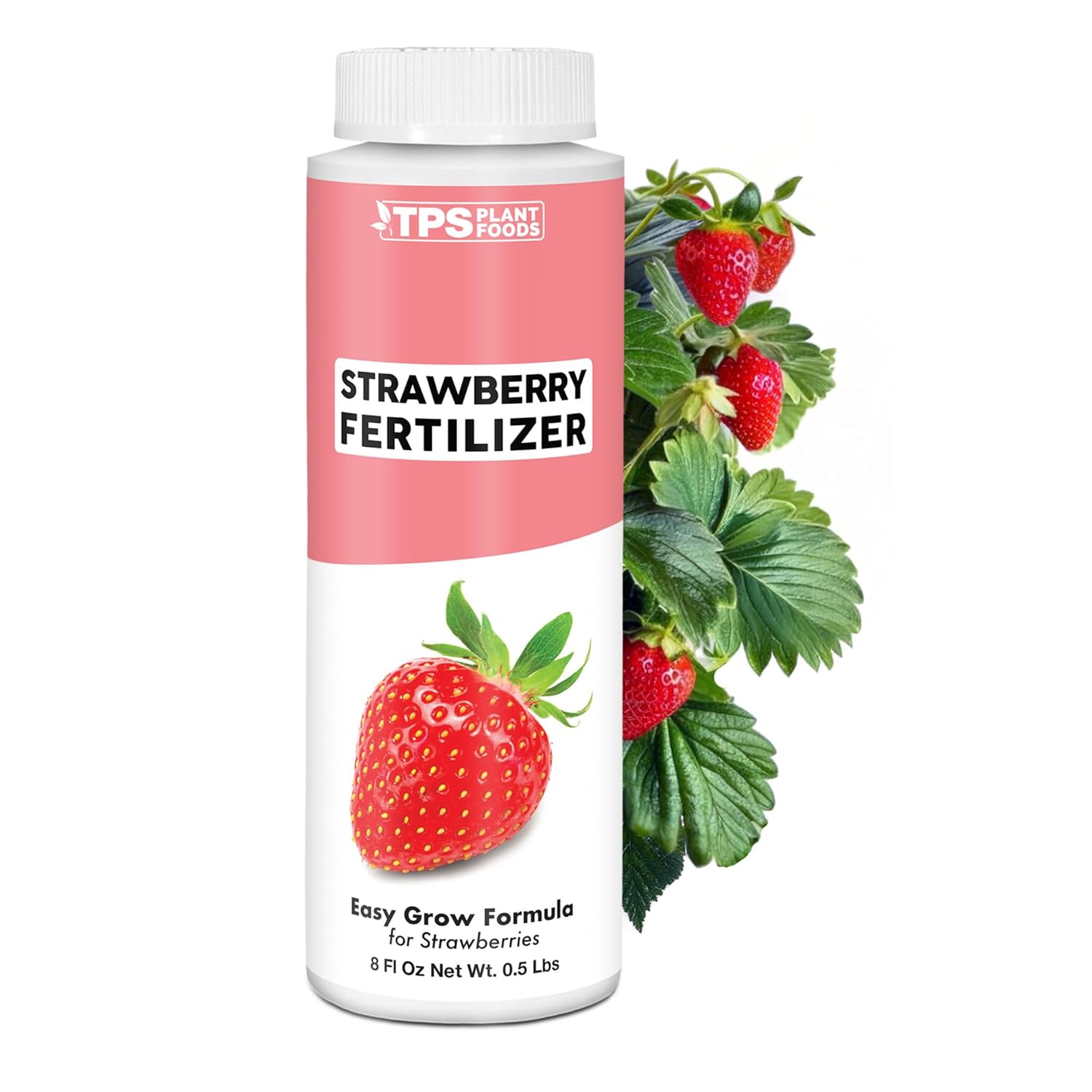
| Item Form | Liquid |
|---|---|
| Application Method | Watering can or spray bottle |
| Target Species | Strawberry |
| Mixing Ratio | 1 teaspoon (5ml) per 1 gallon |
| Coverage | Medium |
This TPS Nutrients liquid formula is designed specifically for strawberry plants and is used diluted in water (1 teaspoon per gallon) and applied to the root zone every 2 to 4 weeks. In practice it encourages stronger blooms and fuller foliage while supporting root runners so plants establish and take up water and nutrients more effectively. The product is easy to use with a watering can or spray bottle and the small bottle size makes it convenient for container growers or small garden beds. Notable features include a kelp-enriched formula and directions aimed at both bed and container use. Limitations are the small unit size relative to regular feeding schedules for larger plantings and the label gives only limited ingredient detail beyond magnesium and kelp enrichment, so growers wanting full N-P-K values or larger coverage may need a different product or to buy multiple bottles. For budget-minded gardeners with a few strawberry plants this provides a straightforward, crop-specific feed that is simple to mix and apply.
Best for: Gardeners growing a small number of strawberry plants in beds or containers who want a simple, crop-specific liquid feed and prefer an easy-to-mix product.
Less Ideal for: Growers managing large strawberry patches or commercial plots who need larger-volume feeds and detailed nutrient analysis.
- Formulated specifically for strawberries to support flowering and fruit set
- Kelp-enriched liquid is easy to dilute and apply with a watering can or spray bottle
- Clear mixing instructions (1 teaspoon per gallon) make dosing simple for beginners
- Works for both garden beds and containers, convenient for small plots
- No full N-P-K breakdown provided on the listing which limits precise nutrient planning
- 8 oz bottle size may require frequent replacement for larger patches of plants
Verdict: A simple, strawberry-focused liquid feed that makes regular small-scale fertilizing quick and easy for home gardeners.
Perfect Plants Strawberry Liquid Fertilizer, 8 oz (8-8-8)

| Item Form | Liquid |
|---|---|
| Specific Uses For Product | Plant Growth, Root Development |
| Application Method | Dilute and pour over soil |
| Target Species | Strawberries |
| Mixing Ratio | 2 tablespoons per gallon |
This is a concentrated liquid strawberry fertilizer designed for straightforward mix-and-water feeding of outdoor strawberries. It uses a balanced 8-8-8 formula with added sulfur, zinc and boron to support bloom, fruit set and steady growth for both everbearing and June-bearing varieties. Typical use is simple: shake, dilute 2 tablespoons per gallon and pour over the soil around plants, which makes it convenient for raised beds, containers and in-ground patches. Liquid application gives even nutrient distribution and quicker uptake than granular products, so you can adjust timing and strength without creating hot spots. The 8 oz bottle is low coverage, so it is best for small patches or as a targeted supplement rather than a season-long supply for large plantings. It does not list detailed nutrient concentrations beyond NPK and micronutrients and coverage is described as low, so plan for more frequent purchases or larger quantities if you feed many plants regularly.
Best for: Home gardeners who grow a small patch or container strawberries and want an easy, adjustable liquid feed to support blooms and steady fruiting.
Less Ideal for: Growers managing large acreage or commercial beds who need high-volume or bulk fertilizer solutions should look for larger capacity products.
- Balanced 8-8-8 NPK formula suited for bloom and fruit development
- Includes micronutrients sulfur, zinc and boron to support flowering and fruit set
- Liquid form mixes quickly for even coverage and faster uptake
- Simple dosing: 2 tablespoons per gallon makes application easy for hobby gardeners
- 8 oz bottle provides low coverage and may require frequent repurchasing for larger patches
- Does not provide detailed nutrient ppm or elemental concentrations on the label
Verdict: A compact, easy-to-use liquid feed that gives home strawberry patches balanced nutrients and quick uptake for better blooms and fruiting.
Farmer's Secret Fruit & Bloom Booster Liquid Fertilizer (8 oz)

| Item Form | Liquid |
|---|---|
| Liquid Volume | 8 fluid ounces |
| Mixing Ratio | 1 teaspoon : 2 gallons |
| Application Method | dilute with water and pour or spray |
Farmer's Secret Fruit & Bloom Booster is a concentrated liquid plant food designed for mid-to-late season use when plants begin to bud and set fruit. You dilute a small amount (1 teaspoon per 2 gallons) and apply it either to the soil with your watering can or as a foliar spray, repeating every 1 to 2 weeks. The formula emphasizes phosphorus and potassium alongside trace minerals to promote root development, flowering and fruit set, which is the kind of nutrient profile banana growers look for during fruiting. Because it is liquid and already mixed, nutrients are immediately available and it is easy to integrate with irrigation or regular watering. The bottle is small but very concentrated, so a little goes a long way. A practical limitation is that the 8 ounce size supplies only a limited number of applications for larger banana plants or multiple trees, so you will need to plan purchases for season-long feeding. Follow dilution directions carefully to avoid overapplication.
Best for: Gardeners who prefer a proven, easy-to-use liquid feed to encourage blooms and fruit and who want straightforward instructions and predictable results.
Less Ideal for: Growers with large banana groves or multiple mature plants who need bulk or long-term feeding should consider larger-volume fertilizers or granular options.
- High phosphorus and potassium formulation supports flowering and fruit set
- Liquid concentrate delivers nutrients immediately and is usable as soil or foliar feed
- Simple, low-strength mixing ratio makes it easy for beginners to apply safely
- Contains additional trace minerals (iron, zinc, calcium) that support overall plant health
- Small 8 oz bottle provides relatively few applications for mature banana plants or multiple trees
Verdict: A highly concentrated, easy-to-use liquid booster that quickly delivers flowering and fruiting nutrients for backyard banana plants and other fruiting ornamentals.
Bloom City Organic Berry Fertilizer, 1 Gallon

| Item Form | Liquid |
|---|---|
| Specific Uses For Product | Organic,Plant Food |
| Coverage | Medium |
| Target Species | berry plants |
| Mixing Ratio | 1:10 |
Bloom City Organic Berry Fertilizer is a 1-gallon liquid concentrate designed for routine feeding of strawberry and blueberry plants in garden beds, raised planters, or containers. You dilute it 1:10 and apply to the soil around plants to encourage stronger roots, healthier foliage, and more consistent fruit set. The formula is described as organic and made from recognizable inputs like kelp and fish bone meal, which makes it appealing for home gardeners who prefer gentler, plant-friendly nutrients. Its liquid form absorbs quickly and is easy to measure for steady, repeatable feeding schedules. Important practical limits are that it is a medium-coverage concentrate, so larger patches will require careful planning to avoid frequent reapplication, and users should follow safety guidance to avoid contact with skin and eyes. For a mainstream, cautious gardener this product delivers a straightforward, low-risk way to supplement berries through the season without relying on synthetic chemicals.
Best for: Home gardeners who want a low-risk, organic liquid feed to maintain steady fruiting for backyard strawberries or blueberries and prefer simple, repeatable application routines.
Less Ideal for: Large-scale or commercial berry growers who need high-coverage or heavy-feeding formulas and users who prefer dry granular fertilizers or custom NPK ratios.
- Organic liquid formula uses kelp and fish bone meal for plant-safe nutrition
- Easy 1:10 dilution and soil drench application for predictable dosing
- Suitable for both garden beds and containers, including strawberries and blueberries
- Made in the USA with ingredients aimed at steady fruit development
- Medium coverage concentrate may require frequent applications for larger plantings
Verdict: A straightforward, organic liquid concentrate that makes safe, repeatable feeding of backyard strawberries and blueberries easy.
Choosing the Right Liquid Fertilizer for Strawberries: Key Factors to Consider
Nutrient Ratio and Stage Matching
Strawberries need different nutrient emphasis through their life cycle. Early growth benefits from slightly higher nitrogen to establish leaves and runners. As plants approach bloom and fruit set, a shift toward phosphorus and potassium supports flower development, fruit size, and sugar accumulation. Choosing a liquid fertilizer with clearly stated N-P-K ratios lets you match feeding to the crop stage.
Using a fertilizer that allows dilution adjustment or alternating formulations makes it easier to avoid overfeeding. Overly high nitrogen during fruiting can produce lush foliage at the expense of berries, while low phosphorus can reduce flower production and fruit quality.
Concentration, Dilution, and Salt Index
Liquid concentrates vary widely in strength. High-concentration products are economical but require precise dilution to avoid salt buildup that can damage strawberry roots. The salt index or an indication of conductivity helps you assess burn risk for the shallow, fine root systems typical of strawberries.
A product with clear dilution charts for containers and in-ground beds reduces guesswork. If you plan frequent feedings, choose lower-strength mixes applied more often, or flush the soil periodically to prevent salt accumulation.
Application Method and Ease
How you apply fertilizer affects plant response and convenience. Root drench delivers nutrients directly to the root zone, which is efficient for potted strawberries and newly planted crowns. Foliar sprays can correct micronutrient deficiencies quickly and support flowering, but they require even coverage and are less effective for macronutrients long term.
Consider compatibility with your existing tools. A formula that works with hand sprayers, watering cans, or hose-end applicators gives flexibility across raised beds, patio pots, and small field patches. Clear instructions for timing and frequency matter most for repeated seasonal feedings.
Ingredient Transparency and Food Safety
Because strawberries are eaten fresh, it is important to choose fertilizers with transparent ingredient lists. Avoid products that contain unspecified additives or potentially harmful salts. Look for labels that state whether the product is intended for edible crops and whether any withholding periods or rinsing steps are recommended.
Organically acceptable inputs may be preferred if you want to avoid synthetic residues. Ingredient clarity also helps when diagnosing nutrient problems, since you can correlate plant symptoms with the specific nutrients supplied.
Solubility and Uptake Speed
Strawberries respond well to nutrients that are available quickly, especially during flowering and fruit development. Water-soluble formulations that dissolve completely at recommended dilutions promote rapid uptake through roots and foliage. Poorly soluble products can clog spray nozzles and deliver uneven nutrition.
If you need quick correction of a deficiency, choose a highly soluble product labeled for foliar or root application. For routine maintenance, slower-release approaches are less critical when using liquid feeds because they are intended for more immediate availability.
Compatibility With Soil and Water Conditions
Soil pH, texture, and local water chemistry influence how fertilizers behave. Hard water can cause some nutrient salts to precipitate, reducing availability. Acidic or alkaline soils can change nutrient uptake efficiency, so choosing a fertilizer and adjusting pH when necessary improves results.
Test your soil and be mindful of cumulative effects from repeated liquid feedings. In sandy soils, nutrients leach more quickly, which may call for more frequent, lighter applications. In heavy clay, nutrients may remain available longer but can cause localized salt buildup if overapplied.
When to Feed Strawberries During the Season
Timing fertilizer applications to plant development maximizes benefit and reduces waste. For newly planted crowns, start with a mild feed after roots are established to promote leaf growth and runner formation. Increase phosphorus and potassium emphasis as flower buds appear to support bloom set and berry development.
During peak fruiting, apply lighter, more frequent liquid feeds rather than a single heavy dose. After harvest, a balanced feed can help plants recover and build reserves for the next season. Avoid high-nitrogen applications late in the season as they can delay dormancy and make crowns more susceptible to cold damage.
- Initial establishment: low-strength nitrogen feed
- Pre-flowering: shift to higher phosphorus and potassium
- Fruiting: light, frequent feeds for steady nutrient supply
- Post-harvest: balanced feed to rebuild plant reserves
Feeding Strawberries in Containers Versus In-Ground
Containers drain quickly and have limited soil volume, so nutrients move through pots faster than garden beds. That means container-grown strawberries often need more frequent, milder liquid feeds. Use lower concentration mixes and feed weekly or biweekly depending on growth and substrate.
In-ground berries benefit from the buffering capacity of native soil but can still suffer from surface salt buildup. For beds and raised planters, apply liquids at root level and occasionally flush with plain water to prevent concentration at the crown. Adjust schedules seasonally based on rainfall and plant vigor.
- Containers: lower concentration, more frequent feeding
- In-ground: root drench and occasional soil flushing
- Raised beds: monitor moisture and salt accumulation
Foliar Feeding: When It Helps and When It Does Not
Foliar sprays supply micronutrients quickly and can correct deficiencies visible in leaves, such as chlorosis or stunted growth. They are most useful for short-term correction of iron, magnesium, or minor element shortages. For macronutrient needs or long-term fertility, foliar feeding should supplement root applications, not replace them.
Spray in the early morning or late afternoon to reduce leaf scorch and maximize uptake. Avoid foliar feeding during full sun or very hot weather. Use formulations labeled safe for foliar use on edible plants and follow dilution guidance to prevent leaf burn.
- Best for micronutrient correction
- Apply in cool parts of the day
- Do not rely solely on foliar sprays for macronutrients
Signs of Overfeeding and Nutrient Deficiency
Overfeeding often shows as burned leaf margins, wilting despite adequate moisture, or poor flowering. High salt levels from concentrated feeds can block water uptake and cause stunted plants. If you suspect overfeeding, flush the soil with water and reduce concentration and frequency.
Deficiencies present differently depending on the missing nutrient. Nitrogen shortages cause pale leaves and slow growth. Phosphorus deficiency can reduce flowering and delay fruiting. Potassium shortages may show as reduced berry size and poor flavor. Regular observation and simple soil or tissue testing help target corrections.
- Overfeeding signs: leaf burn, wilting, crown decline
- Nitrogen deficiency: pale foliage and slow growth
- Phosphorus shortage: reduced flowering
- Potassium shortage: small, less sweet berries
Combining Liquid Fertilizer With Organic Practices
Many gardeners combine liquid feeding with organic soil building to maintain long-term fertility. Apply compost or well-rotted manure in the off-season to increase soil organic matter, then use liquid feeds during the growing season for targeted nutrient boosts. This approach reduces reliance on concentrated feeds and improves soil structure.
If you prefer organic inputs, choose liquid fertilizers derived from plant or mineral sources that are certified or clearly labeled for organic use. Even when using synthetic liquids, integrating organic amendments helps buffer nutrient swings and supports beneficial soil life.
- Use compost in the off-season for slow nutrient release
- Liquid feeds supply fast-acting nutrients during bloom and fruiting
- Match liquid inputs with long-term soil-building practices
How We Chose the Best Liquid Fertilizer for Strawberries
We selected products that match real strawberry growing conditions and everyday gardener concerns. Choice filters focused on nutrient formulation, delivery method, concentration and dilution flexibility, and ingredient transparency. We favored fertilizers with clear N-P-K ratios appropriate for different strawberry stages, including options formulated for flowering and fruit set. Delivery and ease of application were important: products that work with hand sprayers, hose-end applicators, or root drench treatments scored higher because gardeners use varied methods in beds, raised planters, and containers. Concentration and salt index were evaluated to reduce the risk of root burn in shallow strawberry roots. We also checked for compatibility with common organic practices and whether the product left residues that attract pests. Exclusions included fertilizers without clear ingredient lists, products unsuitable for edible crops, and formulations with impractical dilution instructions. The final list balances nutrient accuracy, user safety, and flexible application for real-world strawberry care.
FAQ
How often should I apply liquid fertilizer to strawberry plants?
It often depends on the product strength and whether plants are in containers or beds. Containers usually need weekly to biweekly light feeds, while in-ground plants often do well with every two to four weeks during active growth. Always follow dilution guidance and adjust if plants show stress.
Can I use the same liquid fertilizer for seedlings and mature strawberry plants?
You can use the same product if it allows dilution adjustment, but seedlings need much weaker mixes. Younger plants need gentle feeding to avoid root burn. Switch to stronger bloom-oriented mixes only as plants develop and begin to flower.
Is foliar feeding safe for edible strawberries?
Foliar feeding is safe when using products labeled for edible crops and following dilution instructions. Apply in the cooler parts of the day and avoid spraying close to harvest. Foliar sprays are best for correcting micronutrient issues rather than supplying primary macronutrients long term.
How do I avoid fertilizer burn in shallow-rooted strawberry plants?
Use lower-concentration liquid feeds more frequently rather than strong, infrequent doses. Follow dilution charts, apply at the root zone rather than directly on crowns, and flush the soil with water periodically to reduce salt buildup. Monitor plants for early signs of burn and reduce feeding if symptoms appear.
Should I change fertilizer strategy after harvest?
Yes. After harvest, shift to a balanced, lower-nitrogen feed to help plants recover and store energy for the next season. Avoid high-nitrogen applications late in the season that can delay dormancy and weaken crowns ahead of winter.
Final Verdict
Choosing the right liquid fertilizer for strawberries means aligning nutrient ratios, application method, and concentration with plant stage and growing conditions. Prioritize products that let you adjust dilution, have clear ingredient lists, and work with your preferred application tools. Balance short-term liquid feeding during bloom and fruiting with longer-term soil building to sustain productivity. Focus on timing and moderation: light, frequent feeds during production and reduced nitrogen afterward will help you maximize berry size and flavor while keeping plants healthy season to season.
