

Note: This article contains affiliate links. If you click on these links and make a purchase, I may earn a small commission at no extra cost to you. This helps support my research and content. Read my full affiliate disclosure here.
Spring is the season lawns wake up and demand nutrients to recover from winter stress. Choosing the right liquid lawn fertilizer for spring matters because timing, nutrient balance, and application method determine how quickly turf green-up and root development happen. In this guide we shortlist seven top options suited to spring feeding and practical lawn care. Each pick is evaluated for nutrient formulation, ease of application, and how it behaves on common turf types and typical spring conditions. Read on to compare the products and find an option that fits your spray setup and lawn goals.
Top Picks at a Glance
| Best Overall The best all-around choice for most situations | Simple Lawn Solutions 16-4-8 Liquid Lawn Fertilizer (1 Gallon) |  |
| Best Quality Built to a higher standard if you want something more solid | PETRAMAX Neighbor’s Envy Liquid Lawn Fertilizer Concentrate (1 gal) |  |
| Best Value The sweet spot between price and what you get | Simple Lawn Solutions 16-4-8 Liquid Lawn Fertilizer (32 oz) |  |
| Best Budget The cheapest option that still gets the job done reliably | Scotts Liquid Green Max Lawn Food Refill, 32 fl. oz. | 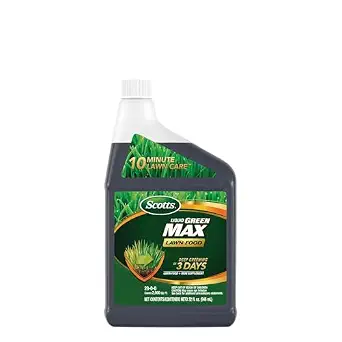 |
| Highest Rated A top-rated pick with lots of positive feedback | Simple Lawn Solutions 16-4-8 Liquid Lawn Fertilizer (64 fl oz) |  |
| Most Popular A crowd favorite that many people choose with confidence | Scotts Liquid Turf Builder Plus 2 Weed Control, Ready‑to‑Spray, 32 fl. oz. |  |
| Best Seller A high-volume bestseller chosen again and again | Scotts Turf Builder Liquid Lawn Food, 32 fl. oz. (covers 2,000 sq. ft.) |  |
Simple Lawn Solutions 16-4-8 Liquid Lawn Fertilizer (1 Gallon)

| Item Form | Liquid |
|---|---|
| Application Method | Spray |
| Mixing Ratio | 1:10 |
| Liquid Volume | 128 fluid ounces |
| Target Species | Fish |
This 1 gallon concentrated liquid fertilizer supplies a balanced 16-4-8 NPK blend with added seaweed and fish emulsion to support greener foliage and stronger roots. It is designed to be mixed at a 1:10 ratio and applied as a spray, making it practical for routine monthly feedings to maintain turf health. The formulation targets nitrogen-driven greening and growth while phosphorus supports root development and potassium helps turf resilience where deficiencies exist. The inclusion of organic fish and seaweed components can aid soil biology and nutrient uptake compared with straight synthetic formulas. For users managing centipede grass, the product is easy to incorporate into an established fertilizing schedule and the full-coverage spray application covers large lawns quickly. Important limitations are that it is a supplemental lawn food rather than a one-time corrective treatment for severe nutrient imbalances and it requires proper dilution and watering after application to avoid uneven results. Expect steady maintenance benefits when used as directed rather than immediate dramatic changes.
Best for: Homeowners who want a reliable, easy-to-apply maintenance fertilizer for centipede and other warm-season lawns and prefer a product that supports steady greening and soil health over time.
Less Ideal for: Gardeners seeking an immediate corrective treatment for acute nutrient problems or those who need a granular slow-release program without monthly spraying.
- Balanced 16-4-8 NPK formula targets greening, root development, and turf strength
- Contains seaweed and fish emulsion to support soil biology and nutrient uptake
- Concentrated 1:10 mixing ratio reduces storage volume and treats large areas from one gallon
- Spray application delivers even coverage for routine monthly maintenance
- Not intended as a corrective treatment for severe nutrient deficiencies
- Requires mixing and follow-up watering to ensure even uptake
Verdict: A dependable monthly liquid lawn food that keeps centipede grass green and healthy with a balanced 16-4-8 formula and added seaweed and fish for soil support.
PETRAMAX Neighbor’s Envy Liquid Lawn Fertilizer Concentrate (1 gal)

| Item Form | Liquid |
|---|---|
| Application Method | Spray |
| Coverage | 16000 |
| Target Species | Lawn Grass |
| Liquid Volume | 128 fluid ounces |
Neighbor’s Envy is a concentrated liquid fertilizer designed to deliver rapid greening and improved turf vigor when applied with a sprayer or hose-end applicator. It combines a high nitrogen content with iron, humic and fulvic acids, potassium, sulfur and sea kelp so you can feed for color, root strength and stress resistance in a single application. Use it on Zoysia and other warm- and cool-season turfs; dilution and spray application let you treat large areas without spreading granular product. Practical benefits include visible color improvement within days, soil-conditioning ingredients that support longer-term health, and pet-safe labeling for everyday yards. Limitations are that performance depends on correct mixing and even spray coverage, and a liquid concentrate requires a sprayer and careful measurement to avoid overapplication. For gardeners focused on efficient, repeatable lawn maintenance, this product simplifies multiple inputs into one bottle but still requires basic application skill to get consistent results.
Best for: Homeowners who want a time-saving, all-in-one liquid treatment to improve Zoysia color and vigor across medium to large lawns while minimizing separate products.
Less Ideal for: People who prefer granular slow-release programs or those unwilling to handle dilution and spray application should consider alternative formats.
- High nitrogen plus iron formula for quick, deep greening of turf
- Includes humic/fulvic acids and sea kelp to support soil health and stress tolerance
- Liquid concentrate covers up to 16,000 sq ft for efficient large-lawn applications
- Designed for spray application so it distributes evenly when applied correctly
- Requires accurate dilution and a sprayer to avoid uneven coverage or overfeeding
- No specific N-P-K breakdown beyond listed ingredients for precise nutrient planning
Verdict: A single, spray-applied concentrate that combines nitrogen, iron and soil conditioners to quickly green and strengthen Zoysia with one convenient product.
Simple Lawn Solutions 16-4-8 Liquid Lawn Fertilizer (32 oz)

| Item Form | Liquid |
|---|---|
| Specific Uses For Product | Lawn Fertilizer |
| Application Method | Spray |
| Mixing Ratio | 3-5 fl. oz. per gallon of water |
| Liquid Volume | 946 ml |
This 32-ounce Simple Lawn Solutions 16-4-8 is a concentrated liquid lawn food formulated to supply balanced nitrogen, phosphorus, and potassium for established turf. It is mixed with water (3 to 5 fl. oz. per gallon) and applied via a hose-end or pump sprayer for even coverage across the lawn. Notable features include its 16-4-8 NPK ratio, added seaweed and fish emulsion for organic micronutrients, and instructions geared to repeat applications every 3 to 4 weeks during the growing season. In practice it promotes green-up and steady top growth while supporting root vigor thanks to its phosphorus content, and the liquid format makes it quick to apply compared with granular fertilizers. Limitations are typical of concentrated liquids: you must measure and mix correctly and keep the lawn watered after application for best uptake, and it is intended for maintenance and corrective feeding rather than for establishing new sod or solving severe soil-structure issues. For gardeners who want an easy-to-apply, regularly scheduled feeding to maintain turf color and health, this product is a practical choice.
Best for: Buyers who prioritize proven, easy-to-apply maintenance feeds for established lawns and want a product backed by straightforward usage instructions and broad grass compatibility.
Less Ideal for: Those starting a new lawn, dealing with compacted or poor soils, or seeking slow-release granular feeding that reduces application frequency should consider alternatives.
- Balanced 16-4-8 NPK formula supports green-up and general turf vigor
- Liquid concentrate mixes for spray application, allowing quick, even coverage
- Contains seaweed and fish emulsion for additional organic micronutrients
- Suitable for a wide range of common grass types
- Requires correct measuring and dilution before spraying to avoid over-application
- Not formulated to address soil structure or severe nutrient lockup problems
Verdict: A concentrated, easy-to-spray 16-4-8 liquid that makes regular maintenance feeding simple for established lawns needing greener turf and improved root support.
Scotts Liquid Green Max Lawn Food Refill, 32 fl. oz.

| Unit Count | 32 Fluid Ounces |
|---|---|
| Item Form | Liquid |
| Application Method | hose sprayer |
| Target Species | Lawn Grass |
| NPK | 29-0-0 |
Scotts Liquid Green Max is a 32 fl. oz. ready-to-use refill that connects to a hose-end applicator to feed lawns without measuring or mixing. It delivers a high-nitrogen 29-0-0 formula plus iron intended to produce visible greening in as little as three days and one bottle covers about 2,000 sq. ft. Typical use is simple: attach the reusable applicator, connect a garden hose, flip the on/off control and spray while you water. The translucent bottle helps monitor how much product remains and the hose sprayer method makes application fast—Scotts says a 2,000 sq. ft. yard can be done in roughly 10 minutes. Because it is liquid and high in nitrogen, it provides quick color and boost to actively growing turf and can be used on any grass type. Limitations are that it is a feed-only product with no weed control and requires the brand applicator to get the advertised coverage; frequent users may prefer larger capacity or concentrated mixes for lower cost per square foot.
Best for: Homeowners who want a quick, easy lawn color boost with minimal fuss and prefer a ready-to-use product over mixing concentrated fertilizers.
Less Ideal for: People managing large properties who need lower cost per square foot or users wanting combined weed-and-feed solutions should consider other options.
- Ready-to-spray refill works with a hose-end applicator for fast, no-mixing application
- High-nitrogen 29-0-0 formula plus iron delivers quick visible greening in about three days
- Covers approximately 2,000 sq. ft. per bottle, suitable for small to medium lawns
- Translucent bottle makes it easy to monitor remaining product while applying
- Requires the Scotts applicator to achieve the stated coverage and ease of use
- No weed control or residual prevention bundled with the fertilizer
Verdict: If you want a fast, no-mess liquid fertilizer to quickly green a small to medium lawn, this ready-to-spray refill is an easy, effective choice.
Simple Lawn Solutions 16-4-8 Liquid Lawn Fertilizer (64 fl oz)

| Item Form | Liquid |
|---|---|
| Specific Uses For Product | Plant Growth, Root Development |
| Coverage | 6,400 Square feet |
| Target Species | Common turf grasses including Bermuda, Zoysia, Fescues, Ryegrass, Kentucky Bluegrass |
| Mixing Ratio | 3 oz per gallon; apply 10 oz per 1,000 sq ft |
This 64-ounce 16-4-8 liquid lawn fertilizer is a concentrated feed for established lawns that mixes with water and is applied with a hose-end sprayer. It supplies 16% nitrogen for greening and growth, 4% phosphorus to support roots, and 8% potassium to help stress tolerance, plus seaweed and fish emulsion for added soil and nutrient support. Typical use is a spring application to boost color and encourage lateral and vertical growth on warm- and cool-season grasses; one bottle is rated to cover about 6,400 sq ft when diluted per the directions. The liquid form makes coverage quick with a hose-end applicator and allows rapid nutrient availability compared with granular products. Important limitations are that it is a supplement rather than a one-step soil amendment for severe deficiencies and it requires regular watering after application for best uptake; safety precautions are needed to avoid drift and contact during handling. For routine spring feeding where fast greening and easy application matter, this product is practical and straightforward.
Best for: Homeowners who want a reliable, easy-to-apply spring feed to quickly green and strengthen established lawns and prefer predictable, repeatable application routines.
Less Ideal for: Gardeners seeking a single seasonal granular product that feeds for months or those needing a product specifically formulated to rebuild severely depleted soils.
- Balanced 16-4-8 NPK ratio supports greening, root development, and stress tolerance
- Contains seaweed and fish emulsion for added organic nutrients and improved soil uptake
- Concentrated liquid formula designed for quick mixing and application with a hose-end sprayer
- Coverage claim of about 6,400 square feet per 64 fl oz bottle simplifies planning for medium lawns
- Requires dilution and hose-end equipment rather than granular broadcast application
- Not formulated as a complete soil amendment for severe nutrient deficiencies
Verdict: A dependable, concentrated liquid feed that makes spring greening and root support fast and simple for established lawns.
Scotts Liquid Turf Builder Plus 2 Weed Control, Ready‑to‑Spray, 32 fl. oz.

| Liquid Volume | 32 fluid ounces |
|---|---|
| Coverage | 6000 square_feet (warm-season); 4000 square_feet (cool-season) |
| Item Form | Spray |
| Active Ingredients | Nitrogen |
This ready-to-spray bottle combines a quick nitrogen boost with broadleaf weed control for an easy lawn maintenance step. You attach the hose, spray evenly across the lawn when weeds are actively growing, then avoid watering for 48 hours so the product can work. The formula lists a 25-0-2 NPK balance and targets common weeds such as dandelions, clover, chickweed, and ground ivy, making it useful for both warm- and cool-season grasses. Coverage is generous for a single 32 fl. oz. bottle: up to 6,000 sq ft on warm-season lawns and 4,000 sq ft on cool-season lawns. Practical benefits include fast visible weed curl within days and no need for separate fertilizer and weed-killer steps, which simplifies care for homeowners who want predictable results. Limitations to note are the restricted list of safe grass types and the need to avoid application above 85°F or watering for two days, plus some stubborn weeds may require a repeat treatment in 3 to 4 weeks.
Best for: Homeowners who want a simple, low‑effort way to feed their lawn and control common broadleaf weeds without separate products and who prefer predictable, do‑it‑yourself lawn care steps.
Less Ideal for: Gardens with mixed planting beds or users who need a product safe around vegetables and ornamentals should choose a different targeted solution.
- Hose-end ready-to-spray design requires no measuring or mixing
- Combines fertilizer and weed control in one application
- Covers large areas per bottle for typical home lawns
- Works on a wide range of warm- and cool-season turf grasses
- Visible weed decline within a few days for many common broadleaf weeds
- Not safe for use on garden beds or non-listed plants
- May cause temporary injury on some bermudagrass varieties and is restricted to listed grasses
- Stubborn weeds may require a second application within a month
Verdict: A single ready-to-spray bottle that simplifies feeding and broadleaf weed control for risk-averse homeowners who want dependable, low-effort lawn results.
Scotts Turf Builder Liquid Lawn Food, 32 fl. oz. (covers 2,000 sq. ft.)

| Item Form | Liquid |
|---|---|
| Coverage | 2,000 sq. ft. |
| Unit Count | 32 Fluid Ounces |
Scotts Turf Builder Liquid Lawn Food is a ready-to-use liquid fertilizer that connects to a standard garden hose so you can feed and water established turf in one step. The bottle includes a reusable hose-end sprayer for easy application: attach, turn on the water, and spray evenly over actively growing grass. Its high-nitrogen formula (NPK 29-0-3) is designed to green lawns quickly and help build thicker turf, and the product can be applied up to four times per year for seasonal maintenance. Practical benefits include fast coverage for small yards, no measuring or mixing, and less effort than a granular spreader. Limits to note are that it is formulated for established lawns only, should not be applied in temperatures above 85°F, and one 32 fl. oz. bottle covers about 2,000 sq. ft., so multiple bottles are needed for larger areas. Users should also avoid mowing for a day or two after application for best results.
Best for: A homeowner who wants a low-effort, predictable spring green-up for an established small-to-medium lawn and prefers ready-to-use products that minimize measuring and setup.
Less Ideal for: Large properties that need frequent coverage or growers establishing new lawns or seedlings who require starter fertilizers or granular products for broader coverage.
- Ready-to-spray hose-end bottle eliminates measuring and mixing
- High nitrogen formula promotes rapid greening and thicker turf
- Covers up to 2,000 sq. ft. per 32 fl. oz. bottle for quick small-yard treatments
- Can be applied up to four times per year to support seasonal lawn care
- Not intended for new or newly seeded lawns
- Effectiveness reduced if applied when temperatures exceed 85°F
Verdict: Choose this ready-to-spray liquid if you want a simple, no-mess way to quickly green and strengthen an already established lawn in spring.
Choosing the Right Liquid Lawn Fertilizer for Spring: Key Factors to Consider
Nutrient Ratio and Analysis
The guaranteed analysis tells you how much nitrogen, phosphorus, and potassium the product supplies and in what form. For spring feeding, a higher proportion of soluble nitrogen encourages visible green-up, while some potassium and phosphorus support root repair. Understanding the percent composition helps you calculate how much active nutrient your lawn will receive per application and whether additional amendments are needed.
Different nitrogen sources act at different rates. Ammoniacal or urea-based nitrogen provides quick color change but can stress turf if overapplied, while stabilized or slow-release nitrogen reduces burn risk but delays peak greening. Read the analysis and match it to how quickly you want results and your turf's vulnerability.
Application Method and Compatibility
Liquid fertilizers come in concentrates, ready-to-use mixes, or hose-end compatible formulas. The required dilution ratio affects how long it takes to treat a lawn and whether your sprayer can deliver an even application. Check label directions for sprayer type, recommended pressure range, and whether a nozzle change is needed.
Compatibility with other spring treatments matters. If you plan to apply a preemergent, broadleaf herbicide, or a soil amendment, verify tank-mix guidance and any timing windows. Ease of calibration reduces waste and uneven patches, so favor formulations with clear, homeowner-friendly dosing charts.
Turf Safety and Timing
Spring temperatures can fluctuate widely, and recently thawed turf is more susceptible to burn from concentrated nutrient contact or overapplication. Labels usually recommend minimum soil or air temperature thresholds and watering instructions after application. Following those guidelines minimizes stress risks and helps nutrients move into the root zone rather than sit on leaf surfaces.
Knowing your grass species and its tolerance to high nitrogen in early spring also guides timing. Cool-season grasses and warm-season grasses respond differently; apply when the grass is actively growing to ensure uptake and avoid wasted product.
Coverage Rate and Cost Per Acre Equivalent
Coverage rate determines how much lawn area a bottle will treat and is a practical constraint for budgeting and logistics. Concentrated liquids that treat large areas reduce packaging waste and application time but require accurate dilution. Calculate the cost or volume needed to treat your lawn size, and consider whether you prefer multiple light applications or a single heavier feed during spring.
Also consider the physical effort and time-hose-end setups usually let you move quickly across the yard, while backpack sprayers can be slower but more precise on small lawns and complex landscapes.
Speed of Visible Results
How quickly you expect green-up influences the product choice. Fast-acting formulations can deliver color within days but may lack longer-term nutrient release. Conversely, formulas with some controlled-release fraction smooth out color and reduce repeat applications. Think about whether you need an immediate aesthetic boost for events or are focused on steady seasonal recovery.
Faster results can require closer attention to dosing and timing. If you prefer lower maintenance, choose options that combine quick-responding nitrogen with a modest slow-release component to extend benefits.
Environmental Considerations
Spring rains can leach soluble nutrients from the root zone, so selecting products with appropriate application timing and following watering guidance reduces runoff risk. Look for label instructions on buffer zones near water features and advice for avoiding application before heavy rain. Responsible application techniques such as targeted spraying, measuring lawn area accurately, and not exceeding recommended rates protect local waterways.
Also consider packaging and refill options if minimizing waste is important to you. Concentrates that reduce plastic per treated area and clear mixing instructions that limit overuse are environmentally preferable.
When to Feed in Spring
Timing a spring application depends on soil temperature and turf growth stage rather than a calendar date. Apply when the grass is actively breaking dormancy and soil temperatures consistently exceed the minimum threshold stated on the label. For cool-season lawns this is often early to mid-spring as shoots thicken; for warm-season lawns wait until new shoots are well established.
If the goal is quick green-up, apply a fast-acting liquid when a warm spell is imminent and follow with light irrigation if recommended. Avoid applying right before a cold snap or heavy frost risk because tender new growth can be damaged.
- Check soil temperature rather than relying on the date.
- Delay feeding until turf is actively growing.
- Avoid treatment immediately before heavy rain or frost.
Mixing and Calibrating Your Sprayer
Accurate mixing is the simplest way to avoid turf damage or uneven results. Use the dilution ratios on the label and measure both fertilizer and water precisely. If you are treating a small area, prepare smaller batches to keep the mix fresh and reduce waste.
Calibration steps include measuring how much area a full tank covers and testing spray patterns for evenness. Walk parallel swaths with a visual marker to ensure overlap is consistent and avoid streaking.
- Measure lawn square footage before mixing.
- Test spray coverage on a small patch first.
- Rinse equipment thoroughly after use to prevent residue buildup.
Combining Fertilizer With Other Spring Tasks
Spring often includes dethatching, aeration, seeding, and weed control. Coordinate liquid fertilizer timing with these tasks to maximize benefits. For example, apply fertilizer after aeration to encourage root uptake, and delay seeding until you understand how concentrated feeding affects new seedlings.
When using herbicides, follow label gap recommendations. Some broadleaf weed treatments require a specific window before or after feeding to avoid reduced efficacy or increased turf stress.
- Apply after core aeration to speed nutrient access to roots.
- Avoid seeding immediately after strong, concentrated feeds unless label allows.
- Respect reentry intervals and tank-mix warnings on labels.
Adjusting Rates for Lawn Condition
Thin or stressed lawns may need gentler, lower-rate applications to prevent burn. Conversely, lawns showing strong recovery from winter may tolerate standard spring rates. Perform a simple turf tissue or soil test if you are unsure about nutrient deficiencies before applying heavy nitrogen.
If you choose repeated light applications, spread them over several weeks rather than one high-rate application. This reduces risk of leaching and provides steady nutrition as grass moves through spring growth stages.
- Use lower rates on thin or recovering turf.
- Prefer multiple light feeds over a single heavy dose when uncertain.
- Test soil or tissue for persistent concerns before escalating rates.
Common Application Mistakes and How to Avoid Them
Overconcentration, uneven coverage, and spraying before heavy rain are the most frequent errors. Always follow label dilution instructions and calibrate your equipment to the lawn's size. When using a hose-end device, avoid walking too fast or too slow which leads to streaking.
Neglecting to water in when required or watering too much immediately after application can both reduce uptake. Read the label for irrigation guidance and follow recommended post-application watering to move nutrients into the root zone without washing them away.
- Calibrate equipment to prevent streaks.
- Follow label watering instructions to aid uptake.
- Store concentrates safely and clean sprayers after use.
How We Chose the Best Liquid Lawn Fertilizer for Spring
We focused on the product attributes that matter most for spring liquid feeding. First, nutrient profile and guaranteed analysis were prioritized to ensure a clear balance of readily available nitrogen for green-up and secondary nutrients that support root health. Second, formulation type and concentration were evaluated so that application rates and dilution needs match common homeowner sprayers and turf sizes. Third, ease of use and compatibility with broadcast or hose-end sprayers were considered to reduce application errors. Fourth, turf safety and recommended timing windows were assessed to avoid burn risk during cool, fluctuating spring weather. Finally, performance notes such as how quickly color returns and whether the formula encourages even uptake were used to choose practical winners. We excluded granular-only products, slow-release-only blends intended for summer feeding, and specialty inputs for sports turf that require professional calibration. Our filters removed concentrates lacking clear analysis or dosing instructions. The final selection reflects products that balance quick nutrient availability, straightforward mixing, and predictable results for typical spring lawn care situations.
FAQ
How soon will I see green-up after applying a spring liquid fertilizer?
Visible green-up often appears within a few days to a week depending on formulation, soil temperature, and turf health. Fast-acting soluble nitrogen shows color quickest, while blends with slow-release fractions take longer to reach peak effect.
Can I apply liquid fertilizer the same day I seed my lawn?
That usually depends on product directions. Many concentrates advise delaying heavy nutrient applications until seedlings are established to avoid burn. Lighter starter formulations designed for seeding are an alternative, but check the label for seeding compatibility.
Is it safe to mix liquid fertilizer with weed control products?
Sometimes, but only if the labels explicitly allow tank mixing. Some herbicides require separate application windows to prevent reduced efficacy or increased turf stress. When in doubt, apply treatments separately with the recommended interval between them.
How often should I apply liquid fertilizer in spring?
Frequency depends on the product concentration and whether it contains slow-release nitrogen. Some gardeners use one comprehensive spring feeding, while others prefer two to three light applications spaced several weeks apart. Follow label guidance and adjust for turf response.
Will liquid fertilizer burn my lawn?
Overapplication or using too concentrated a mix can cause burn, especially on newly emerged shoots or drought-stressed turf. Prevent this by following dilution rates, calibrating your sprayer, and avoiding application during extreme heat or drought.
Do I need to water after applying a liquid fertilizer?
Labels often recommend light irrigation after application to move nutrients into the root zone, but instructions vary. Watering immediately after application can reduce foliar contact time for foliar-applied formulas, so follow the specific product guidance for best uptake.
Final Verdict
For spring feeding, prioritize a liquid formula that matches your timing goals and application equipment. Focus on nutrient analysis, safe dilution and application instructions, and a product that offers a reasonable balance between quick green-up and turf safety. Consider smaller, repeated applications if your lawn is recovering or if weather is unpredictable. With careful calibration and adherence to label directions, you can encourage strong shoot growth and root recovery while minimizing stress and environmental runoff.
