

Note: This article contains affiliate links. If you click on these links and make a purchase, I may earn a small commission at no extra cost to you. This helps support my research and content. Read my full affiliate disclosure here.
If you propagate from cuttings, the rooting compound you choose can make the difference between a handful of failures and a tray of vigorous new plants. Liquid rooting hormone changes how quickly roots form and how consistently softwood, semi-ripe, and hardwood cuttings take, and it affects how easy the product is to apply in a busy garden routine. This guide shortlists the leading liquid rooting hormone options gardeners use for a range of species and situations, then evaluates them on practical, hands-on criteria. Below we summarize what mattered most in our selection process and how each pick performs on rooting speed, application method, and plant compatibility before you examine the individual product blocks.
Top Picks at a Glance
| Best Overall The best all-around choice for most situations | Montorchid Root Drops Liquid Rooting Hormone (4 fl oz) |  |
| Best Quality Built to a higher standard if you want something more solid | Clonex Clone Solution Professional Grade Nutrient, 1 Quart |  |
| Best Value The sweet spot between price and what you get | Root Drops Liquid Rooting Hormone for Cuttings |  |
| Best Budget The cheapest option that still gets the job done reliably | VIRESTA Prop Drops Liquid Rooting Hormone, 4 fl oz |  |
| Highest Rated A top-rated pick with lots of positive feedback | Hormex Liquid Rooting Hormone Concentrate with Vitamin B1, 8 oz |  |
| Most Popular A crowd favorite that many people choose with confidence | Southside Plants Root Drops Liquid Rooting Hormone (4 oz) |  |
| Best Seller A high-volume bestseller chosen again and again | Bonide Root & Grow Concentrate 32 oz |  |
Montorchid Root Drops Liquid Rooting Hormone (4 fl oz)

| Item Form | Liquid |
|---|---|
| Specific Uses For Product | Plant Growth, Root Development |
| Application Method | Drops |
| Target Species | Houseplants |
| Mixing Ratio | 3 drops per 500ml of fresh water |
Montorchid Root Drops is a concentrated liquid rooting hormone designed for propagating common houseplant cuttings and for occasional root support of established plants. It is used by adding a few drops to propagation water (manufacturer recommends 3 drops per 500 ml) or mixing small amounts into watering for transplanted plants. The product contains indole-3-butyric acid (IBA) plus proprietary vitamins and comes with a dropper for precise application, which reduces waste and contamination compared with powders or gels. In practice the small dropper bottle is easy to store and the concentrated formula stretches over many propagation cycles, making it cost effective for regular propagators. Limitations are that the bottle is small so users who propagate at scale will need multiple bottles, and the label does not list full ingredient concentrations beyond IBA and vitamins which may concern growers who prefer fully transparent formulations. For standard houseplant propagation—Pothos, Monstera, Philodendron—this provides a simple, mess-free way to speed root formation and help cuttings transition to soil or LECA.
Best for: Buyers who propagate houseplants regularly and want a precise, economical rooting aid that speeds root formation and eases transitions between water and soil.
Less Ideal for: Large-scale growers or nursery operations that need bulk quantities and fully detailed ingredient analyses should consider larger commercial formulations instead.
- Concentrated liquid formula that requires only a few drops, extending bottle life
- Includes a dropper for precise, low-waste application
- Formulated with IBA plus vitamins to promote faster and denser root development
- Versatile for use in water, soil, LECA, and moss
- Small 4 fl oz bottle may be insufficient for heavy or commercial propagators
- Product listing does not disclose full ingredient concentrations
Verdict: A compact, concentrated dropper formula that makes propagating houseplant cuttings quicker and more precise.
Clonex Clone Solution Professional Grade Nutrient, 1 Quart

| Item Form | Liquid |
|---|---|
| Specific Uses For Product | Root Development, Cloning |
| Coverage | Medium |
| Liquid Volume | 1 quarts |
| Mixing Ratio | 1:0.4 |
Clonex Clone Solution is a professional-grade liquid nutrient designed to speed root initiation and support young plants through the first stages of growth. You use it as a soak or root feed for cuttings and seedlings, mixing according to the label ratio to deliver concentrated vitamins and root-enhancing agents. The formula includes vitamin B1 to reduce transplant shock and is intended to pair with Clonex rooting gel and mist, though it will work with other propagation products. In practice it provides a straightforward way to boost early root cell development and encourage vigorous root masses, which is why many growers add it at first signs of root formation. Important limitations are that it is a nutrient solution rather than a pure hormone, so it complements rather than replaces specialized rooting powders or gels for very difficult-to-root species, and safe handling is required because it can irritate skin and eyes. For growers focused on performance, it is a concentrated, reliable option for improving rooting success in standard propagation workflows.
Best for: Serious hobbyists and commercial growers who prioritize fast, reliable rooting performance and want a concentrated nutrient boost during propagation.
Less Ideal for: Casual gardeners looking for a single-use beginner product or those who need a pure hormone-only rooting agent for very difficult cuttings.
- Concentrated liquid formula supports rapid root initiation and early growth.
- Contains vitamin B1 and root-enhancing agents to reduce transplant shock.
- Versatile application as a medium soak or regular root feed during early development.
- Designed to work with Clonex gel and mist but compatible with other rooting products.
- Not a standalone rooting hormone for very hard-to-root species since it is primarily a nutrient solution.
- Requires careful handling and protective gear to avoid skin or eye irritation.
Verdict: Choose Clonex Clone Solution when you want a concentrated, performance-focused liquid nutrient that accelerates root development in cuttings and seedlings.
Root Drops Liquid Rooting Hormone for Cuttings

| Formulation | Liquid |
|---|---|
| Active ingredient | IBA |
| Use cases | Water, soil, moss, perlite, LECA |
Root Drops is a concentrated liquid rooting hormone designed to stimulate root formation on cuttings and to support transplanting. You use it by adding a drop or two to a cup of water or by briefly dipping cut stem ends before placing them in water, perlite, moss, LECA, or soil. The formula contains IBA, so it encourages faster, stronger root development compared with plain water; because it is a liquid it is easy to measure and mixes cleanly for water propagation. Its concentration means a small bottle lasts through many propagation sessions, which is convenient for hobbyists and enthusiasts who propagate frequently. The product is versatile for houseplants such as pothos, monstera, philodendron, herbs, and many succulents. Important limitations are that results still depend on cutting health and environmental conditions and that some growers prefer powders or gels for direct stem coating in very humid setups, so you may need to adapt your technique for certain species or propagation methods.
Best for: Plant owners who regularly propagate houseplants and want a small, concentrated rooting aid that is easy to measure and works well for water-based propagation.
Less Ideal for: Growers who rely exclusively on powder or gel rooting products for direct stem coating or who propagate very difficult-to-root species without optimizing cutting health and environment.
- Concentrated IBA formula promotes faster and stronger root formation
- Works in multiple media including water, soil, moss, perlite, and LECA
- Very low dose per use extends the bottle for many propagation sessions
- Liquid form mixes cleanly for water propagation and is easy to apply
- Liquid format may be less convenient than powders or gels for direct stem coating in extremely humid or misting setups
- Effectiveness still depends on cutting quality and environment rather than guaranteeing roots on difficult species
Verdict: A small, concentrated liquid rooting hormone that makes water propagation simpler and stretches across many cuttings so you get reliable root starts with minimal product use.
VIRESTA Prop Drops Liquid Rooting Hormone, 4 fl oz

| Item Form | Liquid |
|---|---|
| Application Method | Drops |
| Target Species | Houseplants |
| Liquid Volume | 4 fluid ounces |
| Mixing Ratio | 2-4 drops per 1 cup of water |
VIRESTA Prop Drops is a 4 ounce liquid rooting hormone packaged with a dropper for easy dosing. It is intended for propagation of houseplants and can be used in water, soil, LECA, or moss setups; the brand recommends 2–4 drops per cup of water for regular propagation and 3–5 drops per cup for transplant watering. The dropper bottle makes measuring clean and convenient, so beginners can add a consistent, small dose without mixing powders. Using it in water propagation or when refreshing hydroponic solution should encourage root formation and help cuttings adapt after transplanting. The formula is presented as a multi-ingredient promoter aimed at strengthening roots and reducing transplant shock. Limitations are the small 4 fl oz volume for frequent or large-scale use and the lack of detailed ingredient disclosure, so serious hobbyists who need high-volume supplies or a fully transparent composition may prefer a concentrated or labeled alternative.
Best for: Buyers looking for an affordable, easy-to-use rooting aid to improve success with houseplant cuttings and small-scale propagation projects.
Less Ideal for: Large-scale propagators, commercial growers, or users who need a high-concentration concentrate or complete ingredient disclosure should consider other products.
- Dropper bottle allows precise, mess-free dosing for propagation
- Compatible with water, soil, LECA, and moss so it fits many propagation methods
- Simple dilution guidance makes it beginner-friendly
- Formulated to support root strength and reduce transplant stress
- Small 4 fl oz bottle may run out quickly for frequent propagators
- No full ingredient list provided for users who prefer transparency
Verdict: A simple, beginner-friendly liquid rooting drops solution that makes propagating houseplants easier and more reliable for budget-conscious growers.
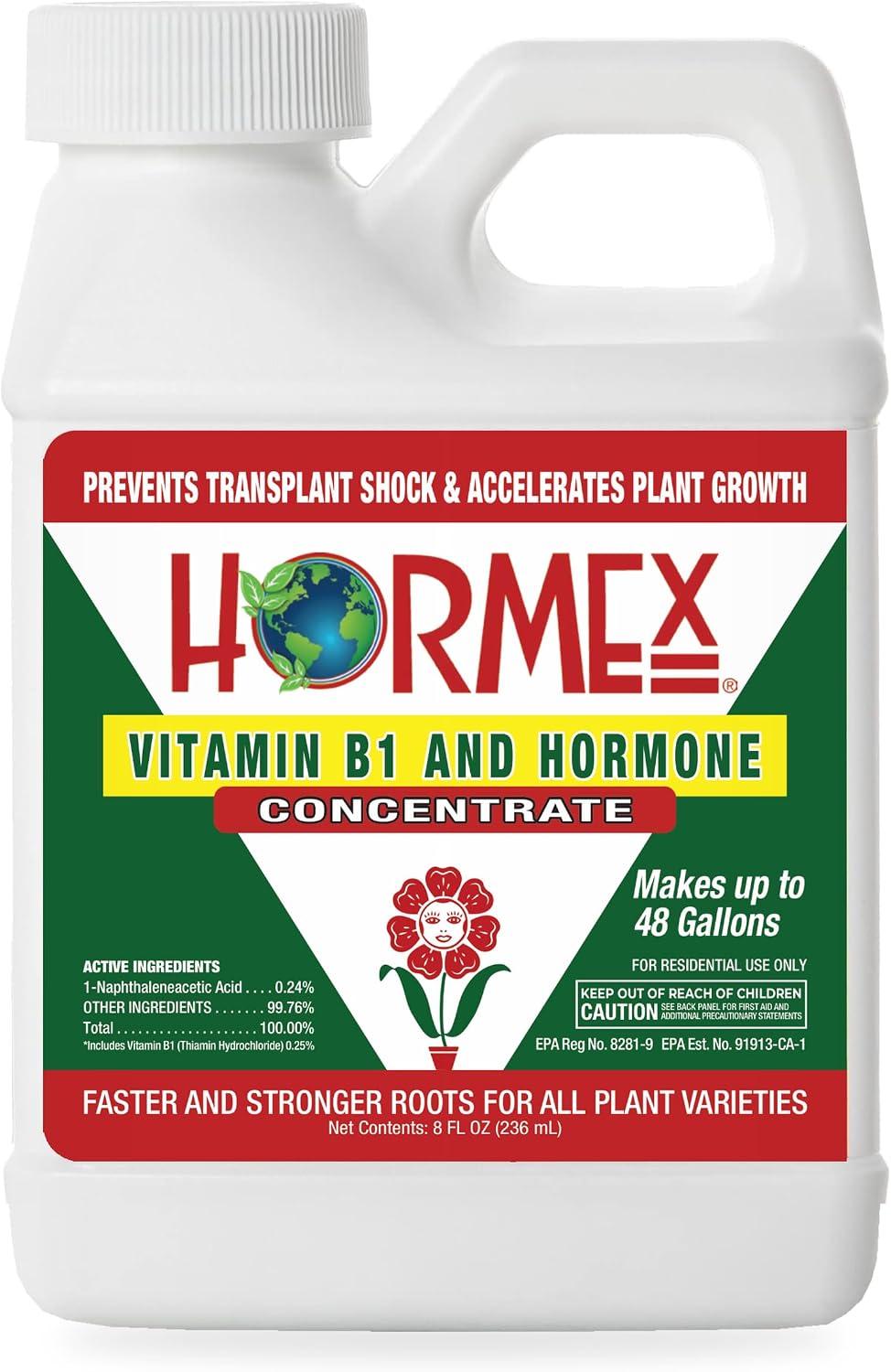
Hormex Liquid Rooting Hormone Concentrate with Vitamin B1, 8 oz
| Item Form | Liquid |
|---|---|
| Specific Uses For Product | Root Stimulator – Enhances Rooting and Growth for All Plant Varieties and Growing Mediums. |
| Coverage | Transplanting – Hydroponics – Indoor Plants – Cut Flowers – Bare Root Planting – Lawn & Ground Cover |
| Liquid Volume | 8 fluid ounces |
| Mixing Ratio | 1:9 |
Hormex Liquid Rooting Hormone is a concentrated plant tonic that combines a rooting hormone with vitamin B1 to help cuttings and transplants establish faster and recover from stress. It is typically mixed into water for drenching newly planted soil, added to hydroponic reservoirs, or used at full strength as a short dip for tender cuttings. Notable features include clear, simple mixing directions (examples: 1 tsp per gallon for transplants, 10 drops per 16 oz for water propagation) and compatibility with soil, coco, rockwool and hydroponic systems. Practical benefits are stronger feeder roots, reduced transplant shock and more reliable water propagation for common houseplants and vegetable or ornamental transplants. As a concentrate a small amount treats many gallons, but users must measure carefully and follow the specified dilutions; the product does not substitute for powdered rooting formulations for tougher hardwood cuttings. Safety directions warn not to ingest or inhale. For gardeners who prioritize consistent, proven rooting support, Hormex offers a dependable, easy-to-use option.
Best for: Gardeners who want a reliable, ready-to-use liquid stimulator to reduce transplant shock and improve rooting success in propagation, repotting and hydroponic setups.
Less Ideal for: Growers who primarily propagate large woody hardwood cuttings or need a dry powder rooting hormone designed for long dips should consider alternative products.
- Concentrated formula stretches a small bottle to treat many gallons of water
- Clear, specific mixing and application instructions for propagation, transplants and hydroponics
- Includes Vitamin B1 alongside rooting hormone to help mitigate transplant shock
- Works across multiple growing media including soil and hydroponic systems
- Not formulated for the toughest hardwood cuttings where a stronger powder may be preferable
Verdict: Choose Hormex when you want a proven, concentrated liquid root stimulator that reliably reduces transplant shock and improves rooting across soil and hydroponic systems.
Southside Plants Root Drops Liquid Rooting Hormone (4 oz)

| Item Form | Liquid |
|---|---|
| Specific Uses For Product | Cuttings in water, soil, or newly transferred to soil |
| Application Method | Drops |
| Unit Count | 4 Ounce |
| Target Species | Houseplants |
Southside Plants Root Drops is a concentrated liquid rooting hormone designed to speed and strengthen root formation for indoor plant propagation. It is applied as drops — for water propagation the recommended dose is two drops per cup — and the product is also intended for use when transplanting cuttings into soil or soilless media such as LECA or sphagnum moss. The formula lists 0.025% indole butyric acid plus vitamins and lanolin-based proprietary components, which makes it more comparable to liquid hormone treatments than to powders or gels. Practical benefits include easy, mess-free dosing, suitability across multiple substrates, and a small bottle that lasts because of the low dose. Limitations are that the concentration is fixed so you cannot adjust strength beyond changing dose, and the product is aimed at houseplants rather than outdoor or edible crops. For growers focused on efficient, repeatable propagation this is a simple, usable option; those needing broad agricultural use or adjustable formulations should consider alternatives.
Best for: Buyers who prioritize efficient, low-waste propagation for houseplants and want a hassle-free liquid option that performs across water and soilless setups.
Less Ideal for: Growers who need adjustable-strength rooting solutions or products formulated for large-scale outdoor or edible crop propagation should look elsewhere.
- Concentrated liquid formula that requires only a few drops per propagation session
- Works across multiple media: water, soil, LECA and sphagnum moss
- Includes vitamins and lanolin-based ingredients intended to promote stronger, healthier roots
- Dropper bottle enables clean, mess-free application
- Fixed formulation with a single listed concentration limits ability to fine-tune hormone strength
- Product labeling and ingredients list use proprietary terms so exact composition beyond active IBA percentage is limited
Verdict: A compact, easy-to-use liquid rooting hormone that speeds and supports houseplant propagation across water and soilless media.
Bonide Root & Grow Concentrate 32 oz

| Item Form | Liquid |
|---|---|
| Specific Uses For Product | Root Development |
| Application Method | Pouring directly onto the soil and roots |
| Target Species | fruit, vegetables, flowers, trees, and bedding plants |
| Mixing Ratio | 4:10:3 |
Bonide Root & Grow is a liquid concentrate designed for use when seeding or transplanting to speed early root formation and help plants establish. You dilute the concentrate per label instructions and pour the solution onto soil and roots when potting seedlings, transplanting plugs, or setting out young vegetables and ornamentals. Notable features include an active IBA rooting hormone and a 4-10-3 nutrient ratio that supplies extra phosphorus to support root growth. In practice it can reduce transplant shock and promote quicker, stronger root systems, which is useful for both container-grown seedlings and recently set out bedding plants. Because it is a concentrate, a single 32 oz bottle yields multiple applications, which stretches a limited budget. Important limitations are that it is a specialized root stimulator rather than an all-purpose feed for ongoing growth and it requires careful dilution and label compliance to avoid overapplication.
Best for: Buyers wanting an affordable, concentrated product to give seedlings and recent transplants a stronger start and who prioritize preventing transplant shock over routine feeding.
Less Ideal for: Gardeners looking for a general weekly fertilizer or a balanced feed for mature plants should choose a different product.
- Contains IBA rooting hormone to stimulate root initiation
- 4-10-3 fertilizer ratio provides extra phosphorus for root development
- Concentrated 32 oz bottle yields many applications, good for tight budgets
- Easy to apply by diluting and pouring directly onto soil and roots
- Formulated mainly for root stimulation so not ideal as a regular all-purpose feed
- Requires careful mixing and label reading to use safely and effectively
Verdict: A budget-friendly concentrated root stimulator that helps seedlings and transplants establish faster by combining IBA with a phosphorus‑rich fertilizer.
Choosing the Right Liquid Rooting Hormone: Key Factors to Consider
Rooting Speed and Consistency
How quickly roots appear and how consistently cuttings develop them affects how many trays you can cycle through in a season. Faster-acting formulas let you pot up sooner and reduce losses from rot or desiccation. Consistency matters because unpredictable results force additional rounds of trial and error, which costs time and plant material.
When evaluating speed, consider typical timelines for the species you grow. Herbaceous cuttings often need a lighter, quicker-acting approach, while hardwood cuttings can require stronger stimulus and longer observation. A hormone that produces steady, repeatable root initials is usually preferable to one that sometimes works extremely well and sometimes fails.
Concentration and Dosing Guidance
Liquid rooting hormones vary in active concentration and recommended dilution. Clear labels and measured dosing reduce the chance of overexposure, which can burn delicate tissues, or underdosing, which produces poor rooting. For gardeners who propagate frequently, predictable dilutions let you scale from single cuttings to whole flats with confidence.
Look for products that provide concentration in familiar units and specific soak or dip times. If you plan to use soaking trays or make a stock solution, choose a concentrate with straightforward mixing instructions to avoid wasted material and inconsistent results.
Application Format and Practicality
Liquid formulas come to you as concentrates to dilute, ready-to-use sprays, or solutions meant for quick dips. Each format has tradeoffs in time, waste, and precision. Quick dips are fast for individual cuttings and reduce handling time, while dilute soak solutions suit batches and misting setups. Spray formats can be useful for foliar treatments but are less reliable for establishing root initials.
Think about your typical propagation workflow. If you take a few cuttings at a time, small dip bottles and droppers are convenient. For larger batches, look for concentrates that mix cleanly into a soak tank. Ease of pouring, measuring, and storage are practical items to weigh alongside the active formulation.
Plant Compatibility and Tissue Sensitivity
Different species and tissue types respond to hormones differently. Soft, herbaceous stems may require a gentler concentration than hardwood cuttings, which often need a stronger stimulus. Some ornamentals and edibles are particularly sensitive to concentrated auxins and benefit from short dips rather than long soaks.
Consider the range of plants you propagate and whether you need a single versatile product or a few specialized formulations. Safety notes and species-specific guidance on labels help avoid damage to sensitive cuttings and ensure you are not applying a too-strong solution to tender growth.
Shelf Life and Storage
Shelf stability affects value and reliability. Concentrates that oxidize or degrade quickly will lose potency and give inconsistent results over time. Clear storage instructions, resealable containers, and concentration that permits smaller working dilutions can help the product last through a propagation season.
For occasional propagators, long shelf life matters more than for heavy users who consume product quickly. Check for dark or airtight bottles and guidance on refrigeration or cool storage if you do not plan to use the concentrate rapidly.
When to Use Liquid Rooting Hormone
Use liquid rooting hormone when you need predictable root initiation or are working with species that historically struggle to root on their own. It is particularly helpful for semi-ripe and hardwood cuttings, as well as for woody ornamentals that set roots slowly. For fast-rooting softwood cuttings, a low concentration or short dip is often adequate.
- Boosts root initiation on hard-to-root species
- Reduces time to visible roots in many cases
- Allows precise control over concentration and exposure time
Application Techniques Gardeners Rely On
Common approaches include quick dips, short soaks, and diluted reservoir solutions. Quick dips are ideal for single cuttings and reduce the risk of tissue browning. Short soaks suit larger batches when you can supervise timing. For misting benches or aeroponic setups, a diluted stock solution provides gentle, repeated exposure without constant handling.
- Quick dip: brief contact, best for delicate cuttings
- Short soak: for batches and tougher wood
- Diluted reservoir: continuous low-dose exposure for automated systems
Safety and Handling in the Garden
Even low-concentration rooting hormones are biologically active. Wear gloves when mixing concentrates and avoid contact with eyes and open cuts. Work in a well-ventilated area and rinse equipment after use to prevent accidental transfer to other plants. Store concentrates out of direct sunlight and away from children and pets.
- Use gloves and eye protection when diluting concentrates
- Follow label disposal recommendations for leftover solution
- Keep bottles capped to preserve potency
Alternatives and When to Skip Hormone Use
Not every cutting needs a hormone. Fast-rooting herbaceous houseplants and many succulents often root readily with clean cuts, proper humidity, and warm, bright conditions. In those cases, the extra step of applying hormone may not improve outcomes enough to justify the effort. Consider the time and plant value. If you are propagating precious specimens, hormone gives an edge. For casual propagation of easy species, focus on sanitation, moisture control, and surface rooting medium instead.
- Skip hormones for species known to root easily
- Use hormone when plant value or seasonality raises the stakes
- Combine good hygiene, humidity, and medium selection with hormone for best results
How We Chose the Best Liquid Rooting Hormone
We focused on attributes that matter when starting cuttings in real home-garden settings. First, rooting effectiveness: measured by how consistently cuttings from common groups-herbaceous, softwood, and woody-initiate roots and how quickly those roots appear. Second, concentration and dosing: clear guidance and predictable strength reduce guesswork and minimize over- or under-treating delicate cuttings. Third, application format and ease of use: whether the product is a dip, soak, or spray, and how well that format fits small-scale propagation. Fourth, plant compatibility and safety: tolerance across a wide range of ornamental and edible species and clear safety instructions for handling. We excluded formulations better described as gels, powders, or hormone-free biostimulants because they behave differently and require different application techniques. Also excluded were products lacking transparent concentration information or with inconsistent user guidance. The final shortlist emphasizes reliable performance, repeatable dosing, and practical packaging for gardeners who take cuttings regularly.
FAQ
Can I use the same concentration for all my cuttings?
It usually depends on the plant. Softwood cuttings typically need a weaker solution or shorter dip than hardwood cuttings. Follow label dilution ranges and err on the low side for tender stems.
How long should I dip cuttings in a liquid hormone?
Dipping times vary by concentration and tissue type. Quick dips of a few seconds often suffice for soft growth, while tougher cuttings may benefit from several minutes in a dilute soak. Consult the product guidance for recommended times.
Will liquid rooting hormone harm my plants if used too often?
Overuse can damage tissue and inhibit rooting. Repeated heavy treatments are unnecessary for most cuttings; a single properly timed dip or soak is usually enough. If symptoms like browning appear, reduce concentration or exposure time.
Is a liquid hormone better than powder or gel?
Each format has advantages. Liquids provide even contact and are easy to dilute for batches. Powders offer convenience for single dips, and gels cling to wounds well. Which is best depends on your workflow and the species you propagate.
Can I make a stock solution and store it?
Some concentrates are intended to be diluted into a stock solution for short-term use. Follow storage guidance; diluted mixes may not keep as long as sealed concentrates and can lose potency or become contaminated.
Final Verdict
Choose a liquid rooting hormone based on the plants you propagate and how you prefer to work. Prioritize products with clear concentration guidance, a format that matches your batch size, and documented compatibility with the species you grow. Accept that stronger solutions help tough wood but require more careful timing and handling. The right tradeoff balances rooting speed, simplicity of application, and safety. Use a conservative concentration for tender stems and step up only when you need added stimulus for hard-to-root material. That approach gives the best chance of consistent, healthy new plants.
