

Note: This article contains affiliate links. If you click on these links and make a purchase, I may earn a small commission at no extra cost to you. This helps support my research and content. Read my full affiliate disclosure here.
If you need serious firewood without overspending, the right log splitter under $3000 makes long work sessions faster and safer. You want dependable splitting force, a robust frame, and controls that reduce fatigue when processing multiple cords of wood. This guide shortlists seven top-performing log splitters suited to homeowners and small-acreage users who need commercial-style results without a commercial budget. We evaluated machines for splitting power, build durability, ease of use, safety features, and transportability. Read on for concise guidance that helps you match a splitter to your routine and wood types before you look at specific models.
Top Picks at a Glance
| Best Overall The best all-around choice for most situations | BILT HARD 40-Ton Gas Log Splitter with 389cc 13 HP Engine (Horizontal/Vertical) |  |
| Best Quality Built to a higher standard if you want something more solid | DEWALT 28-Ton 196cc Kohler Engine Horizontal/Vertical Hydraulic Log Splitter with Auto Return |  |
| Best Value The sweet spot between price and what you get | Landworks Portable 20-Ton Gas Log Splitter, 7 HP, Rapid Auto Return |  |
| Best Budget The cheapest option that still gets the job done reliably | Sun Joe Manual Hydraulic Log Splitter LJ10M, 10-Ton Capacity |  |
| Highest Rated A top-rated pick with lots of positive feedback | GasXcel 16-Ton Electric Hydraulic Log Splitter, 1600W |  |
| Most Popular A crowd favorite that many people choose with confidence | SuperHandy 20-Ton Portable Gas Log Splitter with 7HP Engine |  |
| Best Seller A high-volume bestseller chosen again and again | FULL BOAR 33-Ton Gas Log Splitter with 223cc Engine |  |
BILT HARD 40-Ton Gas Log Splitter with 389cc 13 HP Engine (Horizontal/Vertical)

| Splitting force | 40T |
|---|---|
| Engine | 389cc 13 HP OHV |
| Cycle time | 16 Second |
| Hydraulic reservoir capacity | 6 Gallons |
This BILT HARD 40-ton gas log splitter is built for fast, demanding work: a 389cc 13 HP OHV engine powers a hydraulic system that produces 40 tons of splitting force and completes a full cycle in about 16 seconds. It runs in both horizontal and vertical positions, so you can process large, heavy logs without constant lifting, and the hardened 8-inch steel wedge handles tough hardwoods up to roughly 24 inches long. Designed to be towable, it includes a 2-inch ball coupler, DOT-approved tires, and a sturdy frame for moving between sites. The large hydraulic reservoir and 14 GPM operating speed support continuous splitting with less heat and contamination risk. Expect a substantial machine that boosts throughput for homeowners or small contractors who need high-speed, heavy-duty splitting; assembly and initial setup require space and mechanical familiarity and the unit is heavy to maneuver when unhitched. Regular maintenance of the engine and hydraulic system is important to sustain cycle speed and longevity.
Best for: Buyers who prioritize throughput and power for frequent heavy-duty splitting, such as homeowners with large woodlots or small operators who need a fast, towable splitter that handles dense hardwoods.
Less Ideal for: Casual users who split only occasionally or those without space and means to handle a very large, heavy machine should consider smaller electric or lower-tonnage models.
- Very high splitting force suitable for dense hardwoods (40 tons)
- Fast cycle time (approximately 16 seconds) for high-volume firewood processing
- Dual-position horizontal and vertical operation reduces lifting and speeds large-log handling
- Towable design with DOT-approved tires and 2" ball coupler for easy transport to job sites
- Heavy and bulky which makes solo moving and setup difficult
- Requires routine engine and hydraulic maintenance to preserve performance
Verdict: Choose this splitter when you need maximum power and high-speed cycles for heavy, high-volume firewood production.
DEWALT 28-Ton 196cc Kohler Engine Horizontal/Vertical Hydraulic Log Splitter with Auto Return

| Splitting force | 28 tons |
|---|---|
| Engine | 196cc Kohler 6.5 HP |
| Max log length | Up to 25 inches |
| Operation modes | Horizontal or vertical |
| Wheels | 16-inch pneumatic, DOT-approved |
This DEWALT log splitter is built for high-throughput splitting on farms, large properties, or professional jobs. It uses a 196cc Kohler 6.5 HP engine to drive a hydraulic system that produces 28 tons of splitting force and handles logs up to about 25 inches long. The unit converts between horizontal and vertical operation, so you can tackle both short rounds and long, stubborn pieces. An auto-return cylinder speeds up cycles by retracting the ram without manual resetting, while the integrated log table and cradle hold wood steady for safer, more consistent splits. Road-ready 16-inch pneumatic wheels, a 2-inch ball coupler, and safety chains make it straightforward to move between sites. The splitter is large and heavy, so it demands towing capacity and storage space, and assembly or maintenance will be more involved than with compact electric models. If you need professional-level force and faster throughput for big batches of firewood, this model delivers; casual users with occasional splitting needs might prefer a lighter, simpler unit.
Best for: Buyers who need professional-level splitting power and fast throughput for large volumes of firewood or heavy, difficult logs and who plan to tow and store a heavy-duty machine.
Less Ideal for: Gardeners or homeowners who only split small amounts of wood occasionally or lack a vehicle and space rated for towing a heavy machine should consider smaller, simpler models.
- High splitting force rated at 28 tons for tackling large, knotty logs
- Dual horizontal and vertical operation increases versatility for different log sizes
- Auto-return cylinder speeds cycle time and reduces manual effort
- Integrated log table and cradle improve control and operator safety
- Towable design with 16-inch pneumatic wheels and 2-inch ball coupler for easy transport
- Large size and substantial weight require a capable tow vehicle and significant storage space
- Higher maintenance and assembly needs compared with compact electric splitters
Verdict: Choose this DEWALT if you need a towable, professional-grade splitter that delivers high 28-ton force and fast auto-return cycles for heavy, high-volume firewood work.
Landworks Portable 20-Ton Gas Log Splitter, 7 HP, Rapid Auto Return

| Engine | 7 HP gas |
|---|---|
| Splitting force | 20 ton |
| Max log length | 20 inches |
| Max log diameter | 16 inches |
This Landworks 20-ton log splitter is a gas-powered, horizontal beam machine designed to handle sizable firewood quickly. It pairs a 7 HP engine with a two-stage Bucher gear pump and a stainless steel wedge to split logs up to 20 inches long and 16 inches in diameter. The rapid auto-return ram and a quoted 7.5-second cycle time make it well suited to high-speed splitting tasks where you need to process a lot of wood. Built-in transport wheels and a full-steel beam simplify moving it around a yard or site. Practical benefits include consistent linear power for smoother splits and user-friendly control lever placement for prolonged use. Important limitations are that it is gas only, so it requires outdoor use, fuel and routine engine and hydraulic maintenance, and hydraulic fluid is not included. Assembly and familiarity with safe operating practices are required before use.
Best for: Buyers who need a fast, portable gas splitter for processing large volumes of firewood and who prefer a proven mechanical design over experimental electric alternatives.
Less Ideal for: People who need a low-maintenance, indoors-compatible, or electric-powered splitter or who cannot manage fuel storage and routine engine upkeep.
- High 20-ton rated splitting force for heavy logs
- Fast 7.5-second cycle time with rapid auto-return for high throughput
- 7 HP gas engine provides portable power without needing electricity
- Stainless steel wedge and steel thrust plate for durable splitting performance
- 10-inch transport wheels and compact horizontal design for easier site movement
- Requires gasoline and regular engine and hydraulic maintenance
- Hydraulic fluid is not included so you must supply AW32 or equivalent before use
Verdict: Choose this Landworks 20-ton gas splitter if you want a portable, high-speed machine that can quickly process large quantities of firewood without relying on electrical power.
Sun Joe Manual Hydraulic Log Splitter LJ10M, 10-Ton Capacity

| Capacity | 10 ton hydraulic force |
|---|---|
| Max log length | 18 inches |
| Construction | Steel frame |
The Sun Joe LJ10M is a manually powered hydraulic log splitter that gives homeowners up to 10 tons of force for splitting firewood up to about 18 inches long. It uses a two-speed hand pump so you can generate high splitting pressure without fuel or a motor, and a steel frame with a log cradle and ram return spring for safer, faster cycles. The unit is compact and has rear wheels, making it easier to move around the yard and store when not in use. In practice it handles moderate-sized seasoned hardwoods efficiently and keeps operation simple because there are no engines to maintain. Expect manual pumping to be physically demanding on larger or very dense rounds and slower than powered splitters when processing high volumes. Assembly and handling are straightforward but the manual design limits throughput for heavy seasonal jobs. For a homeowner who needs a reliable, low-maintenance splitter for occasional to regular use, this hits a solid balance of power and portability.
Best for: Homeowners who want a dependable, low-maintenance splitter for occasional to regular firewood preparation and who prefer a portable, non-motorized tool.
Less Ideal for: Users who need to process large quantities of wood quickly or who prefer a fully powered machine for minimal physical effort should consider a gas or electric splitter instead.
- Delivers up to 10 tons of hydraulic splitting force without gas or electricity
- Two-speed manual pump lets you build pressure for tougher logs
- Steel frame with log cradle and ram return spring improves safety and cycle speed
- Compact, wheeled design for easier movement and storage
- Manual pumping is physically demanding and slower than motorized splitters for large volumes
- Not ideal for very large or green timber that requires continuous high power
Verdict: Choose the Sun Joe LJ10M if you want a portable, maintenance-free hydraulic splitter that delivers serious splitting force without gas or electricity.
GasXcel 16-Ton Electric Hydraulic Log Splitter, 1600W

| Splitting force | 16 tons |
|---|---|
| Motor power | 1600W 17.5A |
| Log capacity | Up to 21" long and 16" diameter |
| Cycle time | Approximately 18 seconds |
The GasXcel 16-ton electric log splitter is built to handle tough hardwoods with minimal fuss by combining a 1600W brushless motor and a two-stage hydraulic gear pump. It is used horizontally: place a log on the steel beam, engage the controls, and the hardened steel wedge splits logs up to about 21 inches long and 16 inches in diameter. The splitter runs a roughly 18-second cycle with an auto-return, which keeps throughput steady during seasonal batches. Being electric, it eliminates fuel handling and runs at about 65 dB, making it suitable for yards, garages, and neighborhoods where noise and fumes matter. Mobility is practical for yard use thanks to 8-inch transport wheels and a compact frame. Built-in overload protection helps prevent motor damage during heavy sessions and can be reset after cooling. Important limitations are its weight and footprint that make it less convenient for very tight storage, and as with any residential electric splitter it needs a suitable power outlet and may not match a commercial gasoline unit for continuous industrial use.
Best for: Homeowners who need a dependable, lower-noise splitter for seasonal firewood prep and who prioritize durable, protective electrical components over portable gas engines.
Less Ideal for: Contractors or users who need a lightweight, highly portable unit or continuous high-volume commercial splitting should consider commercial gas-powered models instead.
- High 16-ton splitting force driven by a 1600W brushless motor for handling hardwoods
- Two-stage hydraulic gear pump and 18-second cycle deliver consistent, efficient splitting
- Electric operation at approximately 65 dB reduces noise and eliminates fuel and exhaust
- Built-in overload protection helps safeguard the motor during heavy use
- 8-inch transport wheels and a compact horizontal design allow easier positioning outdoors
- Heavy and relatively large, requiring significant storage space and potentially two people to lift
- Requires a suitable power outlet and is not optimized for continuous industrial workloads
Verdict: Choose this electric splitter if you want a powerful, quiet, and protection-minded machine for reliable residential firewood production.
SuperHandy 20-Ton Portable Gas Log Splitter with 7HP Engine

| Splitting force | 20 Ton |
|---|---|
| Engine | 7HP gas engine |
| Max log length | 20 inches |
| Max log diameter | 16 inches |
This SuperHandy log splitter is a portable, gas-powered horizontal splitter designed to handle large batches of firewood quickly. The 7HP engine drives a two-stage Bucher hydraulic gear pump to deliver a constant 20-ton splitting force, and the ram returns automatically so you can keep a steady rhythm while working through a woodpile. It splits logs up to about 20 inches long and 16 inches in diameter and uses a steel wedge and full-beam frame aimed at field durability. Mobility is practical for a machine this size thanks to 10-inch transport wheels and a setup that is straightforward on level ground. Cycle time is short, so it is suited to high-speed splitting tasks where you need throughput without an electrical outlet. Important limits are that it is gas powered so it needs outdoor, well-ventilated use and regular engine and hydraulic maintenance; hydraulic fluid is not included. Assembly and moving the unit alone may be awkward given the overall mass despite the wheels.
Best for: Buyers who need a fast, field-capable splitter to process large amounts of firewood without depending on electricity and who prefer a proven mechanical design backed by user feedback.
Less Ideal for: People who only split a few logs occasionally or who need a lightweight, fully portable unit for one-person lifting and storage.
- 20 tons of consistent splitting force driven by a 7HP gas engine for heavy-duty splitting
- Rapid auto-return ram and short cycle time for high throughput
- Portable horizontal design with 10-inch wheels for site-to-site movement
- Full-beam steel wedge construction for durability in field use
- Requires gasoline and outdoor ventilation which limits indoor or garage use
- Hydraulic fluid is not included and routine engine/hydraulic maintenance is necessary
Verdict: Choose this splitter if you want a high-throughput, gas-powered 20-ton machine built to move between sites and handle large firewood workloads.
FULL BOAR 33-Ton Gas Log Splitter with 223cc Engine
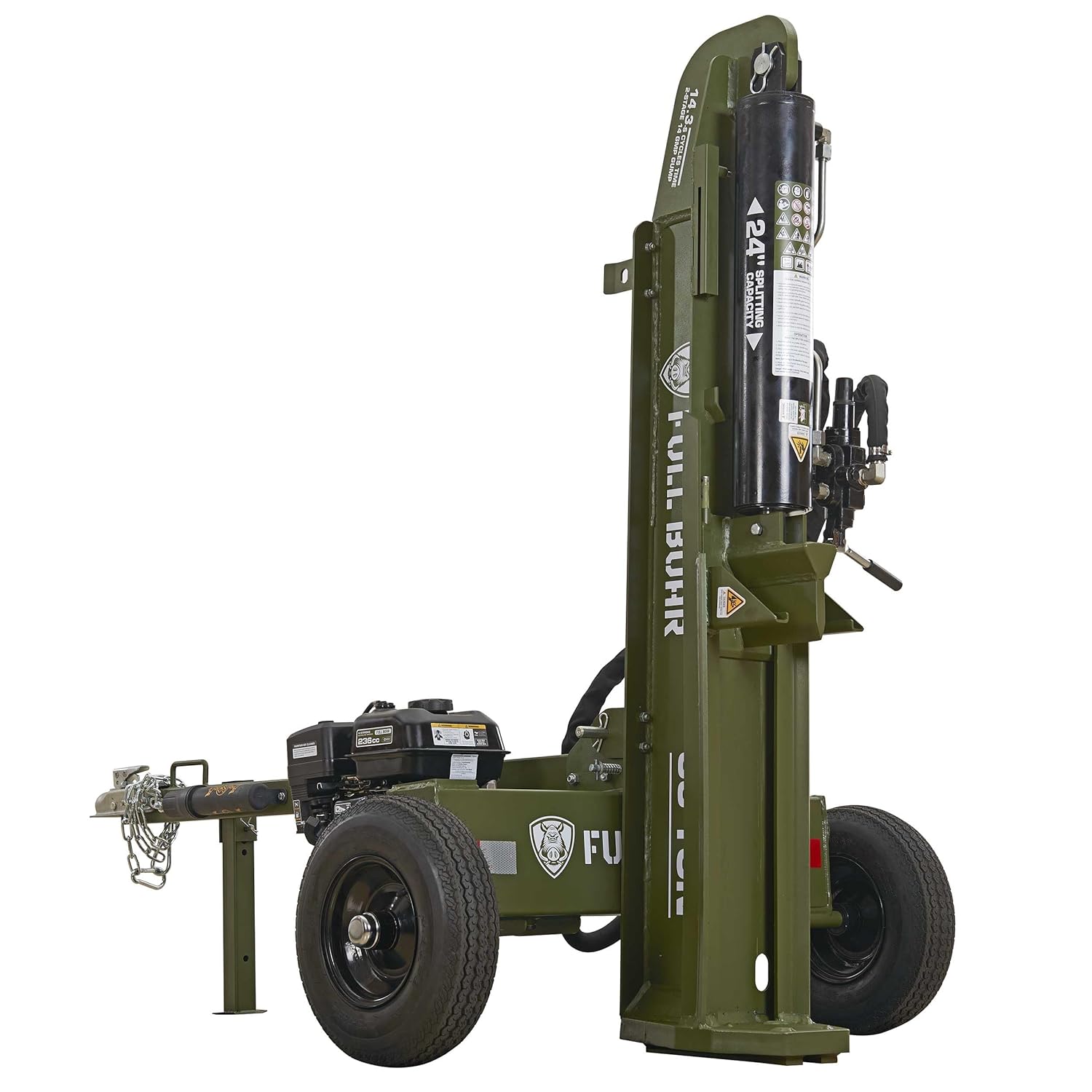
| Thrust | 33 Ton |
|---|---|
| Engine | 223cc OHV |
| Cycle time | 14.3 seconds |
| Log capacity | Up to 24 inches |
| Stroke | 22.75 inch |
The FULL BOAR 33-ton log splitter is a towable, gas-powered machine built for heavy residential and light commercial splitting. It uses a 223cc OHV engine to deliver 33 tons of force and a 22.75-inch stroke, letting you split logs up to about 24 inches long with a 14.3 second cycle time. The H-beam frame and 2-way wedge aim to reduce beam deflection and improve splitting efficiency while the hydraulic cylinder handle lets you pivot the unit between vertical and horizontal positions for easier loading. Built-in features like an internal hydraulic oil filter, DOT-approved tires and a 2-inch ball hitch make it practical to move and operate on-site. Important limits are its substantial weight and large footprint which require a vehicle to tow and some space for storage, and it needs regular engine and hydraulic maintenance like any gas unit. For someone who needs a powerful, portable splitter for high-volume work, it pairs strong performance with worksite flexibility.
Best for: Buyers who want a robust, towable splitter for frequent heavy-duty jobs and prioritize reliability and on-site mobility over minimal storage and maintenance needs.
Less Ideal for: People who need a lightweight, easy-to-store unit for occasional backyard use or those who prefer electric or battery systems with lower maintenance.
- High 33-ton splitting force handles large, hard logs up to about 24 inches
- 223cc OHV engine provides consistent power and a 14.3 second cycle time for faster work
- H-beam construction and 2-way wedge improve splitting stability and efficiency
- Towable design with DOT-approved tires and 2-inch ball hitch for on-site mobility
- Hydraulic oil filter mounted inside the reservoir reduces damage risk from falling logs
- Very heavy and large, requiring towing and substantial storage space
- Requires routine engine and hydraulic maintenance typical of gas-powered equipment
Verdict: A powerful, towable 33-ton splitter that delivers faster, reliable performance for homeowners or contractors who need heavy-duty on-site log splitting.
Choosing the Right Log Splitter: Key Factors to Consider
Splitting Force and Stroke Length
Splitting force, usually measured in tons, determines what size and species of logs a machine can handle reliably. Higher-rated force is necessary for dense hardwoods like oak or hickory, while softer wood species can be split with lower tonnage. Stroke length matters because a longer ram lets you split taller or irregular logs without repositioning. Matching force and stroke to your typical log sizes reduces the need for manual re-splitting and limits wear on the hydraulic system. Consider how often you encounter knotted or frozen wood, since those conditions require extra force and can stall lighter machines. Also check that the splitter's cylinder stroke and wedge geometry work together to push wood cleanly apart rather than binding and blunt the wedge prematurely.
Hydraulic System Performance
The hydraulic pump size, fluid capacity, and valve configuration affect cycle speed and how the machine behaves under continuous loads. A higher-capacity pump shortens the ram return and advance times so you can process more logs per hour. Fluid cooling and reservoir size influence durability during extended use; smaller reservoirs can overheat under repeated heavy cycles. Look for clear service access to filters, hoses, and fittings so routine maintenance is straightforward. Leaks, poorly routed hoses, or undersized fittings reduce available force at the wedge and increase long-term repair needs. Reliable hydraulics deliver steady, repeatable performance and minimize downtime for adjustments during a day of splitting.
Build Quality and Materials
A sturdy welded frame, plate-thickness choices, and quality fasteners determine how well a splitter resists twisting and wear under load. Heavy-gauge steel on beam members and solid mounts for the cylinder prevent frame flex that can cause misalignment and early component failure. Nut-and-bolt connections should be accessible and use grade-appropriate hardware to ease repairs or part swaps. Corrosion-resistant coatings and galvanized or painted finishes protect exposed metal when the splitter is stored outdoors. Bearings, hitch points, and wheel assemblies are small areas that often dictate longevity, so inspect those design details when evaluating options.
Safety Features and Operator Controls
Effective safety design reduces the chance of accidental operation and operator injury during repetitive work. Two-handed controls that force both hands away from the wedge while the ram advances are a common and useful safeguard. A functional beam stop or automatic return prevents the ram from leaving the wedge area unintentionally. Shields and guards over moving parts, clear emergency-stop access, and intuitive control layout help maintain safe operation even in dim light or cold weather. Consider how easily guards can be removed for maintenance without defeating safety systems. Safety features that are simple and robust encourage consistent safe habits in routine splitting sessions.
Mobility, Setup, and Storage
Transport features such as integrated wheels, tongue/hitch design, and a compact footprint determine how readily you can move and store the machine. A splitter that tows easily behind a small pickup or ATV lets you work closer to wood piles, reducing double-handling. Setup complexity matters if you lack mechanical skills; units with simple pin-and-clevis attachments or bolt-on tongues minimize the effort to get the splitter on the road. Consider storage height and whether the splitter can be left outdoors under a cover; corrosion protection and removable wheels can simplify winter storage. Ease of setup and transport influences how often you actually use the machine during the heating season.
Maintenance Accessibility and Parts Serviceability
Routine maintenance tasks include checking fluid level, replacing hoses or seals, greasing pivot points, and tightening fasteners. A design that provides easy access to the reservoir, fittings, and common wear items saves time and keeps the machine in service longer. Standardized fittings and commonly available replacement parts reduce downtime when repairs are needed. Consider whether the manufacturer or support network publishes detailed service instructions and whether parts such as wedges, cylinders, and pump components are commonly stocked. Easier maintenance lowers lifecycle costs and keeps the splitter operating safely.
Matching Splitter Capacity to Your Woodpile
Estimate the species mix and typical log diameters you process each season before choosing a machine. If your pile is mostly smaller-diameter softwoods, a modest-tonnage splitter with a quick cycle will be more productive than a larger, slower unit. Conversely, if you deal with large hardwood rounds or frequent knotted logs, prioritize rated force and a longer stroke to avoid repeated repositioning.
Also consider whether you will process full rounds or pre-cut billets. Machines that handle full rounds reduce cutting time but need more power and a sturdier beam. Think about the time you spend moving logs and whether towing the splitter closer to the pile would save you labor.
- Estimate average and maximum log diameters and species
- Decide if you will split full rounds or pre-cut billets
- Factor in how often you can move the splitter to the woodpile
Work Rhythm and Hourly Output
Consider the machine's hydraulic cycle speed relative to how many cords you expect to process. Faster cycles deliver higher hourly output, which matters if you split multiple cords for the season. But very fast cycles on under-built frames can accelerate wear; balance cycle speed against frame robustness.
Also factor operator fatigue. Controls that reduce lifting or repositioning speed up work and lower strain, letting you maintain a steadier pace across longer sessions.
- Compare cycles per minute under typical loads
- Assess operator ergonomics to reduce fatigue
- Plan realistic daily splitting goals based on output
Wedge Design and Replacement
Wedge shape and sharpness determine how cleanly wood splits and how often the wedge needs dressing or replacement. A tapered wedge with a narrow leading edge initiates splits easily, while a broader wedge provides more separation force for stubborn grain. Heavy-use splitters should allow quick wedge removal and replacement without special tools.
Look for weld-on or bolt-on wedge options depending on your willingness to do field repairs. A replaceable wedge saves time and keeps downtime low when the edge dulls or deforms from striking metal or frozen knots.
- Check wedge attachment method for quick serviceability
- Consider wedge shape suited to your wood types
- Inspect access for re-sharpening or replacement
Storage, Weather Protection, and Winter Use
If the splitter will spend months outdoors, corrosion protection and removable electrical components matter. Hydraulic components should be compatible with cold-weather fluid if you plan winter use. Drain plugs or accessible caps help with winterizing the hydraulic system to avoid freeze damage.
Covers and sheds reduce surface rust and extend component life. Plan where you will park the splitter between uses and whether you can keep the hitch and wheels protected from road salt and wet storage.
- Consider cold-weather hydraulic fluid compatibility
- Plan for covered storage or protective covers
- Look for service points that make winterizing straightforward
Tow and Ground Clearance Considerations
Towing geometry and ground clearance determine how easily a splitter moves over farm tracks, driveways, or uneven ground. A low-slung beam may be more stable on flat ground but could catch on ruts or rocks. Choose a wheel and tongue setup that matches your towing vehicle and common terrain.
Check tongue length and hitch type for compatibility with your trailer wiring and towing practices. Quick-detach tongues or compact stowed configurations improve storage convenience for users with limited space.
- Match hitch type and tongue length to towing vehicle
- Consider ground clearance for your typical terrain
- Assess wheel durability for off-road towing
How We Chose the Best Log Splitter
Our selection focused on practical performance and long-term reliability for homeowners and small-acreage users shopping within the under $3000 price band. We prioritized machines that deliver consistent splitting force appropriate for seasoned hardwoods and softer species commonly heated at home. Durability criteria emphasized thick-walled cylinders, solid welded frames, and corrosion-resistant finishing that extend service life in outdoor storage. Controls and ergonomics were assessed for ease of feeding, safe two-handed operation, clear cycle controls, and accessible maintenance points. Mobility and setup mattered too: we favored splitters with trailer hitches or integrated wheels, straightforward hitching, and minimal assembly. We excluded light-duty garden tools and heavy industrial units outside the price boundary, plus any machines lacking basic safety interlocks or missing clear torque and cycle specifications. The final picks balance hydraulic power, construction quality, user safety, and transportability to suit real backyard splitting workloads.
FAQ
What tonnage do I need for splitting hardwoods?
It depends on log diameter and species. Dense hardwoods and large-diameter rounds typically require higher rated splitting force. For many homeowners processing seasoned hardwood, mid-to-high tonnage machines reduce the need for re-splitting, while smaller tonnage works for softwoods or pre-cut billets.
Can I use a log splitter in cold winter conditions?
Yes, but choose a machine with hydraulic components and recommended fluid for low temperatures. Allow the hydraulic system to warm and follow winterizing steps such as draining or protecting exposed fluids to prevent freeze damage.
How important are two-handed controls?
Two-handed controls greatly reduce the risk of accidental contact with the wedge and are a key safety feature. They also help enforce safer work habits during repetitive splitting tasks and are worth prioritizing for regular use.
Are towable splitters easy to move around the yard?
Many towable splitters are designed for simple towing behind small pickups or ATVs, but ease of movement depends on tongue design, wheel quality, and ground clearance. Look for integrated wheels and a hitch matched to your towing setup for the best mobility.
How often should I perform maintenance on a log splitter?
Regular checks before each season and routine inspections during heavy use are advisable. Maintain hydraulic fluid levels, inspect hoses and fittings for leaks, grease pivot points, and tighten fasteners. Frequency depends on hours of use and operating conditions.
Final Verdict
When choosing a log splitter under $3000, prioritize the combination of rated splitting force and a durable frame that matches the hardwoods and log sizes you process most. Balance hydraulic cycle speed and operator ergonomics so you can work efficiently without accelerating wear. Safety features, easy maintenance access, and transportability are practical factors that determine how often you will use the machine and how long it will last. Focus on the tradeoffs between power, speed, and build quality to select a splitter that meets your seasonal workload with dependable performance.
